

HubSpot vs Salesforce: The Honest CRM Comparison (2026)
You just got the Salesforce renewal quote. $40,000-$50,000+ for 20 seats - up 6% from last year, before anyone mentions Agentforce. Meanwhile, your VP of Marketing is forwarding HubSpot webinar invites with the subtlety of a sledgehammer.
The HubSpot vs Salesforce decision feels existential, but here's what nobody tells you: 30-60% of CRM projects underperform or fail, and it's almost never because the team picked the wrong logo. It's because they ignored implementation reality, admin burden, and data quality.
30-Second Verdict
| Scenario | Pick |
|---|---|
| Under 50 people, straightforward sales | HubSpot - not close |
| 200+ users, complex hierarchies, regulated | Salesforce - still the only real option |
| 50-200 mid-market | HubSpot - unless you need field-level permissions |
| Pair with either if... | ...your real problem is data quality, not CRM features |
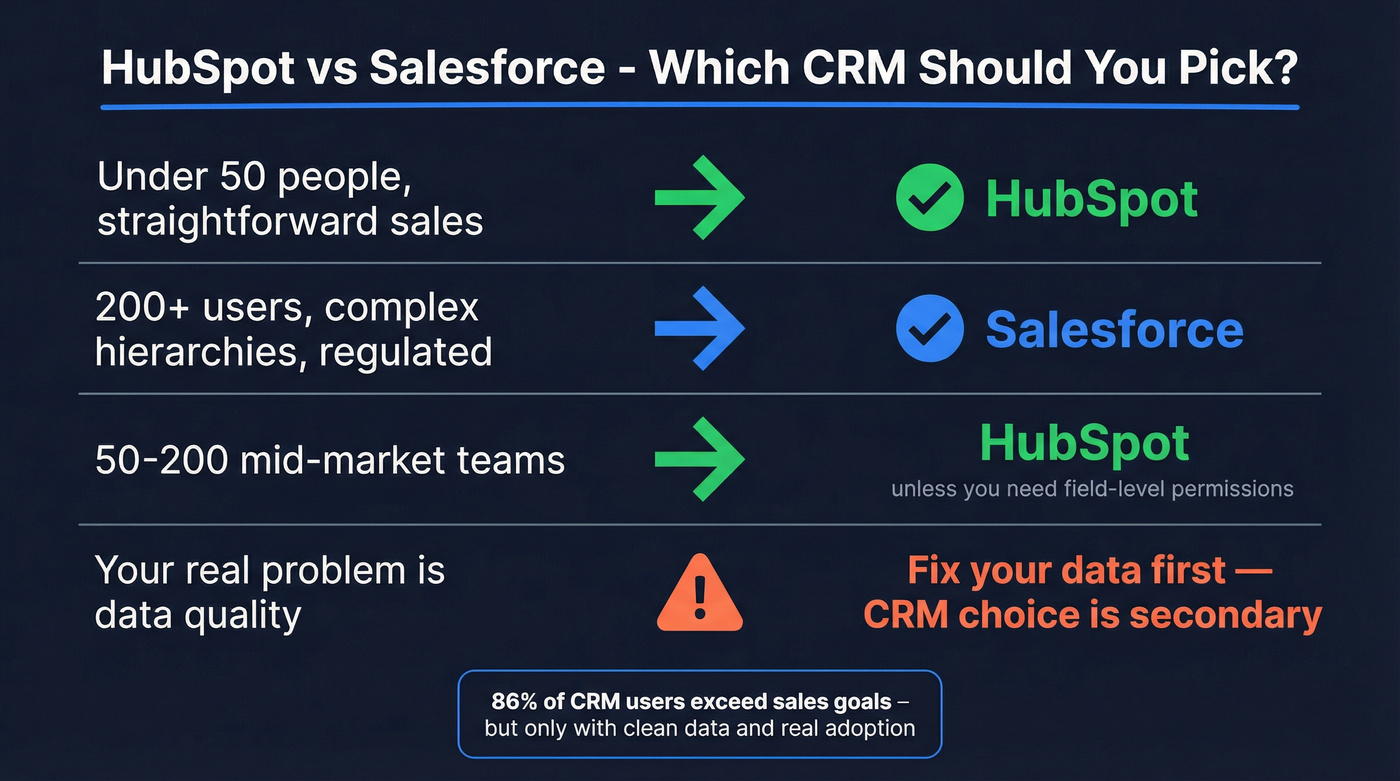
CRM users are 86% more likely to exceed sales goals. But that stat assumes the CRM actually gets adopted and the data inside it is accurate. Let's break down what each platform actually costs, where each one wins, and where the real landmines hide.
2026 Pricing Reality
Both vendors made significant pricing moves that are now fully in effect. If you haven't rechecked numbers recently, you're working with outdated math.
Salesforce raised list prices roughly 6% on Enterprise and Unlimited editions effective August 1, 2025. That puts Enterprise around $159/user/month and Unlimited around $318/user/month. Starter and Pro pricing stayed flat - the increase targets customers who are already locked in and spending real money.
The bigger story is Agentforce. Salesforce retired the Einstein add-on branding and replaced it with Agentforce add-ons at $125/user/month for Enterprise and Unlimited tiers, plus Agentforce 1 Editions at $550/user/month bundling Flex Credits and Data Cloud. The ecosystem reaction has been brutal - comments on SalesforceBen's coverage include "this is insane," and renewal negotiation threads on r/salesforce have gotten ugly fast. There's deep skepticism about Agentforce's practical value, and the pricing isn't helping.
HubSpot made its own structural change, shifting to a seat-based model with Core Seats and View-Only Seats. View-Only Seats let your team get CRM visibility without adding paid Core Seats, which is genuinely useful. The catch: if you're on legacy per-hub pricing, your renewal math just changed. HubSpot's Starter tier dropped to $15/seat/month, but Professional and Enterprise tiers still carry meaningful price tags once you add seats beyond the included allotment.
What You'll Actually Pay
These are the most useful list-price anchors for 2026 budgeting.
Salesforce Sales Cloud
| Edition | Price | Notes |
|---|---|---|
| Starter Suite | $25/user/mo | No planned pricing change |
| Pro | Varies by package | No planned pricing change |
| Enterprise | ~$159/user/mo | Post-Aug 2025 increase |
| Unlimited | ~$318/user/mo | Post-Aug 2025 increase |
| Agentforce add-on | $125/user/mo | Enterprise/Unlimited only |
| Agentforce 1 | $550/user/mo | Includes Flex Credits + Data Cloud |
| Pardot (MCAE) | Up to $4,000/mo | Marketing automation |
HubSpot Customer Platform
| Edition | Price | Included Seats |
|---|---|---|
| Free CRM | $0 | Unlimited users, limited features |
| Starter | $15/seat/mo | Per seat |
| Professional | $1,170/mo | 5 Core Seats, then $45/seat |
| Enterprise | $4,300/mo | 7 Core Seats, then $75/seat |
A few things jump out. Salesforce's entry point at $25/user/month looks cheap until you realize most B2B teams need Enterprise features - custom objects, workflow automation, API access - which puts you at ~$159/user/month minimum.
HubSpot's free tier is genuinely useful for early-stage teams. Professional at $1,170/month for five seats works out to $234/seat/month, comparable to Salesforce Enterprise but with marketing tools baked in. The wildcard is View-Only Seats. If you've got 30 people who need CRM visibility but don't manage deals, that's a significant cost advantage over Salesforce, where every user needs a paid license.
3-Year TCO - The Math That Matters
License pricing is the tip of the iceberg. The real cost difference lives in implementation, admin overhead, and add-on sprawl. Avidly's analysis of mid-market companies found Salesforce TCO runs 2-3x HubSpot over three years. We've modeled this for dozens of mid-market teams, and the admin salary line always surprises people.
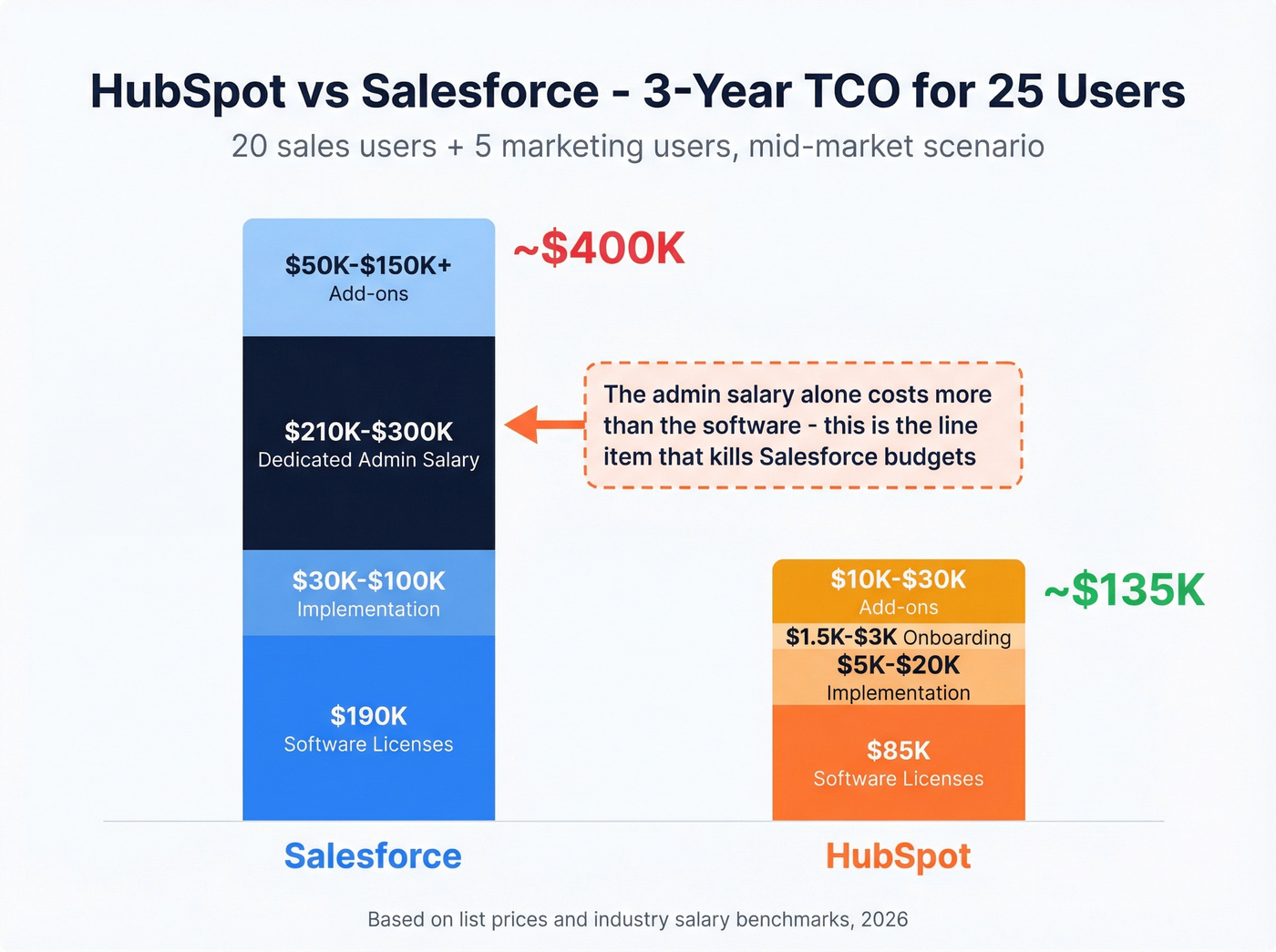
TCO: 20 Sales Users + 5 Marketing Users
| Cost Driver | Salesforce (3 yrs) | HubSpot (3 yrs) |
|---|---|---|
| Software licenses | ~$190K | ~$85K |
| Implementation | $30K-$100K | $5K-$20K |
| Onboarding fees | Included in impl. | $1,500-$3,000 |
| Dedicated admin salary | $210K-$300K | $0 (self-serve) |
| Add-ons (marketing, AI) | $50K-$150K+ | $10K-$30K |
| Estimated 3-Year Total | ~$400K | ~$135K |
That admin salary line is the one that kills Salesforce budgets. HubSpot's designed so your RevOps lead can manage it alongside their other responsibilities. Salesforce practically requires a dedicated admin, and a good one costs $70K-$100K/year. Over three years, that's more than the software itself.
HubSpot has its own hidden cost, though. As your marketing database grows, HubSpot's Marketing Contacts pricing creates a "success tax" - you start paying more precisely because your marketing is working. We've seen teams blindsided by a $15K/year jump in their HubSpot bill because they crossed a contact threshold. Strict CRM hygiene isn't optional; it's a budget line item.
Here's the thing: most teams agonizing over this decision should spend less time comparing feature matrices and more time calculating whether they can afford a full-time Salesforce admin. If the answer is no, the decision is already made.
User Satisfaction at Scale
The G2 comparison page tells an interesting story. Headline numbers are identical, but the details diverge sharply.
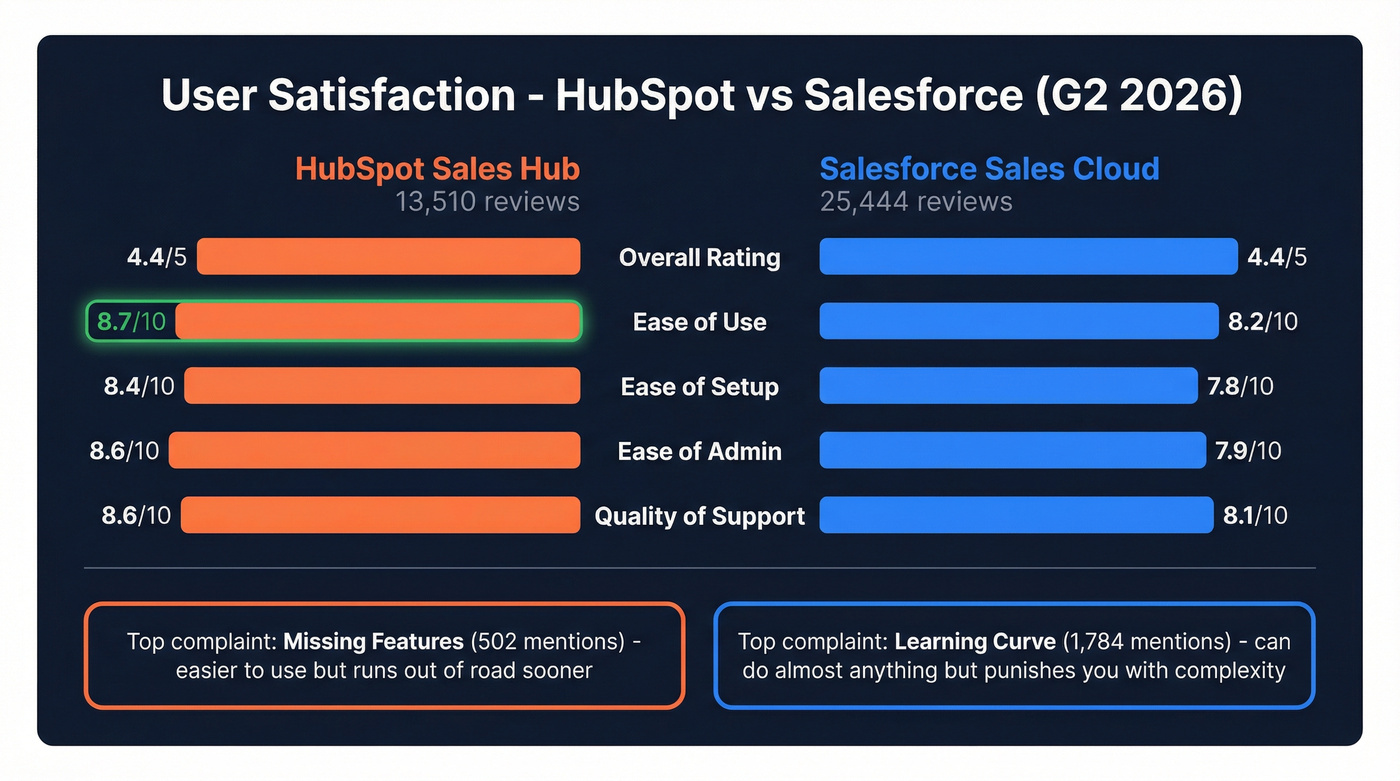
| Metric | HubSpot Sales Hub | Salesforce Sales Cloud |
|---|---|---|
| Overall Rating | 4.4/5 (13,510 reviews) | 4.4/5 (25,444 reviews) |
| Ease of Use | 8.7/10 | 8.2/10 |
| Ease of Setup | 8.4/10 | 7.8/10 |
| Ease of Admin | 8.6/10 | 7.9/10 |
| Quality of Support | 8.6/10 | 8.1/10 |
| Top Con | "Missing Features" (502) | "Learning Curve" (1,784) |
HubSpot wins every operational metric - setup, admin, support, daily usability. But look at the top cons: HubSpot users hit feature ceilings 502 times, while Salesforce users cite "Learning Curve" 1,784 times. That's the fundamental tradeoff in one table.
HubSpot is easier to use but runs out of road sooner. Salesforce can do almost anything but punishes you for that flexibility with complexity. Practitioner communities echo this constantly - Salesforce teams complain about cost and complexity, HubSpot teams hit permissions ceilings and outgrow reporting.
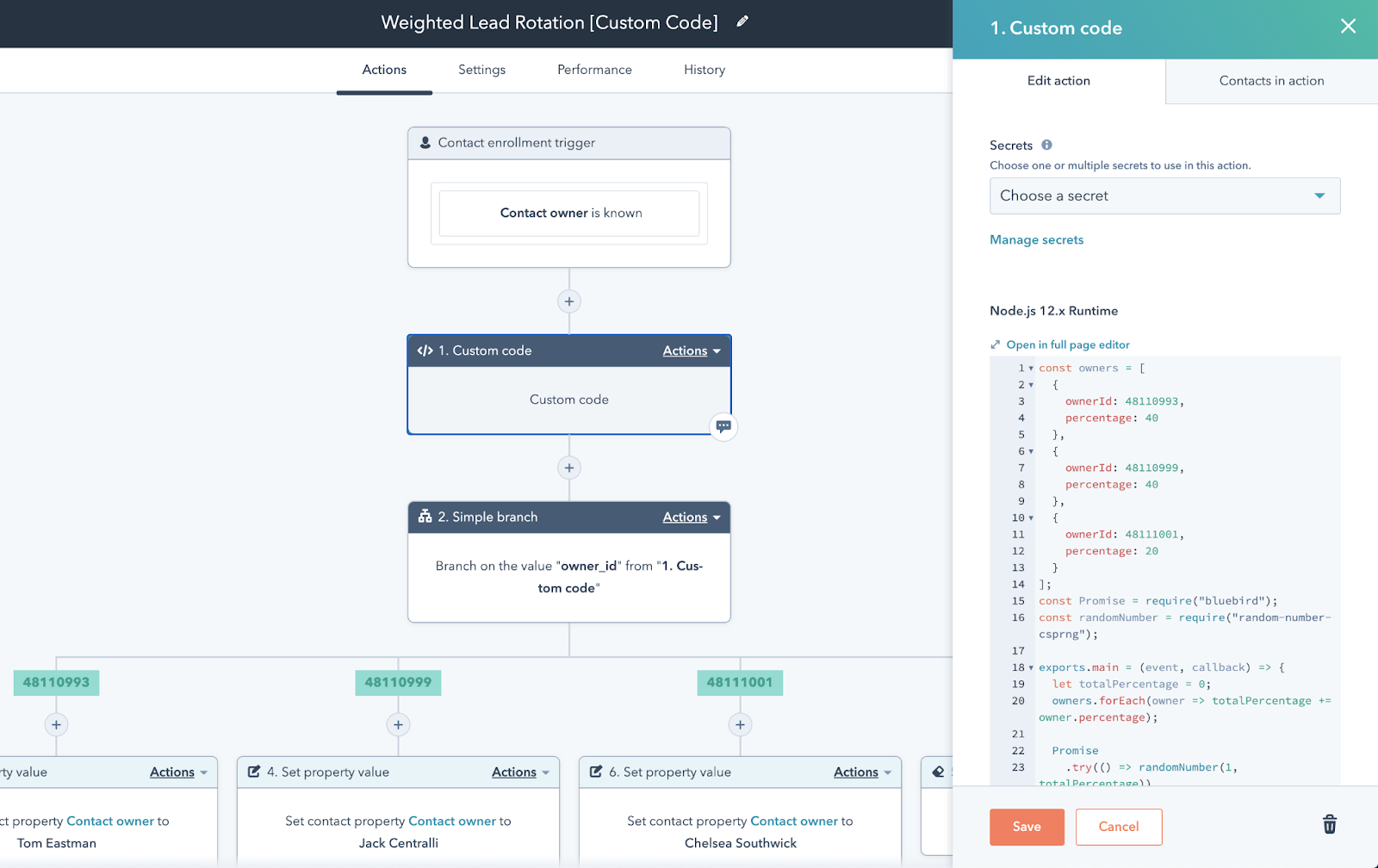

You can spend months debating HubSpot vs Salesforce - but neither CRM will hit quota with bad contact data. Prospeo enriches both with 98% verified emails, 125M+ direct dials, and 50+ data points per contact. Native integrations with HubSpot and Salesforce mean your CRM stays clean automatically.
Stop feeding your CRM garbage. Start with data that actually connects.
Feature Comparison
Automation & Workflows
HubSpot's visual workflow builder is genuinely excellent for standard sales processes. Drag, drop, set triggers, done. In our testing, most teams build their first automated sequence in an afternoon. The limitation shows up at scale - complex branching logic, multi-object workflows, and conditional paths spanning multiple pipelines start to strain HubSpot's architecture.
If you're trying to reduce manual updates, AI CRM data entry automation can matter more than which workflow UI you prefer.
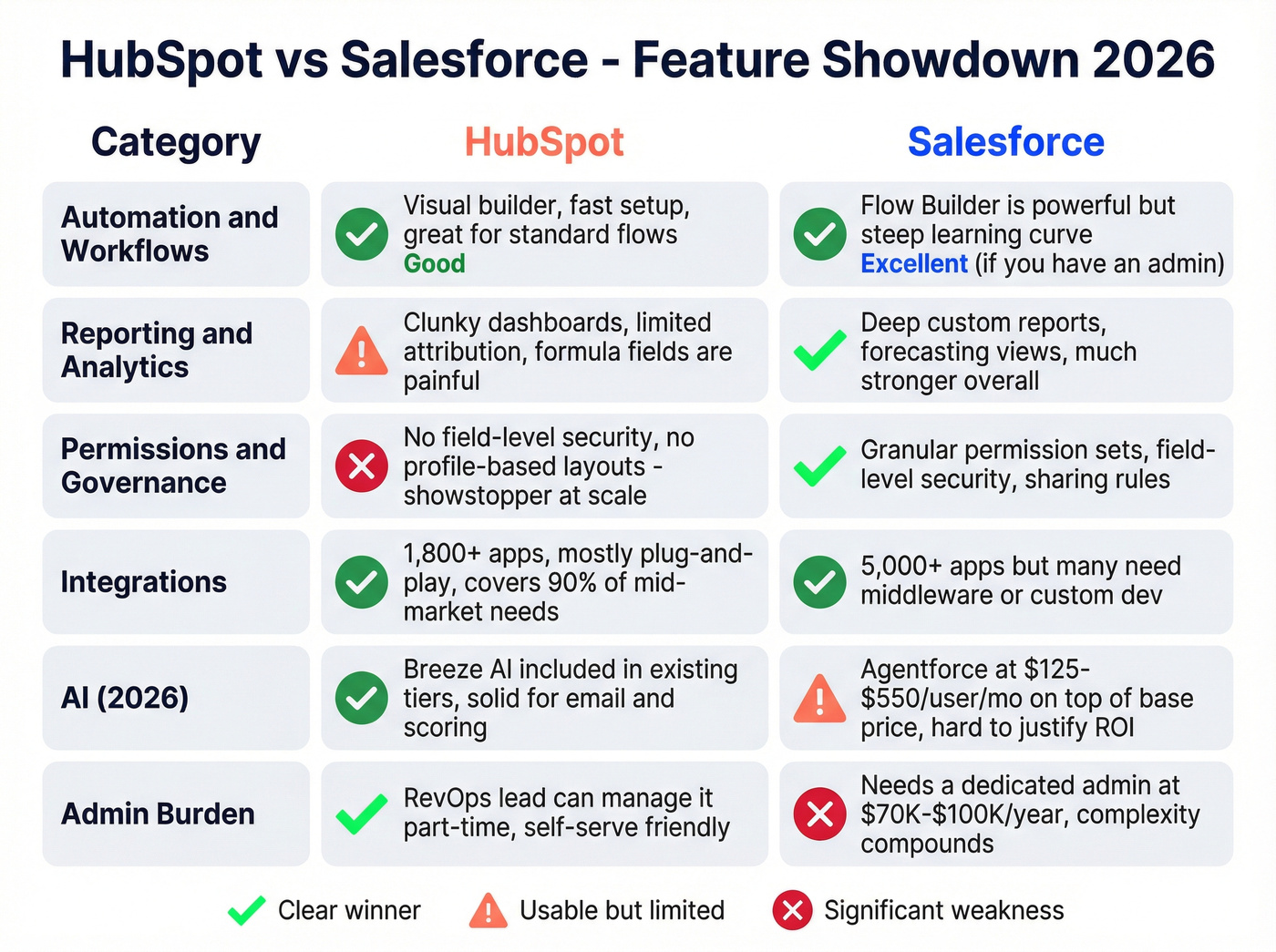
Salesforce's Flow Builder is more powerful but carries a steeper learning curve. Process Builder is deprecated, so everything runs through Flow now. The ceiling is much higher, but so is the floor. Your first automation in Salesforce might take a week where HubSpot takes a day.
Reporting & Analytics
Salesforce wins reporting. Full stop.
HubSpot's reporting is genuinely worse - campaign reporting is unintuitive, formula fields are infuriating, the dashboard designer feels clunky, and attribution modeling is more limited. Salesforce has its own reporting headaches like join limits on report types and trend reports that are basically useless, but the overall depth is significantly greater. If your leadership team lives in dashboards and needs custom forecasting views, pretending this is a close call would be dishonest.
If forecasting is a board-level fight every month, fix the system: deal forecast accuracy is usually the real root cause.

Permissions & Governance
Your compliance officer asks whether an SDR can see a customer's contract value. Your APAC director needs records restricted to their region. If these conversations happen at your company, you need Salesforce.
HubSpot lacks field-level security and can't assign page layouts by profile. For a 30-person startup, that's fine. For a 200-person org with channel partners and regional teams, it's a showstopper.
Salesforce offers granular permission sets, field-level security, sharing rules, and profile-based page layouts. The risk? Admins can configure their instance into oblivion - stacking validation rules and permission exceptions until the system becomes a logic maze nobody fully understands.
Integrations & Ecosystem
Salesforce's AppExchange lists 5,000+ apps. HubSpot's Marketplace offers 1,800+. Raw numbers favor Salesforce, but many Salesforce integrations require middleware - MuleSoft, a Salesforce-owned product, conveniently enough - or custom development to work properly. HubSpot integrations tend to be more plug-and-play, especially for common tools like Slack, Zoom, and outbound sequencers.
For most mid-market teams, HubSpot's ecosystem covers 90% of what you need with less technical overhead.
AI in 2026
Agentforce is a pricing play disguised as an AI product. At $125-$550/user/month on top of already-increased base prices, most mid-market teams won't see ROI this year. The technology demos well, but the practical use cases for a 50-person sales team don't justify the cost.
If you're evaluating AI beyond the CRM vendor pitch, start with what actually ships: AI sales agent workflows and guardrails matter more than branding.
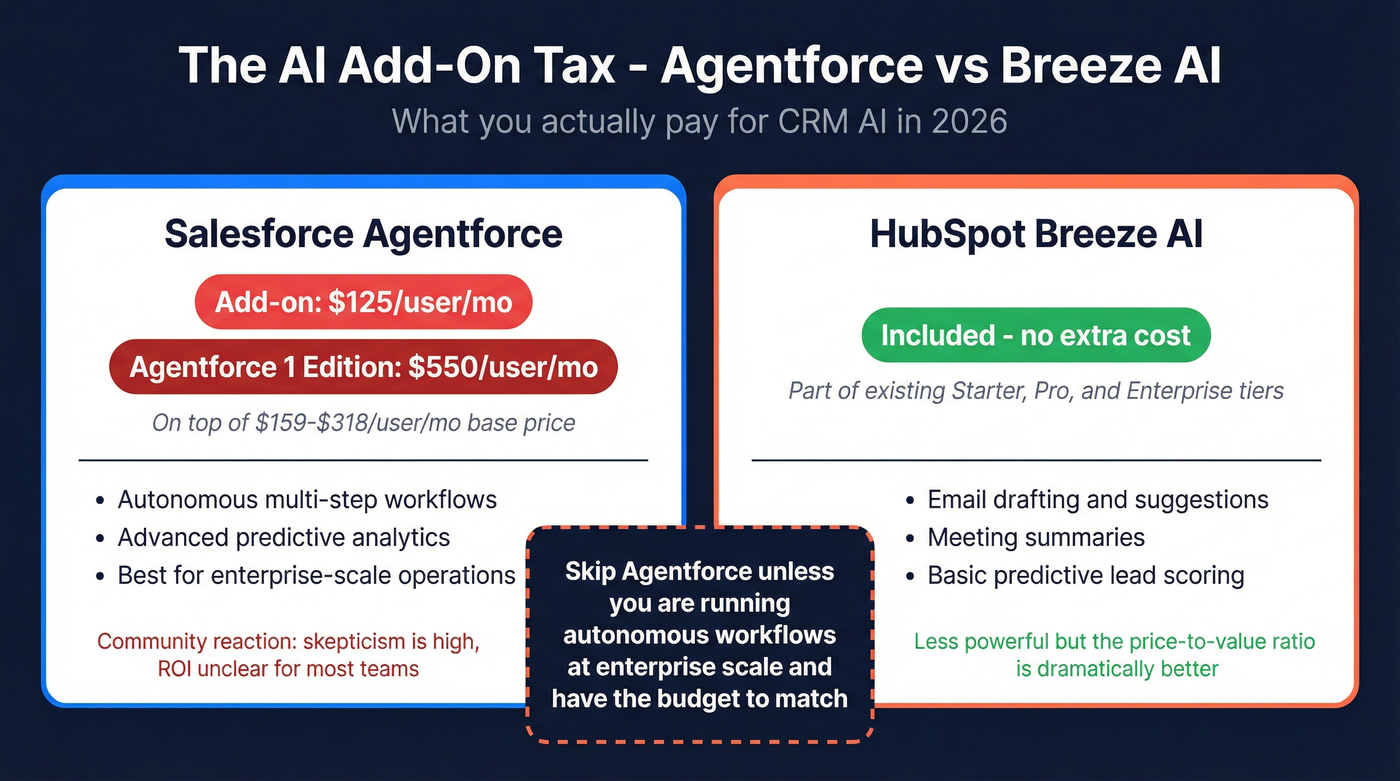
HubSpot's Breeze AI is included in existing tiers - no add-on required. It's less powerful than what Salesforce is building, but the price-to-value ratio is dramatically better for email drafting, meeting summaries, and basic predictive scoring. Skip Agentforce unless you're running autonomous multi-step workflows at enterprise scale and have the budget to match.
The Admin Reality
Every CRM comparison article will tell you Salesforce is more customizable. What they won't tell you is that customizability becomes a liability without dedicated staff to manage it.
I watched a RevOps lead spend three weeks building a Salesforce report that HubSpot could've generated in 20 minutes. Then her VP asked for field-level permissions on a new custom object, and HubSpot couldn't do it. That's the admin reality - each platform's strength is the other's weakness, and you'll feel the friction no matter which side you land on.
Salesforce's lead/contact model is a persistent headache. The separation between leads and contacts creates duplicate nightmares, especially when marketing automation tools sync records in both directions. We've watched teams spend entire quarters cleaning up duplicate records that their Salesforce-Pardot integration created automatically. HubSpot's unified contact model avoids that mess entirely, but the tradeoff is less granular control over visibility and data access.
The most common migration story? A 50-person team that outgrew HubSpot's permissions model but dreads Salesforce's implementation timeline and admin burden. That tension is real, and there's no clean answer.
Who Should Pick What
Pick HubSpot if:
- You're under 50 people with a straightforward sales process
- No regulatory compliance requirements demand field-level security
- TCO matters more than customization ceiling
- You want time-to-value in weeks, not months
- Your RevOps lead wears multiple hats and can't babysit a CRM full-time
Pick Salesforce if:
- You've got 200+ users with complex account hierarchies
- Channel sales, partner accounts, or multi-entity structures are core to your business
- You're in a regulated industry requiring granular permissions and audit trails
- You have budget for a dedicated admin or a small admin team
- Deep reporting and custom objects at scale are non-negotiable
For teams in the 50-200 mid-market range, start with HubSpot unless you have a specific governance requirement that demands Salesforce's permission model. You can always migrate later - and it's cheaper to migrate from HubSpot to Salesforce than to rip out an underused Salesforce instance that's costing you $400K over three years.
The Variable Nobody Compares
The CRM you pick matters less than the data you put into it. Remember that 30-60% failure rate? Most of those failures aren't software problems - they're data problems. Stale emails, wrong titles, departed contacts clogging your pipeline. A $300K Salesforce instance and a free HubSpot CRM produce the same garbage output if the input data is garbage.
CRM data decays at roughly 30% per year. Build a quarterly audit process and use an enrichment tool that runs on a recurring refresh cycle. Prospeo integrates natively with both Salesforce and HubSpot, enriching your CRM records with 98% email accuracy drawn from 300M+ professional profiles on a 7-day refresh cycle - not the 6-week cadence most data vendors run on.
If you want the benchmarks and the operational fixes, start here: B2B contact data decay and how to keep CRM data clean.
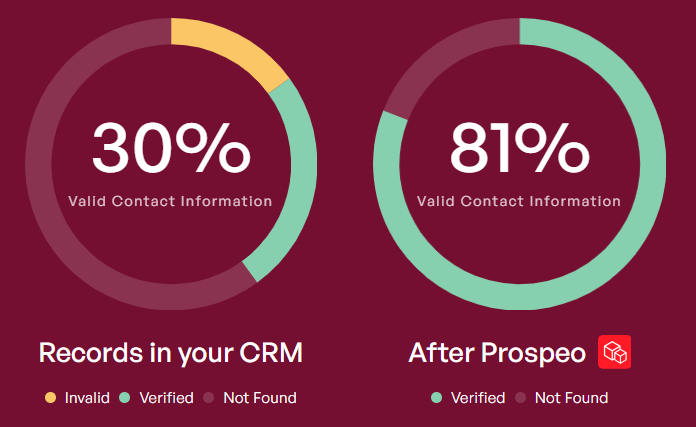
That 3-year TCO analysis is missing one line item: the cost of bad data. Bounced emails burn your domain, wrong numbers waste rep time, and stale records kill pipeline. Prospeo refreshes every 7 days - not 6 weeks - at $0.01 per email. Works natively with both HubSpot and Salesforce.
Your CRM choice matters less than the data quality powering it.
The 90-Day Migration Plan
The most common migration direction right now is Salesforce to HubSpot, typically for companies in the 20-150 GTM user range that realize they're paying enterprise prices for mid-market needs.
| Phase | Days | Focus |
|---|---|---|
| Blueprint | 0-15 | Audit current data, map fields, define migration scope |
| Build | 16-40 | Configure target CRM, set up automations and integrations |
| Data | 41-60 | Clean, deduplicate, and migrate records |
| Cutover | 61-75 | Go live, parallel run, train users |
| Stabilize | 76-90 | Fix edge cases, optimize workflows, confirm adoption |
Data hygiene during migration is critical. This is the single best opportunity to purge stale contacts, fix formatting inconsistencies, and verify emails before they land in the new system. Migrating dirty data into a clean CRM defeats the entire purpose.
FAQ
Is HubSpot really free?
Yes - the free CRM includes contact management, deal tracking, and basic reporting for unlimited users. Meaningful sales automation, custom reporting, and sequences require Starter at $15/seat/month or Professional at $1,170/month. Most growing teams outgrow free within 6-12 months.
How much does Salesforce cost per year?
For a mid-market team of 20 sales users on Enterprise, expect ~$38K-$50K/year in licenses alone. Add implementation, a dedicated admin at $70K-$100K/year, and Agentforce at $125/user/month, and the real annual cost lands at $120K-$200K+.
Can you migrate from Salesforce to HubSpot?
Yes - plan for 90 days with a phased approach. The biggest risk isn't technical; it's data quality during the transfer. Clean before you move, not after.
Is Salesforce Agentforce worth it?
At $125-$550/user/month on top of already-increased base prices, most mid-market teams won't see ROI in 2026. Practitioners have called the pricing "insane" and renewal negotiations have gone sideways. Wait for proven use cases and measurable benchmarks before committing budget.
How do you keep CRM data accurate long-term?
CRM data decays at roughly 30% per year. Build a quarterly audit process, enforce data entry standards, and use an enrichment tool on a recurring refresh cycle. Prospeo connects natively with both HubSpot and Salesforce, refreshes data every 7 days, and verifies emails at 98% accuracy - preventing the stale-data problem that causes most CRM projects to underperform.