How to Keep CRM Data Clean (Without Losing Your Mind)
Your VP of Sales pulls up the pipeline report on Monday morning. The number looks great - $2.4M in Stage 3+. Then someone actually calls the contacts. Half the phone numbers are dead. A third of the "decision-makers" changed jobs six months ago. The pipeline isn't $2.4M. It's maybe $900K, and nobody knows which $900K.
This isn't a hypothetical. 79% of opportunity data never even makes it into the CRM. And the data that does get entered? It costs companies up to 27% of revenue when it's wrong. If you're wondering how to keep CRM data clean, the gap between what your CRM says and what's actually true is where deals go to die.
Here's a framework that actually works - built from what we've seen across dozens of CRM cleanups, not from theory.
What You Need (Quick Version)
You can diagnose the problem in an afternoon. Here's what to do this week:
Run a 30-minute CRM audit. Pull up your contacts. How many haven't been touched in 6+ months? How many have no email, no phone, no company? That's your baseline.
Verify a sample of 100 emails. Export 100 contacts you think are good and run them through a bulk verification tool. The bounce rate will tell you how clean your data actually is. If you need a deeper SOP, use an email verification list workflow.
Assign one person to own data quality. Not a committee. Not "everyone." One human with the authority to set rules and enforce them.
If more than 8% of that sample bounces, your full database needs attention. Keep reading.
The Real Cost of Dirty CRM Data
Let's put numbers on this, because "data quality matters" doesn't get budget approved. Dollar signs do.

Poor data quality costs organizations an average of $12.9 million per year, per Gartner. Across U.S. businesses, the aggregate damage runs $3.1 trillion annually. That's not a typo.
But the number that should scare you most is this one: sales reps waste 546 hours per year - 27.3% of their total time - pursuing bad leads. That's nearly 14 full work weeks spent chasing people who've changed jobs, wrong numbers, and email addresses that bounce.
CRM software delivers $8.71 for every $1 spent - an 871% ROI. But that return evaporates when the data inside the CRM is garbage. You're paying for a Ferrari and filling the tank with sand.

Here's how fast your data actually decays:
The Decay Clock
- B2B contact data decays at 70.3% annually
- 65.8% of contacts change job titles within 12 months
- 42.9% of phone numbers go stale
- 37.3% of email addresses stop working
- Email decay hit 3.6% monthly in late 2024 - nearly double the traditional 1.5-2% monthly rate
And here's the trust gap: 98% of sales leaders say accurate data is important. Only 35% actually trust the data their team has.
Everyone knows the problem. Almost nobody fixes it.
Dirty data means bad segmentation, which means irrelevant outreach, which means lower reply rates, which means reps work harder for worse results. Clean data drives 20% better campaign response rates and 15% higher close rates. Data-driven organizations are 23% more likely to acquire customers and 19% more likely to be profitable, according to McKinsey. The math isn't subtle.

Your CRM loses 70.3% of its accuracy every year. Prospeo's enrichment engine matches 83% of your contacts with fresh data - refreshed every 7 days, not every 6 weeks. Push verified emails (98% accuracy) and direct dials straight into HubSpot or Salesforce. No manual cleanup required.
Stop chasing dead leads. Enrich your CRM with data that's actually current.
Why CRM Data Gets Dirty in the First Place
CRM data hygiene rarely fails in one dramatic moment. It's a slow bleed - small gaps compounding over months until the whole system is unreliable. Understanding these root causes is the first step toward maintaining a clean database long-term.

Nobody Owns It
When no one owns data quality, accountability disappears. Sales assumes marketing will clean records. Marketing assumes RevOps will standardize. RevOps assumes the CRM will handle it. Nothing gets done.
This is the single biggest reason CRMs go bad. Not technology. Not process. Just nobody raising their hand and saying "this is mine."
Manual Entry Under Quota Pressure
Reps are focused on hitting quota, not formatting job titles or logging full firmographic details. Sales reps dedicate 70% of their time to non-selling tasks - and the selling time they do have isn't going toward data entry.
The result? 79% of opportunity-related data gathered by reps never enters the CRM. The stuff that does get entered is often incomplete, inconsistent, or flat-out wrong. "VP Sales" in one record, "Vice President of Sales" in another, "VP, Sales & Marketing" in a third. All the same person.
Tool Sprawl and Data Silos Create Duplicates at Scale
Here's the thing: every tool in your stack is a potential duplicate factory. I've seen this play out dozens of times - a rep imports leads from a prospecting tool, enriches them, pushes them to HubSpot. Another rep does the same search a week later. Now you've got the same contact twice, maybe three times, with slightly different data in each record.
Data silos are prevalent in over 51% of technology, media, and telecom organizations, preventing a unified customer view. The flip side? Companies that integrate databases across departments enjoy conversion rate increases of up to 12.5%. Silos don't just create duplicates - they actively suppress revenue.
Add trade show lists, inbound form submissions, marketing imports, and partner referrals, and you're looking at 10-30% duplicate rates in an unmanaged CRM. Without dedup rules running on import, every new lead source makes the problem worse. (If you need a repeatable import workflow, see how to import leads without trashing your CRM.)
Data Decays Whether You Touch It or Not
Even if you entered perfect data today, it'd be wrong tomorrow. People change jobs. Companies get acquired. Phone numbers rotate. Email addresses bounce.
The 70.3% annual decay rate means your CRM is essentially a different database every 18 months. Email decay alone runs 28% annually - and only 62% of submitted email addresses are valid upon verification. Your "clean" list from January is significantly degraded by June. As one practitioner put it on Reddit: "Bought lists are poison. Even with a good SMTP server, if your data is dirty, you're going straight to spam." (For deeper benchmarks and refresh cycles, track B2B contact data decay.)
The 7-Step Framework to Keep CRM Data Clean
This framework comes from what actually works in practice - a combination of what we've seen in production, what practitioners recommend, and what the best RevOps teams do consistently. If you need to fix your CRM, start here.
Step 1: Run a 30-Minute Audit
Before you buy a tool, before you build a process, spend 30 minutes understanding what you're working with. The best advice from the HubSpot community and r/CRM is simple: audit first.
Here's your checklist:
- Active contacts: Who's been engaged in the last 90 days? These are your priority records.
- Dormant leads: Who hasn't been touched in 6+ months? How many have no activity at all?
- Engaged segments: Which lists, sequences, or campaigns depend on accurate data right now? (If segmentation is the weak point, tighten up how you segment your email list.)
- Workflow dependencies: What automations break when data is wrong? (Lead routing, scoring, territory assignment?)
- Duplicate density: Run a basic duplicate report. What percentage of records have matches?
It's not about the tool - it's about knowing which contacts are worth engaging and which ones are inflating your metrics. That 30 minutes will shape every decision that follows.
Step 2: Define What "Clean" Means for Your Team
"Clean" isn't universal. An enterprise sales team selling six-figure deals needs different data than a PLG company running product-led onboarding.
RevBlack's framework nails the four dimensions: your data needs to be accurate (reflects reality), consistent (standard formats), unique (no duplicates), and governed (everyone knows the rules). If you want a scorecard approach, align this with core data quality metrics and KPIs.
Before you start scrubbing, define:
- Mandatory fields: What must every record have? (Email, company, title, source - at minimum)
- Optional fields: What's nice to have? (Phone, direct dial, industry)
- Unnecessary fields: What custom fields exist that nobody uses? Kill them.
An enterprise sales team might require direct dial, company revenue, and tech stack. A startup running outbound email campaigns might only need verified email, title, and company size. Define your version of clean before you start cleaning.
Step 3: Fix What's Broken (Dedup, Standardize, Purge)
Now you're actually cleaning. Here's when to use each approach:

Merge when: both records contain valuable data - activity history, notes, deal associations. One record has the email, the other has the phone number and a meeting logged. Merge them. Salesforce's own documentation defaults to merge, and that's the right call.
Delete when: one record is clearly junk - test entries, spam signups, completely outdated contacts with zero activity and no deal history.
Archive when: the contact was real but is no longer relevant - left the company, unsubscribed, industry you no longer serve. Don't delete the history; just move it out of active workflows.
Standardization is where most teams underestimate the work:
- Country: "USA" only - not "United States," "US," "America," or "U.S.A."
- Titles: Pick a format. "VP of Sales" or "Vice President of Sales" - not both.
- Company names: "IBM" not "International Business Machines" in one record and "IBM Corp" in another.
A smaller, cleaner database outperforms a large dirty one every single time. Don't be afraid to cut aggressively.
Step 4: Build Validation Rules to Prevent Future Mess
Cleaning is pointless if you don't stop the mess from coming back. This is where validation rules earn their keep.

The frustrating part? Most CRMs don't include basic validation out of the box. You have to build it yourself:
- Dropdowns over free text for every field that has a finite set of values. Country, state, industry, lead source - all picklists. Free text fields are where data quality goes to die.
- Required fields before stage changes. A deal can't move to "Discovery" without a decision-maker contact. Can't move to "Proposal" without company size and budget range. (To tighten stage discipline, map rules to your B2B sales pipeline management model.)
- Regex validation for phone numbers. Enforce a standard format with country code - something like
^\+[1-9]\d{1,14}$catches most garbage entries before they hit the database. - Cross-field validation. If the country is "USA," the state field shouldn't accept "Ontario." If the deal size is "Enterprise," the company size shouldn't be "1-10 employees." These logical checks catch the errors that format validation misses.
The goal is to make it harder to enter bad data than good data. Every dropdown you add, every required field you enforce, is one less cleanup task next quarter.
Step 5: Verify and Enrich Your Data (Clean First, Enrich Second)
Here's a principle I've seen teams violate constantly: you can't enrich bad data. Enriching dirty data just makes the mess more detailed and expensive.
95% of organizations say their business suffers from poor data quality. The fix isn't adding more data - it's verifying what you have first, then filling gaps. This is one of the most overlooked CRM data cleaning tips, yet it makes the biggest difference. (If you’re comparing vendors, start with a shortlist of email verifier websites.)
Before cleanup: "John, maybe contractor?" After: "John Peterson | Peterson HVAC | Orders filters quarterly | Prefers text | Last contact: 2 weeks ago." That transformation requires cleaning first, enriching second.
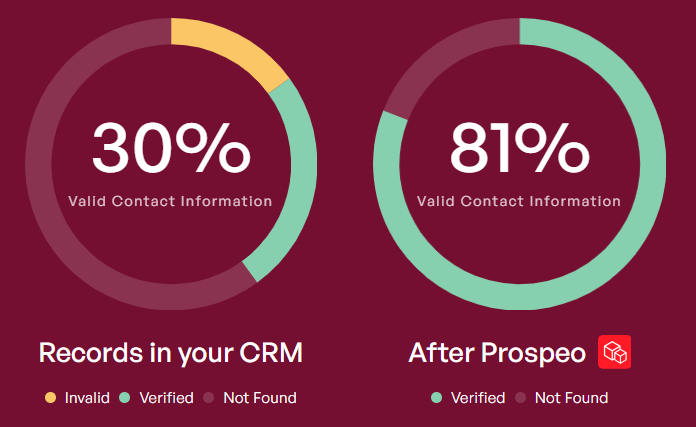
With email decay running 28% annually and only 62% of submitted emails being valid upon verification, skipping this step means you're building campaigns on a foundation that's roughly 40% sand. If you want the full workflow, follow a step-by-step guide on how to verify an email address.
Step 6: Assign Ownership and Build Governance
If nobody owns it, it won't happen. Full stop.
Effective data ownership requires three things: designated stewards, defined decision rights, and clear escalation paths. This isn't about hiring a "data quality manager" - it's about giving someone the authority and accountability to enforce standards.
That person needs to:
- Set and update data entry standards
- Review and approve bulk imports
- Run or delegate regular audits
- Have the authority to reject bad data (even from senior reps)
The payoff is real. Proper governance yields 5-15% revenue growth and a 15-30% reduction in data-related inefficiencies. The cost of recovery is always higher than prevention - a principle I've seen validated in every CRM cleanup project.
Step 7: Automate and Schedule Ongoing CRM Data Maintenance
CRM data maintenance isn't a project. It's a habit. Here's the cadence that works:
- Weekly: Spot-check new records from the past 7 days. Are required fields populated? Any obvious duplicates from imports?
- Monthly: Review key segments. Are engagement metrics trending down? Are bounce rates creeping up? Check one major list or segment per month.
- Quarterly: Deep audit. Re-verify a sample of emails. Run full dedup. Review and prune unused custom fields. Reassess what "clean" means as your ICP evolves.
Automation saves 5-10 hours per week that would otherwise go to manual data entry and cleanup. Set up workflows to flag incomplete records, auto-merge obvious duplicates, and alert your data steward when import volumes spike. If you’re wiring tools together, use a CRM integration for sales automation approach so your rules travel with the data.
Pro tip most teams miss: regular email campaigns double as hygiene checks. Rising bounce rates signal data decay before it becomes a crisis - you're getting a free audit every time you hit send.
Real talk: if you're rolling out AI tools for sales or marketing, start with CRM data hygiene. Poor data quality doesn't just limit automation - it introduces error at scale. Organizations using AI for data quality report 30% accuracy improvements in the first year, but only if the underlying data is clean enough for the AI to learn from. AI trained on dirty data makes confident, wrong decisions faster than any human could.
CRM Audit Checklist - At a Glance
☐ Weekly: Spot-check new records, verify required fields, flag duplicates ☐ Monthly: Review one major segment, check bounce rate trends, audit one lead source ☐ Quarterly: Full dedup, re-verify email sample, prune unused fields, reassess ICP definition
Tools That Help Maintain a Clean CRM Database
You don't need ten tools. Most teams need one cleaning tool and one enrichment/verification tool. Here's what's worth your time.
Budget-Friendly (Under $150/mo)
| Tool | Best For | Starting Price | CRM Integrations |
|---|---|---|---|
| Prospeo | Email accuracy, data freshness | Free / ~$39/mo | SF, HubSpot, Clay |
| Apollo | Free-tier prospecting | Free / $49/mo | SF, HubSpot |
| Dedupely | Lightweight dedup | ~$49/mo | SF, HubSpot, Pipedrive |
| Insycle | HubSpot/SF data ops | $99/mo | SF, HubSpot |
Mid-Market ($149-$500/mo)
| Tool | Best For | Starting Price | CRM Integrations |
|---|---|---|---|
| Clay | Multi-source enrichment | $149/mo | SF, HubSpot |
| DemandTools | Salesforce-heavy orgs | ~$200-500+/mo | Salesforce |
| Breeze Intelligence | HubSpot-native enrichment | ~$150/mo (credit-based) | HubSpot only |
Enterprise ($15K+/yr)
| Tool | Best For | Starting Price | CRM Integrations |
|---|---|---|---|
| ZoomInfo | Large US databases | ~$15K-40K+/yr | SF, HubSpot, etc. |
| Cognism | EMEA/GDPR compliance | ~$15K-30K+/yr | SF, HubSpot |
Hot take: If your average deal size is below $15K, you almost certainly don't need ZoomInfo or Cognism. The core problem for most teams isn't database size - it's that the data they already have is wrong. A $39/month verification tool that catches 98% of bad emails will do more for your pipeline than a $25K/year database you'll never fully use.
Apollo's free tier is solid for teams just starting with enrichment, though email accuracy runs lower (~79%). Breeze Intelligence makes sense if you're all-in on HubSpot and want enrichment baked into your CRM natively.
For cleaning and dedup, Insycle is the most flexible option for HubSpot and Salesforce shops. DemandTools is the heavy-duty choice for Salesforce-specific orgs with complex merge logic.
For connecting everything: Zapier ($20+/mo) or Make ($9+/mo) handle the glue work - syncing verified data between your enrichment tool, CRM, and sequencer.
Skip the enterprise tools if you're under 50 reps. Start with a free verification tier to test a sample. If your data's as bad as most teams', you'll know within an hour. Then add a cleaning tool like Insycle if dedup is a major issue. If you’re evaluating options, compare email lookup tools alongside verifiers.
The Data Quality Governance Framework Most Teams Skip
Here's where I see the biggest gap between teams that clean their CRM once and teams that keep it clean permanently. The difference isn't tools or process - it's governance. Learning how to maintain CRM database quality over time requires a structural commitment, not just a one-off cleanup sprint.
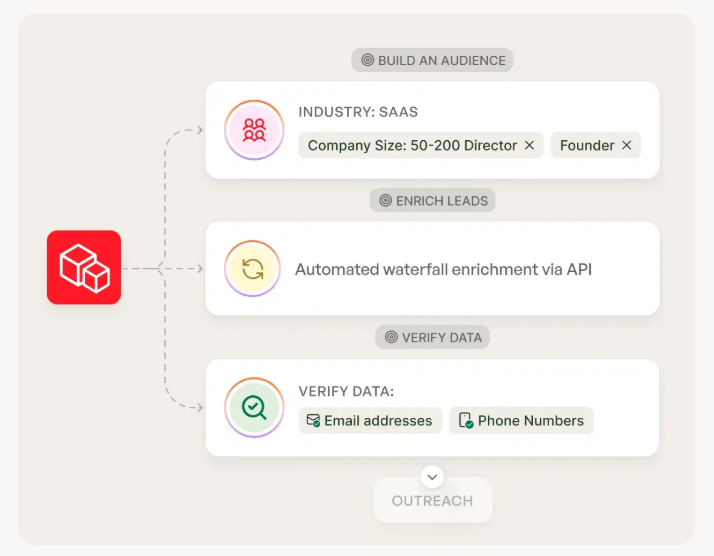
Three root patterns kill data quality over time:
Speed over structure. Teams prioritize shipping campaigns and closing deals over data integrity. Every shortcut - skipping a required field, bulk-importing without dedup, letting reps free-text a country field - creates debt that compounds.
Governance capability gaps. Most organizations don't have the roles, processes, or tools to manage data quality proactively. They react to problems instead of preventing them.
Cultural resistance. Reps see data entry as overhead, not as infrastructure. Until leadership treats data quality as a revenue driver (because it is), the culture won't shift.
The framework that works has three actionable components:
Data stewards. One person per team or business unit who owns data quality for their domain. Not a full-time role for most companies - but a defined responsibility with authority.
Decision rights. Who can create custom fields? Who approves bulk imports? Who decides when to purge vs. archive? Document these decisions once and enforce them.
Escalation paths. When a rep imports 5,000 contacts from a trade show with no dedup rules, who flags it? What happens next? Without escalation paths, problems get discovered months later during a pipeline review.
Organizations with proper data stewardship see 15-30% reduction in data-related inefficiencies. That's not just cleaner data - it's faster reporting, more accurate forecasting, and reps spending time selling instead of fixing records.
Diagnostic Checklist: The Nine Issues That Kill CRM Data
Before you start cleaning, diagnose which of these nine issues are actually hurting you. Most teams have three or four - not all nine:
- Incomplete entry - Required fields left blank at creation
- Duplicates - Same contact, multiple records, conflicting data
- Inconsistent formatting - "USA" vs "United States" vs "US"
- Lack of validation - No rules preventing bad data at entry
- Manual entry errors - Typos, wrong fields, copy-paste mistakes
- Integration issues - Tools syncing conflicting data into the CRM
- Data silos - Departments hoarding data in spreadsheets and separate tools
- Poor visibility - No dashboards or reports tracking data quality metrics
- Training gaps - Reps don't know the standards because nobody taught them
Run through this list with your team. The issues you identify determine which steps in the framework above deserve the most attention.
Case Study: How a 5% Retention Lift Drove 25%+ Profit Growth
A mid-sized event marketing company serving exhibit builders and trade associations was losing ground. Their contact database decayed at 30% annually. It cost them 5x more to acquire new customers than to retain existing ones - largely because bad data meant they couldn't identify at-risk accounts or personalize outreach to existing clients.
They implemented a four-pillar framework:
- Quality at capture: Enforced required fields and validation rules at the point of entry.
- Standardization: Locked down country, title, and company name formats. "USA" only. No variants.
- Quarterly audits: Scheduled deep reviews every 90 days with a designated data steward.
- Action on inactive contacts: Instead of letting stale records sit, they archived contacts with no engagement in 12+ months and re-verified the rest.
The results: a 5% improvement in customer retention drove 25%+ profit growth. They reduced manual effort across the team, shortened lead conversion cycles, and built scalable operations without adding headcount. Cleaner attribution meant marketing could finally prove which channels actually worked.
The lesson isn't complicated. Clean data doesn't just prevent problems - it surfaces growth that dirty data was hiding. Knowing how to keep CRM data clean is ultimately about building the habits and governance that let your revenue engine run on truth instead of guesswork.
Reps waste 546 hours a year on bad data. Prospeo returns 50+ verified data points per contact at $0.01/email - with catch-all handling, spam-trap removal, and bounce rates under 4%. One enrichment run replaces weeks of manual CRM cleanup.
Fix your entire database in minutes, not months.
FAQ
How often should I clean my CRM data?
Run weekly spot-checks on new records, monthly segment reviews, and full quarterly audits with dedup and email re-verification. If your team imports leads from prospecting tools or trade shows frequently, increase to monthly deep reviews. A quarterly cadence catches problems before they compound into pipeline-wrecking messes.
What percentage of CRM data is typically duplicated?
In unmanaged CRMs, 10-30% of records are duplicates. The number grows with team size and the number of lead sources feeding your system. Most teams are genuinely shocked when they run their first dedup report - especially those using three or more prospecting tools.
Should I delete or merge duplicate CRM records?
Merge when both records contain valuable data like activity history, notes, or deal associations. Delete only when one record is clearly junk: test entries, spam, or completely outdated contacts with zero history. Default to merge - Salesforce's own documentation recommends the same approach.
How do I verify if my CRM email data is still valid?
Export a sample of 100-500 contacts and run bulk email verification. Tools like Prospeo verify emails at 98% accuracy and flag invalid, catch-all, and risky addresses - the free tier covers 75 verifications per month. If more than 5-8% bounce, your full database needs a verification pass.
What's the difference between data cleaning and data enrichment?
Cleaning fixes what's wrong - removing duplicates, correcting formats, deleting outdated records. Enrichment adds what's missing - appending job titles, phone numbers, and company data. Always clean first, then enrich. Enriching dirty data just makes the mess more expensive to untangle later.