

How to Build an AI Sales Outreach Tech Stack That Actually Works
Finance just flagged your sales tools spend - and your AI sales outreach tech stack looks like a Frankenstein monster. You're paying for three databases, two sequencers, an enrichment tool nobody logs into, and an "AI SDR" that's basically a glorified mail merge. 77% of US tech decision-makers report moderate-to-extensive tool sprawl, and the sales tech market is barreling toward $104.47B by 2030. Most of that growth isn't new categories - it's overlap.
The consensus on r/sales says it all: "too many tools popping up every week, and most of them promise the world but fall short." The difference between teams that convert and teams that burn cash isn't which AI features they've enabled. It's whether their six core layers actually talk to each other. Get those layers working before you bolt on AI features.
Let's build it right.
What You Need (Quick Version)
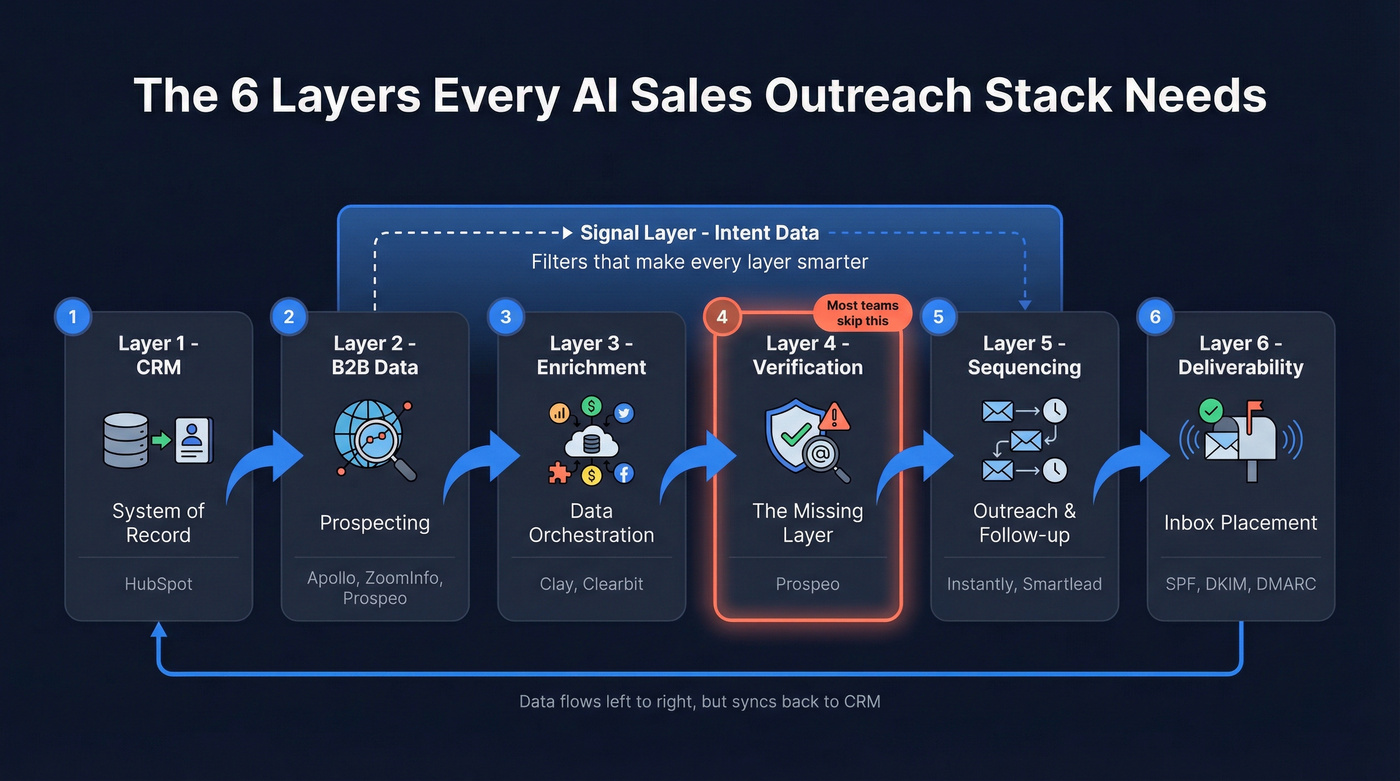
Six layers, one recommended tool each:
| Layer | Function | Pick |
|---|---|---|
| CRM | System of record | HubSpot (free tier) |
| Enrichment | Multi-source data layering | Clay ($149/mo+) |
| Sequencing | Send + follow up | Instantly ($37/mo) |
| Deliverability | Inbox placement | SPF/DKIM/DMARC + warmup |
Here's how the layers connect in practice:
CRM ← B2B Data → Enrichment → Verification → Sequencer → Inbox
The Six Layers Every Outbound Team Needs
Layer 1 - CRM (System of Record)
Everything flows back to the CRM. If your data, sequences, and enrichment don't sync cleanly here, nothing else matters.
HubSpot's free CRM handles most early-stage needs. Salesforce runs $25-$300+/user/mo depending on edition, and it's the right call once you've got a dedicated RevOps person to manage it. Don't buy Salesforce before you have someone to configure it - we've watched teams spend six figures on a CRM that reps refuse to open.
Layer 2 - B2B Data & Prospecting
This is where most teams overspend. Three options worth considering:
Apollo: The Bootstrap Pick
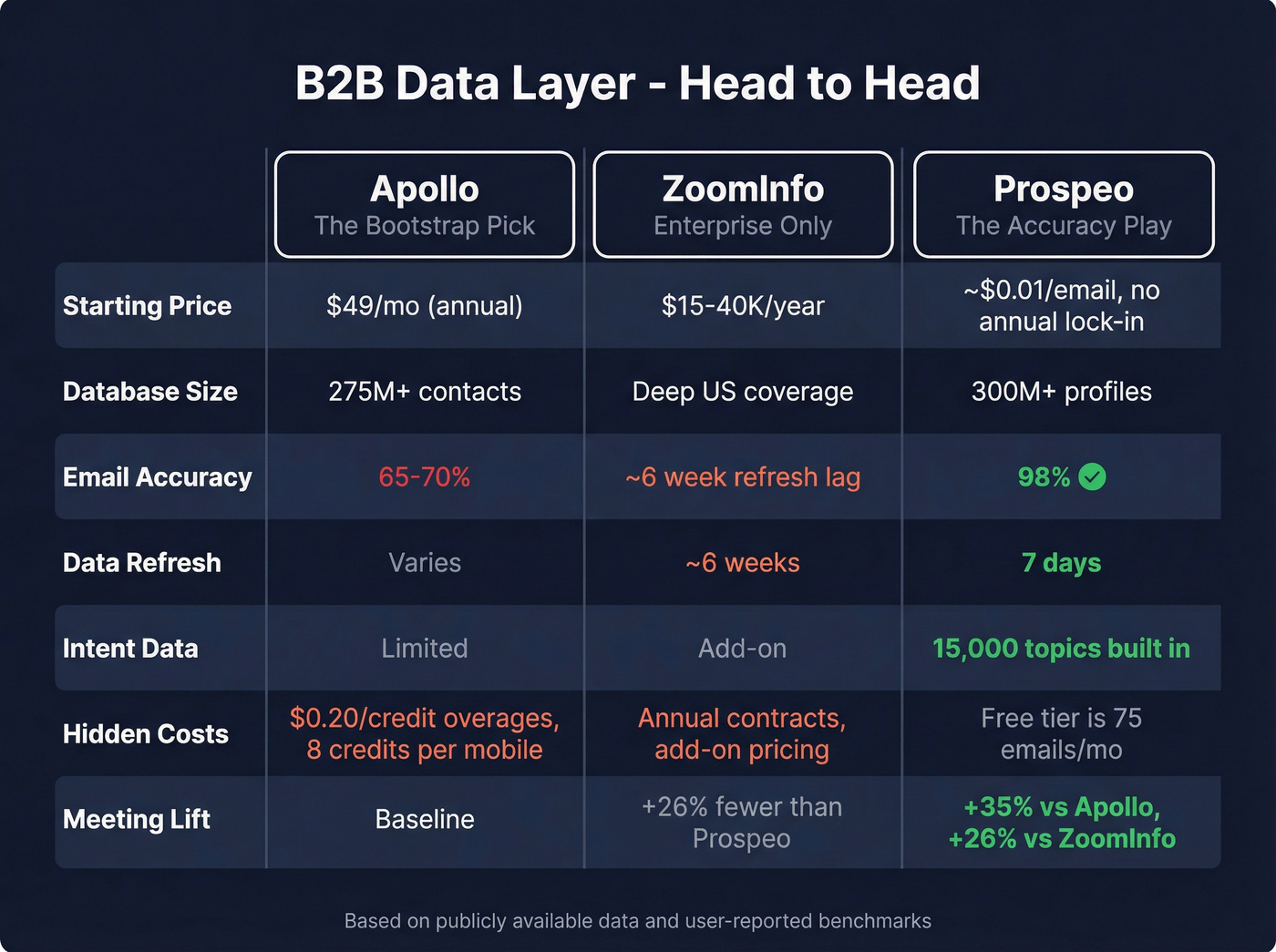
The free tier gives you 25 credits/month, and paid plans start at $49/mo billed annually. Apollo's database covers 275M+ contacts with built-in sequencing and a decent AI writer. The catch: data accuracy sits around 65-70%, bounce rates run 15-25%, and mobile number reveals cost 8 credits each. Overages hit $0.20/credit with minimum purchases.
ZoomInfo: Skip Unless You're Enterprise
Don't bother unless you're running a 50+ seat sales org with budget for $15-40K/year. The database is deep, especially in the US, but an around-6-week data refresh cycle means you're often working with stale contacts.
Prospeo: The Accuracy Play
Prospeo sits between the two on price but leads on data quality - 300M+ profiles with 30+ search filters, intent data across 15,000 topics, and a 7-day refresh cycle. At ~$0.01/email with no annual contracts, it's the self-serve alternative to ZoomInfo that doesn't gate features behind enterprise pricing. Teams using Prospeo book 26% more meetings than ZoomInfo users and 35% more than Apollo users, largely because 98% email accuracy means reps spend time selling instead of cleaning lists.
Layer 3 - Enrichment & Orchestration
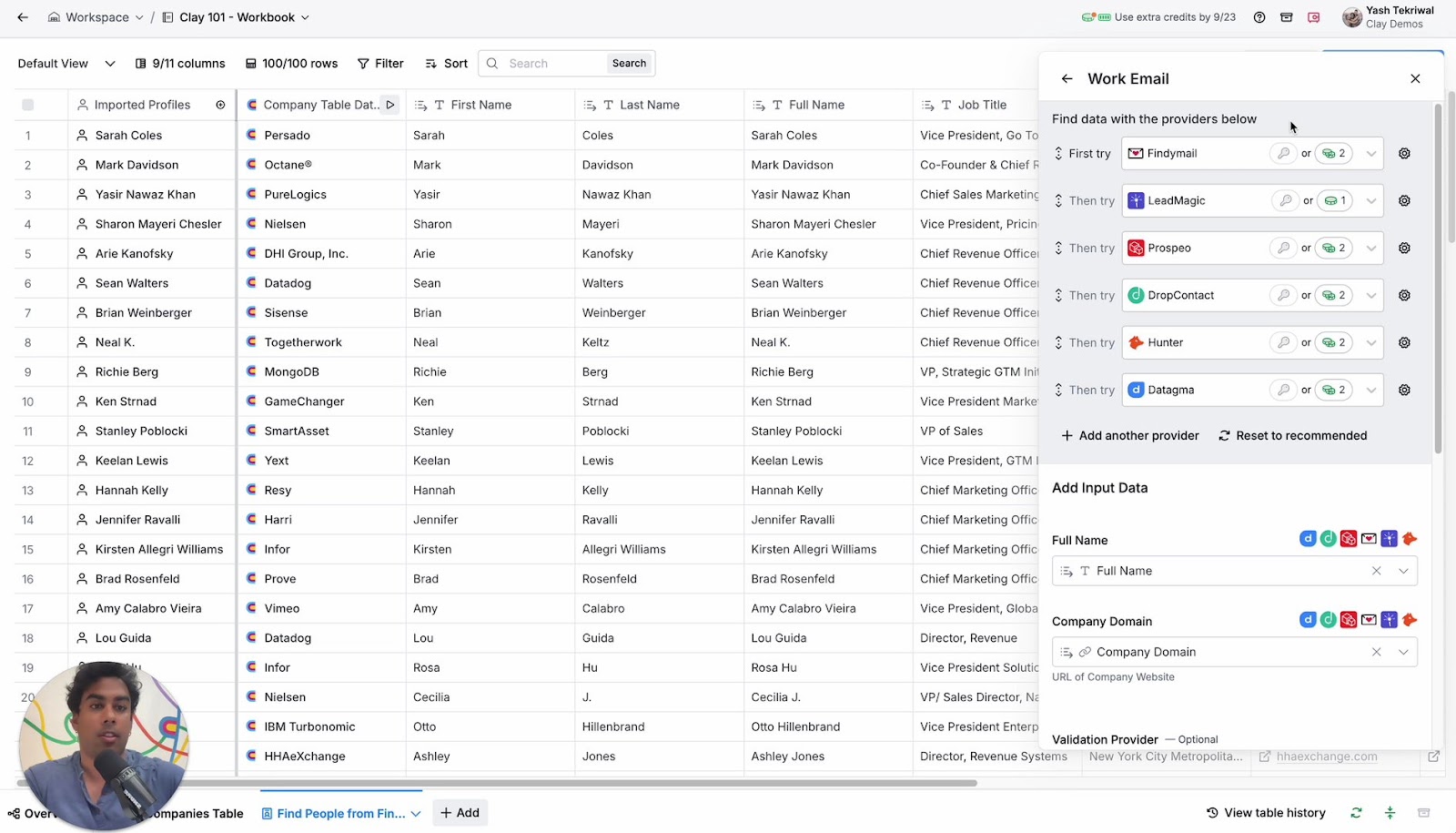
Clay is the enrichment darling right now, and for good reason. It aggregates 75+ data providers into a spreadsheet-like UI where you can build waterfall enrichment workflows - try Provider A, fall back to Provider B, enrich with firmographics from Provider C.
The problem is what Clay actually costs. Sticker price runs $149/mo (Starter), $349/mo (Explorer), or $800/mo (Pro). But credit economics tell a different story. A full contact + company enrichment burns 75 credits. Failed lookups still consume credits, and typical waste runs 20-30%. Top-up credits carry a ~50% markup over base rates. That "advertised $149/mo" becomes $4,200-$9,600/year once you factor in top-ups and dependencies.
Clearbit works well for website visitor enrichment and firmographic data. Airscale is a simpler standalone alternative starting at $49/user/mo - less powerful orchestration, but predictable pricing. If you don't need Clay's waterfall complexity, either is worth a look.
Layer 4 - Verification (The Missing Layer)
Here's the thing: this is the layer every other "tech stack" guide skips. Enrichment gives you data. Verification tells you if that data is real. Conflating them is how teams end up with 18% bounce rates and torched domain reputations.
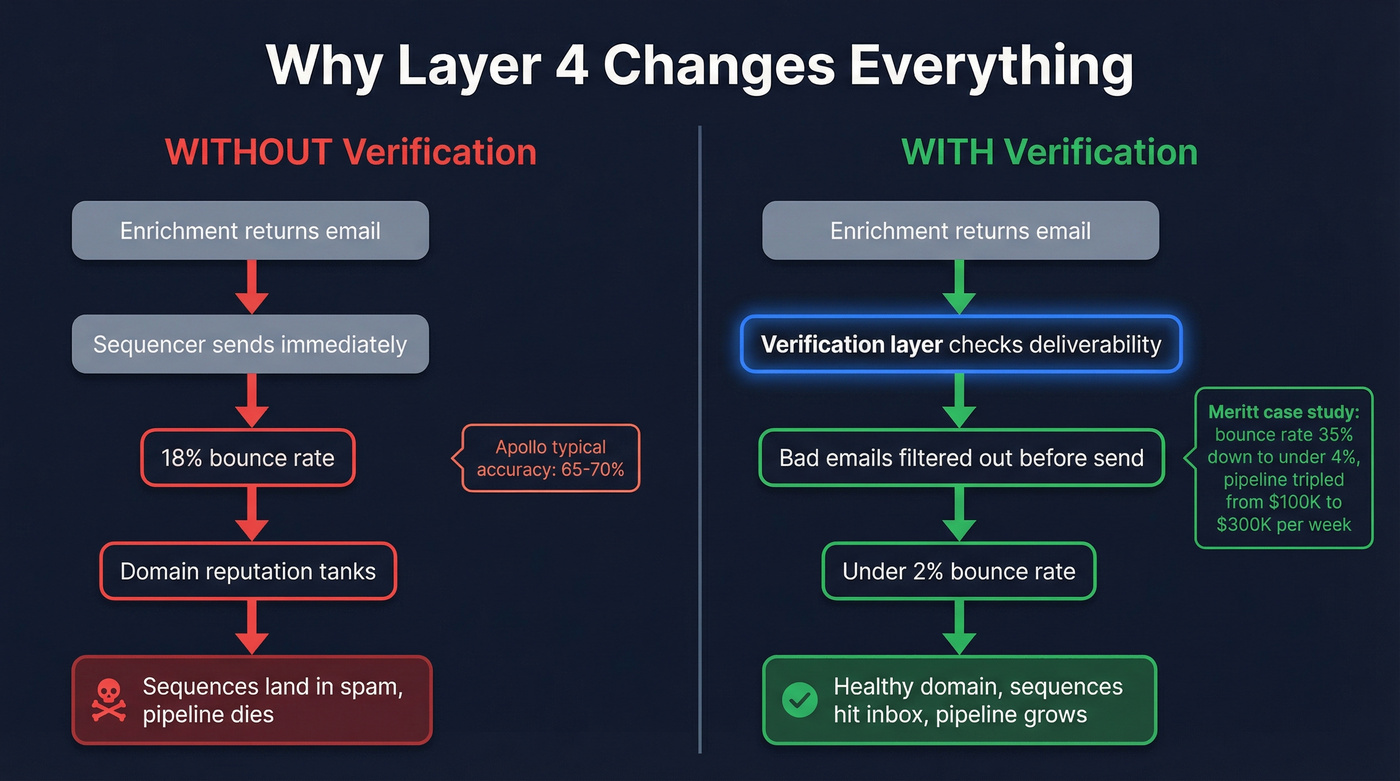
Without a verification step, here's the failure mode: your enrichment tool returns an email address that looks valid, your sequencer sends to it, and it bounces. Multiply that by a few thousand contacts and your sender reputation craters. Apollo's 65-70% accuracy rate isn't unusual for unverified enrichment output - that's just the reality of databases that prioritize coverage over accuracy.
The proof is in production results. Meritt went from a 35% bounce rate to under 4% after adding a dedicated verification layer - and their pipeline tripled from $100K to $300K/week. That's not a marginal improvement. That's the difference between a sequence that works and one that's actively damaging your domain.

Layer 5 - Outreach & Sequencing
The sequencing layer is where AI actually adds value - writing variations, optimizing send times, managing multi-channel cadences.
| Tool | Starting Price | Warmup Included | Best For |
|---|---|---|---|
| Instantly | $37/mo | Yes | Cold email at scale |
| Smartlead | $39/mo | Yes | Advanced A/B testing |
| GMass | $25/mo | No | Gmail-only teams |
| Salesloft | ~$75-150/user/mo | No | Mid-market + CRM sync |
| Outreach | ~$100-150/user/mo | No | Enterprise workflows |
For pure cold email, Instantly and Smartlead are the obvious picks. Both include warmup, and Instantly supports unlimited email accounts. Cold email benchmarks show up to 60% open rates are achievable with good copy and clean data, with typical reply rates landing 1-5%.
Salesloft and Outreach make sense when you need multi-channel orchestration tied to a CRM with reporting your VP of Sales will actually read. They're not cheap, but they're the standard for teams running structured playbooks with 10+ reps.
Layer 6 - Deliverability Infrastructure
This isn't a tool - it's a checklist. Skip any item and your sequences underperform regardless of how good your copy is.
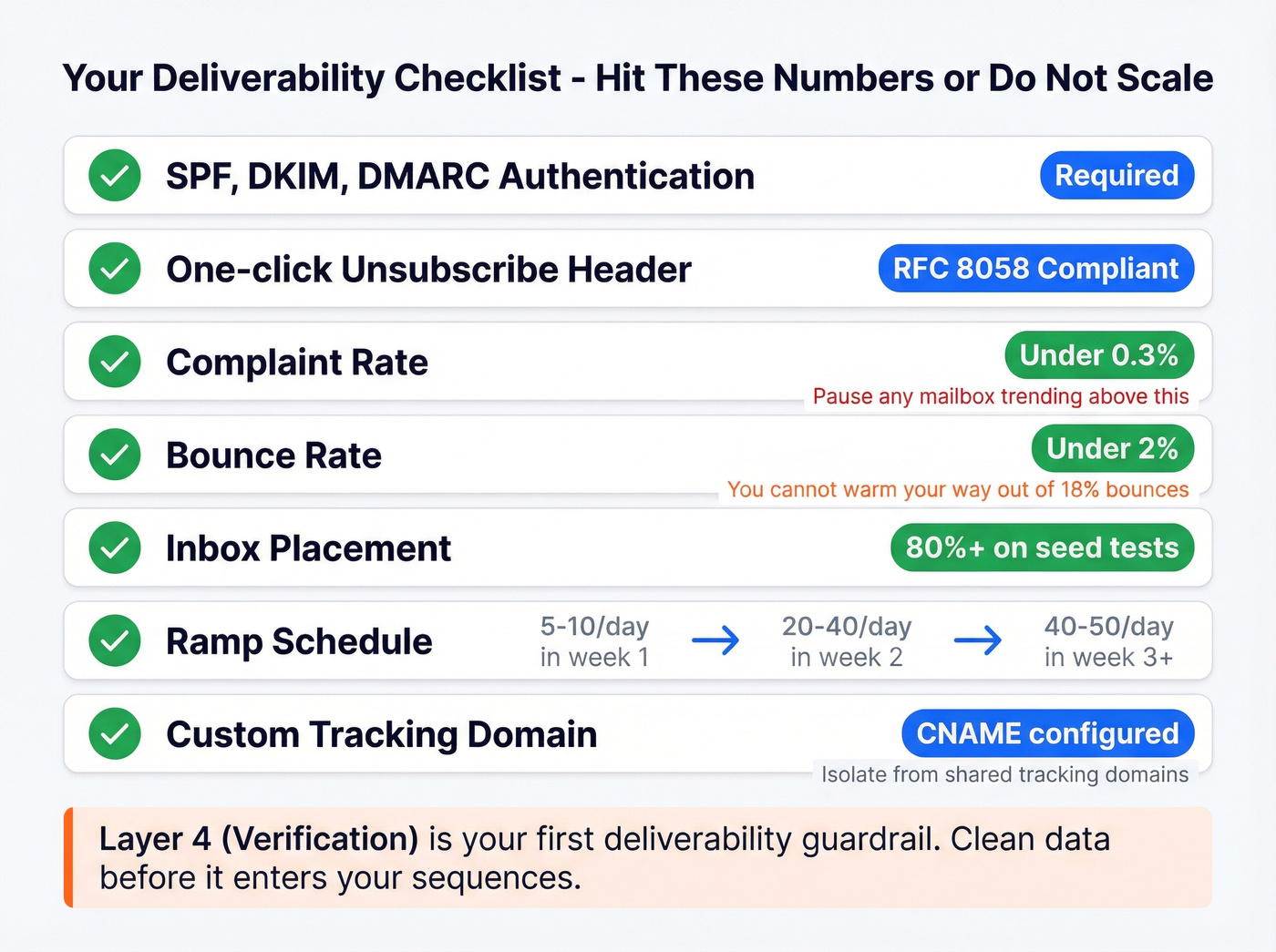
- Authentication: SPF, DKIM, and DMARC records configured on every sending domain. Non-negotiable under Google and Yahoo bulk sender rules.
- One-click unsubscribe: RFC 8058 compliant header in every outbound email.
- Complaint rate: Keep under 0.3%. Pause any mailbox trending above this.
- Bounce rate: Under 2%. This is where Layer 4 becomes your first deliverability guardrail - you can't warm your way out of 18% bounce rates.
- Inbox placement: Target 80%+ on seed tests before scaling volume.
- Ramp schedule: Start new domains at 5-10 emails/day, scale over 4-6 weeks. Most teams aim for 10-20/day in week one, 20-40 in week two, then 40-50/day once metrics are healthy.
- Custom tracking domain: Set up a CNAME to isolate your reputation from shared tracking domains.
The Signal Layer - Intent Data
Intent data isn't a separate tool purchase for most teams - it's a filter that makes every other layer smarter.
| Intent Type | What It Tracks | Tool Examples | Typical Cost |
|---|---|---|---|
| First-party | Website visits, product usage | Instantly, Pocus, Userpilot | Often bundled |
| Second-party | Job changes, partner overlaps, reviews | Common Room, Crossbeam | $0-$500/mo |
| Third-party | Hiring signals, tech changes, funding | Bombora, 6sense, LoneScale | $30K-$100K+/year standalone |
If your average deal size is under $15K, you almost certainly don't need a standalone third-party intent platform. The most underrated move is layering intent into your prospecting filters rather than buying a separate $30K+ contract. Several platforms bundle Bombora-powered intent data across thousands of topics, letting you filter prospects by buying signals directly inside your data layer.
Second-party intent - champion job changes, partner ecosystem overlaps via Crossbeam - delivers the highest signal-to-noise ratio we've seen. Someone who just left a customer account and landed at a new company is a warmer lead than any third-party topic score.

Layer 4 is where most stacks break. Prospeo's 5-step verification and 7-day data refresh eliminate the bounce rate problem before it reaches your sequencer - 98% email accuracy, 300M+ profiles, 30+ filters, no annual contracts.
Stop sending sequences built on bad data. Fix the foundation.
AI SDR Agents - Hype vs. Reality
Most "AI SDR" tools - 11x, Artisan, AiSDR, Amplemarket - are sequencing layers with an AI wrapper. They write emails, manage follow-ups, and sometimes handle basic objection responses. That's useful. It's not magic.
Typical pricing runs $500-$2,000/mo per platform. One enterprise client had 85 different AI models in play across business units before anyone centralized governance. If you're considering an AI SDR, ask one question: what layer in my stack does this replace? If the answer is "none, it's additive," you're adding cost without removing complexity.
What This Stack Actually Costs
| Tool | Layer | Starting Price | Watch Out For |
|---|---|---|---|
| HubSpot CRM | CRM | Free | Feature gates on free tier |
| Apollo | B2B Data | Free / $49/mo (annual) | $0.20/credit overages, 65-70% accuracy |
| ZoomInfo | B2B Data | ~$15-40K/year | ~6-week data refresh |
| Prospeo | Data + Verification | Free / ~$0.01/email | Free tier: 75 emails/mo |
| Clay | Enrichment | $149/mo | 20-30% credit waste |
| Instantly | Sequencing | $37/mo | - |
| Smartlead | Sequencing | $39/mo | - |
| Salesloft | Sequencing | ~$75-150/user/mo | Annual contracts |
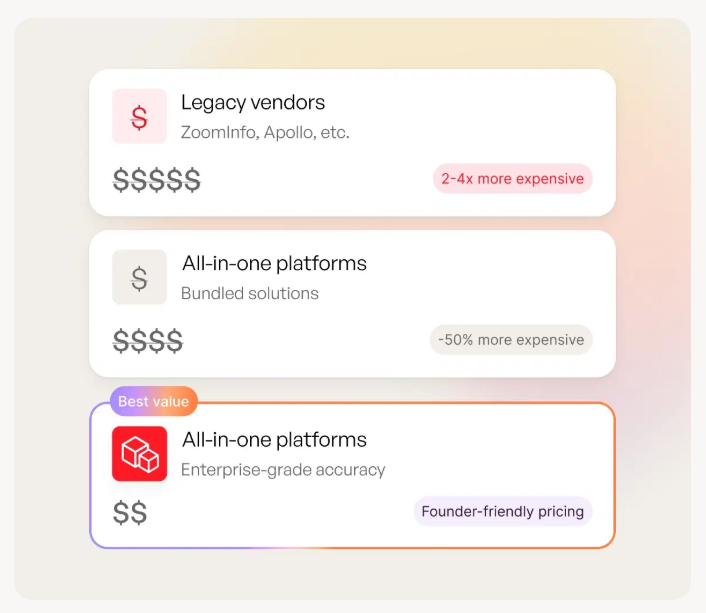
The hidden costs that kill budgets: Clay credit waste turning a $149/mo plan into $350-$800/mo in practice, Apollo overages at $0.20/credit when reps burn through monthly allocations, and ZoomInfo's refresh lag meaning you're paying premium prices for data that's already weeks old.
Three Stack Builds by Budget
Starter (<$150/mo)
Apollo (free tier for prospecting) + Prospeo (free tier for verification, entry plan for deeper prospecting) + Instantly ($37/mo for sequencing and warmup). Total: ~$37-$100/mo.
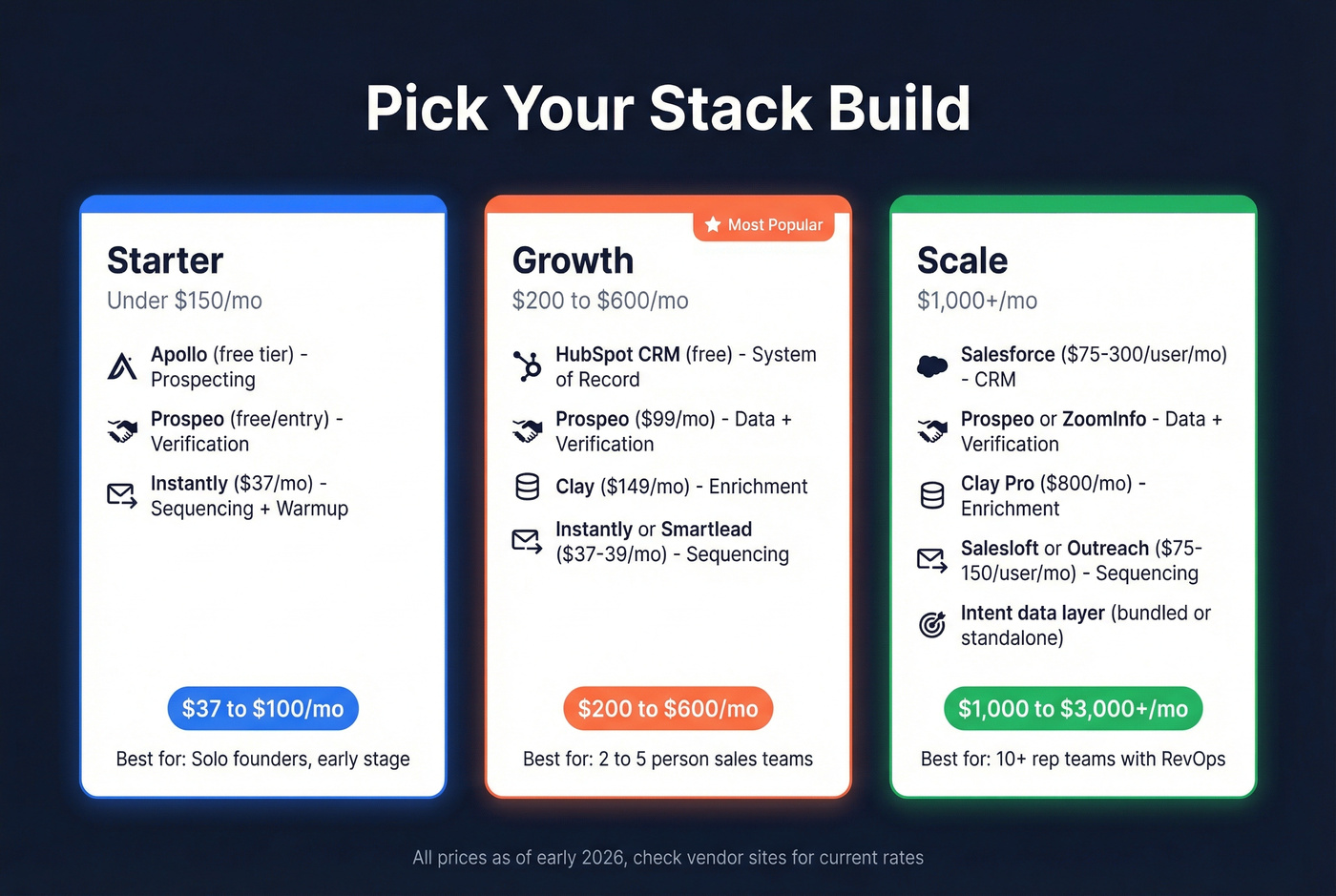
This gets you a searchable database, verified emails before they hit your sequences, unlimited email accounts with warmup, and basic deliverability monitoring. It's a complete outbound engine - enough to book meetings from day one.
Growth ($500-$2K/mo)
HubSpot Sales Hub + a dedicated B2B data platform + Clay Starter ($149/mo for enrichment workflows) + Instantly ($37/mo) + Gong for conversation intelligence. Total: ~$800-$1,500/mo.
This adds CRM automation, multi-source enrichment, and call recording. The Clay + verification combination is powerful here - Clay orchestrates the enrichment waterfall, and your verification layer confirms the output before it ships to Instantly.
Enterprise ($2K+/mo)
Salesforce + ZoomInfo for database breadth + Clay Pro ($800/mo) + Salesloft or Outreach + Gong + 6sense for intent + a dedicated verification layer. Total: $5K-$15K+/mo.
At enterprise scale, the verification layer matters even more. ZoomInfo gives you coverage; verification makes sure that coverage is actually deliverable. The teams running this stack typically see the lowest bounce rates and highest inbox placement because they're verifying before every send. At this tier, every tool should push and pull data through your CRM automatically, eliminating manual handoffs between layers.
Your AI sales outreach tech stack doesn't need more tools - it needs fewer layers doing more. Prospeo combines B2B data, enrichment, and verification in one platform at ~$0.01/email. Teams book 35% more meetings than Apollo users because clean data compounds across every layer downstream.
Collapse three layers into one and start booking meetings this week.
Keeping Your Stack Healthy
Highspot recommends auditing your sales tech stack twice a year. That's the minimum. Deloitte's guidance on AI agent governance is worth heeding too: centralize your AI tools under one owner before they spread across business units unchecked. Gartner predicts that companies failing to manage SaaS costs through 2027 will overspend by at least 25%.
The practical audit: list every tool, its owner, its monthly cost, and the last time someone pulled a report from it. If nobody's touched it in 90 days, it's a candidate for elimination. If two tools do the same thing, keep the one that integrates with more of your stack. One team we know removed a "redundant" collaboration tool and broke automated ERP-triggered notifications that fed their entire deal desk - so map dependencies before you cut.
FAQ
How many tools belong in an AI sales outreach tech stack?
Eight to twelve across six layers is the sweet spot. More than that and you're paying for overlap. Audit twice a year and cut anything that isn't directly producing pipeline or protecting deliverability.
What's the cheapest way to start AI outbound?
Apollo (free) + Prospeo (free tier, 75 verified emails/mo) + Instantly ($37/mo). Under $50/mo for a complete outbound stack with verified data, email warmup, and unlimited sending accounts.
Why do my cold emails keep bouncing?
Your data provider likely isn't verifying emails before delivery. Enrichment and verification are different steps - enrichment finds an address, verification confirms it's real. Add a dedicated verification layer to catch invalid addresses before they hit your sequencer and damage your domain reputation.
Is Clay worth the price?
For complex enrichment workflows, yes - but budget 2-3x the sticker price. Credit waste on failed lookups (20-30%) and top-up markups (~50%) mean a $149/mo plan often costs $350-$800/mo in practice. If you don't need waterfall enrichment, Airscale or Clearbit get the job done for less.
Do I need a separate deliverability tool?
Not a separate tool, but you need the infrastructure: SPF, DKIM, DMARC authentication, a warmup process, and verified data. Most sequencers include warmup. The data quality piece - keeping bounces under 2% - is where most teams fail, and that's a verification problem, not a deliverability tool problem.