Revenue Operations Alignment: A 90-Day Blueprint With the Artifacts You Actually Need
89% of RevOps teams lack clearly defined strategic goals. 42% don't have a budget. A quarter of practitioners are running the entire function solo. You've probably read five articles telling you to "align sales and marketing" without a single SLA template or stage definition you could actually copy into your CRM. Revenue operations alignment doesn't need another think piece - it needs artifacts. Here they are.
What RevOps Alignment Actually Means
RevOps alignment is the operational infrastructure that forces sales, marketing, and customer success to work from the same definitions, the same data, and the same handoff rules. It's not a mission statement exercise. It's not a quarterly offsite where everyone agrees to "communicate better" and then goes back to their own dashboards.
Here's the thing: alignment that depends on goodwill breaks the first time a rep disagrees with marketing's lead scoring. Alignment built into your SLAs, CRM workflows, and meeting cadences survives that disagreement because the system enforces the rules, not the people.
The most common complaint we see in RevOps communities captures it perfectly - "We agreed on definitions in Q1, and by Q3 nobody follows them." That's a systems failure, not a people failure.
Why It Matters in 2026
The RevOps software market is projected to grow from $3.45B to $10.25B by 2033 at 13.5% CAGR. That's infrastructure spend catching up to a real organizational need. Companies that invest in RevOps grow revenue 3x faster than those that don't, and the VP of Revenue Operations title grew 300% over the past 18 months.
79% of organizations now have a formal RevOps function. A Wakefield Research survey commissioned by Salesloft found 73% of companies have a C-suite role dedicated directly to RevOps. For any B2B SaaS company serious about predictable growth, cross-functional revenue alignment isn't a nice-to-have anymore - it's table stakes.
Why Alignment Efforts Fail
Five blockers kill alignment before it starts:
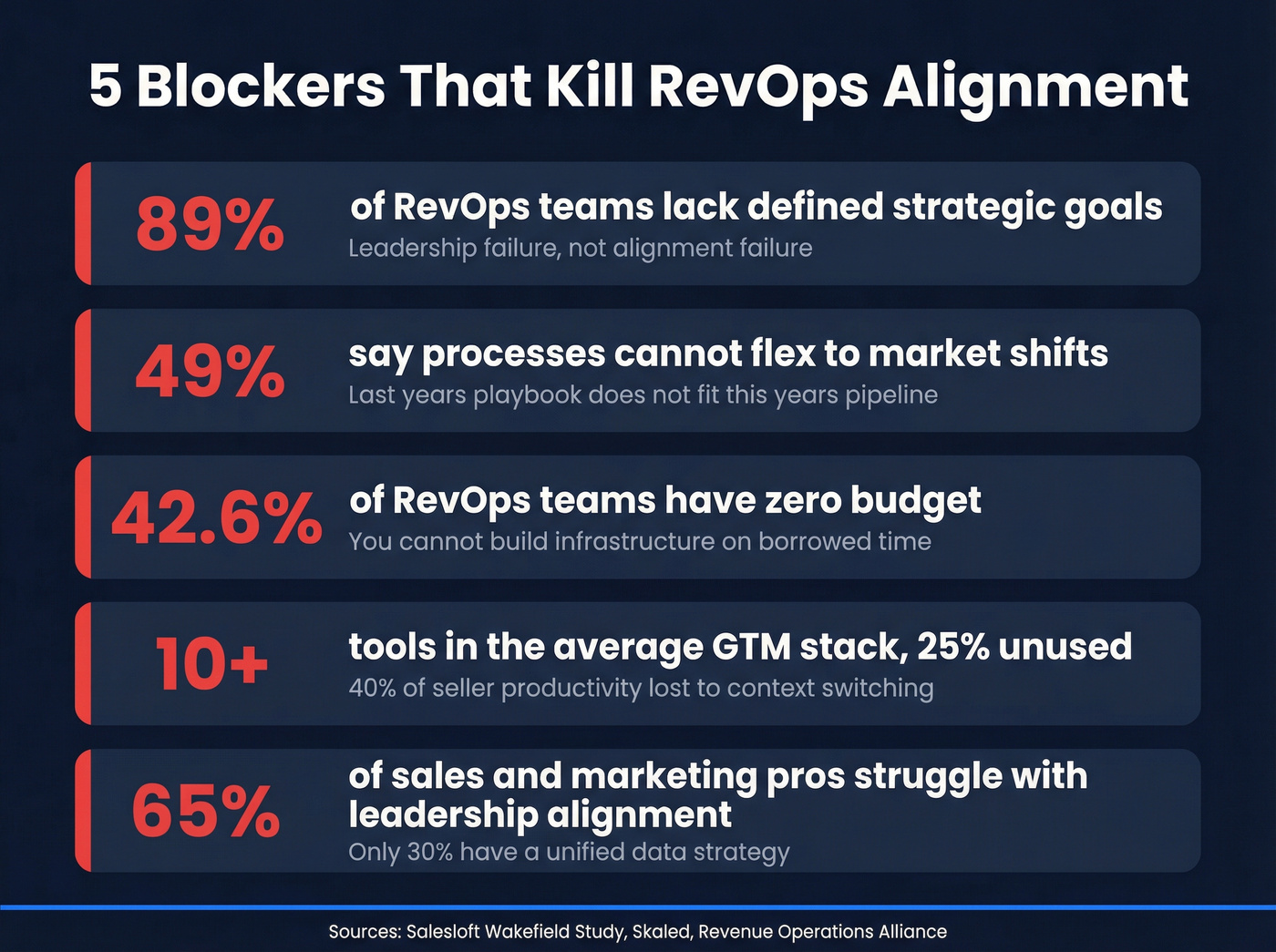
No defined strategic goals. 89% of RevOps teams lack them. If the exec team can't articulate what RevOps owns, nobody downstream can align to it. That's a leadership failure, not an alignment failure.
Rigid processes. 49% of RevOps leaders say their processes can't flex to market shifts. You built the playbook for last year's pipeline. The market moved. The playbook didn't.
No budget. 42.63% of RevOps teams don't have one. You can't build infrastructure on zero dollars and borrowed time.
Tool sprawl. The average GTM team runs 10+ tools with 25% of licenses unused. 67% of reps missed quota last year, and context switching across a Frankenstack is a major contributor - 40% of seller productivity is lost to it.
Leadership misalignment. Forrester found 65% of marketing and sales professionals struggle with it. McKinsey says only 30% of companies have a unified data strategy. If the VPs can't agree on definitions, the ICs never will.
The 90-Day Roadmap
We've run this playbook with teams from $2M to $50M ARR. The structure holds whether you're tackling GTM alignment for the first time or rebuilding a broken process.
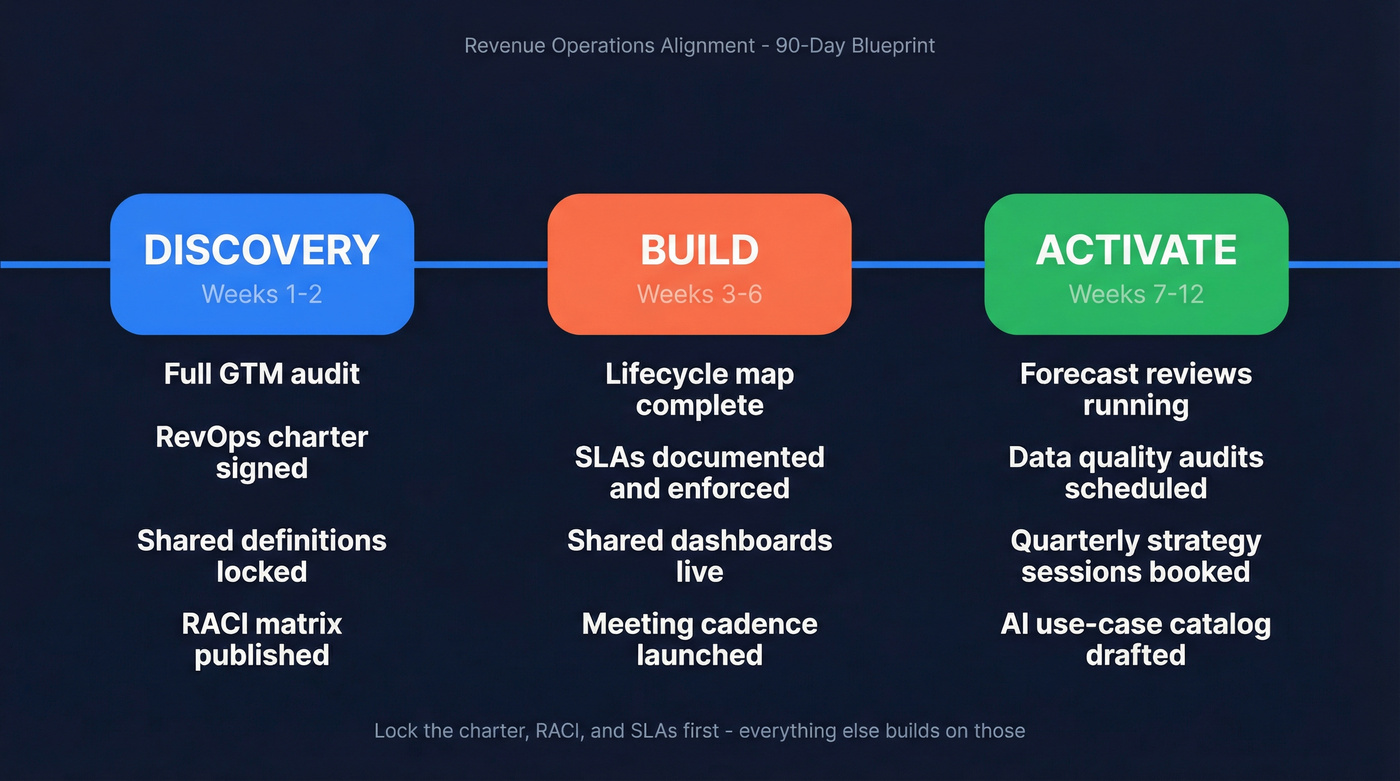
| Phase | Timeline | Deliverables |
|---|---|---|
| Discovery | Weeks 1-2 | Audit, charter, shared definitions, RACI |
| Build | Weeks 3-6 | Lifecycle map, SLAs, dashboards, cadence |
| Activate | Weeks 7-12 | Forecast reviews, data audits, quarterly strategy |
For startups under $5M ARR, this roadmap is the whole program - focus on definitions and SLAs for the highest ROI. For scale-ups north of $5M, layer in formal data audits, integration maps, and an AI use-case catalog with guardrails. Embed this into your annual planning cycle alongside comp design and capacity modeling. Alignment that resets every January isn't alignment.
The 10 non-negotiable assets to produce across 90 days:
- RevOps charter
- Operating model with RACI
- KPI tree and metrics dictionary
- Data dictionary
- Governance playbook
- Operating cadence calendar
- Tech stack blueprint
- Integration map
- AI use-case catalog
- Risk mitigation playbook
Get the charter, RACI, and SLAs locked first - everything else builds on those. Gartner estimates 60% of companies will fail to build an end-to-end revenue process without governance. Don't be one of them.

Your SLAs and stage definitions are only as good as the data flowing through them. Dirty contact records break every handoff in your revenue process. Prospeo's 7-day refresh cycle and 98% email accuracy mean your CRM enrichment actually holds up - 83% match rate, 50+ data points per contact, zero catch-all guesswork.
Stop building alignment on a foundation of decayed data.
Alignment Artifacts You Can Copy
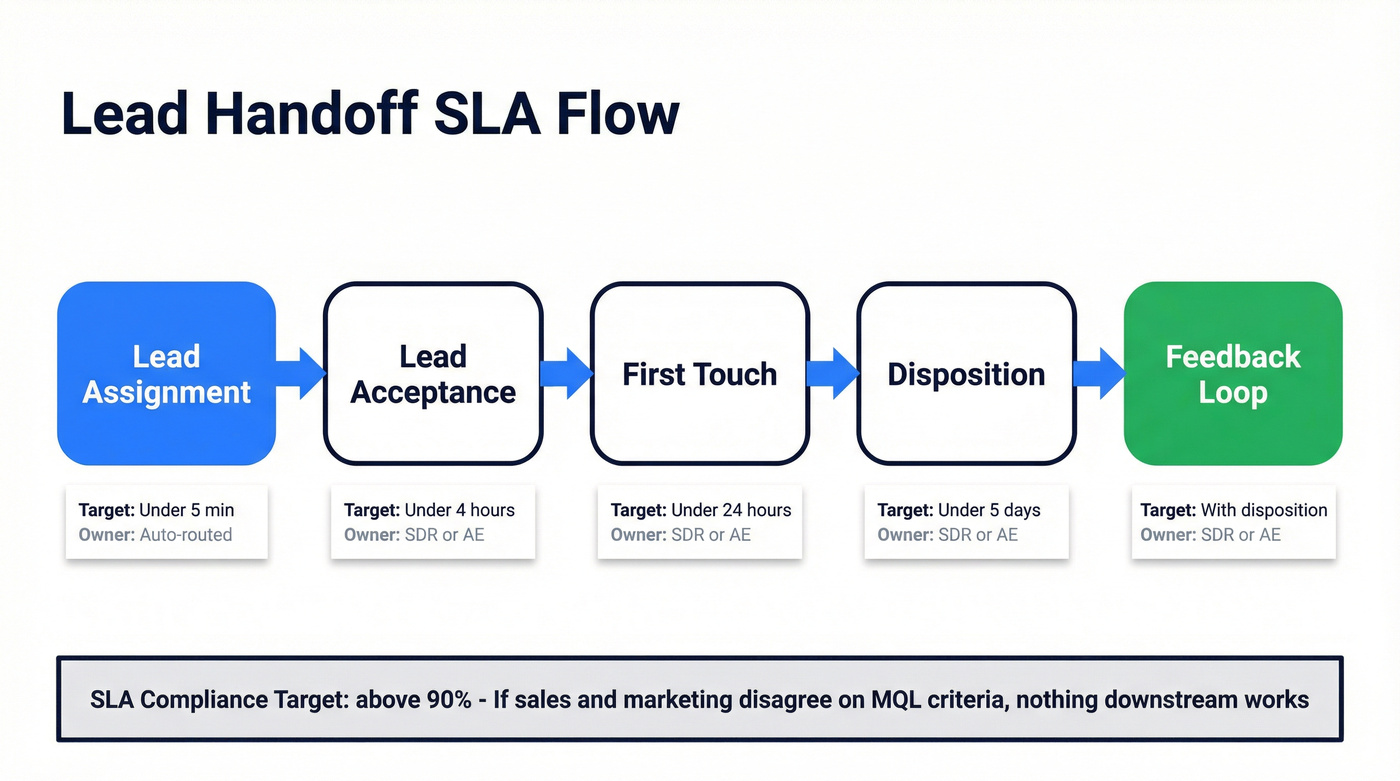
SLA Table
| Handoff Step | Target | Owner |
|---|---|---|
| Lead assignment | < 5 minutes | Auto-routed |
| Lead acceptance | < 4 hours | SDR/AE |
| First touch | < 24 hours | SDR/AE |
| Disposition | < 5 days | SDR/AE |
| Feedback loop | With disposition | SDR/AE |
Lead Stage Definitions
Lock these across all three teams: Lead, MQL, SQL, SAL, Opportunity. Each stage needs a clear owner, entry criteria, and exit criteria. If sales and marketing disagree on what qualifies an MQL, nothing downstream works. This is the single most impactful step in aligning sales, marketing, and customer success around shared revenue goals - and it's the step most teams skip because the conversation is uncomfortable.
Conversion Benchmarks
| Stage | Target Range |
|---|---|
| Lead-to-MQL | 20-30% |
| MQL-to-SQL | 40-60% |
| SQL-to-Opportunity | 50-70% |
| SLA compliance | > 90% |
Meeting Cadence
Run a weekly lead review with SDR managers and demand gen, a bi-weekly campaign review with marketing and sales leaders, a monthly revenue review with full GTM leadership, and a quarterly strategy alignment with execs. Skip any of these and the system decays within a month. We've watched it happen at companies that thought they could get away with dropping the weekly sync - by month two, lead handoff SLAs were being ignored and nobody noticed until pipeline cratered.
RevOps KPI Benchmarks
| KPI | Benchmark | Function |
|---|---|---|
| CAC:CLV ratio | 3:1+ | Cross-functional |
| Net Revenue Retention | 120%+ | CS / Expansion |
| Gross Revenue Retention | 85-90%+ | CS |
| Qualified Meeting to Pipeline | 40-50% | Pipeline mgmt |
The median company spends $2.00 in S&M to acquire $1.00 of new ARR. That ratio worsened 14% in 2024. If your RevOps function isn't actively compressing that number, it's not doing its job.
And here's what makes this harder: 70% of B2B buyers define their needs independently before engaging sales. Your alignment work needs to account for a buyer journey that's mostly invisible to your CRM until the opportunity stage. That means marketing attribution, intent signals, and first-touch data quality matter far more than most RevOps teams give them credit for.
Consolidate, Then Integrate
Let's be honest - most companies don't have a tech stack problem. They have a data quality problem disguised as a tech stack problem. You can consolidate from 10 tools to 4 and still fail if the underlying records are garbage.
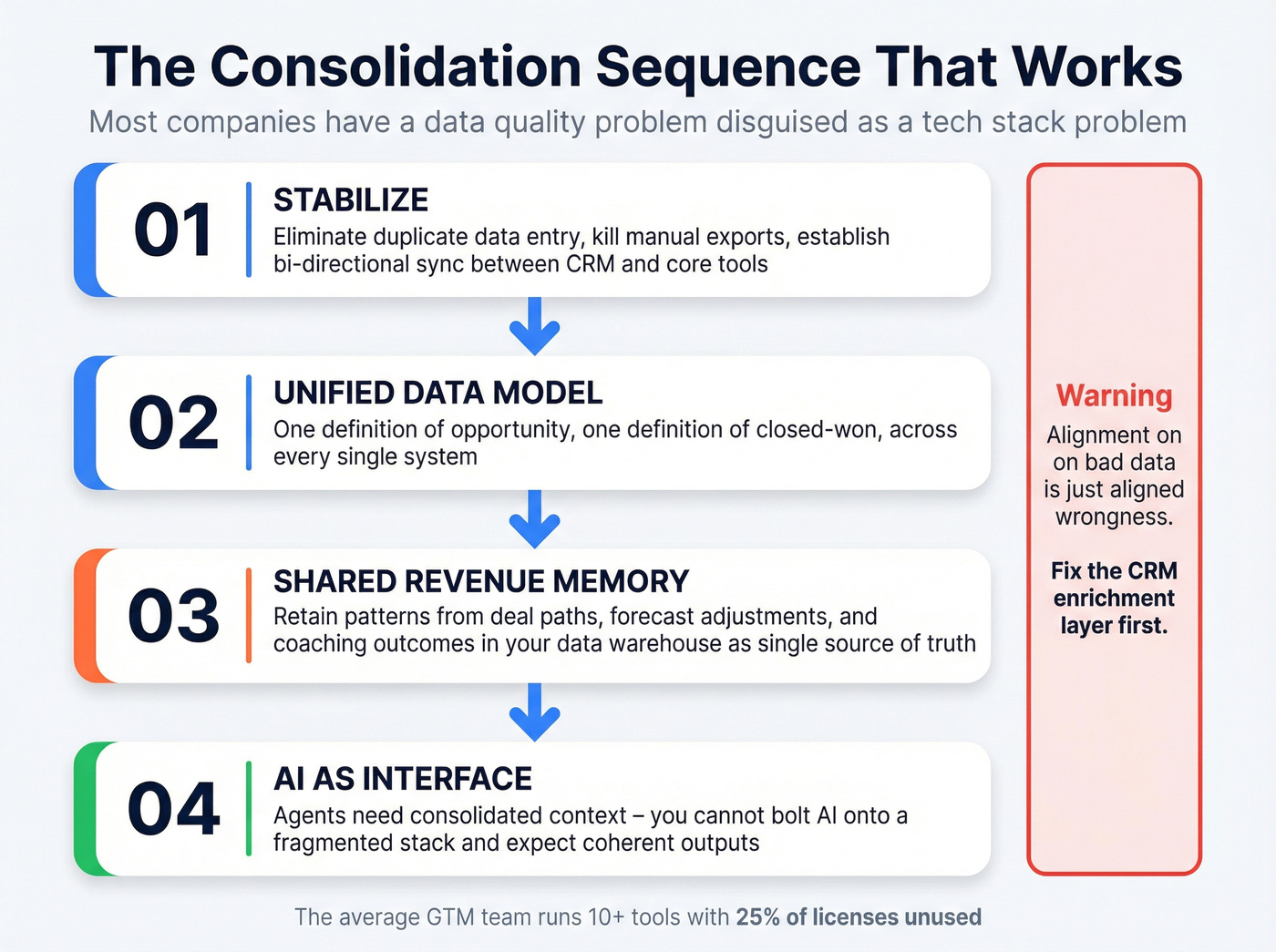
The consolidation sequence that works:
- Stabilize - eliminate duplicate data entry, kill manual exports, establish bi-directional sync between your CRM and core tools.
- Unified data model - one definition of "opportunity," one definition of "closed-won," across every system.
- Shared revenue memory - retain patterns from deal paths, forecast adjustments, and coaching outcomes in your data warehouse as the single source of truth.
- AI as interface - agents need consolidated context. You can't bolt AI onto a fragmented stack and expect coherent outputs.

But none of this works if your underlying data is stale. Alignment on bad data is just aligned wrongness.
The cheapest fix most teams overlook is the CRM enrichment layer. Snyk's team of 50 AEs saw their bounce rate drop from 35-40% to under 5% and AE-sourced pipeline jump 180% after switching to a 7-day data refresh cycle with Prospeo - compared to the 6-week industry average. That's the kind of result that makes every other alignment initiative actually stick, because your reps stop wasting cycles on dead emails and start trusting the data in their CRM.
You just read that 40% of seller productivity is lost to tool sprawl and context switching. Prospeo replaces your email finder, mobile provider, and enrichment vendor with one platform - 300M+ profiles, 125M+ verified mobiles, and native integrations with Salesforce, HubSpot, and every major sequencer. At $0.01 per email, your RevOps budget actually stretches.
Consolidate your data stack before you consolidate anything else.
The Maturity Model
Before you build anything, assess where you are. Score yourself on five questions:
- Do sales, marketing, and CS share a single set of stage definitions?
- Are lead handoff SLAs documented and enforced?
- Does one person or team own cross-functional data quality?
- Do you run at least a monthly revenue review with full GTM leadership?
- Can you pull a single-source-of-truth pipeline report without manual cleanup?
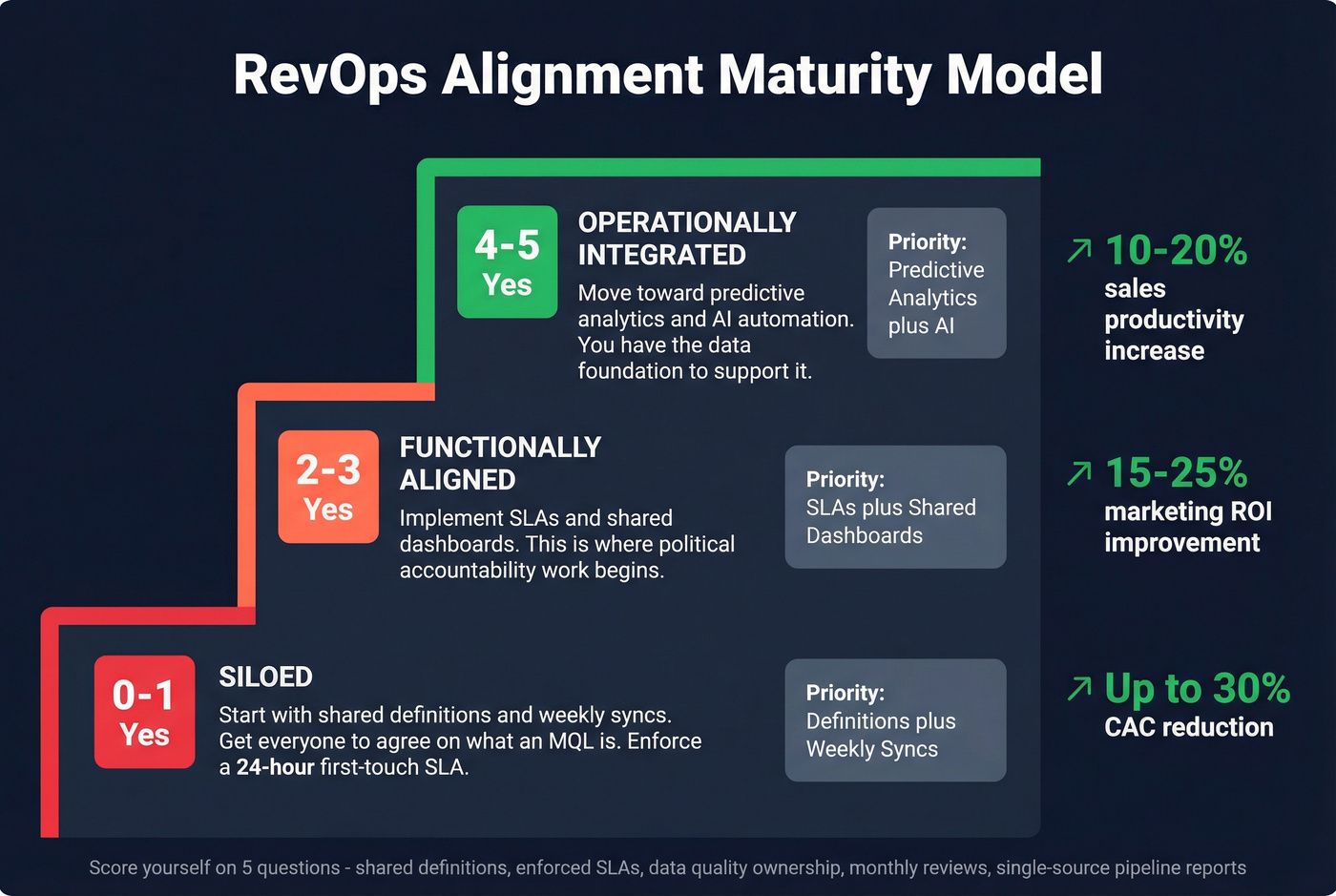
0-1 Yes: You're siloed. Start with shared definitions and weekly syncs. Don't try to boil the ocean - just get everyone to agree on what an MQL is and enforce a 24-hour first-touch SLA.
2-3 Yes: You're functionally aligned. Implement SLAs and shared dashboards. This is where most teams stall because the hard political work of enforcing accountability across departments starts here.
4-5 Yes: You're operationally integrated. Move toward predictive analytics and AI automation. If you're not here yet, skip the AI hype - you don't have the data foundation to support it.
Teams that progress through these stages report 10-20% sales productivity increases, 15-25% marketing ROI improvements, and up to 30% CAC reduction.
FAQ
What's the difference between RevOps and sales ops?
RevOps unifies sales, marketing, and customer success under one function with shared goals, data, and processes. Sales ops focuses exclusively on sales process, tools, and reporting. RevOps is the strategic layer - sales ops is one input into it.
How long does full alignment take?
Foundation in 90 days: charter, SLAs, shared dashboards, enforced definitions. Full maturity - predictive analytics, AI-driven forecasting, dynamic resource allocation - takes 12-18 months. Start with shared definitions and enforced SLAs; those deliver the fastest ROI.
What should you fix first?
Shared definitions. If sales and marketing disagree on what qualifies an MQL, every metric downstream is unreliable. Lock your lead stage definitions first, then enforce SLAs on handoff timing. This single step is where most B2B SaaS alignment efforts either succeed or stall.
What tools do RevOps teams actually need?
A CRM like Salesforce or HubSpot, a data enrichment platform for verification and freshness, and a BI or dashboard layer. Three tools that talk to each other beat ten that don't. Consolidate before adding - most teams run 10+ tools with a quarter of licenses sitting unused.