

Demand Gen vs Brand Awareness: The Debate Is a Measurement Problem
It's budget season. The CEO pulls up a dashboard, points at the brand campaign line item, and asks the question every marketing leader dreads: "What did this actually do?" Meanwhile, the demand gen team is celebrating a record quarter of MQLs - but pipeline is flat and sales is complaining about lead quality. Both sides think they're winning. Neither can prove it.
The demand gen vs brand awareness debate isn't a strategy problem. It's a measurement problem. And until you fix how you measure, you'll keep having the same argument every quarter.
The Short Version
Fix measurement first. The brand-vs-demand war exists because both sides report vanity metrics. Brand teams count impressions. Demand teams count MQLs. Neither metric connects to revenue.
Use a 60/40 brand-to-demand budget split as your baseline. Adjust by maturity stage - startups skew heavier toward activation, growth-stage companies shift toward brand. But 60/40 is the center of gravity backed by the most cited research in the field.
Neither strategy works if your execution layer is broken. The best brand campaign in the world doesn't help if your demand gen team is emailing dead addresses. Data quality is the unglamorous foundation under both strategies.
Definitions: Brand Building vs Demand Gen
| Dimension | Brand Awareness | Demand Generation |
|---|---|---|
| Primary goal | Recognition + trust | Pipeline + revenue |
| Time horizon | 6-18 months | 30-90 days |
| Key tactics | Thought leadership, PR, events | Gated content, ABM, outbound |
| Core metrics | Branded search, share of voice | SQL velocity, CAC payback |
| Content types | Ungated, editorial, storytelling | Case studies, demos, comparisons |
| Buyer stage | Before they know they need you | Actively evaluating solutions |
Brand awareness makes people know your name before they need you. Demand gen captures and converts that awareness into pipeline when they do. Most teams treat these as separate programs with separate budgets, separate teams, and separate dashboards - then wonder why neither performs.
Why the Debate Exists
The real culprit isn't strategy disagreement. It's a measurement crisis that makes both sides look right on their own dashboards while the business stalls.
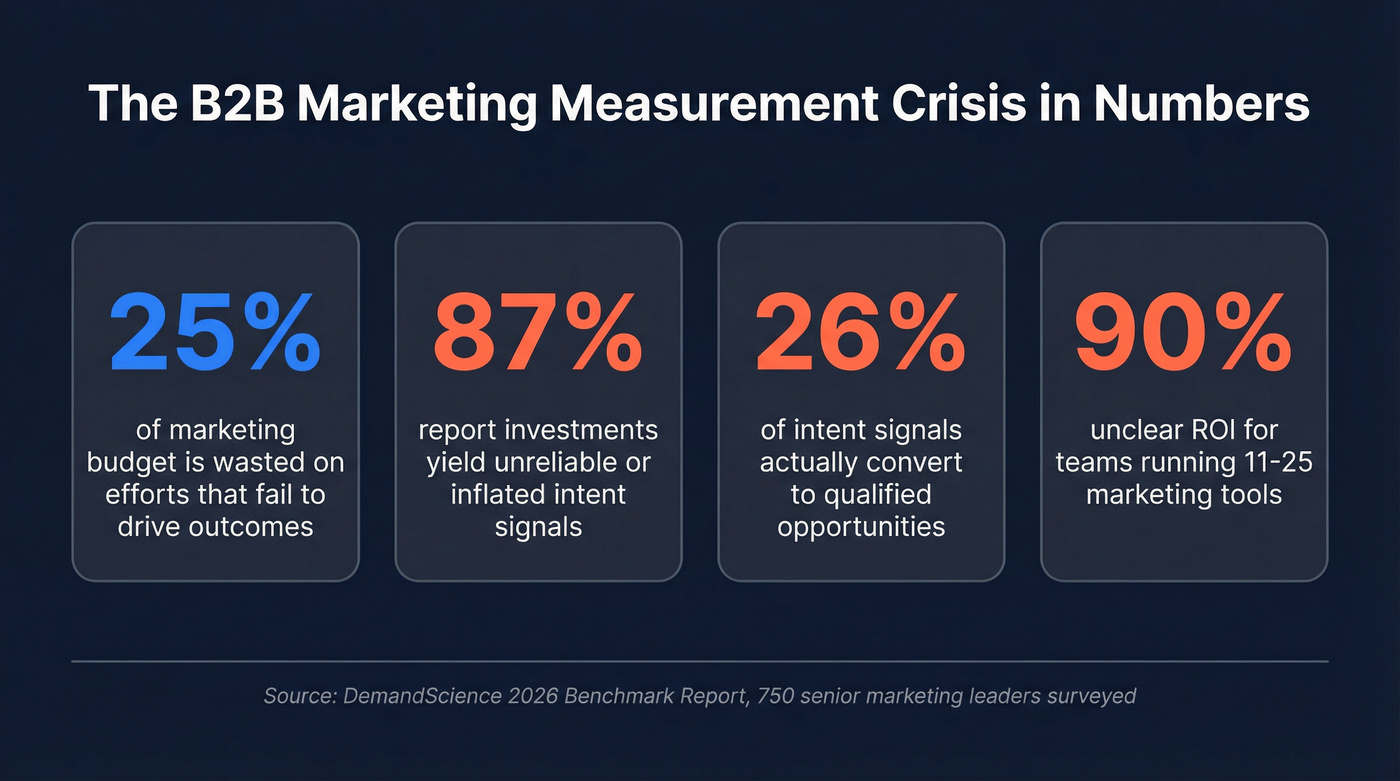
A 2026 benchmark report from DemandScience surveyed 750 senior marketing leaders at companies ranging from $100M to $5B+ in revenue. The findings are brutal: 25% of marketing budget is wasted on efforts that fail to drive outcomes. Two-thirds of those leaders say their dashboards show "success" that doesn't translate into revenue.
It gets worse. 87% report that their investments yield unreliable or inflated intent signals - clicks, downloads, behavioral scores that look promising but go nowhere. Only 26% of those signals actually convert to qualified opportunities. And tool sprawl makes it harder to see clearly: organizations running 11-25 marketing tools report roughly 90% unclear ROI, compared to 62% for teams with 6-10 tools.

A recurring argument on r/B2Bmarketing is that demand gen is brand awareness - every cold email, every ad, every webinar builds recognition whether you label it "brand" or not. There's truth to that. But it misses the measurement distinction that's causing the real damage, and it's why the relationship between brand and demand deserves more nuanced thinking.
Here's the thing: MQLs are the vanity metric of demand gen. If your team celebrates MQL volume without tracking pipeline-to-revenue conversion, you're optimizing for applause, not outcomes. Brand teams aren't innocent either. Measuring awareness with impressions is like measuring fitness by counting gym memberships sold.
Why Brand Awareness Matters More Than You Think
Your demand gen team generated 2,000 MQLs last quarter. Sales accepted 300. Closed 12. Meanwhile, your competitor with half the ad spend is winning deals because prospects already knew their name. That's not a demand gen failure - it's a brand awareness gap, and it illustrates why brand awareness for sales pipeline is just as critical as any activation tactic.
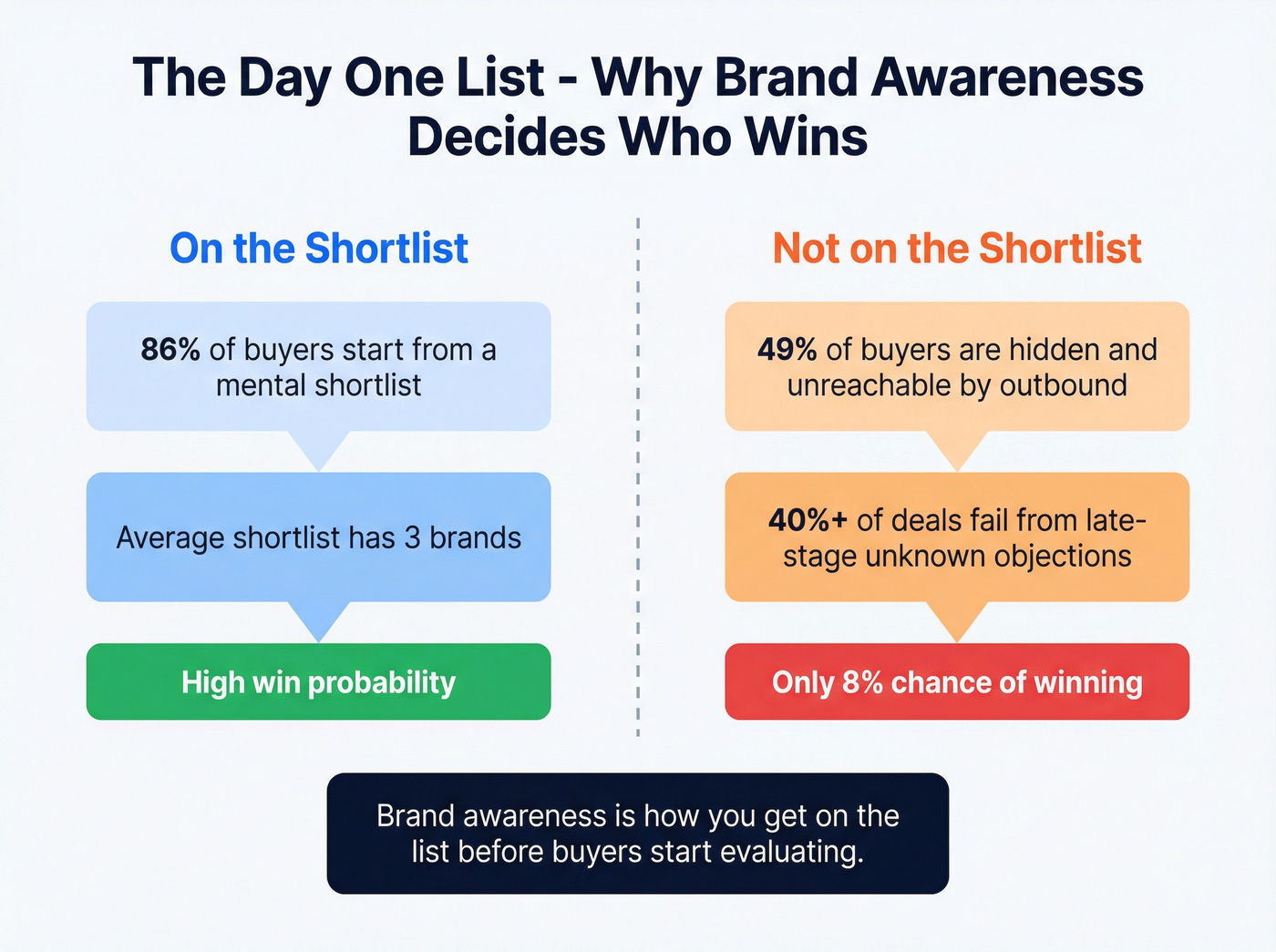
The research backs this up. According to the B2B Institute's research on the "Day One List," 86% of B2B buyers start their purchase journey from a shortlist of brands already in their heads. The average buyer has about three brands on that list. If you're not on it, you've got an 8% chance of winning the deal. Eight percent.
And it's not just about being known - it's about being distinctly known. Dell ran brand campaigns using the same blue visual cues as their category, and 25% of ad attribution went to competitors like Microsoft, Amazon, and IBM. Salesforce leaned into their mascot Astro and saw a +6% uplift in brand attribution. Distinctive assets matter.
49% of buyers are "hidden" - unreachable through traditional outbound or marketing channels. Over 40% of B2B deals fail because these hidden buyers raise late-stage concerns that nobody anticipated. Brand awareness is how you reach people your demand gen campaigns can't touch. With 72% of marketers saying AI-generated content is hurting brand distinctiveness, the companies that invest in genuine brand building will stand out even more in 2026 and beyond.

87% of intent signals are unreliable. That's what happens when your demand gen runs on bad data. Prospeo's 5-step verification delivers 98% email accuracy on a 7-day refresh cycle - so the pipeline your brand campaigns generate actually converts instead of bouncing.
Stop wasting brand spend on leads that bounce. Fix your data layer first.
Why Demand Gen Alone Fails
Demand generation works when you've got accurate intent signals, a dynamic ICP, content informed by actual buyer research, and a measurement framework tied to revenue. Not MQLs.
It breaks when you're optimizing for volume over quality, relying on static firmographic ICPs, and creating content without talking to buyers first. That 87% unreliable intent signal stat isn't abstract - it means most teams are chasing ghosts.
76% of marketing teams create content that isn't informed by verified buyer signals, intent data, or performance analytics. That's content created in a vacuum, pushed into sequences targeting a static ICP that was defined eighteen months ago. The operational toll is staggering: 85% of marketing teams spend more than half their time fixing issues rather than running campaigns, and 78% burn 21%+ of their time on manual data cleanup and troubleshooting alone.
If you're spending 80%+ on activation and wondering why pipeline is flat, you've already answered your own question. Without brand awareness feeding the top of the funnel, demand gen is just expensive lead recycling.
How to Split Your Budget
The most-cited research on this comes from Binet & Field's "The Long and the Short of It," which recommends a baseline of roughly 60% brand building and 40% sales activation. Additional research from Noa Consulting and the Swedish advertisers association suggests an optimal range of 40-70% on brand-building, with the remainder on activation.
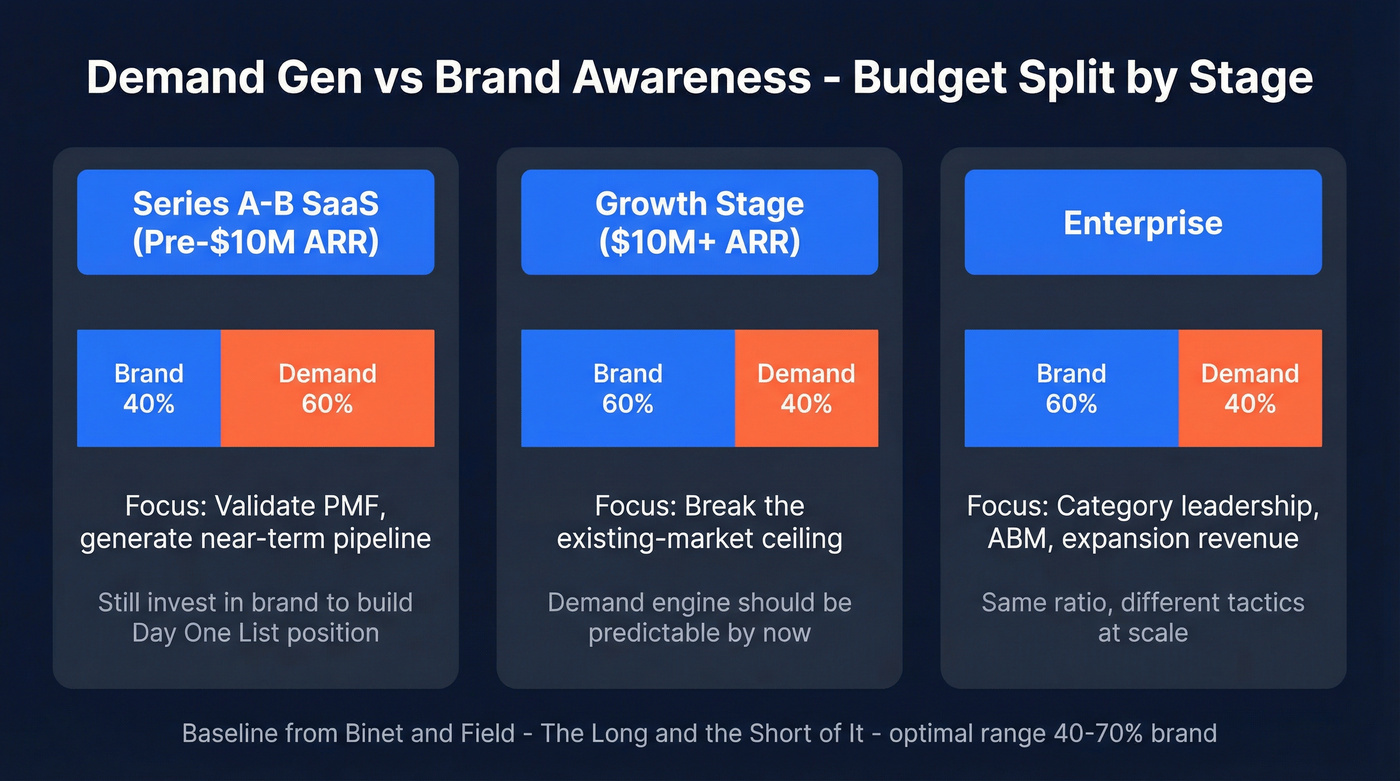
Series A-B SaaS (pre-$10M ARR): Start at 40% brand and 60% demand activation. You need to validate product-market fit and generate near-term pipeline. But don't go to zero on brand - you're building the Day One List position that compounds over time.
Growth stage (~$10M+ ARR): Shift toward the 60/40 brand-to-demand baseline. Your demand engine should be producing predictable pipeline by now. Brand investment is what breaks you out of the "known by our existing market" ceiling.
Enterprise: The 60/40 split holds, but the tactics change. Brand becomes category leadership, analyst relations, and executive thought leadership. Demand becomes ABM, multi-threading, and expansion revenue.
The key insight: performance marketing plateaus. At some point, you've captured all the existing demand in your category. Brand is how you create new demand.
Integration Playbook: 5 Steps
87% of top-performing marketers combine brand and demand, and integrated companies are 3x more likely to outperform competitors. Let's break down what that looks like in practice.
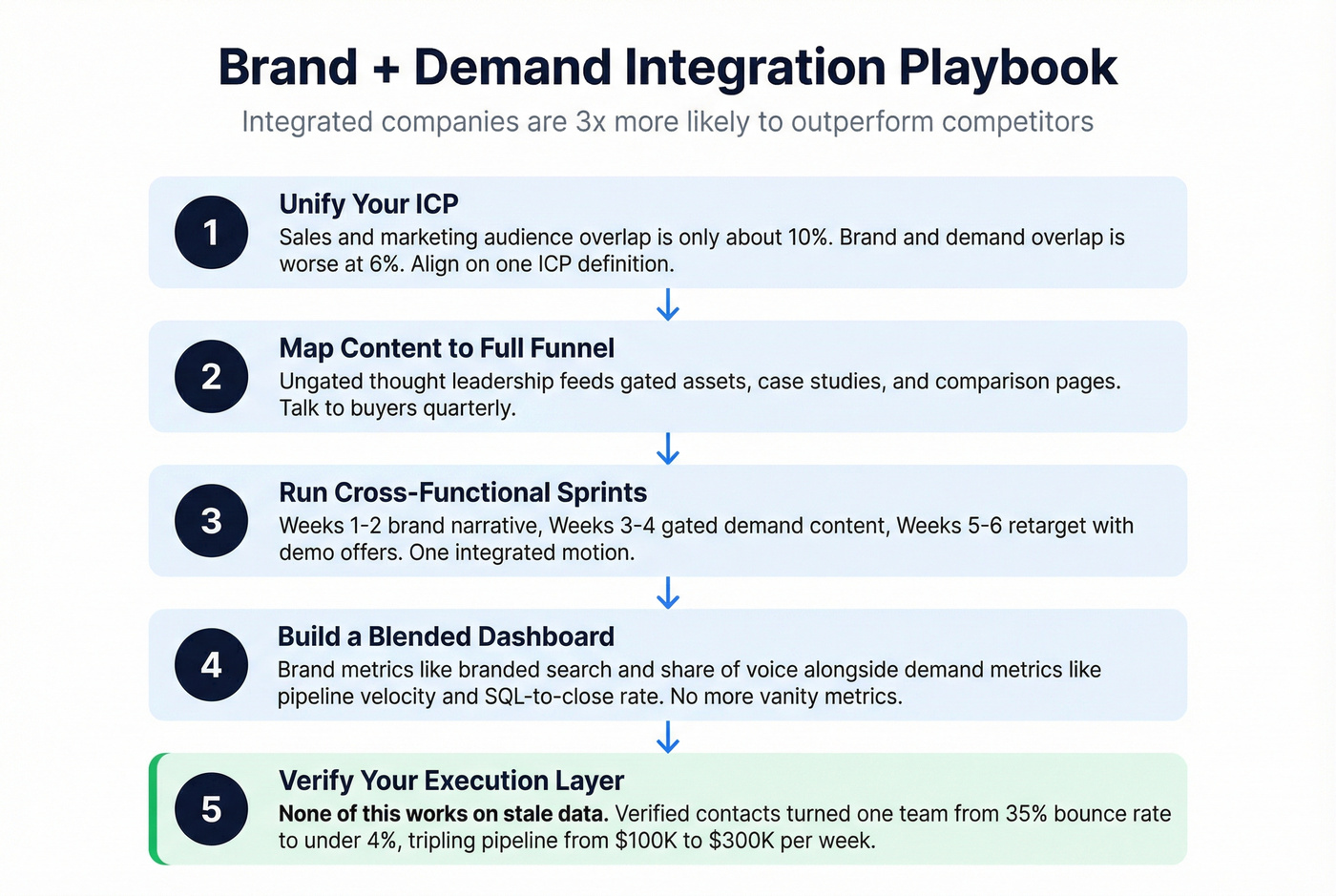
1. Unify your ICP across both teams. The average sales and marketing audience overlap is just ~10%. Brand and demand audience overlap is even worse - roughly 6%. If your brand team is targeting one persona and your demand team is targeting another, you're running two disconnected programs. Align on a single ICP definition first.
2. Map content to the full funnel. Awareness content like ungated thought leadership and brand storytelling feeds demand content - gated assets, case studies, comparison pages. 76% of teams create content not informed by buyer signals. Don't be one of them. Talk to your buyers quarterly and let their language shape both your brand narrative and your demand campaigns.
3. Run cross-functional campaign sprints. Brand and demand teams plan together quarterly, not in silos. Shared OKRs force alignment. Here's what a six-week sprint looks like: Weeks 1-2, launch a brand narrative campaign around a category POV. Weeks 3-4, release gated demand content that builds on the narrative. Weeks 5-6, retarget brand-engaged audiences with demo offers. One integrated motion.
4. Build a blended measurement dashboard. Brand metrics like branded search trend, share of voice, and self-reported attribution from sales calls sit alongside demand metrics like pipeline velocity, CAC payback, and SQL-to-close rate. In our experience, teams that track self-reported attribution from discovery calls get dramatically better brand data than those relying on impression dashboards. Stop measuring brand with impressions and demand with MQLs. Both metrics are lies when used in isolation.
5. Verify your execution layer. None of this matters if your contact data is stale. One team we worked with - Meritt, a sales consultancy - saw their bounce rate drop from 35% to under 4% after switching to verified data, and their pipeline tripled from $100K to $300K per week. Prospeo delivers 98% verified email accuracy on a 7-day data refresh cycle, so your outbound campaigns actually reach the people your brand efforts made aware of you. The free tier gives you 75 emails plus 100 Chrome extension credits per month to test, and paid plans run about $0.01 per email.
76% of teams create content without verified buyer signals. Prospeo tracks 15,000 intent topics via Bombora and layers them with 30+ filters - job changes, headcount growth, technographics - so your demand gen targets the buyers your brand already reached.
Bridge the gap between brand awareness and closed revenue for $0.01 per email.
Metrics That Actually Matter
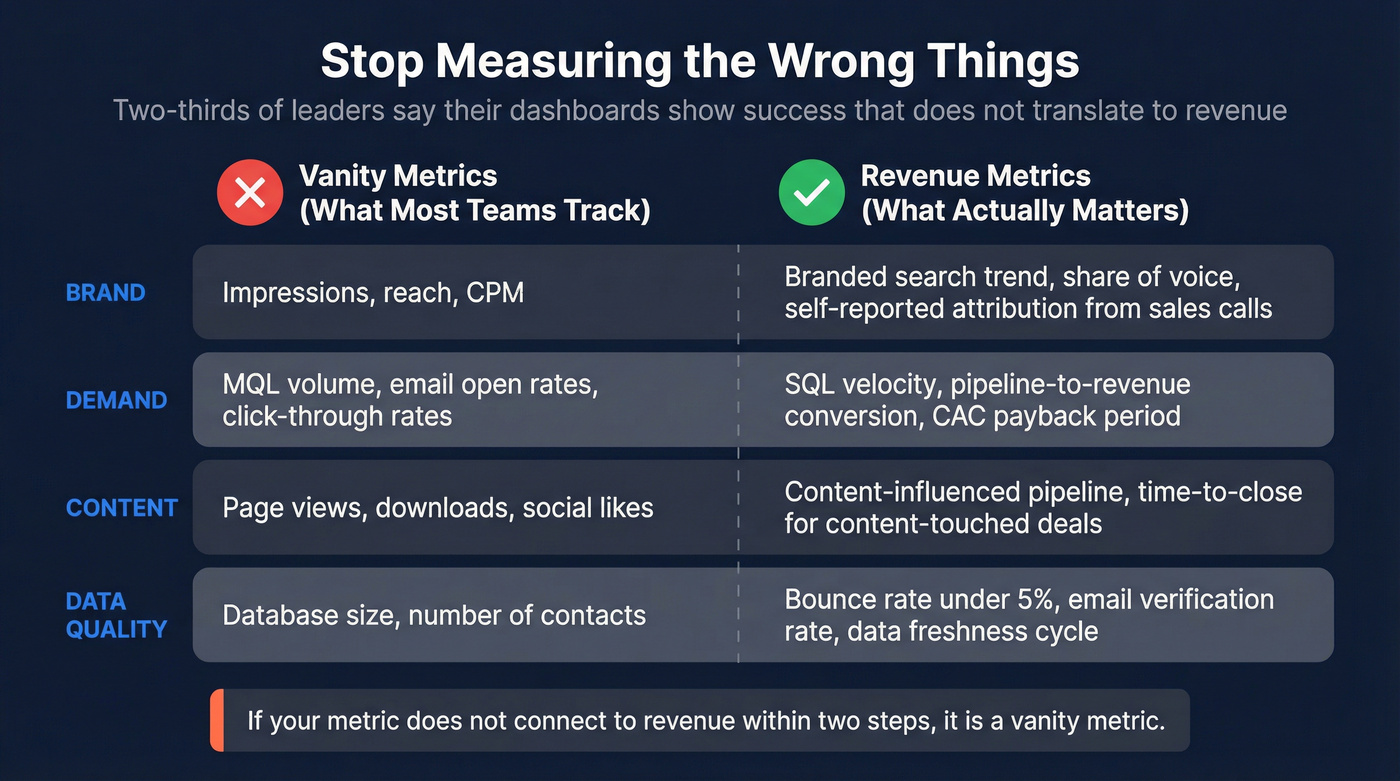
Most marketing dashboards are measuring the wrong things. Two-thirds of leaders admit their dashboards show success that doesn't translate into revenue. We've seen this firsthand across dozens of teams we work with.
Brand Metrics Worth Tracking
- Branded search volume trend - quarter-over-quarter growth. This is the clearest signal that awareness is translating into consideration. Aim for 10-15% quarterly growth in early stages.
- Share of voice in your category - are you showing up in the conversations that matter? Track mentions, media coverage, and analyst inclusion relative to competitors.
- Self-reported "how did you hear about us" from sales calls - the most underrated metric in B2B. Add it to your discovery call script and track it religiously.
Demand Metrics Worth Tracking
- Pipeline-to-revenue conversion rate - what percentage of pipeline actually closes? This exposes quality problems that MQL counts hide.
- CAC payback period - how many months until a customer pays back their acquisition cost? This forces honest accounting of both brand and demand spend. (If you want the math and benchmarks, use a CAC LTV ratio model alongside payback.)
- SQL velocity - time from SQL to closed-won. Faster velocity usually means better-qualified leads entering the funnel, which is often a brand awareness effect.
Stop measuring brand with impressions and demand with MQLs. They make dashboards green while pipeline stays flat - and that's exactly the measurement crisis that keeps the debate alive.
The demand gen vs brand awareness argument ends when measurement improves. Fix the metrics, integrate the teams, verify the data. Everything else is noise.
FAQ
Is demand generation the same as lead generation?
No. Lead gen captures contact info from people already interested - form fills, demo requests, content downloads. Demand gen creates interest and urgency before the capture. Think of it as the cause and lead gen as the effect.
How long does brand awareness take to show ROI?
Typically 6-18 months for measurable impact on branded search volume and inbound pipeline. The Day One List research shows that brand investment compounds - 86% of B2B buyers start from brands already in their heads. The payoff isn't instant, but it's durable in a way paid campaigns aren't.
What's the right budget split for a startup?
Start at 40% brand and 60% demand activation. Early-stage companies need near-term pipeline to survive, so skewing toward activation makes sense. As you approach $10M ARR, shift toward the 60/40 brand-to-demand baseline that Binet & Field's research recommends.
How do I keep outbound from undermining brand investment?
Verify your contact data before every campaign. Bounced emails and wrong numbers don't just waste budget - they damage sender reputation and brand perception. A 7-day data refresh cycle and multi-step verification process keep bounce rates under 4%, so every touchpoint reinforces the brand you're building rather than eroding it.