

Market Persona Guide: Build, Validate & Use Personas That Actually Get Used
Your SDRs send the same generic sequence to CTOs and individual contributors. Marketing blames sales for bad follow-up; sales blames marketing for garbage leads. 71% of companies that exceed revenue goals have documented buyer personas - and yours is a two-year-old PDF nobody's opened since the offsite where it was created.
Understanding your persona market - who you're selling to, what they care about, and how they buy - is the foundation that fixes this. The problem isn't that personas don't work. Most teams build them wrong, file them away, and never connect them to the workflows that generate pipeline.
What Is a Market Persona?
A market persona is a research-based profile of a specific segment within your target audience. It captures who they are, what they care about, how they make decisions, and what blocks them. The concept traces back to Alan Cooper, who introduced personas in the 1990s) as a software design tool - a way to stop engineers from designing for themselves and start designing for real users.
The term gets used loosely, so let's draw some lines. A buyer persona focuses on the person making or influencing a purchase decision. A user persona describes who actually uses the product day-to-day, and that's not always the buyer. A customer persona encompasses both, plus post-sale behavior like renewal patterns and expansion triggers.
Here's the critical distinction: personas are research-based profiles, not fictional characters. The moment you start inventing hobbies and backstories without data, you've crossed from strategy into creative writing.
Why Personas Drive Revenue
Companies using documented personas are 2x more likely to exceed revenue goals. And 96% of marketers report that personalization - which personas enable - increases repeat customers. That's not because the document itself is magic. It's because the research process forces alignment across teams.
Without a persona, your SDR sends the same cold email to a CTO and a mid-level marketing manager. The CTO cares about infrastructure risk and board-level metrics. The marketing manager cares about campaign performance and tool consolidation. Same product, completely different pain points, completely different language. One email can't serve both.
Personas fix this by creating shared vocabulary. The Product Marketing Alliance documents concrete use cases: sales enablement with battlecards and scripts tailored per persona, launch assets that speak to specific pain points, pricing strategy, and positioning. When your sales team says "this is a Sarah deal" and everyone knows Sarah is a VP of Ops at a 200-person company who cares about integration speed, you've eliminated an entire layer of miscommunication.
Types of Marketing Personas
Not all personas serve the same purpose. Zendesk outlines five common types, and which you choose depends on what decisions you're trying to improve.
| Type | Focus | Use When |
|---|---|---|
| Demographic-based | Age, role, income, location | B2C segmentation |
| Psychographic | Values, motivations, fears | Messaging & positioning |
| Journey-based | Awareness through Decision through Advocacy | Content strategy |
| Role-based | Job function, authority level | B2B sales enablement |
| Technographic | Tech stack, tool preferences | Product marketing |
Most B2B teams should start with role-based personas layered with psychographic and technographic details. Skip demographic-only personas entirely - if your persona doesn't include pain points and buying triggers, it's a census form, not a strategy document.
Personas vs. ICP vs. JTBD
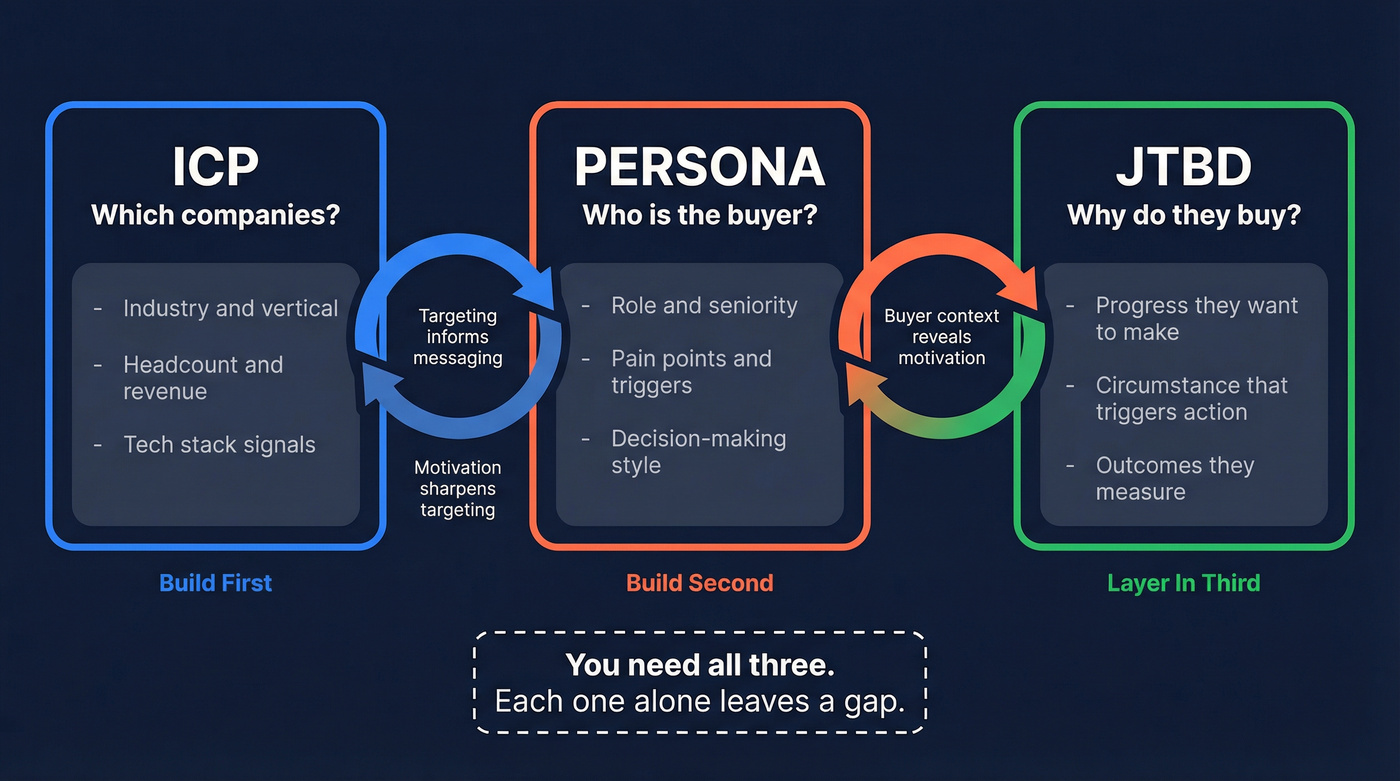
These three frameworks get conflated constantly. They're complementary, not interchangeable.
| Framework | Answers | Best For | Build Order |
|---|---|---|---|
| ICP | "Which companies?" | Account targeting | Build first |
| Persona | "Who's the buyer?" | Messaging & enablement | Build second |
| JTBD | "Why do they buy?" | Product & positioning | Layer in third |
Your ICP is a company-level filter: industry, headcount, tech stack, revenue range. A persona describes the person inside that account - their role, pain points, and decision-making behavior. Jobs-to-be-Done, as SIVO Insights frames it, explains the why - customers "hire" products to make progress in a specific circumstance, a concept Clayton Christensen popularized.
You need all three. An ICP without personas means your targeting is right but your messaging is generic. Personas without JTBD means you know who you're talking to but not what triggers them to act. JTBD without an ICP means you understand motivation but can't prioritize accounts. Build all three, and they reinforce each other like a flywheel.

Your personas define who to target. Prospeo lets you actually reach them. Use 30+ filters - buyer intent, technographics, job changes, headcount growth - to turn role-based personas into verified contact lists with 98% email accuracy.
Stop selling to personas on paper. Start reaching them in real life.
How to Build a Persona
Start With Real Research
The single fastest way to build a useless persona is to skip research and brainstorm in a conference room. Sauce Agency calls this mistake number one, and they're right - "semi-fictional" doesn't mean "made up."
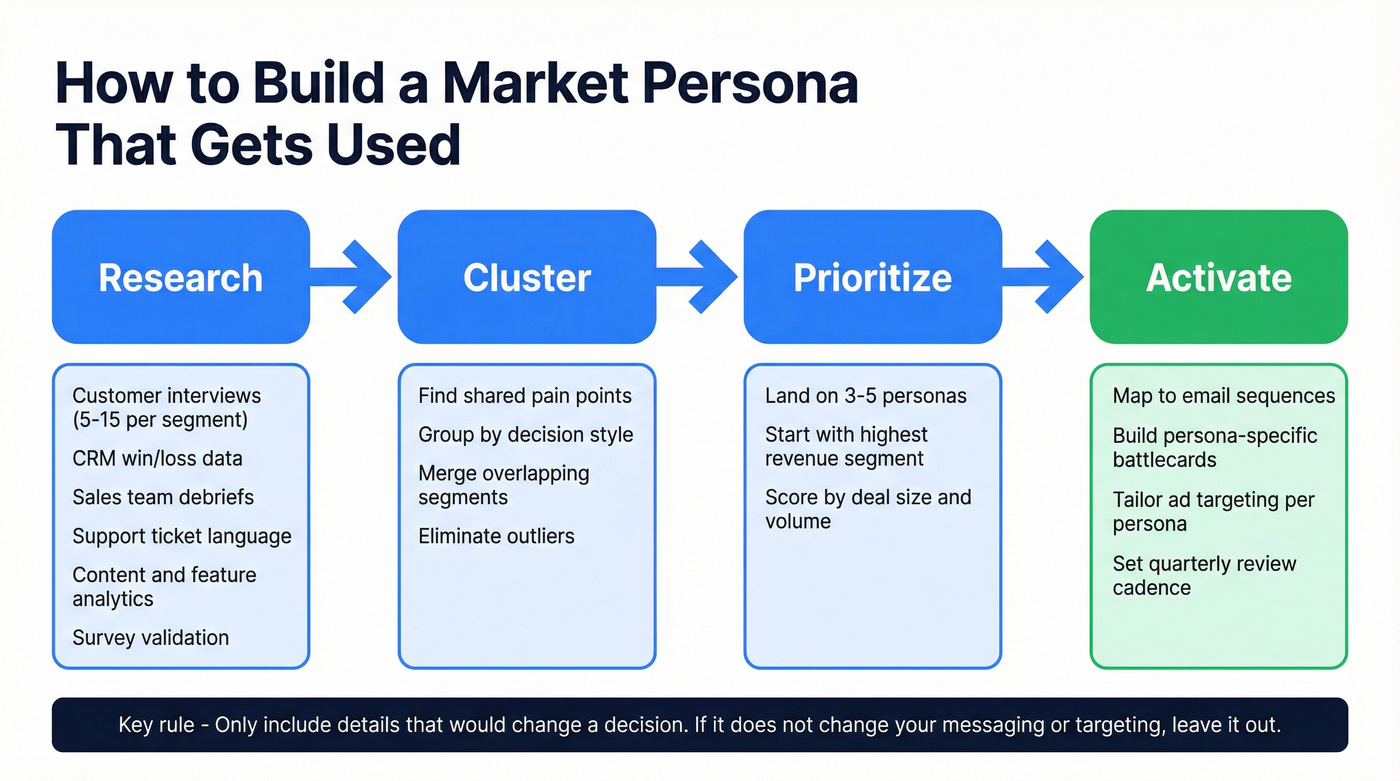
Customer interviews are non-negotiable: 5-15 per segment to find patterns. Beyond interviews, your CRM win/loss data reveals why deals closed or stalled, sales team debriefs surface objections and triggers that never make it into the CRM, and support tickets give you the exact language customers use to describe their problems. Layer in analytics showing which content and features each segment engages with, plus survey data for validation at scale.
The Nielsen Norman Group recommends field studies, surveys, and longitudinal studies as primary inputs. Never build from assumptions alone.
Cluster and Prioritize
Once you've collected research, patterns emerge. You'll notice groups of interviewees who share similar pain points, decision-making styles, and goals. NN/g's method is straightforward: identify characteristics, cluster into groups, then merge or eliminate groups that overlap too much.
Land on 3-5 personas. More than five and you effectively have zero - nobody will use them. Fewer than three and you're treating your audience as a monolith. Start with your highest-revenue segment and expand from there.
What to Include
This is where most personas go wrong. They load up on demographics and forget the details that actually change how you sell. NN/g's rule is elegant: only include details that would change a decision. Brafton's field list provides a solid starting framework:
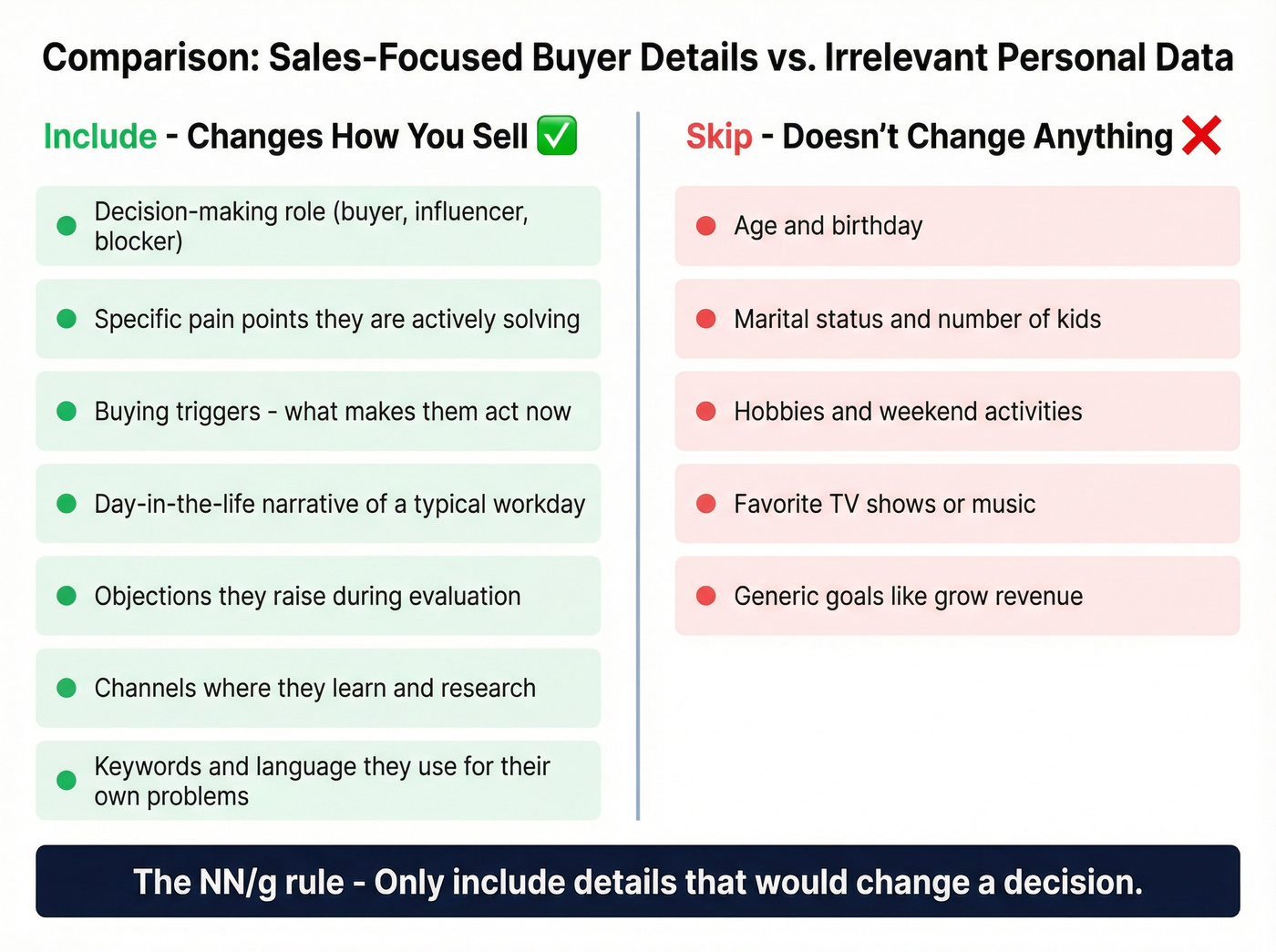
- Decision-making role - buyer, influencer, champion, blocker
- Day-in-the-life narrative - what does a typical Tuesday look like?
- Specific objectives - not "grow revenue" but "reduce CAC by 20% this quarter"
- Pain points the persona is actively trying to solve
- Questions asked during the buying process
- Content preferences and the channels where they learn
- Keywords and language they use to describe their own problems
Acoustic's Think/Say/Feel/Do framework adds another useful lens. What does this persona think about their current situation? What do they say to their team? What do they feel when evaluating solutions? What do they actually do during the buying process.
Filled-In B2B Example
Persona: "Operations Olivia" Title: VP of Revenue Operations | Company: 200-person B2B SaaS
Decision role: Primary buyer for data and ops tools; reports to CRO
Day-in-the-life: Mornings in Salesforce dashboards, afternoons in cross-functional syncs. Constantly firefighting data quality issues that break attribution and forecasting.
Pain points: CRM data decays faster than her team can maintain it. Reps waste 4-6 hours/week on manual research. Bounce rates above 8% are tanking sender reputation.
Buying triggers: New CRO demands pipeline accountability. Existing data vendor renewal at 30%+ price increase. Failed audit of contact data quality.
Objections: "We've been burned by 'verified' data before." "How does this integrate with our existing stack?"
Preferred channels: Peer communities like Pavilion and RevOps Co-op, vendor comparison posts, G2 reviews. Opens cold emails only if the subject line references a specific pain point.
Notice what's missing: age, location, marital status, hobbies. None of that changes how you'd sell to Olivia.
Five Persona Mistakes to Avoid
1. Building from assumptions, not data. A room full of marketers guessing what customers care about produces a persona that reflects internal bias, not reality. Every field should trace back to an interview, a data point, or a CRM pattern.
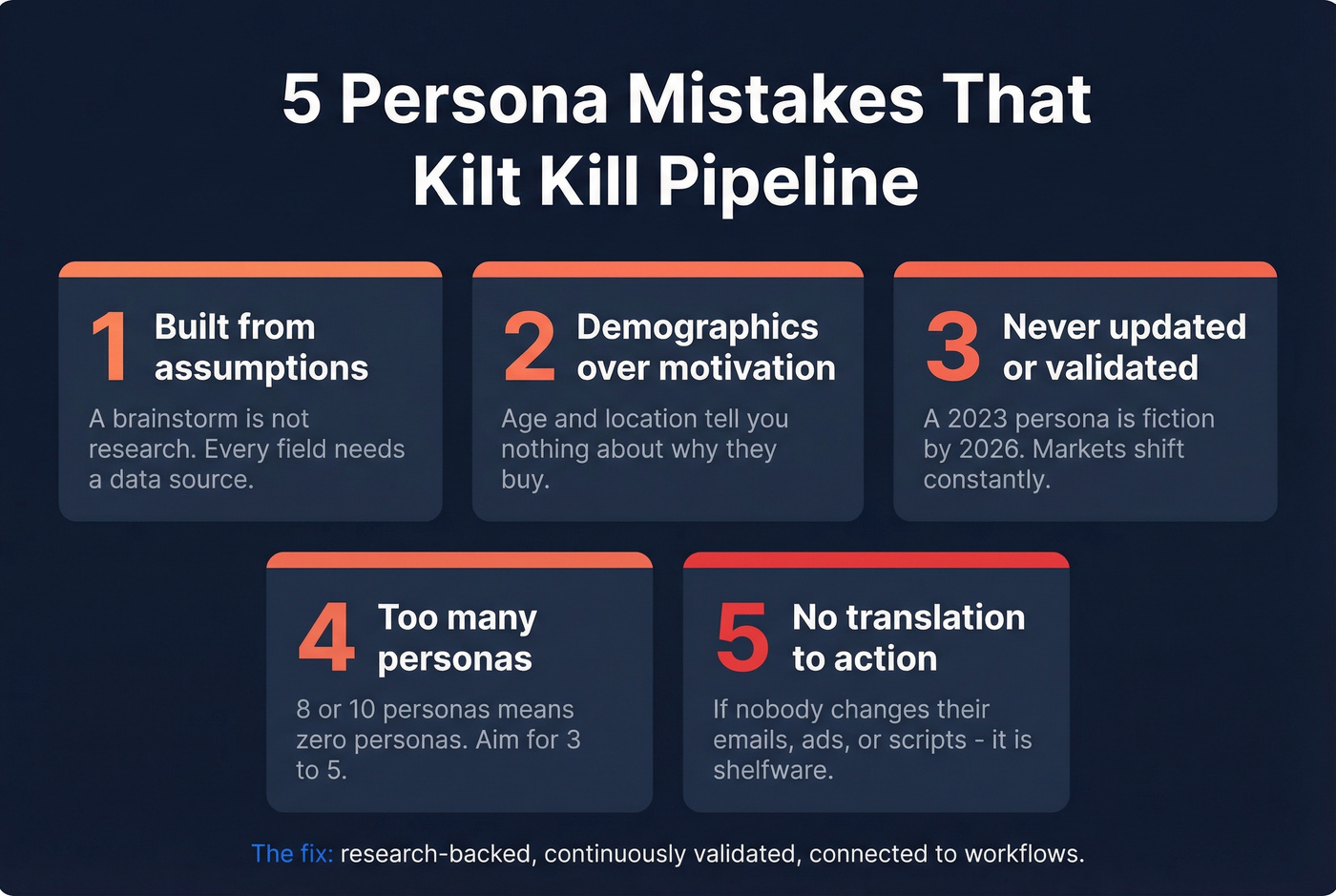
2. Demographic-heavy, motivation-light. Acoustic's critique nails this: "42-year-old dad from New York who drives a Subaru" tells you nothing about why he'd buy your product. Lead with pain points and buying triggers, not census data.
3. Never updating or validating. A persona built in 2023 and never revisited is fiction by 2026. Markets shift, tech stacks evolve, pain points change. Static personas become shelfware.
4. Too many personas. We've seen teams build eight or ten personas and then struggle to create differentiated messaging for any of them. Three to five is the sweet spot - enough to capture real variation, few enough to actually act on.
5. No translation to action. The persona exists, but nobody changes their email copy, ad targeting, or sales scripts because of it. If your persona doesn't directly inform what you say and where you say it, it's an academic exercise.
Are Personas Still Useful?
The "buyer persona is dead" argument has been making the rounds. Apparate's version is the most provocative: they claim moving from static personas to dynamic, behavior-driven profiles lifted response rates from around 5% to 30%+. Their core critique - that traditional personas are static, assumption-driven, and disconnected from real interactions - has merit.
But let's be honest: the "personas are dead" crowd is only half right. Static, demographic-heavy personas built from assumptions and never updated? Those are dead, and good riddance. Research-backed personas that are continuously validated against behavioral signals? More powerful than ever.
The most common complaint in RevOps communities and r/sales threads echoes this: personas become static documents that drift from real buyer behavior within a quarter. The fix isn't to abandon the framework - it's to build validation into the process.
Your personas need three properties: grounded in real research, continuously validated against win/loss data and behavioral signals, and lightweight enough that teams actually reference them. In our experience, the teams that say "personas don't work" almost always built bad personas. The framework isn't broken. The execution is.
From Persona to Prospect List
You've built the persona. Now you need to find the actual people who match it. This is where most guides stop and where the real work begins.
For building the persona document itself, HubSpot's Make My Persona is free and gets the job done. Xtensio, UXPressia, and Delve AI all offer lightweight persona-building workflows with free tiers and paid plans typically starting in the $10-$50/month range. Venngage offers free visual persona templates if your team prefers presentation-ready formats.
But the document is just the starting point. The real value comes from turning your persona attributes into a live prospect list. If your persona is "VP of Revenue Operations at a 200-person SaaS company experiencing data quality issues," you need a tool that lets you filter by job title, company size, tech stack, and buying intent - then returns verified contact data you can actually use.
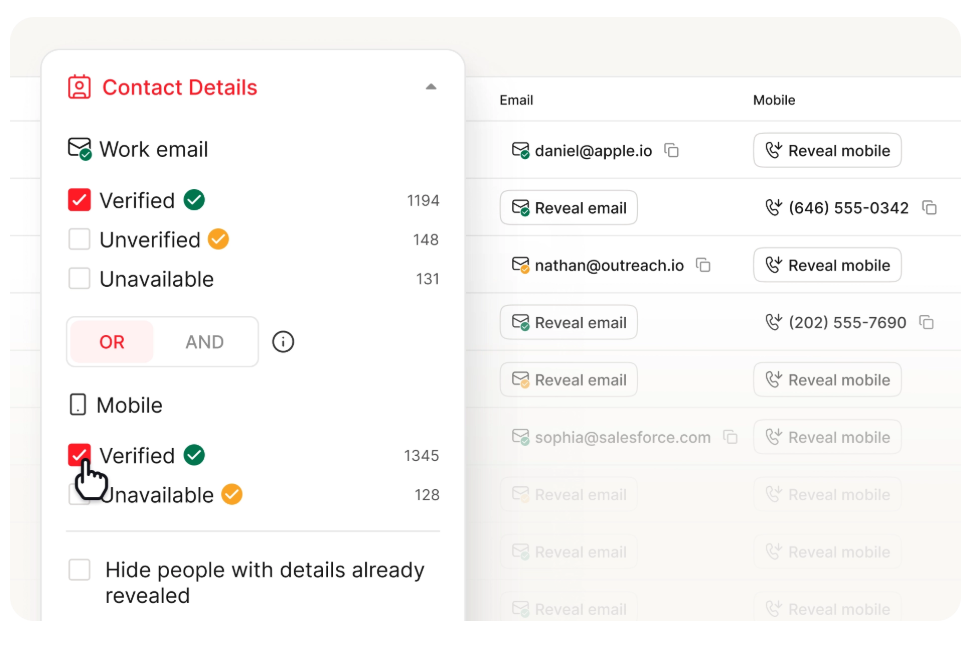
Prospeo bridges this gap. Take your persona attributes and translate them into search filters across 300M+ professional profiles - 30+ filters including technographics, buyer intent across 15,000 topics via Bombora, headcount growth, funding signals, and job changes. Emails come back at 98% accuracy on a 7-day refresh cycle, so your outbound sequences don't bounce and your domain reputation stays intact. There's a free tier to test the workflow before committing.
Keeping Personas Alive
A persona without a validation plan is fiction. Here's a quarterly checklist:
- Review CRM win/loss data - are closed-won deals still matching the persona profile? If your best customers are shifting toward a different title or company size, update accordingly. (If your CRM is messy, start with CRM hygiene.)
- Interview 3-5 recent customers - quick 15-minute calls to check whether pain points and priorities have shifted.
- Audit tech stack fields - what was "uses Marketo" in 2024 might be "migrated to HubSpot" by now.
- Check intent data for behavioral validation - track which companies are actively researching topics relevant to your product. If your persona says "cares about data quality" but intent signals show the segment is researching "AI-powered outbound," your pain point framing needs an update. (See intent signals and how to measure intent data.)
- Push updates cross-functionally - a revised persona in a Google Doc nobody reads is the same as no revision. Update sales enablement, ad copy, and email sequences.
The teams that get the most from personas treat them like living documents, not deliverables.
Skip the 40-page persona playbook if your average deal is under $15k. Build two or three tight profiles, validate them quarterly, and spend the rest of your time actually reaching the people who match them. That's where pipeline comes from. (If you need a system for turning personas into outreach, use a repeatable prospecting workflow and a deliverability-safe outbound email campaign.)
You just layered ICP, persona, and JTBD. Now operationalize all three. Prospeo's database lets you filter by company-level ICP criteria and persona-level role data across 300M+ profiles - then delivers verified emails and direct dials so your SDRs never send a generic sequence again.
Turn your persona research into pipeline for $0.01 per verified email.
FAQ
How many personas should a company have?
Three to five for most B2B teams. More than five dilutes messaging and stretches resources thin - nobody writes differentiated sequences for eight segments. Start with your highest-revenue persona market segment and expand only when research supports adding another.
What's the difference between a buyer persona and an ICP?
An ICP defines the type of company you sell to - industry, headcount, tech stack, revenue. A buyer persona defines the person within that company: their role, pain points, and buying triggers. You need both. The ICP tells you which accounts to target; the persona tells you what to say.
How often should you update personas?
At minimum quarterly. Review win/loss data, interview recent customers, and check whether pain points and tech stacks have shifted. Intent data can flag when your persona's priorities are changing in real time, giving you a behavioral signal between formal reviews.
Can you build personas without customer interviews?
You can start with CRM data, analytics, and sales team input - but interviews are irreplaceable. Even 5-8 conversations per segment reveal patterns that quantitative data misses. Assumption-only personas become fiction fast; budget at least two weeks for primary research before finalizing any profile.