

How to Build an Account-Based Marketing Plan That Actually Works
Most teams buy the ABM platform before they build the ABM plan. They sign a $30K-$100K+/year contract with Demandbase or 6sense, run a few display ads against a hastily assembled account list, and wonder why nothing moved six months later. The platform isn't the problem - the missing account-based marketing plan is.
Here's how to build one that produces pipeline, step by step, with the scoring models, budget frameworks, and timelines that most "ABM guides" conveniently skip.
The Plan in Five Bullets
- Pick your ABM tier - start with 1:few (5-15 accounts per marketer)
- Score and rank accounts using ICP fit + intent signals + sales input
- Map the buying committee (around 10 stakeholders per account) and get verified contact data for every one of them
- Budget 1-5% of ACV per account depending on tier
- Run a 90-day pilot before scaling anything
That's the skeleton. Now let's put muscle on it.
Why Most Teams Skip the Plan
An account-based marketing plan is the operational document that turns "we're doing ABM" from a slide deck aspiration into a coordinated program. It defines which accounts you're targeting, how you'll engage them, who owns what, and what success looks like - before you spend a dollar on technology or ads.
Most teams skip it because ABM platforms make it feel like the tool is the strategy. It's not. Buying Demandbase doesn't mean you're doing ABM any more than buying a CRM means you have a sales process. Meaningful ABM results typically take 6-12 months to materialize, and teams without a plan rarely survive that timeline. They lose executive patience around month four, declare ABM "didn't work," and go back to spray-and-pray demand gen.
The plan keeps everyone aligned long enough for the compounding effects to kick in.
Choose Your ABM Tier
Not all ABM is the same. The tier you choose determines your account load, personalization depth, and budget per account.
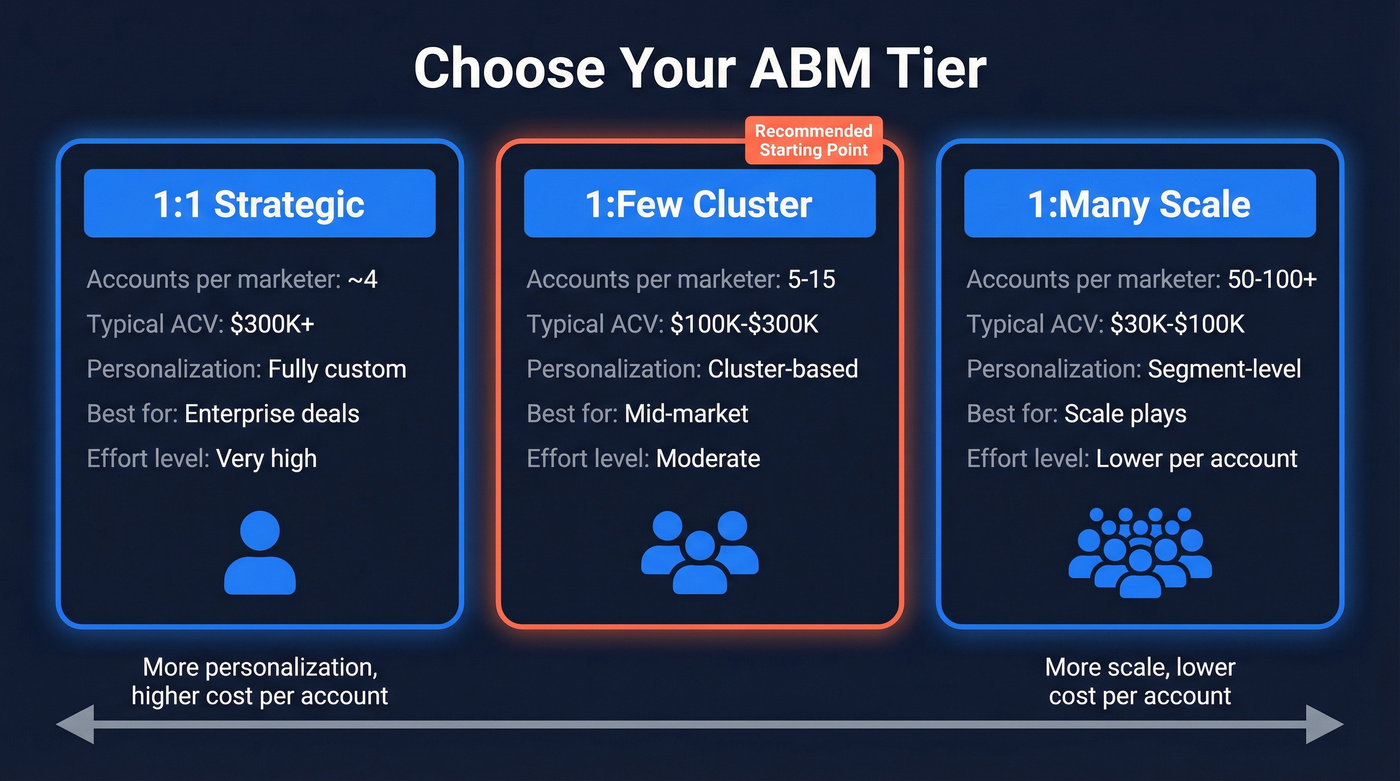
| Tier | Accounts/marketer | Typical ACV | Personalization | Best for |
|---|---|---|---|---|
| 1:1 | ~4 | $300K+ | Fully custom | Enterprise deals |
| 1:Few | 5-15 | $100K-$300K | Cluster-based | Mid-market |
| 1:Many | 50-100+ | $30K-$100K | Segment-level | Scale plays |
A full-time ABM marketer manages roughly 4 accounts in a true 1:1 program. That's not a typo - custom microsites, executive dinners, and bespoke content eat time fast. 1:few clusters typically run 5-15 accounts grouped by shared pain points or industry verticals.
We recommend starting with 1:few. It's the sweet spot where you get enough personalization to differentiate from demand gen, but enough scale to generate statistically meaningful results within a quarter. You can always graduate accounts up to 1:1 or push segments down to 1:many once you've proven the model.

Your target account list is only as good as the contact data behind it. Prospeo's 300M+ profiles, 30+ search filters (intent signals, technographics, headcount growth), and 7-day data refresh cycle let you build scored TALs that don't decay between monthly reviews.
Stop building ABM programs on stale data. Start with contacts that connect.
The 9 ABM Strategy Steps
Step 1: Define Your ICP and Target Account List
Everything starts here. Your Ideal Customer Profile isn't a vague description of "enterprise SaaS companies" - it's a scored, weighted model that tells you exactly which accounts deserve your finite resources.
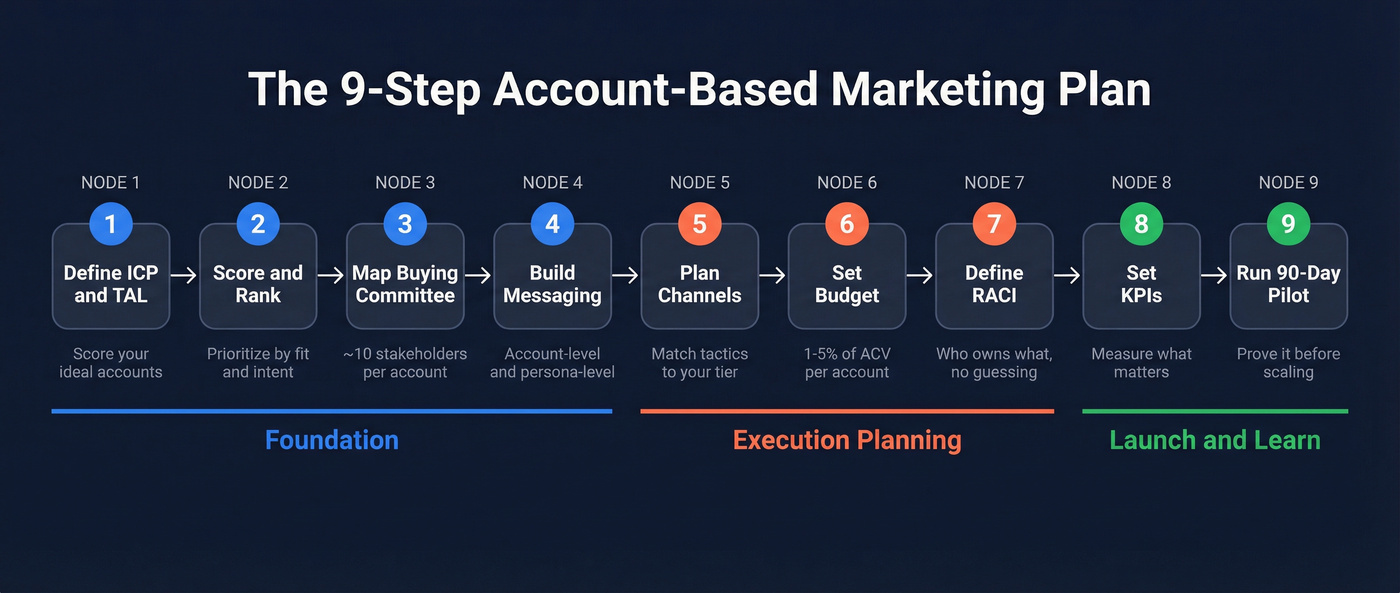
Your ICP template should include:
- Firmographics - industry, revenue range, headcount, geography, growth rate
- Technographics - current tech stack, what they use, what they're missing
- Intent signals - active research on topics related to your solution
- Behavioral data - website visits, content engagement, ad interactions
- Historical fit - do accounts like this actually close? At what ACV?
Once your ICP is defined, build your Target Account List as a structured spreadsheet with columns for company name, ICP score, tier assignment, intent signal strength, and key contacts identified. This isn't a static document - it's a living asset that gets re-scored monthly.
Here's the thing: your TAL is only as good as the data behind it. Stale emails and wrong phone numbers will sink even the most brilliant ABM strategy. Tools with weekly refresh cycles make the difference between reaching a VP who changed jobs last month and bouncing off a dead inbox.

Step 2: Score and Rank Your Accounts
Not every account on your TAL deserves equal attention. Scoring separates the high-potential targets from the "nice to have" list.
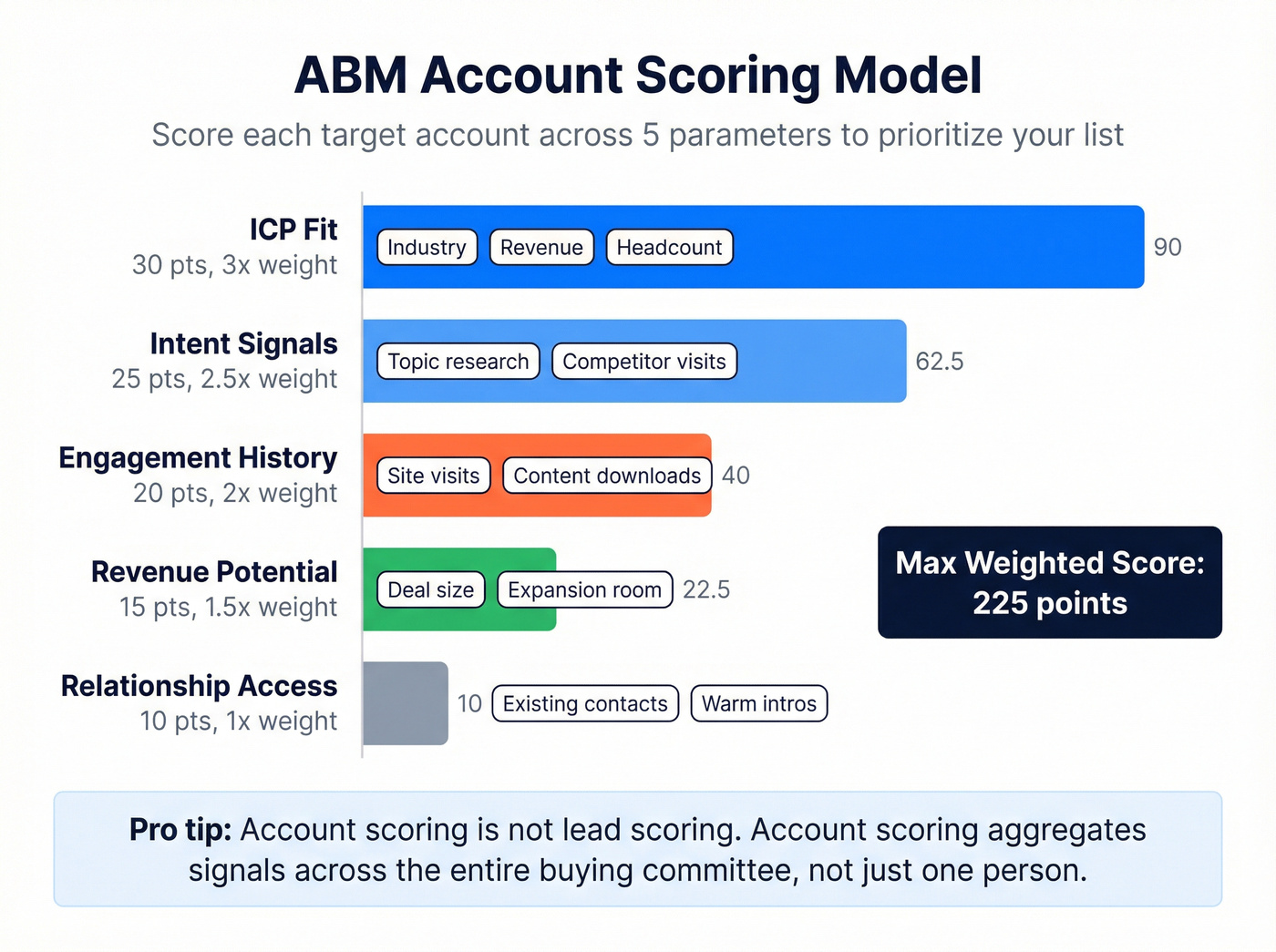
Follow this three-step method:
- Select your parameters based on your ABM goal (new logo vs. expansion)
- Create a scoring scheme for each parameter with max points and sub-criteria
- Assign weights based on business priorities, then compute total scores
Use this scoring model as a starting point:
| Parameter | Max points | Weight | Sub-criteria examples |
|---|---|---|---|
| ICP fit | 30 | 3x | Industry, revenue, headcount |
| Intent signals | 25 | 2.5x | Topic research, competitor visits |
| Engagement history | 20 | 2x | Site visits, content downloads |
| Revenue potential | 15 | 1.5x | Estimated deal size, expansion room |
| Relationship access | 10 | 1x | Existing contacts, warm intros |
One important distinction: account scoring isn't lead scoring. Lead scoring ranks individuals by engagement. Account scoring aggregates signals across the entire buying committee and layers in firmographic fit. You need separate scoring models per product line if your segments differ meaningfully.
For expansion ABM, score existing customers first - they're your highest-probability targets.
Step 3: Map the Buying Committee
Enterprise deals don't have a single decision-maker. They have buying committees of roughly 10 stakeholders, each with different priorities and different levels of influence.
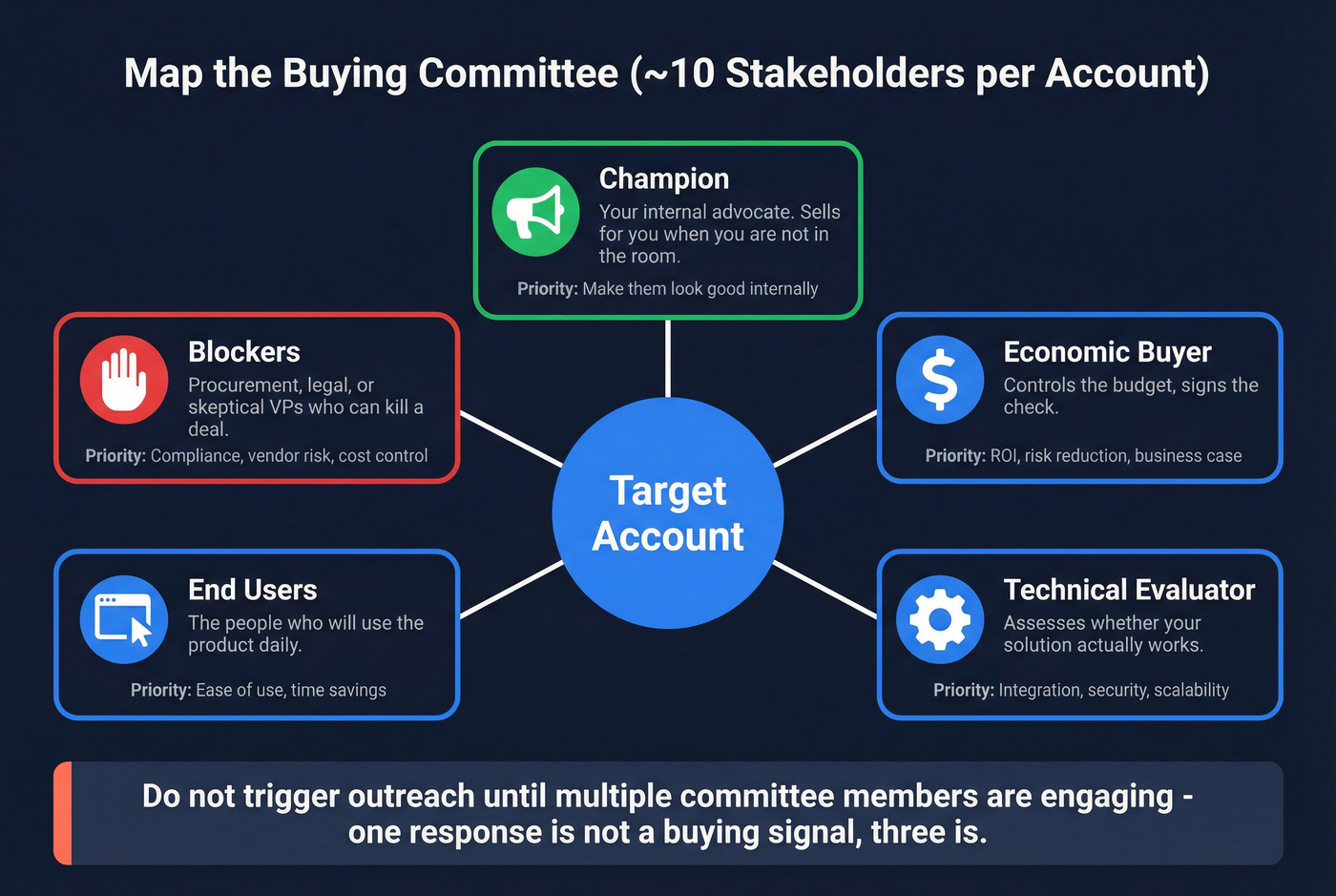
For every target account, map these roles:
- Champion - your internal advocate who sells for you when you're not in the room
- Economic buyer - controls the budget, signs the check
- Technical evaluator - assesses whether your solution actually works
- End users - the people who'll use the product daily
- Blockers - procurement, legal, or skeptical VPs who can kill a deal
The goal isn't just to identify these people - it's to reach them. We've found that building contact coverage across the entire committee, rather than relying on a single champion thread, is what separates ABM programs that generate pipeline from ones that generate reports. Prospeo's database covers 300M+ professional profiles with 98% email accuracy and 125M+ verified mobile numbers, which makes that full-committee coverage practical rather than aspirational. Don't trigger sales outreach until you've hit an engagement threshold across multiple stakeholders - one interested SDR response isn't a buying signal; three committee members engaging with your content is.
Step 4: Build Your Messaging Framework
ABM messaging operates on two levels: account-level and persona-level. Account-level messaging addresses the company's specific business challenges. Persona-level messaging speaks to each stakeholder's individual concerns within that context.
Start by mapping pain points for each target account. What's their strategic priority this year? Where are they losing money? What's their competitive pressure? Then layer persona-specific angles on top. The CFO cares about ROI and risk. The VP of Engineering cares about integration complexity. The end user cares about whether the tool actually makes their day easier.
Match content types to funnel stages:
- Awareness - industry research, benchmark reports, thought leadership
- Consideration - case studies, competitive comparisons, ROI calculators
- Decision - custom proposals, executive briefings, proof-of-concept plans
The biggest messaging mistake in ABM is recycling demand gen content. If your "personalized" outreach is the same whitepaper you send to everyone, you're not doing ABM - you're doing email marketing with a fancier label.
Step 5: Plan Channels and Tactics
Different ABM tiers demand different channel mixes. This is where the process shifts from planning to execution.
| Channel | 1:1 | 1:Few | 1:Many |
|---|---|---|---|
| Display/programmatic ads | ✓ | ✓ | ✓ |
| Personalized email | ✓ | ✓ | ✓ |
| Direct mail | ✓ | ✓ | - |
| Executive events | ✓ | - | - |
| Custom microsites | ✓ | - | - |
| Web personalization | ✓ | ✓ | ✓ |
| Content syndication | - | ✓ | ✓ |
For 1:1 accounts, you're orchestrating every channel simultaneously - a coordinated air-and-ground campaign. For 1:many, you're leaning on scalable digital channels with segment-level personalization. The mistake is trying to run 1:1 tactics across 50 accounts. You'll burn out your team and dilute the personalization that makes ABM work in the first place.
Step 6: Set Your ABM Budget
The cleanest budgeting framework ties spend directly to ACV. Based on N.Rich's allocation model:
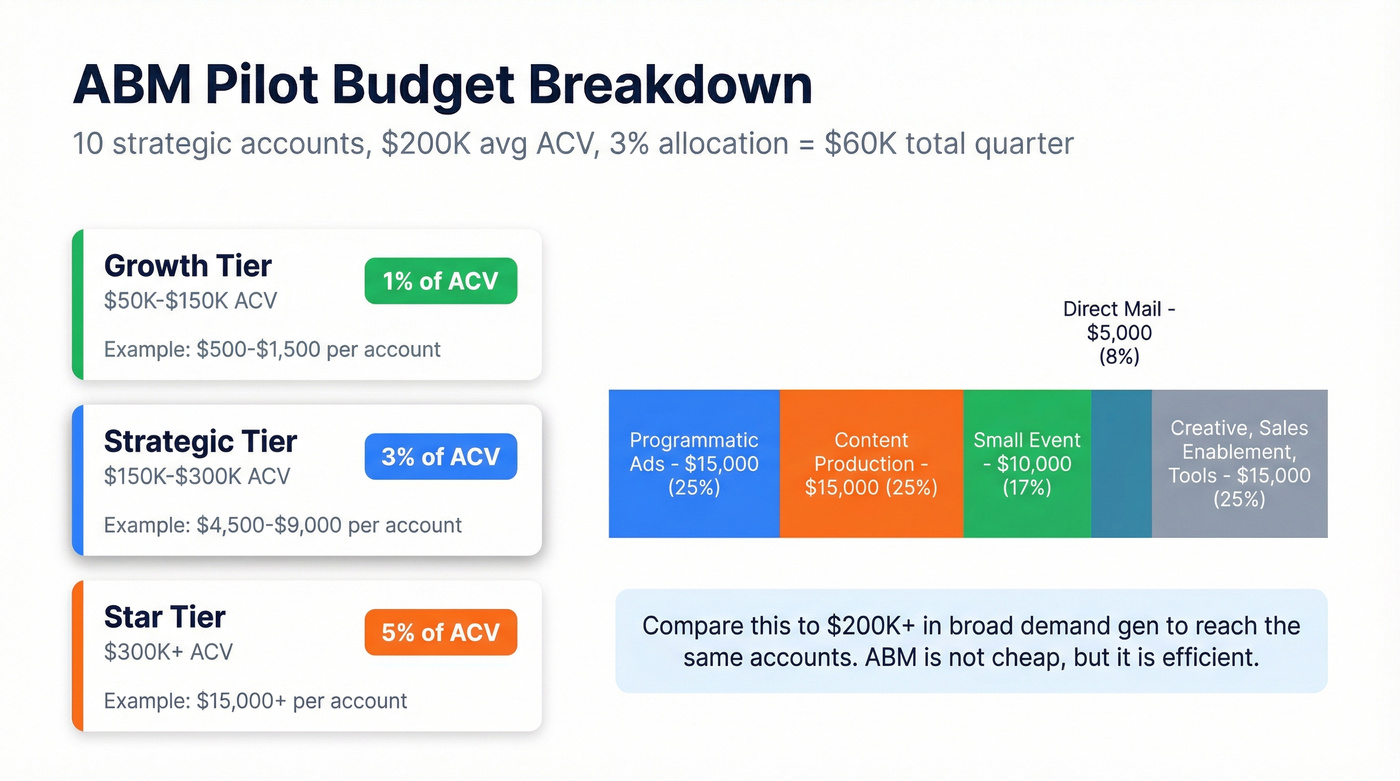
| Account tier | ACV range | Budget (% of ACV) | Example budget |
|---|---|---|---|
| Growth | $50K-$150K | 1% | $500-$1,500 |
| Strategic | $150K-$300K | 3% | $4,500-$9,000 |
| Star | $300K+ | 5% | $15,000+ |
Let's break this down with a real scenario. If you're running a 1:few program with 10 strategic accounts averaging $200K ACV, your total ABM budget is roughly $60K for the pilot quarter - programmatic ads ($15K), direct mail ($5K), content production ($15K), a small event ($10K), and the rest spread across creative, sales enablement, and tools. Not cheap, but compare it to the $200K+ you'd spend on broad demand gen to generate the same pipeline from those specific accounts.
Step 7: Define Roles with a RACI Chart
ABM fails when nobody knows who owns what. A RACI chart eliminates the "I thought marketing was doing that" conversations - and it's one of the most overlooked implementation steps.
| Activity | Marketing | Sales | RevOps | Leadership |
|---|---|---|---|---|
| Account selection | C | R | A | I |
| Content creation | R | C | I | I |
| Outreach execution | C | R | I | I |
| Measurement | A | I | R | I |
| Budget approval | C | I | C | R |
R = Responsible, A = Accountable, C = Consulted, I = Informed.
The critical row is account selection. Sales must be Responsible here - not just Consulted. We've seen ABM programs collapse because marketing picked accounts in isolation, and sales never bought in. If your reps don't believe in the target list, they won't execute against it. Get their input before you finalize anything.
Step 8: Set KPIs and Measurement
ABM metrics look different from demand gen metrics. Stop measuring MQLs and start measuring these:
- Account engagement score - aggregate of all touchpoints across the buying committee
- Pipeline velocity - how fast target accounts move through stages vs. non-ABM accounts
- Influenced pipeline - total pipeline value where ABM touchpoints played a role
- Deal size lift - average ACV of ABM deals vs. non-ABM deals
- Win rate - ABM accounts vs. general pipeline
- Expansion revenue - upsell and cross-sell from ABM-targeted existing customers
The stat worth internalizing: a Forrester Summit keynote cited that when organizations shifted from individual lead metrics to buying-group and opportunity metrics, they saw a 200% increase in win rates and 800% increase in opportunity progression. The measurement framework you choose shapes the behavior of your entire team.
Step 9: Build a 12-Month Timeline
Don't try to launch a full ABM program on day one. Phase it.
| Phase | Months | Focus | Key deliverables |
|---|---|---|---|
| Pilot | 1-3 | Prove the model | 10 accounts, ICP defined, scoring live, first campaigns running |
| Optimize | 4-6 | Refine and expand | Scoring tuned, expand to 25-50 accounts, channel mix optimized |
| Scale | 7-12 | Full program + post-sale | All tiers active, tech stack integrated, playbooks documented, expansion ABM into customer success |
The 90-day pilot is non-negotiable. Pick 10 accounts, run the full playbook, and measure what happens. If engagement scores climb and pipeline starts forming, you've earned the right to scale. If nothing moves, you've learned that for a fraction of the cost of a full rollout.
Most ABM programs that fail skipped this step and went straight to "let's target 200 accounts" with no proof of concept. In months 7-12, extend ABM into post-sale by coordinating with customer success on expansion plays - your best new revenue is sitting inside accounts you've already won.
Common ABM Mistakes That Kill Results
Buying ABM tech and calling it ABM. Demandbase is a platform, not a strategy. Build the plan first, buy the tech second.
No sales input on the target account list. Marketing picks accounts based on firmographics alone. Sales ignores the list. Make sales Responsible for account selection, not just Consulted.
Too many accounts, too little personalization. Targeting 200 accounts with generic messaging is just demand gen with extra steps. Start with 10-15 accounts and go deep.
Measuring leads instead of buying groups. Killing a deal because one contact didn't hit an MQL threshold while other committee members are actively engaging is absurd. Group signals by account and trigger outreach at an engagement threshold.
Ignoring existing customer expansion. Acquiring new customers costs 5-25x more than retaining existing ones. Your current customers are your highest-probability ABM targets. Dedicate at least one ABM tier to expansion.
Bad contact data wrecking execution. You built the perfect account plan, crafted personalized messaging, and then a third of your emails bounced. Verify every contact before it enters a sequence - this one's entirely preventable.
Real talk: if your average deal size is under $30K, you probably don't need a formal ABM program at all. The per-account economics don't justify the investment. Run tight demand gen with account-level targeting instead, and save true ABM for the deals where the math works.
ABM Tech Stack and Costs
You don't need every tool on day one. A recurring complaint on r/sales and ABM practitioner communities is that teams over-invest in technology during the pilot phase, then blame the tools when results lag. Start lean.
| Category | Tools | Price range |
|---|---|---|
| Core ABM platforms | Demandbase, 6sense | $30K-$100K+/yr |
| Intent data | Bombora, 6sense | $20K-$60K/yr |
| Contact data | Prospeo, ZoomInfo, Apollo | Free-$40K/yr |
| ABM advertising | Terminus, RollWorks | $10K-$75K/yr |
| Marketing automation | HubSpot, Marketo | From $800/mo |
| Sales engagement | Salesloft, Outreach | ~$100-$150/user/mo |
For a 90-day pilot, you can run a credible ABM program with a CRM you already have, a contact data tool for verified emails and direct dials, and a basic ad platform. Total incremental cost: under $1,000/month. Add a core ABM platform only after you've proven the model works.
Mapping 10 stakeholders per account means nothing if half your emails bounce. Prospeo delivers 98% email accuracy and 125M+ verified mobile numbers - so you reach the full buying committee, not just the one champion who downloaded a whitepaper.
Cover the entire buying committee at $0.01 per verified email.
ABM Plan Templates and Resources
Don't build from scratch if you don't have to. Smartsheet offers a full suite of free, downloadable ABM templates including an ABM strategy template, playbook template, campaign calendar in Excel, reporting scorecard with funnel progression tracking, and a sales-marketing alignment template. They're vendor-agnostic and customizable.
Demandbase publishes a 7-activity planning framework covering account types, TAL construction, success metrics, channel expansion, budget planning, team structure, and technology requirements. It's solid as a strategic checklist, though the full workbook is gated behind an email form.
Between these two resources and the 9-step framework above, you have everything you need to build a complete ABM marketing plan without hiring a consultant.
FAQ
How long does ABM take to show results?
Expect 6-12 months for meaningful pipeline impact. Early engagement signals - ad clicks, content downloads, site visits from target accounts - appear within weeks. Run a 90-day pilot with 10 accounts before committing budget to a full program.
Can small teams run ABM without a platform?
Yes. You need a CRM, a contact data tool for verified emails and direct dials, and a way to run targeted ads. Start with 1:few targeting 5-15 accounts and add dedicated ABM platforms only after proving pipeline impact.
What's the difference between ABM and demand gen?
Demand gen casts a wide net across an entire market. ABM focuses all resources on specific high-value accounts with coordinated, personalized campaigns. Most B2B teams need both - ABM for enterprise deals above $100K ACV, demand gen for mid-market volume.
What budget should I allocate per target account?
Allocate 1-5% of expected ACV per account. For a $200K deal, that's $2,000-$10,000 across ads, content, direct mail, and events. Growth-tier accounts get 1%, strategic accounts 3%, and top-tier enterprise targets up to 5%.