

How to Overcome the Price Objection (Without Discounting)
Your prospect just said "that's more than we expected" and your finger's hovering over the discount button. Don't touch it. Only 27% of reps consistently hit quota, and folding on price is one reason why.
Overcoming the price objection has always been framed as "sell value, not price." That's not wrong - it's just incomplete. Pricing conversations have gotten 62% longer since 2020, with pricing mentions up 18% since 2022. You need sharper tools than a pep talk about ROI.
Here's the plan: one framework (LAER), five scripts, and a strategy for preventing objections upstream by reaching verified decision-makers before price ever comes up.
Why Buyers Really Push Back on Price
It's almost never about the number.
96% of buyers research before talking to a rep. If your value story doesn't match what they've already concluded, the price feels arbitrary. Worse, 58% of buyers experience discrepancies between what they see on your website and what reps tell them. That gap doesn't create curiosity - it creates suspicion.
Then there's the buying committee problem. With five decision-makers per deal on average, the person saying "too expensive" might just be the one who has to sell it internally. You haven't given them the ammunition to do it. And in real-world selling, the rep who folds first often loses the deal - and the respect.
The LAER Framework
If you only learn one objection-handling framework, make it LAER.
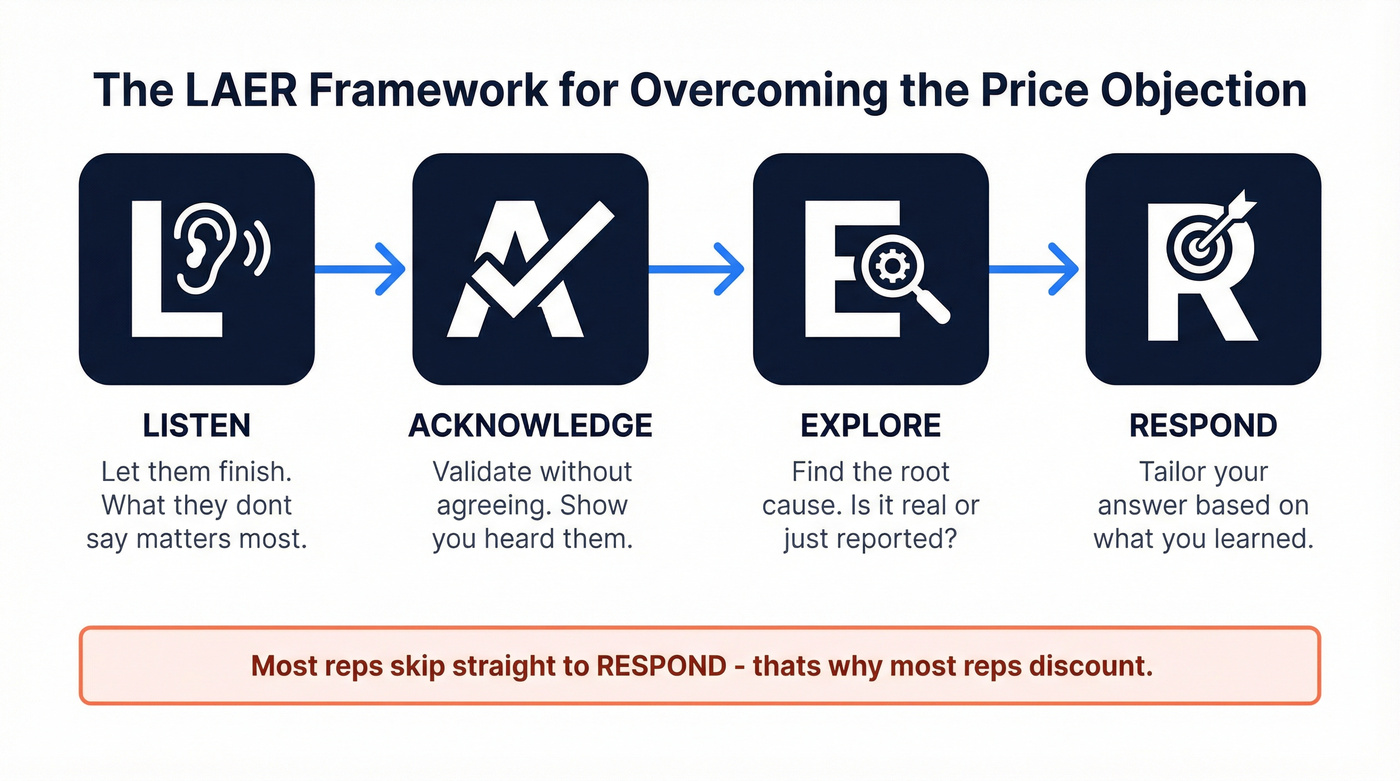
- Listen: Let them finish. What they don't say matters as much as what they do.
- Acknowledge: Validate without agreeing. "That's a fair concern" works. "You're right, we're expensive" doesn't.
- Explore: Find the root cause. "When you say it's too much, are you comparing to a specific alternative or to doing nothing?" One useful distinction from Sandler's methodology: determine whether the prospect is reporting a lower expectation or raising a real objection. These require completely different responses.
- Respond: Tailor your answer based on what you learned - not a canned pitch.
The whole thing takes 60 seconds when you practice it. Most reps skip straight to Respond, which is why most reps discount.
If you want a deeper breakdown of the LAER Framework, it’s worth studying beyond the acronym.

You read it above: reps discount when they're desperate, and desperation comes from thin pipeline. Prospeo gives you 300M+ profiles with 30+ filters - seniority, department, budget authority - so you're negotiating with the right buyer from day one. 98% email accuracy means your outreach actually lands.
Fill your pipeline so you never fold on price again.
5 Scripts for Common Pricing Pushback
These five objections account for roughly 74% of all pushback. On the phone, you've got 15-30 seconds to handle each one.
"Your Price Is Too High"
You: "I hear that. When you say 'too high,' are you comparing us to a specific alternative, or is this about the total investment? Because the biggest cost most teams face isn't our price - it's the cost of doing nothing for another quarter."
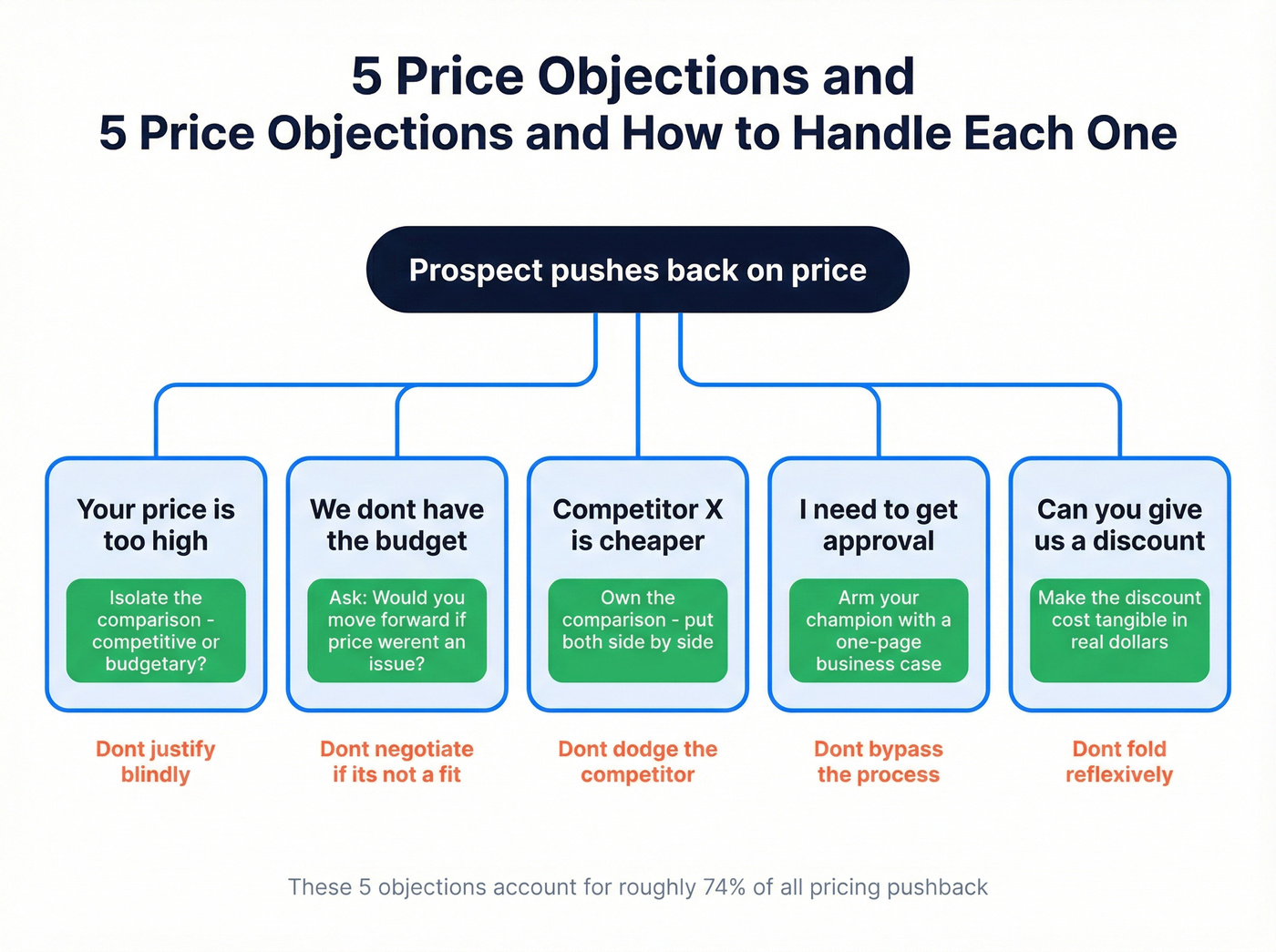
This isolates whether the objection is competitive or budgetary, and reframes inaction as the real expense. You're shifting the prospect's attention from what they'd spend to what they stand to lose by staying put - a loss aversion technique that works because humans feel losses roughly twice as intensely as equivalent gains.
"We Don't Have the Budget"
This one's a fork in the road. Ask: "If price weren't an issue, would you move forward with us?"
If yes, work together on a phased rollout. If no, price was never the real problem - stop selling and start diagnosing. We've seen reps waste weeks negotiating price when the actual blocker was a missing feature or a bad-fit use case. Let's be honest: if the answer to "would you buy this for free?" is still no, you don't have a pricing problem. You have a qualification problem.
"Competitor X Is Cheaper"
Wrong move: Dodging the comparison. Right move: "Good - you should compare. What specifically are you getting at that price? Let's put the two side by side."
Competitive mentions are up 57% since 2022, and discussing competitors early increases your odds of winning an enterprise deal by 32%. Own the comparison. The consensus on r/sales is that reps who refuse to acknowledge competitors come across as insecure, not confident.
"I Need to Get Approval"
Don't fight the process - arm your champion. Offer to build a one-page business case together. 89% of buyers say the winning vendor made it easier to show ROI internally. With five stakeholders per deal, the person on your call is rarely the final decision-maker, and the story they tell the CFO will be a diluted version of your pitch unless you give them something concrete to carry.
"Can You Give Us a Discount?"
You: "A 15% discount on a $50K deal costs $7,500. Do that on 10 deals a quarter and you've given away $75K - a meaningful chunk of a rep's OTE. I'd rather make sure the full package is worth every dollar."
Making the discount tangible shifts the conversation from "can you?" to "should you?" Skip this approach if you're selling a commodity product with transparent market pricing - in that case, you need to differentiate on service, speed, or scope instead.
The Discounting Trap
More than 60% of salespeople cut their price the moment a prospect pushes back. That's not strategy. That's fear.
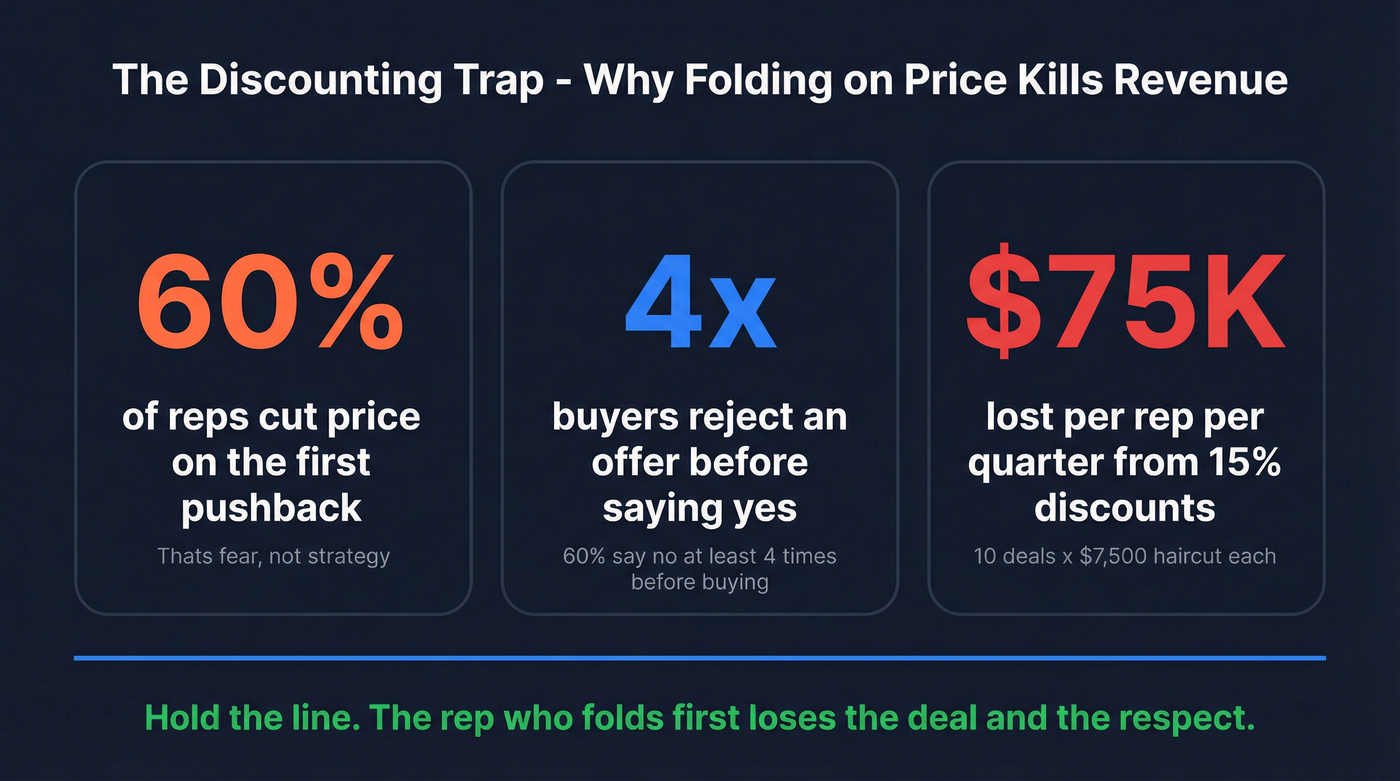
60% of customers reject an offer four times before buying. If you fold on the first pushback, you're not losing because of price - you're losing because you stopped too early. Hold the line.
In deals under $15K ACV, we've found that teams often lose more revenue to premature discounting than to lost deals. A 10% haircut across your pipeline adds up faster than the occasional walkaway.
Prevent the Objection Before It Happens
The best pricing pushback is the one that never comes up. Buyers are 3x more likely to close when they receive consistent information from your website and your reps. One tactic most reps skip: bring up price proactively. When you name the number before they ask, you control the frame.
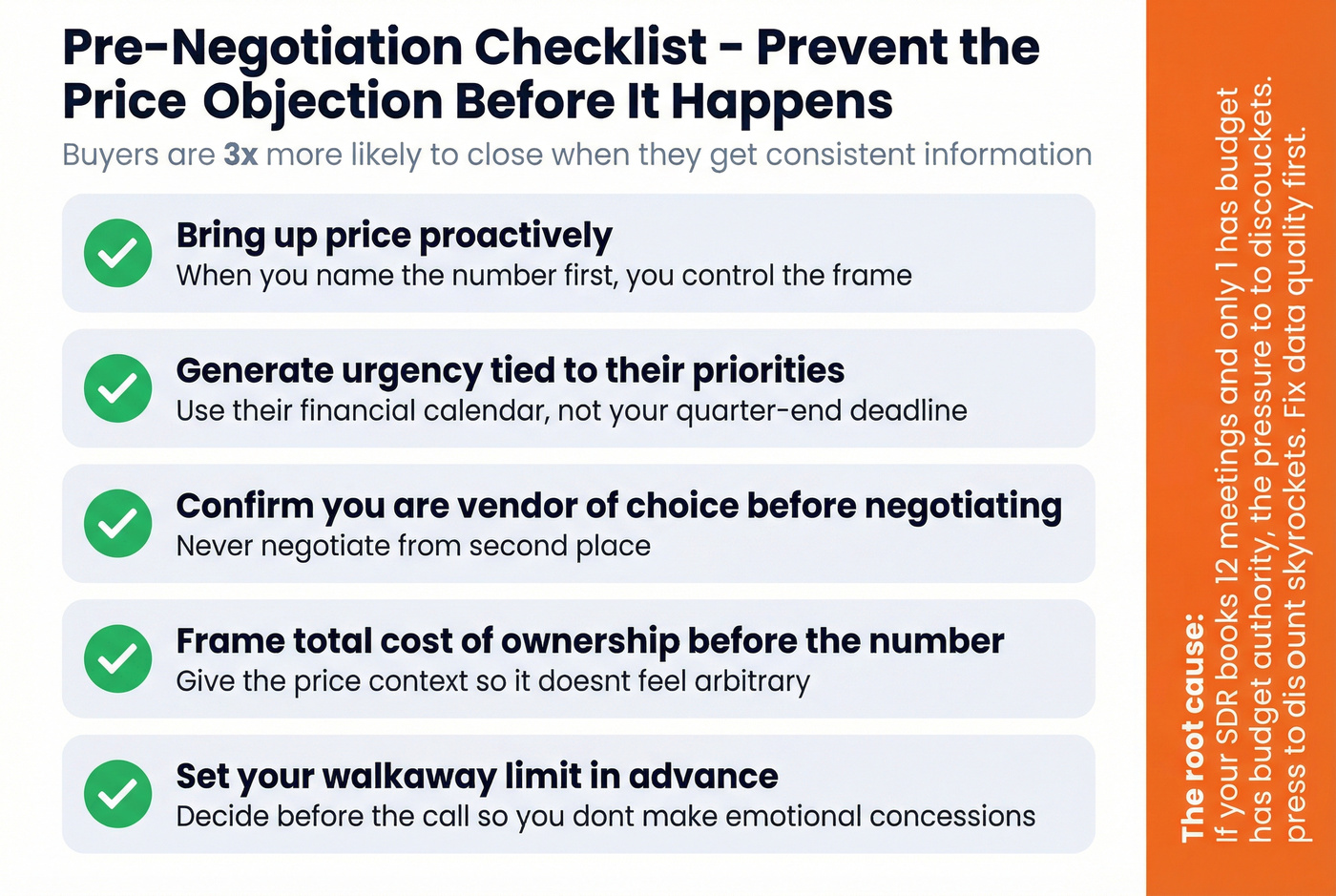
Before any pricing conversation, run through this:
- Generate urgency tied to the prospect's financial priorities, not your quarter-end
- Confirm you're vendor of choice before negotiating - never negotiate from second place
- Frame total cost of ownership before price so the number has context
- Set your walkaway limit so you don't make emotional concessions
Here's where most reps lose the game before it starts. Your SDR booked 12 meetings last week. Three showed. One had budget authority. That one said "too expensive." When you're only getting one real at-bat per week, the pressure to discount skyrockets.
This is a data quality problem disguised as a pricing problem. If you're reaching the wrong people - or reaching the right people with bad contact info - you'll always feel desperate at the negotiation table. Tools like Prospeo help here by letting you filter by seniority, department, and company size across 300M+ profiles with 98% email accuracy, so every conversation starts with someone who can actually approve a purchase order. More at-bats means less desperation discounting.
If you’re scaling outbound, it also helps to build a repeatable prospecting workflow and keep an eye on B2B contact data decay so your lists don’t rot between quarters.

With 5 decision-makers per deal, reaching the wrong person guarantees a price objection. Prospeo lets you map entire buying committees - verified emails at $0.01 each, direct dials with 30% pickup rates - so you arm every stakeholder before the CFO ever asks "why this much?"
Reach the full buying committee, not just the gatekeeper who says no.
FAQ
What's the real reason prospects say "too expensive"?
Insufficient perceived value, lack of urgency, or distrust from inconsistent messaging. Fix the consistency gap between your website and your reps - 58% of buyers spot discrepancies - and the pricing conversation gets dramatically easier.
Should you ever offer a discount?
Only as a strategic trade: phased rollout, reduced scope, or a multi-year commitment in exchange for a lower rate. Never as a reflexive concession. Over 60% of reps discount too early, leaving real revenue on the table.
How do you handle price objections over email?
Don't. Pricing conversations belong on a call where you can read tone, ask follow-ups, and run the LAER framework in real time. If a prospect raises price over email, your response should be one sentence: "Great question - let's jump on a quick call so I can make sure I'm addressing the right concern." Then pick up the phone.