

How Accurate Is Apollo's Email Verification, Really?
You just exported 5,000 "verified" contacts from Apollo, loaded them into your sequencer, and hit send. By morning, 400+ bounced. Your domain reputation took a hit, and now you're wondering what Apollo's email verification accuracy actually looks like in practice.
Short answer: it's not great.
30-Second Verdict
Apollo's 91% accuracy rate sounds solid until you do the math. Even taken literally, that implies up to ~9% wrong - well above the industry guideline of keeping bounces under 2%. On a 5,000-email campaign, 9% means 450 bounces, which is enough to land you in spam folders for weeks.
You either need a standalone verification layer on top of Apollo (roughly $4-10 per 1,000 emails) or a data source that doesn't require a second pass.
What Apollo Claims
Apollo describes a "7-step email verification process" that goes beyond standard SMTP checks, though the specific steps aren't publicly detailed.
The core pitch: most standalone verifiers rely on SMTP "tickling" (handshake checks), which can't reliably validate addresses on catch-all domains. Apollo uses SMTP too, but supplements it with a data contributory network, public data crawling, and vetted third-party providers. It also validates against connected inboxes, CRMs, and CSV uploads, tracking delivery statistics and monitoring bounce rates over time.
The approach is sound in theory. If Apollo can observe an email actively sending and receiving mail through its contributor network, it can confirm validity even when the server won't give a straight answer. Their documentation puts the resulting accuracy at 91%.
What the Numbers Actually Mean
Apollo's docs reveal two different numbers: an 84% email match rate and a 91%+ accuracy rate. These aren't the same thing.
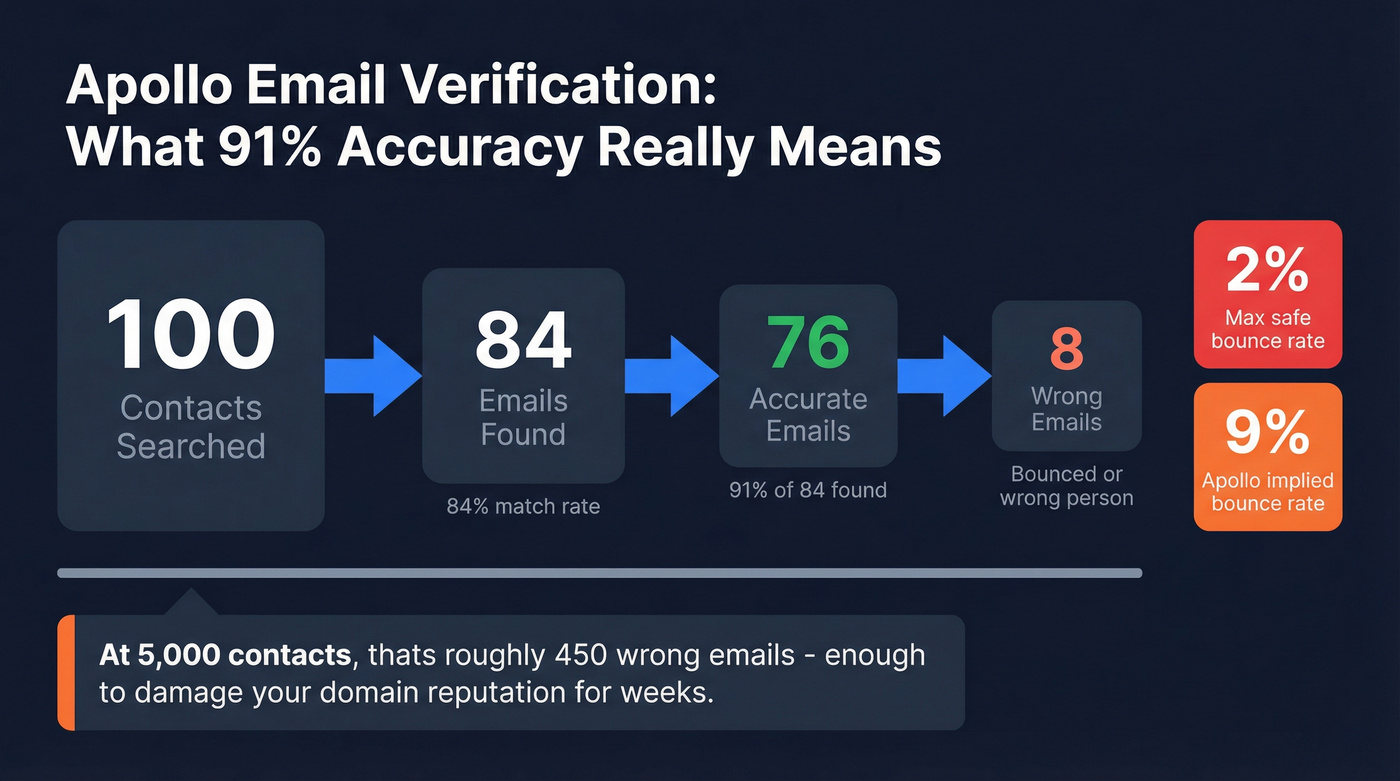
Match rate measures how often Apollo finds an email at all. Accuracy rate measures how often the emails it does find are correct. Out of every 100 contacts you search, Apollo finds emails for about 84. Of those 84, roughly 91% are accurate - meaning 7-8 will be wrong. Some bounce. Others deliver to the wrong person entirely, which is arguably worse.
Here's context most people miss: around 20-40% of B2B domains are configured as catch-all, meaning you can't definitively verify a big chunk of any export with SMTP-style checks alone. Hunter ran a benchmark of 15 email verification providers using 3,000 real business emails. The top overall accuracy? 70%. Not 97%. Seventy percent. Every verifier's marketing page claims 97-99%, but real datasets with catch-all domains and enterprise mail servers collapse those numbers fast.
Apollo's 91% is strong for an all-in-one sales prospecting platform. But it still doesn't guarantee you'll stay under the bounce ceiling you need for safe outbound.
What Users Actually Experience
Bounce rates vary wildly depending on which Apollo email statuses you include in exports. The status field is the single most important filter in Apollo, and most teams don't use it aggressively enough.
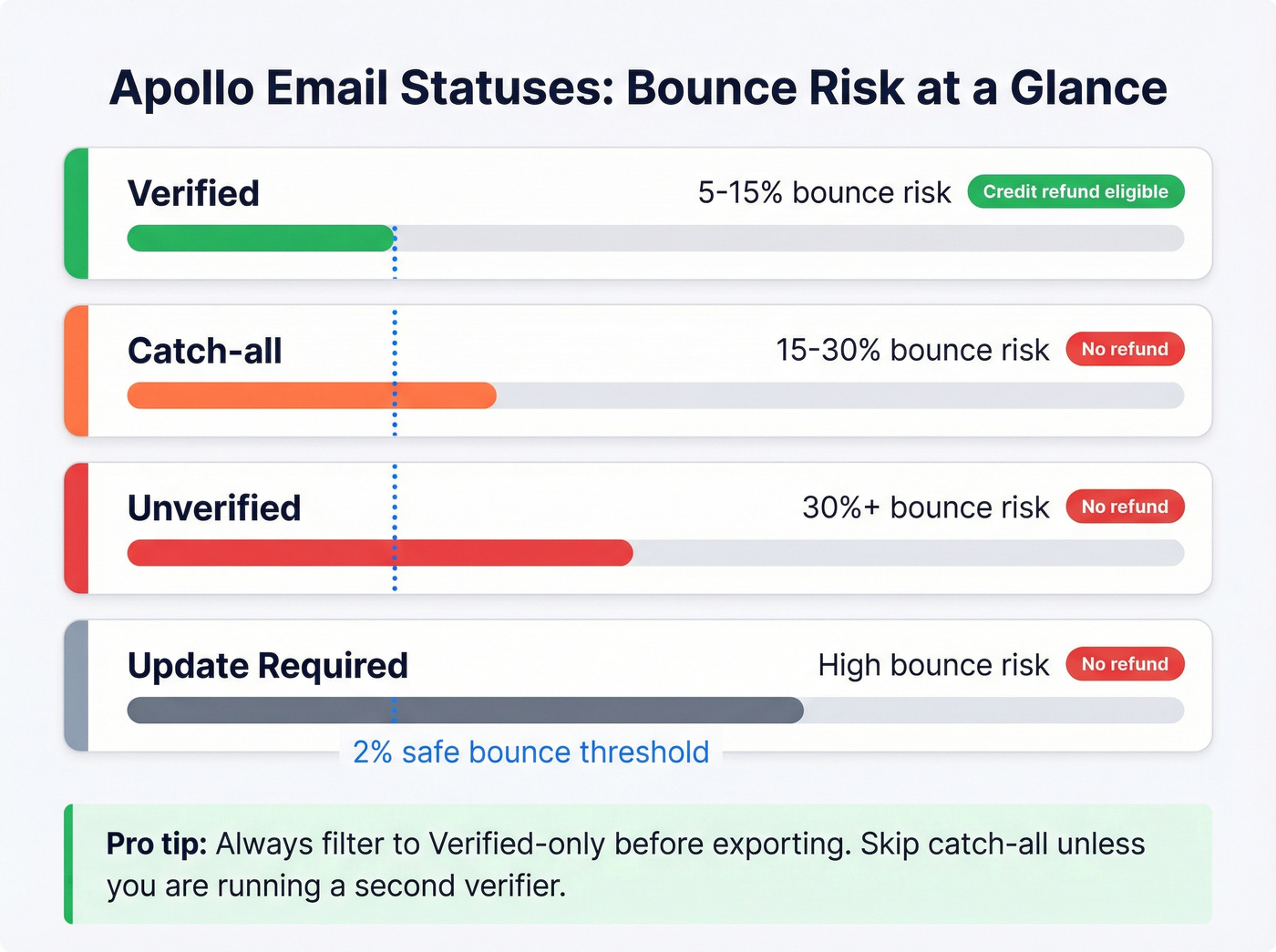
| Status | Meaning | Bounce Risk | Refund? |
|---|---|---|---|
| Verified | Fully confirmed | ~5-15% | Yes (credit refunded if bounce within 30 days) |
| Catch-all | Domain accepts all | ~15-30% | No |
| Unverified | Not confirmed | ~30%+ | No |
| Update Required | Stale record | High | No |
Use Verified-only if you're sending without a second verifier. Skip catch-all entirely unless you're running those addresses through a standalone tool first.
Across reviews and third-party analyses, teams commonly see 16-35% bounce rates when they include catch-all and unverified emails. Even Verified-only lists often land in the 5-15% range. Apollo offers a 30-day credit refund for verified emails that bounce, which is a nice gesture - but it doesn't fix your domain reputation after a bad send.

Apollo refreshes data on a 6-week industry-average cycle. Prospeo refreshes every 7 days - so the emails you pull today are verified against this week's data, not last month's. With 98% accuracy and a 5-step verification process that handles catch-all domains, spam traps, and honeypots, there's no second verifier to buy.
Stop paying twice for emails that should be accurate the first time.
Why Accuracy Degrades Over Time
The real problem isn't verification. It's data freshness.
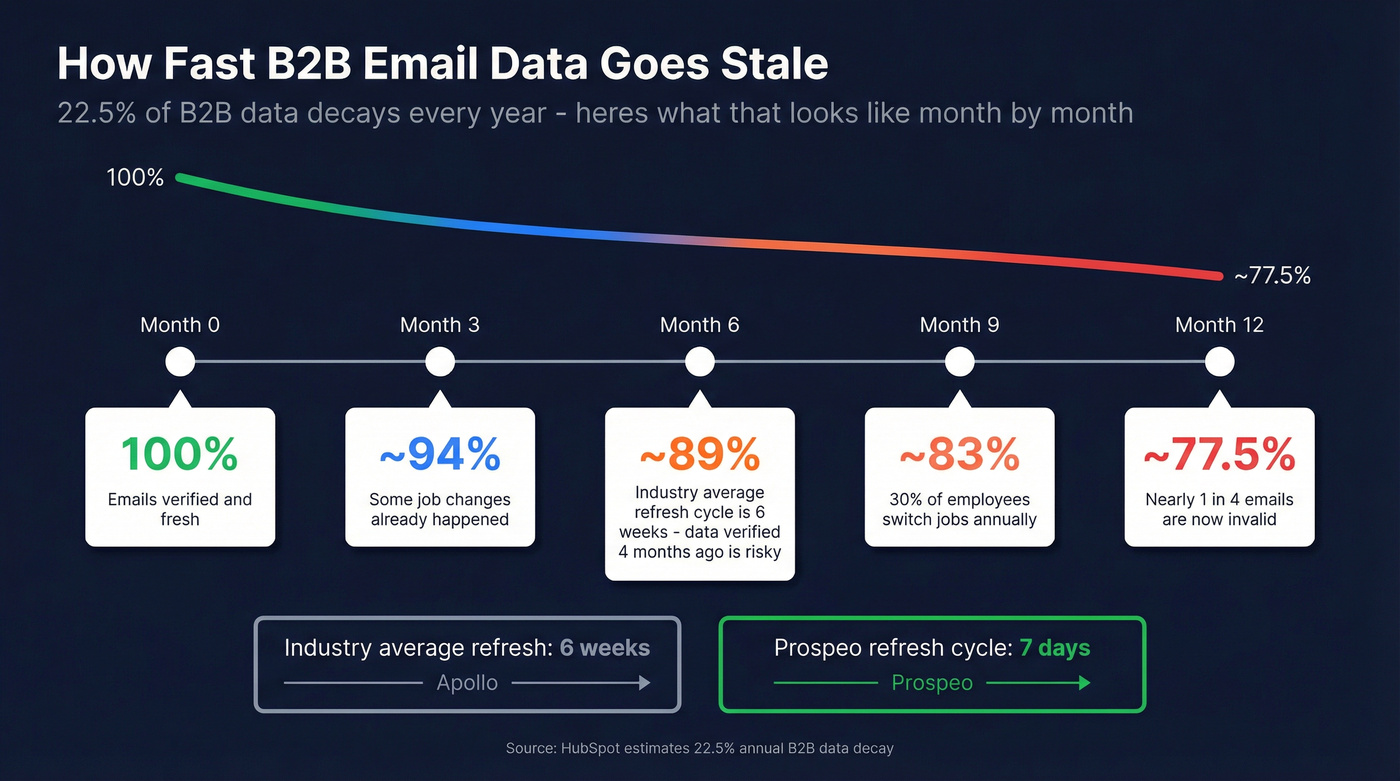
B2B data decays at roughly 22.5% per year. About 30% of employees switch jobs annually. An email valid in January might bounce by April. Gartner estimates poor data quality costs organizations an average of $15M per year, and most of that damage comes from acting on stale records, not missing ones.
Apollo's database is massive, but breadth and freshness are fundamentally in tension. Across B2B data providers, the industry average refresh cycle sits around 6 weeks. That means a meaningful chunk of "verified" emails were verified weeks ago against records that may have already changed. We've seen this pattern repeatedly in our own testing - the gap between "verified at time of capture" and "valid at time of send" is where most bounces hide.
If you want the deeper mechanics and benchmarks behind this, see our breakdown of B2B contact data decay.
Should You Layer a Second Verifier?
If you're committed to Apollo, adding a standalone verifier is the most practical fix:
| Tool | Claimed Accuracy | Cost / 1K | Free Tier |
|---|---|---|---|
| NeverBounce | 97-99% | ~$8 | - |
| Clearout | ~98% | ~$4 | - |
| Bouncer | ~98% | ~$4.90 | - |
| ZeroBounce | 97-99% | ~$10 | 100/mo |
| Kickbox | ~97% | ~$7 | - |
These are vendor-claimed numbers. As the Hunter benchmark showed, real-world results run lower - but even at reduced accuracy, a second pass catches most of what Apollo misses.
At 10,000 emails per month, a standalone verifier adds roughly $40-100/month on top of your Apollo subscription. It works. But you're paying twice for the same outcome: accurate emails. We've watched teams burn 2-3 hours a week on the export-verify-filter loop, and honestly, that time cost is the part nobody talks about.
If you're comparing options, our roundups of the best email checker tools and email ID validators can help you pick a second-pass tool.

Skip the Double-Spend
The Apollo-plus-verifier tax disappears if your data source is accurate from the start.
Let's be honest: if you're spending $40-100/month on a verifier on top of Apollo, plus hours of manual filtering every week, you're solving a problem that shouldn't exist.
This is also why teams increasingly audit prospect data accuracy before they scale outbound.
That $40-100/month verifier tax adds up fast - and it still won't fix stale data. Prospeo delivers verified emails at ~$0.01 each with 98% accuracy, a 7-day refresh cycle, and proprietary catch-all handling built in. Teams using Prospeo book 35% more meetings than Apollo users.
Ditch the export-verify-filter loop and send with confidence from day one.
Getting Under 2% Bounces with Apollo
If you're staying on Apollo, here's the workflow that actually works:
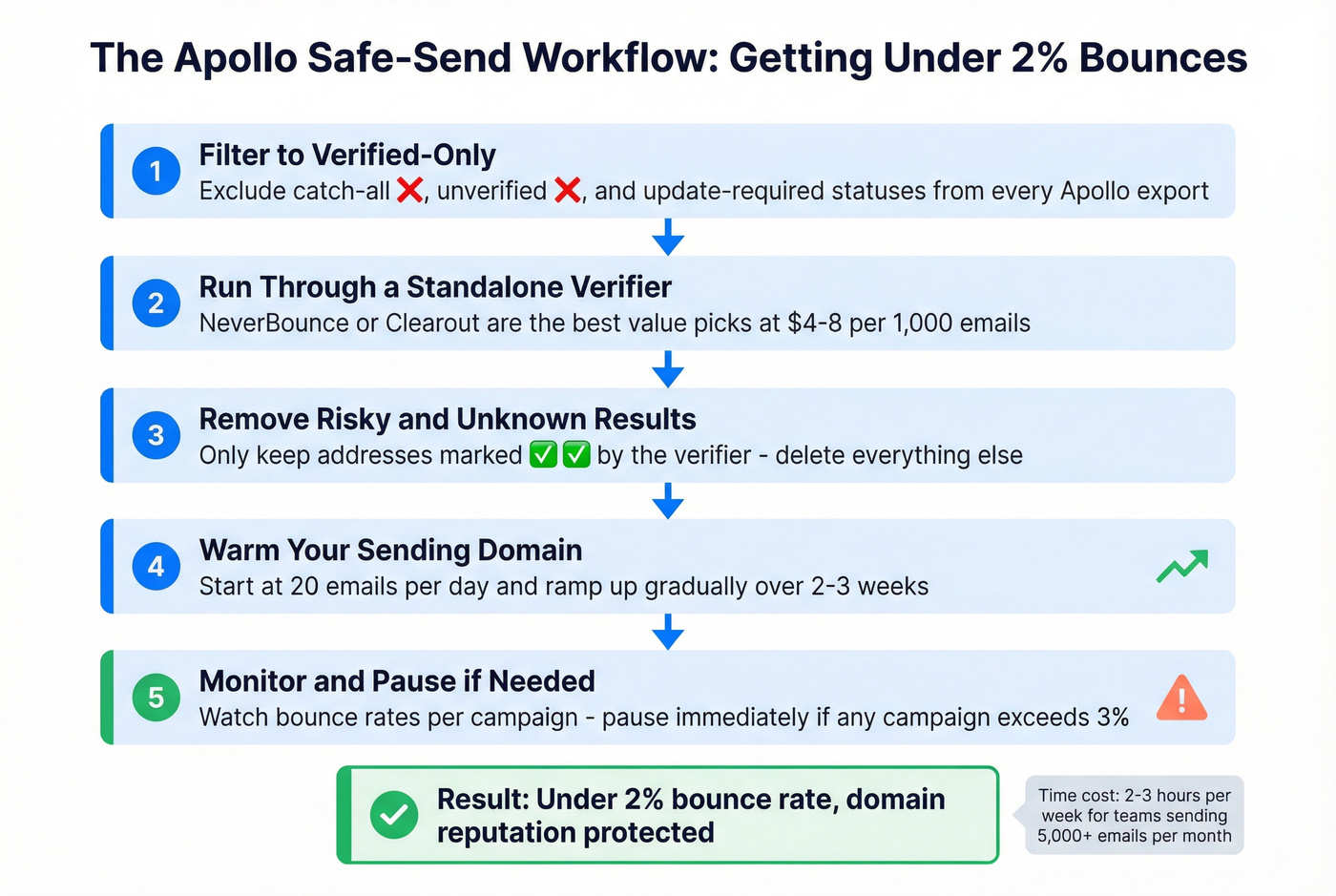
- Filter to Verified-only in every export. Exclude catch-all, unverified, and update-required statuses entirely.
- Run every export through a standalone verifier before loading into your sequencer. NeverBounce or Clearout are the best value picks.
- Remove "risky" and "unknown" results from the verifier output. Only send to addresses marked "valid."
- Warm your sending domains properly. Ramp slowly - 20 emails/day, increasing over 2-3 weeks. (If you need a system, use an automated email warmup playbook.)
- Monitor bounce rates per campaign and pause immediately if any campaign exceeds 3%. If you’re diagnosing issues, start with what a hard bounce actually means.
Here's the thing: if you're sending more than 5,000 emails per month, the time cost of this process is the strongest argument for switching to a data source that doesn't need it. You're spending money and hours compensating for a data quality problem that better tooling solves at the source. The consensus on r/sales is pretty clear - teams that layer verification on top of Apollo eventually get frustrated enough to look elsewhere.
FAQ
How does Apollo's verification compare to standalone tools?
Apollo's 91% accuracy is strong for a bundled prospecting platform but falls below standalone verifiers claiming 97-99%. In Hunter's benchmark of 15 providers, the top real-world accuracy was 70%, so marketing claims across the industry are inflated. The real test is whether 91% keeps you under the 2% bounce threshold, and for most teams it doesn't without a second pass.
Should I send to catch-all emails from Apollo?
Only after running them through a standalone verifier. Catch-all domains accept all mail at the server level, so Apollo can't confirm individual addresses exist. Teams regularly see 15-30% bounce rates on catch-all lists without secondary verification, and only verified-status bounces qualify for Apollo's 30-day credit refund.
What's the most cost-effective way to avoid double verification?
Use a data source with higher native accuracy so you skip the second tool entirely. Prospeo delivers 98% email accuracy with a 7-day refresh cycle and built-in catch-all handling at ~$0.01 per email. The free tier includes 75 verified emails per month - enough to test before committing. For teams already spending $40-100/month on a standalone verifier on top of Apollo, switching eliminates that cost completely.