

The Account Based Marketing Process That Actually Works
Every guide says "identify high-value accounts" as step one. That's wrong. Step one is building a scoring model - otherwise "high-value" is just a gut feeling dressed up as strategy. 64% of marketers now run some form of ABM, but most programs stall because teams skip the operational scaffolding and jump straight to buying a platform.
A solid account based marketing process fixes that.
84% of buying groups have already chosen a preferred vendor before they ever talk to your sales team. Your ABM strategy needs to reach the right accounts, with the right message, across the right stakeholders - before they pick someone else.
The Quick Version
- Build your account scoring model (fit + intent + engagement)
- Tier your target account list (1:1, 1:few, 1:many)
- Research accounts and map buying committees
- Develop personalized messaging by tier
- Execute multi-channel campaigns
- Align sales handoffs
- Measure at the account level
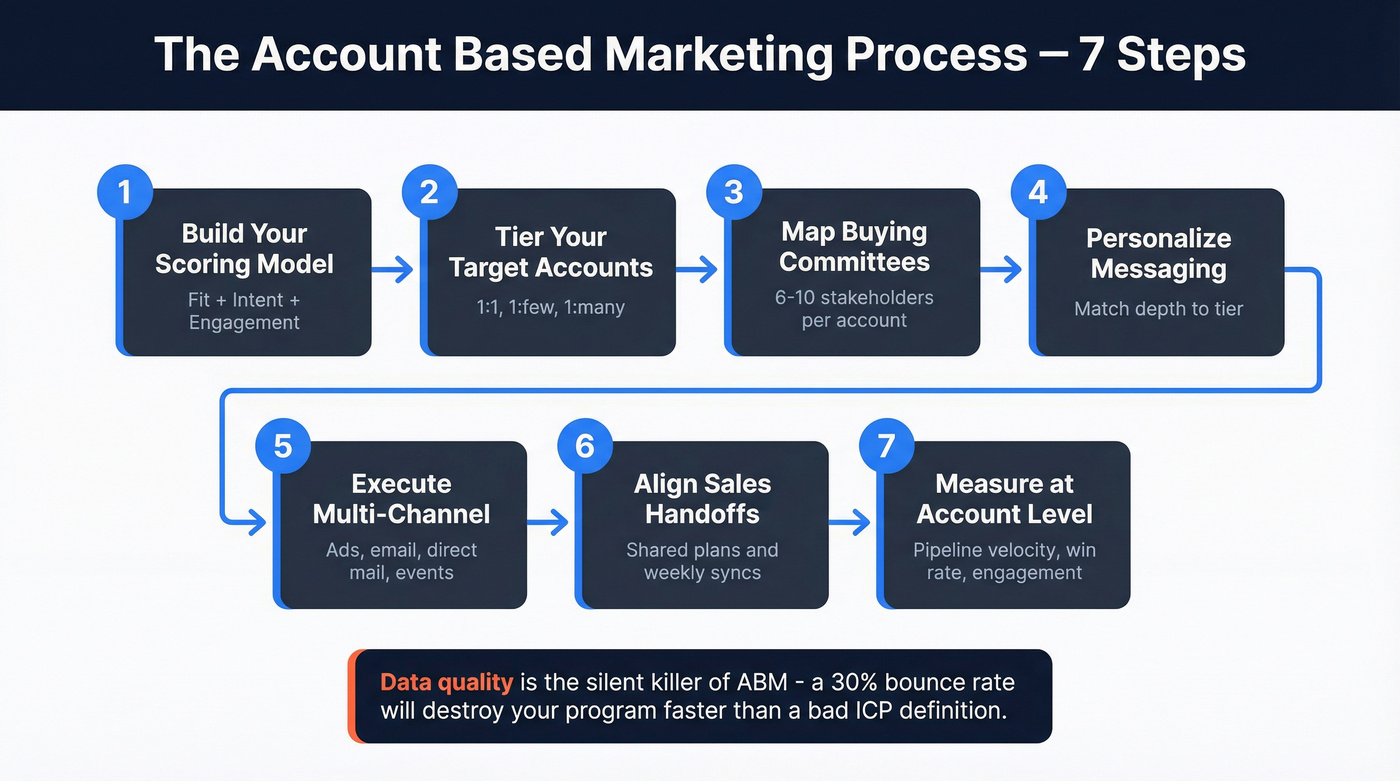
One sentence you should tattoo on your whiteboard: data quality is the silent killer of ABM. A 30% email bounce rate will destroy your program faster than a bad ICP definition ever could.
The 7-Step ABM Process in Detail
Step 1 - Build Your Scoring Model
Most teams skip this and go straight to a list of "dream accounts" their VP picked during a flight. That's not ABM. That's wishful thinking.
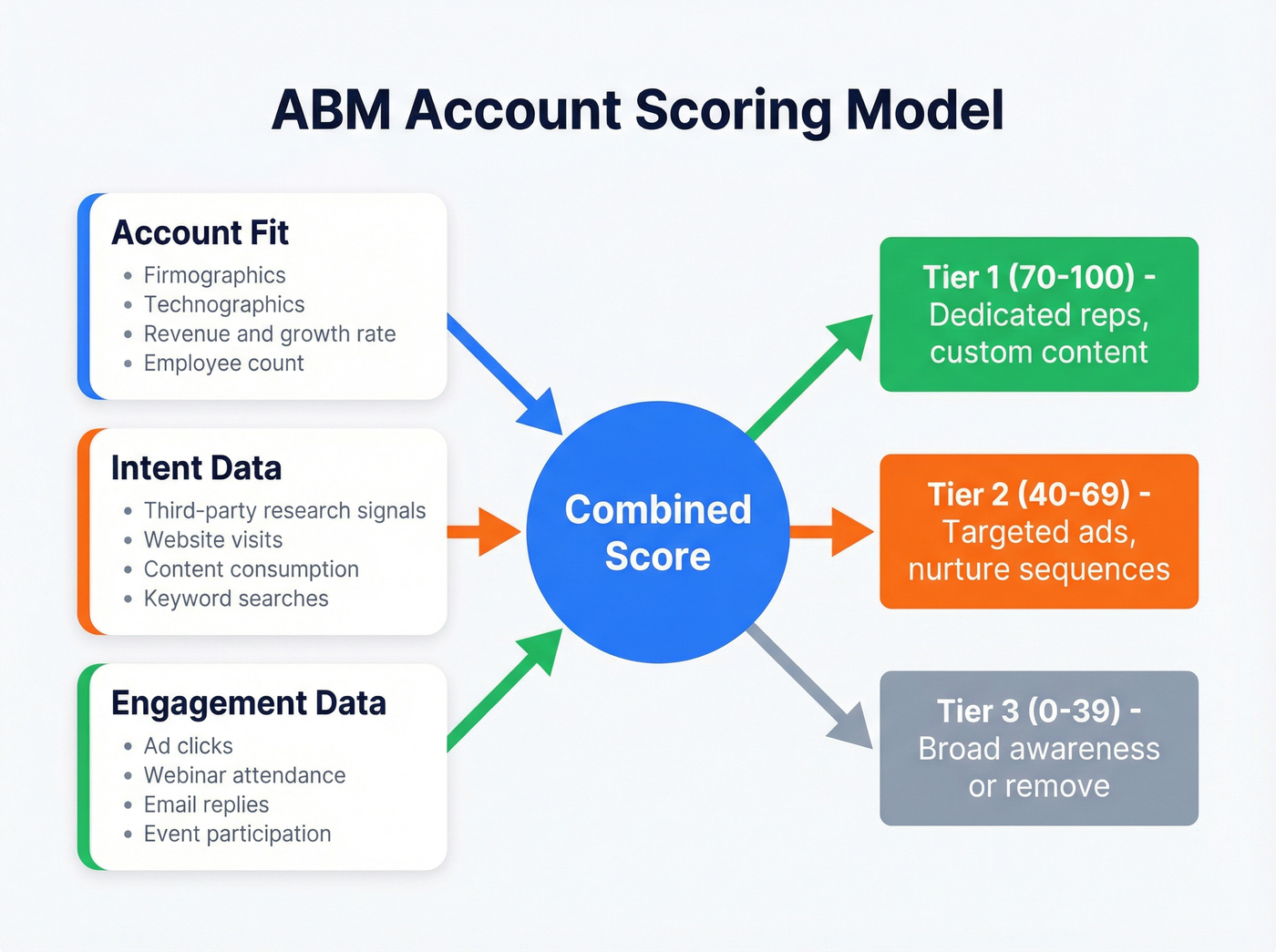
A proper scoring model combines three inputs, a framework Demandbase explains well: account fit covering firmographics, technographics, revenue, and growth rate; intent data from third-party research signals plus your own website visits; and engagement data like ad clicks, webinar attendance, and email replies. Each input gets weighted, and the combined score tells you where to spend your time.
Here's a tiering rubric that works as a starting point:
- Tier 1 (score 70-100): Highest fit and strongest signals. Dedicated reps, custom content, executive outreach.
- Tier 2 (score 40-69): Good fit, moderate signals. Targeted ads, nurture sequences, outbound email.
- Tier 3 (score 0-39): Low fit or low confidence. Broad awareness campaigns, or remove entirely.
A modern shortcut we've been recommending to teams: enrich your account list with firmographic and technographic data, then feed it to an LLM with your ICP criteria to generate fit scores and confidence levels. Test on a small batch, spot-check the output, then scale. It's dramatically better than gut instinct.
Step 2 - Tier Your Target Account List
Once you've scored accounts, decide how many go into each tier and what investment each gets. Deal size is the clearest guide:
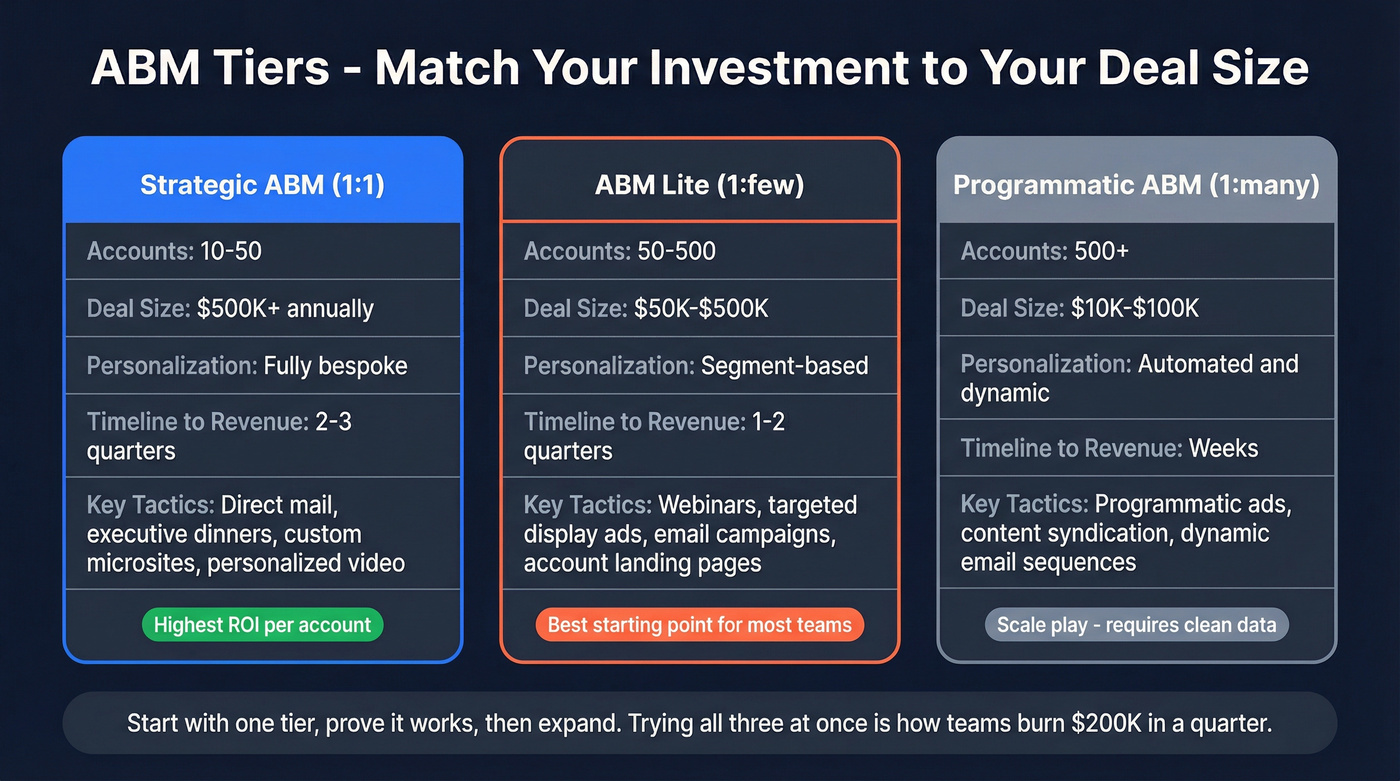
- Strategic ABM (1:1): Accounts worth $500K+ annually. Target 10-50 accounts max with dedicated resources per account.
- ABM Lite (1:few): Mid-market accounts in the $50K-$500K range. Cluster 5-20 similar accounts, run segment-specific campaigns. Total list: 50-500.
- Programmatic ABM (1:many): Smaller deals under $100K. Run 500+ accounts through automated, data-driven campaigns.
Start smaller than your instincts tell you. Twenty-five well-researched accounts will outperform 500 unscored names every single time.
Step 3 - Map Buying Committees
This is where ABM programs live or die.
Buying groups typically include around 10 members, so for every target account you need verified contact data for 6-10 stakeholders - the economic buyer, the champion, the technical evaluator, the end users, and often procurement. The problem is contact data decays fast. If 30% of your emails bounce on the first sequence, your domain reputation tanks and your SDRs lose trust in the entire program before it gets off the ground.
This is where data enrichment tools pay for themselves. Prospeo lets you upload your target account list as a CSV and returns verified emails at 98% accuracy on a 7-day refresh cycle, with 50+ data points per contact at roughly $0.01 per email. Mapping a 10-person buying committee across 100 accounts costs about $10.
Step 4 - Personalize Messaging by Tier
Personalization should match your tier investment. Trying to write bespoke content for 500 accounts will burn out your team in a month.
For 1:1 accounts, create custom assets - personalized landing pages, tailored case studies, a custom ROI analysis. One tactic we've seen work well: invite a decision-maker from a target account onto your podcast. It builds a genuine relationship, gives you insight into their priorities, and creates content you can repurpose across channels. Storemaven and Signify have both been cited as examples of this approach working at scale.
For 1:few, write segment-level messaging. Group accounts by industry vertical, tech stack, or business challenge, then create content that speaks to the cluster. For 1:many, personalization is mostly dynamic - merge fields, industry-specific ad copy, automated sequences. The targeting is what makes it feel relevant, not the copy itself.
Step 5 - Execute Multi-Channel Campaigns
For 1:1 accounts: Direct mail, executive dinners, personalized video outreach, custom microsites. Programmatic ads usually aren't the best spend at this scale - you're better off with a $200 gift and a handwritten note.
For 1:few accounts: Targeted display ads, webinars, email campaigns, account-specific landing pages. Skip fully bespoke content. The ROI doesn't justify it for mid-tier deals.
For 1:many accounts: Programmatic ads, content syndication, dynamic email sequences, lookalike targeting. Skip high-touch tactics - you don't have the headcount.
Let's be honest about a mistake we see constantly: teams running 1:1 tactics on 1:many accounts. That's how you burn $50K in a quarter with nothing to show for it. ABM works best alongside inbound - let inbound surface interested accounts, then use ABM to accelerate them through the pipeline.
Step 6 - Align Sales Handoffs
ABM without sales alignment is just marketing with a fancier name.
At minimum, sales and marketing need to agree on the target account list, share account plans with specific intel like org charts and engagement history, and meet weekly to review account progression. Reps should receive account-specific enablement - not generic battle cards, but "here's what this account's CFO cares about based on the content they've consumed."
Here's the thing: if your sales team didn't help build the list, they won't work it. Get their input during scoring and tiering, not after.
Step 7 - Measure at the Account Level
If your average contract value is under $10K, you probably don't need a full ABM program. But if you're running one, MQLs are the wrong metric. They measure individual lead activity, not account-level buying behavior. Even advanced ABM teams still default to lead-based measurement because that's what their CRM was built to track.
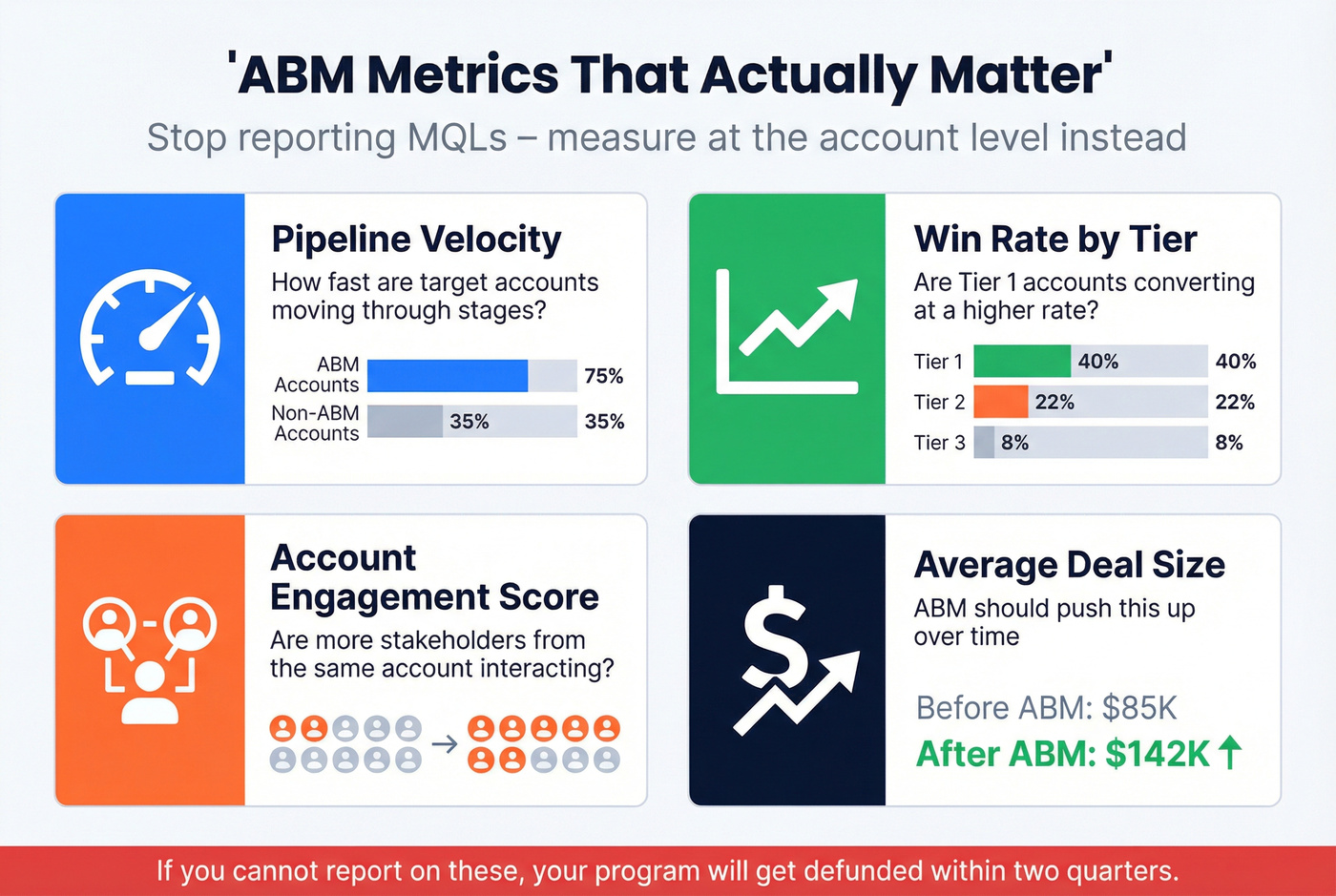
The metrics that matter:
- Pipeline velocity - how fast are target accounts moving through stages?
- Win rate by tier - are Tier 1 accounts converting at a higher rate than Tier 2?
- Account engagement score - are more stakeholders from the same account interacting with your content?
- Average deal size - ABM should push this up over time.
If you can't report on these, your program will get defunded within two quarters. And the same tiered process applies to expansion plays - upsell and cross-sell campaigns targeting existing accounts follow the identical framework.

Mapping a 10-person buying committee across 100 target accounts shouldn't cost thousands or take weeks. Prospeo returns verified emails at 98% accuracy with 50+ data points per contact - refreshed every 7 days so your ABM sequences don't bounce.
Enrich your entire target account list for about $10.
How the Process Changes by Tier
| Tier | Accounts | Deal Size | Personalization | Key Tactics |
|---|---|---|---|---|
| 1:1 (Strategic) | 10-50 | $500K+ | Fully bespoke | Direct mail, events, custom assets |
| 1:few (Lite) | 50-500 | $50-500K | Segment-based | Webinars, targeted ads, email |
| 1:many (Programmatic) | 500+ | $10-100K | Automated/dynamic | Programmatic ads, syndication |
Expect 1:1 programs to take two to three quarters before revenue impact. ABM Lite generates pipeline in one to two quarters. Programmatic shows engagement lift within weeks.
The biggest resource trap is trying to run all three tiers simultaneously from day one. We've seen teams burn $200K in a quarter that way. Pick one tier, prove it works, then expand. If you close 3 of 25 Tier 1 accounts at $500K each, that's $1.5M pipeline from a $50K ABM investment - the math justifies the patience.
ABM Tech Stack by Step
You don't need a $100K platform to start ABM. You need a CRM, a scoring model (even a spreadsheet), and clean data. Everything else is an accelerant.
| Process Step | Tool Category | Examples | Price Range |
|---|---|---|---|
| Identification | ABM platform | Demandbase, 6sense | ~$50-100K+/yr |
| Enrichment | Data platform | Prospeo, ZoomInfo | ~$0.01/email - $15-40K/yr |
| Prospecting | Sales intelligence | Apollo.io | Free + paid from $49/mo |
| Engagement | Marketing hub | HubSpot, RollWorks | ~$800/mo - $50K/yr |
| Measurement | CRM + reporting | Salesforce | ~$25-330/user/mo |
If you're just starting, a data enrichment tool plus HubSpot's free CRM gets you 80% of the way there. Layer in Demandbase or 6sense for intent-driven orchestration once you've proven the model and have budget to match.
Common ABM Mistakes
No scoring model. "High-value" means nothing without a framework. If your target list came from a brainstorm session, you're guessing.
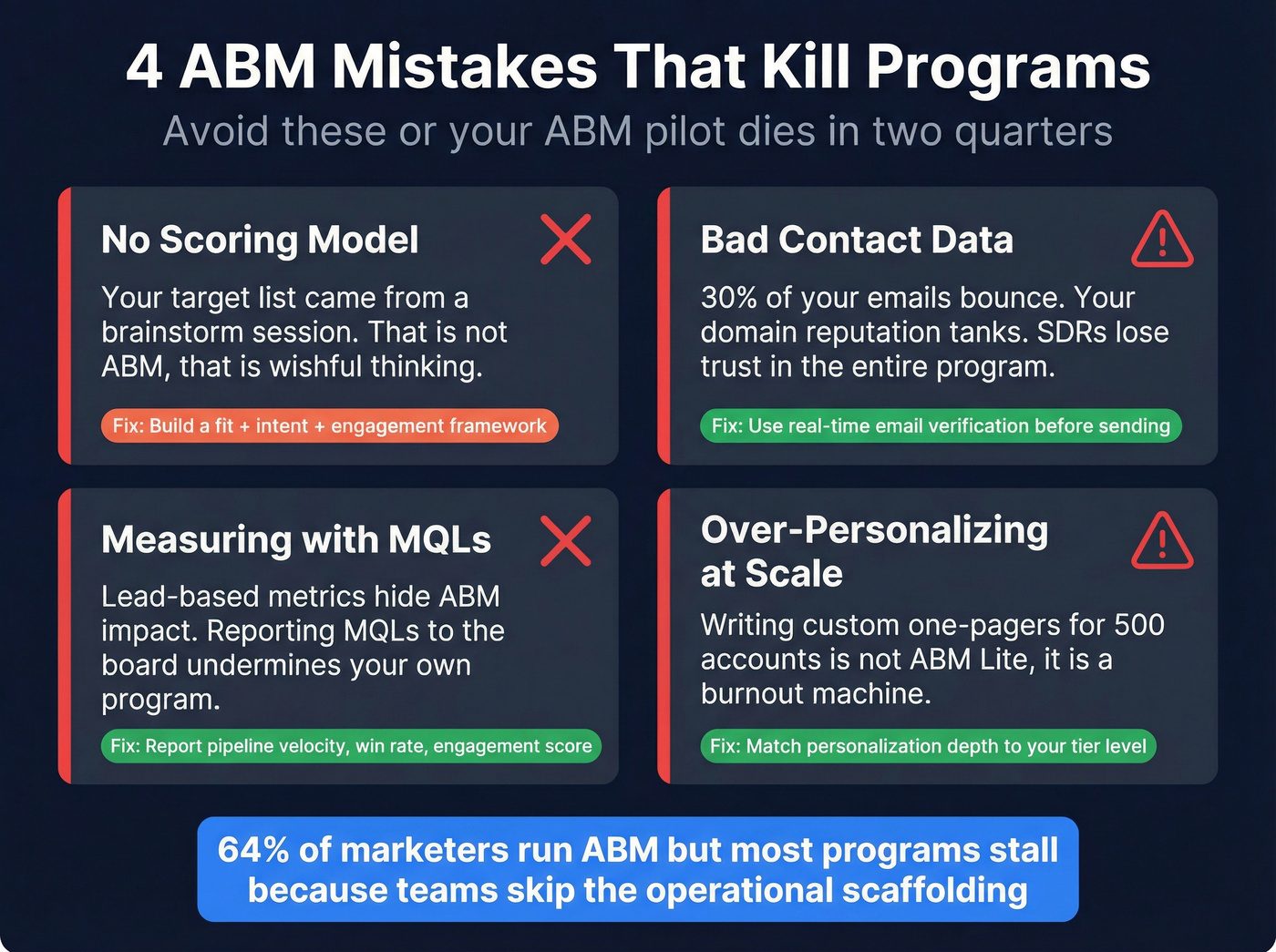
Bad contact data. You mapped 10 stakeholders per account, but 30% of those emails bounce. Your domain reputation tanks and your SDRs lose trust. Use a tool with real-time verification before you send a single sequence. The consensus on r/sales is that bad data is the number one reason ABM pilots fail - and it's hard to argue with that.
Measuring with MQLs. Lead-based metrics hide ABM's real impact. If you're reporting MQLs to the board, you're undermining your own program.
Treating ABM as a campaign. ABM is a strategy, not a six-week sprint. Teams building ABM from scratch consistently report that the first 90 days are about data cleanup, not campaign launches.
Over-personalizing at scale. Writing custom one-pagers for 500 accounts isn't ABM Lite - it's a burnout machine. Match personalization depth to your tier. If you're a two-person marketing team, skip 1:1 entirely and start with 1:few.
No documented workflow. Without a repeatable ABM workflow - from scoring to handoff to measurement - every campaign becomes a one-off experiment. Document each step so your team can execute consistently and onboard new reps without starting from scratch.

Your ABM scoring model is only as good as the contact data behind it. Bad emails kill domain reputation, stall pipeline, and make sales lose faith in the program. Prospeo's 5-step verification and 7-day refresh cycle keep your buying committee data current - not 6 weeks stale.
Stop running ABM on decayed data. Get 98% accuracy from day one.
FAQ
How long does ABM take to show results?
Programmatic ABM shows engagement lift within weeks. ABM Lite generates pipeline in one to two quarters. Strategic 1:1 programs typically need two to three quarters before measurable revenue impact - plan your board reporting accordingly.
How many accounts should I target?
Start with 25 well-researched accounts. Strategic programs cap at 10-50, ABM Lite runs 50-500, and programmatic handles 500+. Teams that start with fewer accounts consistently outperform those who cast a wide net.
What tools do I need to start ABM?
A CRM, a scoring model (a spreadsheet works), and a data enrichment tool for verified buying-committee contacts. Add a dedicated ABM platform later once you've proven the model works and have the budget to justify it.
How do I run ABM with a small team?
Start with programmatic or ABM Lite, build workflows that automate scoring and sequencing, and let your reps focus only on Tier 1 accounts that need a human touch. The key is matching your tier investment to the headcount you actually have - not the headcount you wish you had. A two-person team can run effective 1:few campaigns for 50 accounts if the data is clean and the workflow is documented.