

Where to Find Small Businesses Online: 7 Methods That Work
Your boss asked you to build a list of 500 local businesses by Friday. You searched for it and got a wall of "businesses for sale" marketplaces. That's not what you need.
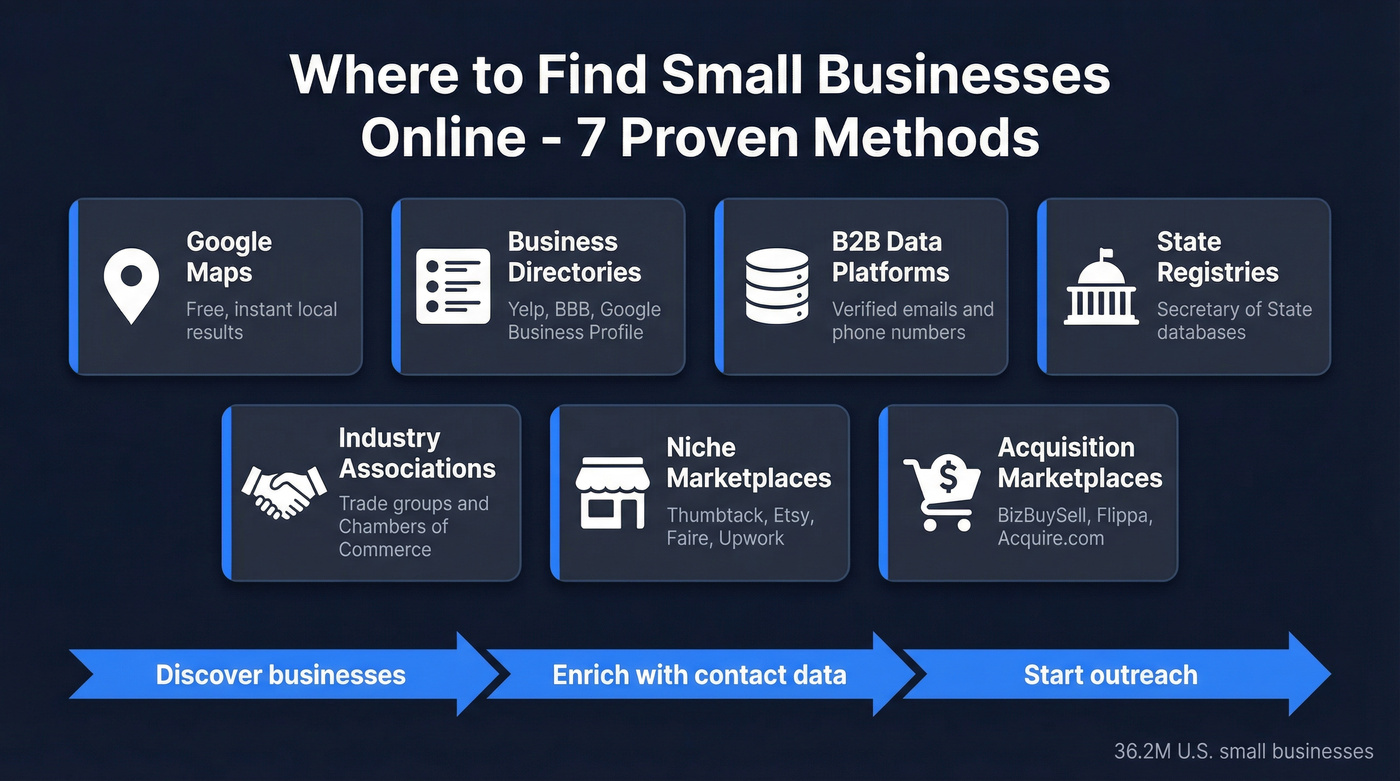
The U.S. has 36.2 million small businesses accounting for nearly 46% of private-sector employment - so figuring out where to find small businesses online isn't the hard part. Finding them with usable contact data is. We've tested dozens of approaches over the years, and the truth is you don't need 15 sources. You need two or three that match your use case.
Quick version:
- Local discovery: Google Maps and business directories like Yelp, BBB, and Google Business Profile
- Verified contact data at scale: A sales prospecting platform that turns business names into decision-maker emails and phone numbers
- Buying a business: BizBuySell or Flippa
Business Directories for Local Discovery
Directories remain the simplest way to discover small businesses by category and location. 31% of top organic results for local searches are directory pages, and businesses with optimized listings see roughly 23% more local search visibility and 42% more customer inquiries.
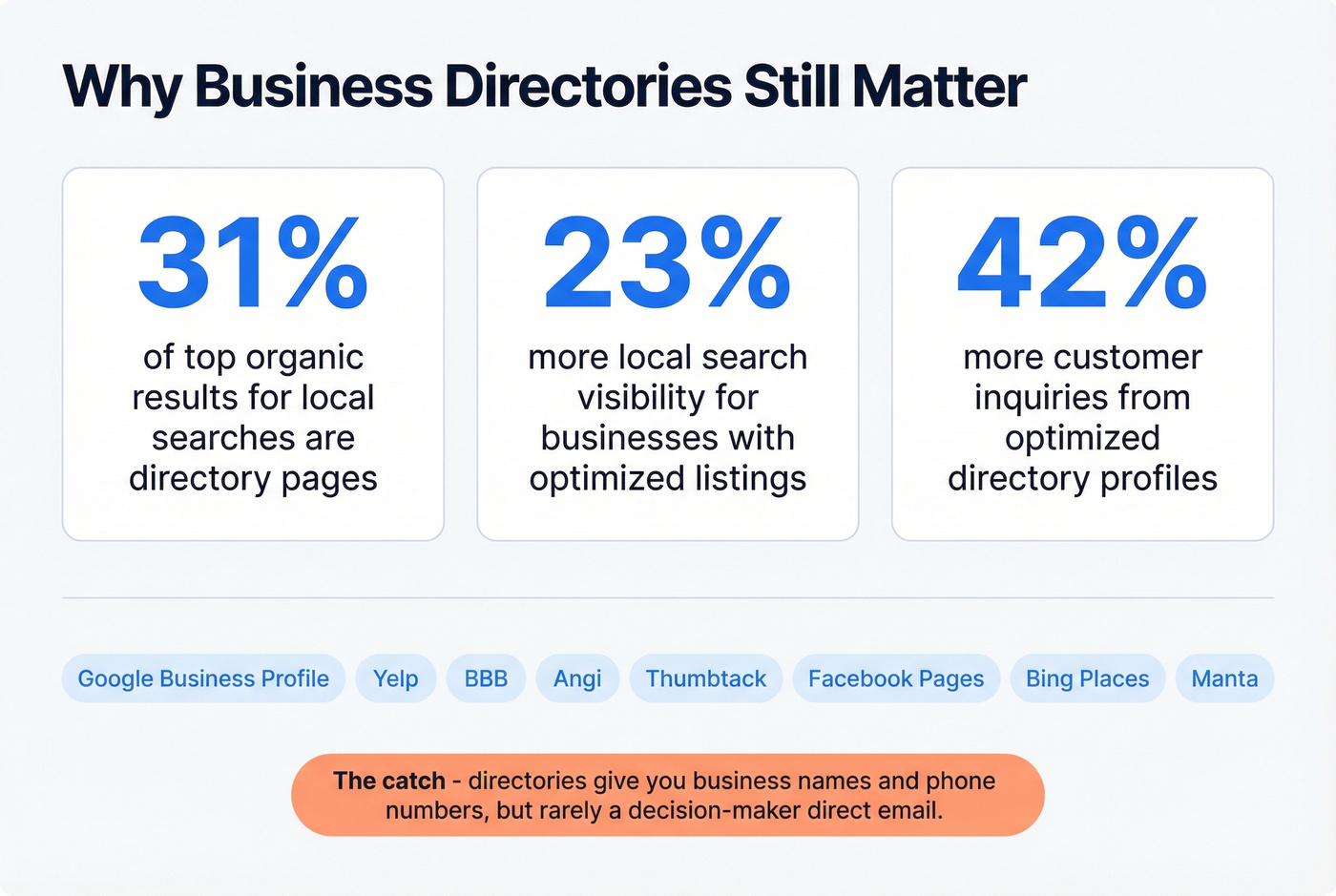
Here's your starter checklist. Google Business Profile is the default starting point. Yelp is strong for service businesses and restaurants. The Better Business Bureau is useful for signaling legitimacy. Beyond those three, Angi covers home services with reviews, Thumbtack's pay-per-lead model means you're finding active and responsive businesses, and Facebook Business Pages reach a massive audience - many SMBs maintain active pages there even when they don't have a proper website. Bing Places is often overlooked but has less competition, and Manta focuses specifically on small business profiles.
The limitation is obvious: you get business names and maybe a phone number, but rarely a decision-maker's direct email. That's where data enrichment platforms come in.
Google Maps & Government Registries
Google Maps is the fastest free method for locating small businesses in a specific area. Search "plumbers in Austin" or "marketing agencies in Denver" and you've got a working list in seconds. It won't give you emails, but it gives you names, addresses, phone numbers, and websites you can work with.
For something more authoritative, every state maintains a Secretary of State business database. New York's Division of Corporations, for example, lets you search by entity name, DOS ID, or assumed name with filters for entity type, status, and date of first filing. Not glamorous. But it's the most reliable source for confirming a business actually exists and is in good standing before you spend time reaching out.

Google Maps gives you business names. Directories give you phone numbers. But you still don't have the decision-maker's email. Prospeo bridges that gap - 300M+ profiles, 98% email accuracy, 7-day data refresh. Go from a list of small businesses to a deliverable prospect list in minutes, not hours.
Stop copying phone numbers from Yelp. Get verified emails at $0.01 each.
B2B Data Platforms
Directories give you business names. Data platforms give you the people behind them - with verified emails and direct dials. This matters because 28% of email addresses in B2B databases go stale every year, and bad data costs organizations an average of $12.9M annually.
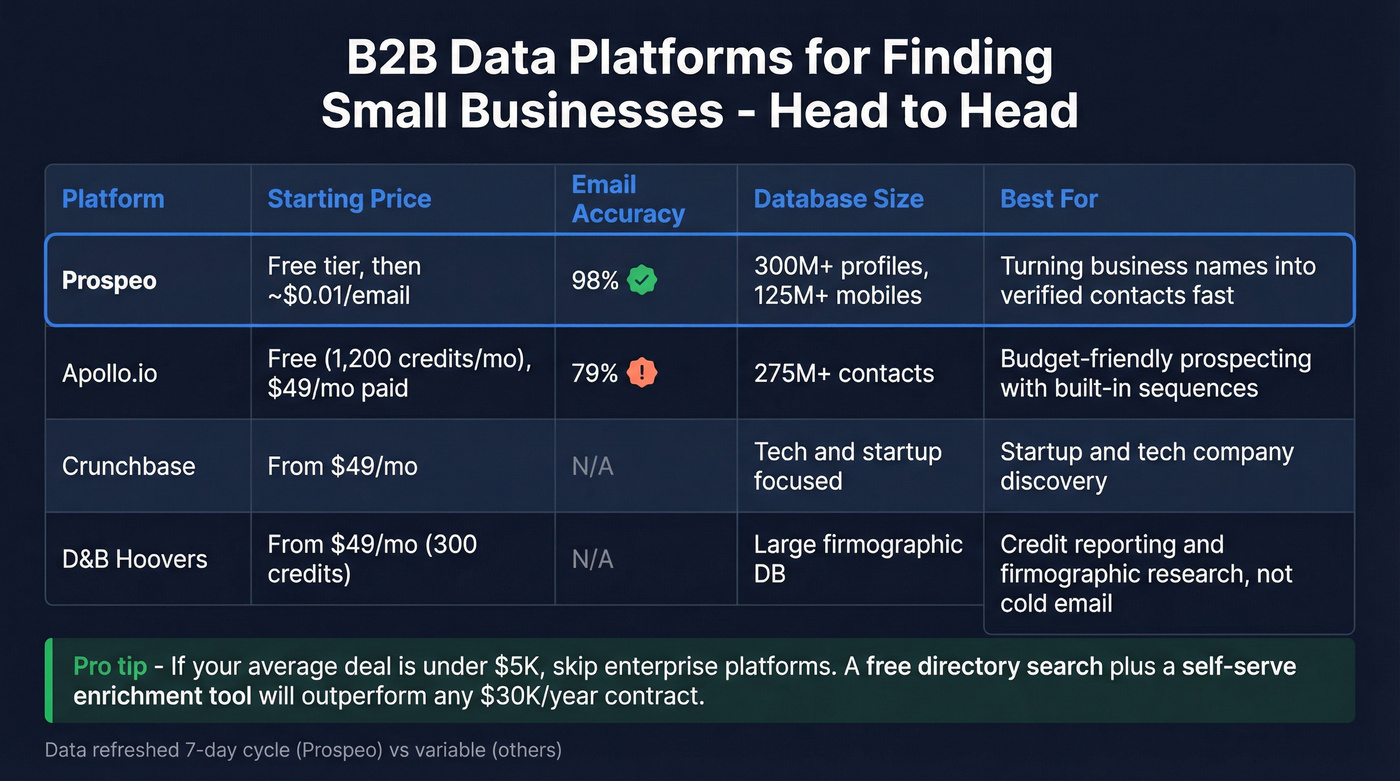
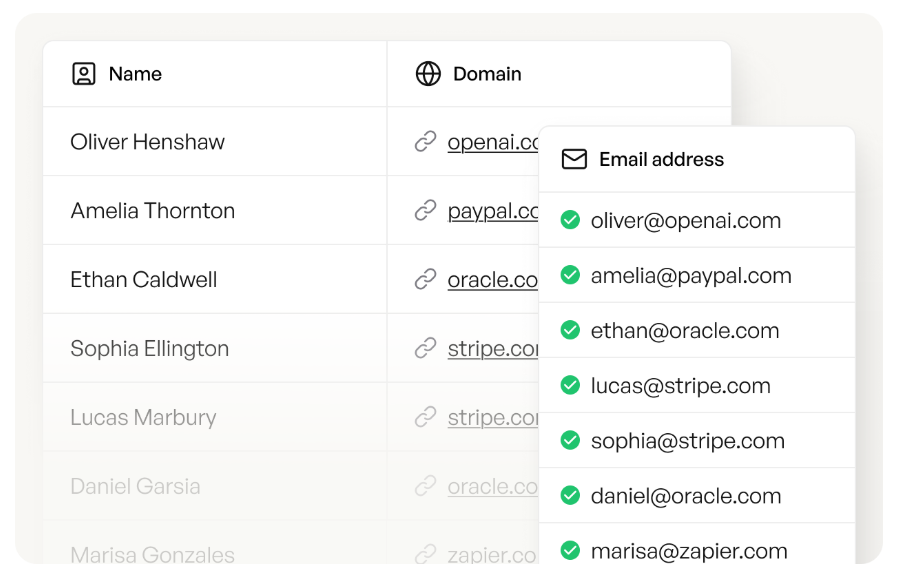
Prospeo is the strongest option we've found for turning a list of business names into actionable contact data. The database covers 300M+ professional profiles with 98% email accuracy and 125M+ verified mobile numbers, all refreshed on a 7-day cycle. You can search using 30+ filters - industry, location, headcount, funding, technographics - and the Chrome extension pulls verified emails from any company website in one click. In our experience, it's the fastest way to go from a Google Maps listing to a deliverable prospect list. Free tier starts at roughly $0.01 per email, no contracts.
Apollo.io is another solid choice, especially for its free plan with up to 1,200 credits per month. Paid plans start at $49/user/month billed annually. Worth noting: their email accuracy sits around 79%, which means more bounces and wasted outreach compared to higher-accuracy platforms. Crunchbase (from $49/mo) skews toward startup and tech company discovery. D&B Hoovers (from $49/mo for 300 credits) is better for firmographic data and credit reporting than direct outreach - skip it if your goal is cold email.
Here's the thing: if your average deal is under $5K, you don't need an enterprise data platform. A free directory search plus a self-serve email finder enrichment tool will outperform any $30K/year contract.
28% of B2B emails go stale every year - and small business contacts churn even faster. Prospeo refreshes every record on a 7-day cycle, so the SMB owner you found on Google Maps yesterday still gets your email tomorrow. 30+ filters for industry, location, and headcount make it easy to target exactly the small businesses you need.
Your Friday deadline doesn't care about stale data. Get 500 verified contacts now.
Industry Associations & Niche Marketplaces
Trade associations maintain member directories that are goldmines for niche prospecting. The National Restaurant Association, the Associated General Contractors of America, local Chambers of Commerce - these directories are curated and current because members pay to be listed.
Specialized marketplaces work similarly. Thumbtack, Etsy, Faire, and Upwork are platforms where small businesses actively list themselves to find customers. If you're targeting a specific vertical like handmade goods, freelance services, or wholesale retail, these give you a pre-qualified list of active businesses. One of our team members built a 200-name prospect list for a client selling POS systems entirely from Faire seller profiles, then enriched the whole batch in about 15 minutes. That kind of workflow beats cold scraping every time - and pairs well with a repeatable prospecting workflow.
If You're Looking to Buy
Roughly 12 million businesses are expected to change hands over the next 10-15 years. The main marketplaces:
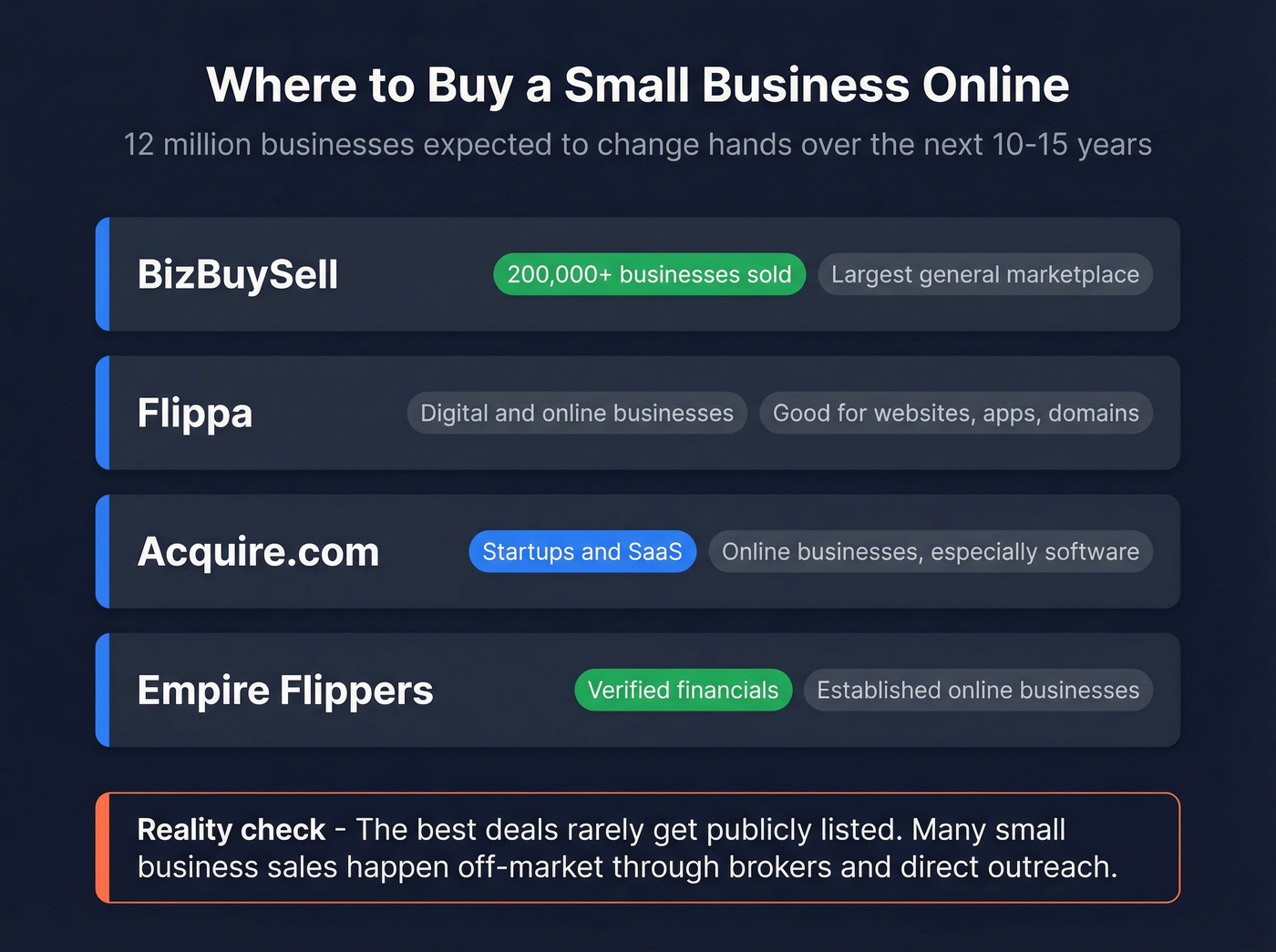
- BizBuySell - one of the largest, with 200,000+ businesses sold to date
- Flippa - digital and online businesses
- Acquire.com - startups and online businesses, especially SaaS
- Empire Flippers - established online businesses with verified financials
Real talk: many small business sales happen off-market through brokers and direct outreach. If you're serious about acquiring, don't limit yourself to marketplaces. The consensus on r/Entrepreneur threads is that the best deals never get publicly listed - and the outreach side looks a lot like modern outbound email campaigns.
FAQ
What's the fastest way to build a small business list?
Start with Google Maps to collect business names by location and category, then enrich that list with a B2B data platform to add verified emails and phone numbers. This two-step workflow takes minutes instead of hours of manual research.
Are Secretary of State business databases free?
Yes. Every U.S. state maintains a free, publicly searchable registry of registered business entities. You'll find entity name, status, registered agent, and filing dates - useful for verifying legitimacy before outreach.
How many small businesses are in the U.S.?
36.2 million as of the most recent SBA Small Business Profiles. They employ nearly 46% of the private-sector workforce and represent 99.9% of all U.S. businesses.
What's the best free tool for finding small business contact data?
Prospeo's free tier gives you 75 email credits and 100 Chrome extension credits per month - enough to build and verify a starter list. Apollo.io offers 1,200 free credits monthly but has lower email accuracy at 79%, which means more bounces and wasted outreach.