

Website Visitor Tracking Comparison: 10 Tools Ranked by Match Rate, Price, and Accuracy
A RevOps lead we know ran a 3-tool bake-off last quarter. The tool with the highest claimed match rate also had the highest bounce rate when reps actually tried to email the "identified" contacts. The cheapest tool outperformed on connect rates. Any website visitor tracking comparison that ignores verification accuracy is just ranking tools by how confidently they lie to you.
Tracking vs. Identification vs. Enrichment
Most articles lump these together. They're three distinct layers, and confusing them is how teams end up paying for the wrong tool.
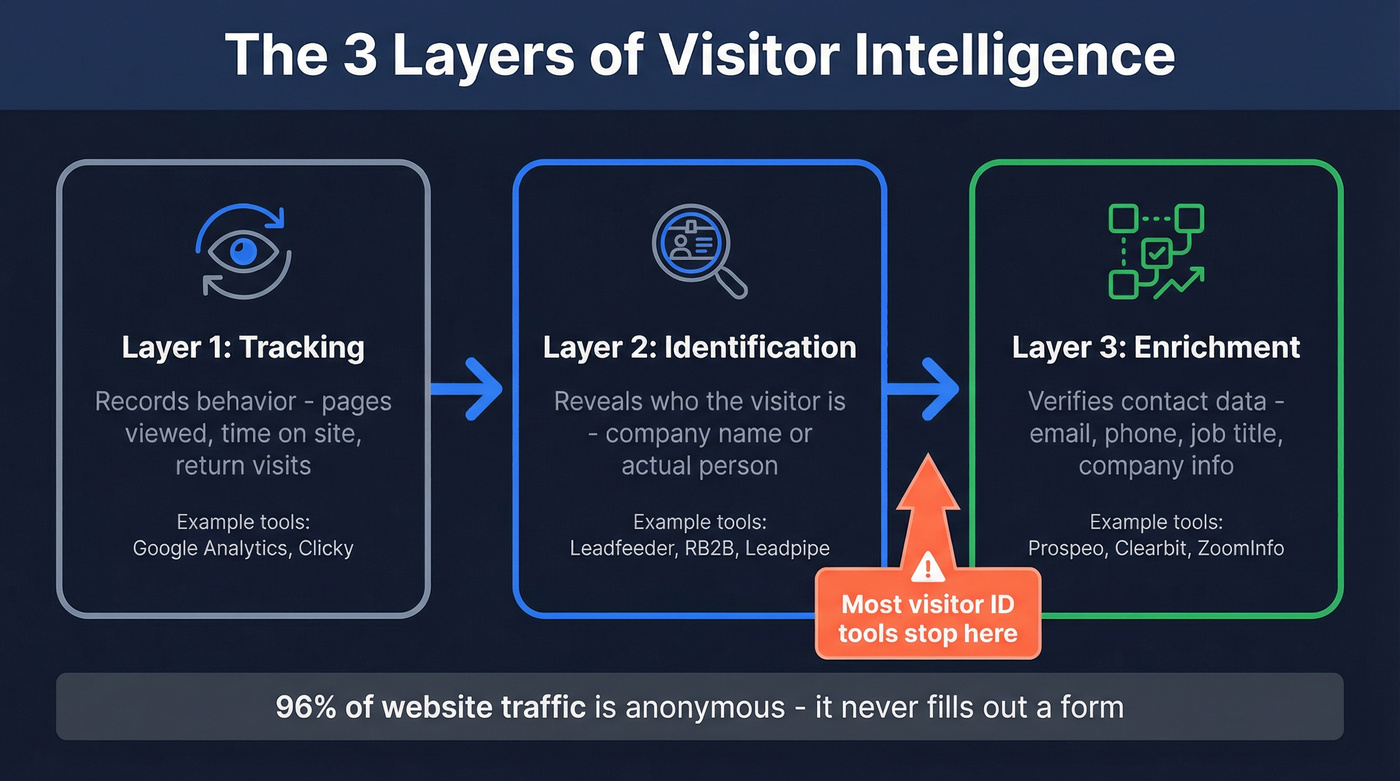
96% of website traffic is anonymous - it never fills out a form. Visitor tracking, identification, and enrichment each solve a different slice of that problem.
| Layer | What It Does | Example Tools |
|---|---|---|
| Tracking | Records behavior: pages viewed, time on site, return visits | Google Analytics, Clicky |
| Identification | Reveals who the visitor is - company or person | Leadfeeder, RB2B, Leadpipe |
Most visitor ID tools stop at layer two. They'll tell you "someone from Acme Corp visited your pricing page." Great. Now what? You still need a verified email and a direct dial to do anything with that signal. That's the enrichment gap, and it's where most teams leak value.
Our Picks
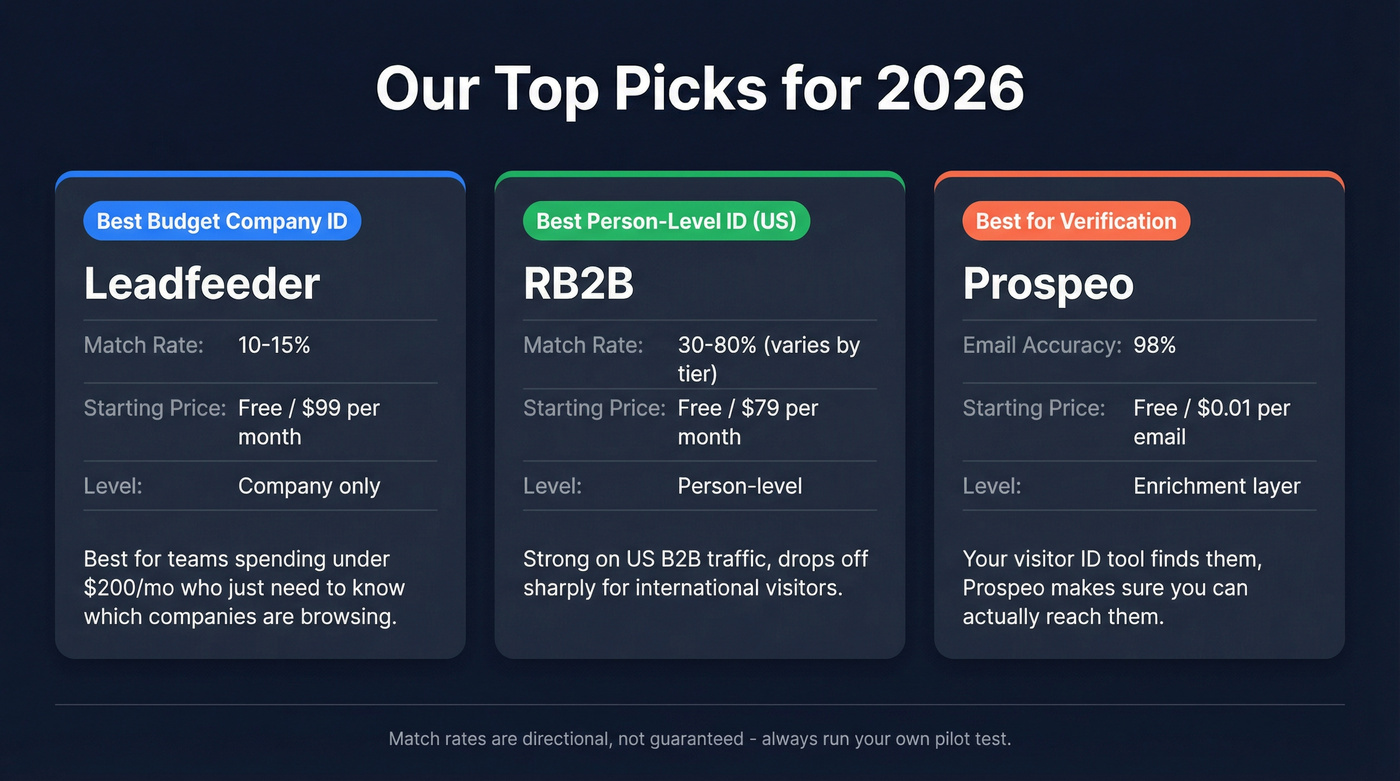
- Best company-level ID on a budget: Leadfeeder - free tier gets you started, paid from $99/mo. Solid for teams that just need to know which companies are browsing.
- Best person-level ID (US traffic): RB2B - Starter is $79/mo (no emails), and Pro starts at $149/mo for business emails + integrations. US-focused, but the match rates are real.
- Best for verifying visitor data before outreach: Prospeo - ~$0.01/email with a free tier (75 emails/mo). Your visitor ID tool finds them; Prospeo makes sure you can actually reach them without torching your domain.
Master Comparison Table
Match rates below draw from a Leadpipe benchmark study describing 6 months of testing across 50,000+ visitors over 90 days. That study is self-published by a vendor with skin in the game, so treat the numbers as directional rather than gospel. Where vendor-reported data differs, we've noted the range.
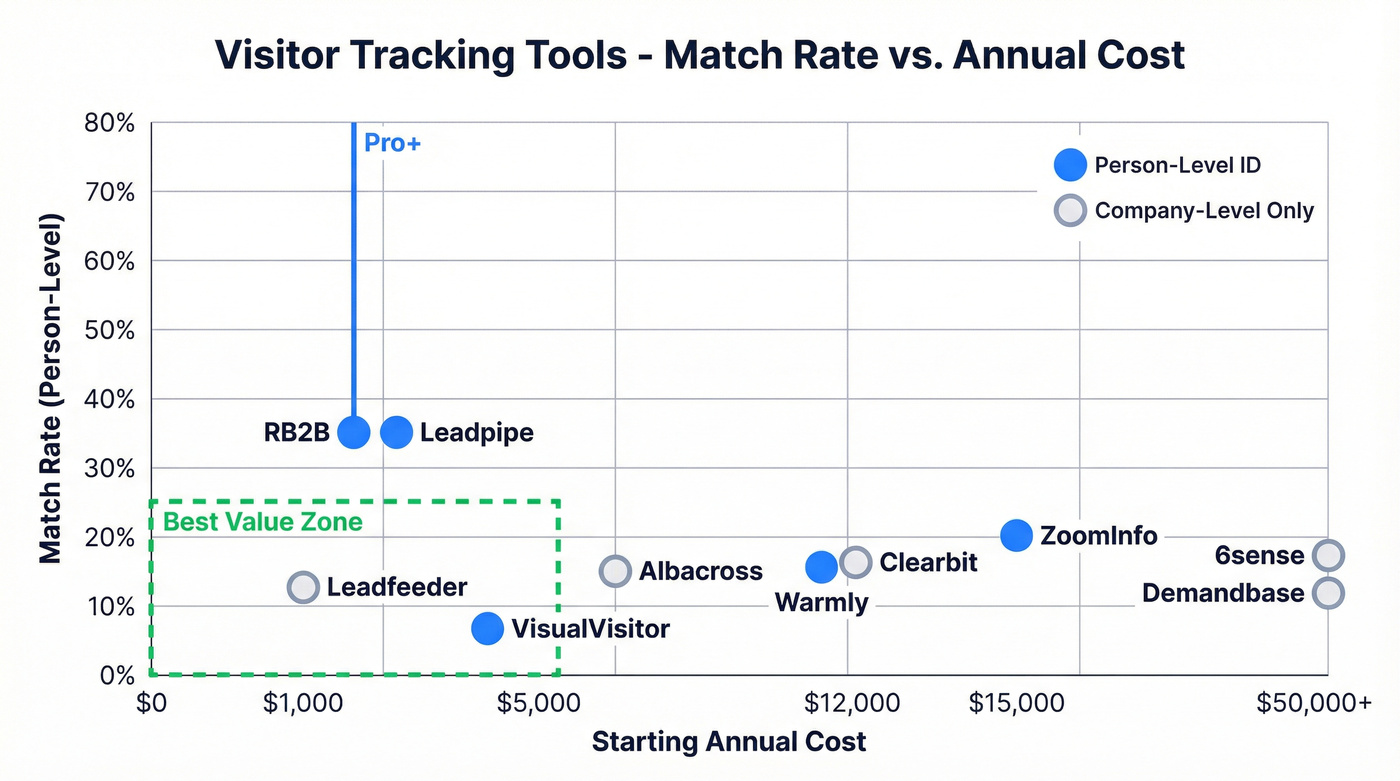
| Tool | Match Rate | Person-Level? | Starting Price | Best For |
|---|---|---|---|---|
| Leadfeeder | 10-15% | No | $99/mo | Budget company-level ID |
| RB2B | 30-40% (Pro), 70-80% (Pro+) | Yes | Free / $79/mo | US person-level ID |
| Leadpipe | 30-40% | Yes | $149/mo | Highest claimed match rate |
| Clearbit (Breeze) | 15-20% | No | ~$12,000/yr | HubSpot ecosystem |
| Warmly | 10-20% | Yes | Free / ~$900/mo | Real-time engagement |
| 6sense | 10-25% | Limited | $50,000+/yr | Enterprise ABM |
| ZoomInfo | 10-30% | Yes | $15,000+/yr | Enterprise all-in-one |
| Demandbase | Varies | Limited | $50,000+/yr | Enterprise ABM |
| Albacross | 10-20% | No | ~$500-$2,000/mo | EU company-level ID |
| VisualVisitor | 5-10% | Yes | $299/mo | Budget person-level |
| VisitorQueue | 10-15% | No | ~$99-$300/mo | SMB company-level |
| VisitorTrack | 10-20% | Yes | ~$150-$500/mo | Quick-setup ID |
Best Visitor Tracking Tools in 2026
Leadfeeder - Budget Company-Level ID
Leadfeeder (now part of Dealfront) is the default starting point for teams that want to know which companies are visiting their site without committing serious budget.

The free plan has no time limit - you get 100 identified companies, 7 days of data retention, and unlimited users. Paid plans start at $99/mo (annual) with unlimited data storage and user seats, priced per website rather than per seat, which makes it unusually affordable for larger teams. Leadfeeder handles remote-worker IP identification better than most IP-based tools by pulling from multiple data sources, and it's GDPR compliant with disclosure requirements similar to Google Analytics.
The limitations are predictable for an IP-based tool. Company-level only - you'll know Acme Corp visited your pricing page, but not which person. Match rates sit in the 10-15% range. The free tier's 7-day data window means you'll miss patterns if you don't check daily.
For teams spending under $200/mo on visitor intelligence, Leadfeeder is the obvious first tool to deploy.
RB2B - Best Person-Level ID (US)
Use this if: Your traffic is primarily US-based and you want actual names and business emails attached to visits, not just company logos.
RB2B's pricing structure is credit-based and tiered aggressively. The free plan gives you 150 monthly resolutions at company-level only, with Slack as the sole output - no email addresses, no CRM integrations. Starter ($79/mo, 300 resolutions) adds LinkedIn URLs delivered to Slack, but still no email addresses. Overages on Starter run $0.45/resolution. Running multiple sites? The additional domains add-on is $99/mo for up to five.
The real product starts at Pro (from $149/mo, starting at 600 resolutions), which unlocks business emails and integrations with HubSpot, Salesforce, and Clay. Pro+ (from $199/mo) bumps identification to 70-80% on average with "Premium Resolution" that expands coverage beyond standard US traffic. Overages drop to $0.25/resolution on Pro and Pro+.
The general pattern with RB2B: strong performance on US B2B traffic that drops off sharply for international visitors. If your site gets meaningful EU or APAC traffic, RB2B won't cover it. Don't judge the product by the free tier - it's a demo, not a workflow.
Skip this if: You sell internationally, or your site traffic is heavily non-US. Also skip if you need behavior tracking - RB2B identifies visitors but doesn't track on-site behavior.
Leadpipe - Highest Claimed Match Rate
Leadpipe positions itself as the match-rate leader, and their own benchmark data backs it up - 30-40% person-level identification across 50,000+ visitors over 90 days. Setup takes about 2 minutes via a JavaScript pixel, and the Starter plan runs $149/mo for 500 identified visitors. The agency plan scales to $1,270/mo for 20,000.
Here's the thing: that benchmark study is self-published. Nobody has independently verified these match rates against a neutral dataset. Leadpipe is also a relatively new entrant with less integration depth than established players, and there's no free tier to test before committing. Treat the 30-40% as a ceiling on high-volume US traffic, not a guarantee for your specific visitor mix. Run a paid pilot on your own site before signing an annual deal.
Clearbit (Breeze) - HubSpot Power Users
Use this if: You're already deep in HubSpot and want visitor identification baked into your existing stack. Clearbit is sold inside HubSpot as Breeze Intelligence - it's positioned as a native add-on rather than a standalone visitor ID tool.
Match rates run 15-20%, company-level only. No person-level identification. At ~$12,000/yr, it isn't cheap for what you get, but the value is in the tight HubSpot integration rather than raw identification power.
Skip this if: You're not on HubSpot, or you need person-level data. Better standalone options exist at lower price points.
Warmly - Real-Time Engagement
Warmly differentiates by combining visitor identification with real-time engagement - automated chat triggers and live visitor alerts when target accounts hit your site. Match rates sit in the 10-20% range with person-level identification available.
There's a free tier for testing, but the paid product starts around $900/mo, which puts it in a different budget category entirely. The real-time engagement features justify the premium if your sales motion involves live chat or instant outreach. If you just want a list of who visited, you're overpaying.
6sense - Enterprise ABM
6sense is an ABM platform that happens to include visitor identification, not the other way around. At $50,000+/yr with an enterprise sales process, it's overkill for any team under 100 employees. The visitor ID component offers limited person-level data - the real value is in intent signals and account scoring across 10-25% of traffic depending on configuration. If you're running a full ABM motion with dedicated ops resources, 6sense is worth evaluating. Everyone else should look elsewhere.
ZoomInfo - Enterprise All-in-One
ZoomInfo offers visitor identification as part of its broader GTM platform. Person-level ID is available with match rates in the 10-30% range depending on configuration, but you're buying it bundled with a $15,000+/yr data platform, intent data, and workflow tools you don't need if visitor ID is your primary goal.
If you're already paying for ZoomInfo, use the visitor tracking feature. If you're shopping specifically for visitor ID, there are far more cost-effective options.
The Rest
Demandbase is 6sense's enterprise ABM competitor. $50,000+/yr, limited person-level ID, heavy on intent and advertising. Skip unless you're running enterprise ABM with a six-figure martech budget.
Albacross focuses on EU company-level identification at ~$500-$2,000/mo depending on volume. Solid for European traffic, weaker on US coverage. Worth a look if your audience is primarily EMEA.
VisitorQueue is budget-friendly at ~$99-$300/mo with company-level identification and basic lead scoring. Good for small teams testing the category without major commitment. The consensus in B2B forums like r/sales is generally positive on ease of setup but lukewarm on match rates.
VisualVisitor offers person-level ID at $299/mo, but match rates of 5-10% make the cost-per-identified-visitor math unfavorable. Test carefully before committing.
VisitorTrack claims 30-second setup and uses a ZoomInfo partnership for data enrichment. Pricing runs ~$150-$500/mo. Identification-only - no on-site behavior tracking.

Every tool on this list has the same gap: match rates mean nothing if the emails bounce. Prospeo closes the enrichment layer with 98% email accuracy, 125M+ verified mobiles, and a 7-day data refresh cycle. Pipe your identified visitors through Prospeo's API and get 50+ verified data points back per contact - starting at $0.01/email.
Stop paying for visitor IDs you can't actually email.
What Match Rates Actually Mean
Most tools oversell match rates. Here's what's happening under the hood.
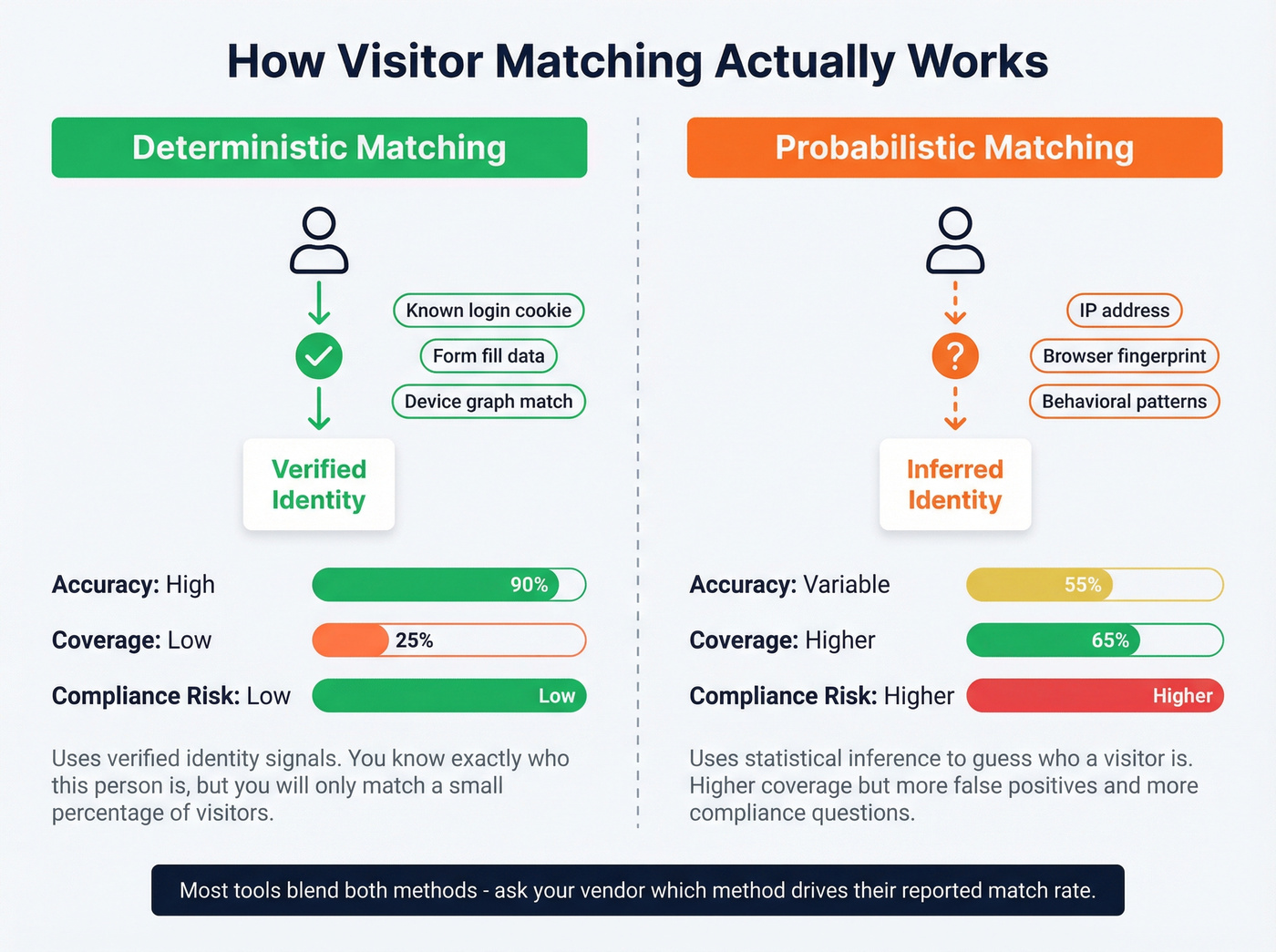
Deterministic matching uses verified identity signals - a cookie from a known login, a form fill, a device graph match. It's accurate but limited in reach. Probabilistic matching uses statistical inference - IP address, browser fingerprint, behavioral patterns - to guess who a visitor is. Higher coverage, higher false-positive rate, and more compliance risk.
| Tool | Company-Level Rate | Person-Level Rate | Primary Method |
|---|---|---|---|
| Leadfeeder | 10-15% | N/A | Reverse IP |
| RB2B (Pro) | Included | 30-40% | Identity resolution |
| RB2B (Pro+) | Included | 70-80% | Premium resolution |
| Leadpipe | Included | 30-40% (claimed) | Identity resolution |
| Clearbit (Breeze) | 15-20% | N/A | Reverse IP + enrichment |
| Warmly | 10-20% | Available | Hybrid |
| 6sense | 10-25% | Limited | Probabilistic + intent |
| ZoomInfo | 10-30% | Available | Hybrid |
| Albacross | 10-20% | N/A | Reverse IP |
| VisualVisitor | 5-10% | Available | Identity resolution |
Remote work has crushed IP-based identification accuracy. When half your visitors are on home Wi-Fi or VPNs, reverse-IP lookup - the backbone of company-level tools - misses them entirely. Person-level tools using device graphs and identity resolution fare better, but they're more expensive and raise more compliance questions.
The California Delete Act deletion mechanism launched January 1, 2026, letting consumers submit a single request to delete their data from all registered data brokers. This directly degrades the identity graphs these tools rely on. Expect your actual match rates to land at the low end of vendor claims, especially if your traffic skews international or remote-heavy.
Real-World Cost Breakdown
| Tool | Plan | Price |
|---|---|---|
| Leadfeeder | Free / Paid | $0 / from $99/mo |
| RB2B | Free / Starter / Pro / Pro+ | $0 / $79/mo / $149/mo / $199/mo |
| Leadpipe | Starter / Agency | $149/mo / $1,270/mo |
| Clearbit (Breeze) | Annual | ~$12,000/yr |
| Warmly | Free / Paid | $0 / ~$900/mo |
| 6sense | Enterprise | $50,000+/yr |
| ZoomInfo | Enterprise | $15,000+/yr |
| Demandbase | Enterprise | $50,000+/yr |
| Albacross | Volume-based | ~$500-$2,000/mo |
| VisitorQueue | Tiered | ~$99-$300/mo |
| VisitorTrack | Tiered | ~$150-$500/mo |
| VisualVisitor | Flat | $299/mo |
| Prospeo | Pay-as-you-go | ~$0.01/email, free tier |
The budget stack we'd recommend for teams spending under $500/mo: Leadfeeder paid ($99) for company-level identification, RB2B Pro ($149) for person-level US traffic, and Prospeo (~$50 at volume) for verification and enrichment. That's under $300/mo for a complete identify-and-reach pipeline. Compare that to a single ZoomInfo contract.
Questions to Ask Vendors
Most comparison articles skip the questions that actually matter during evaluation. Before you sign anything, get clear answers on these five:
- False-positive rate. A 30% match rate means nothing if 40% of those matches are wrong. Ask for false-positive benchmarks, not just match rates.
- Overage pricing. RB2B charges $0.25-$0.45 per resolution over your plan cap. Other tools bury overage costs in contracts. Get the number in writing.
- Data retention policy. How long does the vendor store your visitors' data? This matters for CCPA and GDPR compliance.
- Opt-out handling. When a visitor opts out, how fast does the tool suppress their data? Slow suppression creates legal exposure.
- Integration depth. "Integrates with HubSpot" can mean native bi-directional sync or a one-way webhook. Ask for specifics.
Is Visitor Tracking Legal in 2026?
The US has no comprehensive federal privacy law - just a patchwork of state regulations that keep shifting. Three things matter for visitor identification buyers right now.
CCPA applies to B2B data. Unlike most state privacy laws, California's CCPA covers business contacts. Enforcement by the California Privacy Protection Agency has been active since March 2024. If you're identifying California visitors, you need compliant consent flows.
The Delete Act deletion mechanism launched January 1, 2026. California consumers can now submit a single request to delete their data from all registered data brokers. This affects the identity graphs that visitor ID tools rely on - and it will only expand to more states.
Wiretap lawsuits are real. Law firms are still actively suing under CIPA and the Wiretap Act. Opt-in consent is the safest legal basis for tracking - closing a banner doesn't count as consent under opt-in frameworks.
For EU traffic, GDPR requires explicit consent before any identification. Most tools in this guide are US-focused for a reason.
The Verification Gap
We watched a team pull 2,400 identified visitors from their ID tool last quarter. They pushed the emails straight into an outreach sequence. 35% bounced. Their domain reputation tanked, and it took weeks to recover deliverability.
This is the gap nobody talks about in a visitor tracking comparison. "Identified" doesn't mean "actionable." B2B contact records decay at roughly 30% per year - job changes, company moves, email migrations. The email your visitor ID tool captured might have been valid when it was indexed. By the time your SDR hits send, it's a bounce waiting to happen.
Run every identified contact through a verification layer before it touches a sequence. At ~$0.01/email, verification costs are trivial compared to the thousands it takes to rebuild a burned sender reputation. The math isn't close.
If you're building a full outbound motion around this, pair verification with an email deliverability checklist and a plan to prevent email blacklisting before you scale volume.
The RevOps teams winning this game don't pick one tool - they stack identification with verification. Feed visitor data from RB2B, Leadpipe, or Leadfeeder into Prospeo's enrichment API (92% match rate) and get verified emails, direct dials, and intent signals back in real time. Free tier includes 75 emails/month.
Bridge the enrichment gap before your reps burn another domain.
FAQ
What's the difference between tracking and identification?
Tracking records behavior - pages viewed, session duration, return visits. Identification reveals who the visitor actually is, attaching a company name or individual contact details without requiring a form fill. Google Analytics tracks; the tools in this guide identify. Most teams need both layers working together.
What match rate should I expect?
For US B2B traffic, 10-20% company-level identification is typical. Person-level tools range from 5-40% depending on the tool, traffic volume, and geographic mix. Vendor claims of 30-40% represent best-case scenarios on high-volume US sites - run a paid pilot on your own traffic before committing annually.
Is website visitor identification legal?
In the US, yes - with caveats. CCPA covers B2B data in California with active enforcement since March 2024. Wiretap laws like CIPA create real lawsuit risk without proper consent. Opt-in consent banners are the safest approach. For EU traffic, GDPR requires explicit consent before any identification.
How do I verify contacts from visitor ID tools?
Run identified contacts through an email verification tool before adding anyone to outreach sequences. Skipping verification risks bounces that damage your sender reputation - teams routinely see 30%+ bounce rates on unverified visitor data. A 5-step verification process with catch-all handling and spam-trap removal is the minimum standard you should expect from any verification provider.
What matters most in a visitor tracking comparison?
Focus on four things: match rates tested on traffic similar to yours (not vendor benchmarks), person-level vs. company-level identification, total cost including overages, and whether the tool verifies contact data or just surfaces it. A tool that identifies 1,000 visitors but gives you 350 bounced emails is worse than one that identifies 500 with 98% deliverability.