Email Opening Lines That Get Replies: 2026 Data, Frameworks, and Examples
The average cold email reply rate in 2026 is 3.43%. For every 100 emails you send, roughly 97 people ignore you. The top 10% of senders hit 10.7%+ reply rates - a little over three times the average. That gap isn't about better templates or cleverer subject lines. It's signal-based personalization in your opening line, backed by data that actually reaches inboxes. The email opening lines that get replies share one trait: they prove you know something specific about the person reading them.
Let's break down how to close that gap.
Why Your Opening Line Carries the Weight
58% of all replies come from the first email. Not the follow-up. Not the third touch. The first one.
The mechanics are straightforward. The average professional receives 121 emails per day, and your email lands in a stack where the recipient sees three things: sender name, subject line, and preview text. That preview text is your opening line. A poll conducted by Mixmax found 34% of recipients say preview text is almost as important as the subject line when deciding whether to open.
Once they do open, you've got about six seconds before they decide to keep reading or hit delete. That's the attention window Fundraise Insider documents for cold outreach. Your opening line is the audition. Everything after it - your value prop, your CTA, your PS line - only matters if the opener earns the next sentence.
The Personalization Ladder
Not all personalization is equal. A first name token isn't personalization - it's a mail merge. Real personalization exists on a spectrum, and reply rates scale with each step up.
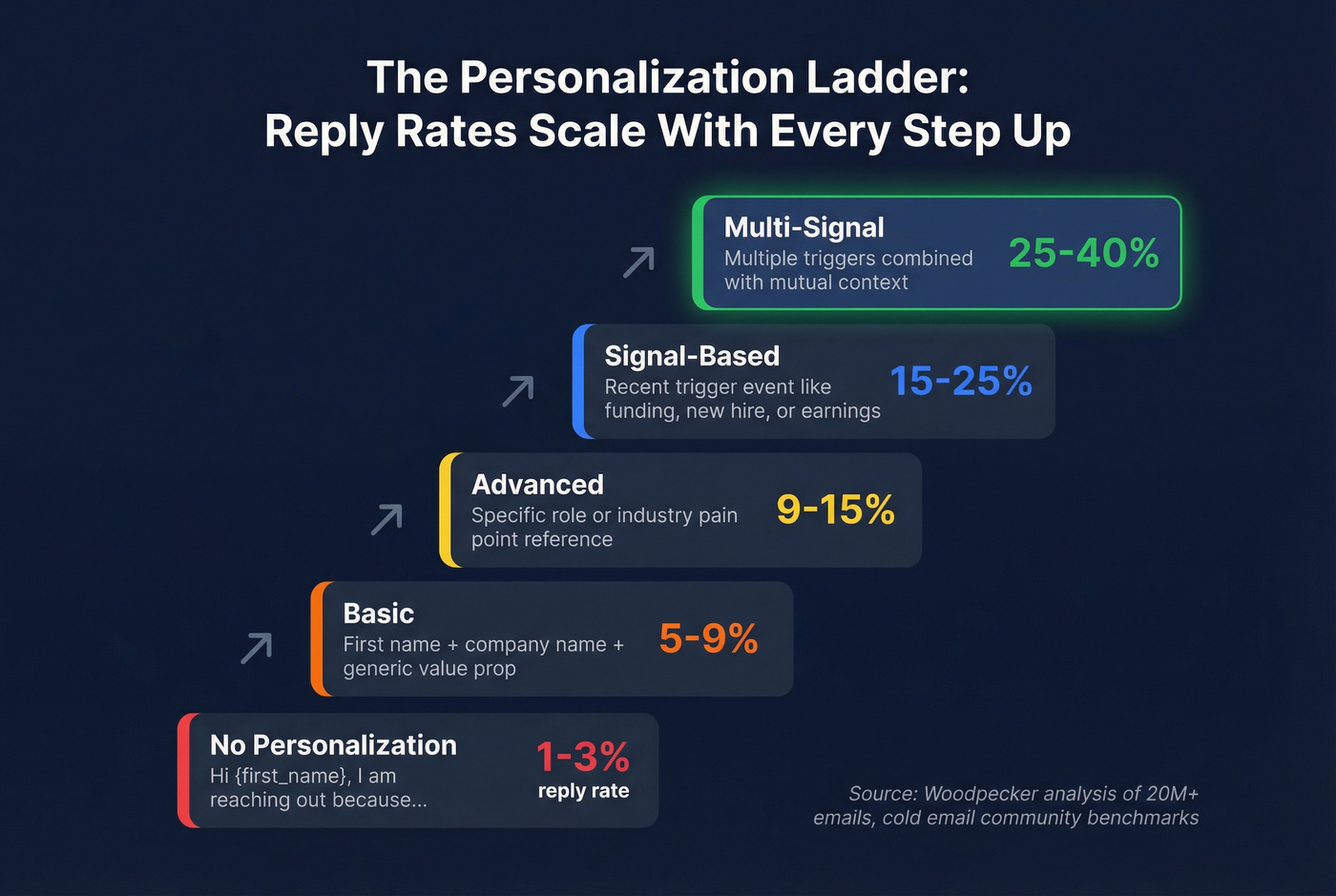
| Personalization Level | What It Looks Like | Expected Reply Rate |
|---|---|---|
| None | "Hi {first_name}, I'm reaching out because..." | 1-3% |
| Basic | First name + company name + generic value prop | 5-9% |
| Advanced | Specific role/industry pain point reference | 9-15% |
| Signal-based | Recent trigger event (funding, hire, earnings) | 15-25% |
| Multi-signal | Multiple triggers + mutual context | 25-40% |
A Woodpecker analysis of 20M+ emails found that advanced personalization in opening lines achieved a 17% response rate versus 7% for non-personalized emails. That's not a marginal lift - it's nearly 2.5x. The consensus across cold email communities on Reddit tracks with this: trigger-based openers outperform compliment-based ones by 2-3x, and generic "I noticed your company..." lines barely beat no personalization at all.
Every rung you climb roughly doubles your reply rate. The jump from "none" to "basic" is easy. The jump from "basic" to "signal-based" is where most teams stall, because it requires actual data about what's happening at the prospect's company right now. We'll come back to how to solve that.
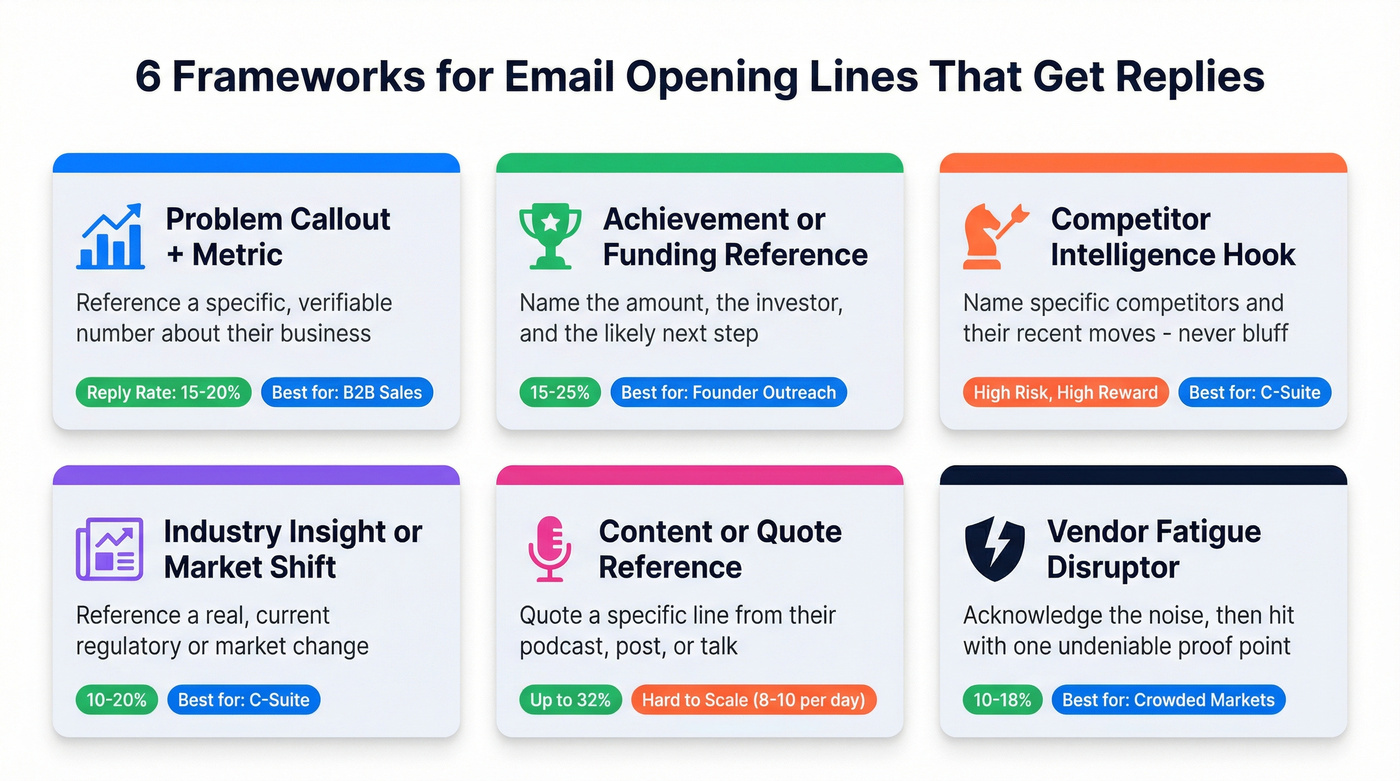
Six Frameworks for Openers That Earn Replies
Templates are a crutch. Frameworks are a tool. The difference: a template gets copied verbatim until it stops working, while a framework gives you a structure to fill with real signals. Here are six frameworks with the context for when each one hits - and when it backfires.
Problem Callout With a Specific Metric
"{{first_name}}, your careers page has had 14 open SDR roles for 6+ weeks - that's a lot of pipeline not getting built. We helped [similar company] cut that ramp gap in half."
The opener here isn't "I noticed you're hiring." It's a specific count (14 roles) and a specific duration (6+ weeks) that signals genuine homework. We've seen this framework consistently produce 15-20% reply rates in B2B sales when the metric is real and verifiable. The most common mistake? Using a vague metric like "growing fast" instead of a number. If you can't find a specific number, use a different framework.
Recent Achievement or Funding Reference
"Congrats on the $18M Series B led by Accel, {{first_name}}. If scaling the sales team is next on the list, we've helped 3 post-Series B companies build outbound engines that hit quota within 90 days."
"Congrats on the funding" is generic. Naming the amount, the lead investor, and connecting it to a likely next step - that's signal-based. Best for founder outreach and partnership requests, where the recipient expects you to understand their trajectory.
Competitor Intelligence Hook
This one is high-risk, high-reward.
When it works, it triggers competitive instinct and implies insider knowledge worth hearing. When it's vague, it backfires badly.
"{{first_name}}, two of your direct competitors rolled out AI-powered onboarding in Q4. I don't know if that's on your roadmap, but we helped [competitor-adjacent company] ship theirs in 6 weeks."
If you can't name the competitors or the specific move, skip this framework entirely. A vague competitor reference reads as a bluff, and the prospect mentally files you under "never respond."
Industry Insight or Market Shift
"{{first_name}}, the new FTC enforcement guidelines on subscription cancellation hit in March. Most SaaS billing teams we talk to aren't ready. Here's what [similar company] did to get ahead of it."
This positions you as a peer who reads the same reports they do, not a vendor reading from a script. Best for C-suite outreach where the prospect expects strategic thinking. You need to reference something real and current - a regulatory change, a market trend, a shift in buyer behavior. Stale insights are worse than no insight.
Content or Quote Reference
The hardest framework to scale, but the highest-converting when done right. One SDR team we spoke with reported a 32% reply rate on podcast-reference openers - but they could only send 8-10 per day because each required manual research.
"{{first_name}}, your comment on Lenny's podcast about PLG metrics being 'vanity math for boards' stuck with me. We've been building something that addresses exactly that gap - would love 15 minutes to show you."
The reference has to be real and specific. "I loved your recent post" is transparent flattery. Quoting a specific line from a specific piece of content is proof of attention.
Vendor Fatigue Disruptor
"{{first_name}}, you probably got 3 emails this week from companies claiming to 'transform your outbound.' I won't do that. I'll just share one metric: we cut [similar company]'s bounce rate from 38% to under 4%, and their pipeline went up 140%."
This works in crowded markets where prospects are numb to pitches. The honesty catches them off guard. Best when you have a genuinely strong proof point to follow the disarm - without one, the self-awareness reads as gimmick.

Signal-based opening lines need signal-based data. Prospeo tracks buyer intent across 15,000 topics, flags job changes, funding rounds, and headcount growth - the exact triggers that turn a 3% reply rate into 25%. With 98% email accuracy and a 7-day data refresh, your personalized opener actually reaches the inbox.
Stop writing great openers to bad email addresses.
Opening Lines by Use Case
Reply rates vary dramatically by context. What's "excellent" for cold B2B sales would be mediocre for recruiting outreach. Here's how to calibrate expectations.
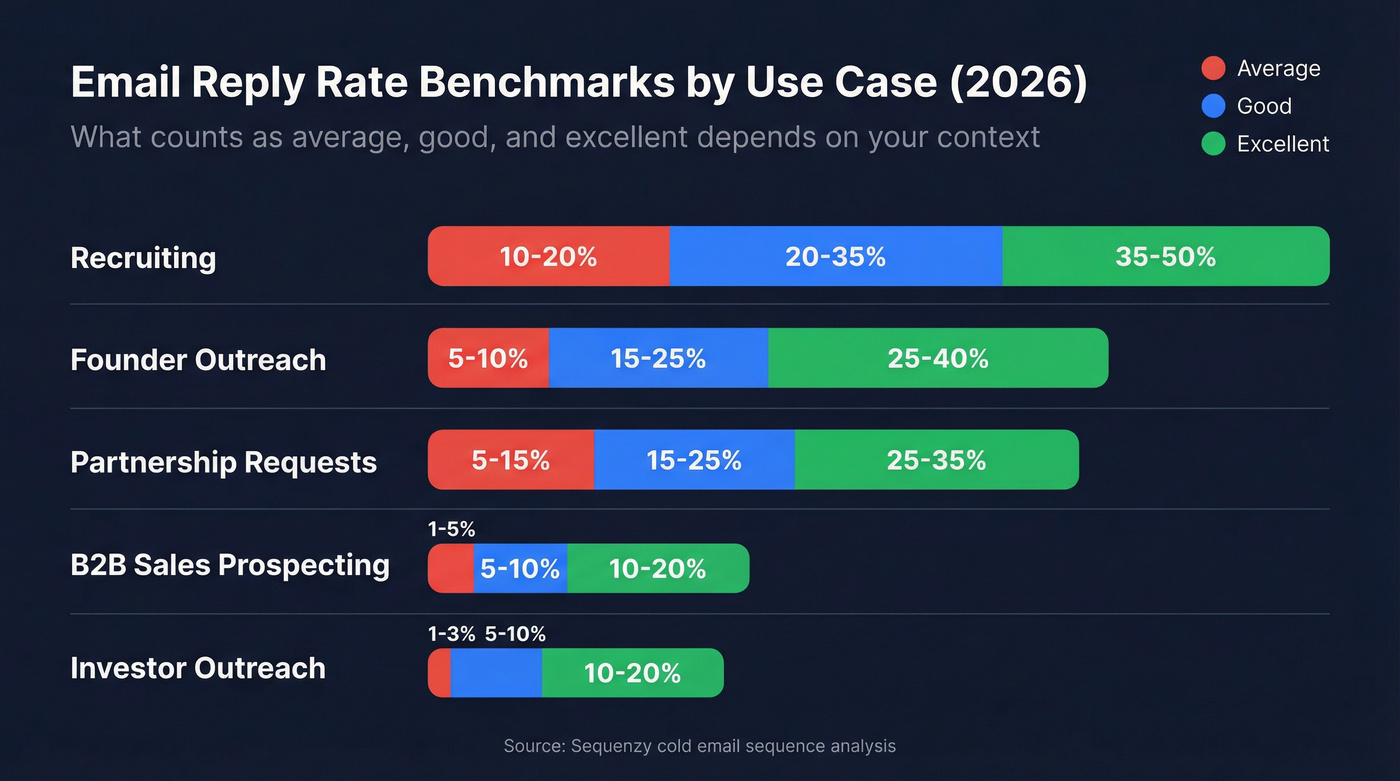
| Use Case | Average | Good | Excellent |
|---|---|---|---|
| B2B sales prospecting | 1-5% | 5-10% | 10-20% |
| Founder outreach | 5-10% | 15-25% | 25-40% |
| Partnership requests | 5-15% | 15-25% | 25-35% |
| Investor outreach | 1-3% | 5-10% | 10-20% |
| Recruiting | 10-20% | 20-35% | 35-50% |
These benchmarks come from Sequenzy's cold email sequence breakdown.
B2B sales prospecting has the widest range because targeting quality matters as much as copy. A problem-callout opener works well here: "{{first_name}}, your G2 reviews mention onboarding as the #1 complaint - we helped [similar company] cut onboarding time by 60%."
Founder outreach converts well because founders are wired to respond to relevant opportunities. Lead with their trajectory: "{{first_name}}, [Company] went from 12 to 45 employees in 8 months - that kind of growth usually breaks at least one internal system. Which one's creaking?"
Partnership requests need mutual value signaled immediately: "{{first_name}}, your integration marketplace has 40+ partners but nothing for [category]. We'd fill that gap and drive installs from our 15K user base."
Investor outreach has the lowest ceiling because investors are the most pitched humans on earth. Skip the flattery, lead with traction: "{{first_name}}, [Company] just crossed $2M ARR with zero paid acquisition. If capital efficiency is what your fund optimizes for, I'd love 15 minutes."
Recruiting has the highest baseline because the value exchange is clear - you're offering someone a job: "{{first_name}}, your engineering team shipped 3 major releases in Q4 - clearly you've built something special. We're working with a senior backend engineer who'd fit right in."
Lines That Kill Your Reply Rate
Some opening lines are so overused they've become mental spam filters. The prospect reads the first five words and their brain files it under "cold email, ignore."
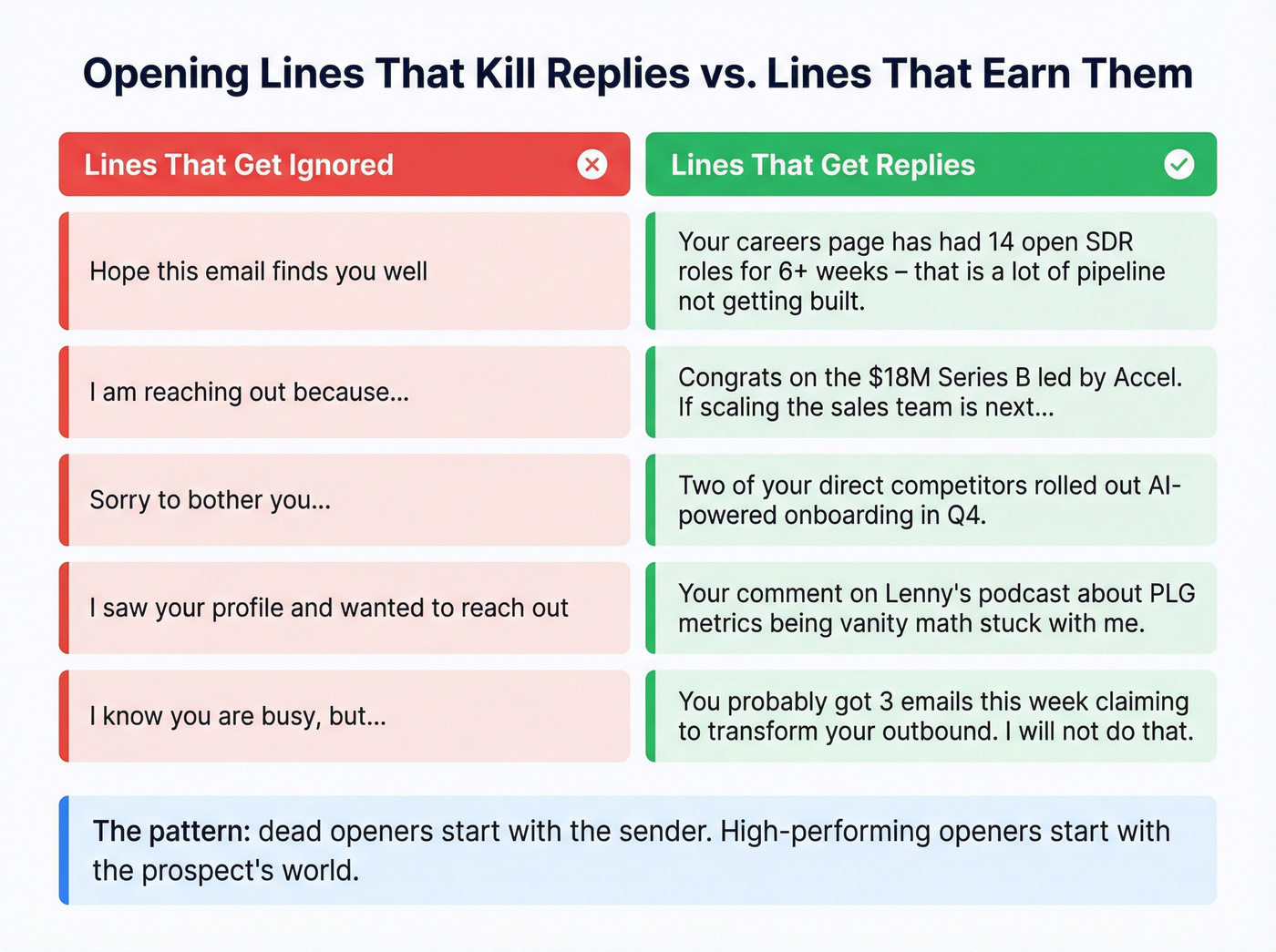
- "Hope this email finds you well" - it finds them annoyed.
- "I'm reaching out because..." - you're announcing that you're cold emailing. They already know.
- "Sorry to bother you..." - apologizing before you've said anything signals low confidence and low value.
- "Just following up..." - as a first-touch opener, this is a lie. As a follow-up, it adds nothing.
- "I know you're busy, but..." - acknowledging their busyness doesn't earn you their time. A relevant signal does.
- "I saw your profile and wanted to reach out" - this signals mass scraping, not genuine research.
The pattern across all of these: they're about you, not them. Every dead opener starts with the sender's perspective. Every high-performing opener starts with the prospect's world.
Your Opener Is Worthless If Your Data Is Bad
Here's the thing nobody writing "best cold email opening lines" articles wants to confront: if your emails are bouncing, no opening line on earth will save you. Most teams burning hours on copy optimization are sending to addresses that bounce, roles that changed six months ago, or contacts who left the company entirely. Fix the foundation first.
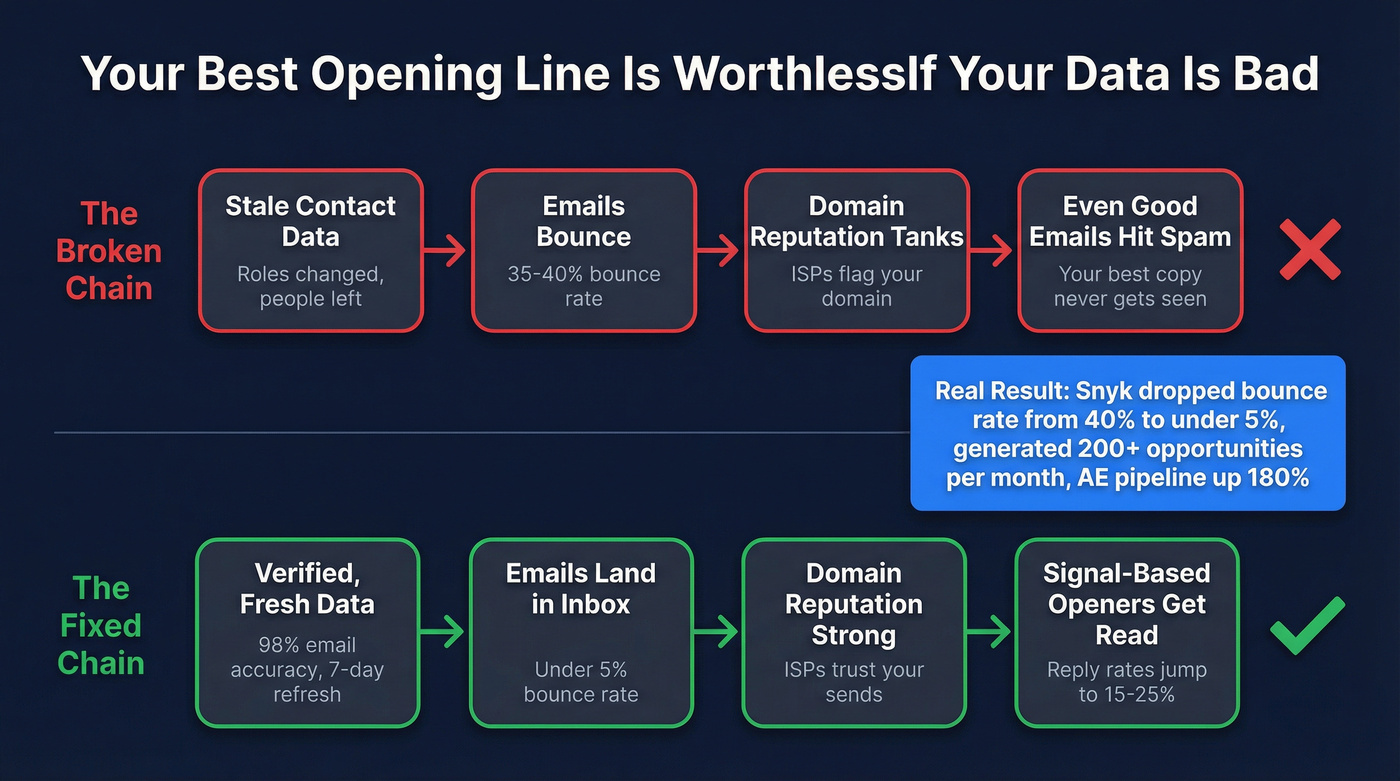
When Snyk's 50-person AE team was running outbound, their bounce rate sat at 35-40%. Four out of every ten emails never reached an inbox. They could've had the best opening lines in B2B sales - it wouldn't have mattered. After switching to Prospeo's verified data, their bounce rate dropped under 5%, and they generated 200+ new opportunities per month with AE-sourced pipeline up 180%.
The chain works like this: stale data leads to bounced emails, which damages your domain reputation, which pushes future emails to spam - even your good emails stop getting seen. Bulk-sender rules tightened starting in early 2024, and by 2025 enforcement got stricter across major inbox providers. SPF/DKIM/DMARC authentication, one-click unsubscribe, bounce rates under 2%, and spam complaints under 0.3% aren't "nice-to-haves" anymore. In 2026, they're table stakes.

How to Test Your Opening Lines
Writing great openers is half the equation. Testing them is the other half.
Change one variable at a time. If you're testing a problem-callout opener against a competitor-intelligence opener, keep the subject line, CTA, and send time identical. You need a minimum of 50 sends per variant - anything less and you're reading noise, not signal. (If you want the math, use this A/B test framework.)
Track reply rate, not open rate. Opens are vanity. Replies are pipeline. Personalized subject lines lift opens ~26%, but that doesn't mean they lift replies. If you're still optimizing for opens, start with open rate vs click rate to align on the right metrics.
Keep first-touch emails under 80 words. The top-performing first-touch emails in 2026 are short and specific. Your opener should be one sentence, not a paragraph. If you need a structure, use a proven sales email structure.
Test weekly. The best-performing senders A/B test their messaging every week. Expect winning variants to deliver a 10-30% relative lift. The biggest bottleneck in testing isn't methodology - it's personalization data. You can't write signal-based openers at scale if you're manually researching every prospect. Tools like Prospeo's enrichment API return 50+ data points per contact, including job changes, company funding, headcount growth, and technographic signals. That's the raw material for personalization without three-hour research sessions. (For a deeper workflow, see data enrichment for cold email.)
The personalization ladder stalls at 'basic' when your data is stale. Prospeo refreshes 300M+ profiles every 7 days - not every 6 weeks like competitors - so the funding round, the open roles, and the tech stack you reference in your opener are current. Teams using Prospeo book 35% more meetings than Apollo users.
Fresh signals make every opening line hit harder.
FAQ
How long should a cold email opening line be?
One sentence, under 15 words. The full first-touch email should stay under 80 words - top performers in 2026 keep it short and specific. Your opener earns the next sentence, not the next paragraph.
What's the best day to send cold emails?
Tuesday and Wednesday see the highest reply rates in 2026 benchmark data, with Wednesday edging out slightly. Avoid Monday mornings and Friday afternoons. Send between 8-10 AM in the recipient's local time zone for best results.
How many follow-ups should I send?
Plan 5-7 total touches spaced 3-7 days apart. 42% of replies come from follow-ups, not the first email. Each follow-up should add new value or a new angle - repeating "just checking in" tanks your credibility fast.
Does email verification actually affect reply rates?
Directly and measurably. High bounce rates damage your domain reputation, pushing future emails to spam - even well-written ones. Keeping bounce rates under 2% is the threshold for healthy deliverability. A 7-day data refresh cycle, versus the 6-week industry average, means you're reaching people at their current role instead of bouncing off dead inboxes.
What free tools help personalize cold email openers at scale?
Prospeo offers 75 free verified emails per month plus 100 Chrome extension credits - enough to test signal-based openers on a real list. Pair that with free tiers from sequencing tools like Instantly or Lemlist to run A/B tests without upfront cost.