The EdTech Go-to-Market Strategy Playbook for 2026
Your CEO just asked why the K-12 pipeline hasn't moved in six months. You've got a solid product, decent demos, and a sales team that knows the space. The problem isn't effort - it's timing, proof, and process.
EdTech is a $189B market headed toward $589B by 2034 at a 13.45% CAGR, and most teams fumble their go-to-market strategy because they treat education like any other vertical. It isn't. K-12 digital penetration remains below 5% of total spending. The runway is massive, but only if you run it correctly.
The Short Version
- EdTech GTM in 2026 is proof-led, not product-led. Lead with outcomes data, not feature lists. Decision-makers want to know what changes in 12 months.
- Time your outbound to the procurement calendar. K-12 budgets typically finalize in late spring. The E-Rate FY2026 Form 471 window closes April 1, 2026. Miss it and you're waiting another year.
- Know your unit economics. The EdTech LTV:CAC benchmark is 5:1 (LTV around $7,100, CAC around $1,431). If your ratio is below 3:1, fix your funnel before you scale spend.
The Sales Cycle Reality
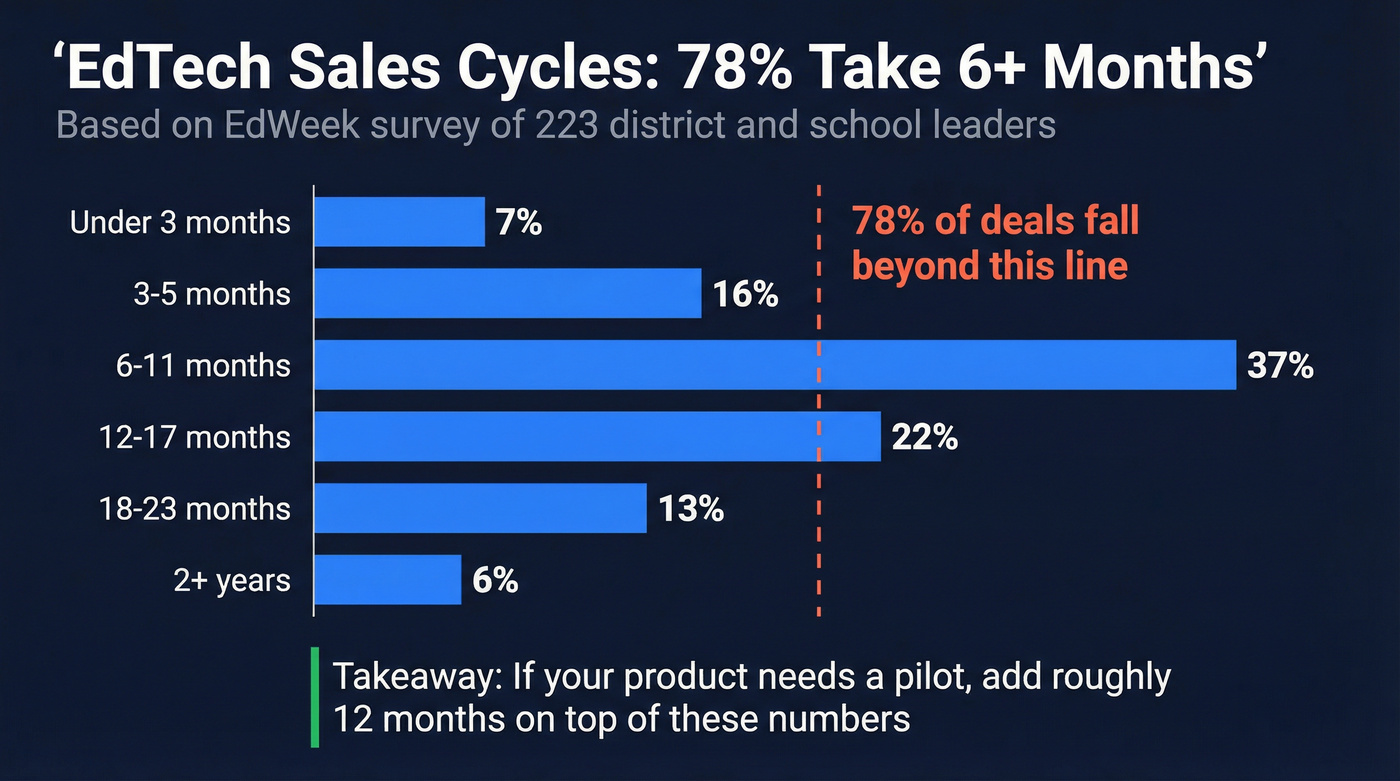
EdTech sales cycles are long. In public education, universities, and enterprise learning programs, they're getting longer. An EdWeek Research Center survey of 223 district and school leaders found that most K-12 purchases take over six months from need identification to signed contract:
| Cycle Length | % of Respondents |
|---|---|
| Under 3 months | 7% |
| 3-5 months | 16% |
| 6-11 months | 37% |
| 12-17 months | 22% |
| 18-23 months | 13% |
| 2+ years | 6% |
That's 78% of deals taking six months or longer. And if your product requires a pilot - most teacher- or student-facing tools do - add roughly a year on top. The pilot runs its course, then the actual purchasing process begins.
Let's be honest: if you're coming from SaaS where a 30-day sales cycle feels slow, education will test your patience. But the contracts are sticky, churn is low, and multi-year renewals are the norm. That tradeoff is worth it - if your cash runway can handle the wait.
Know Your Segments
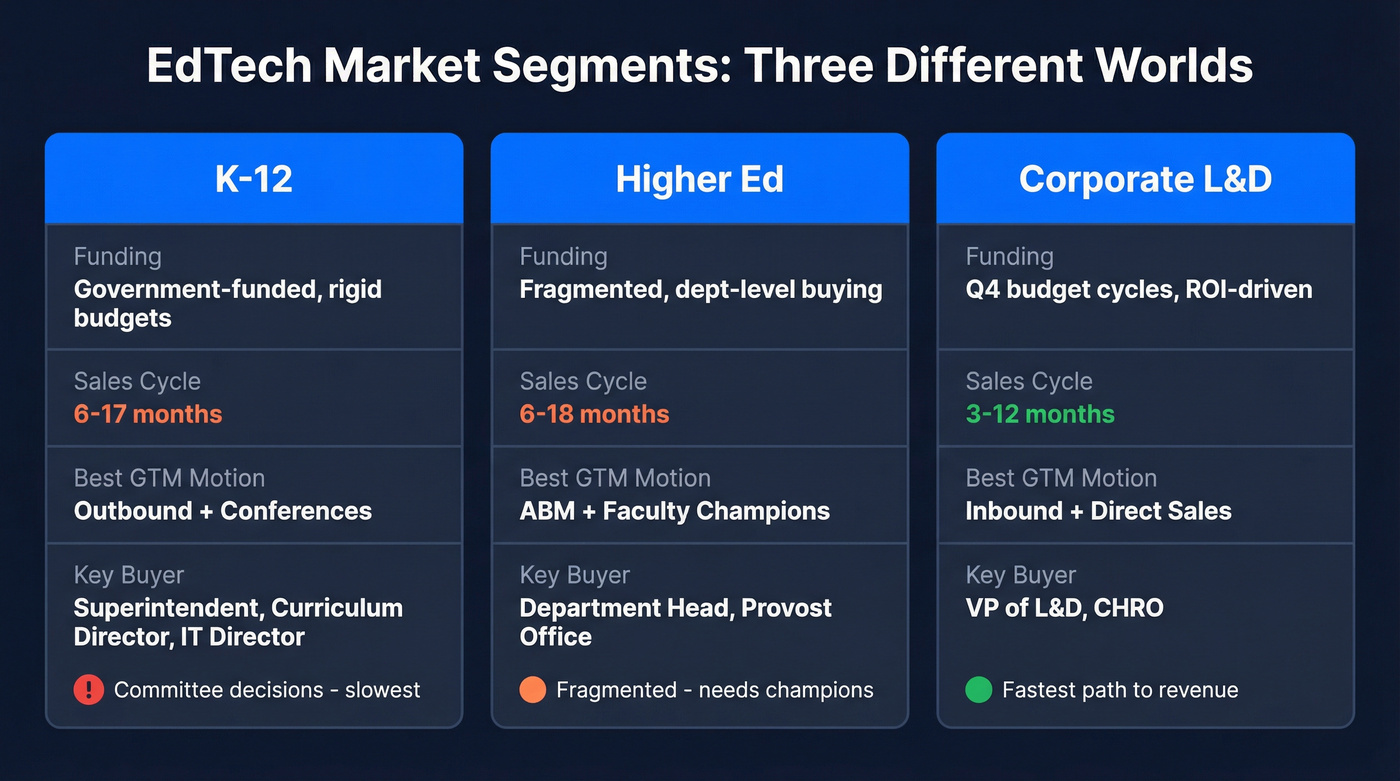
One of the biggest GTM mistakes in EdTech is treating "education" as a single market. A curriculum director and a VP of L&D at a Fortune 500 company have almost nothing in common. Your messaging, landing pages, and case studies should reflect that.
| Segment | Buyer Dynamics | Typical Cycle | Best GTM Motion |
|---|---|---|---|
| K-12 | Gov-funded, rigid budgets, committee decisions | 6-17 months | Outbound + conferences |
| Higher Ed | Fragmented, dept-level buying | 6-18 months | ABM + faculty champions |
| Corporate L&D | Q4 budget cycles, ROI-driven | 3-12 months | Inbound + direct sales |
Administrators want ROI evidence and compliance assurance. Teachers want ease of use and professional development support. IT directors want clean integrations and security documentation. We've watched teams burn six figures on a single campaign that tried to speak to all three personas at once. It doesn't work.

Selling into K-12 means targeting fragmented buyer committees - superintendents, curriculum directors, IT leads - across thousands of districts. Prospeo's 30+ search filters let you build segmented lists by job title, department, and buyer intent across 15,000 topics, so your outbound hits the right persona with the right message before the budget window closes.
Stop sending cold emails to generic district inboxes.
Timing the Procurement Calendar
Miss the budget window and you're dead for a year. We've seen teams lose entire fiscal years by starting outbound in April instead of January.
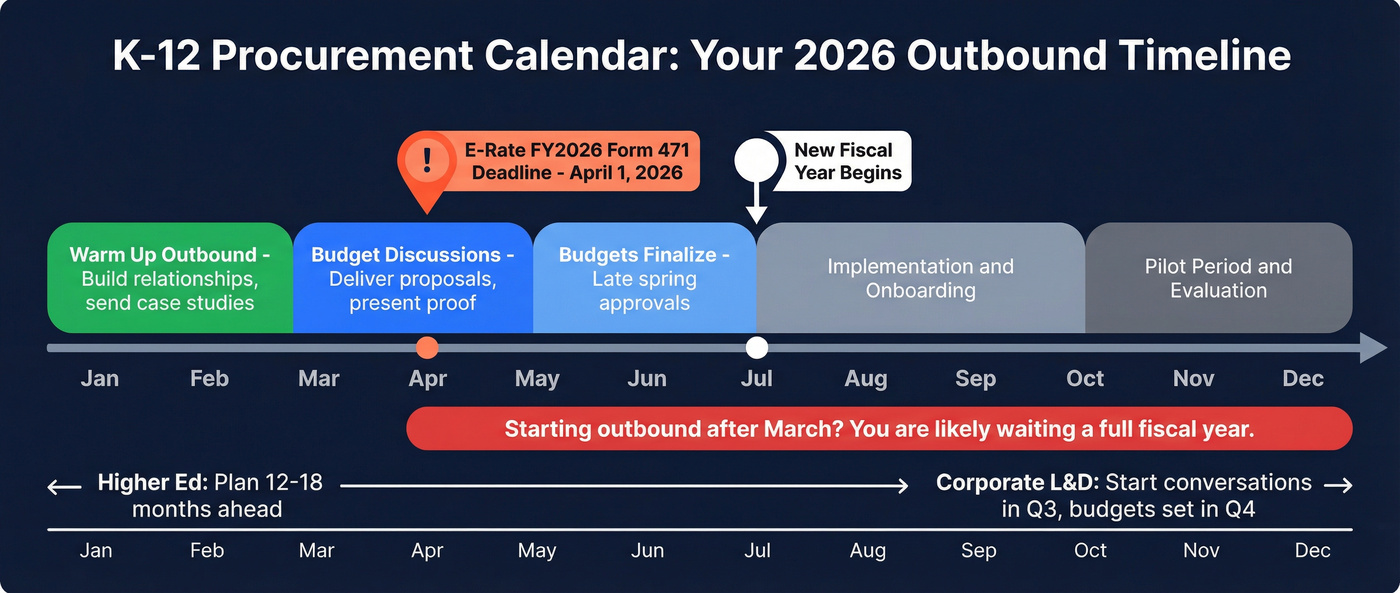
K-12 districts typically operate on a July 1 fiscal year. Budget discussions happen in March and April, with budgets often finalized in late spring. Your outbound needs to be warming up decision-makers by January and delivering proposals by March. The E-Rate FY2026 Form 471 window opened January 21 and closes April 1, 2026 - if your product qualifies for E-Rate funding, this is your single most important deadline.
There was $82B in school bonds issued in 2025, with 150+ proposed bonds set for 2026 votes. But the ESSER cliff is real: one in four districts lack alternative funding now that nearly $200B in pandemic relief has expired. More than a third of district leaders say vendors offering free trials are very likely to break through in this environment - which brings us to the proof question.
For higher ed, plan 12-18 months ahead. Corporate L&D budgets typically set in Q4, so start conversations in Q3.
From Features to Proof
Here's the thing: PLG is a feature, not a strategy. Free trials and self-serve onboarding are table stakes in 2026, but they won't close a six-figure district deal on their own.
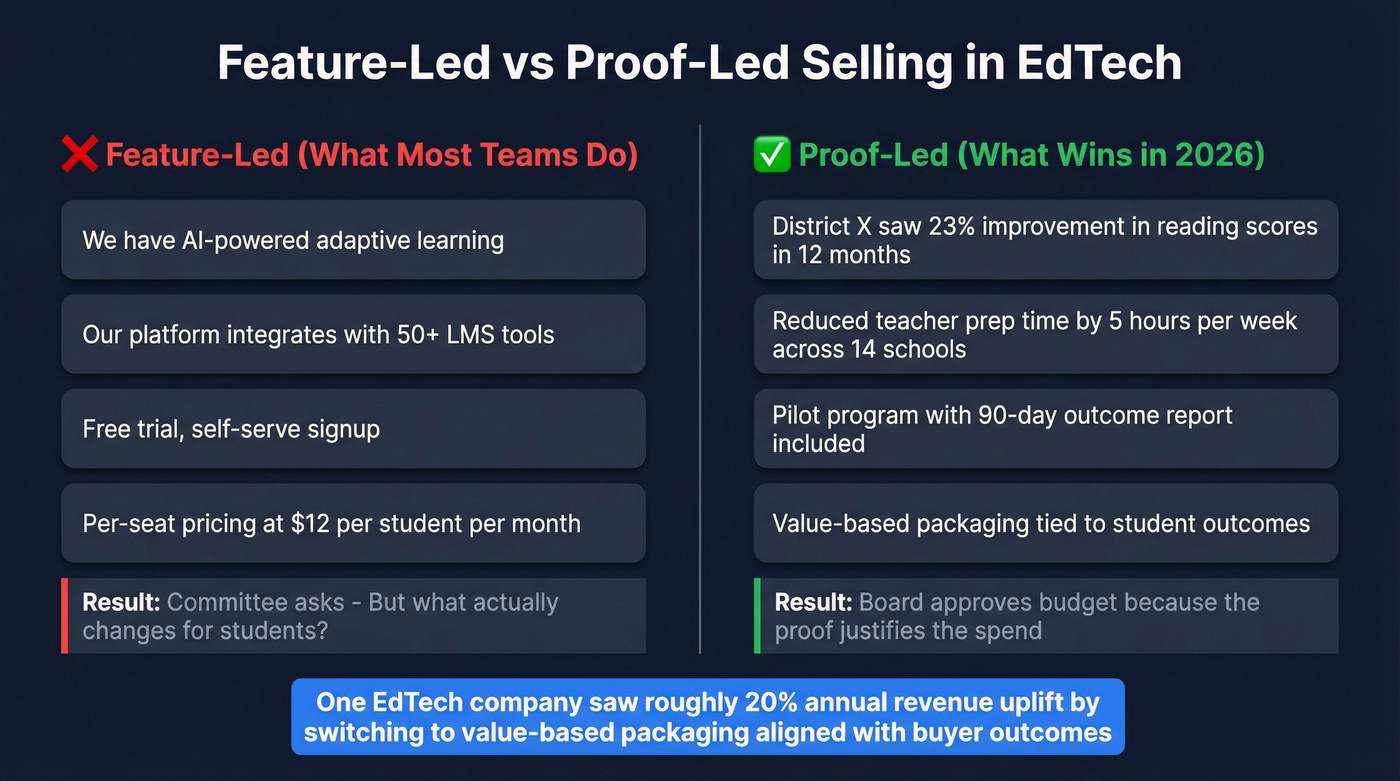
The shift from feature-led to proof-led storytelling is the defining GTM trend this year. A Simon-Kucher case study showed that one EdTech company achieved roughly 20% annual revenue uplift by redesigning pricing from legacy seat-based models to value-based packaging aligned with buyer outcomes. That's not a tweak - that's a structural change in how the company communicated value.
Use this approach if you're selling into K-12 or higher ed, where committees justify spend to boards and taxpayers. Skip the pure PLG playbook if your average deal size exceeds $25k. At that price point, you need a human in the loop with proof materials, not just a signup page. The consensus on r/edtech and r/sales threads about education deals is consistent: districts buy outcomes, not software.
Channels, Costs, and Metrics
Stop obsessing over top-of-funnel lead volume. The metrics that matter are CAC, LTV, sales velocity, and conversion rates. Everything else is vanity.
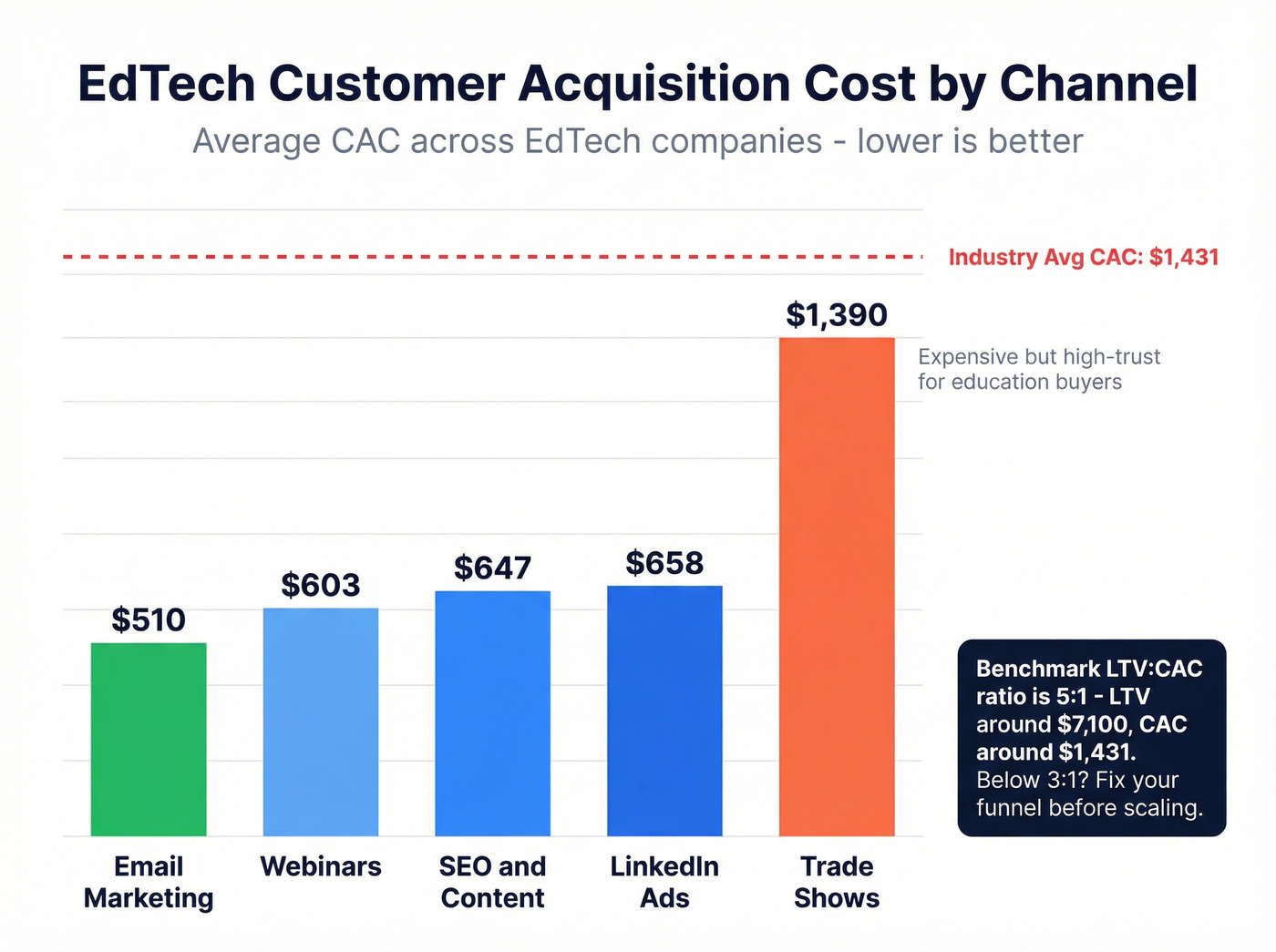
| Channel | Avg CAC | Notes |
|---|---|---|
| Email marketing | $510 | Lowest CAC, highest control |
| Webinars | $603 | Strong for mid-funnel education |
| SEO / content | $647 | Compounds over time |
| LinkedIn ads | $658 | Good for ABM targeting |
| Trade shows | $1,390 | Expensive but high-trust |
With a $1,431 average CAC, every bounced email and bad phone number erodes your margin. We've seen bounce rates above 20% tank entire outbound campaigns in education - verify contacts before you send.
For market context: 256 U.S. EdTech transactions closed in Q3 2025 totaling $1.37B, up 16% from Q2. Over 75% were non-control investments. Capital is backing proven operators with expansion rounds, not unproven launches.
Reaching Education Decision-Makers
You're sending cold emails to info@schooldistrict.edu and wondering why nobody replies. Superintendents, curriculum directors, and IT directors don't sit in generic inboxes. When you're selling against procurement windows that open once a year, stale contact data isn't just annoying - it's a death sentence.
Prospeo gives you 300M+ professional profiles with 30+ search filters, including buyer intent signals across 15,000 topics via Bombora. Filter by job title, department, headcount growth, and funding signals to build a list of education decision-makers who are actually in-market. Every email is verified at 98% accuracy on a 7-day refresh cycle, so you're not burning your domain during a narrow outreach window.

Compliance matters too. Education buyers are sensitive to FERPA and COPPA, and they'll notice if your outreach feels scraped from somewhere sketchy. Clean, GDPR-compliant data isn't just operationally smart - it's a trust signal that separates you from the vendors who get flagged and blocked. (If you need the operational checklist, start with GDPR for Sales and Marketing.)
With a $1,431 average CAC in EdTech, every bounced email eats your margin. Prospeo delivers 98% email accuracy on a 7-day refresh cycle - not the 6-week industry average - so your outbound lands during the narrow procurement windows that define your entire fiscal year. At roughly $0.01 per verified email, the math works even for bootstrapped teams.
Verify every contact before you burn your domain on a once-a-year window.
FAQ
How long is a typical EdTech sales cycle?
K-12 deals take 6-17+ months for 78% of districts surveyed by EdWeek. Corporate L&D moves faster at 3-9 months. Higher ed falls between at 6-18 months, depending on whether buying happens at the department or institution level.
What's a healthy LTV:CAC ratio for EdTech?
The industry benchmark is 5:1 (LTV around $7,100, CAC around $1,431). Anything above 3:1 is sustainable. Below that, tighten your funnel - usually by improving lead quality or shortening sales cycles - before scaling spend.
When should K-12 outbound start?
January at the latest. District budget discussions run March through April, and the E-Rate FY2026 Form 471 window closes April 1, 2026. Starting outbound after March means you're likely waiting a full fiscal year.
How do I find verified contacts for education buyers?
Use a B2B data platform with intent signals and real-time verification. Filter by job title, department, and in-market signals so you're reaching the right people during the narrow procurement window - not blasting generic inboxes.
Is PLG enough for an EdTech GTM in 2026?
No. Free trials help in a post-ESSER budget environment, but district committees demand proof of student outcomes before approving purchases. PLG opens doors; outcome data and case studies close deals above $25k.