

Account-Based Prospecting: The 2026 Operator's Playbook
10,000 emails. 47 replies. 3 meetings. Sound familiar? That's spray-and-pray prospecting - and email-only campaign lead rates are down 29% year-over-year. Account-based prospecting flips the model: fewer accounts, deeper research, more channels, better pipeline.
In practice, this approach works best when you run a tight target list - typically 50-100 accounts - map the full buying committee, and execute a multichannel cadence with enough touches to actually break through.
What Is Account-Based Prospecting?
Account-based prospecting is a focused sales approach that targets high-value accounts through deep research and coordinated, multi-stakeholder outreach. You treat each account as its own market. Not blasting a persona list, but penetrating an organization. The key word is pre-opportunity: your goal is to create the first meeting, surface interest, and generate pipeline.
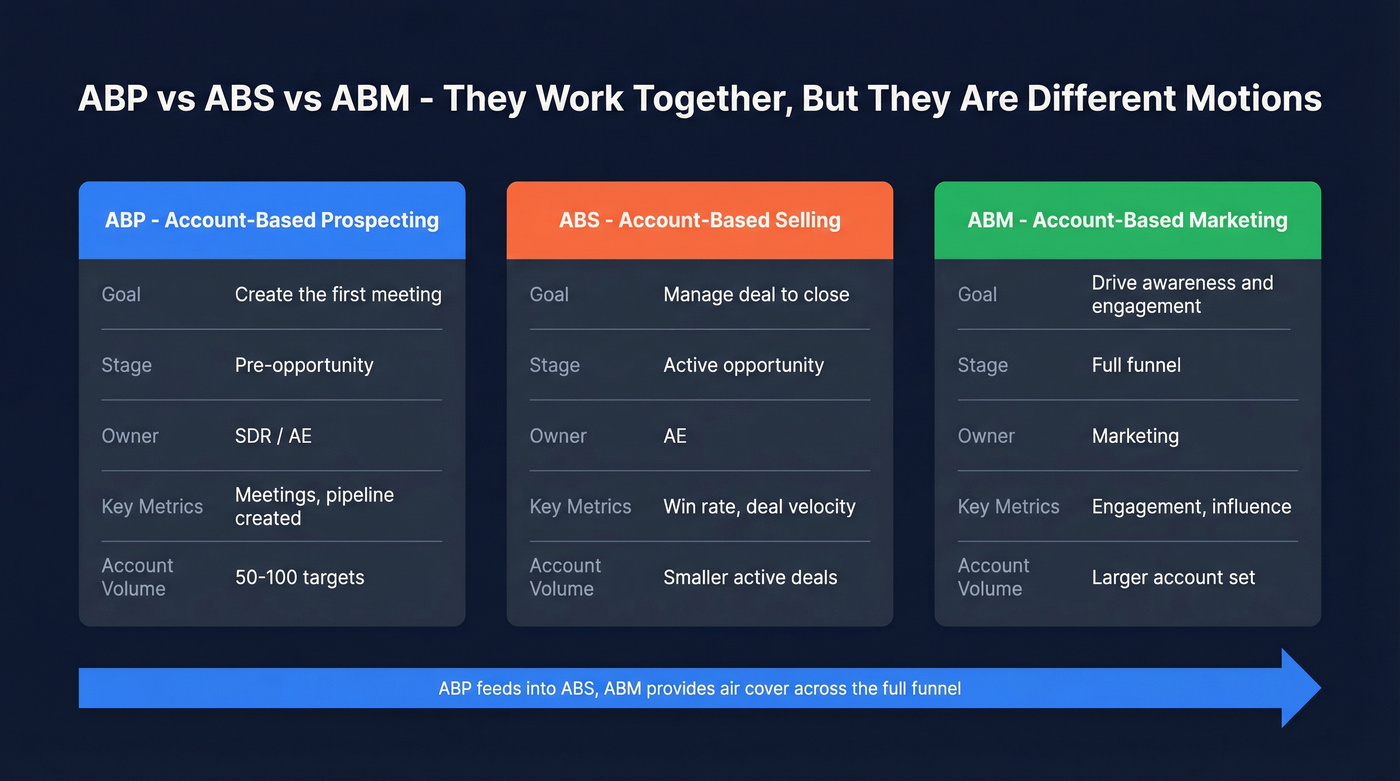
ABP, ABS, and ABM aren't interchangeable:
| ABP | ABS | ABM | |
|---|---|---|---|
| Goal | Create first meeting | Manage deal to close | Drive awareness + engagement |
| Stage | Pre-opportunity | Active opportunity | Full funnel |
| Owner | Sales (SDR/AE) | Sales (AE) | Marketing-led |
| Metrics | Meetings, pipeline | Win rate, velocity | Engagement, influence |
| Account count | ~50-100 targets | Smaller set of active deals | Larger account set |
ABP is the sharp end of the spear. ABS picks up once there's budget and timeline. ABM is the broader air cover marketing runs across the funnel. They work together, but they're different motions with different owners.
Is ABP Right for Your Team?
Not every team needs this motion. It's the right fit if you check most of these boxes:
- High-value deals - ACVs that justify 2-4 hours of research per account
- Complex buying committees - multiple stakeholders influencing the decision
- Longer sales cycles - weeks or months, not transactional one-call closes
- Upsell potential - accounts worth expanding over time
- Access to quality data - you can actually find and verify contacts
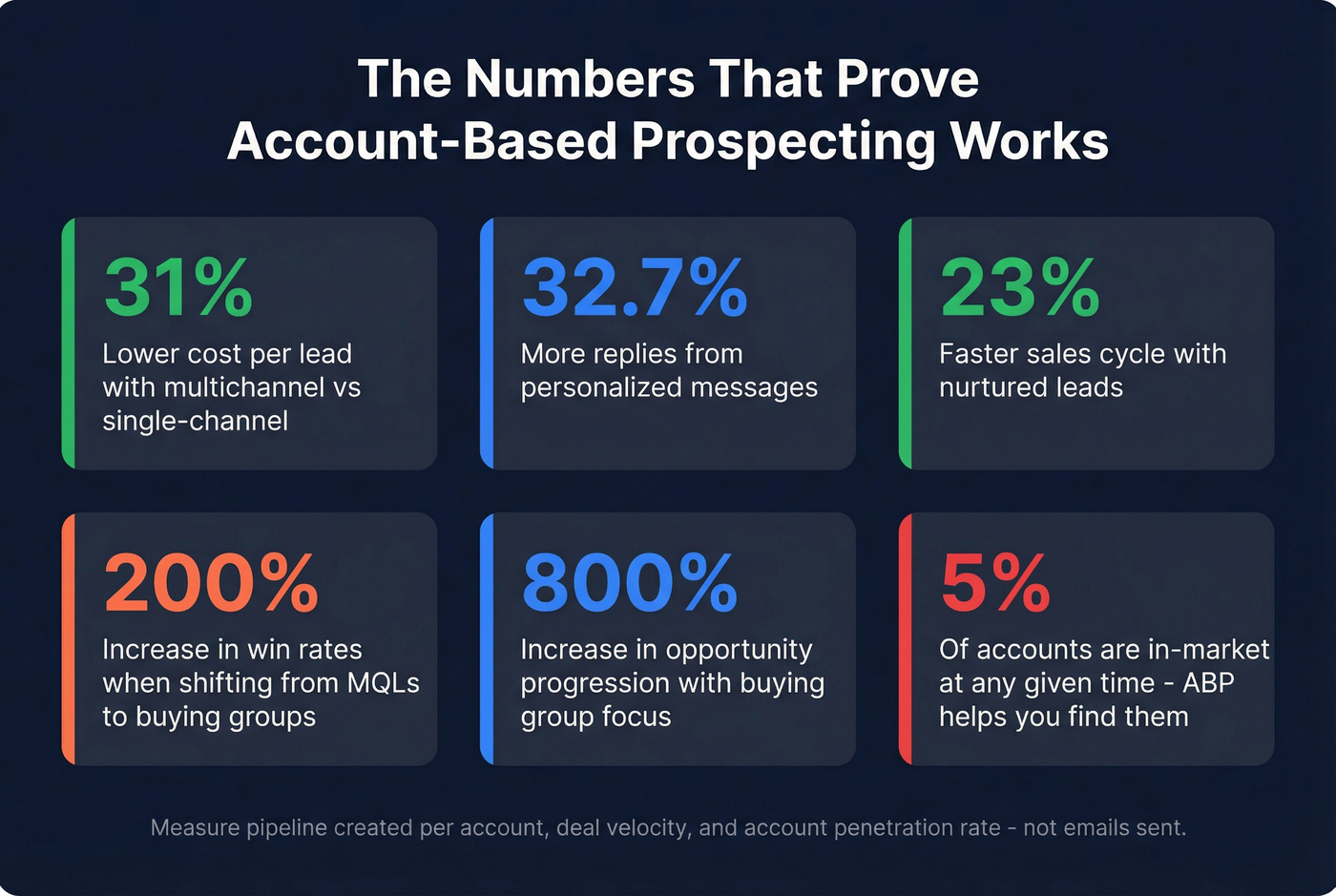
Only 5% of accounts are in-market at any given time. Targeted account selection helps you find and focus on that 5% instead of burning cycles on the other 95%. If your average deal size sits below five figures and your buyer is a single decision-maker, a lighter outbound motion will serve you better.
Why ABP Matters Right Now
A dataset of 97.97 million prospecting emails and 3.6 million multichannel touchpoints tells the story clearly. The average B2B decision-making unit now involves 4.14 stakeholders, and 7% of businesses involve 10 or more. For companies in the 500-1,000 employee range, successful campaigns contacted 11.4 people per company. You can't penetrate a buying committee with a single email thread to one director.
Multichannel campaigns deliver 31% lower cost per lead than single-channel approaches. Personalized messages receive 32.7% more replies. Nurtured leads move through the sales cycle 23% faster. Depth beats breadth, multi-channel beats email-only, and ABP is the operational framework that makes both happen.

Your ABP cadence hits 5-7 stakeholders per account. One bounce kills your domain reputation and buying committee coverage. Prospeo delivers 98% email accuracy on 300M+ profiles with a 7-day refresh cycle - so every contact in your committee map connects to a real inbox.
Stop burning buying committee coverage on stale data.
The 5-Step ABP Playbook
Step 1 - Score and Build a Target Account List
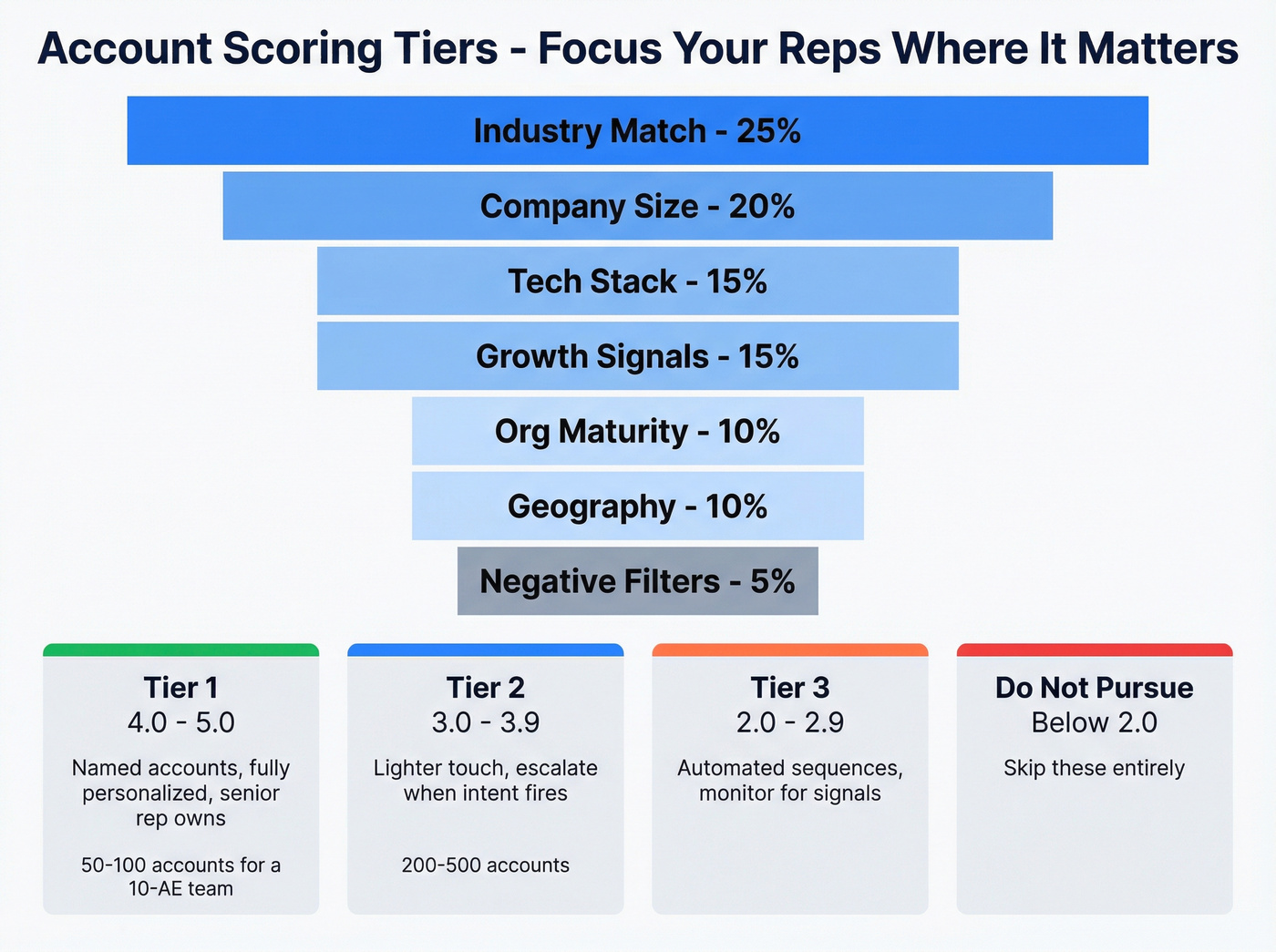
Most programs fail at the starting line because they skip scoring and hand reps a list of logos that "feel right." Here's the thing: before your BDRs can prospect accounts in earnest, you need a weighted scorecard.
| Criteria | Weight | Score 1 | Score 5 |
|---|---|---|---|
| Industry match | 25% | Adjacent vertical | Core ICP vertical |
| Company size | 20% | Outside range | Sweet-spot headcount |
| Tech stack | 15% | No relevant tech | Uses complementary tools |
| Growth signals | 15% | Flat/declining | Hiring, funding, expansion |
| Org maturity | 10% | No clear structure | Defined buying process |
| Geography | 10% | Unsupported region | Primary market |
| Negative filters | 5% | Multiple red flags | No disqualifiers |
Multiply each score (1-5) by its weight and sum the results. Then tier:
- 4.0-5.0 = Tier 1 - named accounts, fully personalized outreach, senior rep ownership
- 3.0-3.9 = Tier 2 - lighter touch, signal-triggered escalation when intent fires
- 2.0-2.9 = Tier 3 - automated sequences, monitored for signals
- Below 2.0 - don't pursue
For a 10-AE team, that's 50-100 Tier 1 accounts, 200-500 Tier 2, and Tier 3 on autopilot. If each AE owns 10 Tier 1 accounts and spends 2-4 hours per week per account, that's 20-40 hours of focused work - there's no room for a 500-account "Tier 1" list. Embed this score as a CRM field so it shows up in pipeline reviews and territory planning.
Step 2 - Map the Buying Committee
Forrester's research puts the average B2B purchase at 13 stakeholders. Even if your deal involves half that, you're multi-threading across 5-7 people. And for mid-market companies, the data shows successful campaigns contact an average of 11.4 prospects per company.
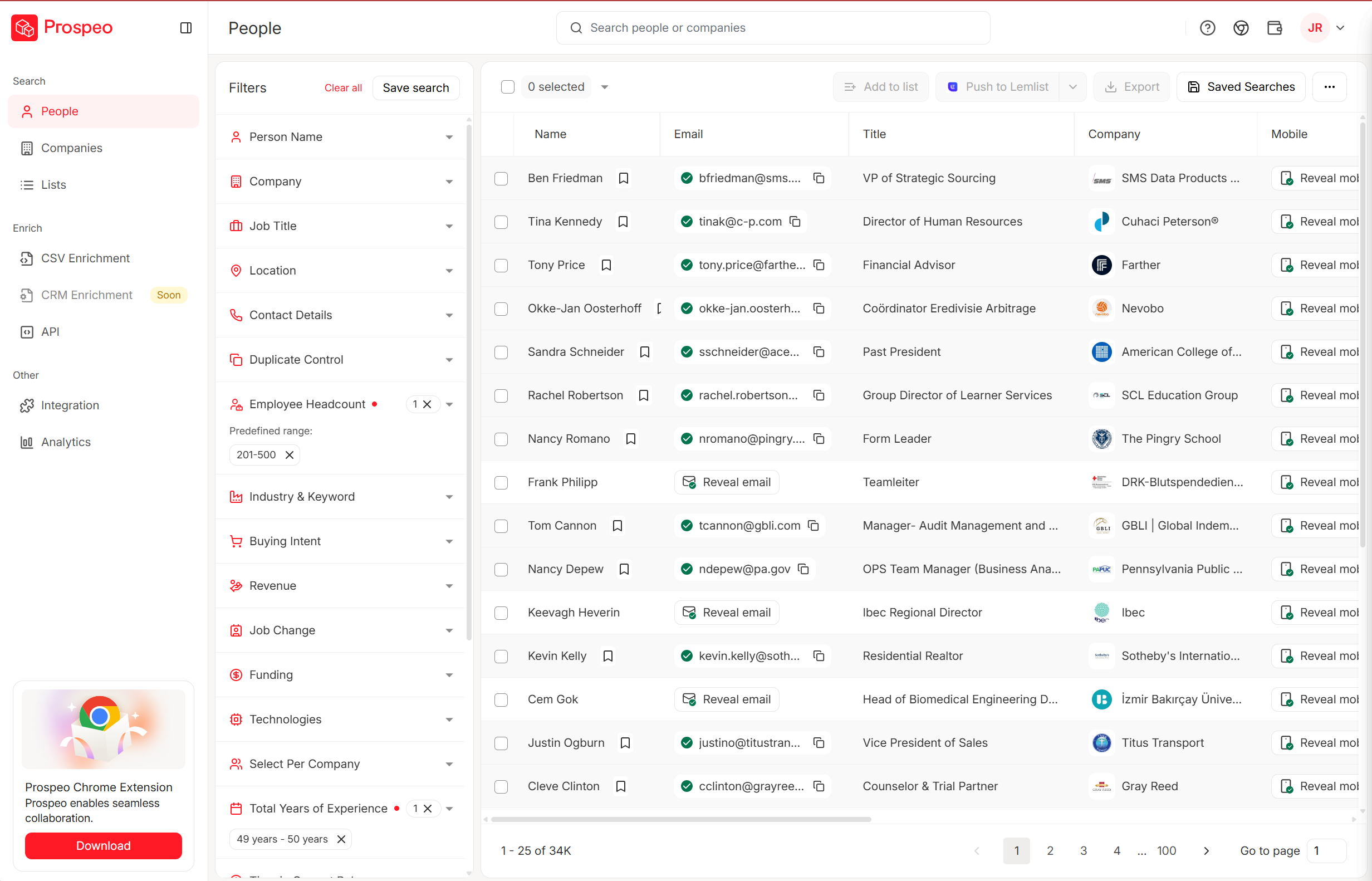
Your cadence is only as good as your contact data. If your emails bounce, you've burned buying committee coverage and torched your domain reputation. We've seen teams lose months of momentum because they trusted stale data from a provider that refreshes every six weeks.
Real-world proof: Snyk's 50-AE team switched to Prospeo and dropped their bounce rate from 35-40% to under 5%, while AE-sourced pipeline jumped 180% with 200+ new opportunities per month. That's not a marginal improvement - it's the difference between an ABP program that works and one that quietly dies.
For each Tier 1 account, identify the economic buyer, 2-3 influencers, a champion candidate, and a potential blocker. Map them by name, title, and verified contact info before you write a single email. Never rely on a single point of contact. If your champion goes dark or changes jobs, you've lost the entire account.
Step 3 - Build Your Outreach Cadence
Eighty percent of sales require 5+ touches. Only 2% close on the first follow-up. Yet most reps give up after two emails - which is genuinely frustrating to watch as a team lead, because the math is right there.
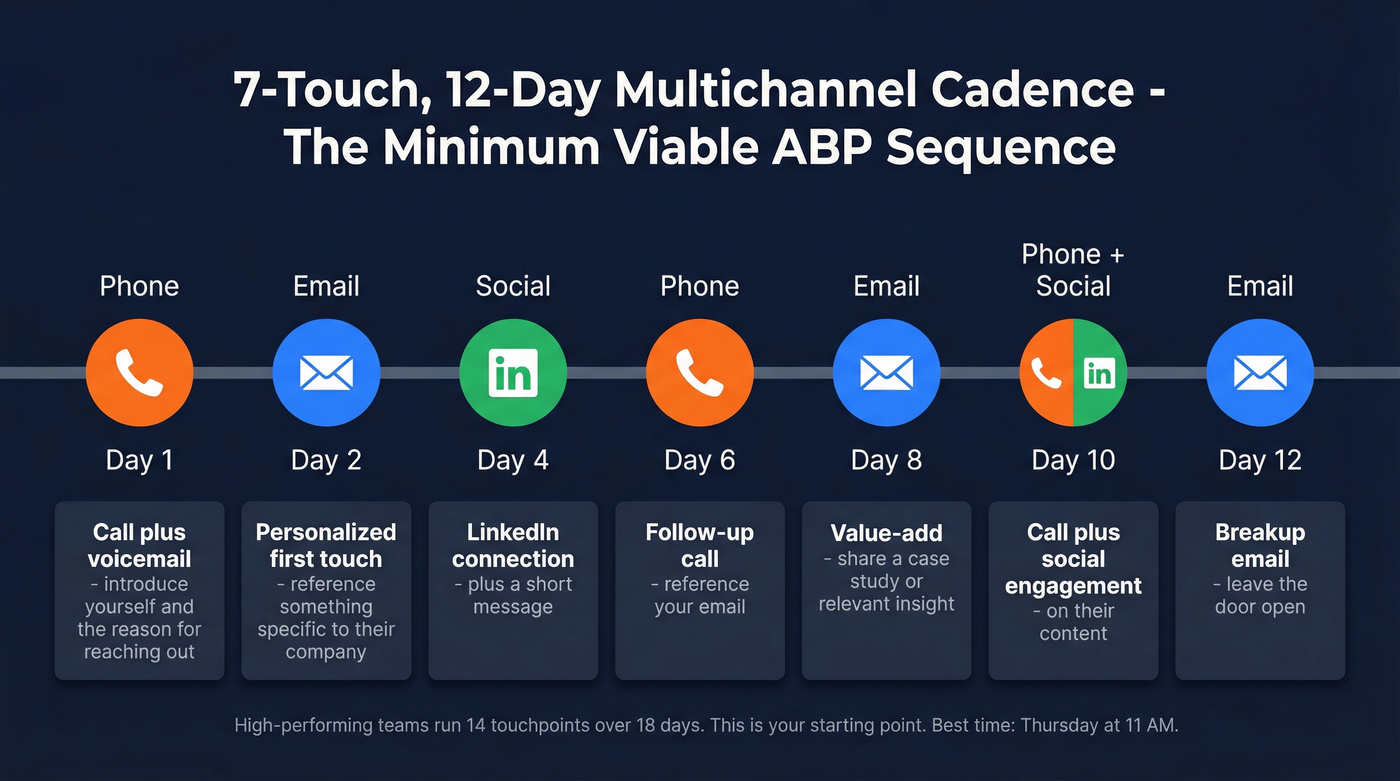
Here's a 7-touch, 12-day multichannel cadence:
| Day | Channel | Action |
|---|---|---|
| 1 | Phone | Call + voicemail |
| 2 | Personalized first touch | |
| 4 | Social | Connection + message |
| 6 | Phone | Follow-up call |
| 8 | Value-add (case study, insight) | |
| 10 | Phone + Social | Call + social engagement |
| 12 | Breakup email |
High-performing teams often run 14 touchpoints over 18 days - our 7-touch, 12-day map is the minimum viable cadence. For Tier 2, stretch to 18-21 days with lighter personalization. For Tier 3, automate entirely and let intent signals trigger escalation. Timing matters too: Thursday at 11 AM shows a 3.96% lead rate, while 3-5 PM is the dead zone. Every touch should add context or value, not just "checking in."
Step 4 - Use Intent Signals for Timing
Only 5% of accounts are in-market at any given time. Intent data tells you which 5%. The signals that matter: topic research (reading about your category), competitor evaluation (visiting comparison pages), hiring patterns (posting roles your product supports), and tech adoption (implementing complementary tools).
If you want a tighter definition of what to track, start with intent signals and build a simple workflow for how to track sales triggers across your Tier 1 list.
Step 5 - Measure Pipeline, Not Activity
The three metrics that matter: pipeline created per account, deal velocity from first touch to opportunity, and account penetration rate across the buying committee. Penetration rate is the clearest indicator of whether your team is multi-threading effectively or leaning on a single contact.
Give the program 3-6 months before you judge it. ABP is a compounding motion, not a sprint.
If your dashboard tracks emails sent and calls made, you're measuring the wrong things. Those are inputs, not outcomes. A Forrester Summit keynote made the case that shifting from MQLs to buying groups drove a 200% increase in win rates and 800% increase in opportunity progression. The measurement frame matters as much as the execution.
The ABP Tech Stack
Let's talk intent data pricing first, because this is where budgets blow up:
| Provider | Annual Cost | Notes |
|---|---|---|
| Bombora | $25K-$80K | Consent-based co-op; bundled via 6sense/Demandbase |
| G2 Buyer Intent | $10K-$87K+ | First-party marketplace signals |
| Demandbase | $40K-$120K | Full platform with intent |
| 6sense | $35K-$150K+ | Platform + predictive |
| ZoomInfo Intent | $7.2K-$36K | Mid-market range |
Budget 15-25% above the quoted license price for implementation and integration.
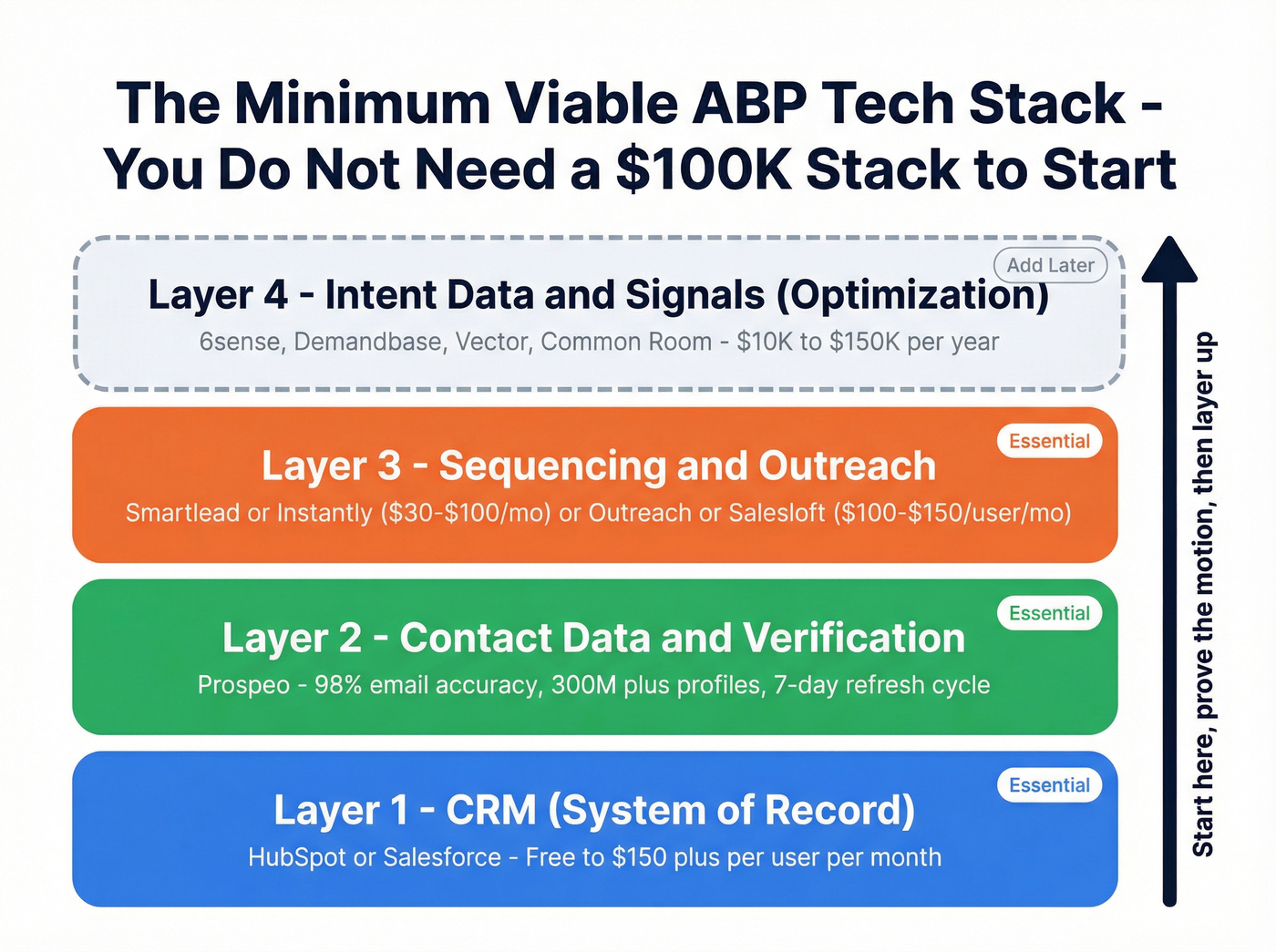
The hot take: you don't need a $100K stack. Most teams don't. In our experience, the minimum viable ABP stack is three layers:
CRM - whether that's HubSpot or Salesforce, this is your system of record. Pricing ranges from free to $150+/user/month depending on tier. (If you're deciding between the two, see HubSpot vs Salesforce.)
Sequencing - Smartlead and Instantly start around $30-$100/month. Outreach and Salesloft run $100-$150/user/month for enterprise features. If you're evaluating options, start with cold email marketing tools and a deliverability-first outbound email campaign setup.
Intent data and visitor identification tools like 6sense, Demandbase, Vector, and Common Room are optimization layers. They make ABP better, but they aren't prerequisites. Start with the three essentials, prove the motion works, then layer in signals.
Three Ways ABP Programs Fail
Wrong accounts. Marketing picks the target list without sales input, or someone dumps 1,000 logos into a spreadsheet and calls it "account-based." The fix: use the weighted scorecard and bring sales into selection from day one. 71% of teams claim an ABM strategy, but only 36% say sales and marketing are actually aligned on account selection. That gap is where programs go to die. If you want a deeper scoring framework, use ABM account prioritization.
Sales and marketing misalignment. Different KPIs, different messaging, nobody looking at the same dashboard. The fix: shared pipeline metrics, joint account reviews, and a single source of truth for account status. If your marketing team is celebrating MQLs while sales is complaining about lead quality, you have this problem. This is where revenue operations alignment stops being a buzzword and starts being a fix.
Measuring leads instead of buying groups. One VP downloads a whitepaper and the entire SDR team pounces - meanwhile three other stakeholders at the same account are showing intent signals nobody's aggregating. The fix: group signals at the account level. Trigger outreach when the account crosses an engagement threshold, not when a single contact raises their hand. The consensus on r/sales backs this up - threads about ABP failures almost always trace back to single-threading or bad account selection, not bad messaging.
Snyk's 50-AE team dropped bounce rates from 35% to under 5% and generated 200+ new opportunities per month with Prospeo. Map 11+ stakeholders per account using 30+ filters - buyer intent, technographics, headcount growth, funding - at $0.01 per verified email. No contracts.
Build your Tier 1 account maps in minutes, not days.
FAQ
How do you build a target account list?
Start with your ICP criteria - industry, company size, tech stack, and growth signals - then score every potential account using a weighted scorecard. Rank them into tiers, validate contacts with an enrichment tool, and get sales buy-in before finalizing. 50-100 deeply researched Tier 1 accounts outperform a thousand unvetted logos every time.
How many accounts should one rep manage?
A single rep should own 10-25 Tier 1 accounts with full research and personalized outreach, plus 50-100 Tier 2 accounts on a lighter cadence. Tier 3 runs on automated sequences. The constraint is research time - 2-4 hours per week per Tier 1 account is the realistic budget.
What's the difference between ABP and ABM?
ABP is sales-led and pre-opportunity - the goal is creating first meetings through direct outreach to specific stakeholders. ABM is marketing-led and spans the full funnel, focused on awareness and engagement across a broader account set. ABP is the spear; ABM is the air cover. They complement each other but have different owners and metrics.
What tools do I need to get started?
The minimum viable stack is a CRM, a verified contact data source, and a sequencing tool. Skip this if you're still trying to define your ICP - no tool fixes a targeting problem. Intent platforms like Bombora or 6sense are valuable but optional until you've proven the core motion. Don't let tool complexity delay your first campaign.