The Sales Call Planning Template That Actually Gets Used
It's two minutes before your discovery call. You've got the prospect's name, a vague memory of their company from the AE handoff, and eleven browser tabs open - none of them useful. You wing it. The call goes nowhere.
5-10 minutes of pre-call research increases qualification accuracy by 43%. And 67% of lost sales trace back to poor qualification - not bad closing skills, not weak product-market fit, but reps walking into calls without knowing what they need to learn. The sales call planning template below fixes that. It's built for speed, not perfection.
Grab the free Google Sheets template and follow along.
What You Need (Quick Version)
Every call plan template needs three things:
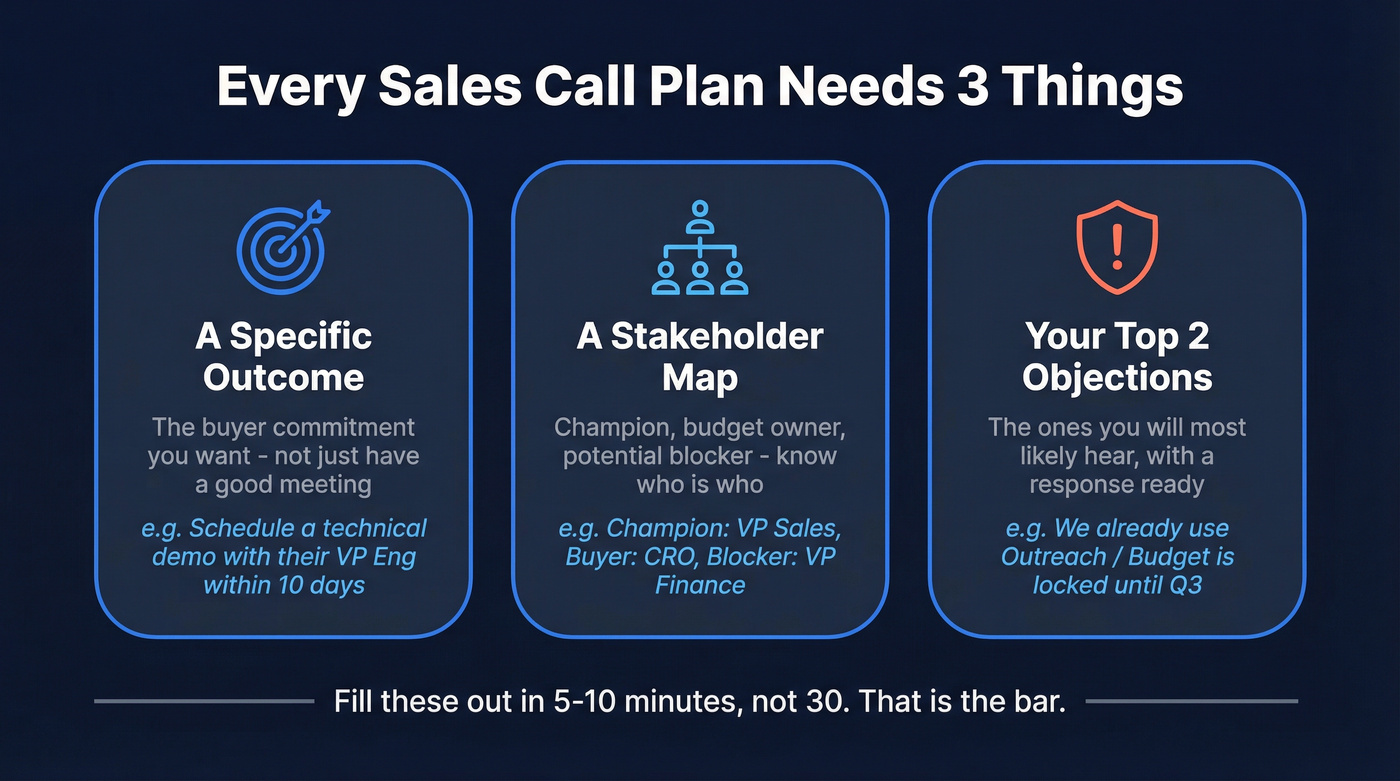
- A specific outcome - the buyer commitment you want, not "have a good meeting"
- A stakeholder map - who's the champion, who controls budget, who might block you
- Your top two objections - the ones you'll most likely hear, with a response ready
The template below gives you those fields plus the research prompts that make them useful. Fill it out in 5-10 minutes, not 30.
What a Sales Call Plan Actually Is
A sales call plan isn't a research report. It's not a dossier on the company's last earnings call or a printout of their org chart. It's contextual intelligence combined with internal alignment - understanding why this buyer is talking to you right now, what they're measured on, and what commitment you need from them before you hang up.
In 2026, account research is a commodity. Any rep can pull up a company's funding history, tech stack, and recent press in two minutes.
The edge isn't knowing about the account - it's knowing what matters to this person in this moment. Are they under pressure from a new CRO? Did they just lose a vendor? Is their budget cycle closing in six weeks? Most downloadable PDFs give you twenty empty fields and zero guidance on which ones actually move the needle. Let's fix that.
The Complete Template
The fields below are split into two tiers. Essential fields are the ones you fill out every time - skip these and you're winging it. If You Have Time fields add depth for high-value calls but aren't worth the effort on a standard discovery.
Essential Fields
| Field | What to Write | Why It Matters |
|---|---|---|
| Company | Name, industry, ~revenue, headcount | Basic context so you don't ask dumb questions |
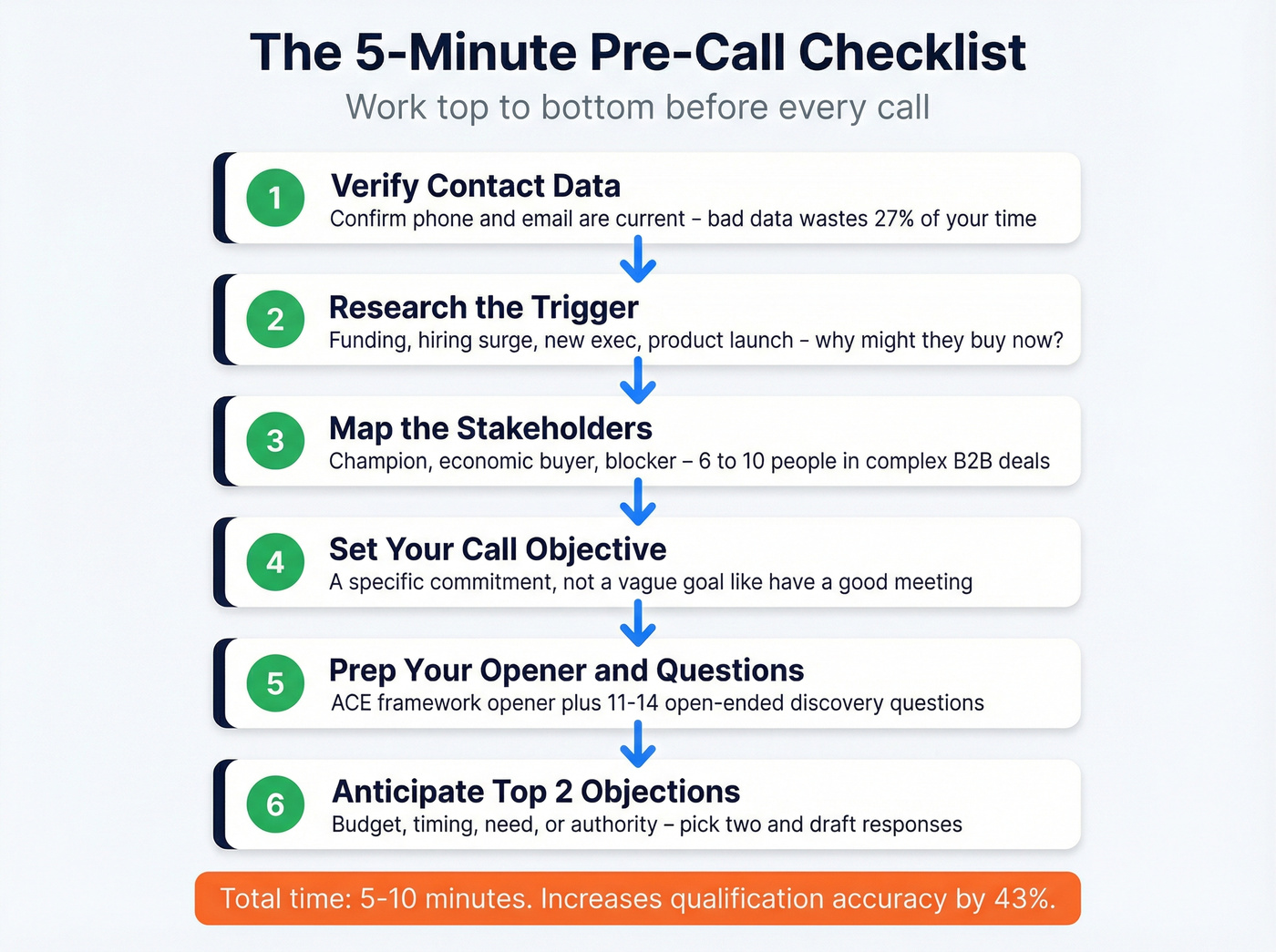
| Recent trigger | Funding, hiring surge, new exec, product launch | The reason they might buy now |
| Prospect name & role | Title + how they're measured | Tells you what they care about |
| Stakeholder map | Champion, economic buyer, blocker | 6-10 decision-makers in complex B2B - know who's who |
| Call objective | Specific commitment wanted | "Schedule a technical demo with their VP Eng" - not "good meeting" |
| Opener script | ACE: Appreciate, Confirm time, End goal | First 30 seconds set the tone |
| Discovery questions | 11-14 open-ended, by framework | Enough to fill the call without monologuing |
| Top 2 objections | Budget/timing/need/authority - pick two | Most objections fall into four buckets. Anticipate yours. |
| Verify contact data | Confirm phone + email are current | Bad data wastes 27% of a rep's time. Verify before you dial. |
| Next steps | What you'll propose at call's end | Have this ready before you dial |
If You Have Time
| Field | What to Write |
|---|---|
| Competitor context | What they're using today, likely switching objections |
| Tech stack | Key tools that integrate or conflict with yours |
| Internal champion notes | Politics, budget, timeline intel from your champion |
| Prior interaction history | CRM notes, past emails, previous call recordings |
| Deal goal type | New business, expansion, or win-back - adjust opener and questions accordingly |

Most templates fail because they have too many fields. Reps look at a 25-field form, decide it's not worth the time, and go back to winging it. The essential fields above take 5-10 minutes. That's the bar.
Here's the thing: if your average deal size is under $8k, you probably don't need 15 minutes of pre-call research. Five minutes with the essential fields will outperform 90% of reps who wing it. Save the deep prep for the deals that actually move your number.
Filled-In Example
Here's the template completed for a realistic scenario: you're an AE at a sales engagement company, calling a VP of Sales at a 200-person fintech that just raised Series B.
| Field | Filled-In Example |
|---|---|
| Company | PayFlow - fintech, ~$15M ARR, 200 employees, Series B closed 6 weeks ago |
| Recent trigger | $28M Series B - likely hiring reps and scaling outbound |
| Prospect | Sarah Chen, VP of Sales - measured on pipeline growth and rep productivity |
| Stakeholder map | Champion: Sarah Chen. Buyer: Marcus Webb (CRO). Blocker: Dana Reeves (VP Finance). |
| Call objective | Get Sarah to agree to a technical demo with RevOps present, within 10 days |
| Opener script | "Sarah, thanks for making time. I know you've got a lot on your plate post-raise..." |
| Discovery questions | 8 questions (see below) |
| Top 2 objections | "We already use Outreach" / "Budget is locked until Q3" |
| Verify contact data | Email verified. Direct dial confirmed. |
| Next steps | Propose 45-min demo with Sarah + RevOps lead. Send invite same day. |
Stakeholder detail: Sarah is the champion pushing for a new tool. Marcus Webb (CRO) controls the budget. Dana Reeves (VP Finance) is concerned about vendor consolidation post-funding. There's also a RevOps lead - unnamed - who you'll need to identify during the call. 86% of B2B purchases stall during the buying process, usually because a blocker or unknown stakeholder surfaces late. Mapping them now prevents that.
Discovery questions for this call:
- How's the outbound team structured today?
- What's your current tech stack for sequencing?
- What's working well - and what's breaking as you scale?
- How many reps are you planning to add this year?
- What does onboarding look like for new reps?
- Who else would need to evaluate a tool like this?
- What's the timeline for making a decision?
- How does budget approval work post-Series B?
Objection responses: For "We already use Outreach" - "Makes sense - a lot of our customers started there. The gap we usually hear about is [specific differentiator]. Can I show you how that works?" For "Budget is locked until Q3" - "Understood. If we could show ROI in a pilot before Q3, would that change the conversation?"
In our experience, the trigger field is the single most valuable line in the template. It gives you a reason to call that isn't "I saw your name on a list." This entire plan took about eight minutes to fill out.

Your template has a "Verify contact data" field for a reason. Bad numbers and bounced emails waste 27% of a rep's time. Prospeo gives you 98% accurate emails and 125M+ verified mobile numbers with a 30% pickup rate - so every call you plan actually connects.
Stop prepping calls for phone numbers that don't work.
Adapting by Call Type
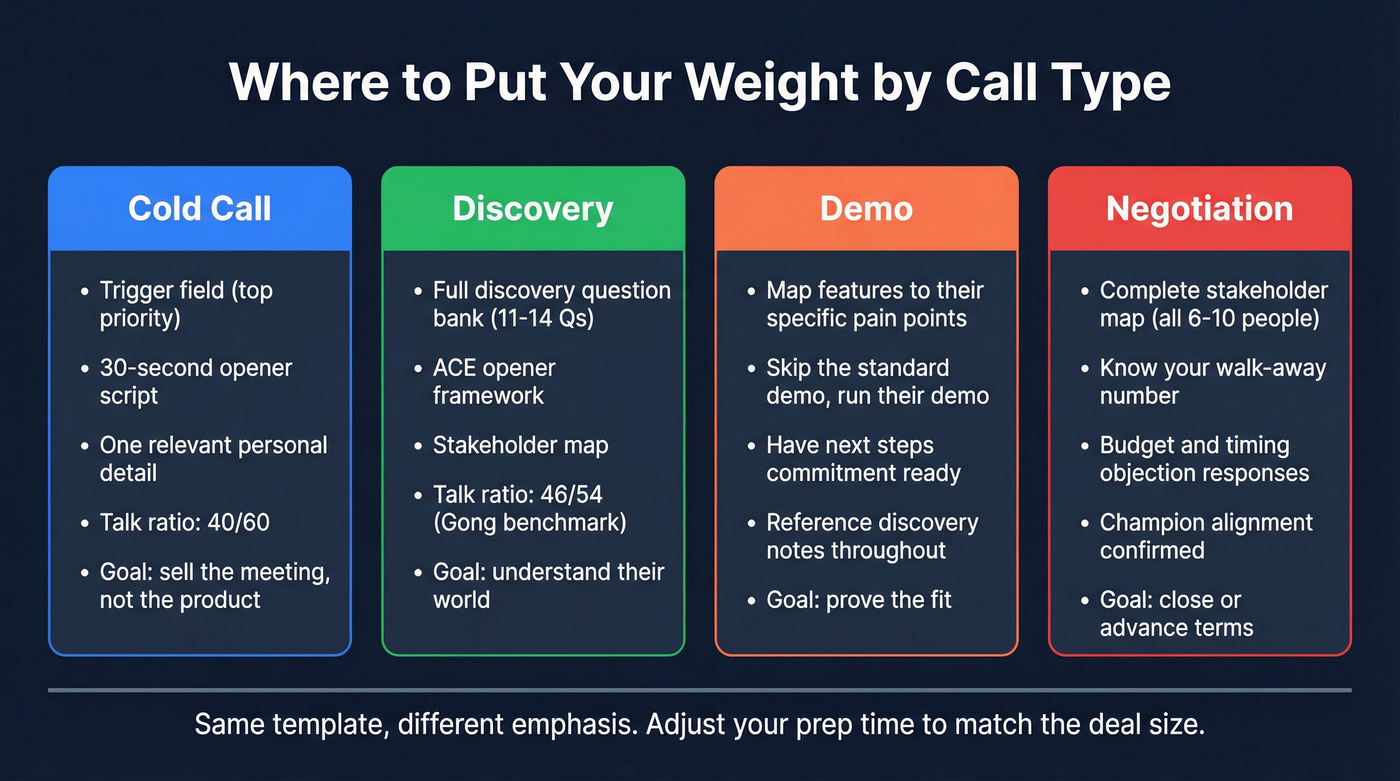
The base template stays the same. What changes is where you put your weight.
Cold Calls
You've got 30 seconds before the prospect decides to hang up. The 5-minute research rule applies: look up recent company news, the prospect's role, and one relevant detail for your opener. Use an assumptive opener - "Hi Bob, this is [Name] from [Company]" - not "Is this Bob?" which triggers defensiveness. Aim for a 40/60 talk ratio. You're selling the meeting, not the product.
Even a quick pre-call checklist with just the trigger and opener fields gives you an edge over reps who dial blind.
Discovery Calls
This is where the template earns its keep. Draft 11-14 targeted, open-ended questions organized by your framework. Open with ACE: Appreciate their time, Confirm the time block, state the End goal. The Gong benchmark is clear - top performers talk 46% of the time; low performers talk 72%. If you're doing most of the talking, you're doing it wrong.
Demo Calls
Skip this section if you're running standard product demos. But for tailored demos - and you should be tailoring - pre-map every feature you'll show to a specific pain point the prospect mentioned during discovery. Don't run the standard demo. Run their demo. Have a "what happens next" commitment ready before you share your screen.
Negotiation Calls
The stakeholder map becomes critical here. Complex B2B deals involve 6-10 decision-makers, and by negotiation stage you need to know every one of them. Know your walk-away number. Anticipate the "budget" and "timing" objection buckets specifically - these are where deals die in the final stretch.
Matching the Template to Your Methodology
Korn Ferry research summarized by Business.com shows that when methodology adoption exceeds 75% across a team, quota attainment rises 21% and win rates climb 15%. The template fields map cleanly to the three most common methodologies. Pick the one your team runs and emphasize those fields.
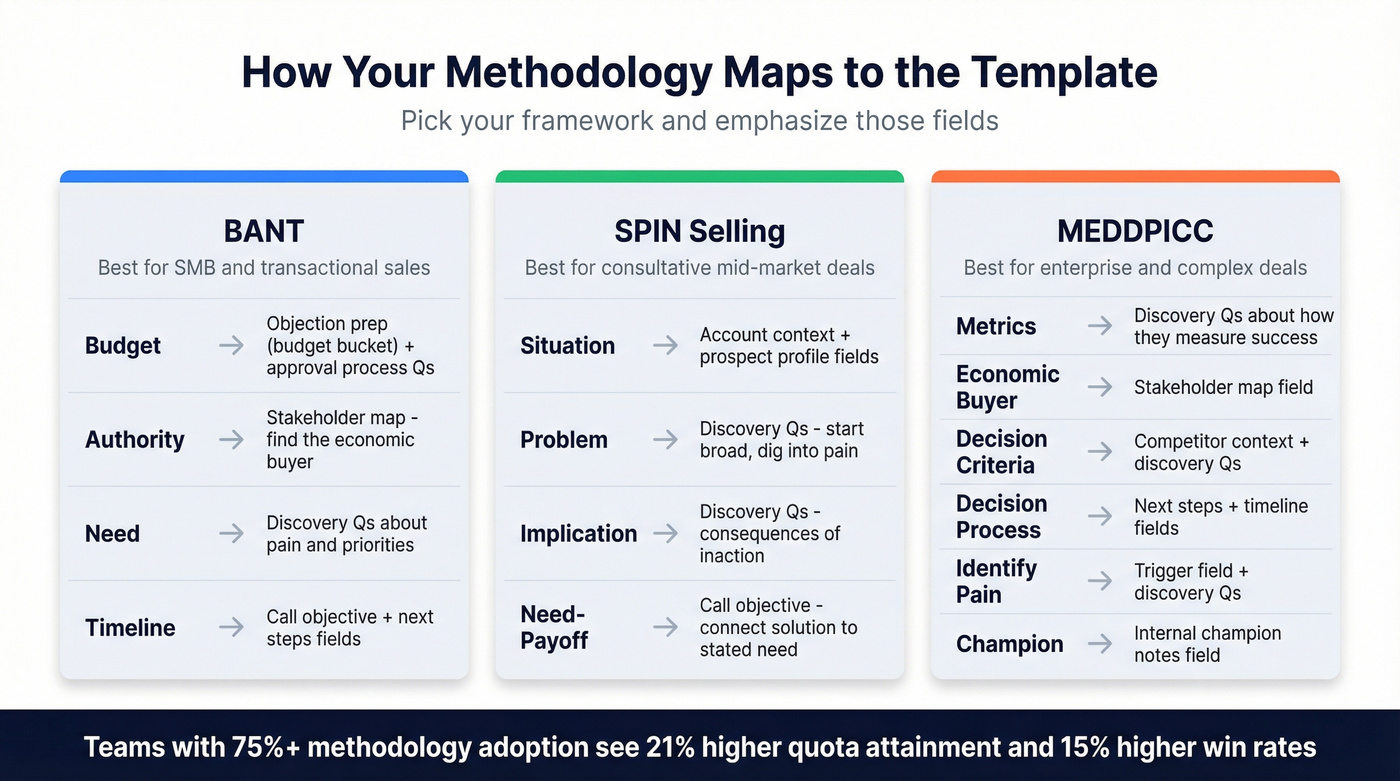
BANT
Best for transactional and SMB sales where the buying process is straightforward.
- Budget - Objection anticipation (budget bucket) + discovery questions about approval process
- Authority - Stakeholder map (economic buyer)
- Need - Discovery questions about pain and priorities
- Timeline - Call objective + next steps
SPIN Selling
SPIN is the sweet spot for consultative mid-market deals where the prospect doesn't yet realize the full scope of the problem. Your Situation questions map to the account context and prospect profile fields. Problem and Implication questions come from your discovery question bank - start broad, then dig into consequences of inaction. Need-Payoff ties directly to your call objective, where you connect your solution to their stated need.
The progression feels natural because it mirrors how people actually think through buying decisions. We've seen reps who internalize SPIN's flow cut their average sales cycle by two weeks simply because they stop pitching features and start surfacing urgency.
MEDDPICC
| MEDDPICC Component | Template Field |
|---|---|
| Metrics | Discovery questions (how they measure success) |
| Economic Buyer | Stakeholder map |
| Decision Criteria + Process | Discovery questions (evaluation and approval) |
| Paper Process | "If You Have Time" fields on procurement |
| Identify Pain | Discovery questions |
| Champion | Stakeholder map |
| Competition | Competitor context field |
MEDDPICC isn't a script you read to the buyer - it's the internal compass that tells you what you still don't know. Best for enterprise and complex deals where the buying process has multiple gates.
Five Pre-Call Mistakes That Kill Deals
Each of these maps to a specific template field that prevents it.
1. No specific call objective. You walk in hoping for a "good meeting" and walk out with nothing actionable. The call objective field forces you to define the buyer commitment you want before you dial.
2. Skipping objection prep. 67% of lost sales trace back to poor qualification. Two minutes anticipating the top objections saves you from freezing mid-call.
3. Talking to the wrong stakeholder. Nothing wastes more time than a 30-minute call with someone who can't approve, influence, or champion your deal. The stakeholder map catches this before you book the meeting.
4. Monologuing. Top performers talk 46% of the time. If you're at 72%, you're pitching, not discovering. The question bank keeps you asking, not telling. The consensus on r/sales is that "shutting up and listening" is the hardest skill to develop - and the one that makes the biggest difference.
5. Not verifying contact data. Bad data wastes 27% of a rep's time. The "Verify Contact Data" field takes 30 seconds and saves you from bounced follow-ups and disconnected numbers. We run everything through Prospeo before dialing - 98% email accuracy on a 7-day refresh cycle means we're not chasing ghosts.
Tools That Speed Up Call Prep
You don't need a ten-tool stack. Teams using advanced sales intelligence tools report 35% higher close rates and 28% shorter sales cycles. Here's what actually matters:
| Category | Tool | Use Case | Pricing |
|---|---|---|---|
| CRM | Salesforce | Log call plans + outcomes | $25-300/user/mo |
| CRM | HubSpot | Log call plans + outcomes | Free CRM; Sales Hub ~$20-$100+/user/mo |
| Conversation Intel | Gong | Talk ratio, call recording | ~$100-150/user/mo |
| Sales Engagement | Outreach | Sequence follow-ups | ~$100-130/user/mo |
| Sales Engagement | Salesloft | Sequence follow-ups | ~$100-150/user/mo |
| Data Verification | Prospeo | Verify emails + phones | Free tier; paid ~$0.01/email |
| Async Coaching | Loom | Record + share call prep | Free; paid from $15/user/mo |
Most teams analyze less than 30% of their customer interactions. Pairing a conversation intelligence tool like Gong with a solid call plan means you're not just preparing better - you're learning from every call and feeding those insights back into the next one.

The best pre-call research means nothing if your prospect's email bounces or their direct dial is dead. Prospeo refreshes every record every 7 days - not every 6 weeks like other providers - so the contact data in your call plan is current when you need it.
Fill in the template with data you can trust at $0.01 per email.
Using the Template as a Post-Call Debrief
The call plan doesn't end when you hang up. The debrief feeds your next plan.
| Debrief Field | What to Capture |
|---|---|
| Stated next step | What did the prospect agree to? "Demo on Thursday" not "follow up." |
| Commitment level | Did they commit or hedge? "Let me check with my team" is a hedge. |
| Stakeholders mentioned | Any new names? Update your stakeholder map. |
| Unanticipated objections | What came up that you didn't prep for? Add it to your objection bank. |
| MEDDPICC gaps | What do you still not know? Which fields are still blank? |
Companies using call analytics see a 25% lift in revenue. The debrief is where that lift starts - not in the software, but in the habit of asking "what did I learn and what do I still need?"
FAQ
How long should pre-call planning take?
Five to ten minutes for a standard call - enough to increase qualification accuracy by 43%. A structured pre-call checklist keeps you focused on the fields that matter so you don't spiral into 30 minutes of research that never makes it into the conversation. For high-stakes enterprise calls, 15-20 minutes is reasonable. That's the ceiling.
Do I need a different template for every call type?
No. Same base template, different emphasis. Cold calls lean on the opener. Discovery calls lean on the question bank. Negotiation calls lean on the stakeholder map.
What if my CRM already has call planning fields?
Most CRM call plan fields are too generic - they capture data, not thinking. Use this template as the prep tool, then log the outcome back into Salesforce or HubSpot.
Can I use this template in Word?
Yes. The Google Sheets version is easiest for collaboration, but you can copy the fields into a Word doc if your team prefers offline prep. Just keep it to the essential fields - a document with 25 blank rows gets ignored just as fast as a spreadsheet with 25 blank rows.
How do I verify contact data before the call?
Run emails and phone numbers through a verification tool before you dial. At 98% email accuracy and a 7-day data refresh cycle, Prospeo catches bounced addresses and dead numbers in seconds - saving the 27% of rep time that bad data typically wastes.