How to Make a Sales Call Script That Actually Books Meetings
Your manager says "just follow the script," but every prospect interrupts you in the first five seconds. The script isn't the problem - rigidity is. If you're figuring out how to make a sales call script that actually works, the answer isn't memorizing lines. After analyzing 300M+ cold calls, Gong found one thing that separated top-quartile cold callers from everyone else: they book 3x more meetings, and they don't do it by reading from a page. They use modular frameworks they rearrange on the fly.
What You Need (Quick Version)
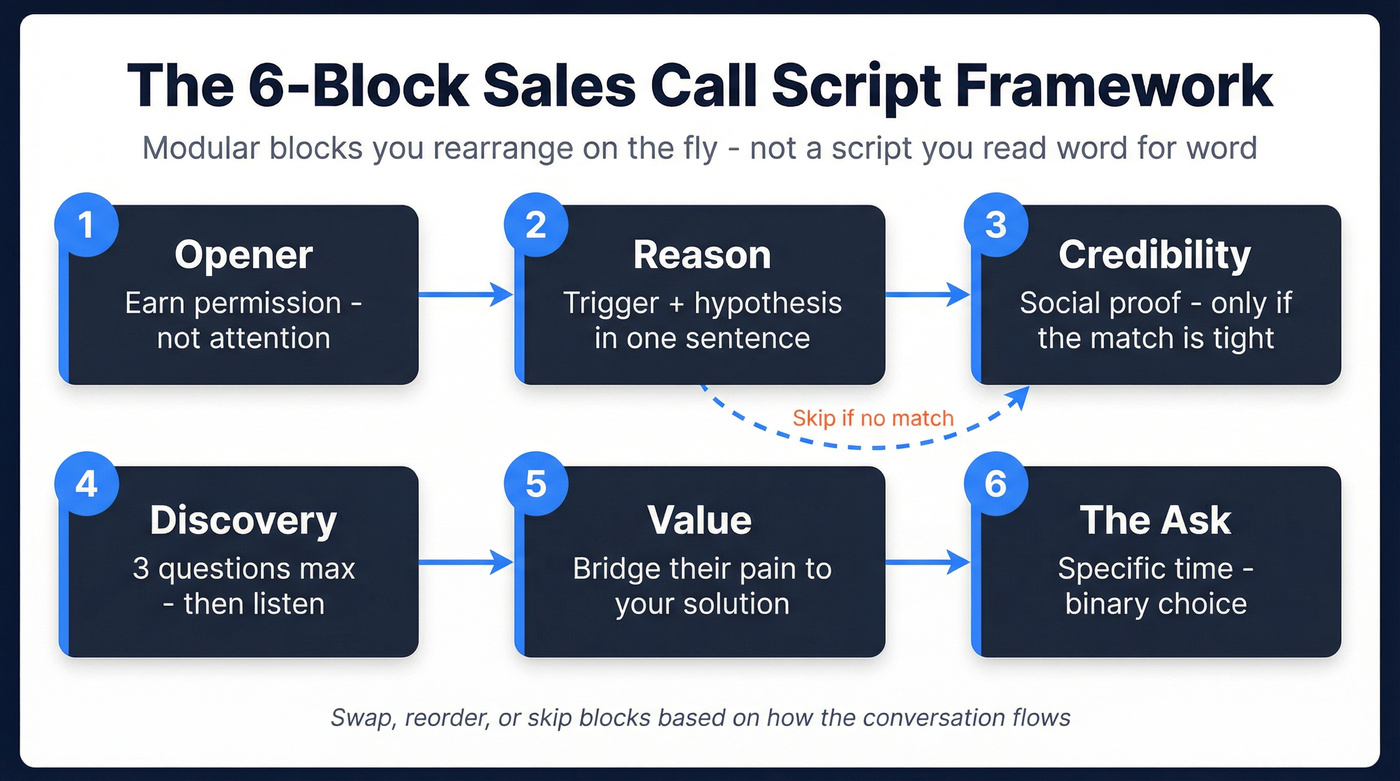
You don't need seven scripts. You need one modular talk track with six swappable blocks: opener, reason, credibility, discovery, value, and ask. Think of it as a blueprint you can build in 20 minutes using the framework below, then iterate monthly using call recordings and three benchmarks - a 43/57 talk-to-listen ratio, your connect-to-meeting rate, and your no-show rate.
What a Sales Call Script Actually Is
A sales call script isn't a teleprompter. It's a set of building blocks you internalize and deploy based on how the conversation unfolds. One rep who logged 11,519 cold calls and booked 335 meetings described the script as a "compass," not a "gospel." Highspot frames it similarly - flexible talk tracks that enable authentic exchanges rather than robotic checkbox pitching.
You don't need separate scripts for cold, warm, gatekeeper, follow-up, voicemail, re-engagement, and closing. You need one master framework with six interchangeable modules. Each module is two to three sentences. You memorize the structure, not the words. When a prospect throws you a curveball at second 8, you skip to the block that fits instead of freezing because they didn't follow your expected flow.
Let's be honest: scripts that sound scripted get hung up on. The consensus across every sales community we've seen - Reddit's r/sales included - is frameworks over word-for-word recitation, every time.
Pre-Call Prep: 2-3 Minutes, Not 20
Spend two to three minutes on pre-call research. More than that and you're procrastinating, not preparing. Forrester analyst Jessie Johnson argues digitally savvy B2B buyers expect providers to use behavioral signals to deliver relevant experiences - your pre-call research is that signal. Here's the four-item checklist:
- Role - What does this person actually own? Budget? Vendor selection? Day-to-day usage?
- Trigger - Any recent event (funding round, new hire, expansion, tech adoption) that makes your call timely? A hook like "I saw your team just expanded into the DACH region" earns you the first 15 seconds.
- Hypothesis - One sentence on what you think their pain is. You'll test this live.
- CTA - Know your ask before you dial. Meeting? Demo? Intro to another stakeholder?
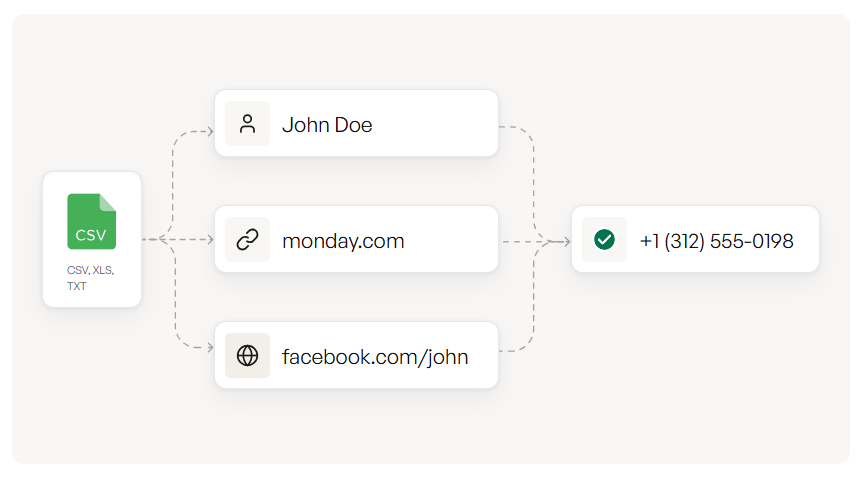
One thing that kills this entire process: calling dead numbers. If your list is stale, you're burning dials on ghosts. Verify the email and mobile before you pick up the phone with an email checker tool and a phone validator. Prospeo refreshes contact data every 7 days - the industry average is 6 weeks - so your script gets tested on real connects, not disconnected lines.
The 6-Block Script Framework
Each block is modular. Swap, reorder, or skip based on how the conversation flows.
Block 1: Opener (Earn Permission)
Three proven options, each suited to a different situation:
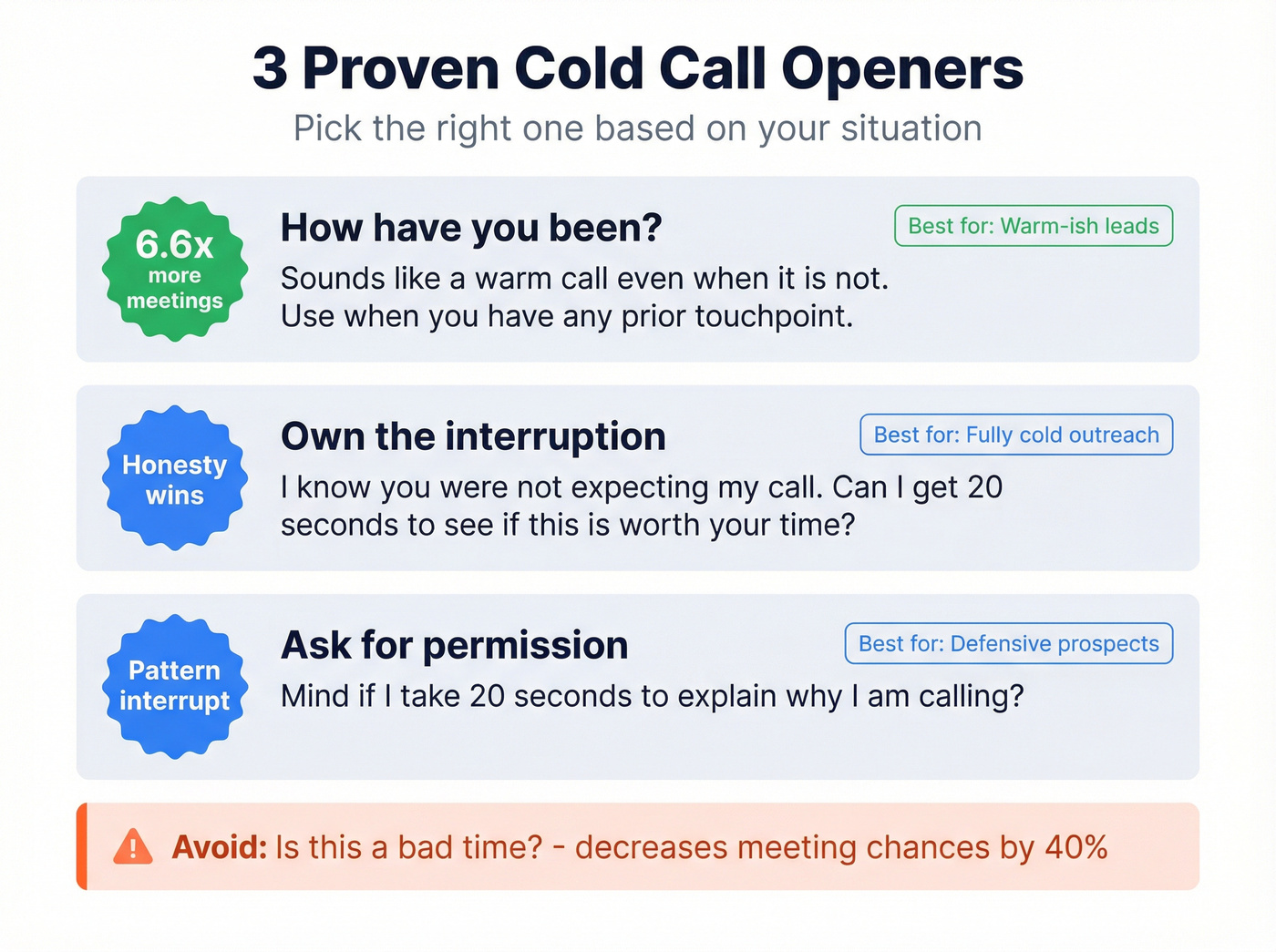
- "How've you been?" - This opener is 6.6x more successful at booking meetings. It sounds like a warm call even when it isn't. Use it when you have any prior touchpoint - a connection request, a webinar attendance, a mutual contact.
- Own the interruption. "I know you weren't expecting my call. Can I get 20 seconds to see if this is worth your time?" Best for completely cold outreach where the prospect has zero context. Honesty buys attention.
- Pattern interrupt. "Mind if I take 20 seconds to explain why I'm calling?" This reframes the dynamic - asking permission psychologically shifts the prospect from defensive to evaluative.
Asking "Is this a bad time?" decreases meeting chances by 40%. Some script guides still recommend it - if you're curious, A/B test it against a permission-based opener and let your booking rate decide.
Block 2: Reason for the Call
One sentence. Stating the reason for your call yields a 2.1x higher success rate than jumping straight into a pitch. Lead with the filled-in version:
"The reason I'm calling is I noticed you just posted three SDR roles on your careers page - I wanted to see if your current outbound tooling is keeping up with the team growth."
The formula: specific trigger + hypothesis. That's it. (If you want more signal ideas, build a simple outbound calling strategy around triggers you can track consistently.)
Block 3: Credibility + Social Proof
Using the wrong "similar company" reference drops win rates by 47% in early-stage deals. A mismatched name-drop is worse than no name-drop at all. Only use this block when you have an exact industry and company-size match.
When the match is tight: "We work with [Company X] - similar size, same space - and they cut their ramp time from 10 weeks to 4." When it's not tight: skip this block entirely and move to discovery.
Block 4: Discovery Questions (3 Max)
Lead with questions before you pitch. Three is the ceiling - more than that and you're running an interrogation. Maintain the 43/57 talk-to-listen ratio that Gong Labs identified as optimal.
| Question Type | Example | When to Use |
|---|---|---|
| Current state | "What's your current approach to [problem area]?" | Always - your default opener |
| Process-specific | "How are you handling [specific workflow] today?" | When you know their tech stack |
| Impact | "What happens when [problem] slows down?" | When they've acknowledged the pain |
Block 5: Value Hypothesis
Here's what most reps get wrong: they hear a pain point and launch into a feature dump. Don't.
One sentence connecting their answer to your solution is all you need.
Weak: "We have an AI-powered platform with 14 integrations and real-time analytics..."
Strong: "Based on what you just said about rep ramp time, we typically help teams like yours cut that from 10 weeks to 4."
Bridge, don't pitch. (If you need better prompts, pull from these best open-ended sales questions.)
Block 6: The Ask
Offer a specific time, not a vague "when works for you." Binary choices work best: "Is tomorrow at 2 or Thursday at 4 better?" This reduces decision friction.
For a softer close: "Does it make sense for me to give you more detail on how this works?" This interest CTA performs 2x better than harder closes in cold outreach.
Stop asking for "15 minutes of their time." Ask for a specific outcome. "I'd like to show you how [Company X] cut their bounce rate in half - that takes about 12 minutes" is infinitely better than a generic time request.

The best sales call script in the world can't book a meeting on a disconnected line. Prospeo gives you 125M+ verified mobile numbers refreshed every 7 days - not the 6-week-old data your current provider recycles. Teams using Prospeo see a 30% pickup rate, which means your 6-block framework actually gets tested on live conversations.
Stop rehearsing scripts into voicemail boxes that don't exist.
Copy/Paste Templates
First Call Script (SaaS Example)
"Hey [First Name], it's [Your Name] from [Company]. How've you been?
[Pause - let them respond]
The reason I'm calling - I noticed your team just rolled out a new outbound motion and hired four SDRs last quarter. A lot of teams scaling that fast run into data quality issues that tank deliverability. We helped [Similar Company] get their bounce rate from 35% down to under 4% in the first month.
Quick question: how are you sourcing contact data for the new reps right now?
[Listen - then bridge to value]
Got it. Based on that, it'd probably be worth showing you how we handle [specific gap they mentioned]. Would Thursday at 3 or Friday at 10 work for a quick walkthrough?"
Voicemail + Follow-Up Email
Voicemail isn't about callbacks. It's about lifting email replies. Leaving voicemails increases email reply rates from 2.73% to 5.87%. More than double.
Voicemail (under 20 seconds): "Hey [First Name], it's [Your Name] from [Company]. I'm sending you a quick email about [one-sentence reason]. Take a look when you get a chance - my number's [number]."
Follow-up email (sent within 2 minutes):
Subject: Just left you a voicemail
[First Name] - tried you just now. Wanted to flag that [trigger/relevance hook]. We helped [similar company] [specific result]. Worth a 12-minute call? I'm open [two specific times].
Gatekeeper Script
Don't pitch the gatekeeper. First-name basis, keep it casual: "Hi, it's [Your Name] - is [First Name] available? I'm just following up on an email I sent over." If they push back, ask for voicemail: "Could you transfer me to their voicemail? I'll keep it brief."
"Not Interested" Recovery
This objection hits roughly 60% of cold calls. Don't argue. Bridge:
"Totally fair - most people say that before they know why I'm calling. Can I take 20 seconds? If it's not relevant, I'll hang up myself."
One more shot. If they say no again, thank them and move on.
Objection Handling Responses
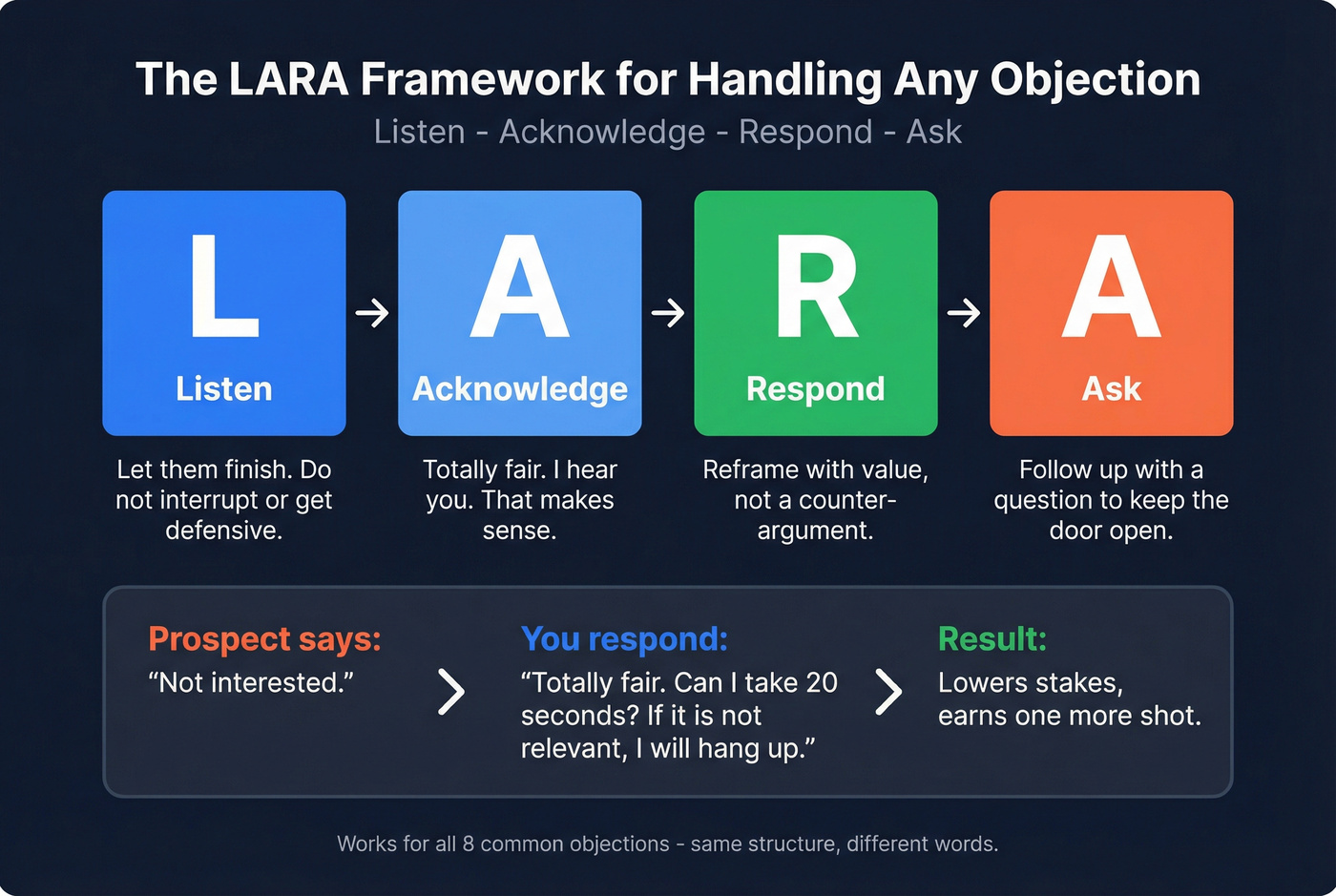
The LARA framework - Listen, Acknowledge, Respond, Ask - works for every objection. Here are the eight you'll hear most:
| Objection | Response | Why It Works |
|---|---|---|
| "Not interested" | "Totally fair. Can I take 20 seconds? If it's not relevant, I'll hang up." | Lowers stakes, earns one more shot |
| "Send me an email" | "Happy to. So I send the right thing - what's your biggest priority this quarter?" | Reframes deflection into discovery |
| "No budget" | "Is this about funds not being allocated, or timing with your budget cycle?" | Separates real objection from reflex |
| "We already have a solution" | "Good - most of our customers did too. What made you start looking at alternatives?" | Plants a seed of evaluation |
| "Call me next quarter" | "Absolutely. What's changing next quarter that makes the timing better?" | Tests if it's a real timeline or brush-off |
| "I don't have time" | "I get it - 20 seconds, and if it's not relevant, I'm gone." | Respects their time, earns a window |
| "How'd you get my number?" | "Your info's in our database. The reason I'm reaching out is [reason]." | Deflect and redirect to value |
| "What's this about?" | "Great question - [one-sentence reason for call]. Does that resonate?" | Direct answer, then qualify |
When a prospect says "interesting, send me some info," don't celebrate. That's a soft deflection. Qualify it: "When you say interesting, what specifically stood out?"
Cold Calling Benchmarks for 2026
| Metric | Average | Top Performers |
|---|---|---|
| Cold call to meeting rate | 2.5% | 5-8% |
| Dials per meeting | 40 | 15-20 |
| Successful call duration | 5:50 | - |
| Failed call duration | 3:14 | - |
| Talk-to-listen ratio | - | 43% / 57% |
| Best calling windows | 8-9am, 4-5pm local | +47% connect rates |
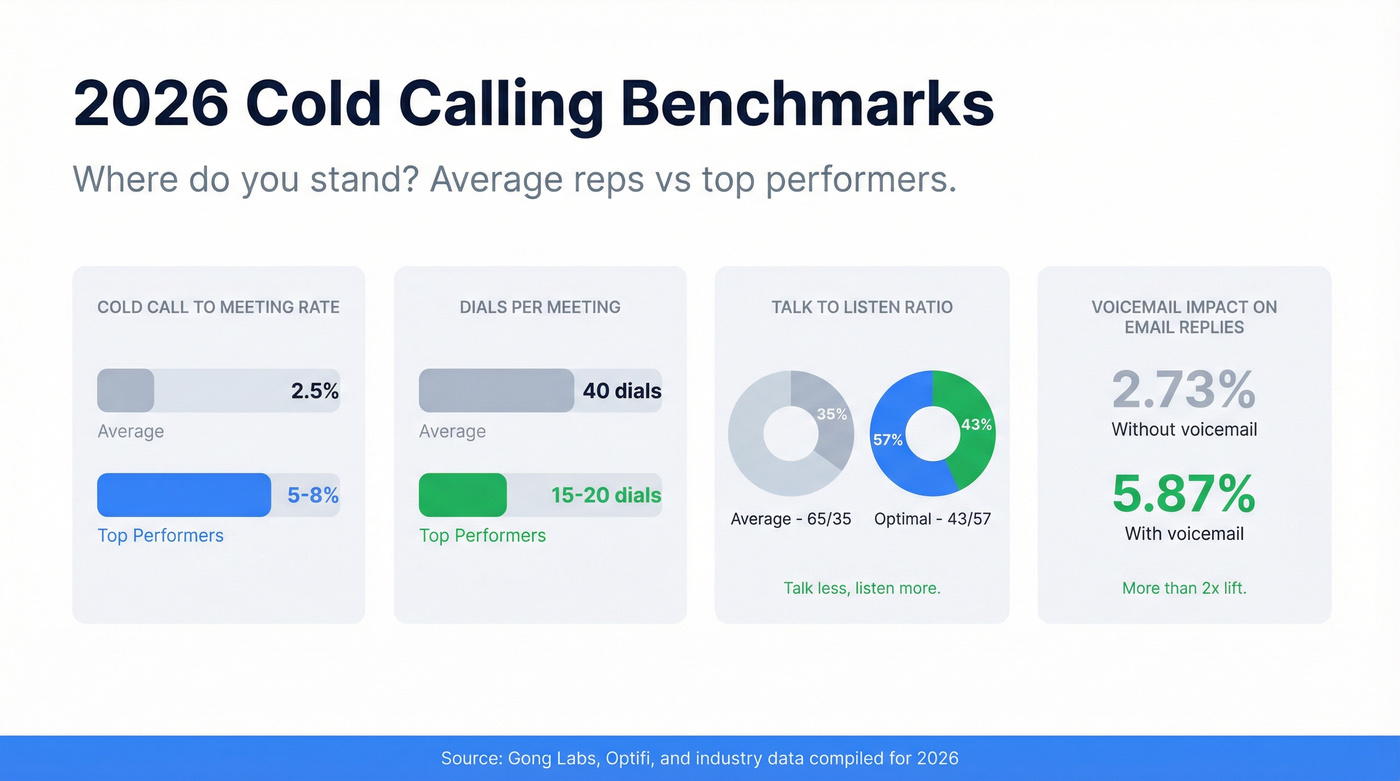
Successful calls run almost twice as long as failed ones - 5:50 versus 3:14. That extra time is discovery and value conversation, not filler. If your calls are consistently under four minutes, you're pitching too early.
Look, if you're selling deals under $10K, you probably don't need a 6-block script at all. A 2-block version - opener plus ask - with a tight list and fast dials will outperform an elaborate framework on low-ticket deals. Save the full blueprint for deals where the discovery actually matters.
Cold calling also amplifies every other channel. Even without connecting live, making the call nearly doubles email reply rates: 3.44% versus 1.81%. And multi-threading - reaching multiple contacts at the same account - boosts win rates by 130% on deals over $50K. (If you want the full case for it, see the benefits of cold calling.)
How to Iterate Monthly
Close's founder built his first cold calling script within an hour of the idea. Goal: one deal in four weeks. Result: seven paying customers in 14 days. The script wasn't perfect - it was testable. That's the point.
We've seen teams double their connect-to-meeting rate in 30 days just by A/B testing their opener. Set a monthly 15-30 minute script review and test these in priority order:
- Opener + permission line - This is where most calls die. Test two openers for two weeks, track connect-to-conversation rate.
- Reason-for-call sentence - Swap triggers and hypotheses. See which ones earn discovery questions.
- Meeting ask wording - Binary time offer versus interest CTA. Track booking rate.
Pull three call recordings per review - one great, one terrible, one average. Listen for where the conversation stalls. Gong Labs found that low performers' talk time swings 10% between won and lost deals, while top performers stay consistent. In our experience, consistency in delivery matters more than finding the "perfect" line. (To systematize this, use a simple cold call coaching cadence.)
Tools Worth Considering
| Category | Tool | Starting Price |
|---|---|---|
| Data quality | Prospeo | Free tier, ~$0.01/email |
| Conversation intel | Gong | ~$160-250/user/mo |
| Conversation intel | Chorus | ~$40/user/mo + ZoomInfo |
| Dialer | Aircall | ~$30/user/mo |
| Dialer | JustCall | $19-49/user/mo |
| Meeting assistant | Fireflies | $10-18/user/mo |
| Meeting assistant | Otter | $8.33-20/user/mo |
Skip conversation intelligence tools if your team is under five reps - the ROI doesn't justify the cost until you have enough call volume to spot patterns. For teams that size, a free Otter account and a shared Google Doc of winning talk tracks will get you 80% of the way there.
Your script can't get a fair test on bad data. Verify your list first - Prospeo covers 300M+ professional profiles with 125M+ verified mobile numbers and a 30% pickup rate, with a free tier to start. (If you're comparing options, start with these sales prospecting platforms.)
You just spent 2-3 minutes on pre-call prep - the trigger, the hypothesis, the perfect opener. Don't waste it on bad data. Prospeo's 98% email accuracy and verified mobiles mean every dial is a real shot at a meeting. At $0.01 per email, your cost per connect drops while your booking rate climbs.
Turn every scripted call into a real conversation for a penny per lead.
FAQ
How long should a cold call script be?
One page max, six modular blocks. If you can't scan the entire framework in 90 seconds, it's too long - trim filler and keep each block to two or three sentences.
What's the best opening line for a cold call?
"How've you been?" books meetings at a 6.6x higher rate than standard openers. For zero-touchpoint prospects, try "Mind if I take 20 seconds to explain why I'm calling?" - it earns permission without sounding desperate.
How many dials does it take to book one meeting?
Average reps need about 40 dials per meeting. Top performers book one every 15-20 dials. The gap comes down to opener quality, list accuracy, and calling during peak windows (8-9am or 4-5pm local time).
Do voicemails actually help?
Yes - voicemails more than double email reply rates, lifting them from 2.73% to 5.87%. Leave a sub-20-second message, then send a follow-up email within two minutes for maximum impact.
How do I keep my contact list accurate for cold calling?
Use a data provider with frequent refresh cycles. Stale data is the silent killer of cold calling programs - we've watched teams blame their script when the real problem was 30% of their numbers were disconnected. Weekly refresh cycles and real-time verification before dialing make the difference between testing your script and testing your patience.