

Phone Validator: How It Works & Best Tools (2026)
Your SDR team ran 500 dials last Tuesday. 300 went to disconnected numbers, wrong line types, or voicemail boxes that were never set up. The phone validator you used said every single one was "valid." We've watched this exact scenario play out dozens of times, and the root cause is always the same: most tools don't actually validate anything meaningful. They check formatting. A number with the right digit count and a real country code passes, even if nobody's picked up that line in three years.
The gap between "correctly formatted" and "actually reachable" is where money goes to die.
What You Need (Quick Version)
Most free phone validators only check syntax - correct digits, valid country code, proper length. That tells you almost nothing about whether a human will answer. If you need to know whether a number is real, active, and the right line type, you need carrier-level validation. Here's the shortcut by use case:
- Developers building validation into apps - Twilio Lookup. Free format checks, pay-per-request for carrier signals.
- Fraud prevention and risk scoring - IPQualityScore (IPQS). Deep carrier pings, DNC/TCPA scrubbing, 1,000 free lookups/month.
- SMBs wanting predictable monthly costs - Abstract API. Flat tiers from $19/mo, 190+ countries.
If you're in B2B outbound, keep reading. The tool you need isn't a standalone validator - it's a sales prospecting platform that handles validation before you ever see the number.
How Phone Validation Works
Phone validation isn't one thing. It's a stack of increasingly expensive checks, and most tools only run the first one or two layers. Understanding the stack helps you figure out what you're actually paying for.
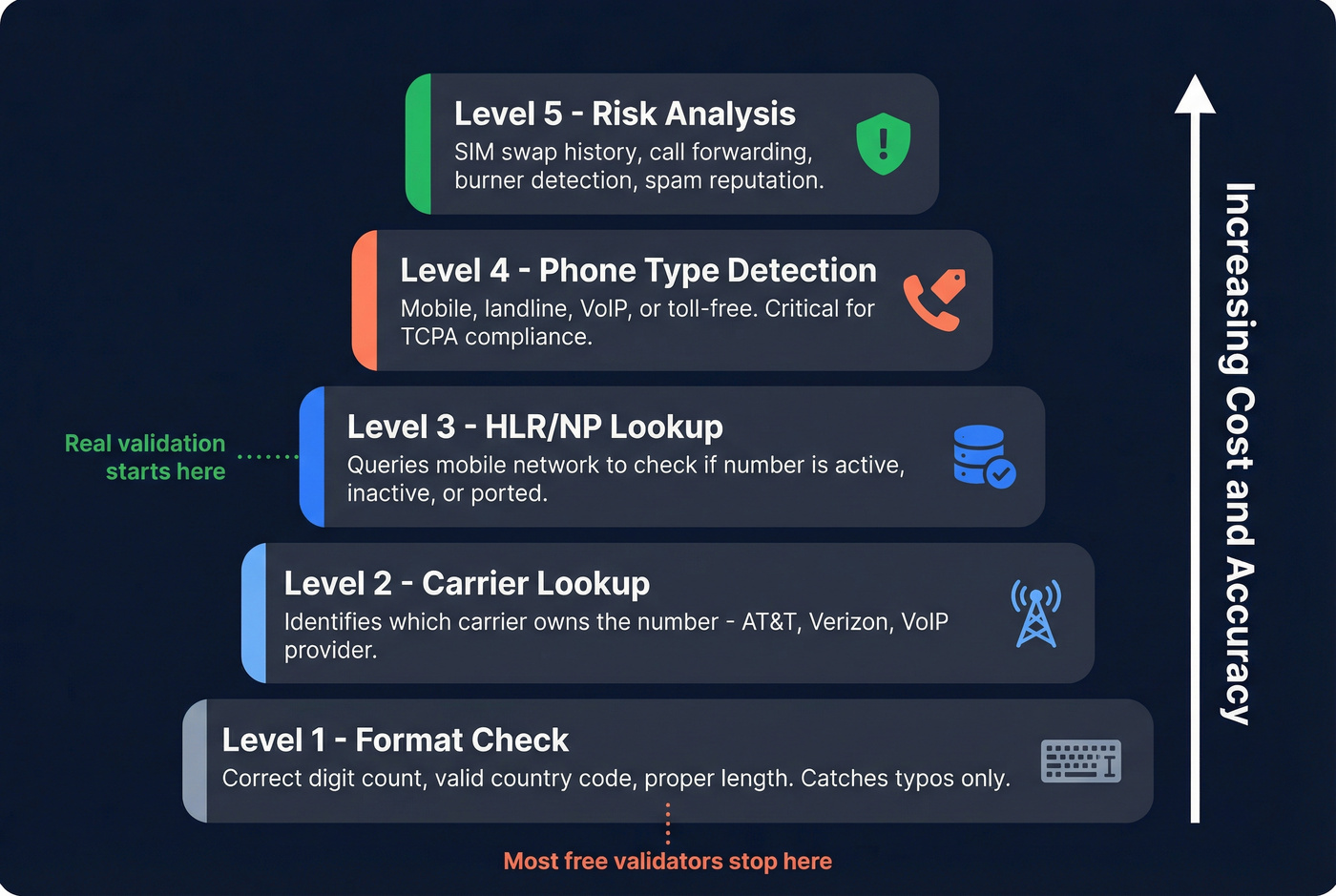
Level 1 - Format check. Pure syntax. Does the number have the right digit count for its country code? Is the area code real? This catches typos and obviously fake entries like 555-0100. It tells you nothing about whether the number is connected. Every tool does this, and many stop here. If you're paying for format-only validation, you're overpaying - every programming language has a regex library that does this for free.
Level 2 - Carrier lookup. The system queries telecom databases to identify which carrier owns the number - AT&T, Verizon, a regional carrier, or a VoIP provider. Useful for line-type detection, but still doesn't confirm the number is active.
Level 3 - HLR/NP lookup. This is where real validation starts. An HLR lookup queries the mobile network operator's database to check whether a number is active, inactive, or disconnected, and it also returns roaming status. A Number Portability lookup checks whether the number has been ported between carriers - critical because a number that started as a Verizon landline might now be a T-Mobile mobile.
Level 4 - Phone type detection. Mobile, landline, VoIP, or toll-free? This matters enormously for compliance. TCPA rules treat mobile numbers differently from landlines, and texting a landline is a waste of money and a potential legal problem.
Level 5 - Risk analysis. The most advanced layer scores numbers for fraud signals: SIM swap history, call forwarding status, disposable/burner phone detection, and spam reputation. Fraud prevention teams live here.
Here's the thing: a number can pass levels 1 and 2 with flying colors and still be completely disconnected. Format-only validation gives false confidence, and that false confidence costs real money in wasted dials, burned SMS credits, and compliance exposure.
Validation vs. Verification vs. Intelligence
These three terms get used interchangeably, but they mean different things.
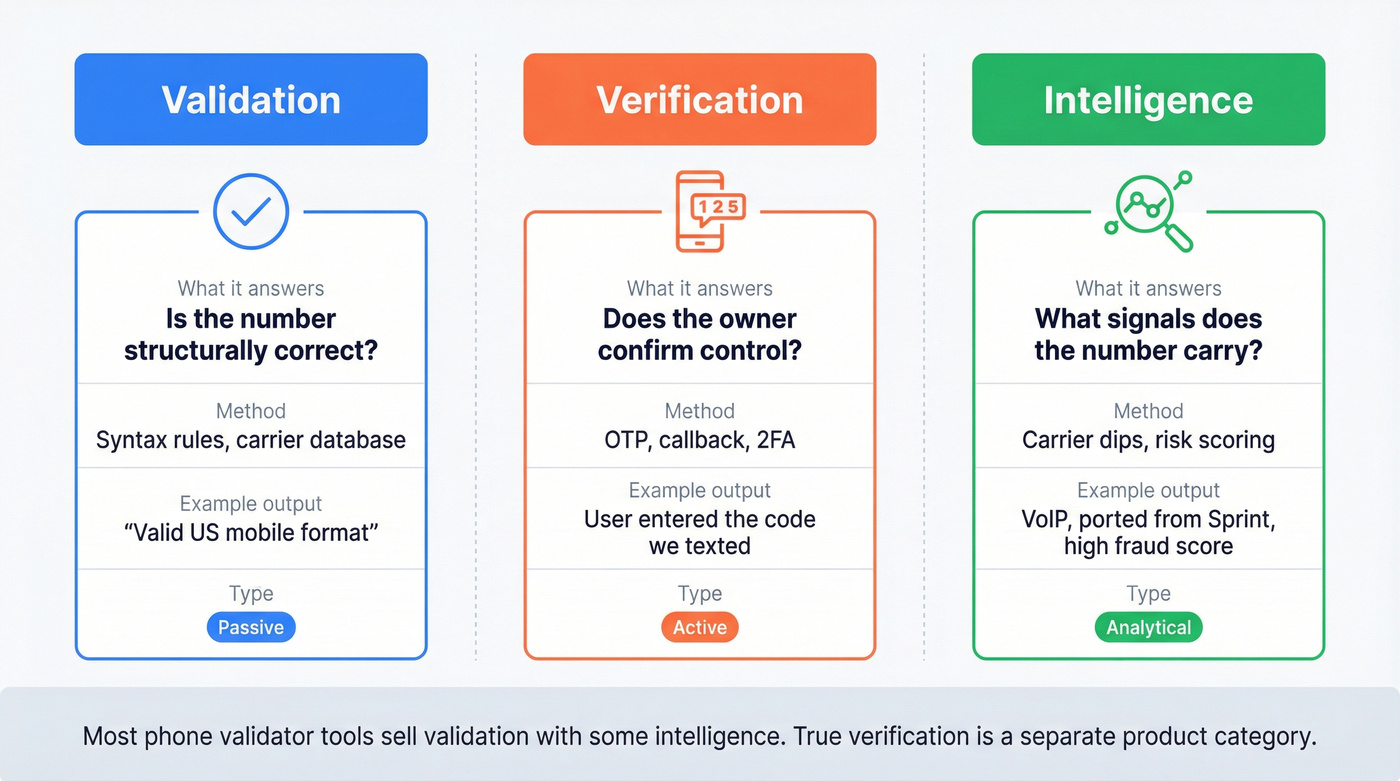
| Term | What It Answers | Method | Example |
|---|---|---|---|
| Validation | Is the number structurally correct? | Syntax rules, carrier DB | "Yes, this is a valid US mobile format" |
| Verification | Does a human confirm ownership? | OTP, callback, 2FA | "User entered the code we texted" |
| Intelligence | What signals does the number carry? | Carrier dips, risk scoring | "VoIP, ported from Sprint, high fraud score" |
Validation is passive - you're checking data against rules. Verification is active - you're asking the number's owner to prove they control it. Intelligence is analytical - you're extracting signals that inform decisions about fraud risk, deliverability, or contact strategy.
Most tools in this category sell validation with some intelligence layered on. True verification through OTP or callback is a separate product category entirely, handled by tools like Twilio Verify or Vonage Verify.
Why Bad Numbers Cost You
If you're calling or texting US consumers, TCPA compliance isn't optional - it's existential. Penalties run $500 per violation, up to $1,500 for willful infractions. A campaign to 1,000 contacts without proper consent can trigger $500K to $1.5M in fines. The FCC tightened consent requirements in 2024, and enforcement has only accelerated since.
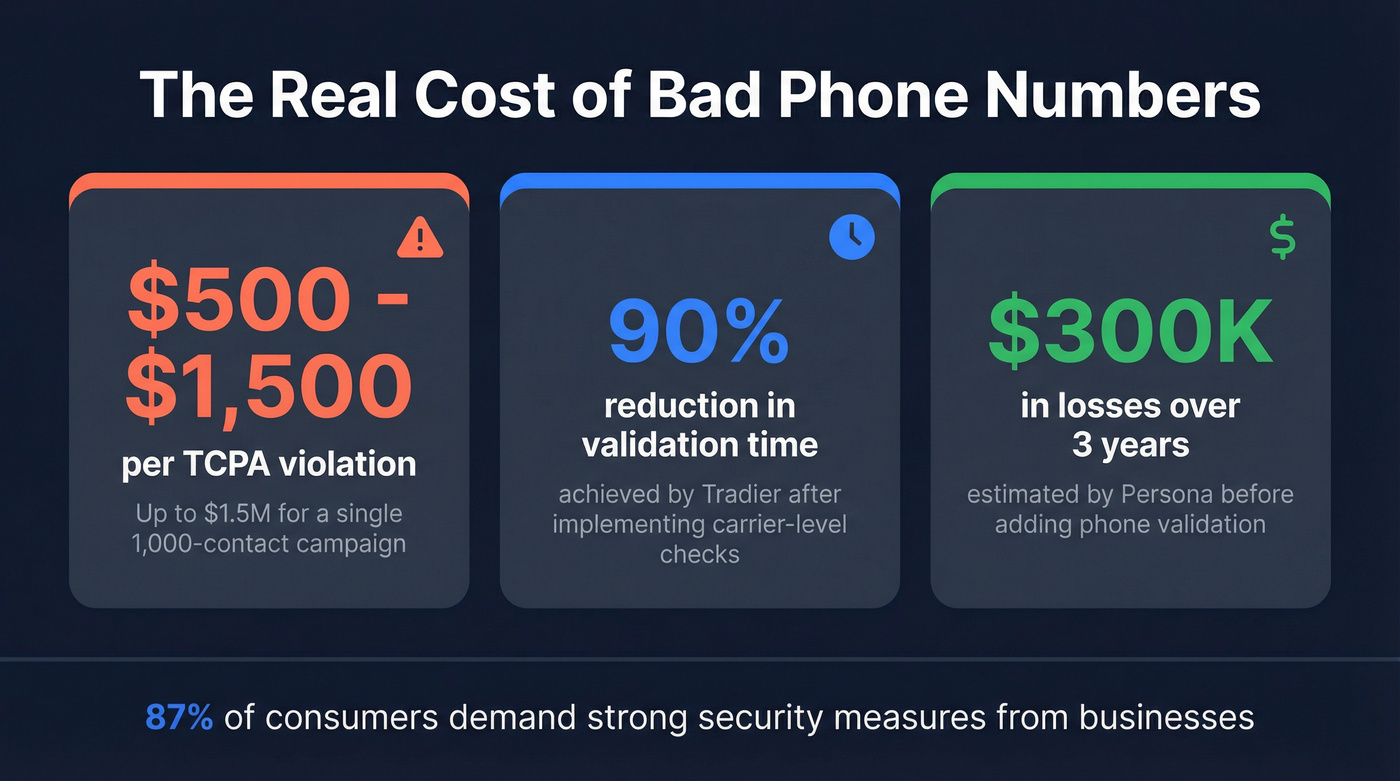
Line-type detection is the compliance prerequisite most teams overlook. TCPA rules restrict automated calls and texts to mobile numbers without prior express consent. If your validation tool can't distinguish mobile from landline from VoIP, you're flying blind into a minefield.
The operational costs go beyond fines, too. Tradier reduced validation times by roughly 90% after implementing Twilio's Identity Match. Persona estimated around $300,000 in losses over three years before adding Lookup to their stack. These aren't edge cases - they're what happens when you treat phone number validation as an afterthought. And 87% of consumers demand strong security measures from businesses they interact with, so validated phone data isn't just a compliance checkbox. It's a trust signal.

Most phone validators check formatting and call it a day. Prospeo runs 125M+ mobile numbers through carrier-level verification before they hit your list - so you never pay to validate what's already broken. 30% pickup rate across all regions, at $0.10 per number.
Stop validating bad data. Start with numbers that actually connect.
Best Tools for Phone Validation
Twilio Lookup
Use this if you're a developer building validation into a product and want the deepest feature set available via API.
Skip this if you're a non-technical team looking for a simple UI to clean a list before a campaign.
Twilio Lookup is the reference implementation for phone validation APIs. Format checks are free. After that, you pay per signal: line type intelligence at $0.008/request, line status at $0.007 - dropping to $0.00385 above 10M queries - identity match at $0.10, and reassigned number risk starting at $0.02 for low volumes. SIM swap and call forwarding detection require a sales conversation.
The feature depth is unmatched: SMS Pumping Risk Score, reassigned number checks, caller name for US numbers, call forwarding status for UK numbers. But this is an API-first product with no drag-and-drop list cleaner, so you'll need engineering resources to integrate it. Costs stack quickly when layering multiple signals. At 100K lookups with line status plus line type, you're looking at roughly $1,500 at low-volume rates.
IPQualityScore (IPQS)
If your compliance team keeps you up at night, IPQS is the tool that lets you sleep. Where Twilio gives you building blocks, IPQS gives you a pre-assembled compliance engine - DNC opt-in status retrieval and TCPA scrubbing built directly into the validation flow, something most pure-play validators don't touch.
Their "deep ping" system uses direct carrier relations in 75+ countries and supports carrier-level validation across 150+ countries to determine connected vs. disconnected status, not just format correctness. The returned data includes carrier name, line type, prepaid status, risk score, and geographic data. HLR and LRN lookups work even for ported numbers in most countries.
The free tier gives you 1,000 lookups/month. Paid plans require contacting sales - expect roughly $0.005-$0.01 per request at moderate volumes based on market positioning.
Abstract API
Abstract API is the best value per dollar in this category. No contest. Monthly tiers run from $19/mo for 1,000 calls up to $499/mo for 650,000 calls, with clean steps at $39 (25K), $69 (50K), $99 (100K), and $199 (250K) in between. You get carrier detection, line type classification, and fake/invalid number flagging across 190+ countries. Throughput handles 10 to 10,000 requests per second - more than enough for batch processing.
The tradeoff is depth. Abstract doesn't offer risk scoring, SIM swap detection, or compliance scrubbing. For straightforward "is this number real and what type is it" validation, nothing else comes close on price-to-coverage ratio. SMBs and mid-market teams that want predictable budgets should start here.
Numverify
Numverify covers 232 countries - the broadest in this roundup. For carrier identification and basic validation, it works well. For live connection checks and deeper risk signals, you'll hit the ceiling quickly.
The free tier gives you 100 requests/month, and paid plans start at $14.99/mo with 256-bit HTTPS encryption and roughly 99.9% uptime. Numverify also sends usage notifications at 75%, 90%, and 100% of your plan limit - a small but thoughtful feature for budget-conscious teams. It's the right entry point for international validation on a tight budget.
Trestle
Trestle charges $0.015 per query on self-serve, with enterprise custom pricing for higher volumes. You get carrier name, line type, prepaid status, disconnected detection, and a phone activity score. No bells, no whistles, no hidden fees. Country coverage isn't publicly documented, so confirm international support before committing. For US-focused teams that want simple pay-as-you-go without a monthly plan, Trestle delivers exactly what it promises.
Loqate
Loqate prices in GBP - prepaid tiers range from 6.1p/lookup on the PS100 plan down to 3.1p/lookup on the PS2,500 plan, roughly $0.04-$0.08 USD. It includes risk scoring and disposable/VoIP detection. Best for UK/EU enterprise data quality teams that want phone validation as part of a broader data quality workflow. If you aren't buying into that ecosystem, the pricing premium is hard to justify.
PhoneValidator.com
PhoneValidator.com has been running since 2005 and offers free single-number lookups for basic line-type detection on North American numbers. It identifies whether a number is a cell phone, landline, toll-free, VoIP, or fake/invalid. Batch processing runs around $0.01-$0.03 per lookup. Bare-bones but functional for quick one-off checks.
Others Worth Knowing
ClearoutPhone offers a free tier and paid plans from around $5-$15/mo for small batches, with bulk processing for teams just getting started with validation. Textmagic provides a free single-number validator tied to their SMS platform - useful if you're already sending messages through them. Messente has a free single-number tool with bulk validation via API, typically in the $0.005-$0.01 range per lookup.
Pricing Compared
| Tool | Free Tier | Pricing | Monthly Plans | Best For |
|---|---|---|---|---|
| Twilio Lookup | Format only | $0.007-$0.10/request | Pay-per-use | Developers |
| IPQS | 1,000/mo | ~$0.005-$0.01/request | Contact vendor | Fraud prevention |
| Abstract API | No | $0.019-$0.0008/request | $19-$499/mo | SMBs (best value) |
| Numverify | 100/mo | Varies by plan | From $14.99/mo | Budget / international |
| Trestle | No | $0.015/query | Pay-per-use | Pay-as-you-go |
| Loqate | No | ~$0.04-$0.08/query | From ~PS100 prepaid | UK/EU enterprise |
| PhoneValidator | Single lookups | ~$0.01-$0.03/query | Not public | Basic checks |
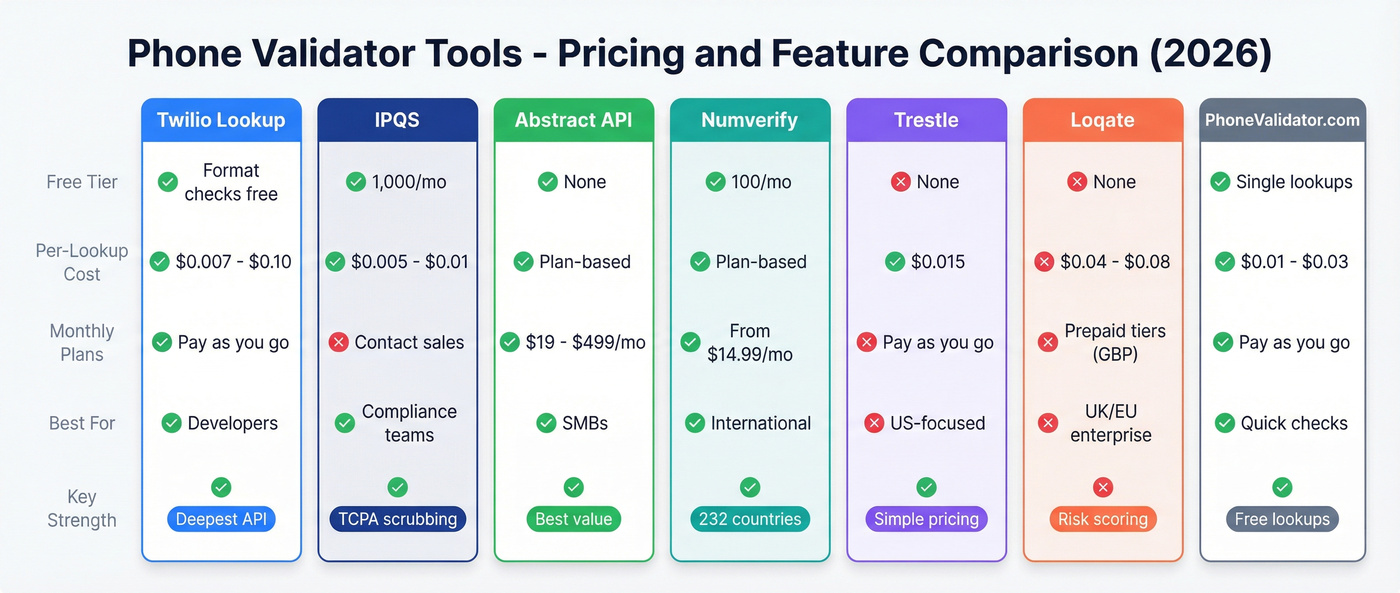
In our testing, costs stack faster than most teams expect when layering multiple signals. If you're validating 300,000 numbers through Twilio Lookup at the line status rate of $0.007 each, that's a $2,100 charge for a single batch. Add line type intelligence and you're at $4,500. These costs are manageable for product teams baking validation into onboarding flows, but they add up fast for sales teams cleaning purchased lists.
Let's be honest: if your average deal size is under $10K, you probably don't need Twilio-level granularity. Abstract API at $99/mo for 100K lookups gives you 80% of the value at 5% of the cost.
Choosing the Right Tool
Building validation into a product? Twilio Lookup. The API is well-documented, per-signal pricing lets you control costs, and the feature depth covers everything from format checks to SIM swap detection. Your engineers will thank you.
Cleaning a list before an SMS campaign? IPQS for compliance-heavy campaigns with TCPA scrubbing built in, or Abstract API if you just need line type plus validity at predictable monthly costs.
International coverage on a budget? Numverify. 232 countries, free tier to test, paid plans from $14.99/mo. It won't give you deep carrier intelligence, but it catches formatting errors and identifies carriers globally.
B2B outbound and cold calling? This is where the whole "phone validator" framing breaks down. Validating a number tells you it works. It doesn't tell you it belongs to the VP of Engineering you're trying to reach. For B2B sales teams, the answer isn't a standalone validator - it's a data platform that gives you pre-validated numbers attached to the right people.
What Comes After Validation
Look - a validated mobile number belonging to the wrong person wastes your rep's time just as effectively as a disconnected one. A common frustration across r/sales and similar communities is that format-only validators return "valid" for numbers that haven't been active in years. The disconnect between "valid format" and "someone will answer" is the number-one complaint practitioners raise.
The real workflow for B2B teams isn't validate then dial. It's validate, enrich, verify identity, then reach out. Most standalone phone validators handle step one and leave you to figure out the rest. If you're building that workflow, start with data quality and CRM hygiene so bad records don’t keep re-entering your system.
We've seen B2B teams cut their validation workflow in half by starting with pre-verified data instead of buying a list and running it through a separate tool. Prospeo maintains 125M+ verified mobile numbers already attached to professional profiles with 50+ data points per contact, refreshed on a 7-day cycle instead of the 6-week industry average. Pickup rates run at 30% across all regions - that's what happens when validation and enrichment happen in the same step. Pricing works on credits at roughly $0.01 per email and 10 credits per mobile number, with a free tier to test before committing. If you’re sourcing numbers for outreach, it also helps to understand what a direct dial is and how teams find phone numbers reliably.
Your SDRs shouldn't waste half their dials on disconnected lines. Prospeo's 125M+ verified mobiles are refreshed every 7 days - not the 6-week industry average - so the number you pull today is the number that rings tomorrow. Teams using Prospeo see a 30% pickup rate vs. 11-12% from competitors.
Ditch the standalone validator. Get pre-verified direct dials instead.
FAQ
What is phone validation?
Phone validation checks whether a number is structurally correct, active, and reachable. Basic validators only confirm format - correct digit count, valid country code. Advanced tools query carrier databases via HLR lookups to confirm line type, connection status, and porting history. Format-only checks miss disconnected numbers entirely.
Is there a free phone validator?
Yes - most tools offer free single-number lookups or small monthly tiers. IPQS gives 1,000 free lookups/month, Numverify offers 100/month, and PhoneValidator.com provides unlimited single checks. For B2B teams, Prospeo's free tier includes 75 emails and 100 Chrome extension credits with pre-validated mobile numbers attached.
What's the difference between HLR lookup and format validation?
Format validation checks syntax: correct digit count, valid country code, proper area code. HLR lookup queries the mobile network's Home Location Register to confirm the number is currently active, identify the serving carrier, and detect ported numbers. HLR catches disconnected and deactivated numbers that format checks pass as "valid."
How much does phone validation cost at scale?
At 100K numbers: Twilio Lookup costs roughly $700 for line status alone, Abstract API runs $69-$99/month depending on your tier, and Trestle costs about $1,500 at $0.015/query. Format checks are free or near-free, while layering carrier dips, risk scoring, and identity matching can push costs 10-20x higher. Twilio's pricing page has the full breakdown.
Can I get pre-validated mobile numbers for B2B outreach?
Yes. Instead of buying a list and running it through a separate tool, platforms like Prospeo maintain 125M+ verified mobile numbers refreshed weekly and attached to professional profiles with job title, company, seniority, and 50+ data points. Free tiers let you test before committing - no contracts required.