

Prospecting vs Lead Generation: What Actually Matters in 2026
Your VP of Sales says marketing leads never convert. Your CMO says reps don't follow up fast enough. They're both right - and they're arguing about the wrong thing.
61% of B2B buyers now prefer a rep-free experience, which means the old playbook of "generate leads, toss them over the wall, hope sales closes" is broken. The real question in the prospecting vs lead generation debate isn't which one wins - it's whether your team knows which job each one does, and whether the data and handoff process exist to make either work. Here's a number worth anchoring on: qualified inbound leads convert to booked meetings at a 62% median rate. Outbound runs 2-5%. Both numbers are useful. Neither tells the full story.
The Quick Version
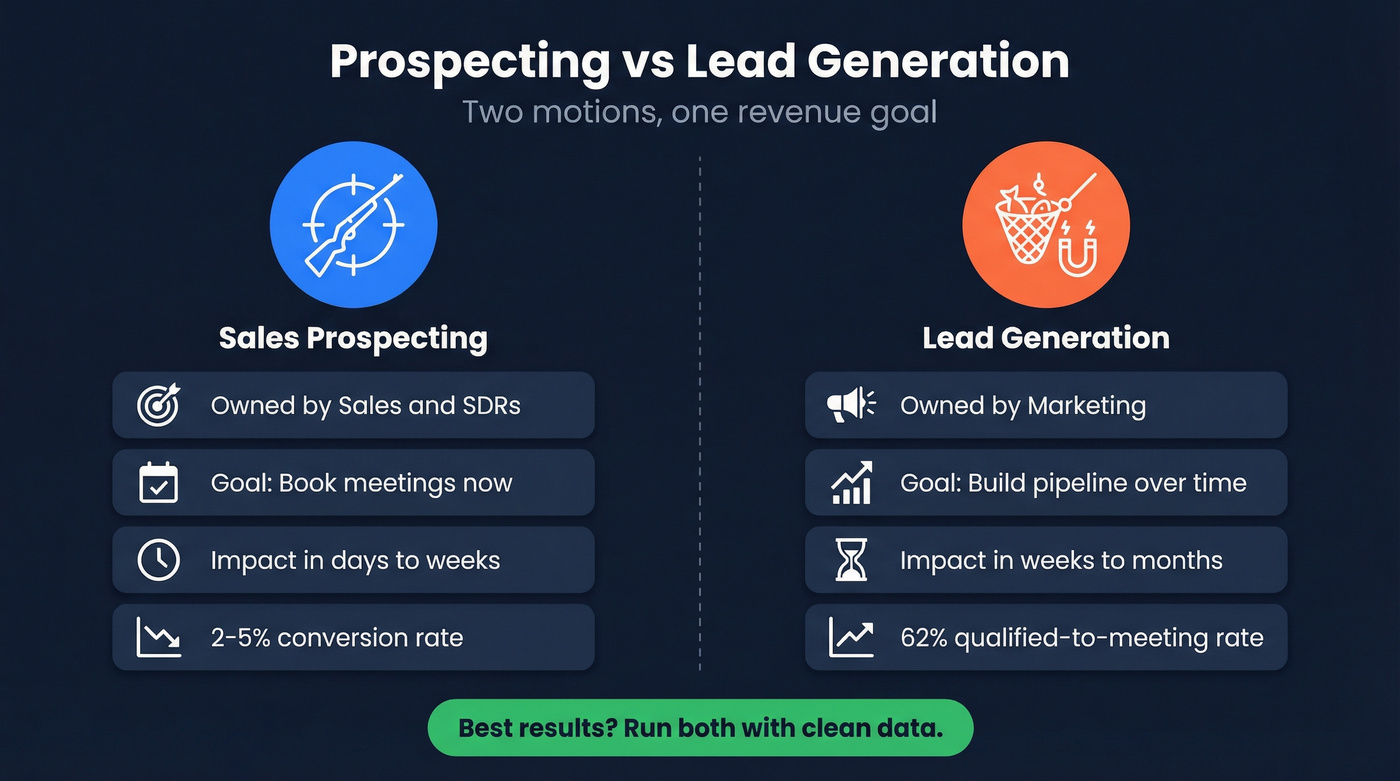
Prospecting is sales-owned outbound to named accounts. It fills pipeline now. Lead generation is marketing-owned inbound at scale. It compounds over months.
- Pipeline thin today? Prospect.
- Building for next quarter? Invest in lead gen.
- Doing both but results are flat? Your data is probably the problem.
Both motions fail without clean contact data. A high bounce rate tanks your domain reputation and wastes every dollar you spend on sequences or content. Fix the data layer first, then worry about strategy. (If you want the deeper breakdown, see the difference between prospecting and lead generation.)
What Is Sales Prospecting?
Sales prospecting is a rep or SDR identifying specific accounts and contacts, then reaching out directly to start a conversation. It's targeted, semi-automated, and owned by sales. The goal isn't awareness - it's a meeting on the calendar.
A typical sequence runs 7-10 touches over about 3 weeks, mixing cold email, phone, and social. The conversion math is humbling: outbound converts at roughly 2-5% from initial contact to meeting. You need volume and precision - the right person at the right company at the right time.
Prospecting works best when it's signal-based, not spray-and-pray. In our experience, the reps who layer intent data and job-change signals into their target lists consistently outperform those working static CSVs. Context beats personalization every time - knowing why someone might care right now matters more than getting their first name right.
What Is Lead Generation?
Lead generation is the marketing-owned engine that attracts potential buyers at scale - content, paid ads, webinars, SEO, events. Where prospecting is a rifle, lead gen is a net. The goal is a steady flow of people raising their hands, then qualifying and routing them to sales.
In 2026, the playbook has shifted hard toward first-party data and AI-powered scoring. Third-party cookies are effectively dead, so your owned channels - email lists, community, product usage data - are the durable foundation. Smart teams use AI for predictive account scoring and next-best-content recommendations, but keep a human in the loop for anything customer-facing. Email discipline matters more than ever: SPF, DKIM, and DMARC authentication are table stakes, sequences should stay concise at 100-120 words per email, and list hygiene needs to be continuous, not quarterly. (For the full deliverability playbook, use this email deliverability checklist.)
Side-by-Side Comparison
Eight dimensions separate the two motions.
| Dimension | Prospecting | Lead Generation |
|---|---|---|
| Ownership | Sales / SDR team | Marketing team |
| Primary goal | Book meetings now | Build pipeline over time |
| Core tactics | Cold email, calls, social | Content, SEO, ads, events |
| Funnel stage | Mid-funnel (qualification) | Top-of-funnel (awareness) |
| Key KPIs | Reply rate, meetings booked | CPL, MQLs, conversion rate |
| Time to impact | Days to weeks | Weeks to months |
| Tools | Prospeo, Apollo, Outreach | HubSpot Marketing Hub, CMS, analytics |
| Key risk | Rep burnout, bad data | Lead quality, slow follow-up |
The KPI row deserves a closer look. PandaDoc's taxonomy maps it cleanly: lead gen lives in CPL, landing page conversion rate, and MQLs generated. Prospecting lives in response rate, meetings booked, and average time to first meeting. If your team measures outbound by MQLs or inbound by meetings booked, you've got a metrics mismatch that'll cause friction every single week. (If you're rebuilding measurement, start with lead source tracking in your CRM.)

Whether you're prospecting named accounts or nurturing inbound leads, a 35% bounce rate kills both motions. Prospeo's 98% email accuracy and 7-day data refresh mean your outbound sequences actually land and your inbound follow-ups hit real inboxes - not spam traps.
Stop debating strategy. Fix the data layer that makes both motions work.
2026 Benchmarks Worth Knowing
The median qualified-to-booked rate is 62%, with top-10% teams hitting 78%+. That's across one million-plus B2B SaaS form submissions. Vertical differences are real: Construction Tech leads convert at 69.1%, Ecommerce at 68.8%, while Sales Tech sits at 62.8%. If you're benchmarking against a single number, you're probably benchmarking wrong.
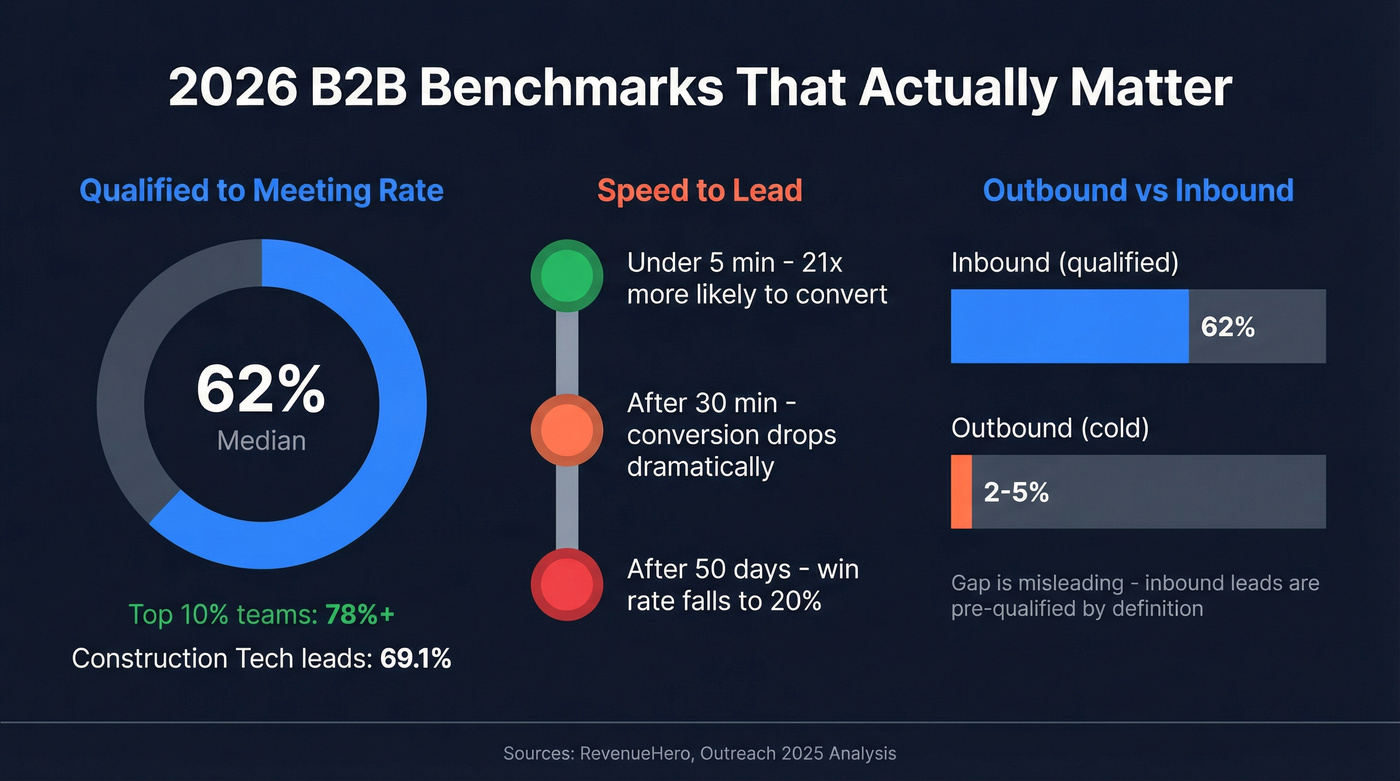
Outbound runs 2-5% from first touch to meeting. The gap looks damning, but it's misleading - inbound leads are pre-qualified by definition, while outbound is cold.
Speed matters enormously. Leads contacted within 5 minutes are 21x more likely to convert than those contacted after 30 minutes. Deals closed within 50 days carry a 47% win rate - after that threshold, win rates drop to 20% or lower. Every day of delay costs you. That same analysis found 45% of teams running a hybrid AI-SDR model, with 34% reporting sales cycles of 1-2 quarters. (If you’re operationalizing speed-to-lead, map it to buying signals follow up.)

Here's the thing: if your bounce rate is above 5%, no strategy pivot will save you. Fix your data source before you touch anything else. We've seen teams waste entire quarters debating inbound versus outbound when the real problem was a 35% bounce rate torching their sender reputation. (This is usually just B2B contact data decay showing up in your metrics.)
When to Prioritize Each
Stop treating this as a binary choice. Use these diagnostics instead.
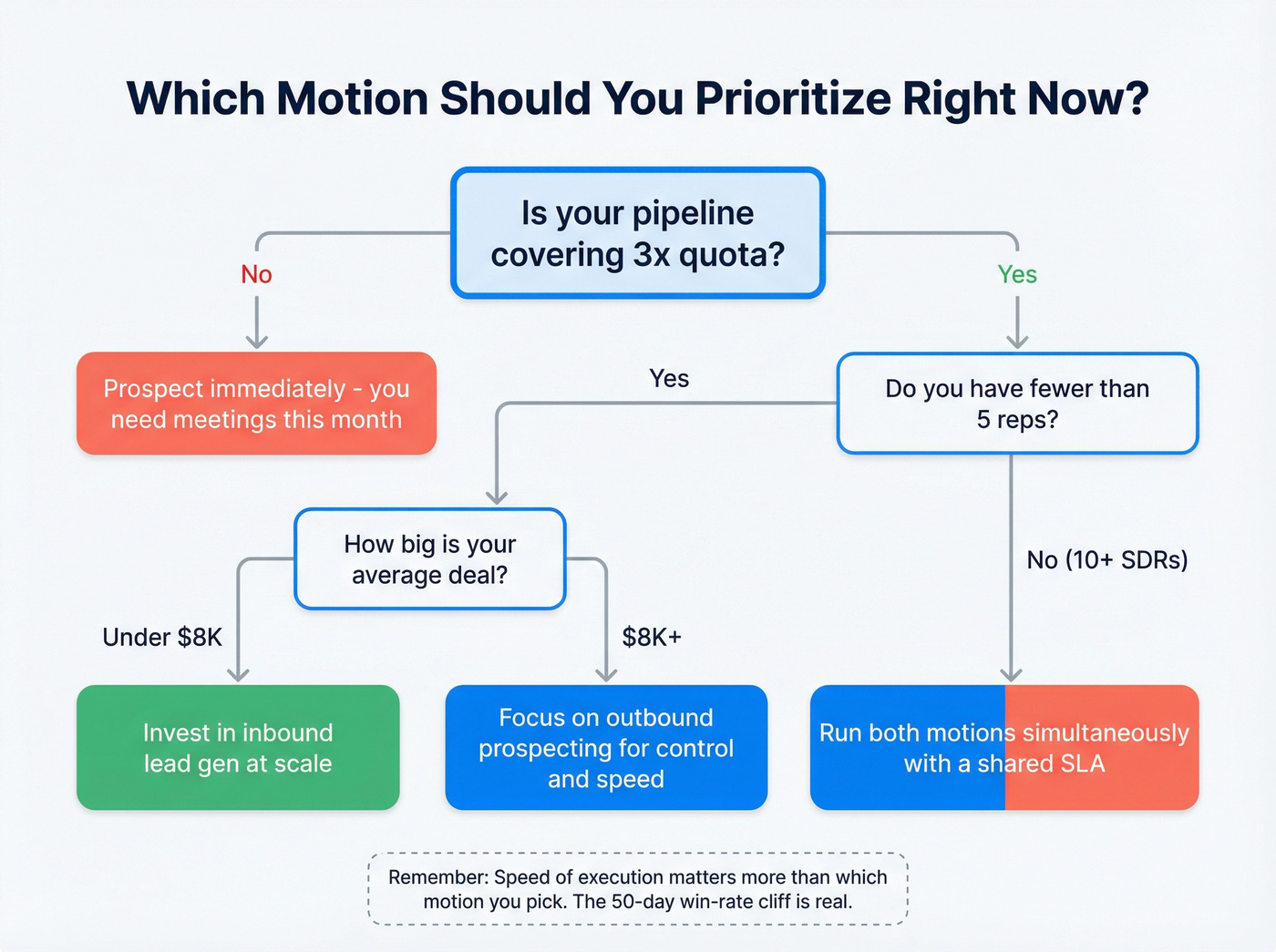
Is your pipeline covering 3x quota? No? Prospect immediately. You need meetings this month, not MQLs next quarter.
Pre-Series B with fewer than 5 reps? Prospecting gives you control and speed. Lead gen infrastructure takes months to build and requires dedicated marketing headcount you probably don't have yet.
For teams where the average deal size is under $8K, inbound at scale makes more sense - you can't afford reps manually working accounts that close for $3,000. But if you've got 10+ SDRs, run both motions simultaneously. Under 5? Pick one and execute it well.
Do you have a marketing team producing content consistently? If not, don't pretend you're running lead gen. A blog post every six weeks isn't an inbound engine - it's a hobby.
The 50-day win-rate cliff reinforces all of this: whatever motion you choose, speed of execution matters more than which motion you pick. A fast outbound team with decent data will outperform a slow inbound machine with perfect content. (If you’re building the outbound side, use a repeatable prospecting workflow.)
How to Combine Both Motions
Companies with strong sales-marketing alignment achieve 20% annual revenue growth. Misaligned companies see 4% revenue decline. The difference is almost always a missing or broken SLA. When you combine prospecting and lead generation under a shared revenue goal, both motions reinforce each other - inbound content warms accounts that outbound reps are targeting, and prospect insights from sales inform marketing's targeting and messaging. (This is where Revenue Operations alignment usually makes or breaks execution.)
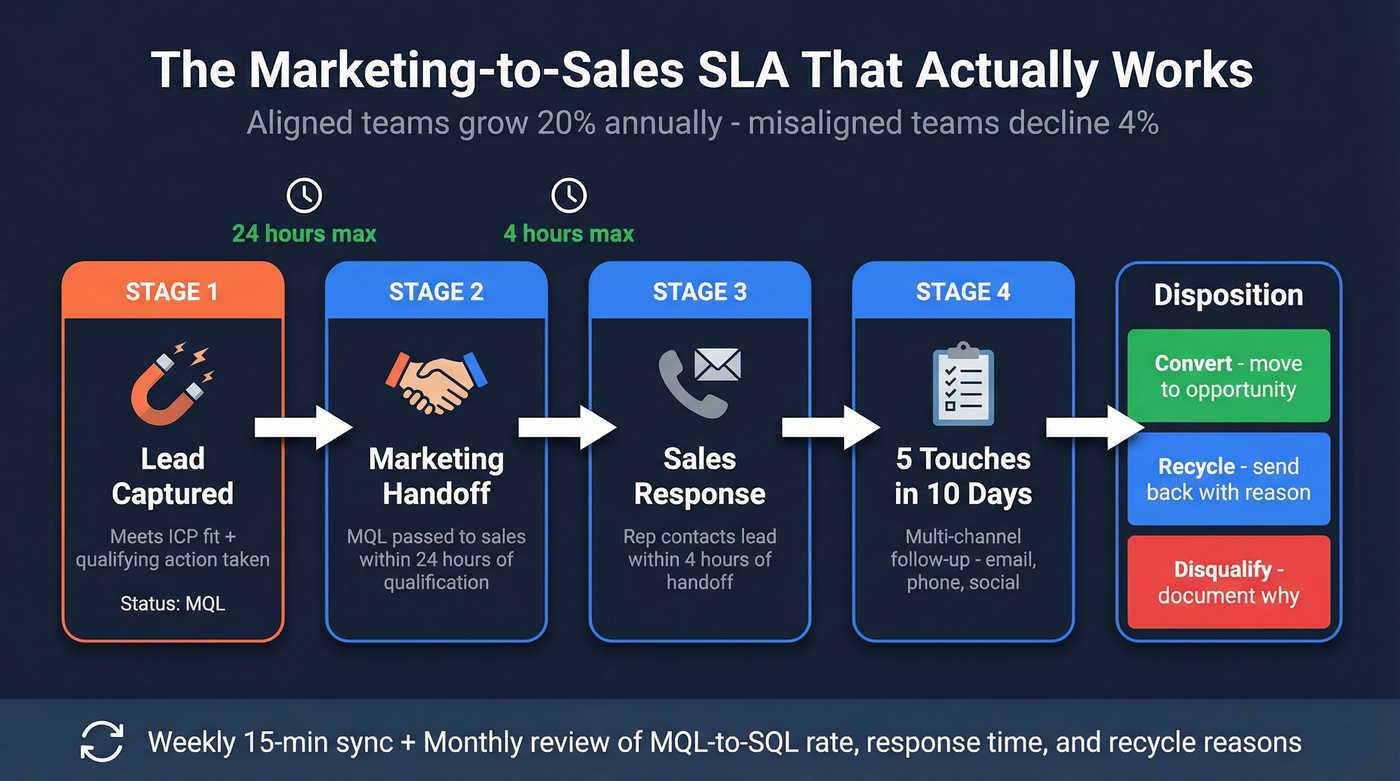
Let's break down a working SLA template:
MQL = Meets ICP fit criteria + has taken a qualifying action. SQL = MQL contacted by sales and confirmed as a real opportunity with budget, authority, and timeline.
Commitments:
- Marketing hands off MQLs within 24 hours of qualification
- Sales responds to every MQL within 4 hours of handoff
- Sales makes 5 follow-up attempts over 10 business days, multi-channel
- Every lead gets a disposition: convert, recycle with reason, or disqualify with documented reason
Run a weekly 15-minute sync between marketing and sales leads. Monthly, review MQL-to-SQL conversion rate, average response time, and recycle reasons. Most teams skip the feedback loop, and that's where alignment dies. If marketing never hears why leads got disqualified, they can't fix targeting. We've watched this pattern play out at dozens of companies - the ones that close the loop grow faster, full stop.
Tools You Need
Your stack breaks into three layers: data, sequencing, and CRM.
Data and Contact Finding
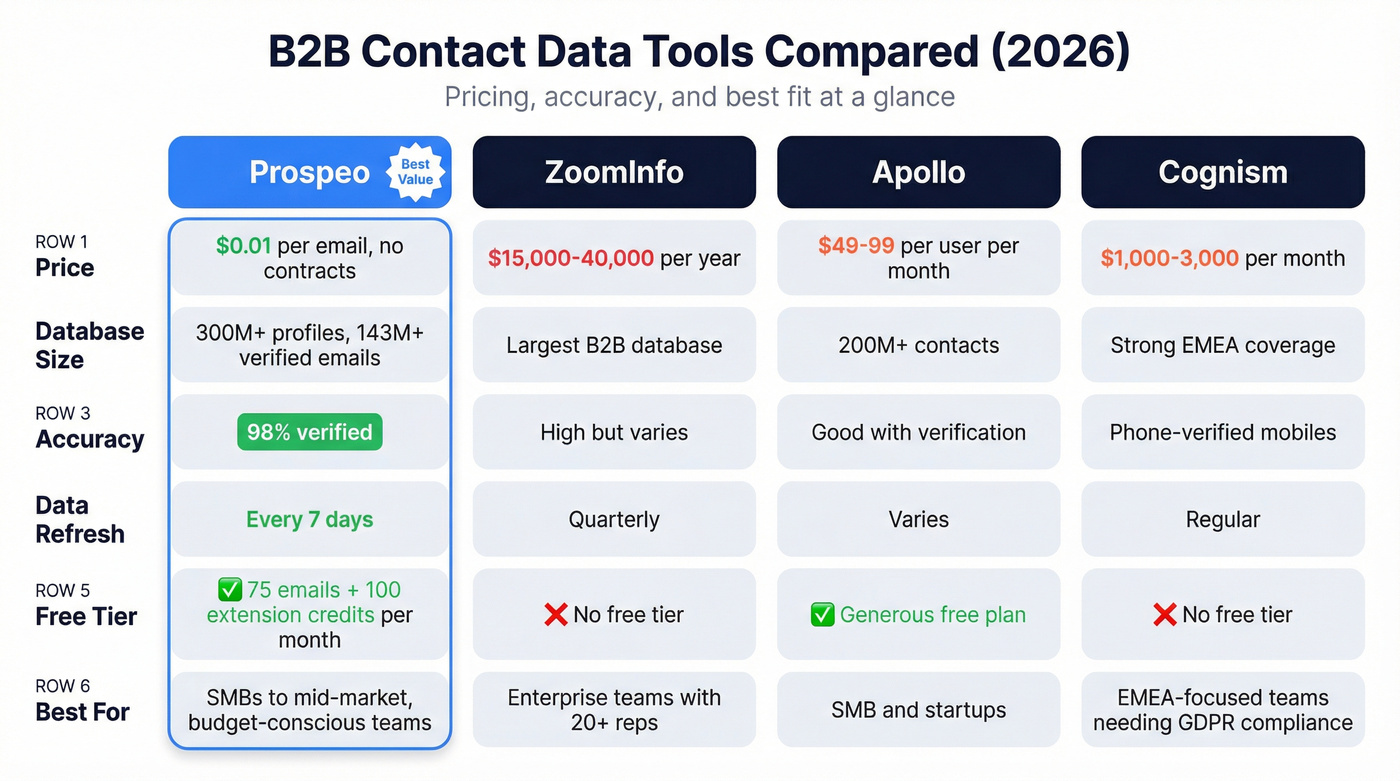
Prospeo covers 300M+ professional profiles with 143M+ verified emails at 98% accuracy, plus 125M+ verified mobile numbers - all refreshed every 7 days. The free tier gives you 75 emails and 100 Chrome extension credits per month, enough for a solo founder testing outbound. Paid plans start at roughly $0.01 per email with no contracts.

ZoomInfo runs $15,000-40,000/year with annual contracts - the enterprise default, but most teams under 20 reps don't use half the platform. Skip it if you're pre-Series B or budget-conscious. Apollo offers a generous free tier with paid plans from ~$49-99/user/month, making it the SMB go-to. Cognism is the pick for EMEA-heavy teams at $1,000-3,000/month, with strong GDPR compliance. (If you’re evaluating vendors, start with prospect data accuracy and how it’s measured.)
Sequencing
Outreach is the multi-channel standard at ~$100-150/user/month. For email-only outbound, Instantly and Smartlead run $30-100/month with inbox rotation and warmup built in. (Need copy that fits modern deliverability? Use these Outreach email templates.)
CRM
HubSpot's free CRM is hard to beat for early-stage teams. Marketing Hub Professional starts around $800+/month - steep, but it consolidates lead gen, nurture, and reporting under one roof.
The 2-5% outbound conversion rate only works at volume with precision. Prospeo gives you 30+ filters - buyer intent, job changes, headcount growth - so your reps reach the right person at the right company at the right time. At $0.01 per email, scaling outbound doesn't break the budget.
Layer intent signals into your prospecting lists and book 26% more meetings.
FAQ
Can you run both prospecting and lead generation simultaneously?
Yes - most B2B teams run both in parallel. Lead gen builds pipeline over months through inbound channels, while outbound fills gaps immediately. The key is a clear SLA so marketing leads don't die in a CRM and outbound doesn't duplicate inbound efforts. Ownership and timing differ, but both contribute to revenue when coordinated.
What's the biggest mistake teams make?
Using bad contact data. A high bounce rate damages your domain reputation, tanks deliverability, and wastes every dollar spent on sequences or content. Verify your data first - cutting bounce rates from 35% to under 5% often improves results more than any strategy change.
Is outbound prospecting still effective when buyers prefer self-service?
Yes. While 61% of B2B buyers prefer a rep-free experience, roughly 40% still want to talk to a rep. Even self-directed buyers respond to relevant, signal-based outreach - especially when it's timed to intent signals like category research or job changes.