

How to Follow Up on Buying Signals (Before Your Competitor Does)
A prospect visits your pricing page three times in a week. Your rep sends a follow-up email Tuesday morning. It bounces. By Wednesday, a competitor has the meeting booked.
Every article lists 15 buying signals you should watch for. Almost none tell you how to execute the follow-up in the 300 seconds after one fires. That's the gap we're closing here - the actual mechanics of responding fast enough to win.
The Short Version
Respond to high-intent signals within 5 minutes. Demo requests, repeat pricing visits, direct questions about implementation - these have a half-life measured in minutes, not hours.
Run a signal-triggered cadence of 8 touches over 12 days across email, phone, and social. Generic "just checking in" sequences don't cut it.
Verify contact data before you hit send. A bounced email on a hot signal is a dead deal. (If you need a stack, start with an email checker tool.)
Why Speed Kills (And Why You're Too Slow)
The data is brutal. A Workato mystery-shop of 114 B2B companies found that zero called a lead within 5 minutes. Only one sent a personalized email within 5 minutes. The average personalized response took 11 hours and 54 minutes. And 63% of companies never responded at all.
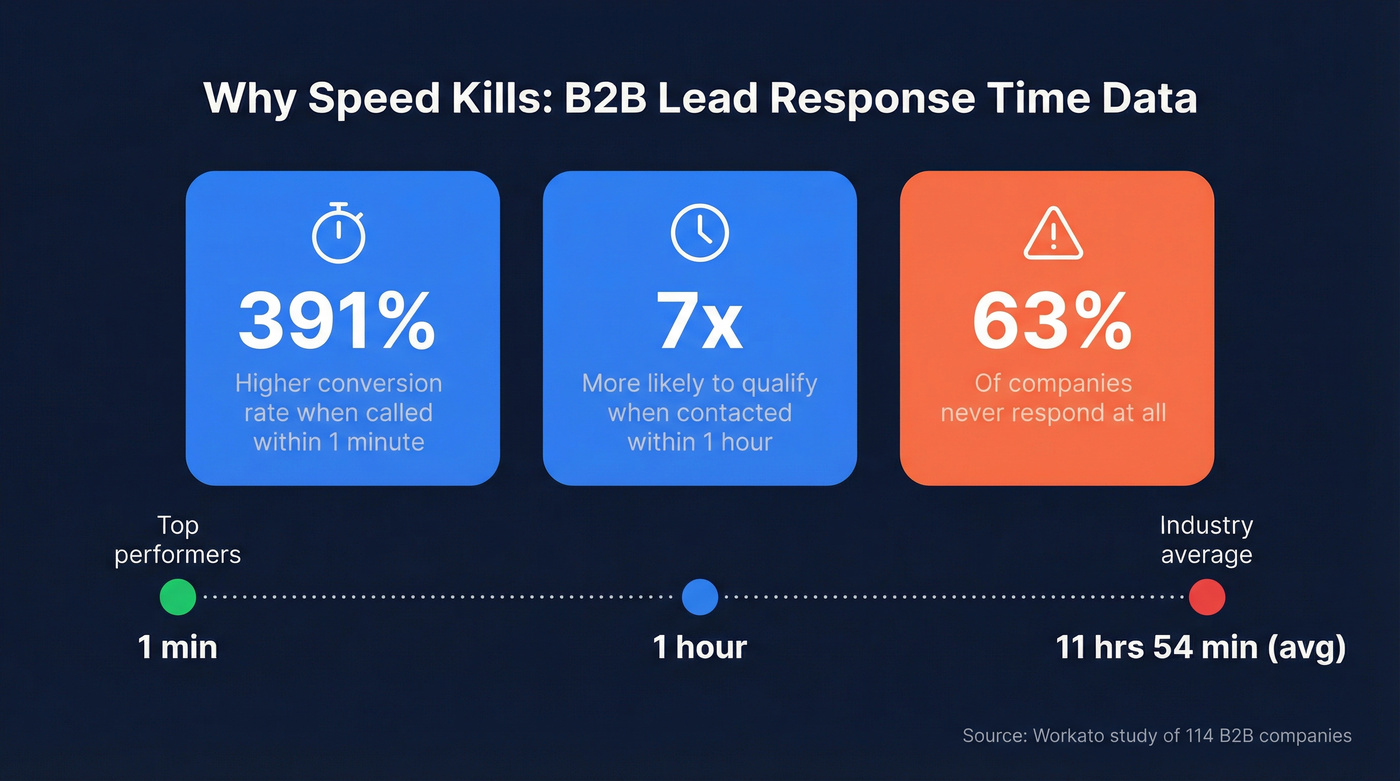
Leads contacted within 1 hour are 7x more likely to qualify. Prospects called within 1 minute convert at 391% higher rates. Corporate Visions research shows 85% of B2B purchases go to a vendor already on the buyer's day-one shortlist - meaning if you're not there early, you're not there at all.
Here's the thing: your competitors aren't fast either. That Workato study proves it. We've seen teams go from zero booked meetings to consistent pipeline just by cutting response time from hours to minutes. It doesn't require superhuman effort. It requires a system.
Your Signal-to-SLA Cheat Sheet
Not every signal deserves the same urgency. A demo request and a blog visit are fundamentally different actions. Treat them that way.
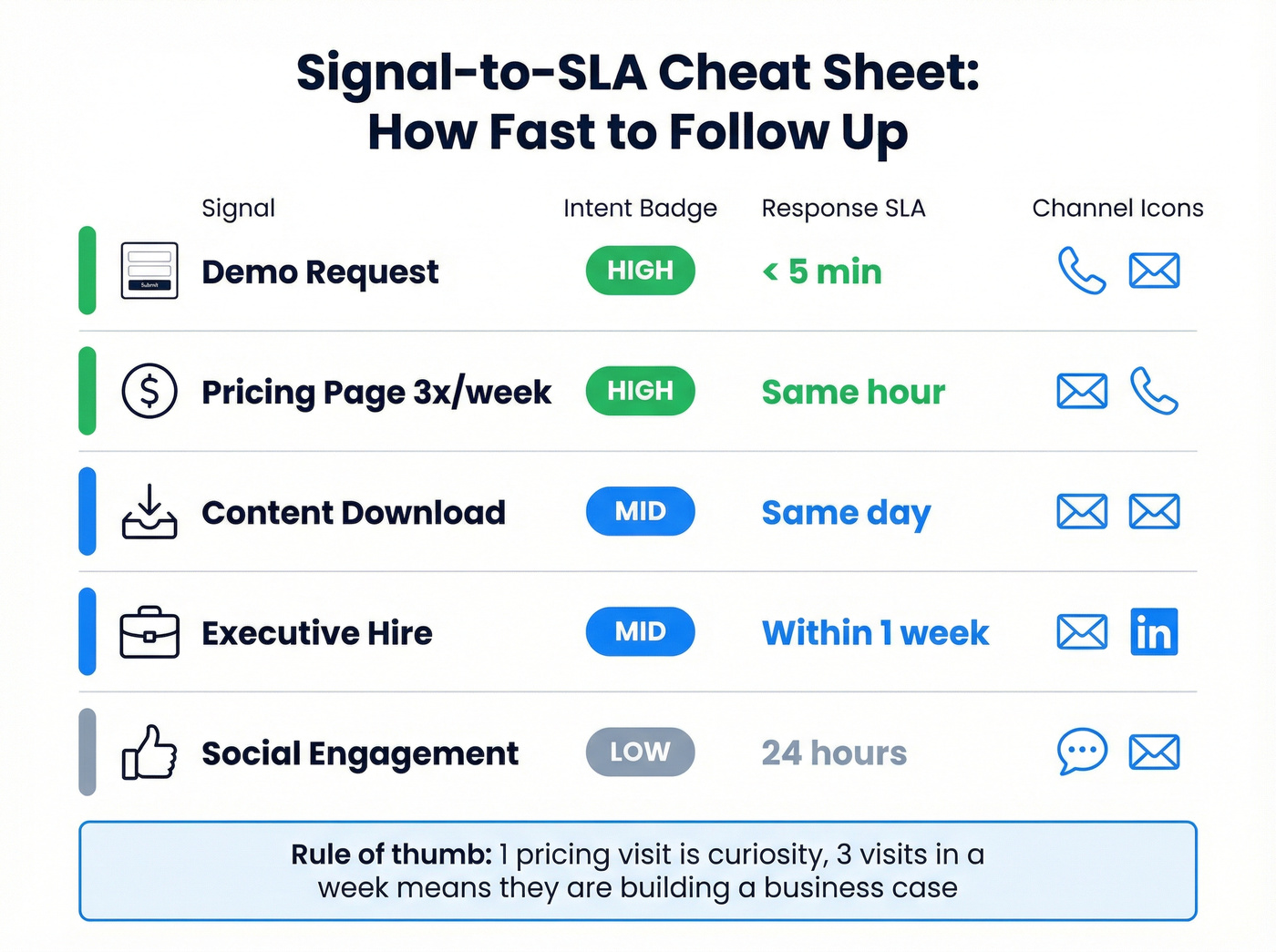
| Signal Type | Intent | Response Time | First Channel | Follow-Up Channel |
|---|---|---|---|---|
| Demo request | High | < 5 min | Call + email | Email Day 2 |
| Pricing page 3x/week | High | Same hour | Call Day 2 | |
| Content download | Mid | Same day | Email Day 3 | |
| Executive hire | Mid | Within 1 week | Social Day 10 | |
| Social engagement | Low | 24 hours | Social DM | Email Day 3 |
The ZoomInfo threshold is worth internalizing: one pricing page visit means curiosity. Three visits in a week means they're building a business case. That's when you need to be in their inbox.
One signal sales teams overlook: conversational cues. When a prospect asks tough, specific questions about implementation or integration, that's high intent. Those questions mean they're already picturing your product inside their stack.
Follow-Up Templates That Actually Work
Template 1: Demo Request
Trigger: Form submitted. Timing: Within 5 minutes.
Minute 0-1: verify the contact's email and mobile number. Minute 1-3: personalize the template below. Minute 3-5: send email and dial.
Subject: Your [Product] demo - let's get this scheduled
Hi [Name], saw you just requested a demo. I'd love to walk you through [specific use case based on their company]. Do you have 20 minutes tomorrow at [time] or [time]?
Short, direct, two options. Don't overthink it.
Template 2: Repeat Pricing Page Visits
Trigger: 3+ pricing page visits in 7 days. Timing: Same hour.
Subject: Quick cost comparison for [Company]
Hi [Name], looks like you've been researching [Product] pricing - smart move. Most teams in [their industry] care about [specific ROI angle]. Want me to walk you through what [similar company] saved in Q1?
Referencing the behavior directly shows you're paying attention. The consensus on r/sales is that signal-specific messaging dramatically outperforms vague "touching base" emails, and our own testing confirms it.
Template 3: Champion Job Change
Trigger: Key contact starts new role. Timing: Within first week.
Subject: Congrats on the new role at [Company]
Hi [Name], congrats on the move. Worth a quick conversation about bringing that same approach to [pain area]? Leaders in your role typically evaluate this in their first quarter.
If you want to systematize this, build automated champion tracking so job-change signals never slip.

You just saw the data: a bounced email on a high-intent signal kills the deal before it starts. Prospeo gives you 98% verified email accuracy and 125M+ direct dials - refreshed every 7 days, not 6 weeks. Verify contact data in seconds so your 5-minute follow-up actually reaches the buyer.
Stop losing hot signals to bad data. Verify before you send.
The Signal-Triggered Cadence
RAIN Group research shows meetings require 8 touches on average (and you can steal a full sales cadence example if you need one). Outreach data suggests the optimal window is 17-21 days with 8-12 touchpoints across a channel mix of roughly 40-50% email, 20-30% phone, and 15-25% social.
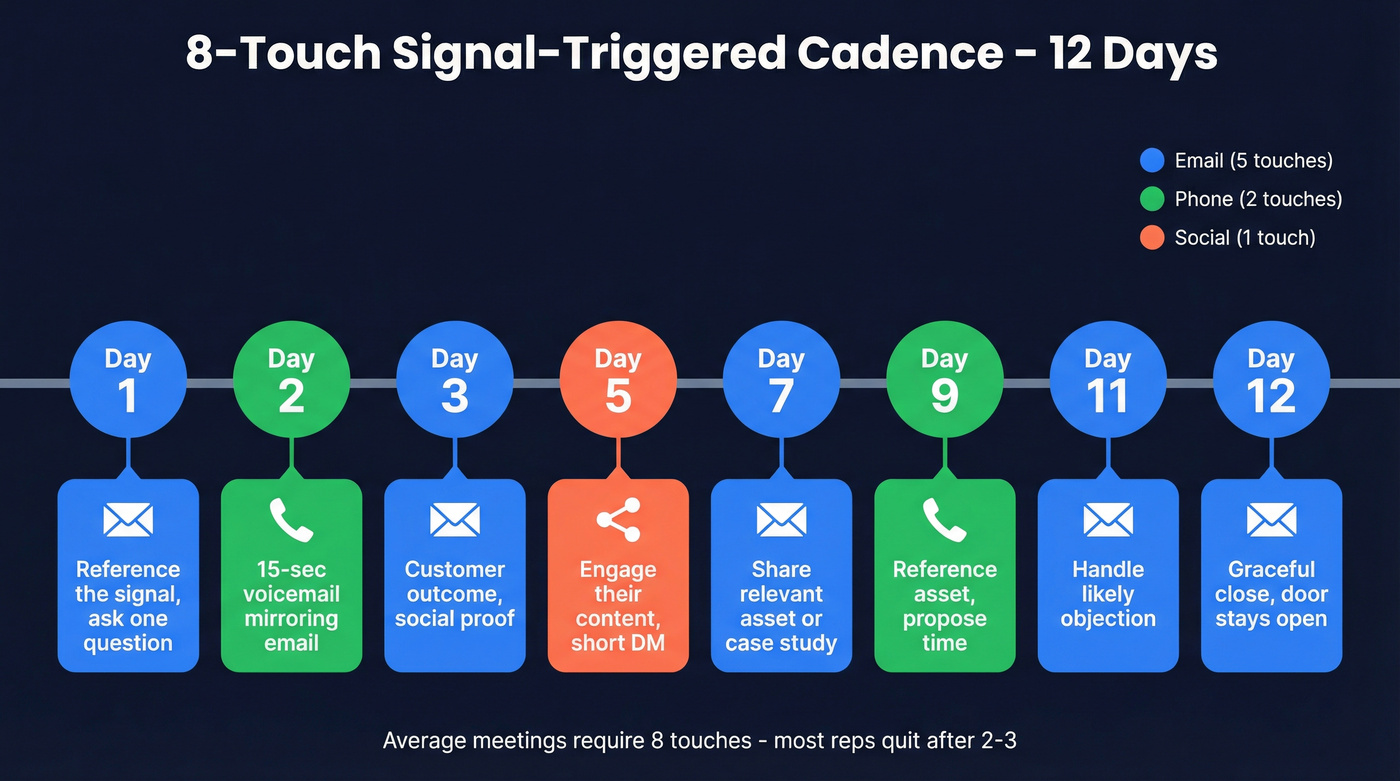
Here's an adapted 8-touch, 12-day cadence built for speed:
| Day | Channel | Purpose |
|---|---|---|
| 1 | Reference the signal + one question | |
| 2 | Call | 15-sec voicemail mirroring email |
| 3 | Customer outcome / social proof | |
| 5 | Social | Engage with their content + short DM |
| 7 | Share relevant asset (video/case study) | |
| 9 | Call | Reference asset + propose time |
| 11 | Handle likely objection | |
| 12 | Graceful close - door stays open |
How to Score and Prioritize Signals
Use a three-tier system:
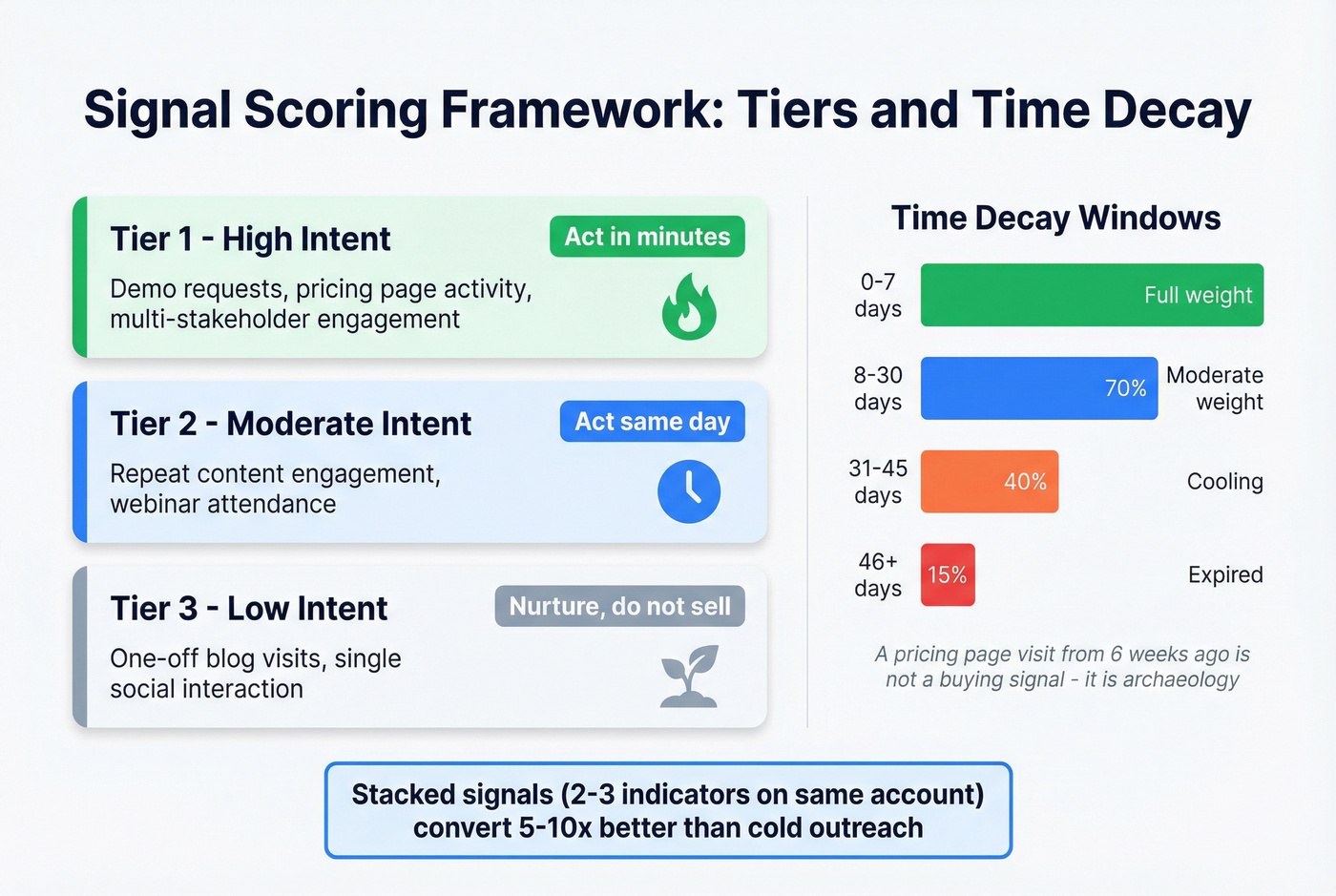
Tier 1 (high intent): Demo requests, pricing page activity, multi-stakeholder engagement. Act within minutes.
Tier 2 (moderate): Repeat content engagement, webinar attendance. Act same day.
Tier 3 (low): One-off blog visits, single social interaction. Nurture, don't sell.
Apply time-decay windows to keep scoring honest: 0-7 days gets full weight, 8-30 days moderate, 31-45 cooling, and anything past 46 days is expired. A pricing page visit from six weeks ago isn't a buying signal anymore - it's archaeology.
The real advantage is stacked signals. Accounts showing 2-3 indicators on the same account convert 5-10x better than cold outreach. A prospect who visits your pricing page, downloads a case study, and follows your company on social in the same week? That's not a lead. That's a deal waiting for a rep to show up.
If you want a more formal model, use an ABM lead scoring approach and align it with lead prioritization.
Five Mistakes That Kill Your Signal Response
1. Responding in hours instead of minutes. The Workato data doesn't lie - average personalized email response is nearly 12 hours. Build alerts that fire the moment a high-intent signal triggers. (If you need the ops layer, start with how to track sales triggers.)
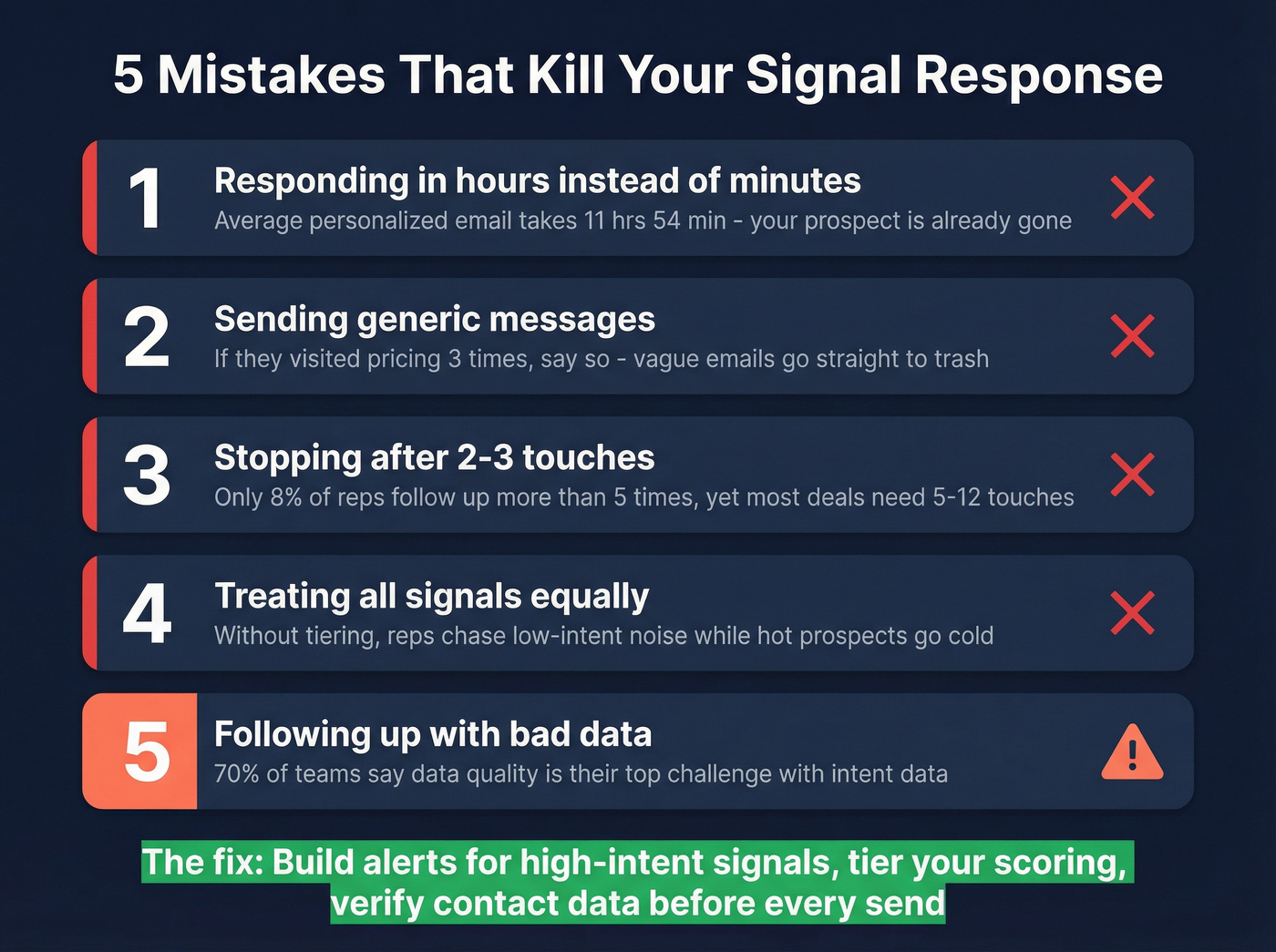
2. Sending generic messages. If someone visited your pricing page three times, reference it. Mention the exact behavior. It's the difference between a reply and the trash folder.
3. Stopping after 2-3 touches. Only 8% of reps follow up more than five times, yet most deals require 5-12 touches. Use all 8 touches in the cadence above. Most reps quit right before the deal would've closed.
4. Treating all signals equally. Without tiering and scoring, your reps waste time chasing low-intent noise while high-intent prospects go cold.
5. Following up with bad data. In our experience, this is the most expensive mistake on the list. 70% of teams say data quality is their #1 challenge with intent data. When your email bounces on a hot signal, that prospect doesn't wait around - they book with whoever shows up next. Prospeo verifies emails in real time with 98% accuracy on a 7-day refresh cycle, compared to the 6-week industry average. That gap is the difference between a booked meeting and a lost deal. (If you want the deeper mechanics, see email verification for outreach.)
Let's be honest: most teams don't have a buying signal problem. They have a speed and data quality problem. You can track every intent signal on the planet, but if your rep takes 12 hours to respond with an email that bounces, you've built an expensive system that feeds your competitors.
Stacked signals mean nothing if your reps can't reach the prospect. Prospeo tracks 15,000 intent topics via Bombora and pairs them with verified emails and mobiles - so when a buying signal fires, you have the right contact data ready. Teams using Prospeo book 35% more meetings than Apollo users.
Detect the signal. Reach the buyer. Book the meeting - all in one platform.
Common Questions
What are the strongest buying signals in B2B?
Demo requests, repeat pricing page visits (3+ in a week), and multi-stakeholder engagement are the highest-intent indicators. Accounts showing multiple stacked signals simultaneously convert 5-10x better than single-signal leads, making them the top priority for any outbound team.
How fast should you respond?
High-intent signals demand a response within 5 minutes - prospects called within 1 minute convert at 391% higher rates. Mid-intent signals like content downloads should get same-day outreach. 78% of buyers purchase from the first vendor to respond.
How many touches does it take to book a meeting?
Eight on average. The optimal cadence runs 8-12 touchpoints over 17-21 days across email, phone, and social. Most reps stop after 2-3 attempts, which is why most reps miss quota.
What's the difference between first-party and third-party buying signals?
First-party signals come from your own channels - website visits, demo requests, email opens. Third-party signals come from external providers tracking research activity across the web. The strongest approach combines both to build a complete picture of buyer readiness. Skip third-party intent data if you haven't nailed your first-party signal response yet; there's no point paying for more signals you can't act on fast enough.