

The Best Open-Ended Sales Questions (And How to Actually Use Them)
You're five minutes into a discovery call and the prospect is giving you one-word answers. "Fine." "Maybe." "We're looking at a few options." 85% of sales professionals say getting prospects to engage in discovery is their biggest challenge - and the fix isn't more questions. It's the right ones, asked at the right time, in the right order.
Why Open-Ended Questions Win Deals
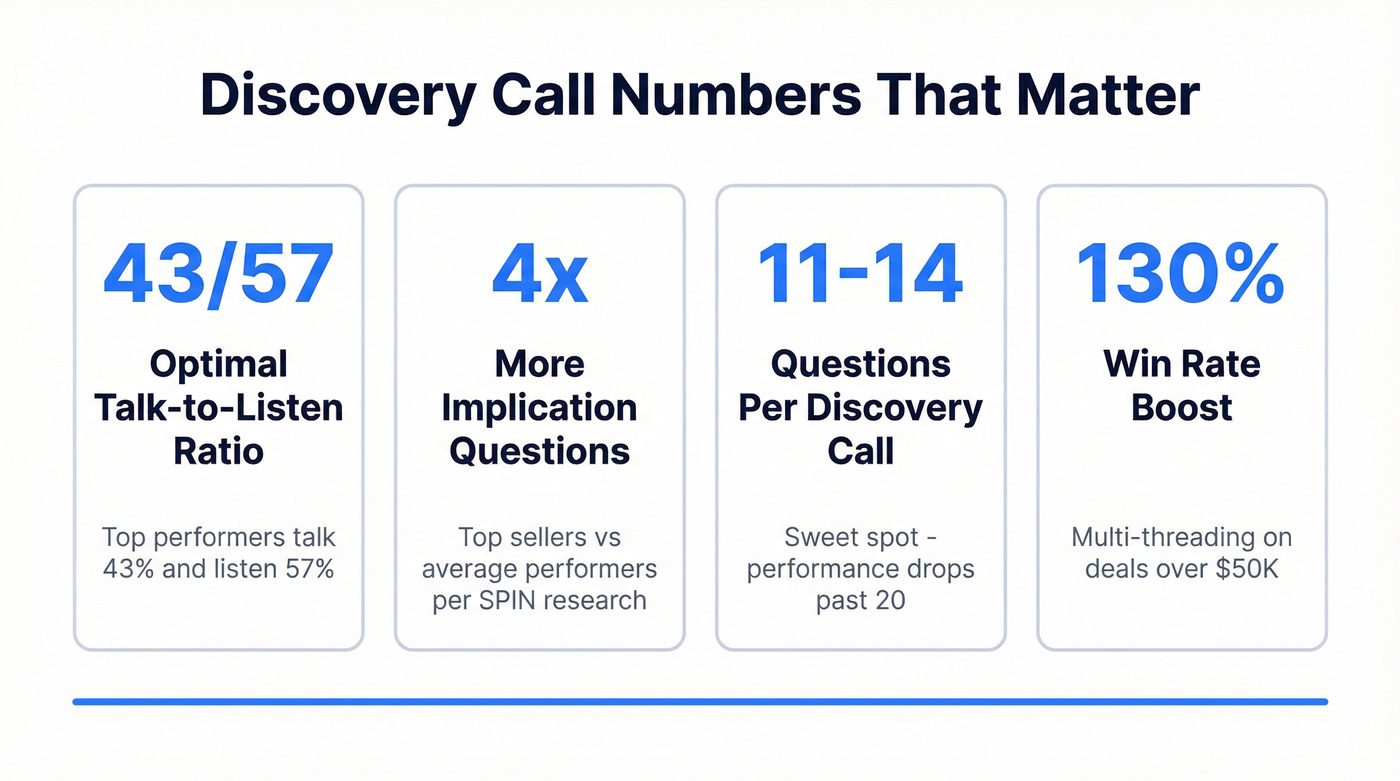
Research across millions of sales calls puts the optimal talk-to-listen ratio at 43/57. But the ratio itself isn't what separates winners from losers. It's consistency. Low performers swing from 54% talk time on won deals to 64% on lost deals - a 10-point gap that signals improvisation, not process.
Open-ended questions keep that ratio steady because they force the prospect to do the talking, which means you're learning instead of pitching. Sales teams with strong questioning skills report win rates between 20-30%, while script-heavy approaches see conversion rates in the low teens.
There's a psychological layer too. Closed questions easily become leading or priming questions - "So you're having trouble with X, right?" nudges the prospect toward your narrative instead of revealing theirs. Open-ended questions eliminate that bias. And experienced reps will tell you the same thing: the hardest part of discovery isn't knowing what to ask. It's shutting up long enough to hear the answer.
27 Questions Organized by Deal Stage
A list of 50 questions is a crutch, not a strategy. What follows are 27 questions organized by where you are in the deal, each tagged with its framework origin - SPIN (Situation, Problem, Implication, Need-Payoff) or MEDDIC (Metrics, Economic Buyer, Decision Criteria, Decision Process, Identify Pain, Champion). SPIN selling was developed from research on 35,000+ sales calls, and MEDDIC has become the default framework for enterprise deal qualification. Pick the questions that fit your motion and practice them until they sound like conversation, not a checklist.
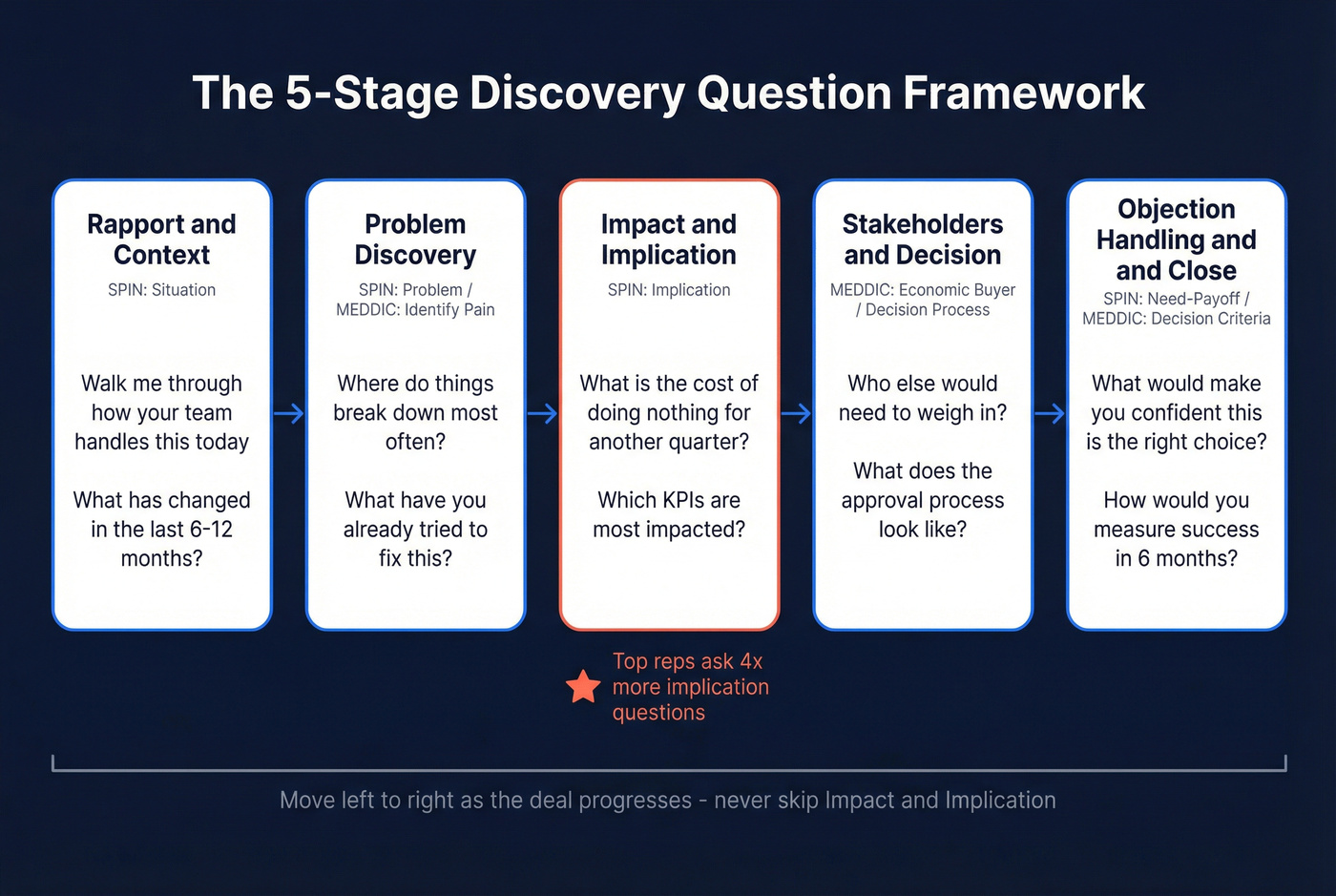
Rapport & Context
Most questions here map to SPIN's Situation category - they warm up the call and establish baseline understanding.
- "Walk me through how your team handles [process] today."
- "What's changed in your business over the last 6-12 months that's driving this conversation?"
- "How does [department] fit into the broader company priorities right now?"
- "What does a typical day look like for someone in your role?"
Problem Discovery
This is where you earn the right to sell. These map to SPIN's Problem category and MEDDIC's Identify Pain, and they're what separates reps who uncover real pain from those who skim the surface.
- "What's the biggest bottleneck in your current workflow?"
- "Where do things break down most often?"
- "Can you help me understand what's not working about your current solution?"
- "What have you already tried to fix this?"
- "If you could change one thing about how this works today, what would it be?"
- "How long has this been a problem?"
Don't rush through these. When a prospect says "it's been a problem for about a year," that's not the end of the answer - it's the beginning. Follow up. "What finally made it urgent enough to look at solutions now?" That's where the real story lives.
Impact & Implication
This is where deals are won or lost. Top salespeople ask 4x more Implication questions than average performers, according to Rackham's original SPIN research. These are the questions that turn vague frustration into quantified urgency.
Your prospect just told you their current process breaks down every month. Now make that pain concrete:
- "What happens downstream when that process fails?"
- "How does this problem affect your team's ability to hit their numbers?"
- "What's the cost of doing nothing for another quarter?"
- "Which KPIs are most impacted by this issue?"
- "Can you help me understand how leadership measures success for this initiative?"
- "If this doesn't get solved, what does that mean for [broader goal]?"
We've seen reps skip this entire section because they're eager to pitch. Don't. A prospect who hasn't articulated the cost of inaction has no urgency to buy.
Stakeholders & Decision Process
Here's the thing: closed-won deals have 2x as many buyer contacts as closed-lost. Multi-threading boosts win rates by 130% on deals over $50K. You need to map the buying committee early.
- "Who else would need to weigh in on a decision like this?"
- "What does the approval process look like once your team decides to move forward?"
- "Who's responsible for final sign-off on budget?"
- "Is there someone on your team who's championing this internally?"
- "What would need to be true for your leadership to prioritize this?"
Objection Handling & Closing
These questions reframe objections as solvable problems and help the prospect sell themselves. They map to SPIN's Need-Payoff and MEDDIC's Decision Criteria.
- "If you could automate [pain point], what would that free your team up to do?"
- "What are the non-negotiable features you need in a solution?"
- "What would make you confident this is the right choice?"
- "How would you measure whether this was successful six months from now?"
Post-Sale & Expansion
Most reps treat the close as the finish line. It's not - it's the starting line for expansion revenue.
"What's changed since the last time we talked?" is a proven opener that re-validates your understanding without assuming you already know. Pair it with "Where are you seeing the most value so far, and where are the gaps?" and "What new priorities have come up that we should be thinking about together?" You'll surface upsell opportunities that would otherwise stay invisible for months.

You just mapped the buying committee with perfect stakeholder questions. Now you need verified contact data to actually reach them. Prospeo gives you 98% accurate emails and 125M+ verified mobile numbers so your multi-threading strategy connects with real decision-makers, not dead inboxes.
Stop losing deals to bad data after running great discovery.
How to Deliver Them Well
The question is maybe 20% of the equation. How you ask it, when you ask it, and what you do with the answer is the other 80%.
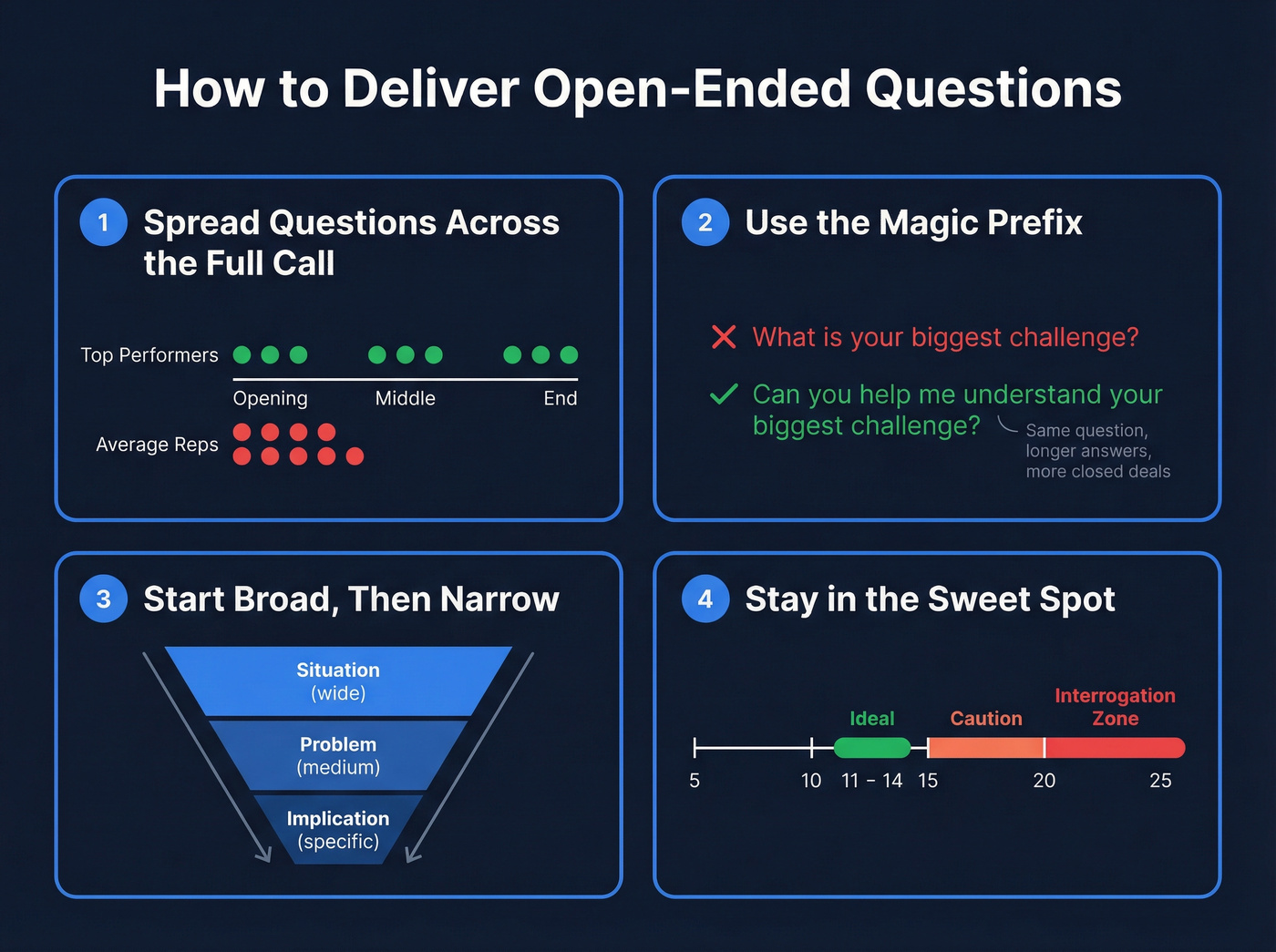
Spread questions across the full call. Top performers distribute discovery questions evenly - not just in the first five minutes. Average reps dump them upfront, then spend the rest pitching. Don't be that rep.
Use the "Can you help me understand..." prefix. This phrasing shift produces longer prospect answers, and longer answers link directly to closed deals. "What's your biggest challenge?" becomes "Can you help me understand your biggest challenge?" Same question, dramatically different response.
Start broad, then narrow. Researchers call this the funnel technique: begin with wide situation questions, then progressively tighten toward implications and decision criteria. It mirrors natural conversation and keeps the prospect from feeling cornered. Think of it as earning the right to ask harder questions by showing you listened to the easy ones.
Stay in the 11-14 range. That's the sweet spot for a typical discovery call. Past 20 questions, performance drops. If your calls feel like interrogations, you're asking too many questions, not too few.
Mistakes That Kill Discovery Calls
Interrogation mode. Rapid-fire questions with no space for the prospect to think. If you're asking a new question every 30 seconds, you're running a survey, not having a conversation. Slow down. Let silence do the work. Respond to what you hear before moving on.
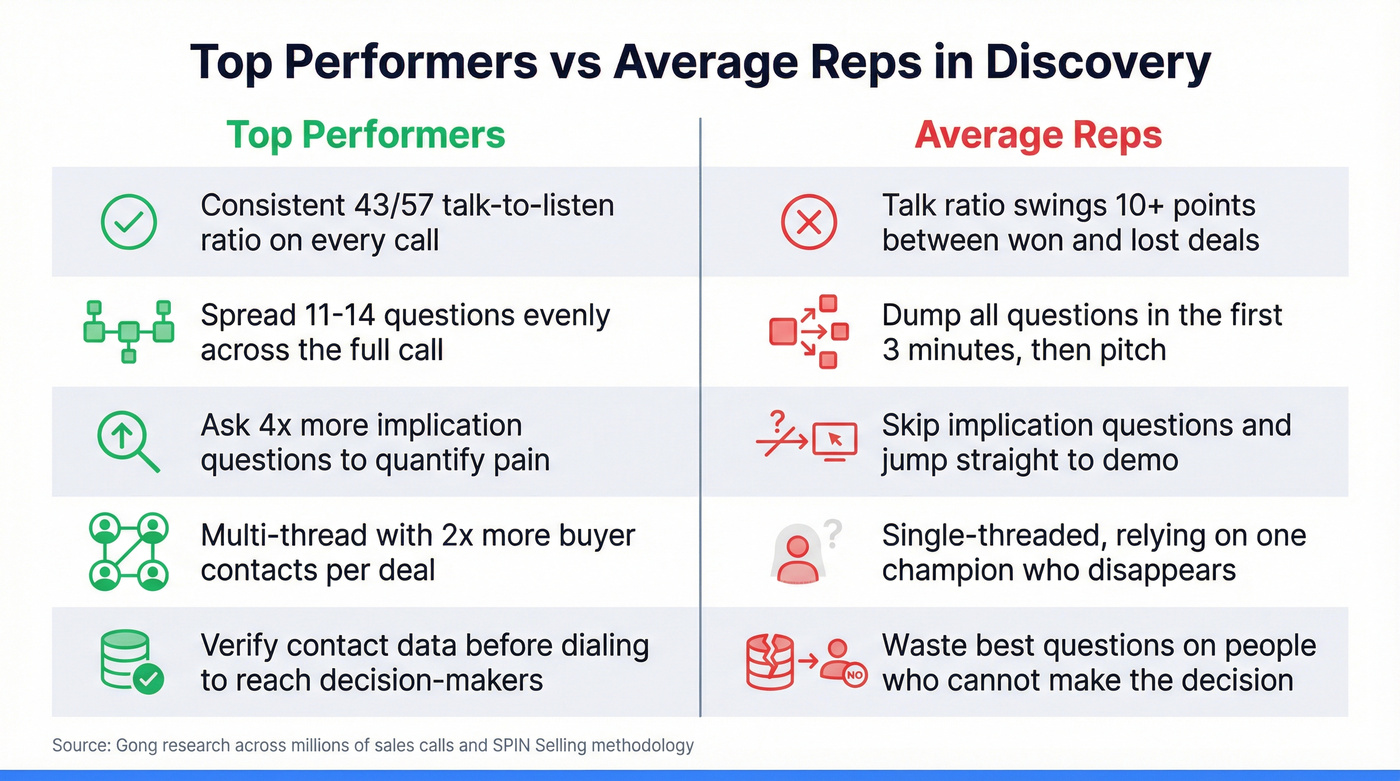
Inconsistent talk ratio. Low performers swing their talk time by 10 percentage points between won and lost deals. That inconsistency means they're reacting emotionally instead of following a process. In our experience, the reps who struggle most in discovery aren't asking bad questions - they're asking them all in the first three minutes, then filling the rest with pitch.
Never asking who else is involved. Strategic enterprise deals average 17 contacts. If you're single-threaded on a deal worth $50K or more, you're gambling with a 130% win rate boost you're leaving on the table. (If you want a tighter definition and playbook, see multithreading.)
Talking to the wrong person entirely. Look - the biggest discovery mistake happens before the call even starts. You've prepped your questions, rehearsed your framework, and the person on the other end can't make the decision and won't champion it internally. Verify your prospect's direct contact data before you dial. Tools like Prospeo give you verified emails and direct dials across 300M+ profiles with 98% email accuracy, so you're not wasting your best questions on someone who'll just "loop in their boss" and disappear.
Let's be honest: if your average deal size is under five figures and you're spending more time prepping questions than verifying you're talking to the right person, you have your priorities backwards. Contact accuracy matters more than question perfection - especially with B2B contact data decay working against you.
Discovery calls only happen when prospects pick up. Prospeo's 125M+ verified mobile numbers deliver a 30% pickup rate - nearly 3x the industry average. Pair your SPIN questions with direct dials that actually connect, starting at $0.01 per lead.
Ask better questions to prospects who actually answer the phone.
FAQ
What's the difference between open-ended and closed-ended sales questions?
Open-ended questions can't be answered with yes or no - they start with what, how, or why and reveal priorities you didn't anticipate. Closed-ended questions confirm specific facts after discovery is already done. Both have a place, but discovery runs on open-ended ones.
How many discovery questions should I ask per call?
Aim for 11-14 open-ended questions per discovery call. Performance drops past 20 - at that point you're interrogating, not discovering.
What makes a sales question powerful enough to change the conversation?
The most powerful questions tie a prospect's stated problem to a measurable business outcome. Implication questions like "What's the cost of doing nothing for another quarter?" force the prospect to quantify their own pain - far more persuasive than any stat you could cite.
How do I verify I'm reaching the right prospect before a discovery call?
Use a B2B data platform to confirm direct emails and phone numbers before you dial. Bouncing between gatekeepers and outdated contacts wastes the prep work you put into your discovery framework. Skip this step and you'll burn through your best questions on people who can't act on them.