Every Type of Referral You Should Know in 2026
65% of new business comes from referrals. Referral leads convert at 3-5x the rate of other channels. Yet most companies treat referrals like weather - something that happens to them, not something they engineer.
Understanding the different types of referrals, and which ones actually drive results, is the difference between hoping for growth and designing it. Whether you're building a sales pipeline, managing patient care, or hiring your next engineer, each referral category works differently and deserves different infrastructure.
Quick Overview
There are 10+ distinct referral types across three contexts: business, healthcare, and hiring. Each works differently and deserves different infrastructure.
Referral quality matters more than referral type. A lukewarm name-drop and a personal introduction with active advocacy are both "referrals" - but they close at wildly different rates. Jump to what matters most: business referrals cover 9 categories, healthcare referrals cover clinical workflows, and the quality framework applies to all of them.
Types of Business Referrals
Business referrals aren't one thing. They're at least nine distinct channels, each with different mechanics, trust dynamics, and scalability profiles.
Direct / Word-of-Mouth
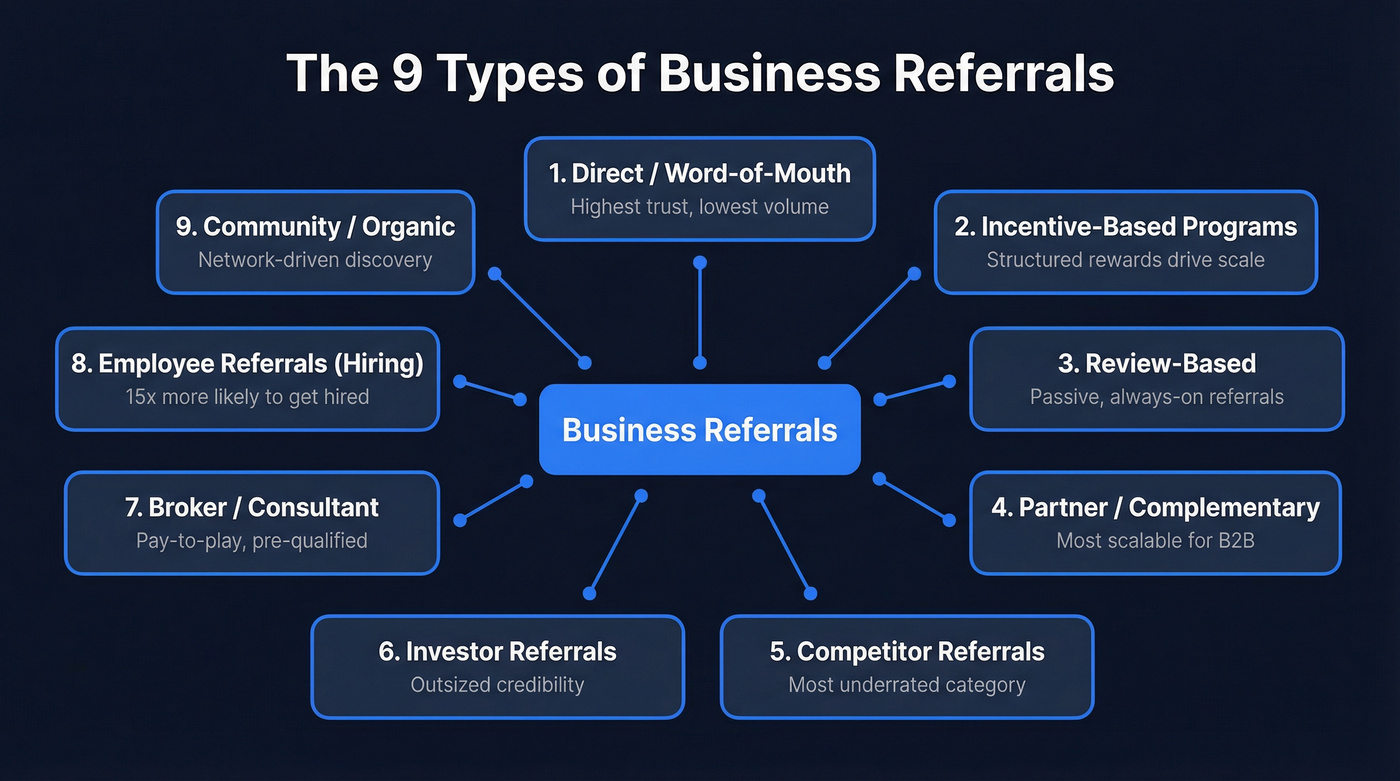
This is the baseline - a happy customer tells a colleague about you without being asked. Friends, family, acquaintances passing your name along in casual conversation. Unprompted word-of-mouth carries the highest trust signal because there's zero incentive distortion. The tradeoff is that volume is low and unpredictable. You can't build a pipeline on it alone, but it's the foundation everything else builds on.
Incentive-Based Programs
Structured referral programs add a reward mechanism to word-of-mouth. The SaaS world has refined this into a science:
| Program | Incentive | Smart Design Choice |
|---|---|---|
| Dropbox | 500MB per referral (capped at 16GB) | Both parties rewarded - drove 3,900% growth in 15 months |
| Canva | Credit for Premium elements; widget appears after design export | Catches users at peak satisfaction |
| Todoist | 2 free months of Pro | Only pays out after referred friend upgrades - filters low-quality leads |
The key design choice is whether to gate the reward on the referred user's conversion. Gating reduces participation but dramatically improves lead quality. Match the incentive to your SaaS sales cycle length and average deal value.
Review-Based Referrals
Online reviews function as passive, always-on referrals. They don't feel like a referral, but they operate on the same trust mechanic: one buyer's experience influencing another's decision. Word-of-mouth influences 20-50% of purchasing decisions, and reviews are just word-of-mouth at scale. The best companies treat review generation as a referral channel, not a reputation management chore.
Partner / Complementary Service
For B2B, this is the most scalable referral type. Adjacent specialists working on the same accounts - a branding agency referring a PPC agency, an implementation consultant referring a data vendor - create a reciprocity dynamic that compounds over time. Tech platform partner programs are a specific variant where platforms generate co-marketing and co-selling leads, rewarding agencies that deliver great outcomes. We've seen a single strong partner relationship generate more qualified pipeline than months of cold outreach, and the leads arrive pre-sold on your credibility.
Competitor Referrals
The most underrated category on this list.
Competitor referrals happen when another company in your space can't take the work - budget mismatch, timeline conflict, capacity overflow, or a project outside their sweet spot. Smaller firms can systematically build relationships with larger competitors and become the go-to overflow option. The consensus on r/sales and B2B services communities is that cultivating competitor relationships pays off disproportionately because almost nobody does it. The goodwill compounds: today's referral becomes tomorrow's reciprocal introduction.
Investor Referrals
When a VC or angel is genuinely impressed with a portfolio company's work, they refer it to other founders in their network. These introductions carry outsized credibility because the referrer has financial skin in the game. For early-stage companies, a single investor referral to a well-connected founder can open doors that months of outbound never would.
Broker / Consultant Referrals
The pay-to-play model. Agency search consultants, industry brokers, and procurement advisors match buyers with providers for a fee - typically 10-30% of project fees. Leads arrive pre-qualified and ready to buy. The downside is margin compression. If your margins can absorb the commission and the deal sizes justify it, broker referrals are a legitimate channel. Just don't let them become your only one.
Employee Referrals (Hiring)
Skip this section if you're only here for sales pipeline - but don't sleep on hiring referrals if you're scaling a team. The numbers are hard to ignore:
- Referred applicants are 15x more likely to get hired
- The process runs ~10 days faster
- Companies save $3,000+ per hire vs. other sourcing channels
- Employee referrals account for 30-50% of all hires
The same principles apply: incentivize clearly, make the process frictionless, and close the loop with the referrer.
Types of Referrals in Healthcare
Healthcare referrals operate in a completely different context. Clinical need, insurance requirements, and regulatory compliance drive the mechanics rather than relationships or incentives.
Internal referrals happen within the same healthcare system. A primary care physician refers a patient to a specialist in the same hospital network, keeping records and billing within one system.
External referrals send patients outside the network - to a specialist, facility, or provider not affiliated with the referring physician's organization. These require more coordination and documentation.
Self-referrals occur when patients go directly to a specialist without a physician's recommendation. Some insurance plans allow this; many HMOs don't.
Split referrals divide care responsibilities between two providers who co-manage the patient. The referring physician stays involved in treatment decisions rather than fully handing off.
E-referrals use electronic systems to transmit referral information between providers. They reduce paperwork delays and improve tracking - a growing standard in modern healthcare systems.
Prior authorization referrals require insurance approval before the patient can see a specialist. These add a bureaucratic layer that can delay care and frustrate everyone involved.

Partner and competitor referrals are powerful - but unpredictable. While you build those relationships, Prospeo gives you 300M+ verified contacts with 98% email accuracy and 30+ filters to find the exact buyers you'd want referred to you. Same quality leads, no waiting for someone else's introduction.
Stop waiting for referrals. Start building pipeline on demand.
The 5 Levels of Referral Quality
Not all referrals are created equal. BNI's five-level framework is the most useful model we've found for understanding why some close easily while others feel barely warmer than a cold call.
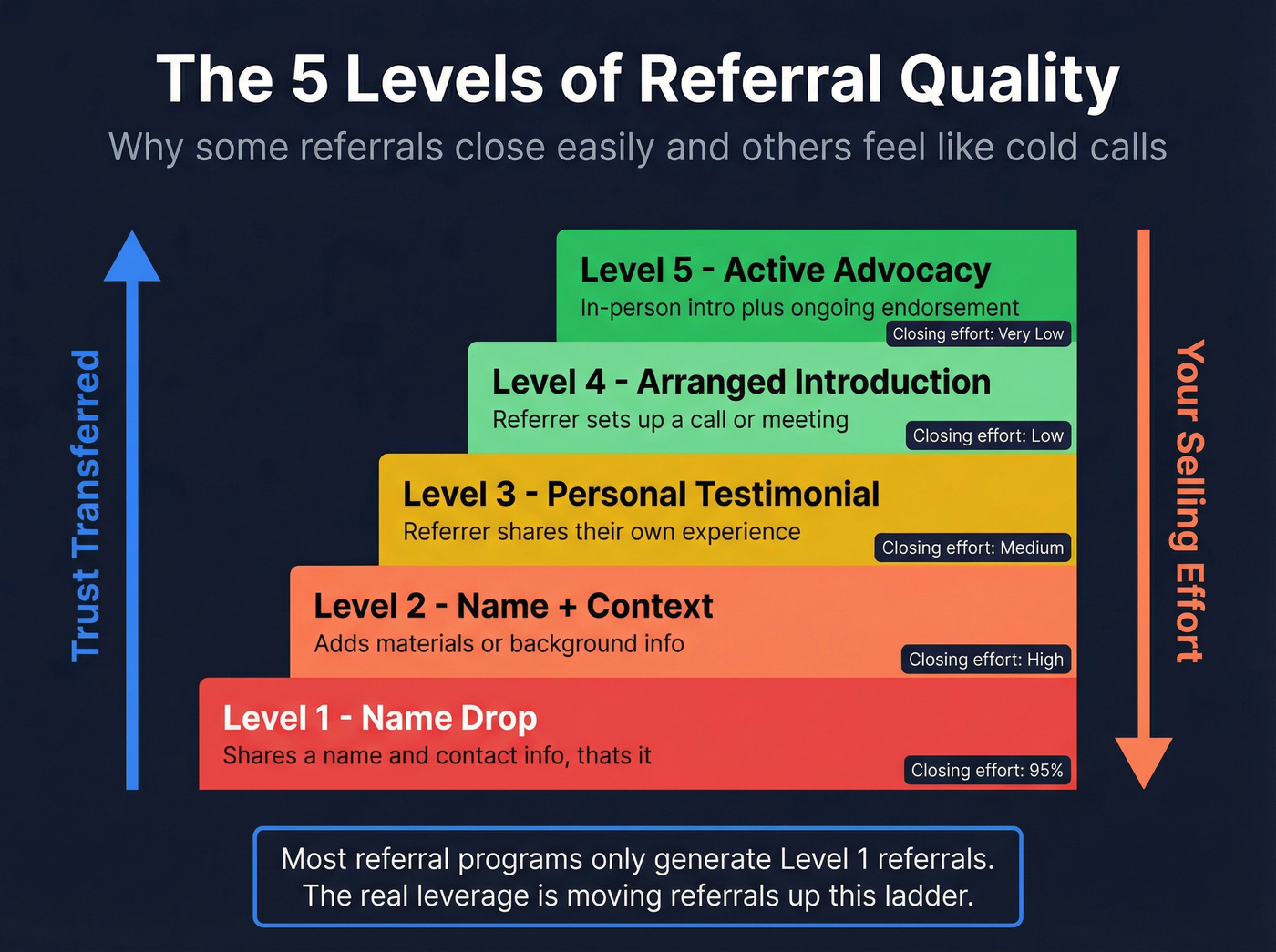
| Level | What the Referrer Does | Your Closing Effort |
|---|---|---|
| 1 | Shares name + contact | ~95% |
| 2 | Adds materials/context | High |
| 3 | Shares personal testimonial | Medium |
| 4 | Arranges intro call/meeting | Low |
| 5 | In-person intro + advocacy | Very low |
At Level 1, someone gives you a name and says "you should call them." That's better than nothing, but the prospect doesn't even remember the referrer mentioned you. At Level 3, the referrer has actively told the prospect about their personal experience - trust is already partially transferred. At Level 5, the referrer arranges a meeting, participates in it, and actively advocates for you. That's practically a closed deal.
Here's the thing: most referral programs generate Level 1 referrals and then wonder why conversion rates disappoint. The real leverage isn't getting more referrals - it's moving existing ones up the quality ladder. Coach your referrers. Give them materials. Make it easy for them to arrange introductions rather than just share names.
Referral Benchmarks Worth Knowing
These numbers frame why referrals deserve dedicated infrastructure:
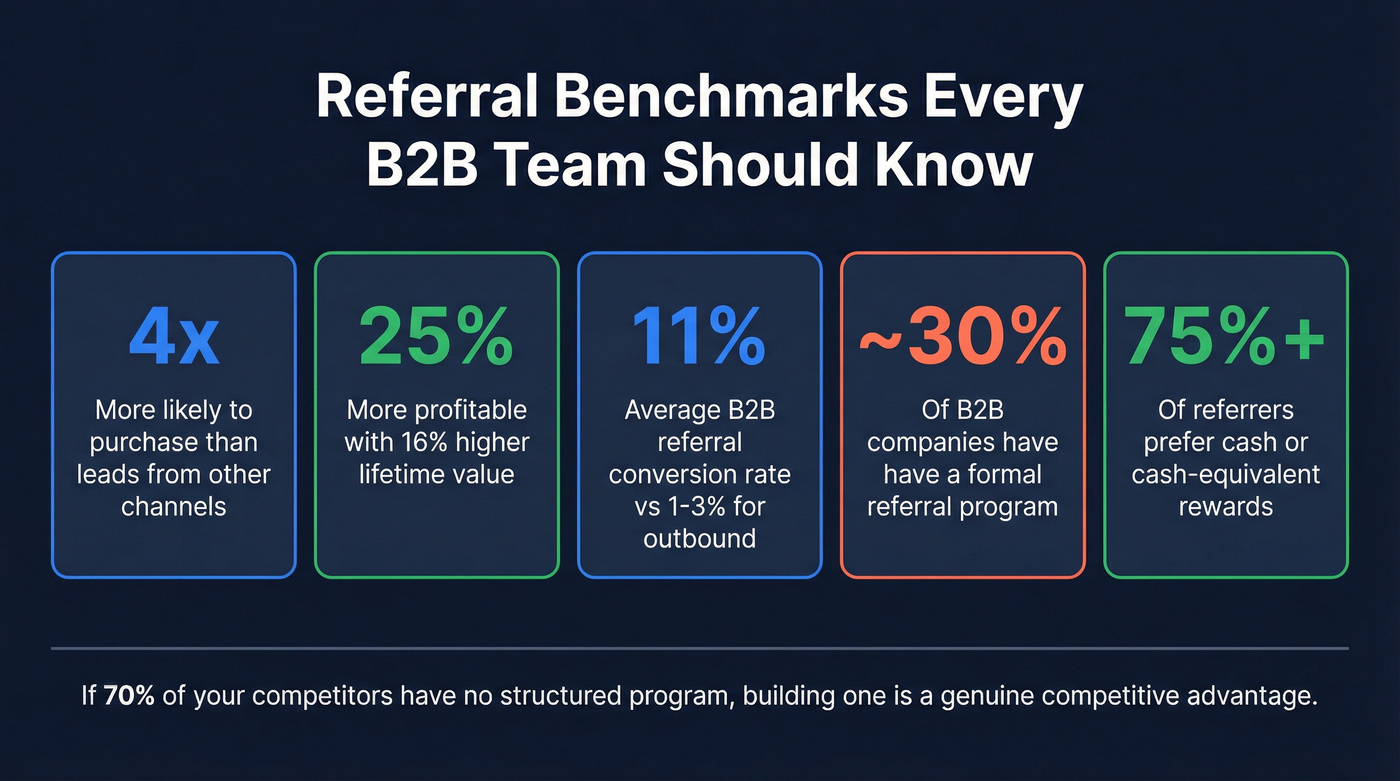
- Referral leads are 4x more likely to purchase than leads from other channels
- Referred customers are 25% more profitable and carry 16% higher lifetime value
- B2B referred leads convert at an 11% average rate - compare that to 1-3% for most outbound channels
- Only ~30% of B2B companies have a formal referral program
- 75%+ of referrers prefer cash or cash-equivalent rewards
That last point about the 30% adoption rate is the one worth sitting with. If 70% of your competitors don't have a structured program, building one isn't table stakes - it's a genuine competitive advantage.
Five Mistakes That Kill Programs
1. No tracking or attribution. Tag every referral lead source in your CRM from day one - type, referrer name, and date. Most teams skip this and then can't scale what's working.
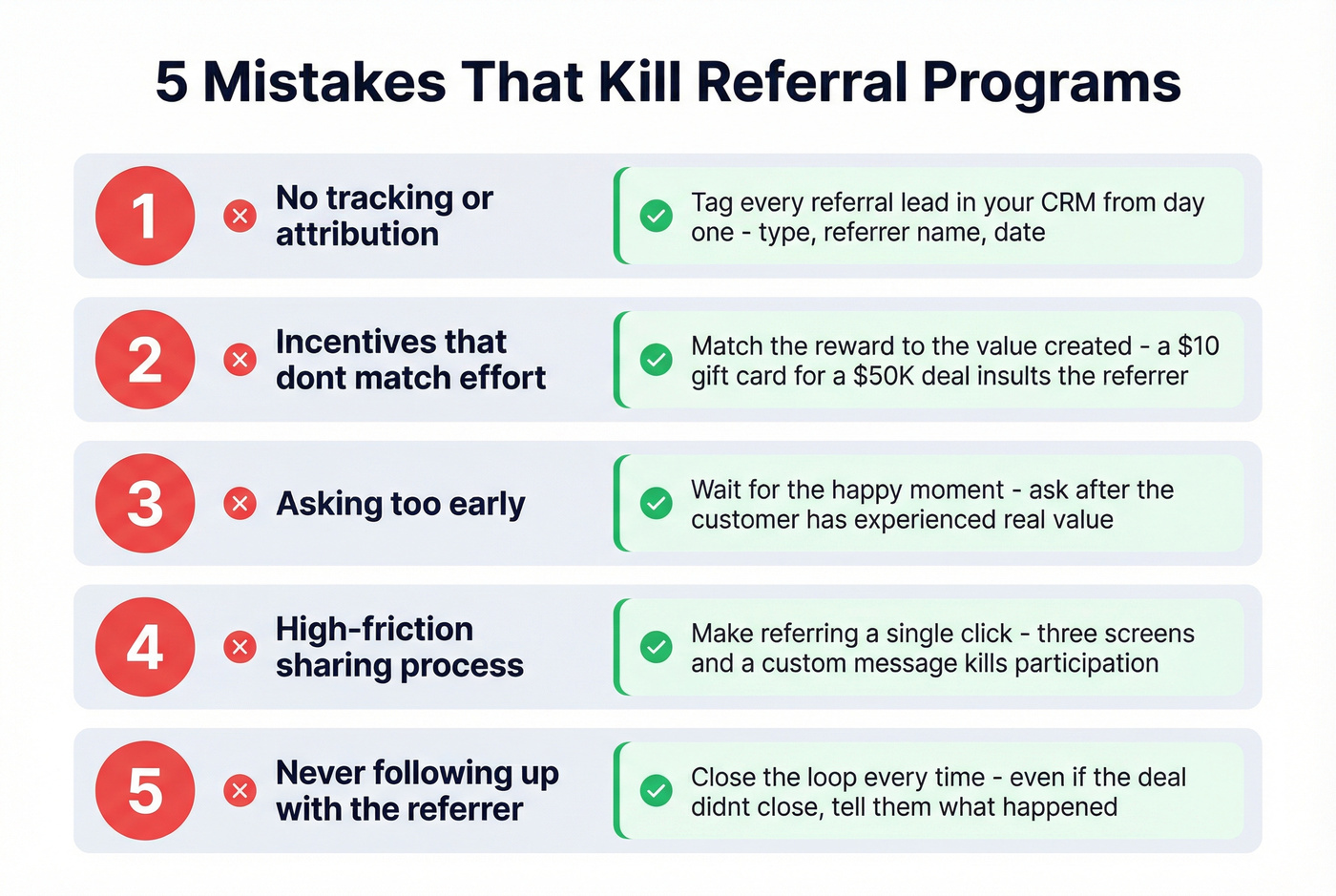
2. Incentives that don't match effort. A $10 gift card for a referral that generates a $50,000 deal insults the referrer. Match the reward to the value created.
3. Asking too early. Requesting referrals before a customer has experienced real value feels desperate. Wait for the "happy moment" - Canva's post-export trigger is the model here.
4. High-friction process. If referring someone requires three screens and a custom message, participation collapses. The best programs make sharing a single click.
5. Never following up with the referrer. When someone refers a prospect and never hears what happened, they stop referring. Close the loop - even if the deal didn't close.
When Referrals Plateau
Every referral-driven company hits the same ceiling. The first 20-30 customers come from warm introductions. The next 50 come from a structured program. Then volume flattens because your network is finite.
Let's be honest about this: referrals are your highest-converting channel, but if your average deal size is under five figures, you probably can't afford to wait for them. You need outbound prospecting running in parallel from day one. And the difference between a 2% reply rate and a 12% reply rate is almost entirely data quality - verified emails that actually land, direct dials that actually connect, and contact records that aren't six months stale.
In our experience, the teams that pair a strong referral program with clean outbound data grow fastest because they're never dependent on a single channel. Prospeo's 7-day data refresh cycle and 98% email accuracy mean outbound lists don't decay before you use them, which is the silent killer of most cold outreach campaigns. (If you want the benchmarks behind that decay, see contact records that aren't six months stale.)
Referrals convert 3-5x better because trust is baked in. But even the best referral program has volume limits. Prospeo's intent data tracks 15,000 topics so you can reach in-market buyers who are already looking for what you sell - the closest thing to a warm referral without knowing someone.
Reach buyers already searching for your solution - no referral required.
FAQ
What's the best referral type for B2B?
Partner referrals from complementary service providers. They're scalable, naturally reciprocal, and come with built-in context about the prospect's needs - so you skip the discovery phase that slows down cold-sourced deals.
How do healthcare and business referrals differ?
Healthcare referrals are clinical - internal, external, split, e-referral - and often require insurance authorization. Business referrals are relationship-driven and incentive-based, with no regulatory gating. The trust mechanics overlap, but the workflows are completely different.
What's the difference between a referral and an affiliate?
A referral comes from genuine relationship or firsthand experience. An affiliate promotes for a commission, often without personal use. Referrals convert higher because real trust is involved - affiliates scale wider but carry less credibility per lead.
How should I track referral sources?
Tag every referral by source type in your CRM, then measure conversion rate and lifetime value per source. Most teams that label "referral" as a distinct lead source find it outperforms paid, organic, and outbound channels on close rate and deal size.
What if referral volume isn't enough?
Supplement with outbound prospecting using verified data. Clean contact records with high deliverability rates are the lowest-risk way to fill pipeline gaps between warm introductions - and tools like Prospeo make it possible to test outbound for under $50/month.