The Best Social Selling Tools for 2026: Build a Stack, Not a Collection
Your SDR spent three weeks warming up a VP of Engineering on LinkedIn. Thoughtful comments, a shared article, a genuine connection request that actually got accepted. Then they sent the follow-up email - and it bounced. Three weeks of social selling, gone because of bad contact data.
That's why choosing the right social selling tool for each layer of your workflow matters more than picking one all-in-one platform. Brands publish 9.5 social posts per day on average but manage only about 2 outbound engagements daily. The posting is easy. Converting is where teams fall apart, and no single tool covers everything you need - you need a stack of three that actually work together.
Our Picks
| Stack Layer | Pick | Why | Starting Price |
|---|---|---|---|
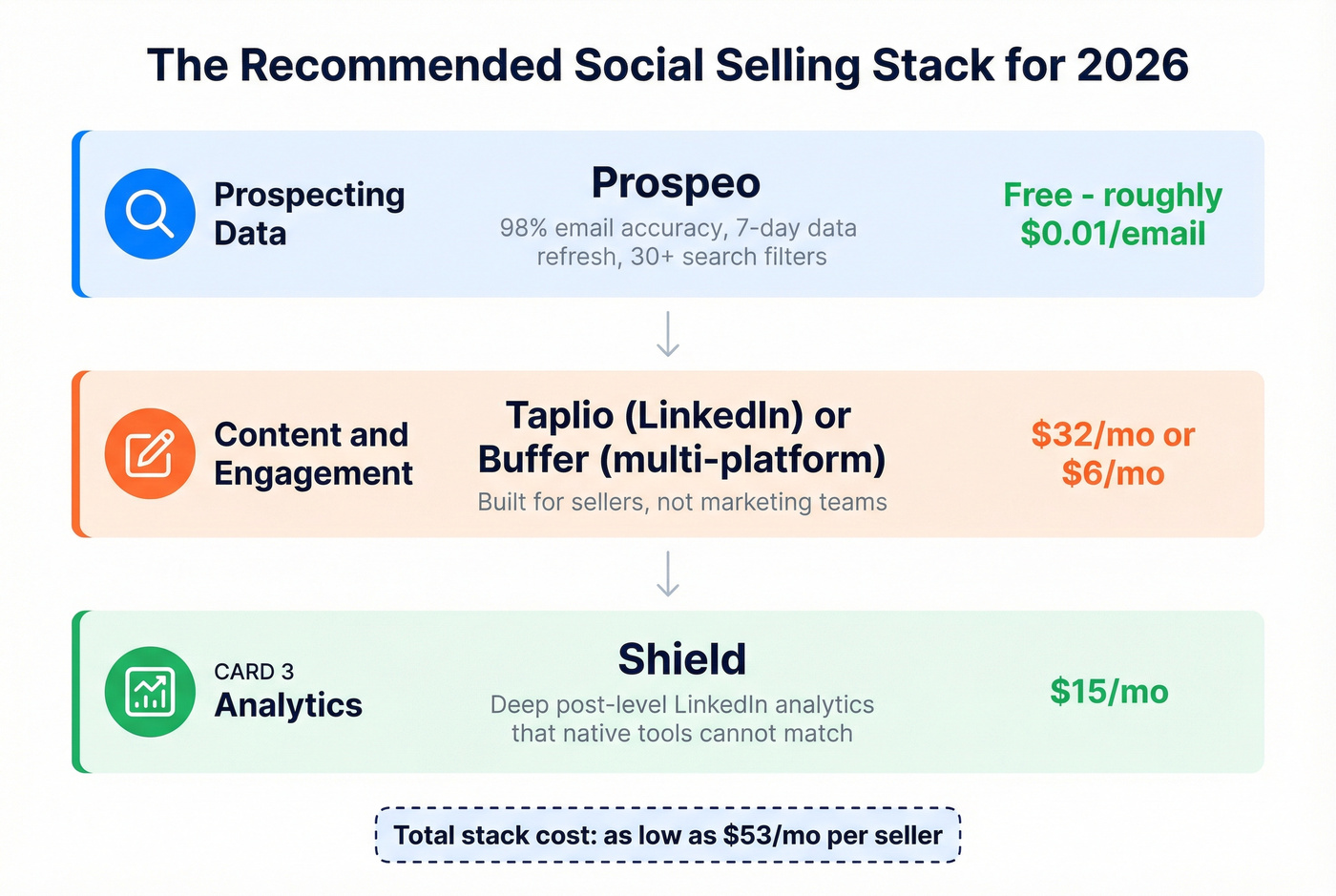
| Prospecting data | Prospeo | 98% email accuracy, free tier, no contracts | Free / ~$0.01/email |
| Content & engagement | Taplio (LinkedIn) / Buffer (multi) | Built for sellers, not marketing teams | $32/mo / $6/mo |
| Analytics | Shield | Deep post-level LinkedIn analytics | $15/mo |
What Social Selling Actually Is
Social selling means using social platforms to find, connect with, and nurture specific prospects - not to broadcast brand content at an audience. That distinction determines which software you need. Social media marketing builds awareness. Social selling builds pipeline.
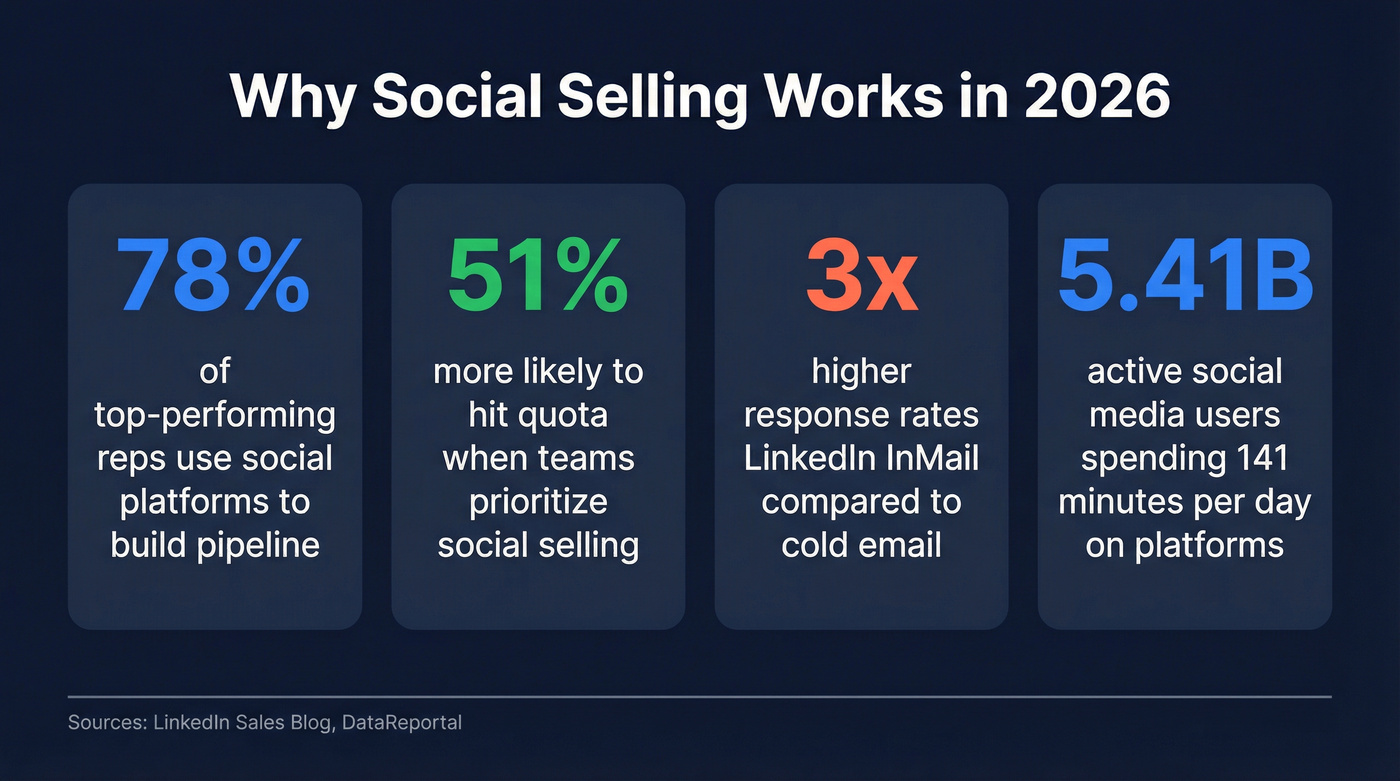
The numbers are hard to argue with. 78% of top-performing reps use social platforms to build pipeline, and teams that prioritize social selling are 51% more likely to hit quota. LinkedIn InMail delivers response rates up to 3x higher than email. With 5.41 billion active social users spending 141 minutes per day on platforms, your prospects are already scrolling. The question is whether you're engaging them or just posting into the void.
The 3-Layer Social Selling Stack
GetApp lists 60+ tools in the social selling category alone. Without a framework, you'll end up with five disconnected subscriptions and a VP of Sales asking whether anyone can prove ROI on any of them.
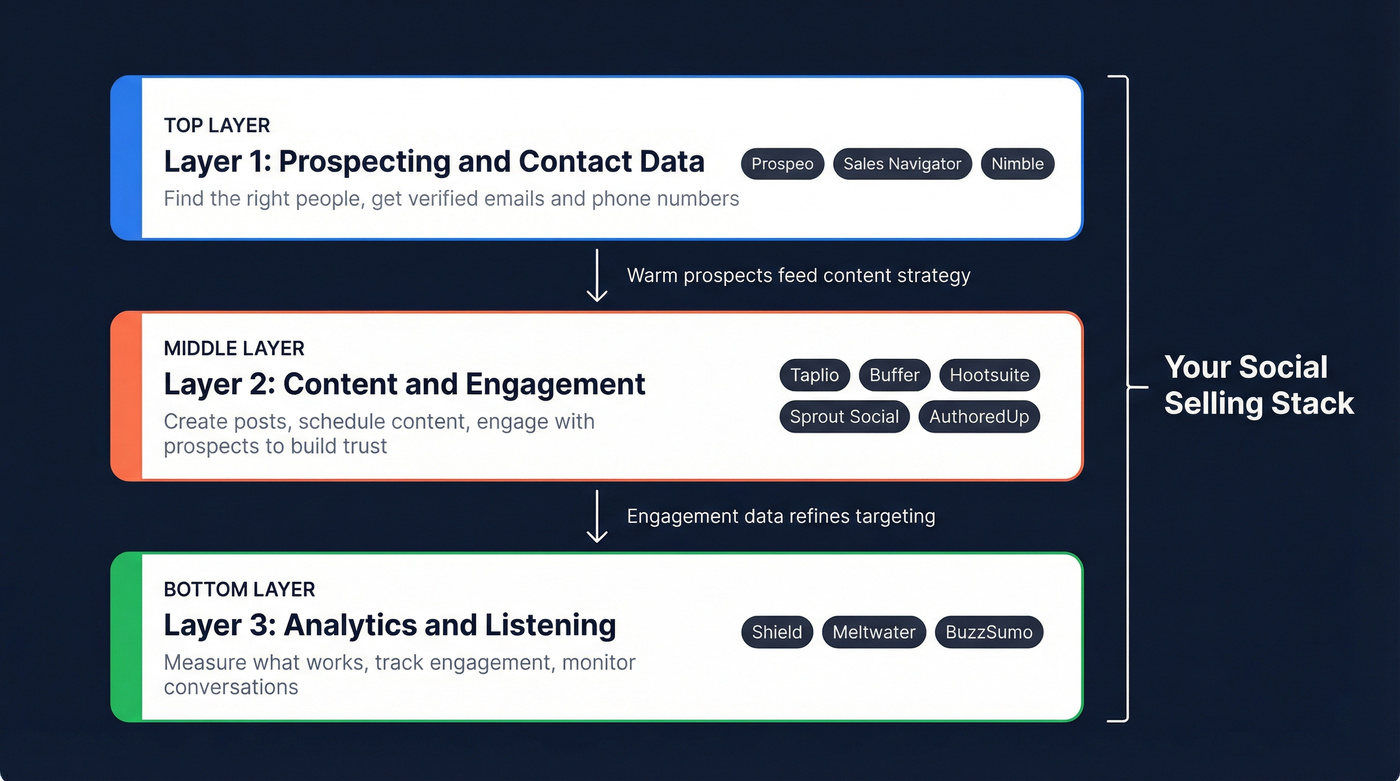
Every social selling workflow breaks down into three layers:
- Prospecting & Contact Data - Finding the right people and getting verified contact info so you can move conversations off-platform.
- Content & Engagement - Creating posts, scheduling content, and engaging with prospects' activity to build visibility and trust before outreach.
- Analytics & Listening - Measuring what's working, tracking engagement trends, and monitoring relevant conversations.
Pick one from each layer, make sure they integrate, and you've got a functional stack.
Best Tools for B2B Social Selling
Layer 1: Prospecting & Contact Data
Prospeo
Use this if you need verified emails and direct dials to convert social engagement into actual pipeline. Skip this if you're looking for a social scheduling suite - that's not what Prospeo does.
Prospeo covers 300M+ professional profiles with 143M+ verified emails and 125M+ verified mobile numbers. The 98% email accuracy is the headline stat, but the 7-day data refresh cycle is what separates it from competitors running on month-old records. Those 125M+ verified mobiles come with a 30% pickup rate - critical when email alone isn't cutting it. When Snyk's 50 AEs adopted it, bounce rates dropped from 35-40% to under 5% while AE-sourced pipeline grew 180%.
You get 30+ search filters including buyer intent powered by Bombora, technographics, job changes, and headcount growth signals. The Chrome extension (40K+ users) pulls verified contact data from professional profiles and company websites without leaving your browser. Integrations push directly into Salesforce, HubSpot, Smartlead, Instantly, and Lemlist. GDPR compliant with DPAs available.
Pricing starts free - 75 verified emails per month, no credit card. Paid plans run about $0.01 per email with no contracts.
LinkedIn Sales Navigator
Sales Navigator is table stakes for social selling on LinkedIn, but it's not a complete solution on its own.
The deep search filters, lead recommendations, and account tracking are genuinely useful - you won't find prospects this precisely on free LinkedIn. Core plans run $80-100/user/month, Advanced $110-150/user/month, and Advanced Plus starts around $1,600+/seat/year. You get 50 InMail credits per month on Core and Advanced, and TeamLink on Advanced lets you tap your whole org's network.
Here's the catch: search results cap at 2,500 leads per query, there's no native CSV export, and Sales Navigator won't give you verified emails or phone numbers. You'll still need a separate data tool to get contact info for the prospects you find. Think of it as the discovery layer, not the outreach layer.
Nimble
Nimble runs $25/user/month with a 14-day trial. It pulls social context into a lightweight CRM, making it a strong option for teams that want to track interactions across platforms without Salesforce complexity. With a 4.4/5 rating across 1.8K reviews on GetApp, it's well-liked by teams that value simplicity over power. It won't replace a dedicated data tool, but for small teams that need relationship tracking more than raw prospecting volume, it's solid.
Layer 2: Content & Engagement
Taplio
Taplio is the social selling tool LinkedIn-focused sellers actually use, and there's a reason it keeps showing up in practitioner conversations on r/sales and LinkedIn creator communities. It combines content creation, scheduling, and analytics into a single dashboard built specifically for LinkedIn - not retrofitted from a multi-platform tool.
Use this if you're focused on LinkedIn and want content creation plus scheduling in one place. Skip this if you need multi-platform publishing or deep analytics - Taplio's metrics are relatively high-level compared to Shield.
Starting at $32/month billed annually, it's priced for individual sellers and small teams. The AI-assisted content features help you draft posts faster, and the engagement tools let you track and interact with prospects' activity systematically. For deep post-level metrics, pair it with Shield.
Hootsuite vs. Buffer: Pick One
These two get compared constantly, so let's settle it.
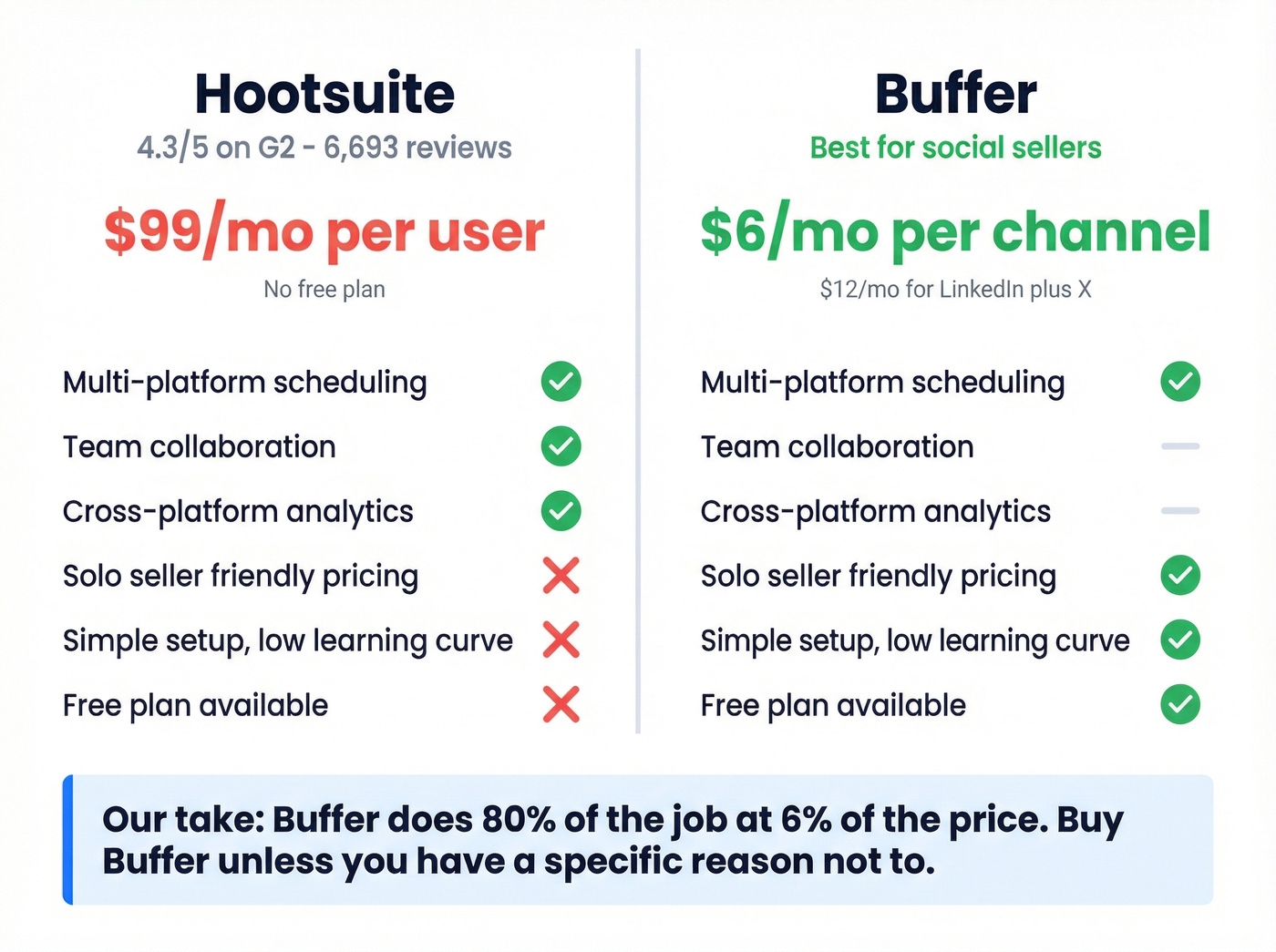
Hootsuite is the established multi-channel platform - 4.3/5 on G2 with 6,693 reviews, strong team collaboration features, and cross-platform analytics. It starts at $99/month per user with no free plan anymore, which is a consistent G2 complaint.
Buffer starts at $6/month per channel. It handles scheduling, basic analytics, and multi-platform publishing without the complexity. For a solo seller running LinkedIn and X, you're looking at $12/month total.
Look, $99/mo per user is too much for an SDR who just needs to schedule LinkedIn posts and track engagement. Hootsuite makes sense for marketing teams coordinating across five platforms. For social sellers, Buffer does 80% of the job at 6% of the price. Buy Buffer unless you have a specific reason not to.
Sprout Social
Sprout Social is the enterprise play - 4.4/5 on G2 with 6,188 reviews, genuinely useful AI tools, and a HubSpot integration that G2 reviewers praise. Pricing runs $199/$299/$399 per month depending on tier. That's enterprise money, and it's overkill for teams under 20 people.
Their own data shows brands average only 2 outbound engagements per day - the tool is powerful, but the engagement gap persists regardless of what you're paying. The right choice for mid-market teams with budget who need social listening, publishing, and analytics in one platform. For everyone else, the price-to-value ratio doesn't work for social selling specifically.
AuthoredUp
AuthoredUp focuses on LinkedIn content formatting and optimization at $16.63/month billed annually. Great for making posts visually stand out with formatting tools LinkedIn's native editor lacks. Analytics depth is limited - pair it with Shield if you need serious metrics.
Layer 3: Analytics & Listening
Shield
Use this if you want to know exactly which LinkedIn posts drive engagement, profile views, and inbound conversations. Skip this if you need scheduling or content creation - Shield is analytics-only, and that focus is a feature.
Starting at $15/month for personal plans and $20/profile/month for teams, Shield provides post-level LinkedIn analytics that native LinkedIn analytics can't match - engagement rates, follower growth trends, and content performance breakdowns. We've found it's the fastest way to figure out which content themes actually generate replies versus just likes.
Meltwater
Meltwater combines social listening with media intelligence for teams tracking brand mentions, competitor activity, and industry conversations at scale. Enterprise pricing runs $500-2,000+/month depending on scope. Best for mid-market and enterprise teams where social selling is part of a broader brand monitoring strategy.
BuzzSumo
BuzzSumo excels at content research and trending topic discovery - figuring out what to post before you post it. Plans run $99-299/month with a 7-day free trial. It's a content intelligence tool rather than a direct selling tool, but it feeds the engagement layer with data on what's actually resonating in your market.
Bonus: Employee Advocacy
GaggleAMP
GaggleAMP coordinates employee sharing at scale - marketing curates content, reps share it with one click. Typically $500-1,500/month for mid-market teams. Worth it if you have 50+ sellers and want to amplify reach without asking everyone to become a content creator.
Bonus: LinkedIn Automation
Dripify
Dripify starts at $39/user/month billed annually and automates LinkedIn connection sequences and follow-ups. LinkedIn's Terms of Service prohibit automation tools, and account restrictions are real - we've seen reps get temporarily locked out. The ROI is strong when it works, but you're accepting risk.
HeyReach
HeyReach takes LinkedIn automation further with multi-sender capabilities at $79/sender/month ($59 for 10+ accounts). Same ToS risk applies.
LeadDelta
LeadDelta is a lightweight LinkedIn CRM and connection manager at $9.80/user/month billed annually. It organizes your existing network rather than automating outreach - lower risk, lower reward, but genuinely useful for managing a large connection base.
Other tools worth knowing: SocialPilot ($25.50/mo), Zoho Social ($15/mo), and Agorapulse ($79-149/mo) all offer solid social management at various price points. None are built specifically for social selling, but they're viable alternatives if the tools above don't fit your workflow.

Three weeks of warming up a prospect on LinkedIn means nothing if the follow-up email bounces. Prospeo's 98% email accuracy and 7-day data refresh cycle ensure the contacts you pull from social selling are actually reachable - not stale records from six weeks ago.
Stop losing warm prospects to bad data. Start converting them.
Pricing Comparison
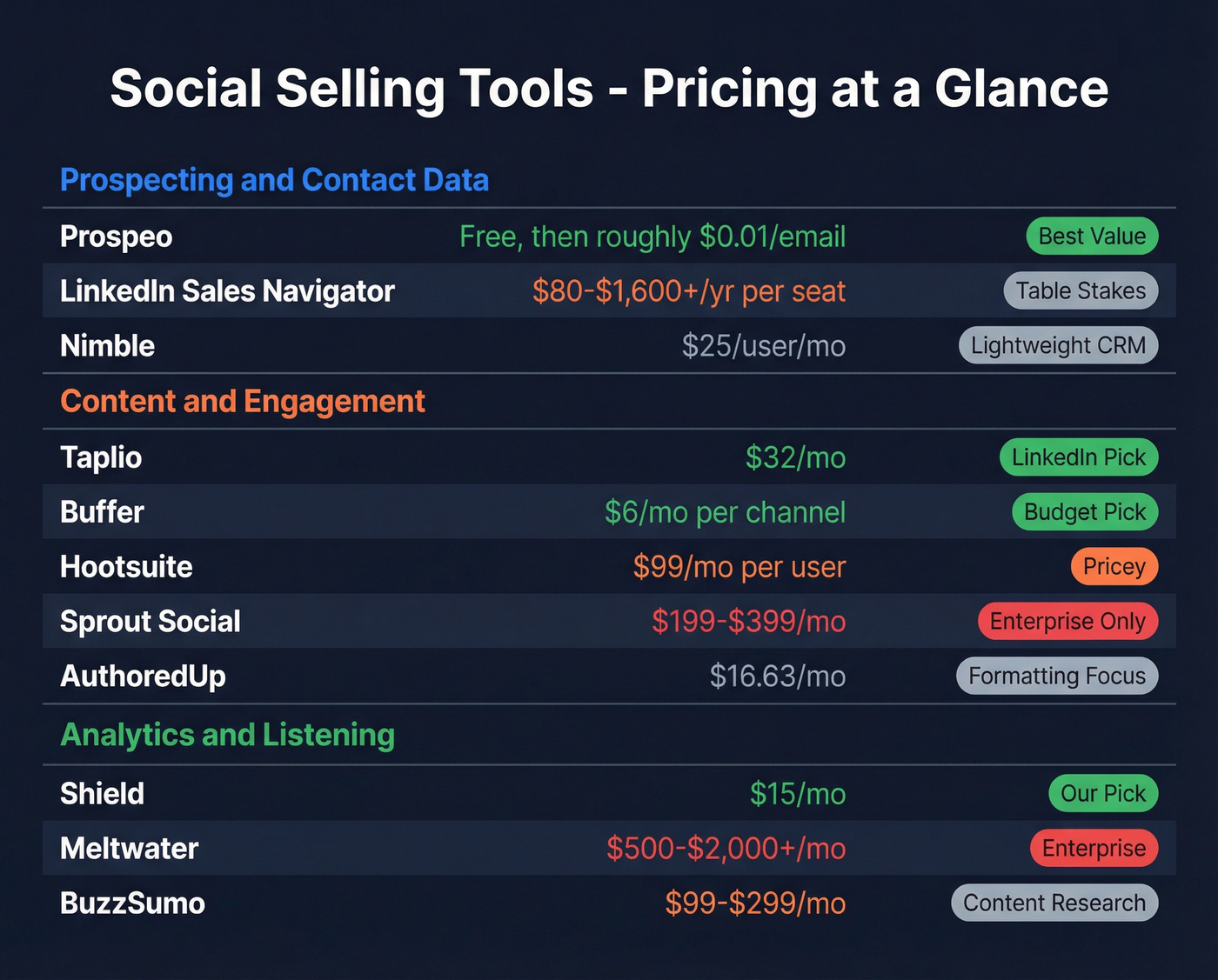
Most social selling tools offer 15-30% discounts on annual billing. Free trials typically run 15-30 days.
| Tool | Stack Layer | Starting Price | Free Trial | Best For |
|---|---|---|---|---|
| Sales Navigator | Data | ~$80/user/mo | 30 days | LinkedIn prospecting |
| Nimble | Data/CRM | $25/user/mo | 14 days | Small team social CRM |
| Taplio | Content | $32/mo | Free trial | LinkedIn content + growth |
| Hootsuite | Content | $99/user/mo | 30 days | Multi-brand management |
| Sprout Social | Content | $199/mo | 30 days | Mid-market teams |
| Buffer | Content | $6/channel/mo | Free tier | Solo sellers, small teams |
| AuthoredUp | Content | $16.63/mo | Free trial | LinkedIn formatting |
| Shield | Analytics | $15/mo | Free trial | Post-level LinkedIn data |
| Meltwater | Analytics | ~$500+/mo | Demo | Enterprise listening |
| BuzzSumo | Analytics | ~$99/mo | 7 days | Content research |
| GaggleAMP | Advocacy | ~$500+/mo | Demo | Employee sharing at scale |
| Dripify | Automation | $39/user/mo | 7 days | LinkedIn sequences |
| HeyReach | Automation | $79/sender/mo | Free trial | Multi-sender automation |
| LeadDelta | Automation | $9.80/user/mo | Free trial | Connection management |
How to Build Your Stack
Here's our hot take: if your deals typically close under $10k, you probably don't need Sprout Social, Meltwater, or any tool that costs more than your monthly coffee budget. Start lean, prove ROI, then upgrade.
Solo seller / $0-50/mo: Prospeo's free tier (75 verified emails/month) + Buffer ($6/mo) + Shield ($15/mo) = roughly $21/month. Verified contact data, multi-platform scheduling, and LinkedIn analytics. This stack punches way above its price.
Small team / $100-300/mo: A paid data tool + Hootsuite ($99/mo) + Nimble ($25/mo). Deeper data credits, team-level social management, and a lightweight CRM tracking social interactions. Total runs $150-200/mo.
Mid-market / $500+/mo: Your data layer + Sprout Social ($199/mo) + Sales Navigator (~$100/user/mo) + Meltwater. The full stack - verified data, enterprise social management, LinkedIn prospecting, and social listening. Budget $500-1,000+/month depending on team size. At this tier, you're investing in a B2B social selling platform that covers every stage from discovery to closed-won.
The common thread across all three tiers: start with accurate contact data. Every other social selling tool in your stack becomes more valuable when the emails you send actually land. I've watched too many teams invest $300/month in content tools while sending outreach that bounces 30% of the time - that's burning money on both ends.
Social selling generates the relationship. Prospeo closes the gap between LinkedIn engagement and booked meetings - 143M+ verified emails, 125M+ direct dials with a 30% pickup rate, and a Chrome extension that pulls contact data without leaving your browser.
Turn every LinkedIn connection into a reachable prospect for $0.01.
LinkedIn Content Tips for Sellers
Most sellers get this backwards. They obsess over posting frequency when the real opportunity is engagement. Sprout Social's own benchmarks show a 20% jump in average inbound engagements year-over-year - the audience is getting more active, but most sellers aren't capitalizing.
When you do post, format matters. Multi-image posts drive 6.6% engagement, native documents 5.85%, and video 5.6%. Text-only posts lag behind.
But the bigger lever is commenting thoughtfully on your prospects' posts before you ever send a connection request. In our experience, reps who spend 15 minutes a day commenting on target accounts' content see 2-3x more connection acceptances than those who lead with a cold request. Engage more than you post - that's the social selling playbook in five words.
One free tool worth checking: your LinkedIn Social Selling Index (SSI). It scores your profile, network, and engagement on a 0-100 scale. It's not perfect, but it gives you a baseline before you start optimizing.
Social Selling Tool FAQ
What's the best social selling tool?
There's no single best option - you need a stack of three. For most B2B teams, start with Prospeo for verified contact data, add Taplio or Buffer for content and engagement, and Shield for LinkedIn analytics. That covers all three layers at roughly $21-50/month without overspending.
Are social selling tools worth the investment?
Teams that prioritize social selling are 51% more likely to hit quota, and 78% of top-performing reps use social platforms to build pipeline. A lean 3-tool stack costs $21-150/month - far less than one missed deal from a bounced email.
How much do social selling tools cost?
Individual tools range from $6/month (Buffer) to $399/month (Sprout Social enterprise). A solid 3-tool stack runs $20-150/month depending on team size. Prospeo's free tier covers 75 verified emails monthly, so you can start at near-zero cost and scale up.
What's the difference between social selling and social media marketing?
Social media marketing builds brand awareness for broad audiences. Social selling builds one-to-one relationships with specific prospects to generate pipeline. Different goals, different metrics, different software - though there's overlap in the content and scheduling layer.
Do I need Sales Navigator for social selling?
It's useful but not required. Sales Navigator helps you find and track prospects on LinkedIn, but it won't give you verified emails or phone numbers. Pair it with a data tool to fill the contact information gap and actually move conversations off-platform.