

Cold Call Social Selling: The Hybrid Playbook That Actually Works
It's Monday morning. Your SDR team has 200 dials queued up, a social selling workshop from last quarter gathering dust, and a pipeline that isn't moving. Half the team swears cold calling is dead. The other half thinks social selling isn't "real selling." They're both wrong - and the cold call social selling debate is a false binary that's costing you meetings every week. The reps who figured that out six months ago are already at 120% of quota.
72% of cold calls don't reach a human. Meanwhile, social media delivers a 42% response rate - nearly double email. Neither channel is enough on its own. The reps who combine phone outreach and social engagement in a structured cadence are the ones actually booking meetings.
What You Need (Quick Version)
Multi-touch campaigns convert 28% better than single-touch outreach. To run a hybrid cadence, you need exactly three things:
- A sequencing tool. Something that coordinates your emails, calls, and social touches in one workflow. Apollo, Salesloft, or similar.
- 15 minutes of daily social engagement. Not posting thought leadership. Engaging with your prospects' content - commenting, reacting, building familiarity before you ever pick up the phone.
Cold Calling by the Numbers
Let's be honest about what the data says. Cold calling works, but the averages are brutal.
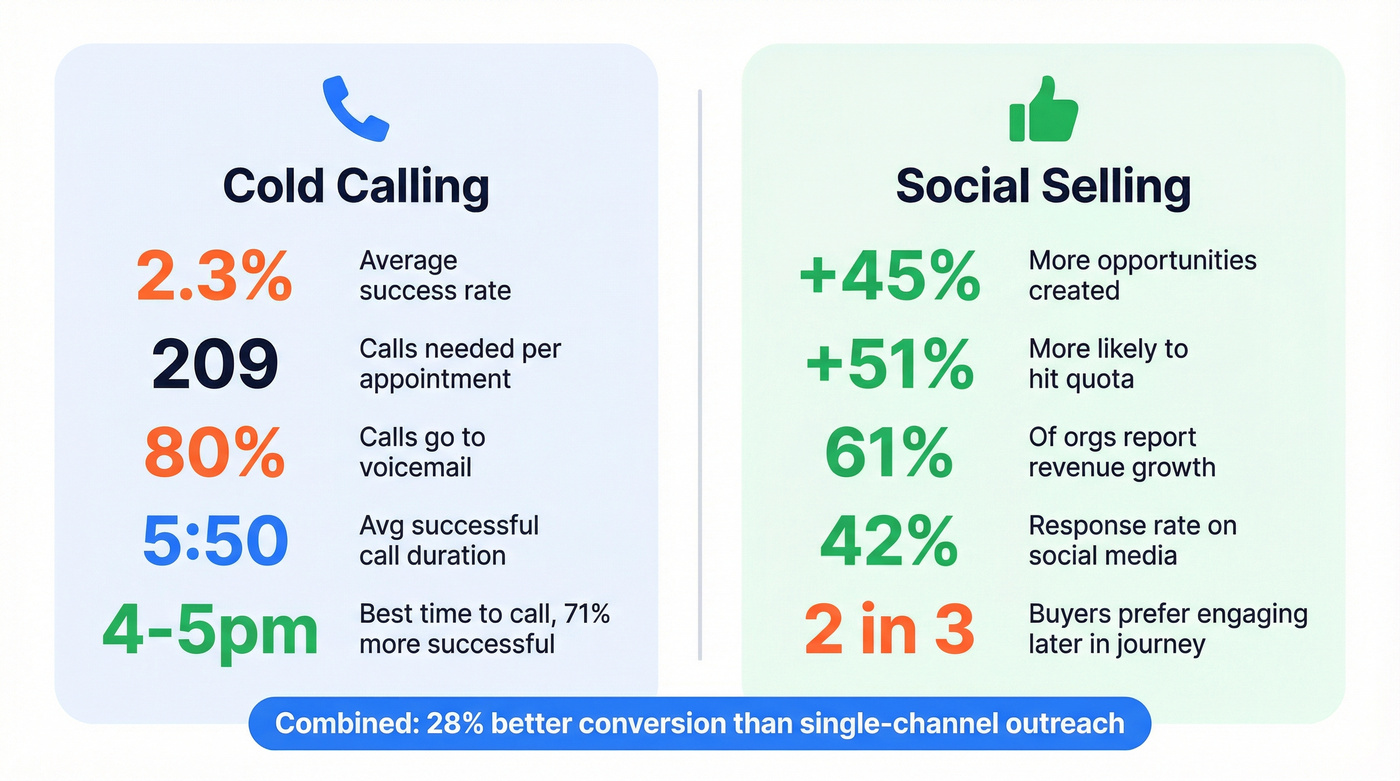
| Metric | Benchmark | Source |
|---|---|---|
| Avg success rate | 2.3% | Cognism |
| Calls per appointment | 209 | Bridge Group |
| Calls going to voicemail | 80% | RAIN Group |
| Successful call duration | 5:50 | Gong |
| Failed call duration | 3:14 | Gong |
| Best time to call | 4-5pm | Lead Forensics |
| Top performer rate | 5-8% | LeadIQ |
The gap between average and top performers is massive. A 2.3% average success rate means most reps grind through 209 dials to book a single meeting. Top performers hit 5-8%, roughly three times the average. The difference isn't talent. It's preparation, timing - afternoon calls between 4-5pm are 71% more successful than other time slots - and whether the prospect has any idea who you are before the phone rings.
That last part is where social selling enters the picture.
Social Selling by the Numbers
Social selling's stats look impressive in isolation.
| Metric | Impact | Source |
|---|---|---|
| More opportunities | +45% | inBeat |
| More likely to hit quota | +51% | inBeat |
| Orgs reporting revenue growth | 61% | inBeat |
| Response rate (social media) | 42% | HubSpot |
| Buyers preferring later engagement | 2 in 3 | G2 |
Reps using social selling create 45% more opportunities and are 51% more likely to hit quota and are 51% more likely to hit quota. Those are real numbers. But there's a catch the social selling evangelists don't talk about enough.
Nearly 2 out of 3 buyers now prefer engaging with salespeople later in the buying journey - up 17 percentage points year over year. Social selling alone is slow. It builds awareness and trust, but it doesn't create urgency. You can comment on a VP's posts for three months and never get a meeting if you don't eventually pick up the phone.
Why Top Reps Blend Both
Social selling without phone follow-up is content marketing with extra steps. You're building familiarity without converting it into pipeline. Cold calling without any prior social engagement is the equivalent of knocking on a stranger's door - it can work, but you're starting from zero trust every single time.
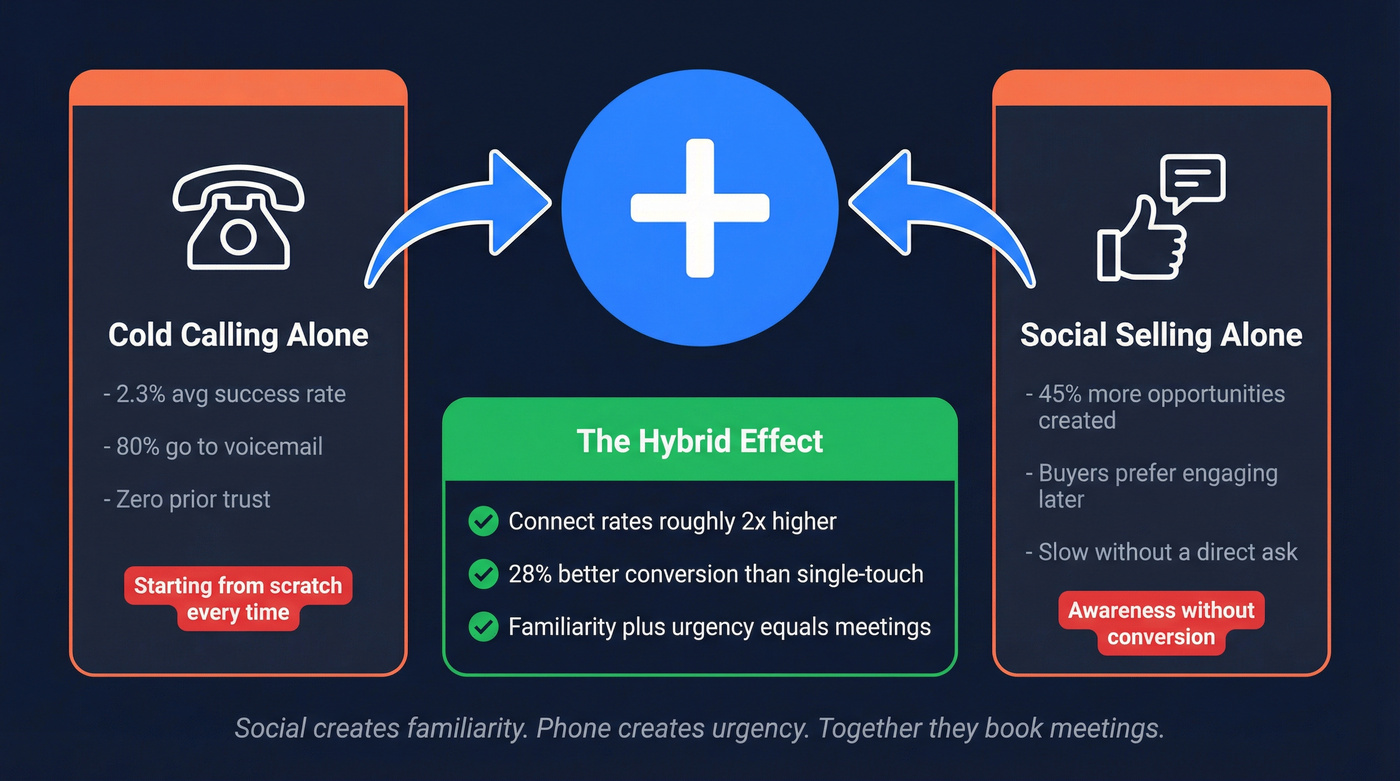
Social creates familiarity. Phone creates urgency. When a prospect has seen your name in their feed three times before you call, that first dial isn't cold anymore - it's warm, and the conversation starts differently. We've seen connect rates roughly double when reps invest even a few days of social engagement before dialing.
The mix shifts by segment and industry. Enterprise deals with long sales cycles and multiple stakeholders lean heavier on social because you need to multi-thread across a buying committee. SMB deals with shorter cycles lean heavier on phone because speed matters more than relationship depth. In SaaS, the social warm-up matters most since buyers are active on professional networks and expect it. In healthcare or financial services, phone still dominates because compliance limits social engagement and decision-makers are less active online. Every segment benefits from the hybrid approach, but the ratio changes.
Here's the thing: if your average deal size is under $10K, you probably don't need a 10-day cadence. Compress it to five days and lean harder on phone. The social warm-up still helps, but speed-to-contact matters more than relationship depth at that price point.

Multi-touch cadences convert 28% better - but only when your contacts are real. Prospeo's 300M+ profiles refresh every 7 days with 98% email accuracy and 125M+ verified mobiles at a 30% pickup rate. Your social warm-up earns the right to call. Bad data wastes it.
Stop burning dials on dead numbers. Verify before you sequence.
The Hidden Variable - Your Data
None of this works if your data is bad.
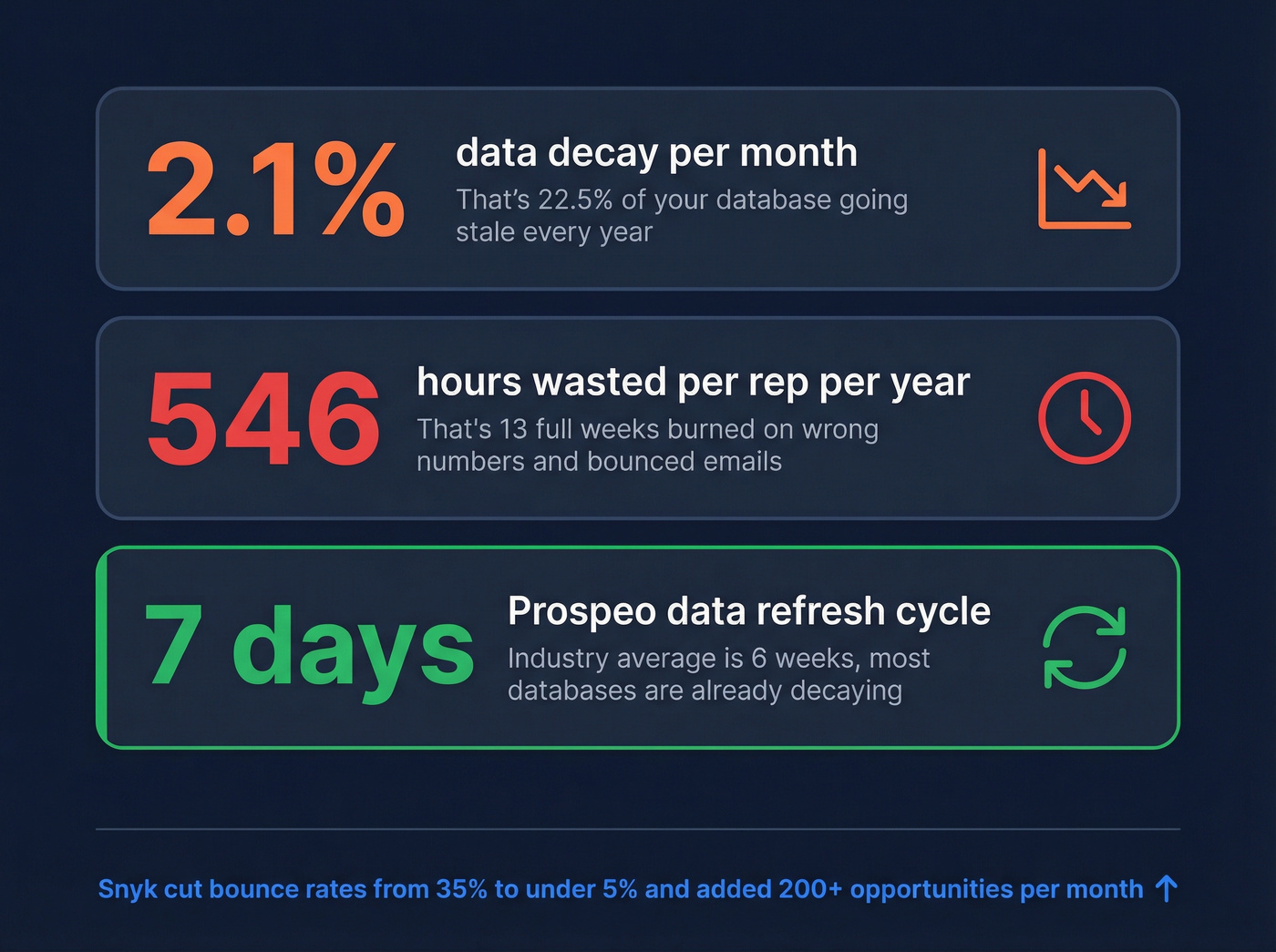
B2B contact data decays at roughly 2.1% per month - about 22.5% annually. People change jobs, get promoted, switch companies. Inaccurate data wastes an estimated 546 hours per rep per year. That's 13 weeks of a rep's time burned on wrong numbers and bounced emails - more than an entire quarter gone.
Your data layer matters more than your sequencing tool, your dialer, or your social strategy combined. If you're calling dead numbers and sending emails that bounce, your hybrid cadence is just a structured way to waste time.
Prospeo solves this at the foundation. The platform covers 300M+ professional profiles with 98% email accuracy and 125M+ verified mobile numbers that deliver a 30% pickup rate. Records refresh on a 7-day cycle - the industry average is six weeks, which means most databases are already decaying by the time you export a list. The 5-step verification process catches bad emails before they hit your sequences, including catch-all domain handling and spam-trap removal.
One example we keep coming back to: Snyk runs 50 AEs prospecting 4-6 hours per week and used Prospeo to cut bounce rates from 35-40% to under 5%, driving 200+ new opportunities per month and increasing AE-sourced pipeline by 180%. That's the kind of downstream impact clean data creates.
Snyk's 50 AEs cut bounce rates from 35% to under 5% and added 200+ opportunities per month. The difference wasn't their cadence - it was their data. Prospeo's 5-step verification catches bad emails, spam traps, and catch-all domains before they torch your sender reputation.
Your hybrid playbook deserves data that keeps up. Prospeo refreshes every 7 days.
The 10-Day Hybrid Outreach Cadence
Here's the exact sequence we recommend. Adjust timing based on your sales cycle length, but the structure holds across most B2B motions.
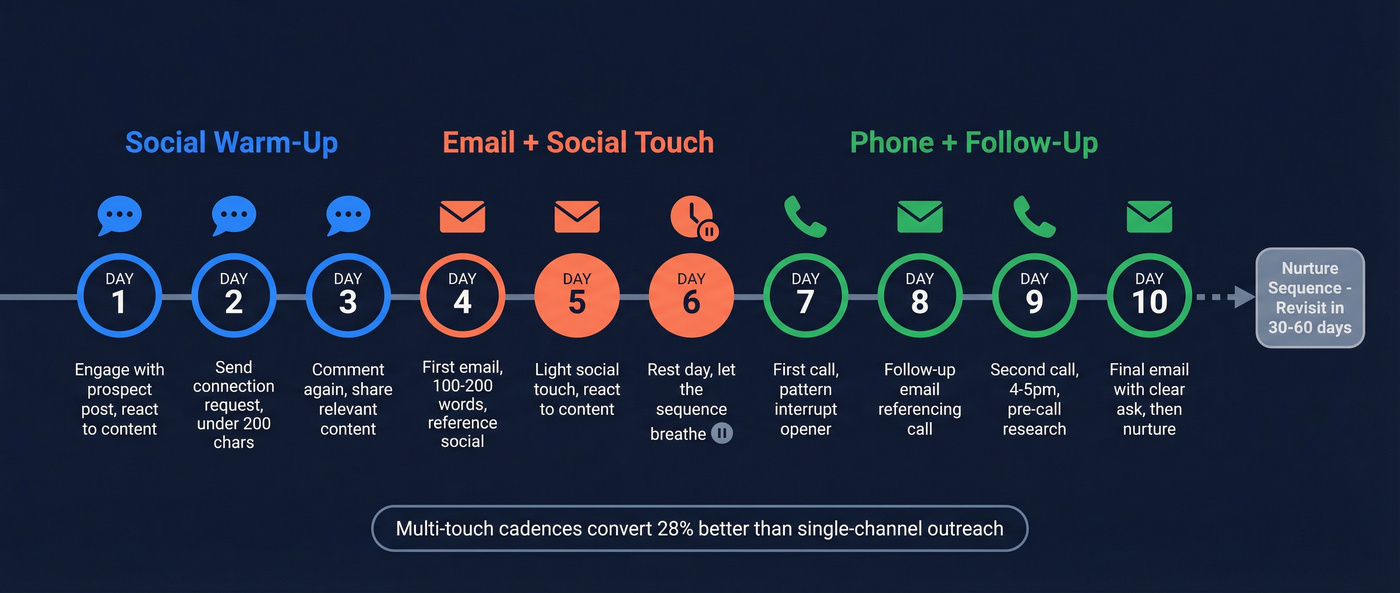
Days 1-3: Social Warm-Up
Day 1: Find your prospect's professional profile and engage with a recent post. Leave a substantive comment - not "Great post!" but something that shows you actually read it. React to two or three other pieces of their content.
Day 2: Send a connection request. Keep it under 200 characters. Requests in the 150-175 character range see 25% higher acceptance rates. Don't pitch. Reference something specific: a post they wrote, a mutual connection, a company milestone.
Day 3: Engage again. Comment on another post or share something relevant to their industry and tag them. The goal is simple: make your name familiar enough that when they see your email or hear your voice, there's a flicker of recognition.
Days 4-6: Email + Social Touch
Day 4: Send your first email. Keep it between 100 and 200 words. Personalized subject lines are 26% more likely to be opened, and personalized body copy boosts response rates by 112%. Reference the social engagement - "I noticed your post about X" is a natural bridge.
Day 5: React to their content or comment on a company update. Keep it light.
Day 6: Rest day. Let the sequence breathe.
Days 7-10: Phone + Follow-Up
Day 7: First call. Verify the email and phone number before you dial - doing this in bulk saves hours of wasted effort. Open with a pattern interrupt, not "Is this a good time?" Reference your prior touchpoints: "I sent you a note earlier this week about [topic] - wanted to put a voice to the name."
Day 8: Follow-up email referencing the call. If you got voicemail, reference that: "Left you a quick voicemail - here's the 30-second version in writing."
Day 9: Second call attempt. Afternoons between 4-5pm work best. Spend 5 minutes researching before every dial - check recent company news, their latest posts, any job changes. Following up within 5 minutes of a web lead engaging boosts qualification odds by 8x.
Day 10: Final touch - a short, direct email with a clear ask. If there's no response after 10 days of multi-channel outreach, move the prospect to a nurture sequence and revisit in 30-60 days. Companies that excel at lead nurturing generate 50% more sales-ready leads at 33% lower cost, so the nurture sequence isn't a graveyard - it's a pipeline.
Phone Mistakes That Kill Connects
Even with a warm social foundation, bad phone habits will tank your results. We see these five constantly.
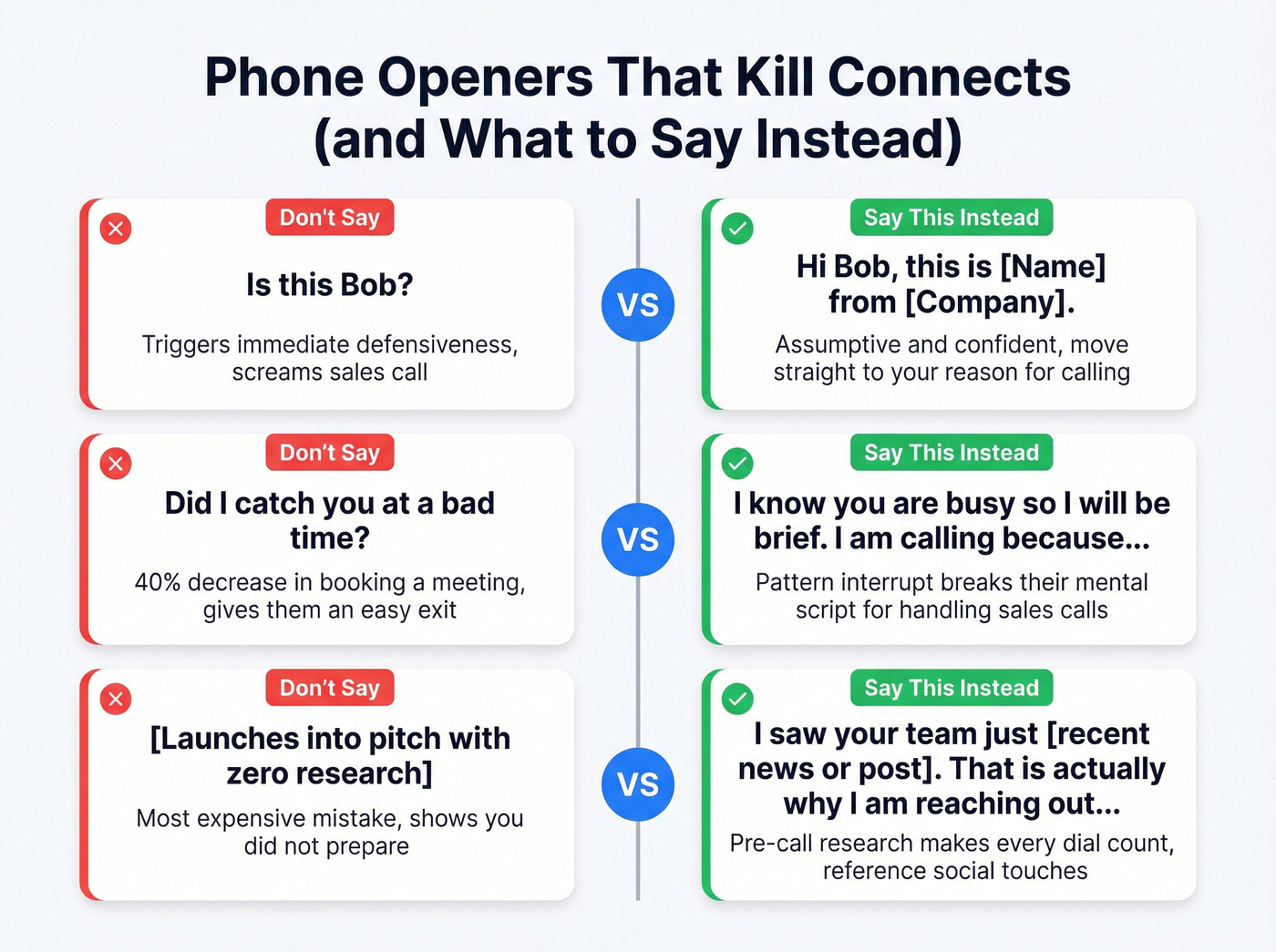
"Is this Bob?" triggers immediate defensiveness. The prospect knows it's a sales call before you finish the sentence. Go assumptive and confident instead: "Hi Bob, this is [Name] from [Company]." Move straight into your reason for calling.
"Did I catch you at a bad time?" decreases your chance of booking a meeting by 40%. You're giving them an easy exit. Try: "I know you're busy, so I'll be brief. I'm calling because..." Pattern interrupts work because they break the prospect's mental script for handling sales calls.
Skipping pre-call research is the most expensive mistake. Check recent company news, the prospect's role, and their latest social activity. Reps who explain why they're calling see 2.1x higher success rates.
Pitching the product on a cold call is a losing move. You're not closing a deal - you're selling a meeting. Use the 3-minute call strategy: minute one for your intro and value prop, minute two for qualifying questions, minute three for proposing a next step.
Talking too much kills engagement. Aim for a 40/60 talk-to-listen ratio. Successful calls average 5:50 in duration - nearly double the failed call average of 3:14. Longer calls mean the prospect is engaged. You can't get there by monologuing.
Tools for Hybrid Outreach
You don't need a massive tech stack. Four categories, and you probably already have half of them.
Data & Verification: Prospeo - this is your foundation. Without verified emails and phone numbers, every other tool in the stack underperforms. Starts free with 75 emails/month, paid plans at roughly $0.01/email. If you're comparing options, start with an email validator and a phone validator.
Sequencing: Salesloft runs ~$125-175/user/month and handles multi-channel cadences well. Apollo offers a free tier with paid plans from ~$49-99/user/month - solid for teams that want prospecting and sequencing in one platform. If you want more options, these cold email marketing tools and sales prospecting platforms are a good starting point.
Dialers: Orum and Nooks are the two parallel dialers worth evaluating, typically ~$150-300/seat/month. They're expensive but pay for themselves if your team makes 100+ dials daily. Skip this category if your team dials fewer than 50 calls a day - a regular phone and a good CRM will do. If you're tightening your call process, use a cold call checklist and a pre-call research checklist.
Social: You don't need a social selling tool. You need 15 minutes and a browser. Manual engagement is more authentic and more effective than any automation. If budget allows, Sales Navigator at ~$100/seat/month helps with targeting, but it's not required to run this playbook. For a deeper system, follow a social selling strategy and consider social listening for sales.
FAQ
Is cold calling dead in 2026?
No. Top performers convert 5-8% of calls into meetings, roughly 3x the average. The channel isn't dead; bad data and zero preparation are what kill it. Combine calls with social warm-up and you'll consistently outperform single-channel callers.
How do cold calling and social selling work together?
Social engagement builds name recognition so your call isn't truly cold. Three to five days of light interaction - commenting, connecting, reacting - shifts the conversation from stranger to familiar name. Two or three genuine touches before dialing is enough to roughly double connect rates.
What's the fastest way to verify contacts before a hybrid cadence?
Upload your list to Prospeo's bulk verification, which checks emails at 98% accuracy and phone numbers across 125M+ verified mobiles together. Results return in minutes on a 7-day refresh cycle, so you're pushing only live contacts into your sequencer instead of burning dials on stale records.
Do I need separate tools for cold calling and social selling?
No. Most teams run a hybrid cadence with three tools: a data platform for verified contacts, a sequencer like Salesloft or Apollo for multi-channel workflows, and a browser for manual social engagement. A parallel dialer is optional unless your team exceeds 100 dials per day.