Prospect Pain Points: How to Find & Use Them in 2026
84% of reps missed quota last year. Not because they couldn't demo. Not because the product was wrong. Because they walked into calls without understanding what actually hurts their prospects. And here's the kicker: 69% of buying decisions are already made before a prospect ever talks to sales, which means the window to uncover real pain is shrinking fast.
Every "pain point" article tells you to "ask open-ended questions." That's not a system. What follows: three frameworks to structure discovery, a 25+ question bank you can copy into your call prep, and a pre-call research method so you walk into every conversation with a pain hypothesis - not a blank slate. If you only read one section, read the Sandler Pain Funnel.
What Are Prospect Pain Points?
A prospect pain point is a specific problem costing your buyer time, money, reputation, or sanity - and that they're motivated enough to solve. Sandler Rule #34 puts it bluntly: no pain, no sale. If there's no real pain, there's no deal. Just a polite conversation that goes nowhere.
Pain points fall into five categories:
- Financial - budget pressure, wasted spend, revenue leakage
- Productivity - time lost to manual work, slow processes, bottlenecks
- Process - broken handoffs, redundant steps, lack of standardization
- Support - poor vendor responsiveness, inadequate training, missing documentation
- People - hiring struggles, retention issues, team morale, skill gaps
Most reps stop at the first category a prospect mentions. The best reps dig through all five until they find the one that actually drives a decision.
Three Levels of Pain
Not all pain is created equal. The Sandler methodology breaks buyer pain into three distinct levels, and understanding this hierarchy is what separates stalled deals from signed contracts.
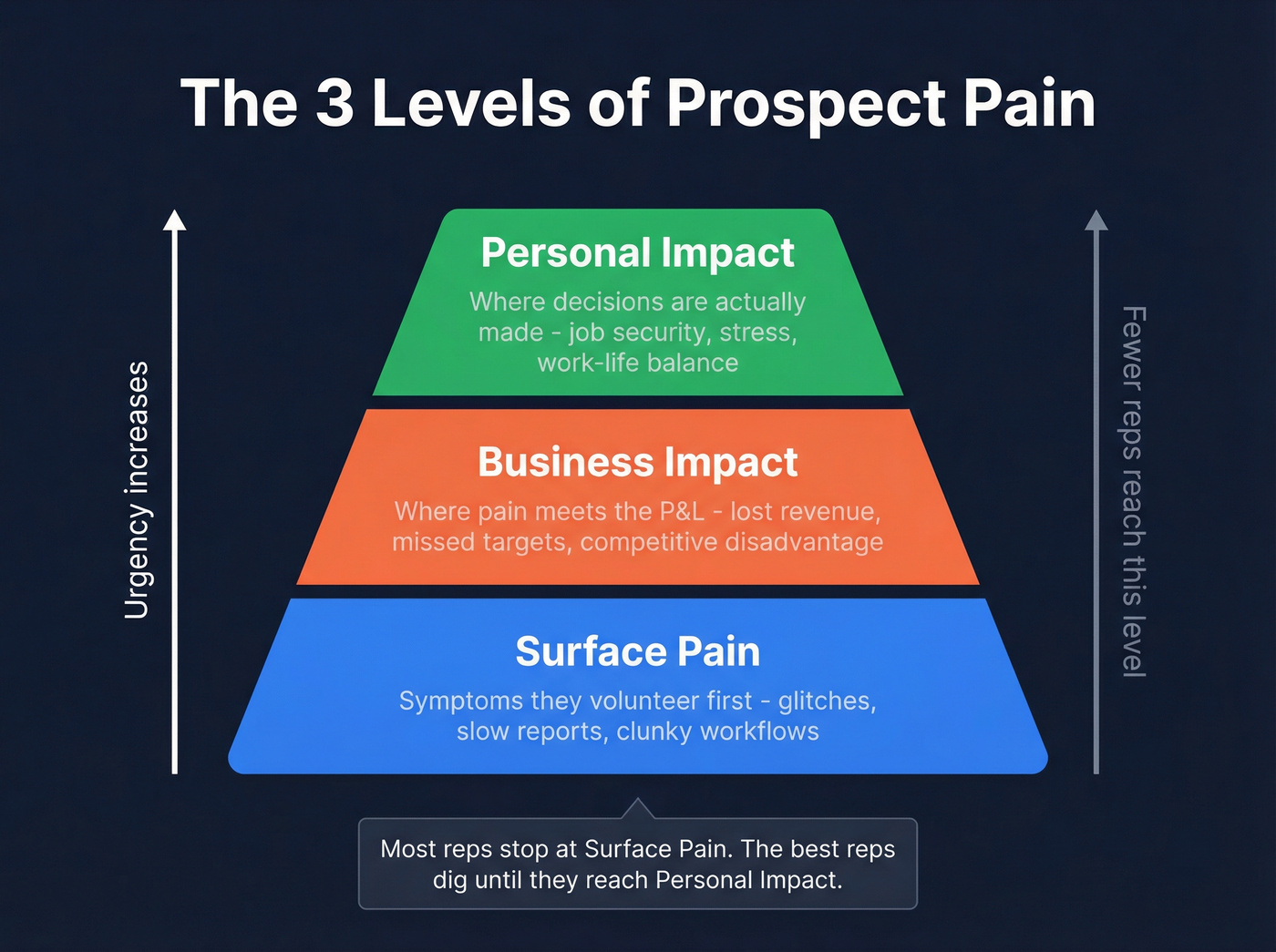
Surface pain is what prospects volunteer first. Glitches in their current tool. Slow reports. A clunky workflow. These are symptoms, not root causes - easy to talk about because they're low-stakes and impersonal.
Business impact is where surface pain meets the P&L. Lost revenue, missed targets, slower growth, competitive disadvantage. "What's the financial impact of those slow reports?" Now you're speaking the language of budget holders.
Personal impact is where decisions are actually made. Job security. Stress. The VP who can't make it to their kid's soccer game because they're manually fixing data every Friday night. This level feels uncomfortable to probe, but it's the emotional core that creates urgency. If you never get past surface pain, you're competing on features and price. If you reach personal impact, you're the rep who actually understood what's at stake.
Three Frameworks for Pain Discovery
SPIN Selling
Neil Rackham built SPIN after studying 35,000 sales calls. It stands for Situation, Problem, Implication, and Need-Payoff. The call flow: Opening (2 min) → Situation (5 min) → Problem (10 min) → Implication (10 min) → Need-Payoff (5 min) → Close (3 min). Notice that implication questions get as much airtime as problem questions. That's intentional.
Situation questions establish context - limit these to 3-5, because Rackham's research found that top performers ask fewer situation questions, not more. Problem questions surface the pain. Implication questions are the differentiator: you're quantifying consequences and connecting dots the prospect hasn't connected yet. Need-Payoff questions get the prospect to articulate value themselves. When they say the ROI out loud, they're selling themselves.
Here's the thing: the biggest SPIN mistake we see is reps treating it as a checklist instead of a conversation. They rapid-fire situation questions, skip implications entirely, and then answer their own need-payoff questions. That's not discovery. It's an interrogation followed by a pitch.
For more structure on discovery, see discovery calls and best open-ended sales questions.
Sandler Pain Funnel
David Sandler developed this in the late 1960s, and it's still the sharpest tool for drilling into a single problem until you hit emotional bedrock. Where SPIN explores broadly, the Sandler Pain Funnel goes deep on one thread.
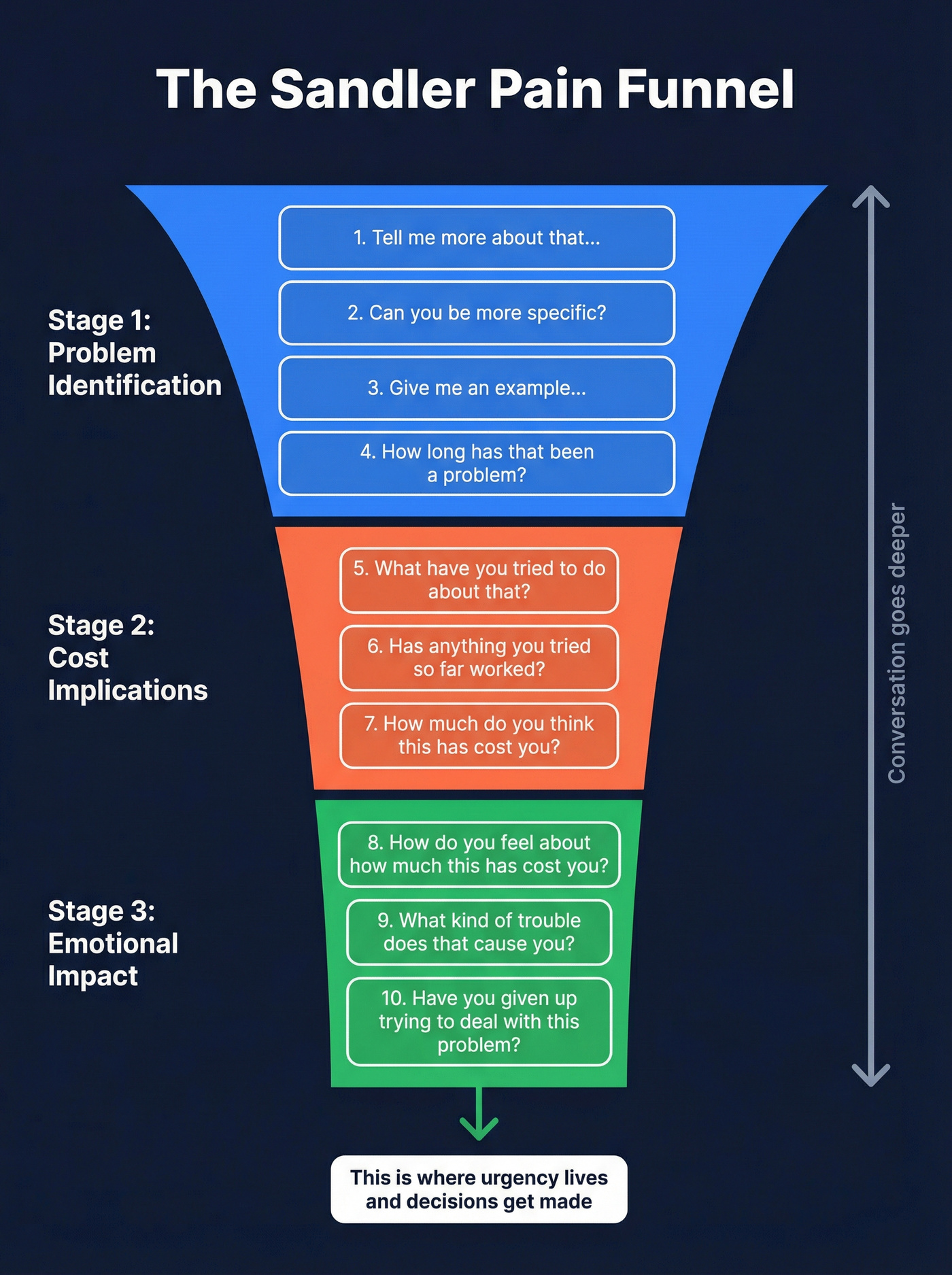
The sequence is fixed - ten questions across three stages:
Stage 1: Problem Identification
- "Tell me more about that..."
- "Can you be more specific?"
- "Give me an example..."
- "How long has that been a problem?"
Stage 2: Cost Implications 5. "What have you tried to do about that?" 6. "Has anything you've tried so far worked?" 7. "How much do you think this has cost you?"
Stage 3: Emotional Impact 8. "How do you feel about how much this has cost you?" 9. "What kind of trouble does that cause you?" 10. "Have you given up trying to deal with this problem?"
By question 8, you're no longer talking about software or processes - you're talking about how this person feels. That's where urgency lives. One critical tip: keep the tone conversational. These questions turn manipulative fast if delivered robotically. Use permission language when shifting to emotional territory - "Would it be okay if I asked how this has affected you personally?" goes a long way.
MEDDIC
MEDDIC is the enterprise-grade qualification framework. In 2026, the average B2B deal involves 13 stakeholders. If you're selling six-figure deals with that many people and a 6-month sales cycle, MEDDIC is your operating system.
The acronym: Metrics, Economic Buyer, Decision Criteria, Decision Process, Identify Pain, Champion. The two categories that matter most for pain discovery are Metrics (forcing the prospect to put numbers on the pain) and Identify Pain (mapping who else feels it and whether it's getting worse).
Skip MEDDIC for a 15-minute discovery call with a mid-market prospect. It shines when you're navigating complex buying committees and need to map pain across multiple stakeholders. If you want a deeper comparison, see MEDDIC vs MEDDPICC and account qualification.
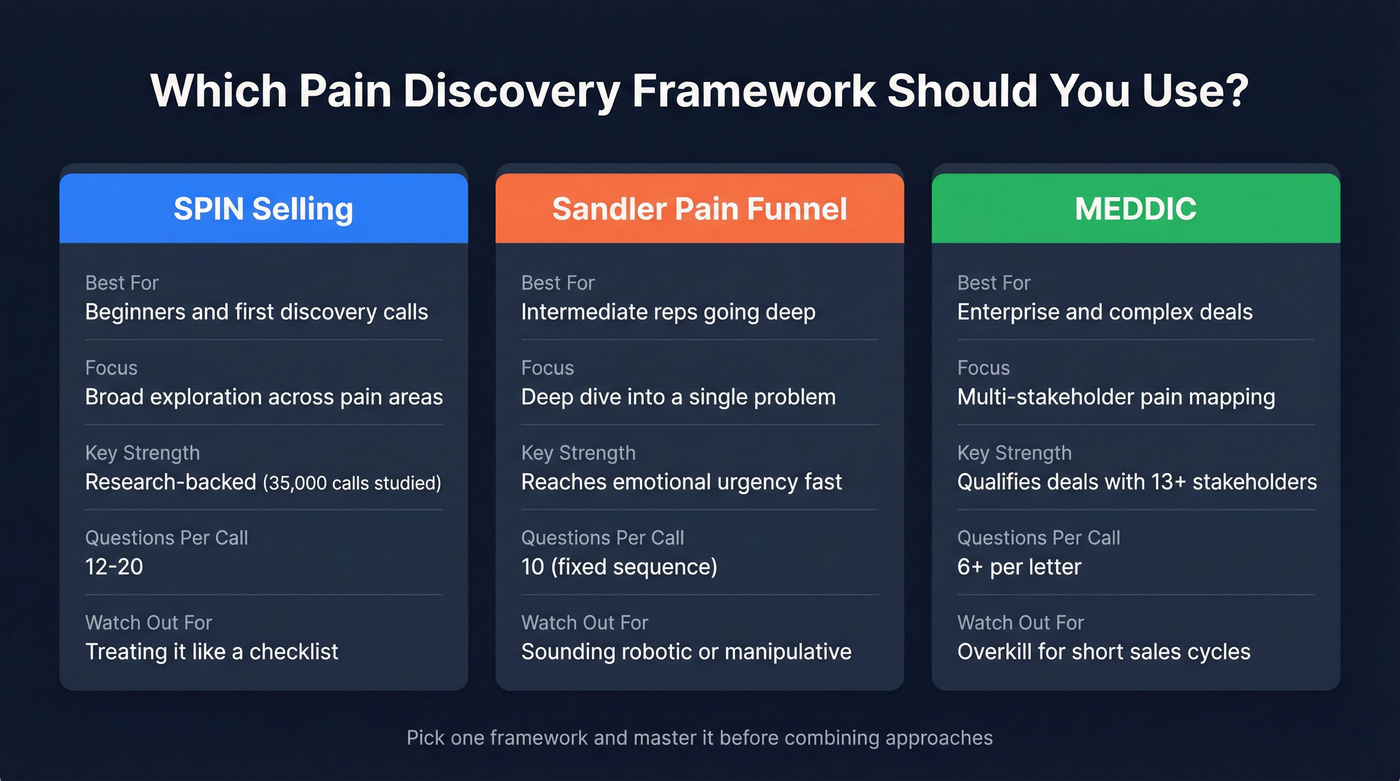
Framework Comparison
| SPIN | Sandler | MEDDIC | |
|---|---|---|---|
| Best for | Beginners | Intermediate | Enterprise |
| Focus | Broad exploration | Deep single-problem | Multi-stakeholder |
| Key strength | Research-backed | Emotional urgency | Deal qualification |
| Questions/call | 12-20 | 10 (fixed) | 6+ per letter |
Inconvenience vs. Problem
Lee Salz draws a distinction that saves deals: an inconvenience is an annoyance people live with; a problem triggers action and investment. Most stalled deals die in the gap between the two.
Think of it as a hierarchy of needs for your buyer. A director of sales ops might see broken data as a burning problem. Their VP sees it as an inconvenience they've lived with for three years. 89% of B2B buyers report a deal stalling in the past year, and misaligned pain perception between stakeholders is one of the top reasons why. Your job isn't just to uncover pain - it's to help your champion reframe the inconvenience as a problem for the people above them.
Ask directly: "Do your colleagues view this as an inconvenience or a problem?" That single question reveals whether you have organizational buy-in or just one frustrated manager.
If you're dealing with stalled deals, map this to your sales pipeline challenges and closed lost analysis.

You just learned how to uncover pain before the call. But a pain hypothesis is only useful if you can reach the right person. Prospeo gives you 98% accurate emails and verified direct dials for 300M+ professionals - so your pre-call research turns into actual conversations, not bounced emails.
Stop researching prospects you can never reach. Start with verified contact data.
25+ Discovery Questions by Pain Level
Copy these into your call prep doc and pick 8-12 per conversation. They're organized by pain level - use the framework abbreviations to match your preferred methodology.
Surface-Level
- "What challenges are you facing with [current process/tool]?" - SPIN
- "What made you say yes to this meeting?"
- "Tell me more about that..." - Sandler
- "Can you be more specific? Give me an example." - Sandler
- "How long has that been a problem?" - Sandler
- "When specifically does this come up?"
- "What's frustrating about how you're doing this today?" - SPIN
- "What would you change if you could wave a magic wand?"
Business Impact
- "What's the financial impact of this issue?" - Sandler
- "How much do you think this has cost you?" - Sandler
- "What have you tried to do about it? Has anything worked?" - Sandler
- "What happens if you don't fix this in the next six months?" - SPIN
- "How does this affect your team's ability to hit quota?" - SPIN
- "Which KPIs does this impact most directly?" - MEDDIC
- "Is the problem getting worse over time?"
- "Who else on your team is affected by this?"
- "Do your colleagues view this as an inconvenience or a problem?"
Personal Impact
- "How do you feel about how much this has cost you?" - Sandler
- "What kind of trouble does that cause you?" - Sandler
- "Have you given up trying to deal with this problem?" - Sandler
- "How is this situation affecting you personally?"
- "If you had those 10 hours back each week, what would you do with them?" - SPIN
- "How would solving this change your day-to-day?"
- "What does success look like for you specifically - not the company, you?"
- "If this project succeeds, what does that mean for your role?" - MEDDIC
Don't ask all of these. Let the prospect's answers guide which thread you pull next.
How to Research Pain Before the Call
Discovery calls should confirm pain you've already hypothesized, not start from zero. 81% of buyers already have a preferred vendor at first contact. If you're not shaping their pain perception early, you're already behind.
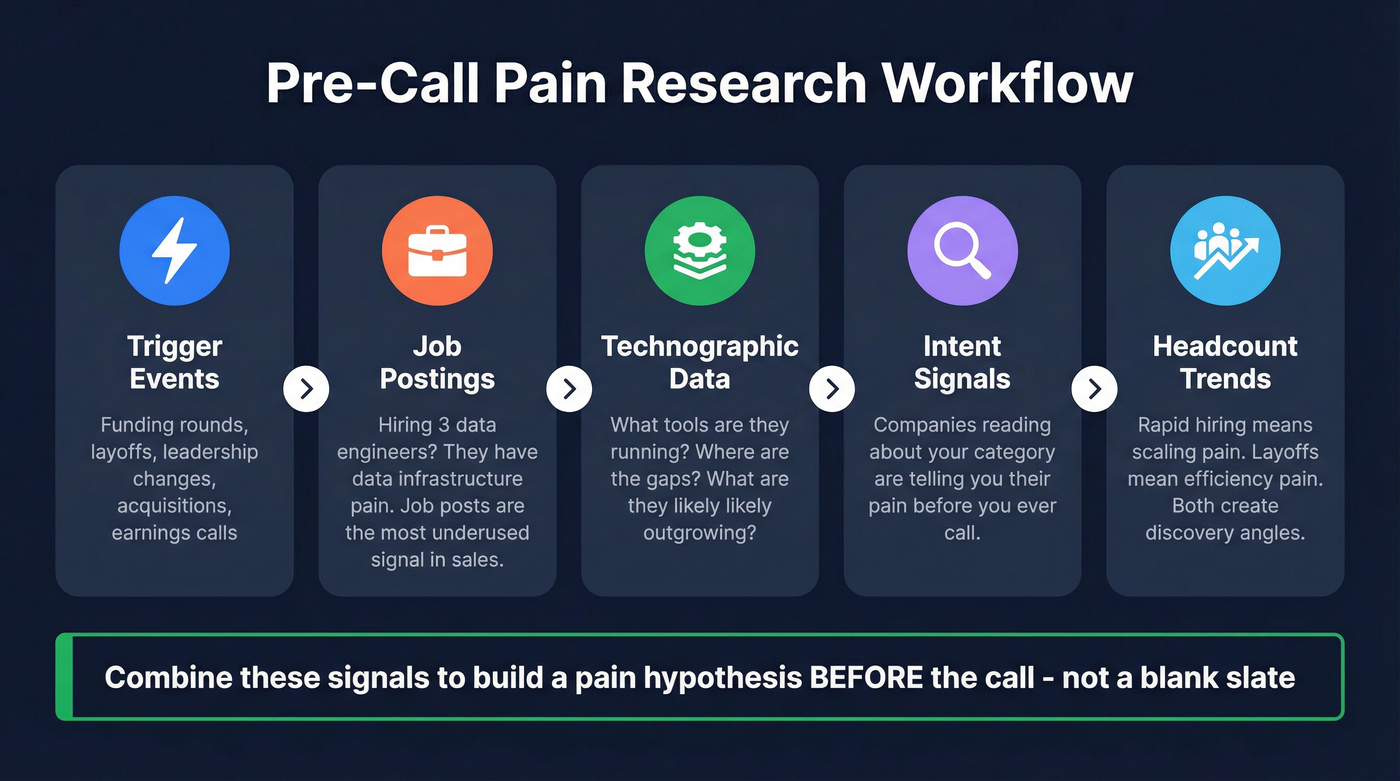
Start with trigger events - funding rounds, layoffs, leadership changes, acquisitions, earnings calls. Each signals a shift in priorities and potential new pain. Then check job postings. If a company is hiring three data engineers and a RevOps manager, they're dealing with data infrastructure pain. Job posts are the most underused research signal in sales.
Layer in technographic data to understand what tools they're running and where the gaps are. Check intent signals - companies reading about "email verification" or "sales data accuracy" are telling you their pain before you ever pick up the phone. Track headcount trends too: rapid hiring means scaling pain, layoffs mean efficiency pain, and both create clear discovery angles. When you combine these signals, you can identify buyer challenges with surprising accuracy before anyone picks up the phone.
Prospeo's B2B database makes this workflow concrete - filter by buyer intent across 15,000 Bombora topics, layer in technographic data and headcount growth signals, then get 98% verified emails for the contacts you find. Instead of guessing who might have pain, you're building lists of prospects already showing buying signals.

80% of B2B sales interactions now happen through digital channels. Your prospects are leaving breadcrumbs everywhere. The reps who read those signals before the call are the ones who reach personal-impact questions by minute 15 instead of still asking "so what does your company do?" at minute 10. Use a pre call research checklist to make it repeatable.
Using Pain Points in Cold Email
The best pain-based outreach follows a simple structure: 3-5 pain points per persona, one solution mapped per pain, and emails under 50 words. The challenges a VP of Sales cares about are different from the ones a CTO loses sleep over, even at the same company.
Compare these two approaches:
Before (generic):
"Hi Sarah, I'd love to show you how our platform can help your team. We work with companies like yours to improve sales efficiency. Would you be open to a quick call?"
After (pain-specific):
"Sarah - saw you're hiring 3 SDRs while your team's running on [competitor tool]. If bounce rates are eating into their ramp time, we cut that to under 4% for teams your size. Worth 15 min?"
The second email works because it references a real signal (hiring), names a specific pain (bounce rates during ramp), and quantifies the outcome. It's 42 words. It doesn't ask for permission to exist. In our experience, pain-specific emails like this outperform generic ones by 3-4x on reply rates.
Before you send pain-based emails, verify your contact data. A perfectly crafted message bouncing off a dead email is worse than no email at all - and it torches your domain reputation in the process. If you're building sequences, start with a proven outreach email template and tighten deliverability with email verification for outreach.
The Sandler Pain Funnel works when you're talking to the right stakeholder. Prospeo's 30+ search filters - including buyer intent, job changes, and department headcount - let you identify who's feeling the pain right now, not six months ago. Data refreshes every 7 days, so you're always reaching people in their current role with their current problems.
Find the stakeholder with the burning problem, not the one who left last quarter.
Five Discovery Mistakes That Kill Deals
1. Skipping to pitch before diagnosis. You wouldn't trust a doctor who prescribed medication before asking about symptoms. We've watched reps lose six-figure deals by jumping to a demo after two surface-level questions. Finish discovery before you open a single slide.
2. Rapid-fire situation questions. "How many reps do you have? What CRM? What's your tech stack?" Five questions in 90 seconds feels like an interrogation. Space them out. React to answers. Be human.
3. Answering your own need-payoff questions. "If you could save 10 hours a week, that'd be huge, right?" You just robbed the prospect of the chance to articulate value in their own words. Ask the question. Then shut up.
4. Too many "why" questions. "Why haven't you fixed this?" sounds accusatory. Swap for "what" and "how" - "What's prevented you from addressing this so far?" Same information, zero defensiveness.
5. Treating discovery as a one-call event. Pain evolves. New stakeholders surface. Priorities shift. Your prospect's pain in January might look completely different by March. Build discovery into every call, not just the first one.
Let's be honest: if your average deal size is under $10k, you probably don't need a 45-minute MEDDIC-style discovery process. A tight 15-minute Sandler Pain Funnel will get you to emotional urgency faster than any enterprise framework. Match the depth of your discovery to the size of the deal.
FAQ
What are the main types of prospect pain points?
The five core categories are financial (budget pressure, wasted spend), productivity (time lost, inefficient workflows), process (broken handoffs, manual steps), support (poor vendor responsiveness), and people (hiring, retention, team morale). Most deals stall because reps only explore one category instead of all five.
How do you uncover pain on a discovery call?
Use a structured framework like SPIN Selling or the Sandler Pain Funnel. Start with broad situation questions, drill into specific problems, quantify business impact, then explore personal consequences. Moving from surface symptoms to the emotional core is where buying decisions happen - aim to reach personal-impact questions by minute 15.
How do you research buyer pain before a call?
Monitor trigger events like funding rounds, layoffs, and leadership changes. Check job postings for recurring challenges. Layer in technographic and intent data - tools like Prospeo's B2B database let you filter by 15,000 Bombora intent topics and headcount growth, so you walk in with a pain hypothesis instead of a blank slate.
What's the difference between an inconvenience and a real pain point?
An inconvenience is an annoyance people tolerate indefinitely; a real pain point triggers action and budget allocation. 89% of B2B deals stall partly because stakeholders disagree on which category their problem falls into. Ask "Do your colleagues view this as an inconvenience or a problem?" to gauge organizational buy-in.