

Business Decision Makers: How to Find and Reach Them in 2026
You just lost a deal you thought was closed. The champion loved you, the demo crushed, the proposal was signed - and then someone from procurement you'd never spoken to killed it in week eleven. This happens because the average B2B buying decision now involves 8.2 stakeholders, and 86% of B2B purchases stall at some point in the process. If you're still single-threading to one contact and hoping they'll sell internally for you, you're playing a game you can't win.
Reaching the right business decision makers - all of them - is the only reliable path to closed-won.
The Quick Version
The modern buying committee isn't one person with a budget. It's 8-13 people with competing priorities. Here's the shortcut:
- Map six roles for every deal: champion, economic buyer, technical buyer, end users, executive sponsor, and legal/compliance.
- Get verified contact data for each. Stale emails and switchboard numbers won't cut it - you need direct dials and confirmed addresses.
- Run multichannel outreach tailored by role. The CFO gets an ROI pitch. The technical buyer gets an integration pitch. The end users get a usability pitch.
- Prioritize in-market accounts. Intent data tells you who's researching solutions right now, so you're not cold-calling into indifference.
What Is a Business Decision Maker?
A business decision maker is anyone with the authority to approve, block, or materially influence a purchase. That's the clean definition. Here's where most sales content gets it wrong: they treat "decision maker" as a single person. It's not. It's a role within a buying committee, and multiple people can hold decision-making power at different stages of the deal.
Don't confuse the terms. A stakeholder is anyone affected by the purchase. An influencer shapes the committee's opinion without owning the outcome. A decision maker has actual authority over whether the deal moves forward. The buying committee is the full group - decision makers, influencers, and stakeholders combined. In B2B, you're never selling to just one of these.
The Buying Committee by the Numbers
The days of selling to a single VP are over. The data makes this painfully clear.
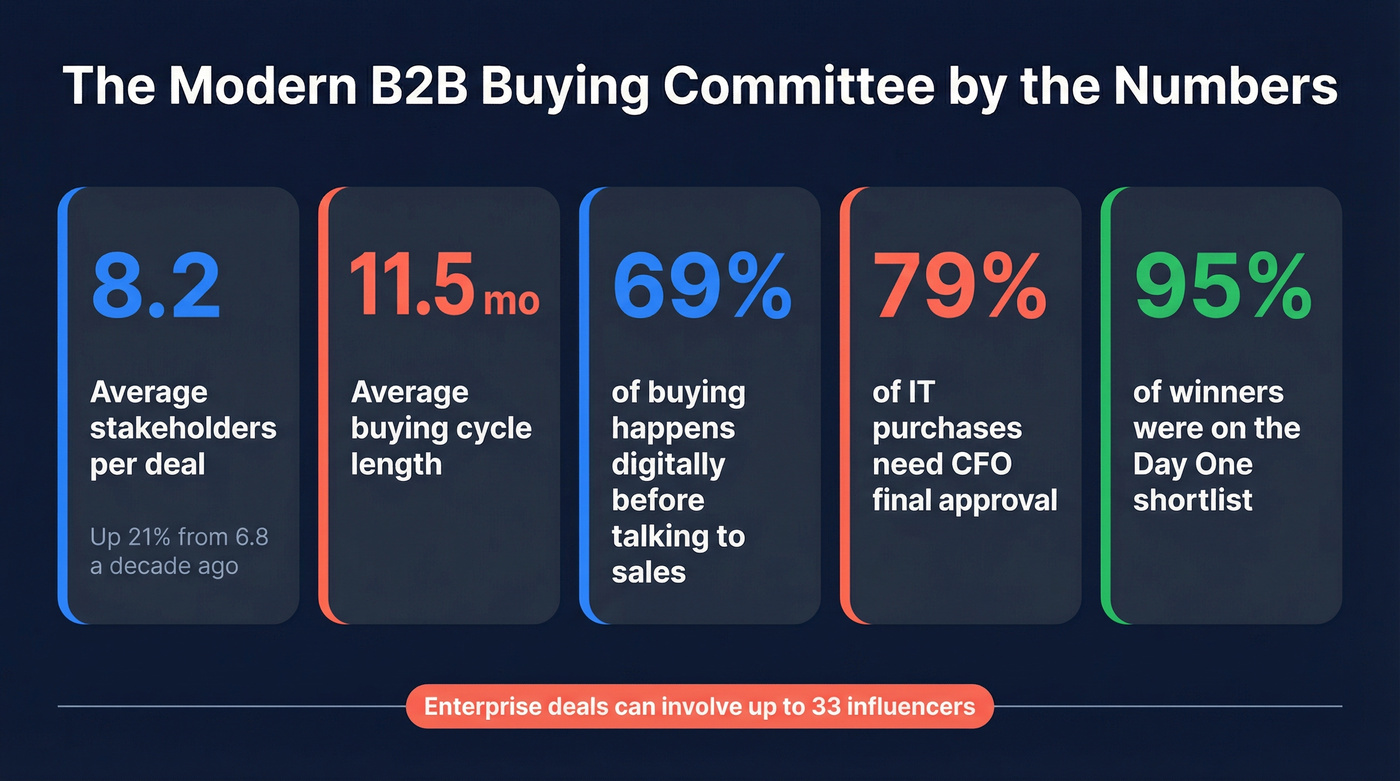
The average B2B buying group involves 8.2 stakeholders - up 21% from 6.8 a decade ago. Some sources put the number even higher: one compilation pegs it at 13 people for complex purchases. For technology purchases specifically, buying groups average 25 people (13 from IT, 12 from lines of business). Enterprise orgs? Thirty-three influencers. And 44% of all software decisions are now made by committee, rising to 71% in enterprise organizations.
The approval chain adds friction at every stage. 79% of IT and software purchases require CFO final approval, and 61% of software deals get slowed or blocked by legal and compliance teams. The average buying cycle runs 11.5 months.
Buyers aren't waiting for you, either. 69% of the buying process happens digitally before a prospect ever talks to sales. 81% have already decided on a preferred vendor before the first meeting. And 94% of B2B buyers now use AI tools during their research process, with 29% starting their research with AI tools more often than search engines. Your prospects are more informed, more skeptical, and more committee-driven than they've ever been.
Here's the stat that should keep you up at night: 95% of the time, the winner is on the buyer's Day One shortlist. If you're not in the conversation early, you're probably not in it at all.
Types of Decision Makers to Map
You'll see other guides categorize corporate decision makers by personality type - "brand-centric," "risk-taker," "aggregator," "cautious." That's interesting for a psychology class, but useless in a live deal. You can't filter a database by "cautious buyer." What matters is the function each person plays in the buying committee. Here's the framework we use, illustrated with a cybersecurity tool purchase.
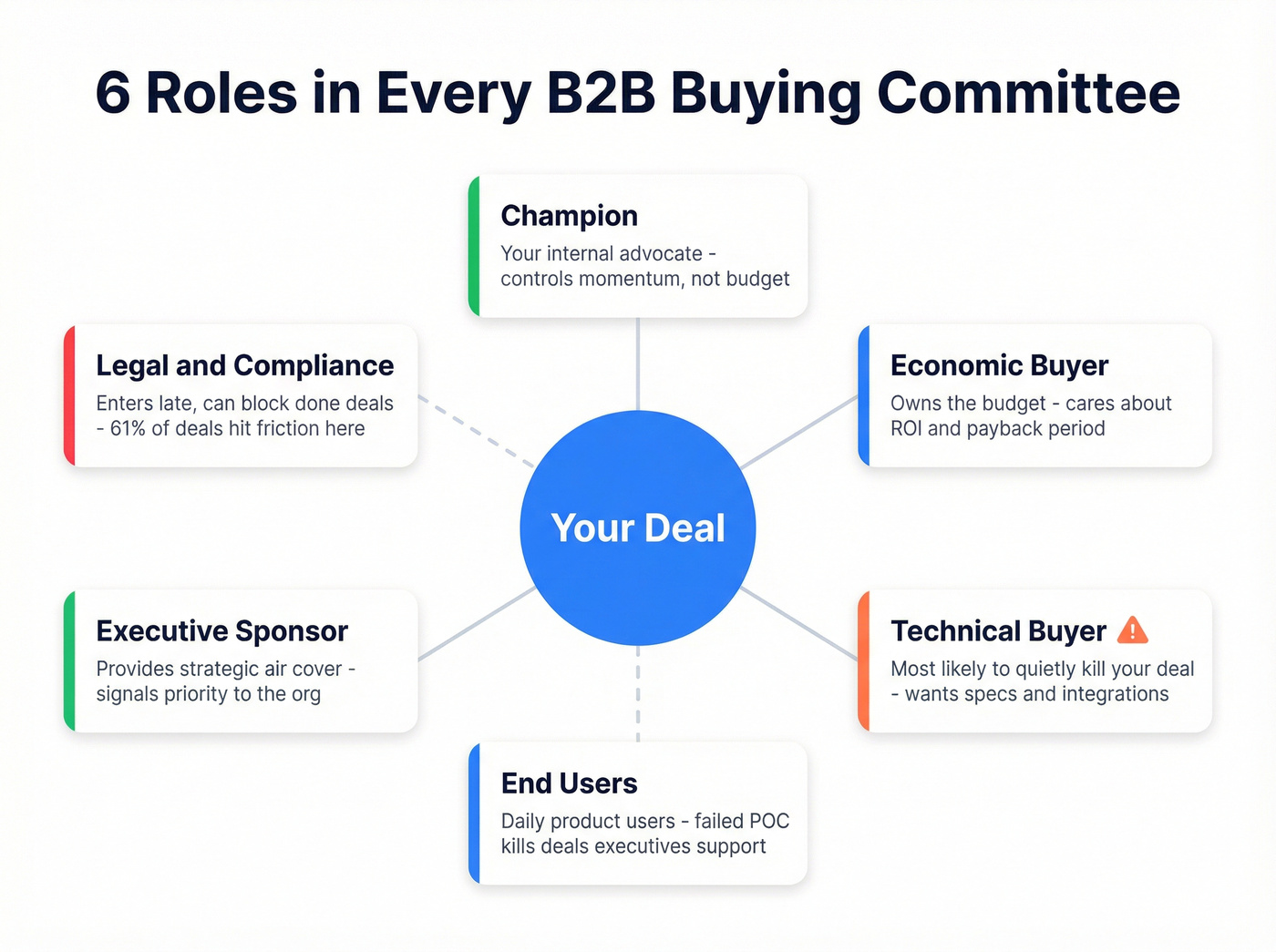
Champion
Your internal advocate - the person who discovered you, believes in your solution, and sells for you when you're not in the room. In our cybersecurity example, this is the CISO who identified the gap in the security stack. Champions rarely control budget, but they control momentum.
Economic Buyer
The person who owns the budget and cares about ROI, TCO, and payback period. Usually the CFO or a finance leader. If you can't articulate the financial case in two sentences, you'll lose this person before they finish reading your email.
Technical Buyer
Warning: this is the person most likely to kill your deal quietly. The technical buyer digs into specs, integration requirements, and compatibility. For our cybersecurity purchase, this is the CTO asking whether your tool plays nicely with their existing SIEM and cloud infrastructure. They're looking for reasons to say no - give them documentation before they have to ask.
End Users
The security analysts who'll actually use the product daily. Their collective influence is enormous. A failed POC driven by poor usability can kill a deal that every executive supports. Don't underestimate this group.
Executive Sponsor
The CEO or senior VP who provides strategic air cover. They won't attend every meeting, but their endorsement signals priority to the rest of the organization. Without an executive sponsor, deals drift into the "nice to have" pile and die there.
Legal & Compliance
The team that reviews contracts, data handling, and regulatory requirements. They enter late and can delay or block deals that are otherwise done. 61% of software deals hit friction here - plan for it by sending your security questionnaire and DPA proactively.
If you use MEDDIC or MEDDPICC, this maps directly: if you can't name your champion and economic buyer, you don't have a qualified deal.

You just mapped 6 roles per deal. Now you need verified contact data for each one. Prospeo gives you 98% accurate emails and 125M+ verified mobile numbers across 300M+ profiles - with 30+ filters to pinpoint champions, economic buyers, and technical evaluators by title, department, seniority, and intent signals.
Stop single-threading. Reach every decision maker in the buying committee.
How to Identify the Right Decision Makers
Finding the right people starts before you ever open a prospecting tool.
Build decision-maker personas, not title lists. Define each role by function, seniority, and department. "Director+ in finance who owns software budget approval" is useful. "CFO" alone is too broad for large orgs and too narrow for small ones.
Map accounts with your champion. Once you have an internal advocate, ask them directly: "Who else needs to sign off? Who could block this?" Champions know the org chart politics that no database captures. This is the single highest-leverage activity in complex sales - nothing else comes close.
Research the organization. 10-K filings, press releases, and recent leadership hires reveal reporting structures and strategic priorities. If a company just hired a new CRO, that person is rebuilding the stack - and they're someone you need to reach.
How to Find Verified Contact Data
You've mapped the buying committee. You know the six types of decision makers. Now you need working emails and phone numbers for each person - and this is where most outbound operations quietly fall apart.
Roughly 28% of B2B emails become invalid every year due to job changes, company restructuring, and role shifts. A list you built three months ago already has dead addresses in it. Bounce rates above 5% damage your sender domain reputation, and once that's burned, even your good emails land in spam.
We've seen this pattern play out with our own outbound: teams rewrite sequences three times before realizing the list was the problem all along. The data has to be right first. Everything else is downstream.
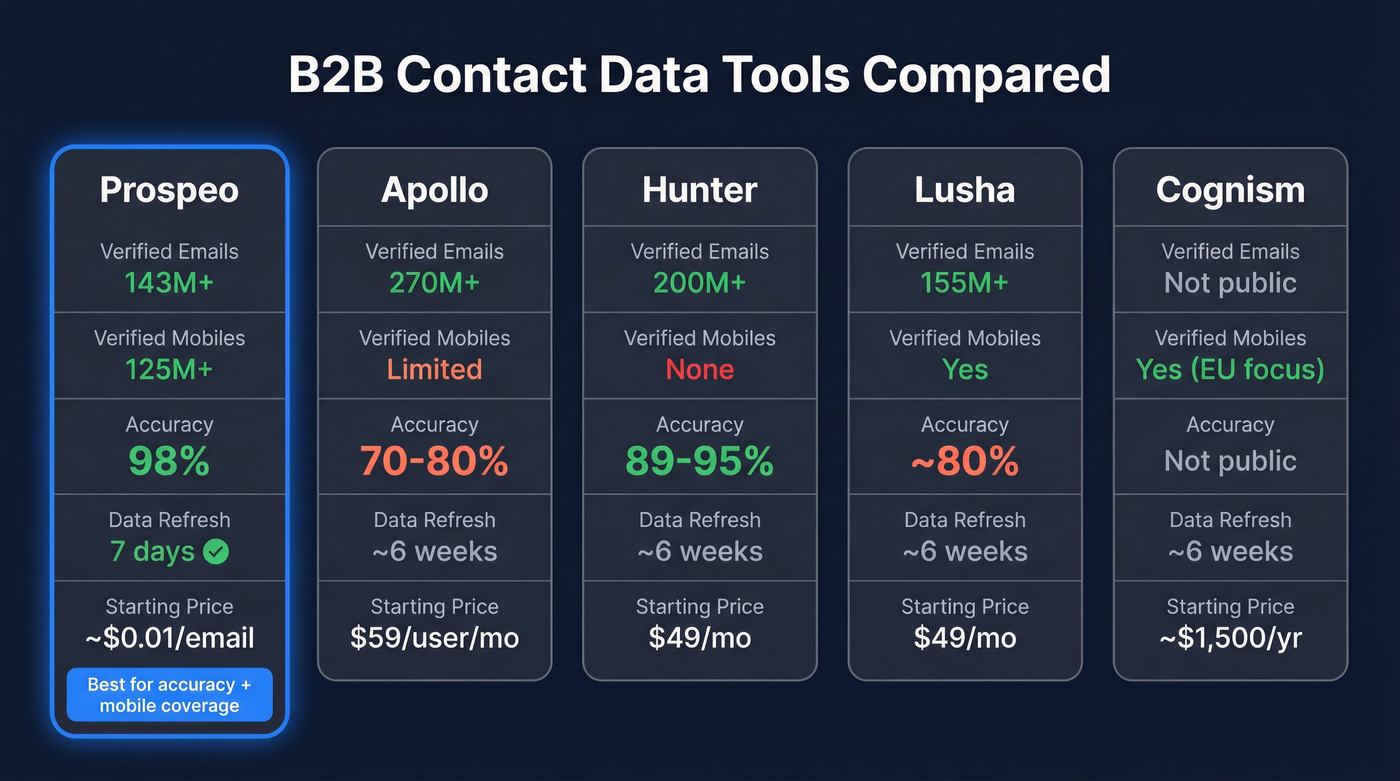
Prospeo's leads database covers 300M+ professional profiles, 143M+ verified emails at 98% accuracy, and 125M+ verified mobile numbers with a 30% pickup rate. The key difference is a 7-day data refresh cycle - while most providers refresh around every 6 weeks, weekly refresh means the data you pull today is still accurate next week. Search with 30+ filters including buyer intent, technographics, job changes, and headcount growth to find exactly the people you mapped. Here's how the main options compare:
| Tool | Verified Emails | Verified Mobiles | Accuracy | Free Tier | Starting Price | Best For |
|---|---|---|---|---|---|---|
| Prospeo | 143M+ | 125M+ | 98% | 75 emails/mo | ~$0.01/email | Accuracy + mobile coverage |
| Apollo | 270M+ contacts | Limited | 70-80% | 75 credits/mo | $59/user/mo | Raw database size |
| Hunter | 200M+ contacts | No | 89-95% | 25 searches/mo | $49/mo | Email-only workflows |
| Lusha | 155M+ profiles | Yes | ~80% | 40 credits/mo | $49/mo | Quick lookups |
| Cognism | Not public | Yes (EU focus) | Not public | No | ~$1,500/yr | EU mobile numbers |
Apollo has the largest raw database, but accuracy in the 70-80% range means you're bouncing one in four or five emails. Hunter doesn't offer mobile numbers at all, which kills your phone outreach. Cognism is strong for European mobile coverage but requires an annual commitment. Skip Cognism if you're primarily targeting North American accounts - you're paying a premium for EU-focused data you won't use.
95% of the time, the winner is on the buyer's Day One shortlist. Prospeo's intent data tracks 15,000 topics so you know which accounts are actively researching solutions right now - then gives you verified direct dials and emails for every stakeholder in the committee, refreshed every 7 days.
Get on the shortlist before your competitors do.
How to Reach Decision Makers
Having the right data is half the battle. The other half is using it intelligently across channels.
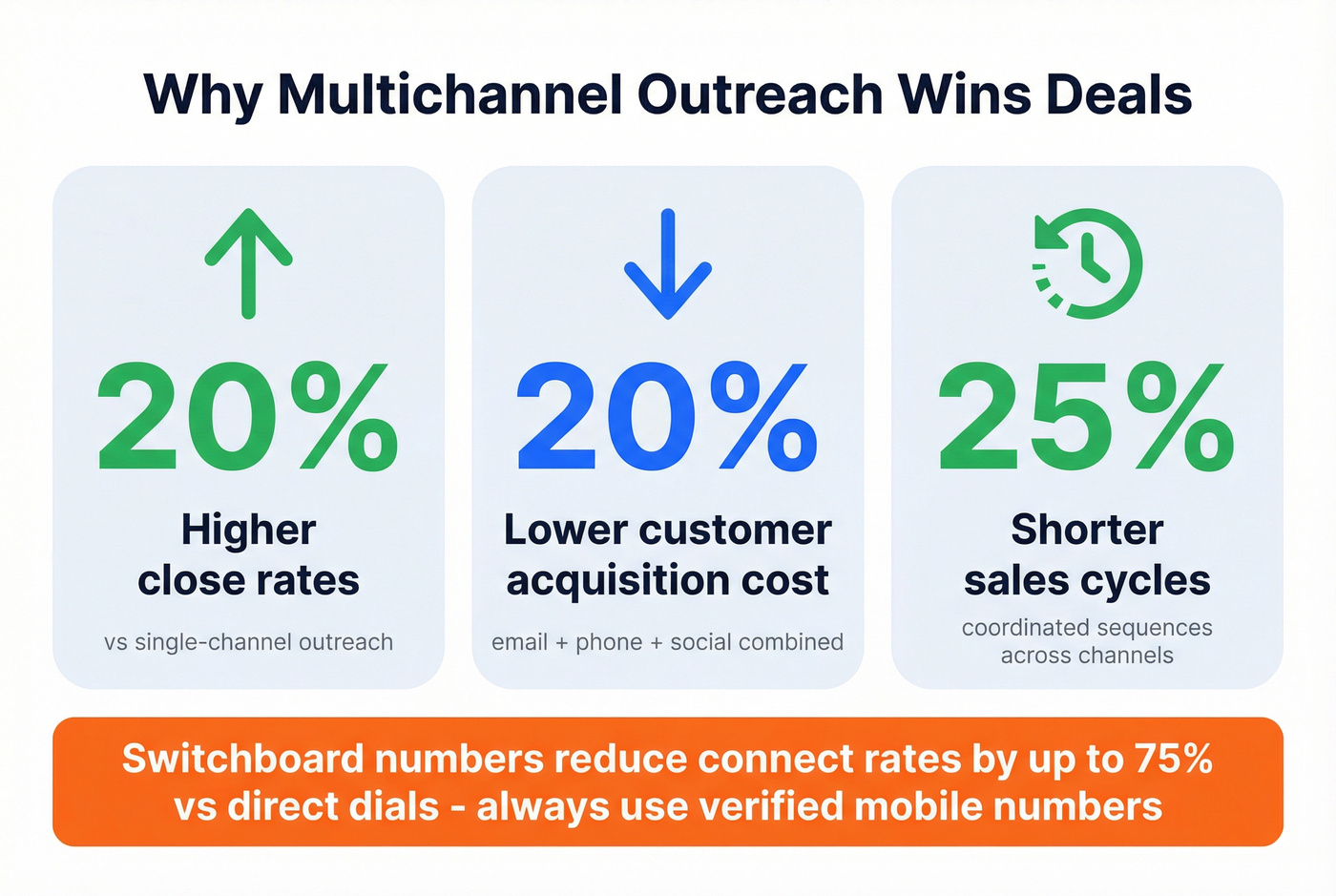
Multichannel outreach - email, phone, and social touches in a coordinated sequence - delivers 20% higher close rates, 20% lower CAC, and 25% shorter sales cycles compared to single-channel approaches. That's not marginal. That's the difference between a team that hits quota and one that doesn't.
Direct dials matter more than most teams realize. Using switchboard numbers instead of direct dials reduces connect rates by up to 75%. Let's be honest - if you're calling the main office line and asking to be transferred, you're burning rep time on a channel that barely works.
Personalize by role, not by name. Dropping someone's first name into a template isn't personalization. Real personalization means the economic buyer gets an ROI case with payback math, the technical buyer gets integration specifics and security documentation, and the champion gets internal selling ammunition they can forward to their boss. Each role in the buying committee has different concerns, and your messaging should reflect that.
Outbound reply rates dropped 15% between 2023 and 2024. The bar is higher now. Before you blame your copy, verify your list - a 28% annual data decay rate means even a three-month-old list has dead addresses. Run it through a verification tool before you hit send.
Mistakes That Kill Deals
The consensus on r/sales is almost always the same: deals die because the rep was single-threaded to one contact who couldn't push the deal through. Here are the patterns we see over and over.
Single-threading to one contact. This is the #1 reason good deals die. Your champion leaves the company, gets reassigned, or simply doesn't have the internal influence you assumed. If you haven't built relationships with at least three people in the buying committee, you're one reorg away from starting over. If you want the playbook, start with multithreading.
Pitching features to economic buyers. The CFO doesn't care about your API documentation. They care about revenue impact, cost savings, and payback period. Mismatching your pitch to the role signals you don't understand their business - and that's a fast way to get deprioritized.
Ignoring legal and compliance until they block you. Send your security questionnaire, DPA, and compliance documentation proactively. Don't wait for week ten when legal surfaces and adds six weeks to your timeline. In our experience, the teams that treat legal as a parallel workstream instead of a final gate close 30-40% faster on enterprise deals.
Using stale data and blaming messaging. Most outbound fails because of data quality, not messaging quality. If your bounce rate is above 5%, stop rewriting your sequences and fix your list first - starting with B2B contact data decay and email deliverability.
FAQ
What is a business decision maker?
A business decision maker is any individual with the authority to approve, block, or significantly influence a B2B purchase - typically part of a committee of 8-13 stakeholders rather than a single person. Understanding what each one cares about (budget, technical fit, usability, or compliance) is essential for navigating complex deals.
How many people are involved in a typical B2B purchase?
The average B2B buying group involves 8.2 stakeholders, up 21% from a decade ago. Technology purchases average 25 people, and enterprise deals can involve 33 or more influencers split between IT and line-of-business teams.
How do I find decision-maker contact information?
Start by mapping buying committee roles with your internal champion, then use a verified data platform to pull emails and direct dials for each stakeholder. Layer in intent data to prioritize accounts actively researching solutions - this ensures you're reaching people with real budget timing, not cold prospects.
What's the difference between a decision maker and an influencer?
A decision maker has final authority to approve or block a purchase, while an influencer shapes the committee's opinion through technical evaluations or user feedback without owning the outcome. Both matter - losing a decision maker's support kills deals; losing an influencer's support slows them.
What are the main types of B2B decision makers?
The six functional roles to map in every deal are champion, economic buyer, technical buyer, end users, executive sponsor, and legal/compliance. Each carries different authority at different stages - executive sponsors set direction early, while legal gatekeepers surface late and can block deals that are otherwise done.