The Multi-Threaded Sales Approach: What 1.8M Deals Reveal About Winning
Your champion just went dark. Two weeks before close, their Slack status switched to "exploring new opportunities," and your $85K opportunity is sitting in limbo with zero internal advocates. We've watched this scenario kill pipeline for years - and it's entirely preventable.
Gong's analysis of 1.8 million opportunities found that a multi-threaded sales approach on deals over $50K closes at 130% higher rates. Single-threading a deal that size isn't just risky. It's negligence.
The Short Version
Multi-threaded selling means engaging 5+ stakeholders per deal, not just your champion. Across 1.8M deals, the win-rate lift is 130% on opportunities over $50K. 6sense's BDR benchmark puts the standard at 9 contacts per account with 21 touches each. But multithreading only works if your contact data is accurate - bouncing emails to more people isn't engaging the buying committee, it's spam at scale.
What Is Multi-Threaded Selling?
Single-threaded selling means one contact carries your deal forward internally. One point of failure. They leave, get reassigned, lose political capital, or simply stop caring, and your deal dies with them.
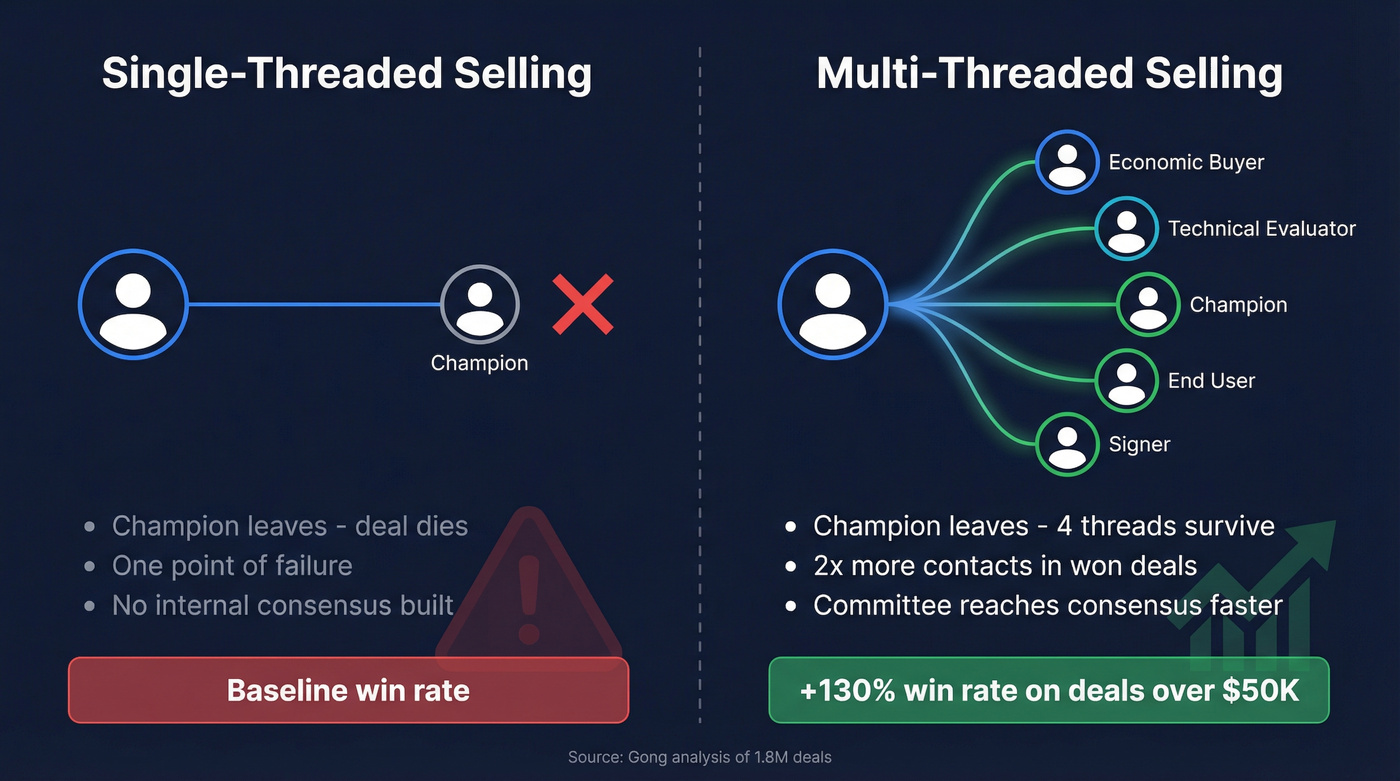
A multi-threaded approach is the deliberate practice of building direct relationships with multiple stakeholders across the buying committee. Gong calls single-threaded deals an "immediate red flag" unless the deal is transactional and low-cost. For anything above $50K, you need threads running to the economic buyer, the technical evaluator, end users, and ideally someone who controls the signature.
Why It Works
The data isn't subtle.
Across that 1.8M-opportunity dataset, 77% of deals already involve multiple contacts - single-threaded deals are the minority, and they lose more often. Closed-won deals have 2x as many buyer contacts as closed-lost. In strategic enterprise wins, the average is 17 contacts.
The buying committee keeps growing. Industry research consistently pegs the average B2B purchase at 13 stakeholders, with 89% of buying decisions crossing multiple departments. Each person typically brings 4-5 pieces of independent research into the process, and buyers spend only about 17% of their purchasing time meeting with suppliers. Every meeting you get needs to count across multiple threads.
Gartner buying-group benchmarks also show 74% of buying teams experience unhealthy internal conflict during the decision process, and teams that reach consensus are 2.5x more likely to rate the outcome as high quality. Your job isn't just to sell - it's to help the committee align.
| Metric | Single-Threaded | Multi-Threaded |
|---|---|---|
| Buyer contacts per deal | 1 (champion only) | 2x more in won deals |
| Win-rate lift (>$50K) | Baseline | +130% |
| Strategic enterprise wins | - | Avg. 17 contacts |
| BDR contacts per account | - | 9 (up from 6.4) |
| Attempts per contact | - | 21 touches |
| Avg. cadence length | - | 53 days |
Data: Gong (1.8M deals), 6sense BDR benchmark

You mapped 9 stakeholders. Two emails bounced. One went to someone who left last month. Now your multi-threaded strategy is single-threaded again. Prospeo's 7-day data refresh and 98% email accuracy mean every thread you build actually connects to a real person - with verified direct dials for the contacts who won't answer cold emails.
Stop breaking threads with bad data. Start with contacts that connect.
Map Your Buying Committee
Every multithreading guide tells you to "identify key stakeholders" as if that's the hard part. It's not. The hard part is finding their verified email and direct dial when your CRM has a generic info@ address and a phone number from 2019.
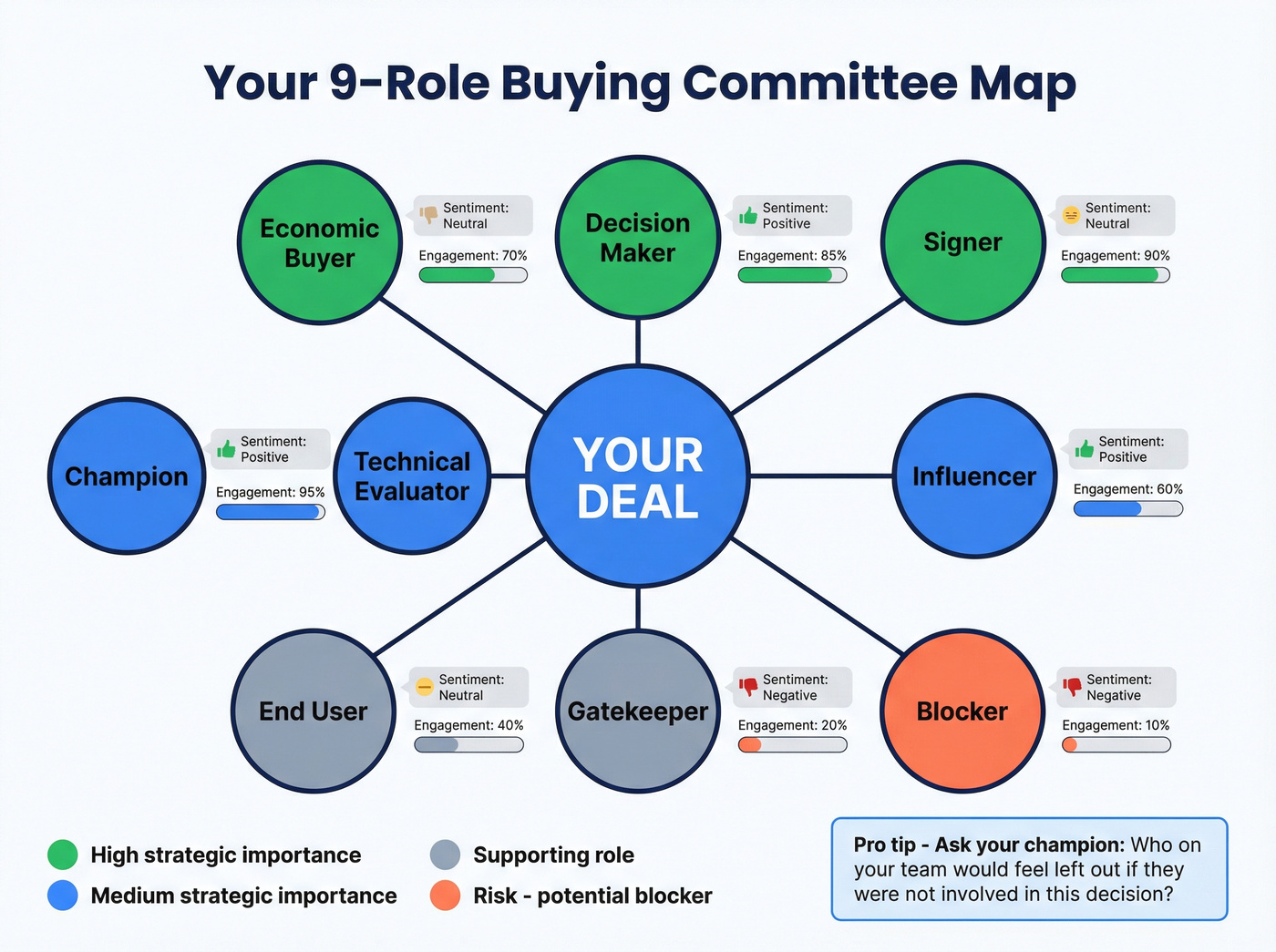
Start with a practical 9-role list: Economic Buyer, Technical Evaluator, Champion, End User, Influencer, Blocker, Decision Maker, Gatekeeper, and Signer. For each person, track reporting structure, sentiment, engagement level, and strategic importance. A stakeholder map without sentiment data is just an org chart - and org charts don't close deals.

Here's where bad data kills multithreading in practice. You mapped 8 stakeholders, found emails for 5, two bounced, and one went to someone who left six weeks ago. Now you've got threads to two people - that's barely threaded. We've found that Prospeo's 7-day data refresh cycle makes a real difference here, since the contacts you pull actually correspond to people who still work there. When you're threading into 9 stakeholders, every bounced email is a broken thread.
One discovery question experienced AEs swear by: ask your champion directly, "Who on your team would feel left out if they weren't involved in this decision?" It surfaces hidden stakeholders without going around anyone.
Execute: Persona-Based Outreach at Scale
Multithreading doesn't mean sending the same email to nine people. Each stakeholder gets messaging tailored to their role and position in the decision process. Outreach recommends a "persona matrix" - personas on one axis, touch intensity on the other, with each cell getting its own sequence.
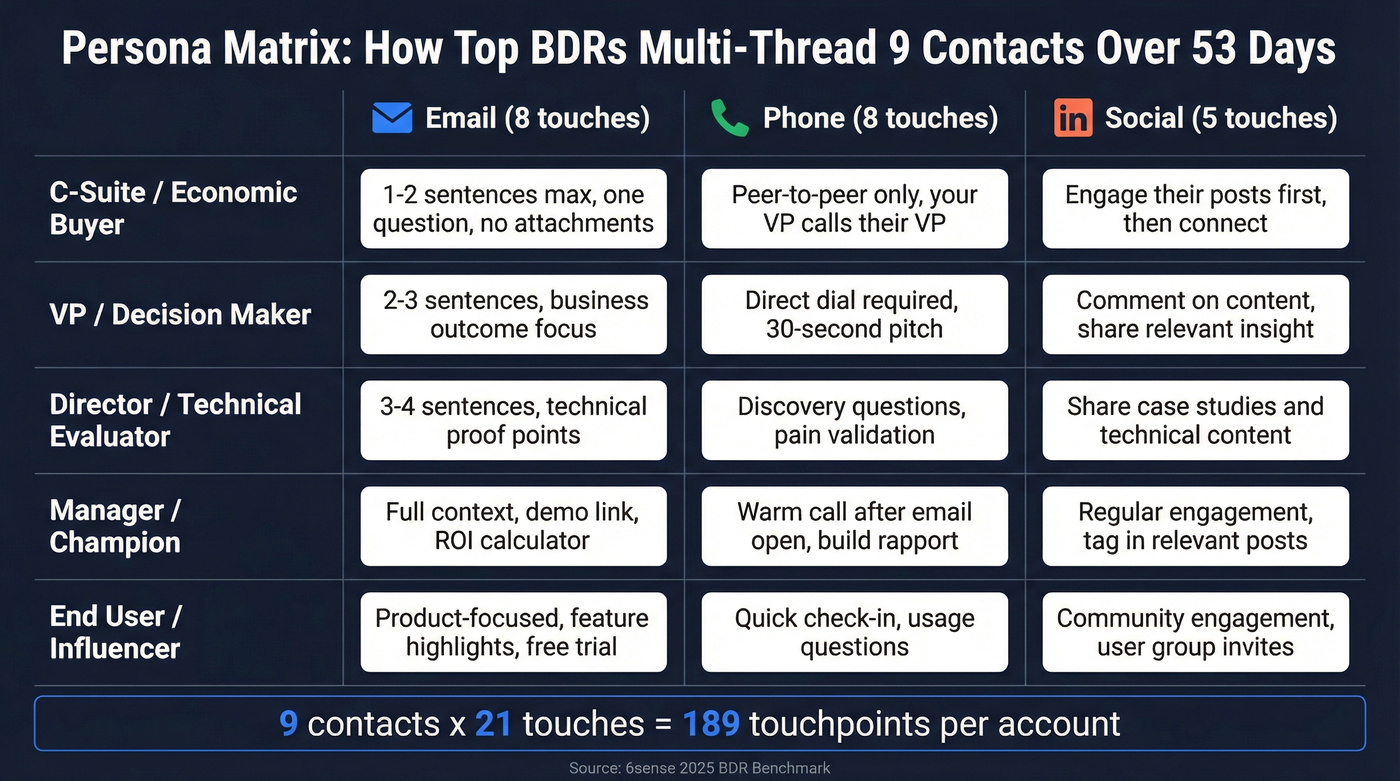
Here's what top BDR execution looks like right now: 90% of BDRs multithread (up from 83%), reaching 9 individuals per account with 21 attempts per contact - split across 5 social touches, 8 calls, and 8 emails over a 53-day cadence.
Let's be honest about one thing that separates good multithreaders from great ones: email length. Emails get shorter as you go up the org chart. Your end-user email can be three paragraphs with a demo link. Your VP email should be two sentences and a question. C-suite gets one sentence, maybe two. The higher the title, the less patience they have for your pitch.
For benchmarking, Outreach's data shows cold outbound reply rates of 8-15% with 1-3% meeting conversion, while warm inbound hits 20-30% reply and 8-12% meetings. If you're below those floors, fix your messaging or data quality before scaling threads.
When Multithreading Backfires
More contacts doesn't automatically mean better outcomes. Here are the patterns we've seen blow up deals:
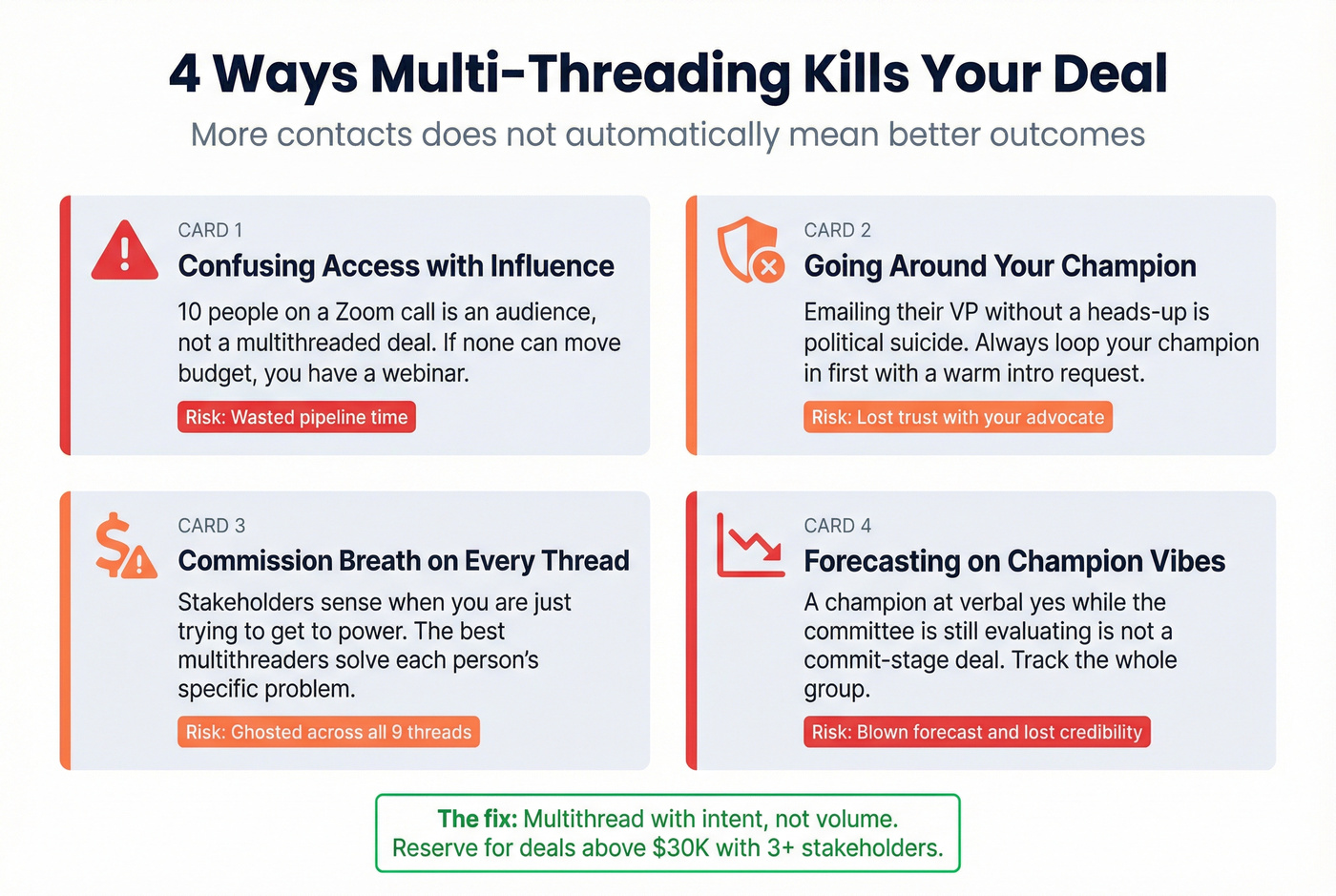
Confusing access with influence. Ten people on a Zoom call is an audience, not a multithreaded deal. If none of them can move budget, you've got a webinar, not a sales process.
Going around your champion without warning. This is political suicide. If your champion finds out you emailed their VP without a heads-up, you've lost trust with the one person actually advocating for you. Always loop your champion in first - even a quick "I'd love to connect with Sarah on the technical side, would you mind introducing us?" goes a long way.
Multithreading with commission breath. Stakeholders sense when you're just trying to get to power. Peer-to-peer outreach works - have your VP reach out to their VP. But if every touchpoint screams "I need this deal to close," you'll get ghosted across all nine threads simultaneously. The consensus on r/sales is that the best multithreaders genuinely help each stakeholder solve their specific problem, not just pitch the same value prop nine different ways.
Forecasting on champion enthusiasm alone. Track where the mass of the buying group actually sits. A champion at "verbal yes" while the committee is at "still evaluating" isn't a commit-stage deal.
Here's a take that'll get pushback: if your average deal sits below five figures, you probably don't need to multithread at all. Skip it. The overhead of mapping and engaging 9 stakeholders will eat your margin. Multithreading is a weapon for complex, high-ACV deals - not a universal best practice.
Tools That Make It Work
You need four categories covered:
Contact data: Prospeo - 98% email accuracy, 7-day refresh, 125M+ verified mobiles, self-serve at roughly $0.01/lead with no annual contracts. For multithreading specifically, the 30+ search filters let you pull an entire buying committee by department and seniority in one search instead of hunting contacts one by one.
Engagement tracking: Gong gives you visibility into which threads are active and which have gone cold, so you know where to re-engage before a thread dies quietly. Enterprise pricing, typically sold on annual contracts.
Multi-stakeholder sequencing: Salesloft or Outreach (roughly $100-$200/user/mo depending on package) handle persona-specific cadences across the full committee.
Account mapping: Lucidchart (free plan available) or honestly just a whiteboard. The tool matters less than updating it weekly.
6sense says top BDRs reach 9 contacts per account with 21 touches each. That's 189 touchpoints - and every bounced email burns your domain reputation at scale. Prospeo gives you verified emails and 125M+ direct dials across the entire buying committee, so your persona matrix actually reaches the economic buyer, the technical evaluator, and the signer.
Multi-thread with 300M+ verified contacts at $0.01 per email.
FAQ
How many stakeholders should you engage when multithreading?
Top BDRs reach 9 individuals per account, and won enterprise deals average 17 contacts. For mid-market deals in the $30K-$80K range, aim for 5-8 across at least 2 departments - enough to survive one champion going dark.
What's the difference between multi-threaded and single-threaded selling?
Single-threaded means one contact drives the deal internally - a single point of failure. Multi-threaded selling means direct relationships with multiple buying committee members, reducing risk if any contact leaves, gets reassigned, or loses influence.
Does multithreading work for smaller deal sizes?
For deals under $15K with one or two decision-makers, multithreading adds overhead that rarely pays off. Reserve it for complex sales with 3+ stakeholders and longer cycles - typically $30K+ ACV where champion risk justifies the extra outreach investment.