

The Economic Buyer: 2026 Playbook for B2B Sales
You're three months into a deal. The champion loves you. The technical team passed the POC. Then the CFO asks one question - "What's the business case?" - and the whole thing stalls.
In a post-mortem of slipped and lost deals, one sales manager found they hadn't met the economic buyer in 6 out of 7 losses. Meanwhile, 86% of B2B deals stall during the buying process. The pattern is clear: if you haven't met the economic buyer, you don't have a deal - you have a hope.
What Is an Economic Buyer?
The economic buyer is the individual who holds final authority to approve budget for a purchase. In MEDDIC and MEDDPICC frameworks (see also: MEDDIC), the EB is a dedicated qualification field - it's the "E" - and for good reason. This person evaluates your deal through the lens of ROI, business risk, and strategic alignment. Not features. Not technical fit.
Typical titles include CFO, COO, VP of Finance, and General Manager, though the title varies wildly by company size and deal scope. At a 20-person startup, the budget holder is the founder. At a Fortune 500, it might be a divisional VP you'll never meet unless you engineer the introduction.
Economic buyers rarely self-identify. Surfacing them is the seller's job. The key distinction: this person can say yes and no. Everyone else in the buying committee can only block.
EB vs. Other Stakeholder Roles
The buying committee is crowded. Gartner puts the average at 6-10 people, and Forrester pegs it at 13 stakeholders, with 89% of purchases crossing departmental lines. Understanding who does what saves you from pitching the wrong message to the wrong person.
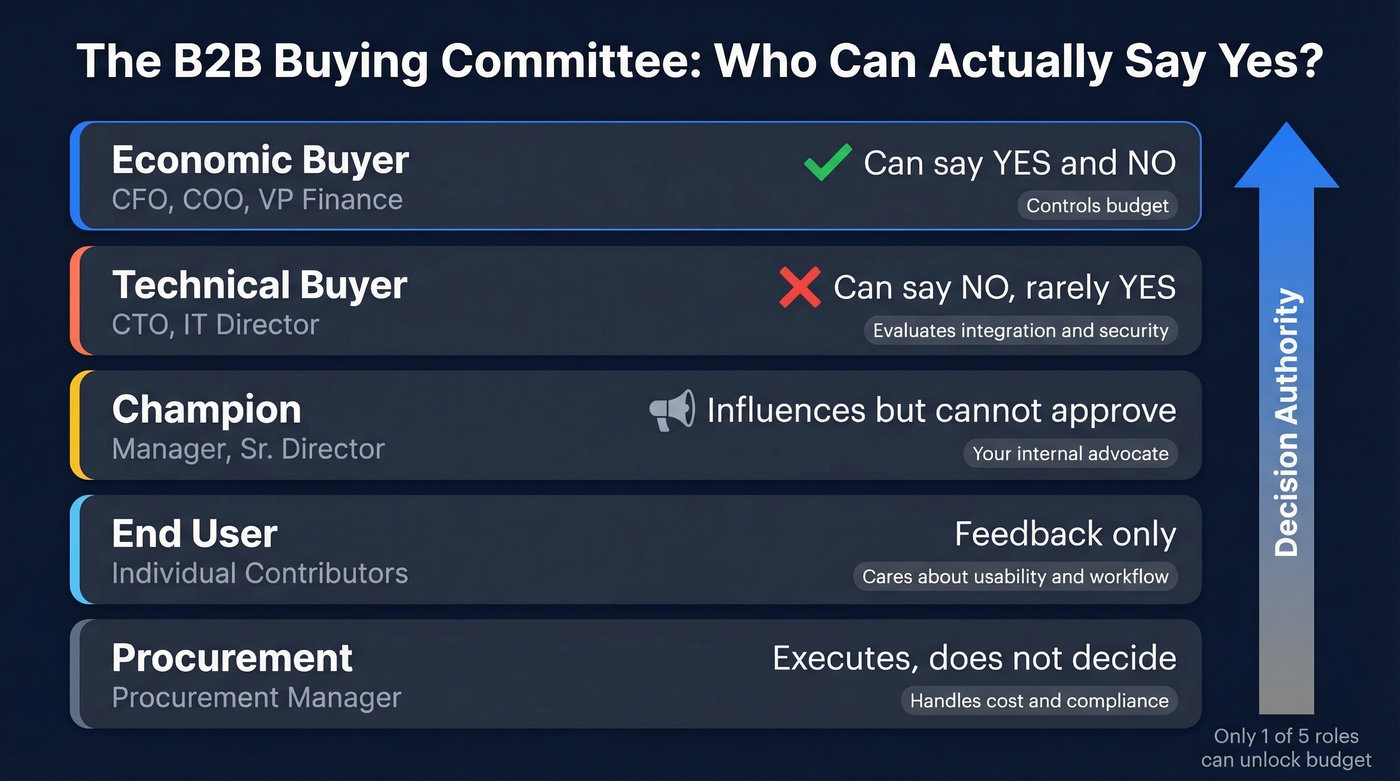
| Role | Focus | Authority | Typical Titles |
|---|---|---|---|
| Economic Buyer | ROI, budget, risk | Can say yes or no | CFO, COO, VP Finance |
| Technical Buyer | Features, integration | Can say no, rarely yes | CTO, IT Director |
| Champion | Internal advocacy | Influences, can't approve | Manager, Sr. Director |
| End User | Usability, workflow | Feedback only | Individual contributors |
| Procurement | Cost, compliance | Executes, doesn't decide | Procurement Manager |
Here's the thing: the technical buyer's "no" kills deals quietly. They reject on integration risk or security concerns, and the deal never reaches the EB. But their "yes" doesn't unlock budget - it just removes a blocker. The economic buyer is the only role where approval actually moves money.
In smaller deals, one person often wears multiple hats - the technical buyer and budget owner might be the same VP.
Why EB Alignment Makes or Breaks Deals
The numbers are brutal. When the economic buyer raises ROI concerns after a solution has been presented, the chance of closing drops by 79%. That's not a headwind - that's a wall.
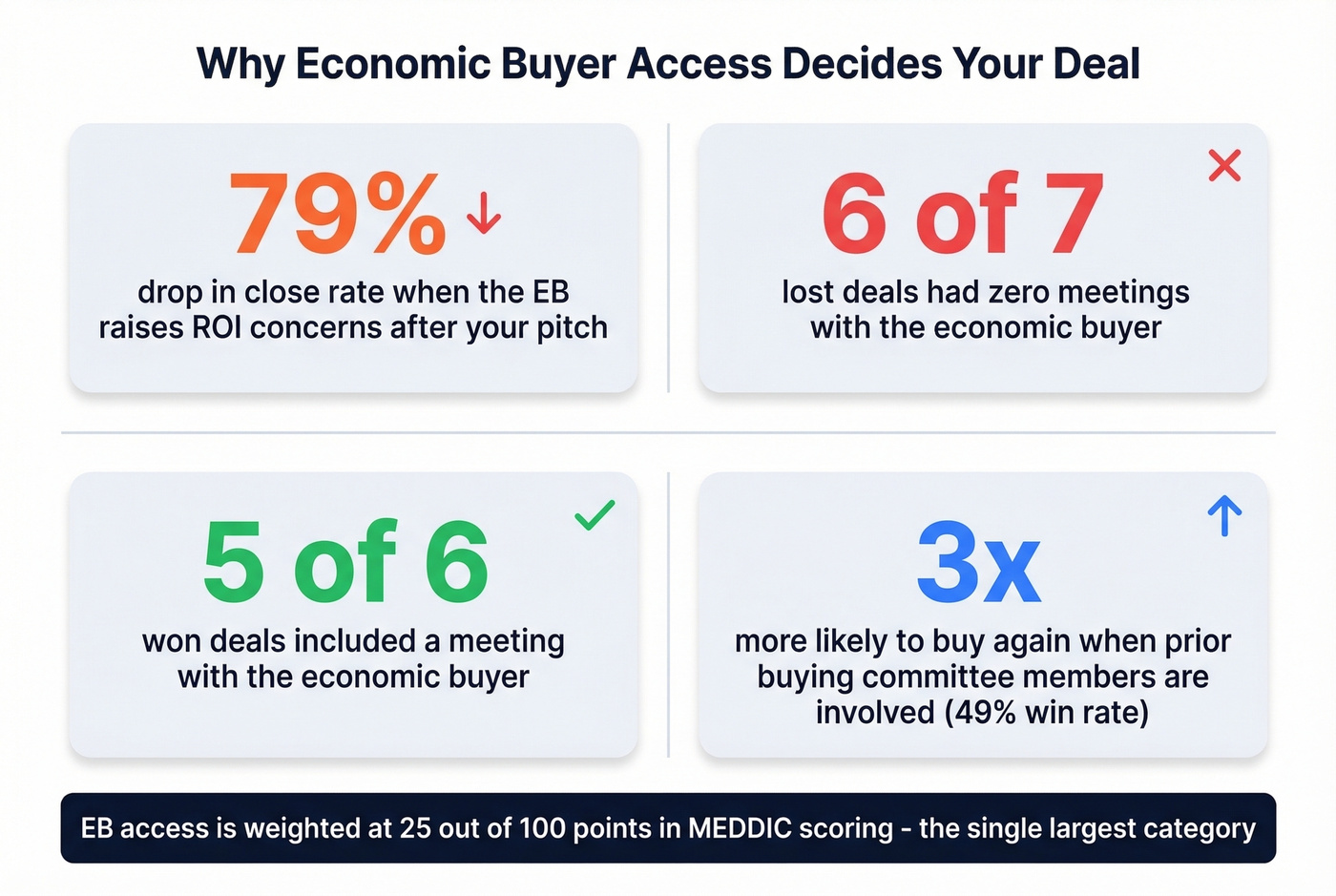
One sales leader on r/sales shared their MEDDIC scoring model: Economic Buyer was weighted at 25 points out of 100 - the single largest category, ahead of Champion (15), Identified Pain (15), and Metrics (15). That weighting reflects what we've seen repeatedly: EB access is the strongest predictor of deal velocity.
And even when deals close without proper EB alignment, 81% of buyers end up dissatisfied with the provider they chose - often because the budget holder's priorities were never addressed during the sales process. The timing pressure is real, too: 83% of buyers define their requirements before talking to sales, and the average B2B sales cycle runs 10.1 months. If you're engaging the EB late, you're fighting a decision framework built without your input.
Prior buying committee members are 3x more likely to purchase again with a 49% win rate. The EB's past experience with vendors like you shapes the outcome before you walk in the room.
A note on deal size: If your average contract value is under $25K and your sales cycle is under 60 days, you probably don't need a formal EB engagement strategy. Just sell to the person with the credit card. Everything below is for deals where the money is real and the committee is big enough to kill you.
How to Identify the Economic Buyer
By Company Size
The budget authority looks different at a 15-person startup than at a 5,000-person enterprise. Knowing where to look saves you weeks of navigating the wrong org chart branch.
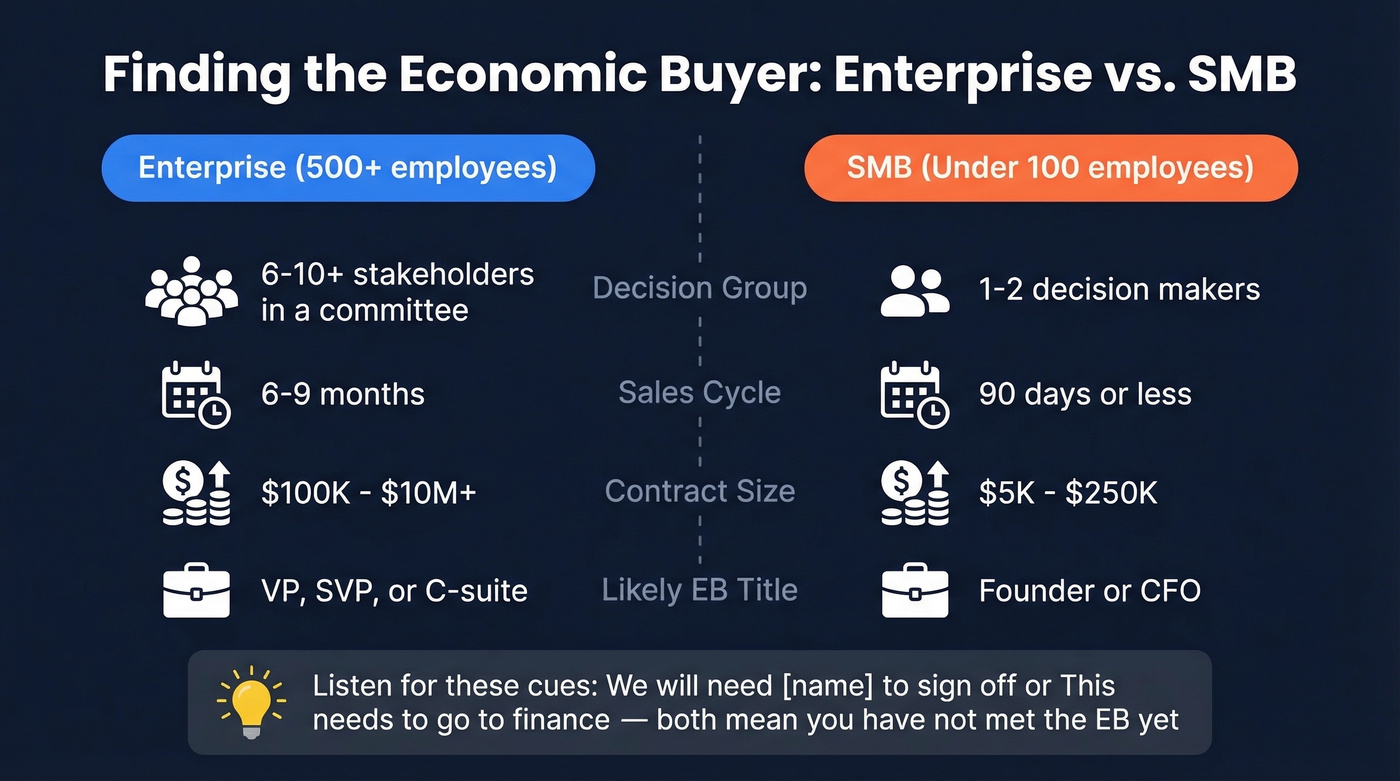
| Factor | Enterprise | SMB |
|---|---|---|
| Decision group | Committee (6-10+) | 1-2 people |
| Sales cycle | 6-9 months | 90 days or less |
| Contract size | $100K-$10M+ | $5K-$250K |
| Likely EB | VP/SVP/C-suite | Founder or CFO |
Under 25 employees, you're almost always selling to the business owner or CFO directly. Above 25, subject matter experts get involved and the EB becomes harder to reach. Listen for meeting cues: "We'll need [name] to sign off" or "This needs to go to finance." Both are dead giveaways that you haven't met the EB yet.
Discovery Questions That Surface the EB
Don't guess. Ask. These aren't meant to be fired off in sequence - pick 2-3 that fit your conversation and weave them in naturally. The goal is to surface the EB's identity, involvement level, and decision criteria before you're deep into a technical evaluation.
- "Who has the final say in purchasing decisions like this, and will I be able to meet with them as part of this process?"
- "What does success for this project look like specifically for the budget owner? What are their personal goals?"
- "Who ultimately approves the budget for new tools or solutions in your organization?"
- "How does the EB typically measure ROI on a new solution?"
- "Who has approved deals of this size in the past?"
- "Is there a higher mission or initiative this project is attached to?"
- "If we build a strong business case, who needs to see it before budget gets released?"
The best reps surface the EB organically by asking about process, not by demanding a name.

You just mapped the buying committee. Now you need verified emails and direct dials for the economic buyer. Prospeo gives you 30+ filters - including title, seniority, department, and company size - to pinpoint the exact CFO or VP who controls budget. 98% email accuracy means your outreach actually lands.
Stop getting blocked at the champion level. Reach the EB directly.
How to Get Access to the EB
In won deals, that same sales manager met the economic buyer 5 out of 6 times. In losses, 6 out of 7 had no EB meeting. Access isn't a nice-to-have. It's the deal.
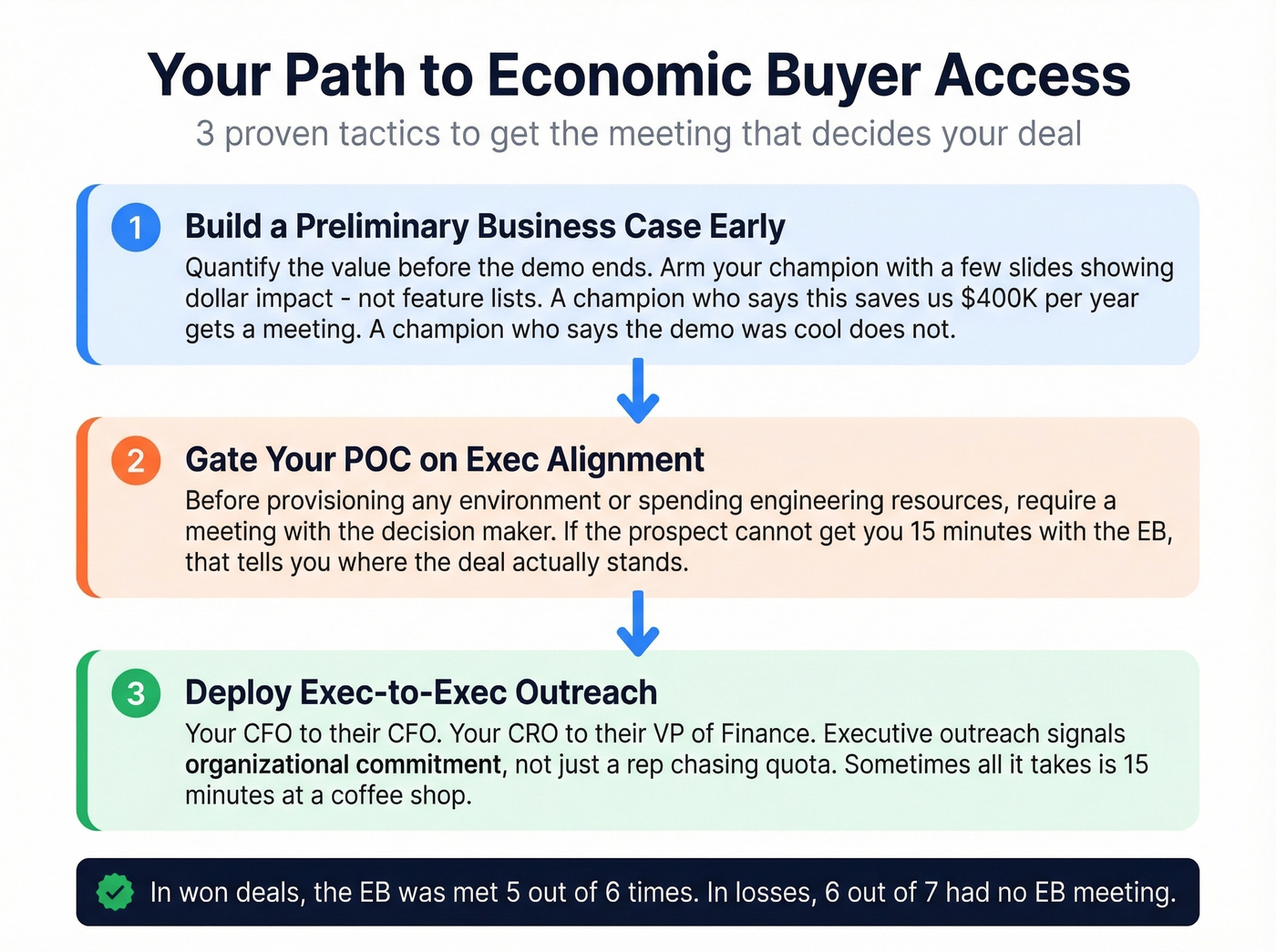
Build a Preliminary Business Case
Most reps wait until the end of the sales cycle to build a business case. That's backwards. Build a lightweight version - a few slides with quantified benefits - early enough for your champion to use as ammunition internally.
You're not selling to the EB directly at this stage. You're arming your champion to sell for you. A champion who walks into their VP's office with "this tool saves us $400K/year in manual enrichment" gets a meeting. A champion who says "the demo was really cool" doesn't.
Gate Your POC on Exec Alignment
A rep on r/techsales was running a competitive POC with only an engineering manager and a weak business case. They took the advice to require exec alignment before provisioning the environment. The talk track: "In order to provision an environment for a POC and spend engineering resources, we need to meet with the decision maker and have executive alignment."
Within a week, they had an intro to the executive stakeholder.
Let's be honest: giving away a POC without executive alignment is working for free and hoping someone pays you later. If the prospect can't get you 15 minutes with the EB, that tells you everything about where this deal actually stands. (If you're running one, use a sales POC checklist.)
Deploy Exec-to-Exec Outreach
Your CFO to their CFO. Your CRO to their VP of Finance. Exec-to-exec outreach works because it signals organizational commitment, not just a rep chasing quota. (This pairs well with account-based selling when the committee is large.)
One story that stuck with us: a CEO-assisted meeting helped secure a $3M deal when the EB gave just 15 minutes at a train station cafe. That's all it took - 15 minutes of face time with the right person, at the right level. Your executives don't need to run the deal. They need to open the door.
The Fake Champion Problem
Rich Liu put it bluntly: "If you don't have a very clear line to the economic buyer, then you cannot consider that the sale is getting done."
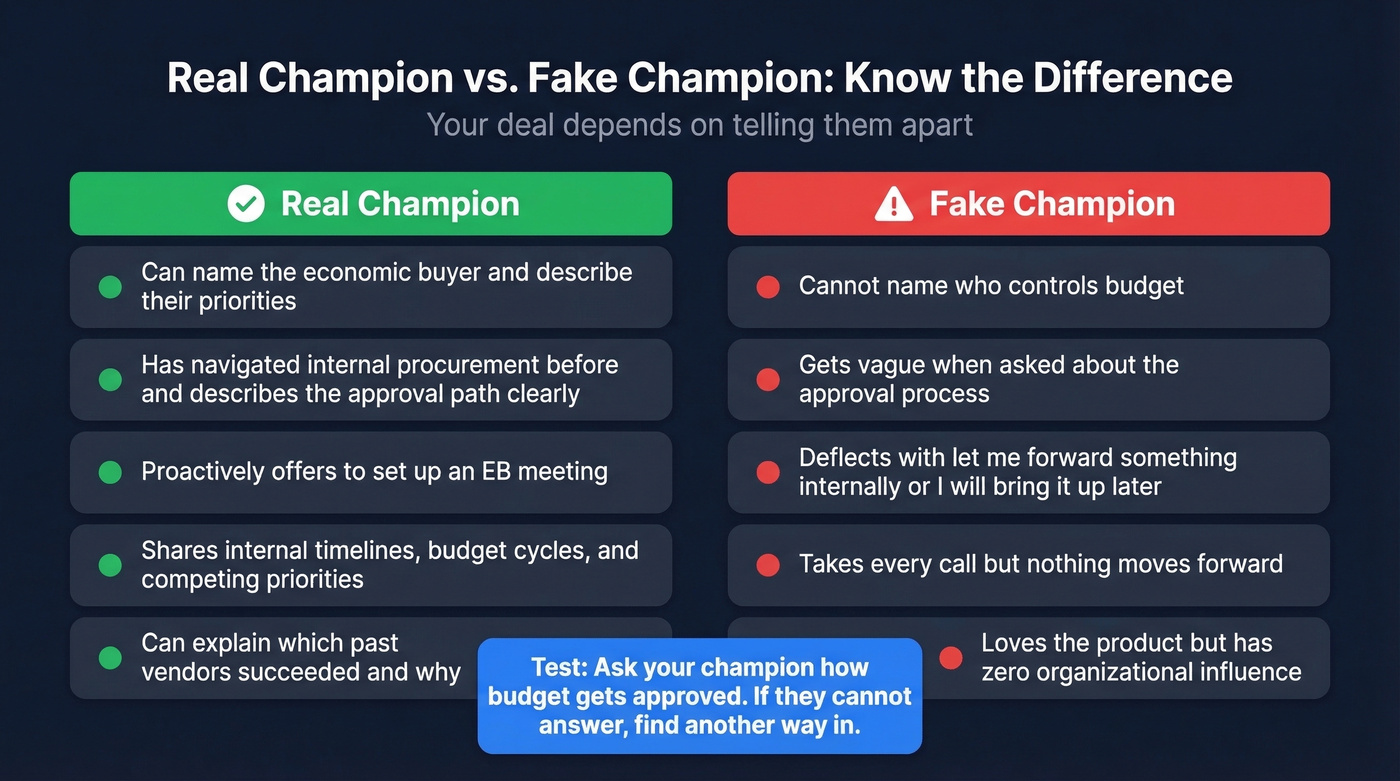
The fake champion is the enthusiastic user who loves your product, takes every call, and can't name the budget owner. They'll deflect when you ask for an EB intro - "let me forward something internally" or "I'll bring it up at our next planning meeting." These are stall signals, not progress signals.
Test your champion with behavioral validation questions. Ask which past vendors have been successful at their company, what behaviors those vendors exhibited, and how the champion shepherded them through the approval process. A real champion has answers - they've navigated internal procurement before and can describe the path. A fake champion gets vague. If your champion can't articulate how budget gets approved, you need to find another way in. (More: discovery questions that uncover real authority.)
Selling to the Economic Buyer
You're not selling to the EB - you're arming your champion to sell for you. The EB gives you 15 minutes. Your champion carries the message for weeks. Every interaction should reinforce business outcomes, not features.
Engage after you've built technical momentum but before procurement takes over and the budget window narrows. Lead with what the EB cares about: revenue impact, cost reduction, risk mitigation, competitive advantage. Leave the feature comparison matrix for the technical buyer. Understanding the EB's decision criteria ahead of time - how they weigh ROI, payback period, and strategic fit - lets you tailor every slide and talking point to what actually moves the needle. (If you need structure, borrow from sales deck storytelling.)
The 5-Section Business Case
Keep it to a 5-minute read. The EB won't spend longer than that.
- Executive Summary - One paragraph: what you're proposing and the expected outcome.
- Current Challenges - Quantify the cost of the status quo. Time wasted, revenue leaked, risk exposure.
- Recommendations - What you're proposing and why it fits their specific situation.
- Business Impact / ROI Case - Time savings, cost savings, revenue gains. Use their numbers, not yours.
- Investment - Total cost, payment structure, timeline to value.
The ROI case is where deals are won or lost. If you can show a 3-5x return using the prospect's own data, the EB's decision becomes straightforward.
How to Find the EB's Contact Info
Every guide tells you to identify the economic buyer. Almost none help you actually reach them. You've done the discovery work, you know the EB is the VP of Finance, and your champion keeps saying they'll "set something up." Two weeks pass. Nothing happens.
Here's the workflow that cuts through: research the org chart, identify the likely EB by title and seniority, pull their verified email and direct dial, and reach out directly. Prospeo makes that last step fast - search by company and title across 300M+ professional profiles, get 98% verified email accuracy, and have the contact info in minutes instead of waiting for an internal forward that never comes. (If you're building lists at scale, see lead enrichment and firmographic filters.)

Building a business case for the economic buyer requires knowing who they are before month three. Prospeo's database of 300M+ profiles refreshes every 7 days, so you're never pitching stale contacts. Layer intent data across 15,000 topics to find EBs actively researching solutions like yours - at $0.01 per verified email.
Identify the economic buyer on day one, not after the deal stalls.
Common Mistakes
Feature-led pitches to the EB. The economic buyer doesn't care that you have 47 integrations. They care that you'll save their team 12 hours a week and reduce churn by 15%.
Late engagement. Contacting the EB after the technical eval is done and the budget window has closed is a recipe for "we'll revisit next quarter."
Title-based assumptions. A VP of Engineering might control $2M at one company and have zero spending authority at another. Titles lie. Discovery doesn't.
Giving away POCs without exec alignment. You're spending engineering resources on a deal that has no budget sponsor. Stop.
Relying on the champion to "forward something internally." If the champion won't make an intro, go direct. That's not going around them - it's doing your job. (Use these sales follow-up templates to keep momentum.)
FAQ
What's the difference between an economic buyer and a decision maker?
An economic buyer is always a decision maker, but not every decision maker is an economic buyer. The EB specifically controls budget approval - they can release funds. A technical decision maker can reject a solution on integration or security grounds but typically can't approve spending. When someone says "decision maker," ask which kind. The distinction changes your entire approach.
Can there be more than one economic buyer on a deal?
Rarely. In enterprise deals, budget authority sometimes splits across departments - IT budget plus marketing budget - creating co-EBs. In most deals, one person holds final sign-off. If you genuinely can't identify a single EB, your deal qualification is incomplete. Go back to discovery and ask who writes the check.
How do I find the EB's email if my champion won't introduce me?
Research the org chart, identify the likely EB by title and seniority, then use a B2B data tool to pull their verified email and direct dial. We've found that going direct - rather than waiting weeks for an introduction that never materializes - is often the move that unsticks a deal.
What matters most when selling to the economic buyer?
Business outcomes: revenue impact, cost reduction, and time to measurable ROI. Align your pitch to the EB's decision criteria - payback period, strategic fit, and competitive urgency - and let your champion handle feature-level conversations with the rest of the buying committee. A 3-5x ROI case built on the prospect's own data is the single most persuasive asset you can bring.