

Technical Buyer vs Economic Buyer: What They Care About and How to Win Both
You're three weeks into a deal. The VP of Engineering loves your product - she's already mapped out the integration plan. Then the CRO kills it because "the business case doesn't justify the spend this quarter."
That's the technical buyer vs economic buyer distinction in action, and it's the difference between a closed deal and a stalled pipeline. [86% of B2B purchases stall](https://www.forrester.com/press-newsroom/forrester-the-state-of-business-buying-2024/) during the buying process, and 81% of buyers end up dissatisfied with the provider they ultimately choose. Role misalignment between these two buyer types is one of the biggest reasons for both problems.
Quick Summary
The economic buyer controls budget and asks "Why now?" The technical buyer evaluates feasibility and asks "Why you?" They have fundamentally different priorities, objections, and definitions of success.
74% of B2B buyer teams experience unhealthy conflict during the decision process. Winning deals means aligning both roles around shared business goals - not pitching each one in isolation.
The Core Difference
Here's the most common misconception in enterprise sales: the economic buyer isn't always the CFO. The economic buyer is whoever can reallocate budget toward your purchase. Sometimes that's a VP of Sales, sometimes a COO, sometimes a department head with discretionary spend.
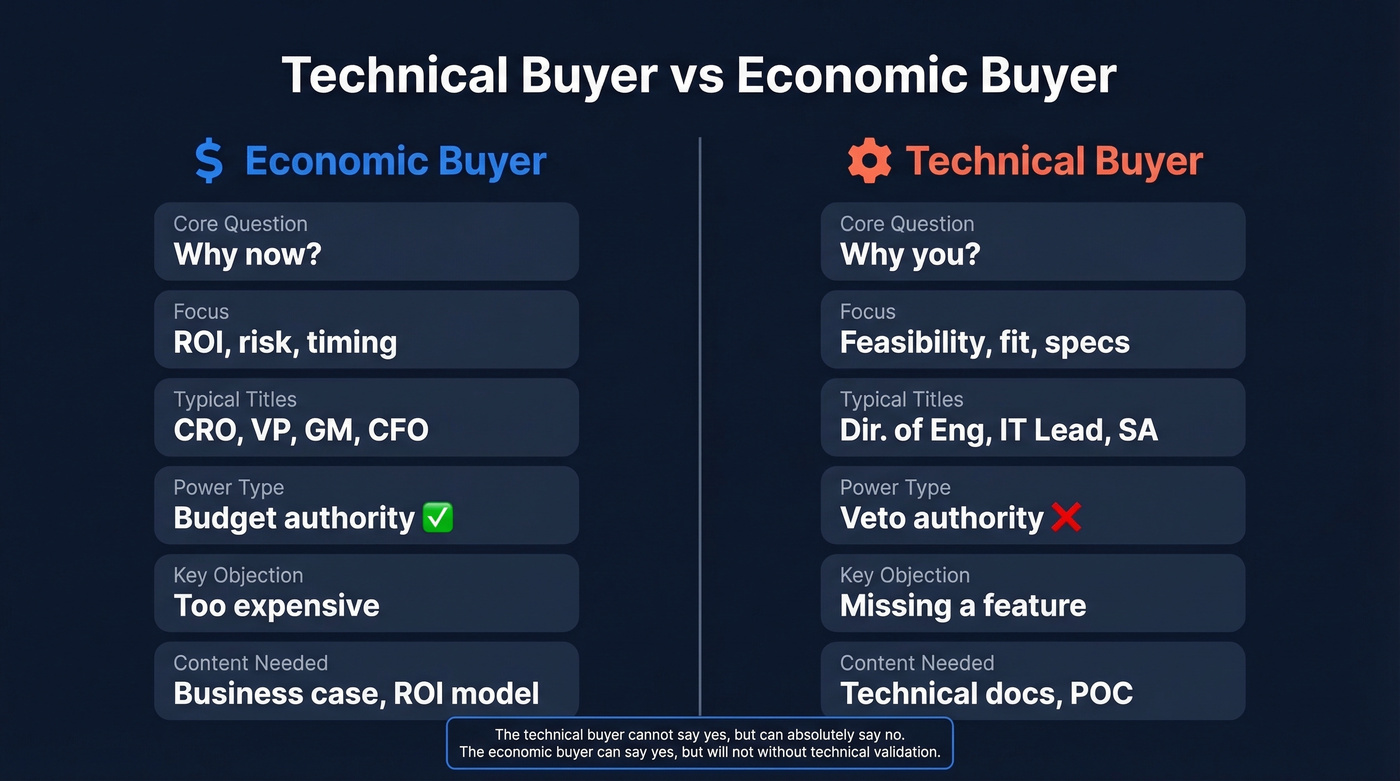
The technical buyer evaluates whether your solution actually works within their environment. Integration, security, compliance, and whether your product will create more problems than it solves - that's their world.
| Dimension | Economic Buyer | Technical Buyer |
|---|---|---|
| Core question | "Why now?" | "Why you?" |
| Focus | ROI, risk, timing | Feasibility, fit, specs |
| Typical titles | CRO, VP, GM, CFO | Dir. of Eng, IT Lead, SA |
| Power type | Budget authority | Veto authority |
| Key objection | "Too expensive" | "Missing a feature" |
| Content needed | Business case, ROI model | Technical docs, POC |
This framework draws from Force Management's buyer persona model. The critical insight: the technical buyer can't say yes, but they can absolutely say no. The economic buyer can say yes, but won't without technical validation.
Why Confusing Them Kills Deals
Scenario one: technical win, economic loss. Your SE crushes the POC. The engineering team is sold. But nobody built a business case for the VP who controls budget. She asks "what's the ROI?" and your champion stammers. Deal pushed to next quarter. Then dead.
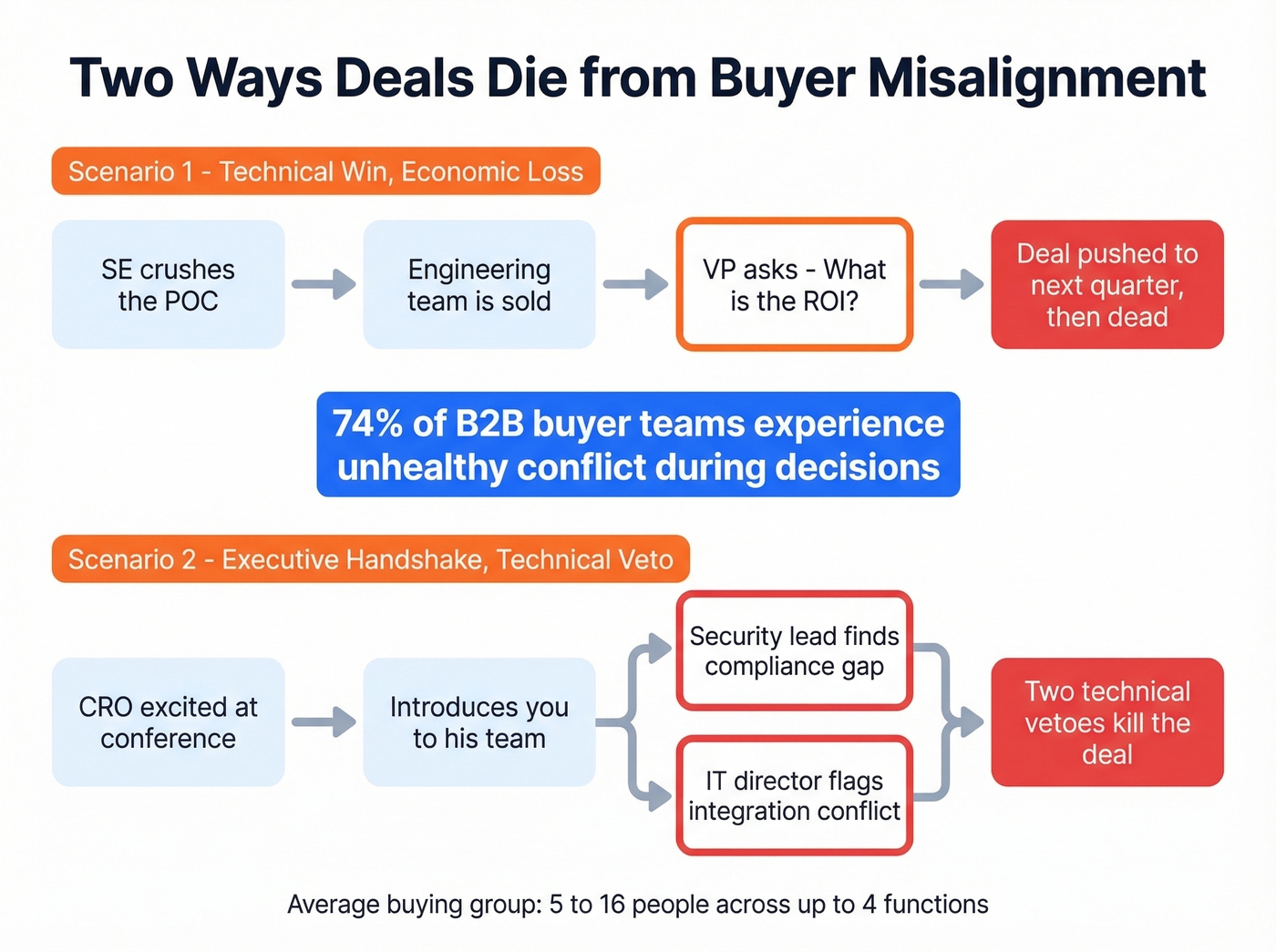
Scenario two: executive handshake, technical veto. You got the CRO excited at a conference. He introduces you to his team. The security lead finds a compliance gap, and the IT director flags an integration conflict. The CRO's enthusiasm can't override two technical vetoes.
Ask any AE who's lost a deal at the procurement stage. They'll tell you the same thing: they sold the wrong person on the wrong value prop. That 74% unhealthy conflict stat isn't abstract - it's these exact situations playing out across buying groups of 5 to 16 people spanning up to 4 functions.

Selling to both technical and economic buyers starts with reaching them. Prospeo's 300M+ profile database lets you filter by seniority, department, and job title - so you can identify the budget holder and the technical evaluator in the same search. Pull 98% accurate emails and verified direct dials for the entire buying committee.
Stop guessing who controls the budget. Find the full buying committee now.
How to Identify Each Buyer
Before your first discovery call, build a hypothesis about who controls budget and who evaluates technical fit. Look at the org chart, recent hires, and reporting structure. You need to answer two questions: "Who can write the check?" and "Who can kill the deal on technical grounds?"
Then validate with discovery. For the economic buyer, uncover who has final sign-off on budget, whether funds are already allocated or you need to build a business case together, and what measurable outcomes define success for them personally.
For the technical buyer, ask directly about must-have integration requirements, security and compliance review processes, and how evaluation criteria are weighted. These questions draw from [MEDDPICC](https://meddicc.com/meddpicc/) qualification methodology - best suited for enterprise deals with ACV above $50k and sales cycles longer than six months - and Miller Heiman's Strategic Selling framework.
Here's the number that should scare you: buyers define requirements 83% of the time before speaking with sales. Miss that window and a competitor writes the spec.
Once you've mapped the buying committee, you still need to actually reach the right people. We've found that org charts are hypotheses until you have verified contact data. Prospeo's leads database lets you search by job title, department, and seniority across 300M+ professional profiles, then pull verified emails and direct dials for both the budget holder and the technical evaluators.
When Both Buyers Disagree
Let's be honest about something counterintuitive: tailoring your pitch to each individual buyer can make things worse.
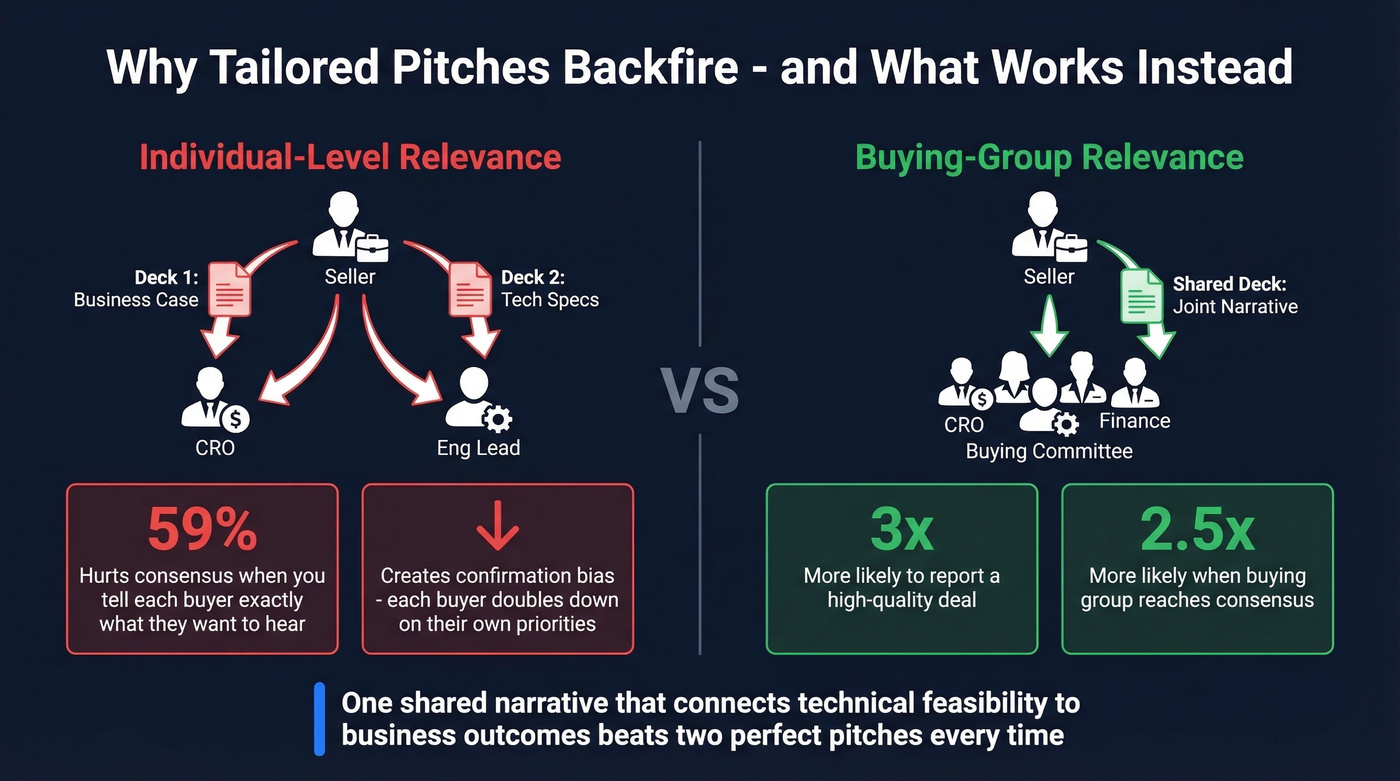
Gartner's research found that individual-level relevance - telling each stakeholder exactly what they want to hear - hurts consensus by 59%. It creates confirmation bias where each buyer doubles down on their own priorities and nobody converges.
What works is buying-group relevance: framing your solution around shared business goals. When buyers experience buying-group relevance, they're 3x more likely to report a high-quality deal. And buying groups that reach consensus are 2.5x more likely to report the deal was high-quality.
The tactical move is to build a narrative connecting the technical buyer's "this works" to the economic buyer's "this is worth it" through a shared outcome - reduced churn, faster time-to-market, lower operational risk. Don't pitch them separately and hope they align. Build the alignment yourself.
We've seen too many reps run parallel tracks - one deck for the CRO, another for the engineering lead - and then act surprised when the buying committee can't agree. One shared narrative beats two perfect pitches every time.
A word on "objective" technical evaluations: there's no such thing. Requirements are political artifacts shaped by internal priorities, existing vendor relationships, and team dynamics. The sooner you recognize that the technical buyer's "objective criteria" are just as subjective as the economic buyer's gut feeling about ROI, the better you'll sell.
The Full Buying Committee
The technical and economic buyers get the most attention, but an average of 13 people are involved in B2B buying decisions, with 89% spanning two or more departments. Average sales cycles have compressed from 11.3 months in 2024 to 10.1 months in 2025, which means you have less time to navigate more stakeholders.
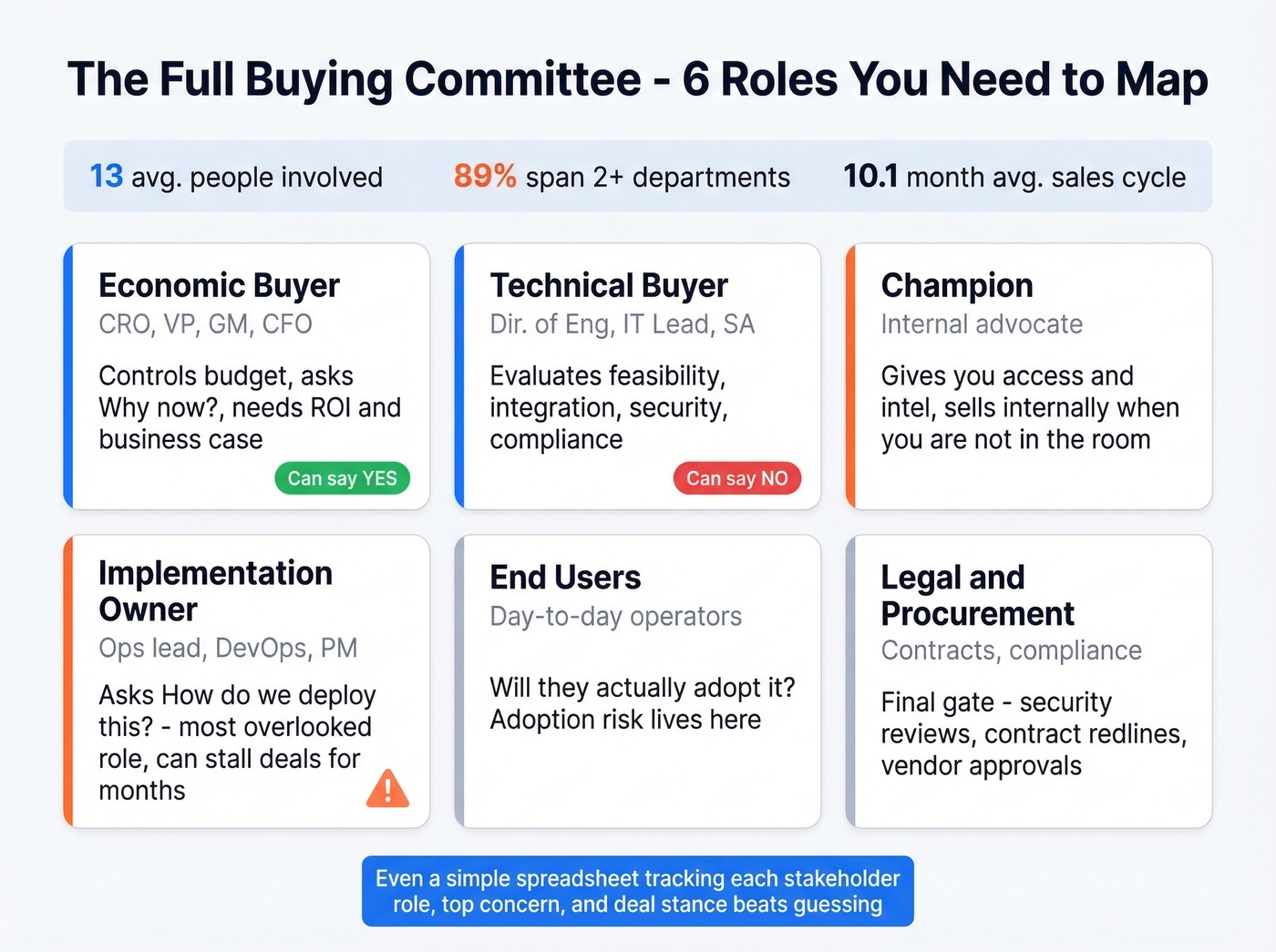
Beyond budget holders and technical evaluators, you're dealing with champions who give you access and intel, implementation owners who ask "how do we actually deploy this?", end users, and legal/procurement. The consensus on r/sales is that the implementation owner is the most overlooked persona - they rarely have veto power, but their objections during late-stage diligence can stall a deal for months. Skip this role at your own risk.
MEDDPICC and Miller Heiman's four buying influences both provide structured ways to map these roles. If you're running enterprise deals, you should be using one of them. For teams that need to move fast, even a simple spreadsheet tracking each stakeholder's role, their top concern, and their stance on your deal beats guessing.
Deals die when you pitch the wrong person. Prospeo gives you 30+ filters - including department headcount, seniority, and job title - to map every stakeholder from the CRO to the Engineering Director. At $0.01 per email, reaching a 13-person buying group costs less than a cup of coffee.
Reach every buyer in the deal for less than the cost of one lost quarter.
FAQ
Can one person be both the technical and economic buyer?
Yes, especially in mid-market deals where a VP of Engineering controls both budget and technical evaluation. This is common at companies under 200 employees. Treat them as both roles: lead with ROI, then prove feasibility in the same conversation.
Should I contact the economic buyer or technical buyer first?
Prioritize the technical buyer early in most enterprise deals. Buyers define requirements 83% of the time before engaging sales - miss that window and a competitor writes the spec. The exception: if the deal is top-down from an executive referral, start economic and loop in technical immediately.
How do I find verified contact info for buying committee members?
Map the org chart, identify who controls budget and who evaluates technical fit, then use a B2B data platform to pull verified emails and direct dials by title and seniority. A 7-day data refresh cycle means you're reaching people at their current roles, not stale records from months ago.
What's the biggest mistake reps make with multiple buyer types?
Pitching each stakeholder in isolation with tailored messaging that sounds great individually but creates conflicting expectations. Gartner's data shows this approach hurts consensus by 59%. Build one shared narrative that connects technical feasibility to business outcomes instead.