

The Sales POC Playbook: When to Run One, When to Skip It, and How to Convert
A RevOps Manager lead we know ran a sales POC last quarter that consumed 70 hours of SE time, involved three stakeholders who couldn't approve a purchase, and ended with "we'll circle back next quarter." The deal was worth $18K ACV. The SE time alone cost over $7K. That's not a proof of concept - that's free consulting with extra steps.
Here's the short version: a sales POC proves technical feasibility in the buyer's environment. It's not a demo, not a self-serve free trial, and it's different from a POV. Only run one for deals above $50K ACV with genuine technical uncertainty. Before you build anything, get written success criteria, confirm the economic buyer is involved, and time-box to 2-4 weeks.
What Is a Sales POC?
A proof of concept in sales is a prospect-specific trial where the buyer tests your solution using their own data in a controlled sandbox. It's a joint effort between your SE team and the buyer's technical evaluators, designed to answer one question: can this actually work in our environment?
"POC" means different things at different companies. An SE on r/salesengineers got tripped up in an interview because their org used "POC" as a post-sales reduced-scope trial, while the interviewer meant a presales activity. For this article, we're talking about the presales proof of concept - a structured evaluation before the contract is signed.
POC vs Demo vs POV vs Trial
| Format | Duration | Resource Investment | Who Leads | What It Proves |
|---|---|---|---|---|
| Demo | 30-60 min | Low | Seller | "Here's what it does" |
| Free Trial | 7-14 days | Minimal | Buyer (solo) | "Can I figure it out?" |
| POC | 2-6 weeks | High | Joint (SE + buyer) | "Can it work here?" |
| POV | 4-8+ weeks | Very high | Joint (exec-sponsored) | "Is it worth the ROI?" |
| Pilot | 1-3 months | Highest | Buyer (post-sale) | "Does it scale?" |
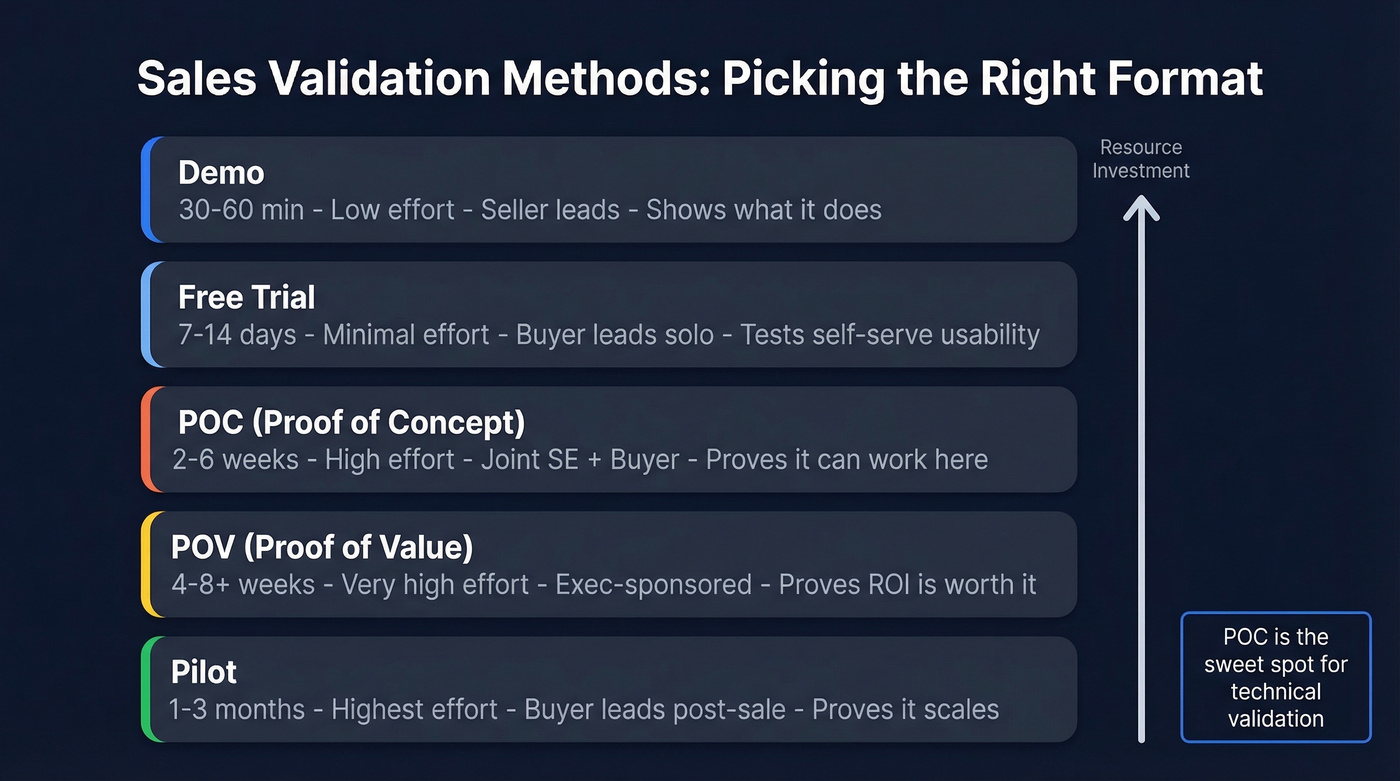
A POC answers "can it work?" with binary pass/fail criteria. A POV answers "is it worth it?" with measurable business outcomes tied to ROI. POVs take longer, cost more, and usually need an executive sponsor.
Free trials are the trap. Prospects spend minutes in the platform, don't get training, and leave with a bad impression of a product that works well when properly configured. If your product needs any enablement to reach an "aha moment," a free trial is actively hurting you.
Why POCs Convert
POCs create psychological commitment that makes walking away feel expensive. Two behavioral economics principles are at work here. The endowment effect means prospects overvalue what they help create - after two weeks configuring your tool with their data, that sandbox isn't just a test anymore. It's their implementation. Then loss aversion kicks in: after investing 40+ hours of team time, walking away means admitting that investment was wasted.
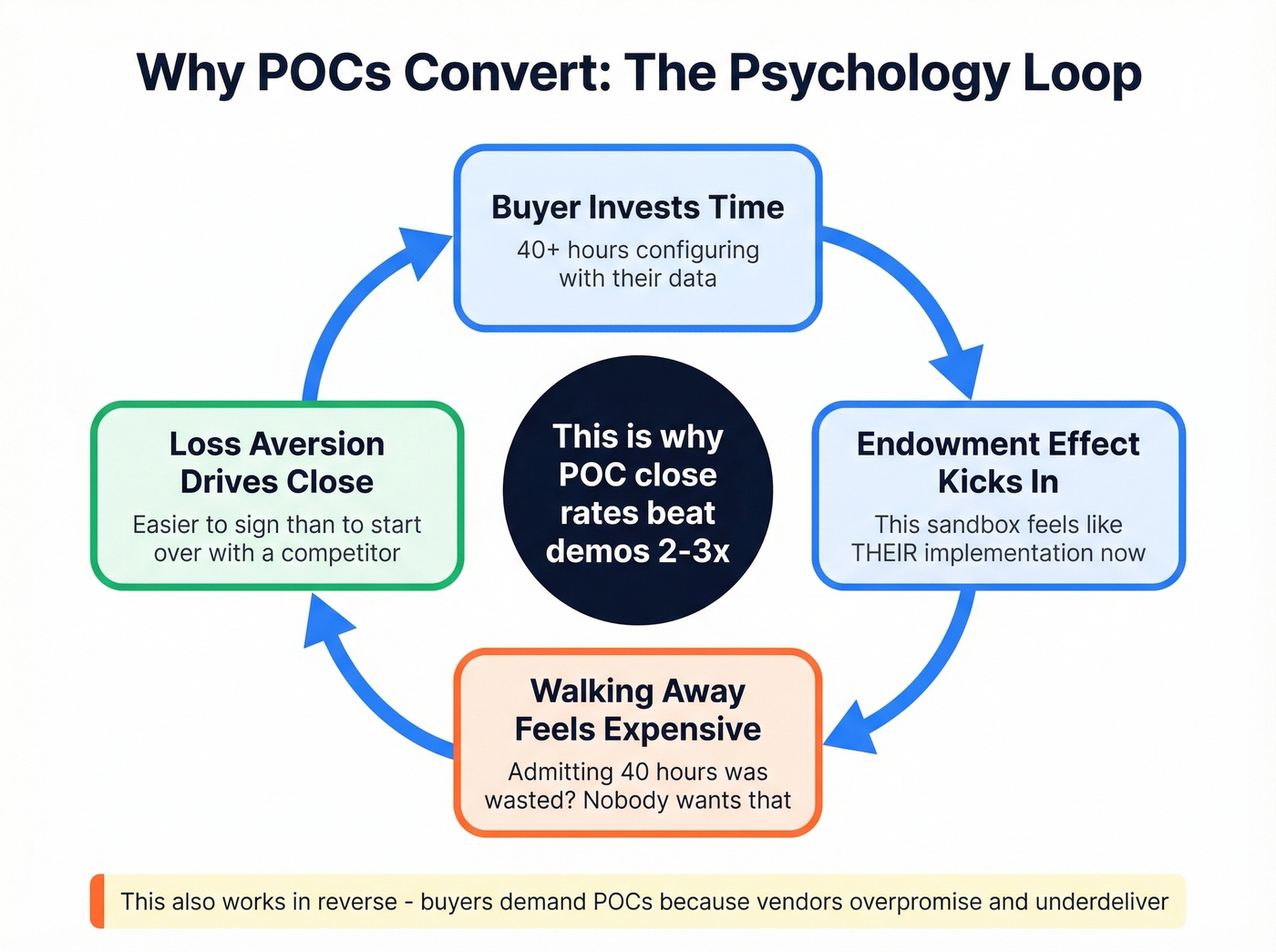
This is also why buyers demand POCs. The vendor overpromise problem is well-documented on Reddit - sales says "yes it can do that," delivery says "not available, needs customization," and the buyer eats paid change requests after signing. Proof of concept engagements exist because buyers got burned.
When to Run One (and When to Say No)
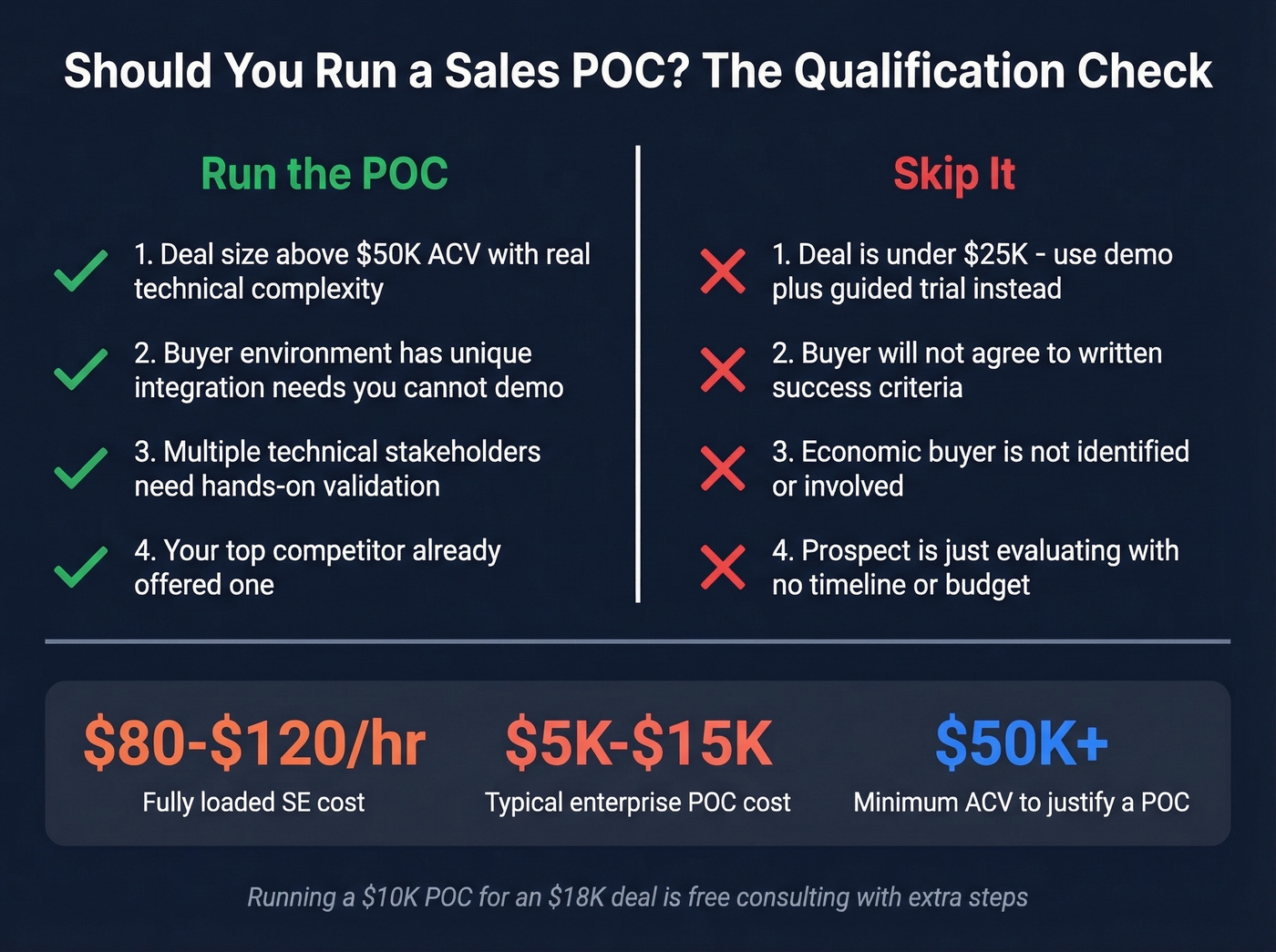
Run a POC when:
- Deal size exceeds $50K ACV with genuine technical complexity
- The buyer's environment has unique integration requirements you can't demo
- Multiple technical stakeholders need hands-on validation
- Your top competitor already offered one
Skip the POC when:
- The deal is under $25K - use a demo plus a guided trial instead
- The buyer won't agree to written success criteria
- The economic buyer isn't identified or involved
- The prospect is "just evaluating" with no timeline or budget
A senior SE runs $80-$120/hr fully loaded. A typical enterprise POC consumes 40-80 hours of SE time, totaling $5,000-$15,000 when you factor in infrastructure, project management, and opportunity cost. Running that for an $18K ACV deal is a losing proposition even if you close it.
In our experience, the $50K threshold isn't arbitrary - it's where SE cost stops eating the margin. And if a prospect won't agree to success criteria before the engagement, they're not serious. That's the single strongest qualification signal we've found.

Your POC dies the moment you pitch it to someone who can't sign the contract. Prospeo's B2B database gives you verified emails and direct dials for economic buyers, technical evaluators, and champions - filtered by seniority, department, and 30+ other criteria. 98% email accuracy means you reach the right stakeholders before scoping a single hour of SE time.
Stop burning $10K POCs on people who can't approve the deal.
The 6-Step POC Process
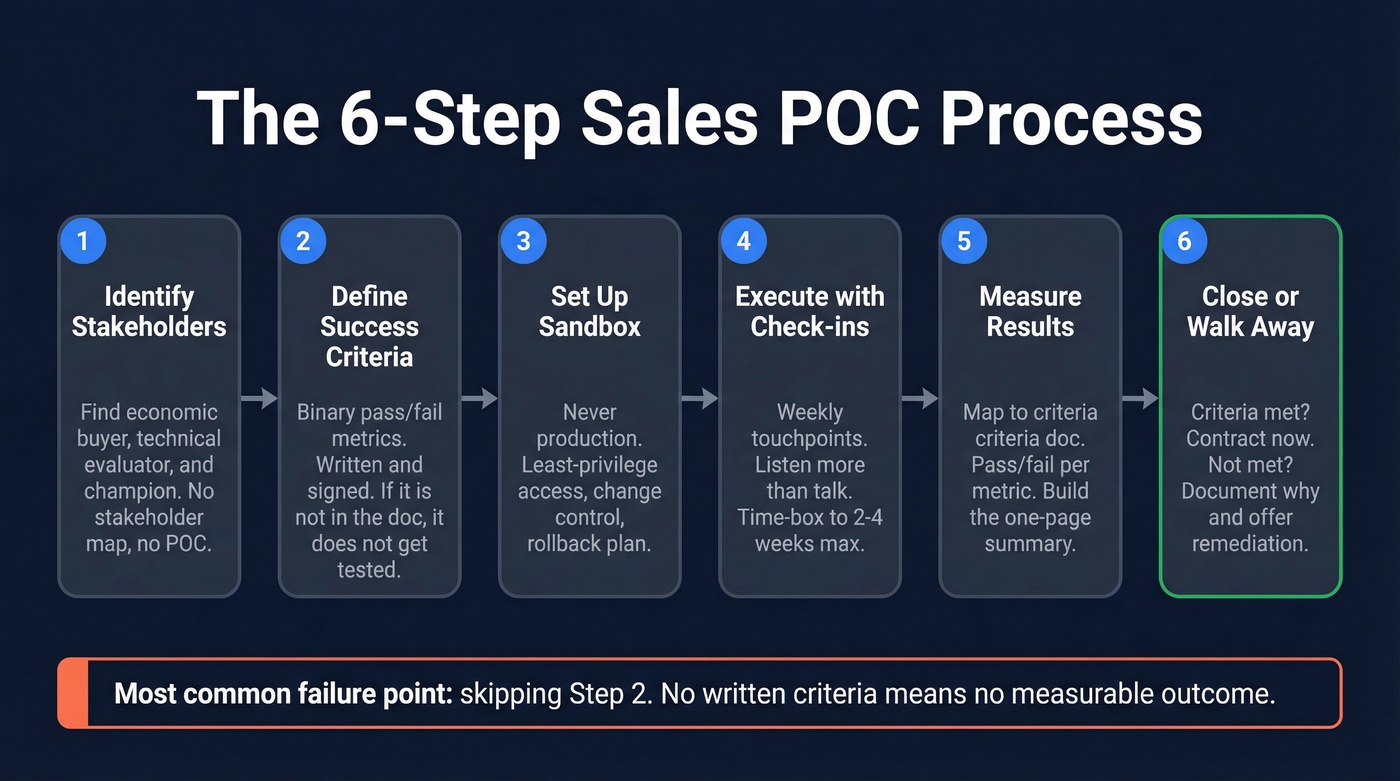
1. Identify Stakeholders
Find the economic buyer, technical evaluator, and internal champion before scoping anything. A POC evaluated by someone who can't approve the purchase dies in committee. Every time.
This is where data quality becomes a prerequisite. You need verified contact information for the right people, not whoever filled out the inbound form. Prospeo's B2B database gives you verified emails and direct dials for the right stakeholders so you're not burning POC cycles on stale contacts.

2. Define Written Success Criteria
This is the most important step, and the one teams skip most often.
Criteria should be binary and SMART: the platform processes 10,000 records in under 3 minutes with less than 1% error rate - pass or fail. Include explicit in-scope and out-of-scope definitions. If it's not in the document, it doesn't get tested. We've seen teams lose six-figure deals because the buyer added "one more test" in week three that was never scoped, failed predictably, and torpedoed the entire evaluation.
3. Set Up the Sandbox
Never run a POC in production. An SE on r/salesengineers described accidentally taking down a customer's production server during a proof of concept, triggering a multi-hour incident response. That deal didn't close.
Sandbox with least-privilege access, change control, and a rollback plan. The 30 minutes you spend on environment isolation saves you from explaining to a CTO why their production database is down.
4. Execute with Check-Ins
Weekly touchpoints, not "set it and forget it." Your SE should be actively removing blockers and gathering feedback. Top-closing reps speak 43% of the time versus 65% for average performers - during check-ins, listen more than you talk. The buyer's questions tell you exactly where the deal stands. Time-box the entire engagement to 2-4 weeks.
5. Measure Against Criteria
Map results directly to the criteria document. No subjective "it felt good." Build a results document with pass/fail per criterion and supporting data. This becomes your closing weapon - when the economic buyer asks "did it work?", you hand them a one-page summary with green checkmarks next to every criterion they defined.
6. Close or Walk Away
If criteria are met, transition immediately to contract negotiation with a Mutual Action Plan. Don't let momentum die - the endowment effect is strongest right after a successful proof of concept.
If criteria aren't met, document exactly why and offer a remediation plan if the gap is fixable. A failed POC with clear documentation builds more trust than a vague "it didn't work out."
Sales POC Template
Every POC document needs five components:
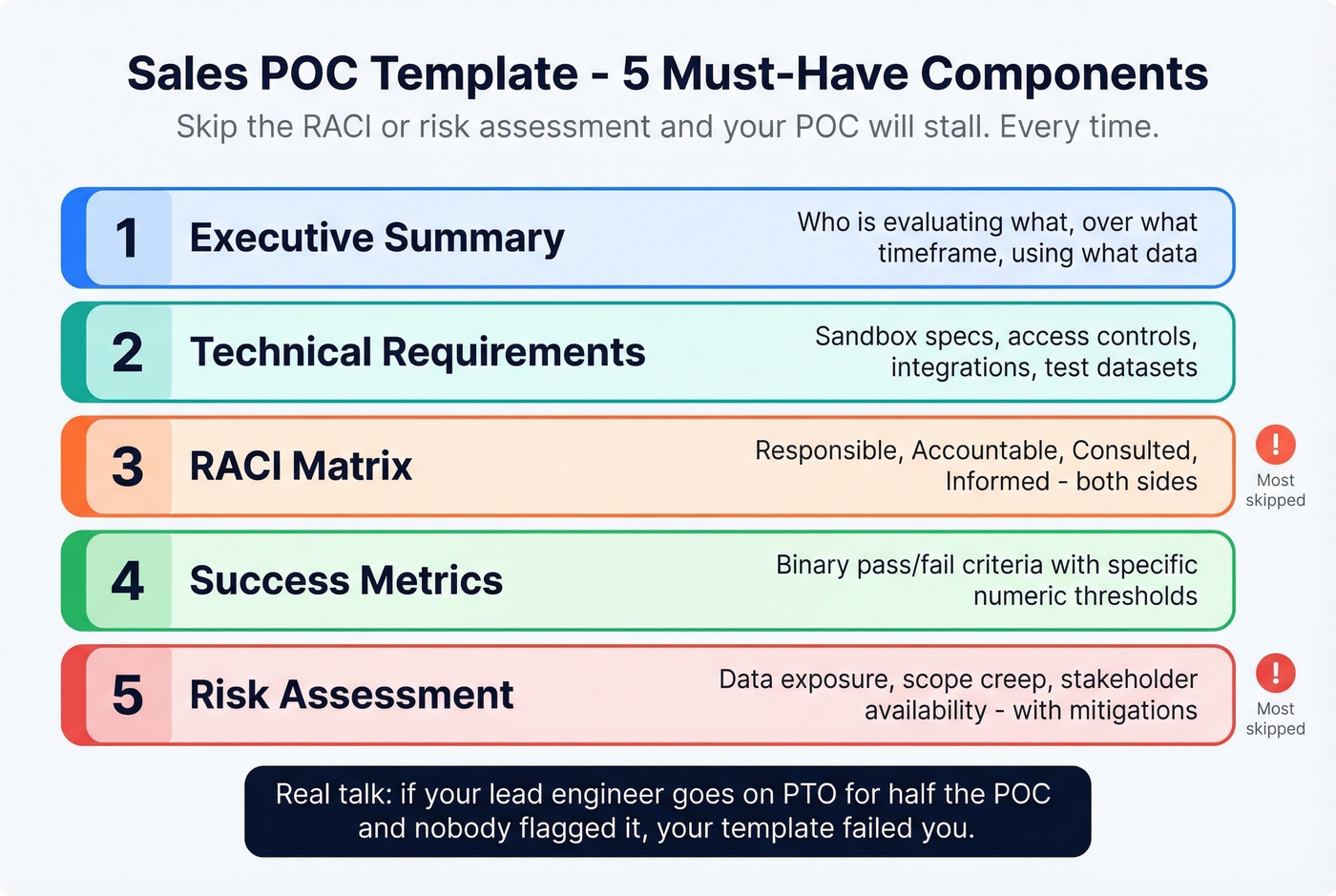
- Executive Summary - Who's evaluating what, over what timeframe, using what data
- Technical Requirements - Sandbox specs, access controls, integrations, test datasets
- RACI Matrix - Responsible, Accountable, Consulted, Informed for both sides
- Success Metrics - Binary pass/fail criteria with specific thresholds
- Risk Assessment - Data exposure, scope creep, and stakeholder availability risks with mitigations
Let's be honest: most teams skip the RACI matrix and the risk assessment. Then they wonder why the buyer's lead engineer went on PTO for two of the four POC weeks and nobody flagged it. Build the document. Use it.
Mistakes That Kill Deals
Running in production. Sandbox environments exist for a reason. No exceptions.
No written success criteria. If success isn't defined before the POC starts, it can't be measured when it ends. This is the consensus across every presales community we've participated in - and it's the number one reason POCs stall.
Scope creep. "Can we also test this one more thing?" is how a 2-week POC becomes a 6-week free consulting engagement. If you're running more than two free proofs of concept per quarter for sub-$50K deals, your qualification process is broken.
Wrong stakeholders. A mid-level manager who can't sign off on a $75K contract shouldn't be your primary evaluator. If the economic buyer isn't at least informed, you're building a case for someone who can't act on it.
The Paid POC Strategy
Look - if you're giving away POCs for free on every deal, you're training buyers to treat your SE team as free consultants.
Champify's approach is worth studying. They offer a 15-month agreement with a 3-month paid opt-out period. CEO Todd Busler reports that 14 out of 15 participants converted into long-term customers. We've seen paid opt-out structures roughly double conversion rates on enterprise deals. The math is straightforward: prospects who put money down are prospects who've already decided they're serious.
For teams selling below the $50K threshold, skip the formal POC entirely. A well-structured demo with a 14-day guided trial - where your team provides async support and checks in twice - gets you 80% of the validation at 10% of the cost.
Reaching the Right Stakeholders
Your proof of concept is only as good as the stakeholders evaluating it. If your contact database refreshes on a six-week cycle, you're reaching people who've changed roles, left the company, or moved departments. That's how you end up running a POC for a "VP of Engineering" who's been an IC for two months.
Prospeo refreshes data every 7 days and includes 125M+ verified mobile numbers, so you're starting with direct dials instead of gatekept switchboards. When you're investing $5K-$15K in a proof of concept engagement, stale contacts aren't just inefficient - they're the kind of mistake that kills the deal before it begins.
If you're tightening qualification before committing SE hours, align your POC gate with a clear sales qualification framework and document who owns each step in your sales process.
Every POC starts with identifying the right people - and bad contact data is the fastest way to waste your SE team's time. Prospeo delivers 143M+ verified emails and 125M+ verified mobiles, refreshed every 7 days. At $0.01 per email, qualifying your POC stakeholders costs less than a single hour of SE time.
Verify every contact in your deal before you scope the POC.
FAQ
How long should a sales POC last?
Two to four weeks for enterprise deals; one to two weeks for SMB. Anything beyond six weeks signals scope creep or lack of buyer commitment - tighten your success criteria or walk away.
Should a POC be free or paid?
For deals above $50K ACV, use a paid opt-out structure - Champify reports 93% conversion with this model. Below $25K, skip the POC entirely and offer a guided trial instead.
What's the difference between a POC and a POV?
A POC answers "can it work?" with binary pass/fail criteria in 2-6 weeks. A POV answers "is it worth it?" with measurable ROI outcomes over 4-8+ weeks, typically requiring executive sponsorship.
What if the POC fails?
Document which success criteria weren't met and why. Offer a remediation plan if the gap is fixable within one sprint, or walk away cleanly - transparent failure keeps the door open for re-engagement next quarter.
How do you find the right stakeholders for a POC?
Map three roles before scoping: economic buyer, technical evaluator, and internal champion. Verify current titles and direct contact details using a platform that refreshes weekly - role changes happen fast, and a POC run for the wrong person wastes $5K-$15K in SE time.