

Digital Sales Room: What It Is, What It Costs, and Why Half Fail
Your AE sent a proposal last Tuesday. Radio silence. The champion who was "super excited" hasn't opened the doc, replied to the follow-up, or forwarded anything to procurement. Every digital sales room vendor says their tool fixes this - a beautiful, centralized deal room that keeps buyers engaged and deals moving.
The data tells a messier story.
What Is a Digital Sales Room?
Gartner defines digital sales rooms as "private, persistent microsites" that connect buying and selling teams throughout the customer journey, combining content, commerce, and planning tools into a single shared space. You'll also hear them called deal rooms, virtual deal rooms, DSRs, or sales microsites - same concept, different branding.
One important distinction: a DSR isn't a virtual data room. VDRs are security-heavy environments built for M&A due diligence and legal compliance. DSRs are buyer-facing collaboration spaces designed to push sales deals forward. If you're closing a $200k SaaS deal, you want a DSR. If you're selling a company, you want a VDR.
Why DSRs Matter in 2026
The global market hit $1.2 billion in 2024 and is projected to reach $6.5B by 2033 - a 20.7% CAGR. North America accounts for 38% of that spend, with APAC growing fastest at 24.3%.
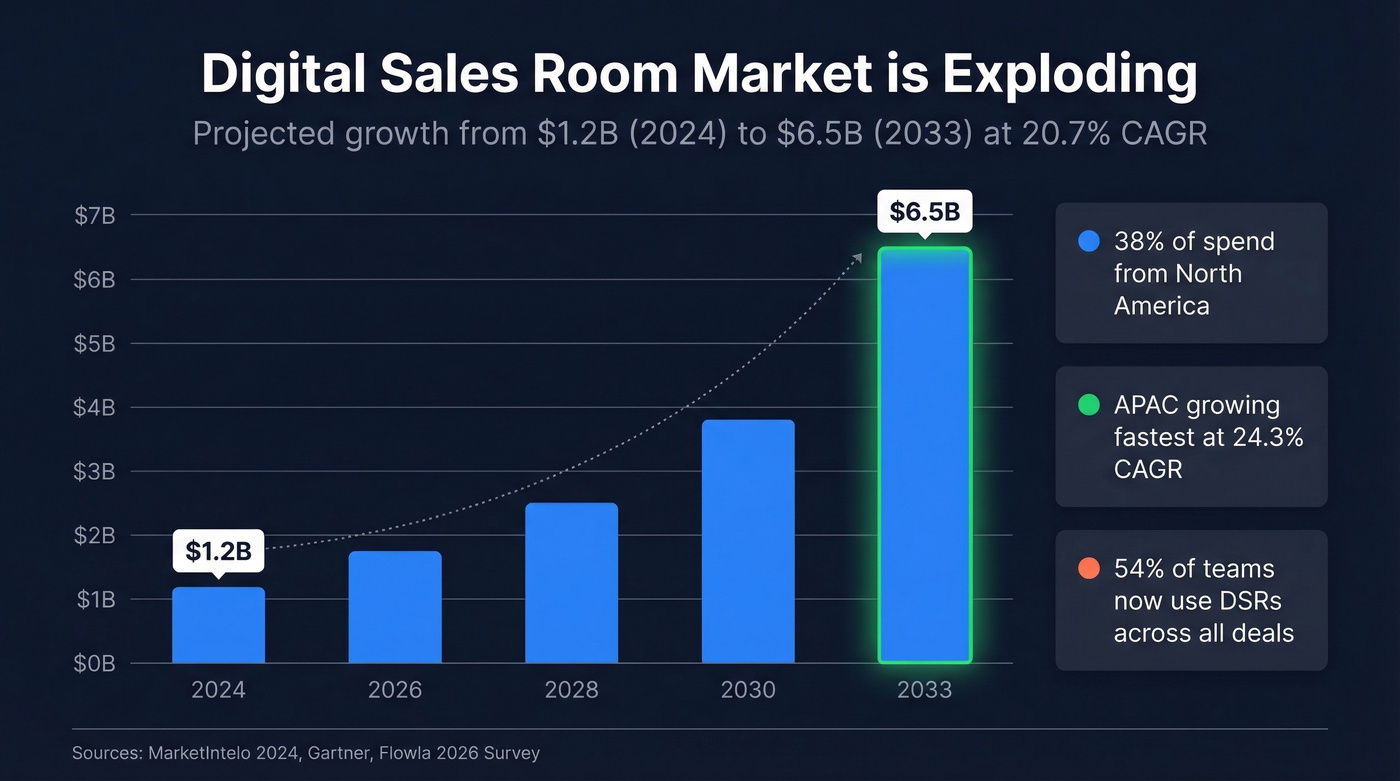
Gartner's "Innovation Insight for Digital Sales Rooms" report predicted that 30% of B2B sales cycles would be managed through DSRs by 2026. A Flowla survey of 100+ practitioners found that 54% now use them across all deals, suggesting we're at least in the ballpark. The category has crossed from "emerging" to "mainstream."
The Reality Check: 48% Never Get a Buyer View
Adoption doesn't mean engagement. That same Flowla survey - and HummingDeck's 2026 comparison - found that roughly 48% of deal rooms created never receive a single buyer view. Nearly 30% of sales professionals have never used a DSR at all. And at least one r/sales thread questions what these platforms add beyond tools like Zoom or Google Meet. Three failure modes keep showing up:
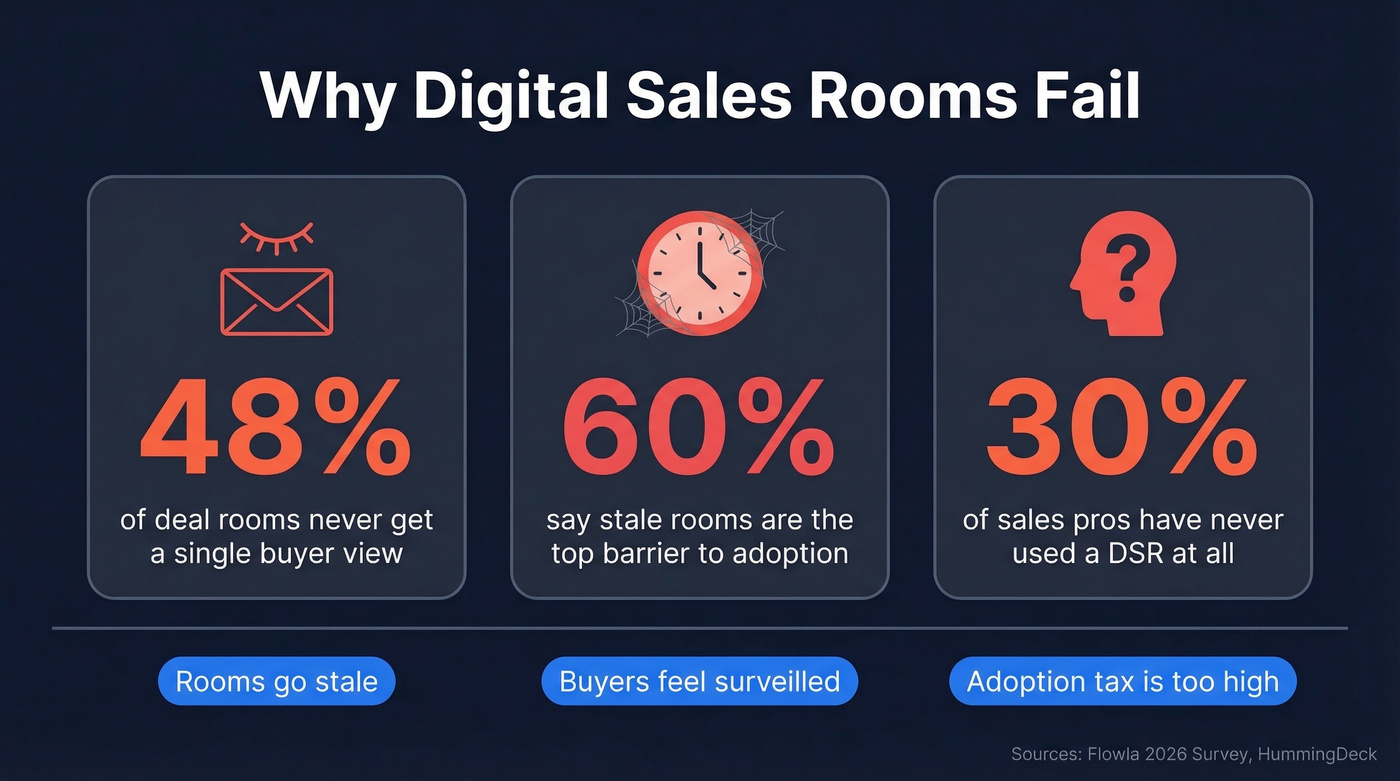
Rooms go stale. 60% of practitioners cite this as the top barrier. We've seen teams abandon DSRs within a month because nobody updated the content after discovery.
Buyers get uncomfortable with the surveillance. When every click is tracked and timestamped, some champions hesitate to share the room internally. That's a real tension - the analytics are the whole point for sellers, but they can feel invasive to buyers who didn't ask for a tracking pixel on their reading habits.
There's the adoption tax. Your champion has to teach their buying committee how to use yet another platform. Login-gating makes this worse - requiring an account to view content kills engagement before it starts.
Here's the thing: if your average deal involves fewer than three stakeholders and closes in under 30 days, you probably don't need a deal room. A well-structured email thread and a shared Google Drive folder will do the job. DSRs earn their keep on complex, multi-stakeholder deals where the buying committee needs a single source of truth.

48% of deal rooms never get a buyer view - and bad contact data is a silent killer. If your champion left the company three months ago, that beautiful DSR you built is dead on arrival. Prospeo refreshes 300M+ profiles every 7 days, so you're always sending to real, verified buyers.
Fix the contact data before you fix the deal room.
Features That Actually Move Deals
Not every DSR feature justifies its price tag. Skip the flashy demo and focus on what changes buyer behavior:
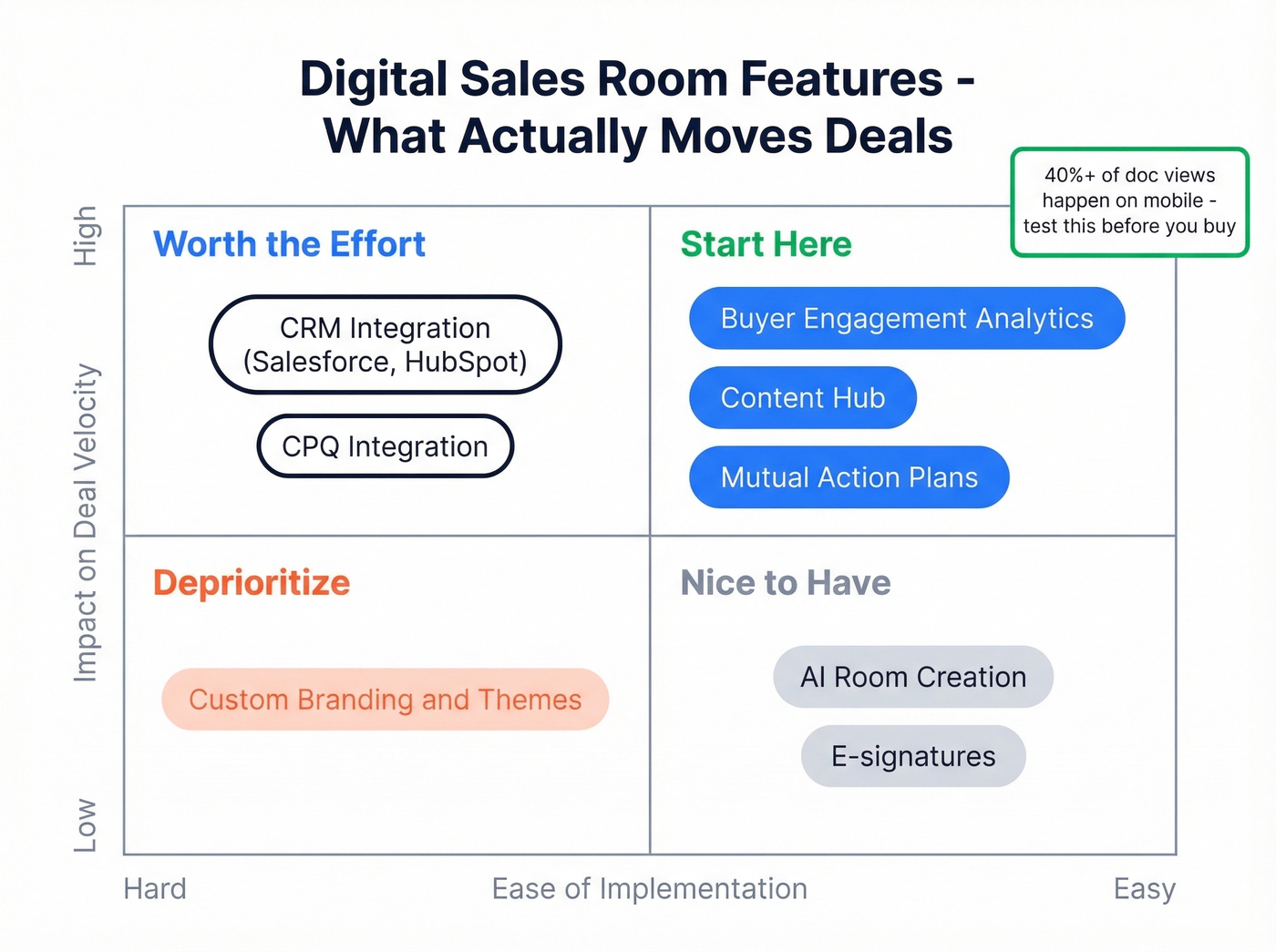
- Content hub - centralized docs, videos, case studies, and proposals in one place instead of scattered email attachments
- Buyer engagement analytics - who viewed what, when, and for how long. This is the real value; it replaces guessing with data-driven selling (and it pairs well with a clean sales process).
- Mutual action plans - shared timelines with buyer-assigned actions and deadlines
- E-signatures - close without switching to DocuSign or PandaDoc
- CRM integration - Salesforce and HubSpot sync so activity flows into your pipeline (see how to connect outreach tool to CRM)
- AI assistance - faster room creation with generated copy, structured summaries, and templates
- Security - SOC 2 Type II and GDPR compliance are table stakes for enterprise deals
One non-negotiable: 40%+ of document viewing happens on mobile. If your DSR doesn't render well on a phone, your CFO is squinting at a proposal on their commute and giving up. Test this before you buy.
What DSR Software Costs
| Tool | Free Plan | Paid Starting Price | Notes |
|---|---|---|---|
| Dock | ✅ 50 workspaces | $350/mo (5 users) | Premium $1,000/mo for 10 users |
| GetAccept | ❌ | $49/user/mo (DSR) | eSign-only at $25; product library capped at 3 in Pro |
| Aligned | ✅ Starter | $29/user/mo | G2 reviewers flag limited customization and integration gaps |
| Trumpet | ✅ 10 pods | ~£36/user/mo | Included in G2's 2026 shortlist |
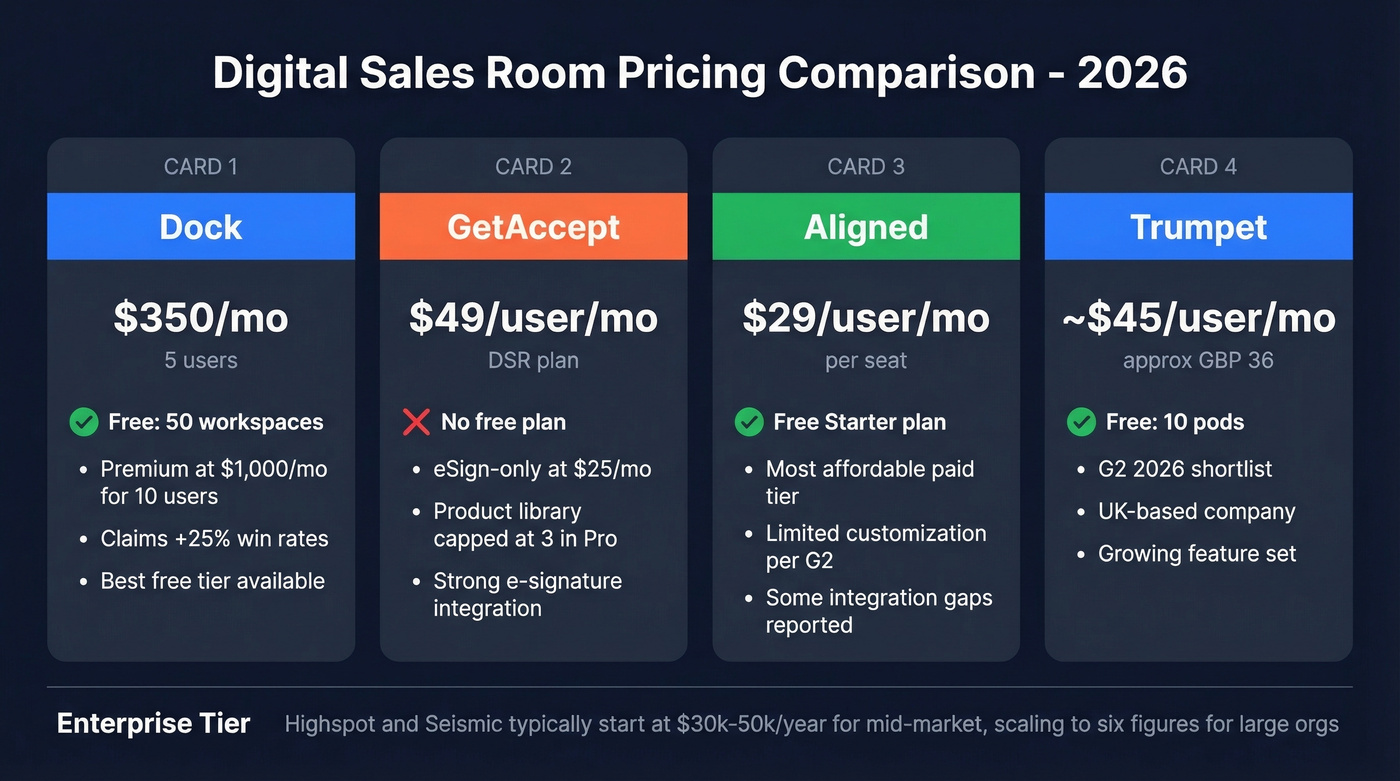
Industry-wide, expect $10-65/user/month for per-seat pricing or $99-499/month for flat team plans. Enterprise platforms like Highspot and Seismic typically start at $30k-50k/year for mid-market teams, scaling to six figures for large orgs. CPQ integration is usually the feature that pushes you into that tier.
For teams under 20 reps, start with Dock's free tier or Aligned's Starter plan. You'll know within two weeks whether buyers actually engage. Dock claims rooms built on their platform see +25% win rates and +22% more deals closed - vendor stats, but a useful benchmark if you're building a business case internally.
How to Build a Room That Gets Used
The difference between a DSR that drives deals and one that collects dust comes down to setup discipline. Here's what works in practice:
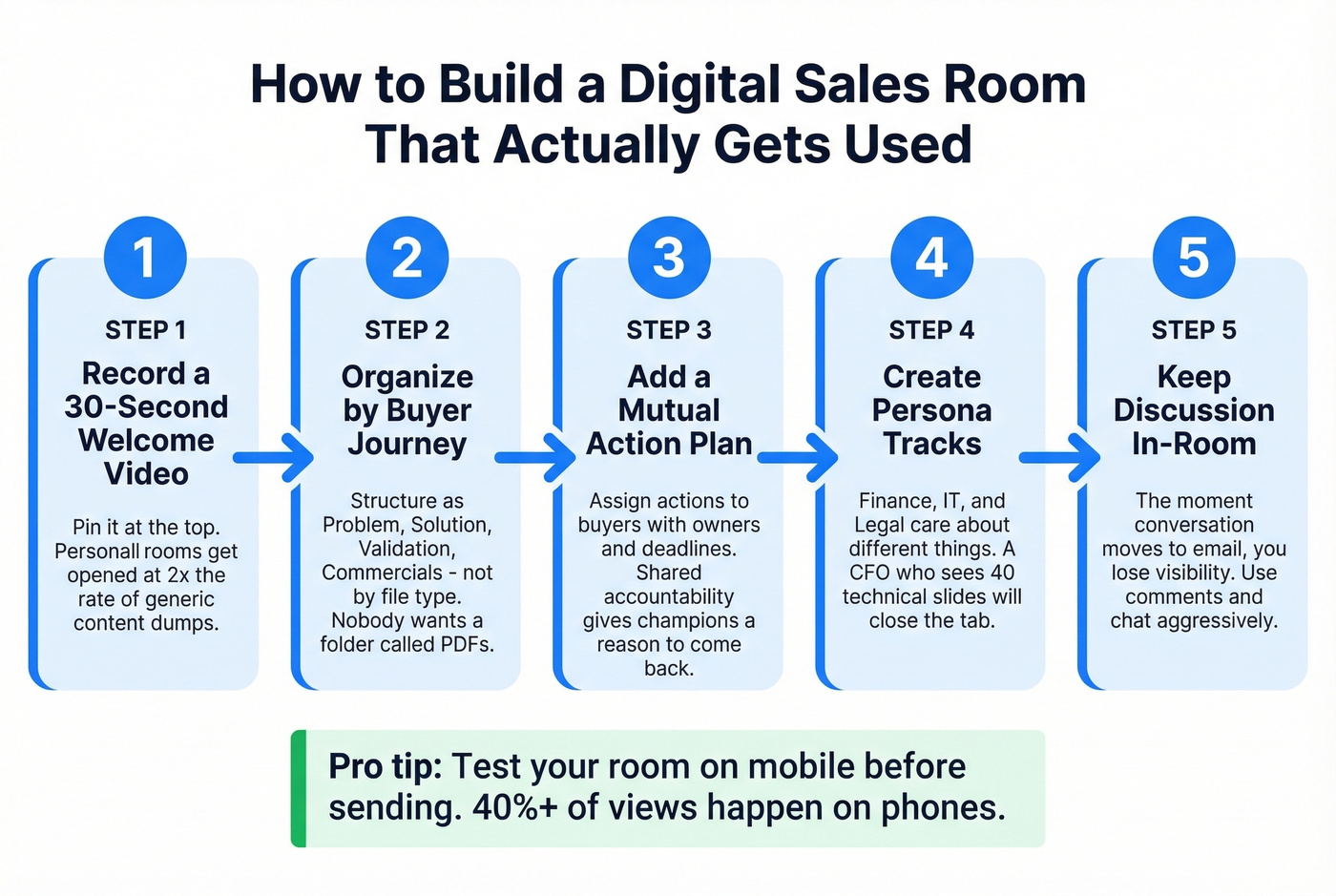
Start with a 30-second welcome video and a pinned executive summary. "Here's what we heard from you" beats a generic content dump every time. We've found that rooms with a personalized video in the first slot get opened at roughly 2x the rate of rooms that lead with a PDF.
Organize by buyer journey stage, not file type. Structure the room as Problem → Solution → Validation → Commercials. Nobody wants to dig through a folder labeled "PDFs."
Embed a mutual action plan with owners and dates. Assign actions to buyers, not just your team. This creates shared accountability and gives champions a reason to return to the room.
Create persona tracks. Finance, IT, and Legal care about different things. Separate their content so nobody drowns in irrelevant slides. A CFO who sees a 40-slide technical architecture deck will close the tab.
Keep collaboration in-room. The moment discussion moves to email, you've lost visibility. If your DSR has a comments or chat feature, use it aggressively (and tighten your sales communication norms so it sticks).
Your Contact Data Has to Be Right First
Let's be honest about the biggest DSR failure nobody talks about: sending the link to the wrong person.
You built a beautiful deal room with a mutual action plan, a personalized video, and three case studies. The link went to a prospect who left the company two months ago. The room sits empty and you blame the tool. We've watched this happen more times than we'd like to admit - a team spends hours on a deal room, then sends it to a bounced email address because their CRM data was six months stale.
The digital sales room is the last mile. Before you invest in a DSR platform, make sure the people you're inviting still work there. Prospeo verifies emails in real time with 98% accuracy and refreshes records every 7 days, compared to the 6-week industry average. The free tier lets you validate 75 contacts a month without a contract or a sales call. If you're evaluating vendors, start with a quick scan of data enrichment services and your best contact management software options.
You just built a perfect digital sales room with persona tracks, a mutual action plan, and a welcome video. None of it matters if you're emailing the wrong stakeholder. Prospeo delivers 98% email accuracy and 125M+ verified mobiles - so your DSR link reaches the actual buying committee, not a bounced inbox.
Stop building deal rooms for people who already left the company.
FAQ
Is a DSR the same as a virtual data room?
No. Virtual data rooms handle M&A due diligence and legal compliance with heavy security controls. A DSR is a buyer-facing collaboration space built to move sales deals forward - think shared content, action plans, and engagement tracking rather than document escrow.
Do buyers actually use deal rooms?
54% of teams now deploy them across all deals, but 48% of rooms never receive a single buyer view. The gap comes down to setup quality. Rooms with a welcome video, a mutual action plan, and persona-specific content see significantly higher engagement than generic content dumps.
What's the cheapest DSR tool in 2026?
Dock offers 50 free workspaces and Trumpet gives you 10 free pods. For paid plans, Aligned starts at $29/user/month - roughly 80% of enterprise functionality at a fraction of the cost of Highspot or Seismic.
How do I keep contact data accurate before sharing a room?
Use a verification tool that refreshes records frequently. Stale data is the silent killer of deal room engagement - if your champion changed jobs last quarter, your beautiful DSR is sitting in an abandoned inbox. Tools like Prospeo run a 5-step verification process on a 7-day refresh cycle, returning 98% accuracy so the stakeholders you invite are still at the company and reachable.