

Sales Communication: What the Data Says Actually Works in 2026
You've had that call - the one that felt perfect. Great energy, real rapport, the prospect was laughing at your jokes. Then they ghosted. You pulled the recording. You talked 65% of the time.
96% of prospects research before they'll take your call, and 71% prefer doing their own homework over talking to sales. The rules changed. Most teams didn't notice. What works in sales communication today isn't charm or persistence - it's precision backed by numbers. And the biggest problem isn't how you talk. It's whether you're reaching the right person at all.
The Quick Version
If you take nothing else from this piece, nail these three things:
- Get your talk-to-listen ratio under 57%. Analysis of 326K sales calls shows closed-won reps talk 57% of the time. Lost deals? 62%. That 5-point gap is worth real money.
- Multi-thread every deal over $50K. Win rates jump 130% when you engage multiple stakeholders. Single-threaded deals die in committee.
- Fix your contact data before you fix your pitch. Reps lose 27.3% of their time to bad numbers and dead emails. Verify contacts before you dial so your skills actually reach a human.
Numbers Behind Great Conversations
The average sales call runs a 60/40 talk-to-listen split. That's also what losing looks like.
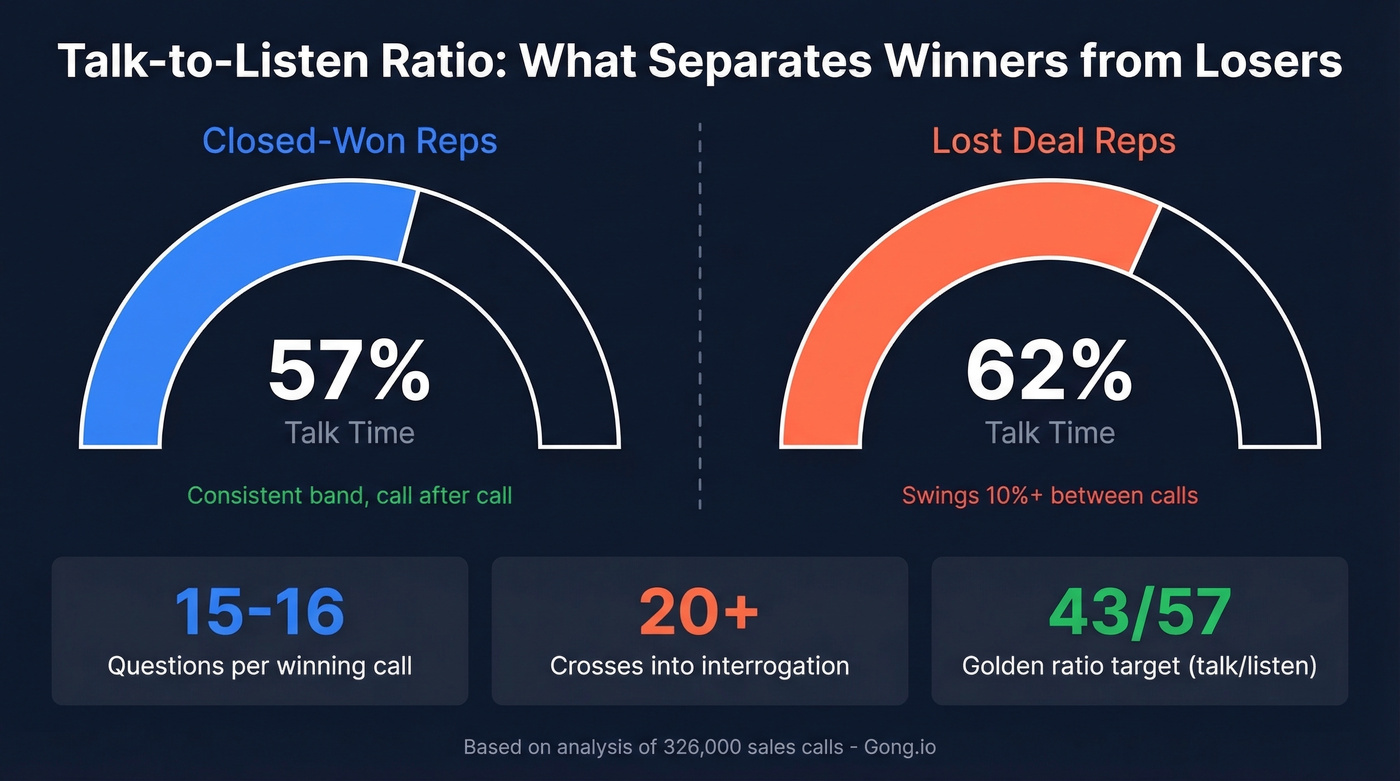
Gong's 326K-call dataset tells a cleaner story. Reps who closed deals talked 57% of the time. Reps who lost talked 62%. The old "golden ratio" of 43% talk / 57% listen still holds as the target, but the real insight isn't the number - it's the consistency. High performers stay within a tight band regardless of outcome, while low performers swing 10% or more between calls, hitting 54% talk when they win and 64% when they lose. That volatility signals a rep who's reactive, not in control of the conversation.
Every experienced sales leader eventually gives the same advice in different words: shut up and listen. The data backs it up. But questions matter too - winners ask 15-16 per call. Go past 20 and you've crossed into interrogation territory. Fewer, better questions that open real dialogue beat checking boxes on a discovery template every time.
Core Skills That Move Deals
Vantage Partners frames it well: the first 80% of sales success is preparation and enablement. The last 20% - the actual conversation - makes or breaks the deal. Most reps over-invest in the 80% and wing the 20%.
Active Listening
This isn't just "shut up and nod." It's hearing the thing behind the thing. When a prospect says "we're evaluating a few options," the average rep moves to differentiation. The great rep asks what's driving the evaluation now. We've seen this pattern on hundreds of call reviews - start with what's working before digging into problems, and prospects open up faster because they don't feel interrogated from the first question.
Storytelling That Closes
Stories close deals that features can't. The best reps structure them around a simple arc: here's a company like yours, here's the problem they faced, here's what changed. No jargon, no feature lists - just a recognizable situation and a resolution the prospect can picture themselves in. (If you want to systematize this, build it into your sales deck storytelling.)
Executive Presence
How you carry yourself on video and in-person signals credibility before you say a word. It's one of the six essential consultative selling skills Vantage Partners identifies, and it's the one most reps neglect entirely. Record yourself on a Zoom call. Watch it on mute. You'll learn more in two minutes than from any coaching session.
Frameworks Worth Using
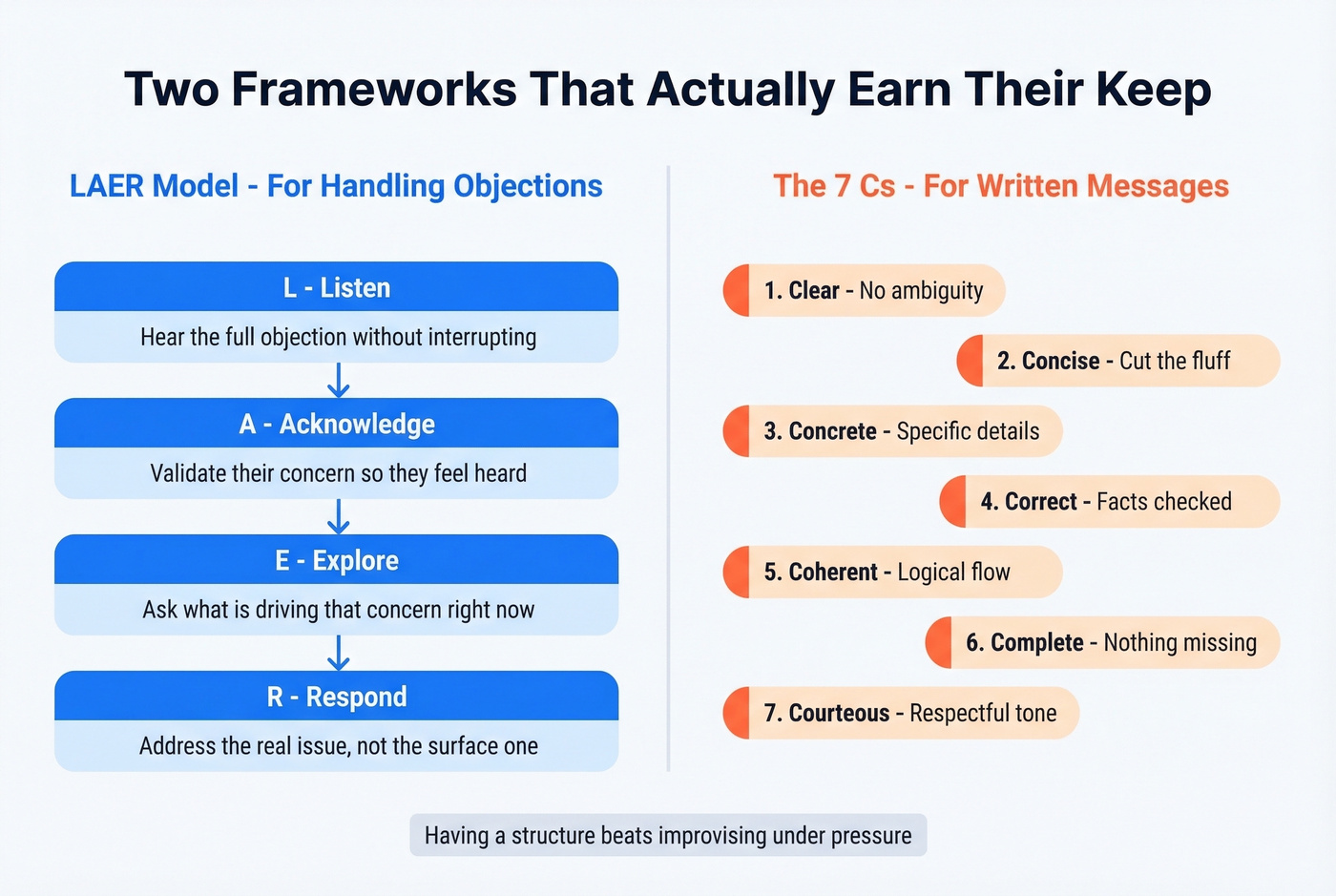
Two frameworks earn their keep in practice. The LAER model (Listen, Acknowledge, Explore, Respond) gives reps a repeatable structure for handling objections without getting defensive. The 7 Cs - clear, concise, concrete, correct, coherent, complete, courteous - work as a quick quality check on any written message before you hit send. Neither is revolutionary, but having a structure beats improvising under pressure.
Channels: Where to Invest
Here's the thing: most teams spread themselves across every channel equally and master none. Pick two, get great at them, then add a third.
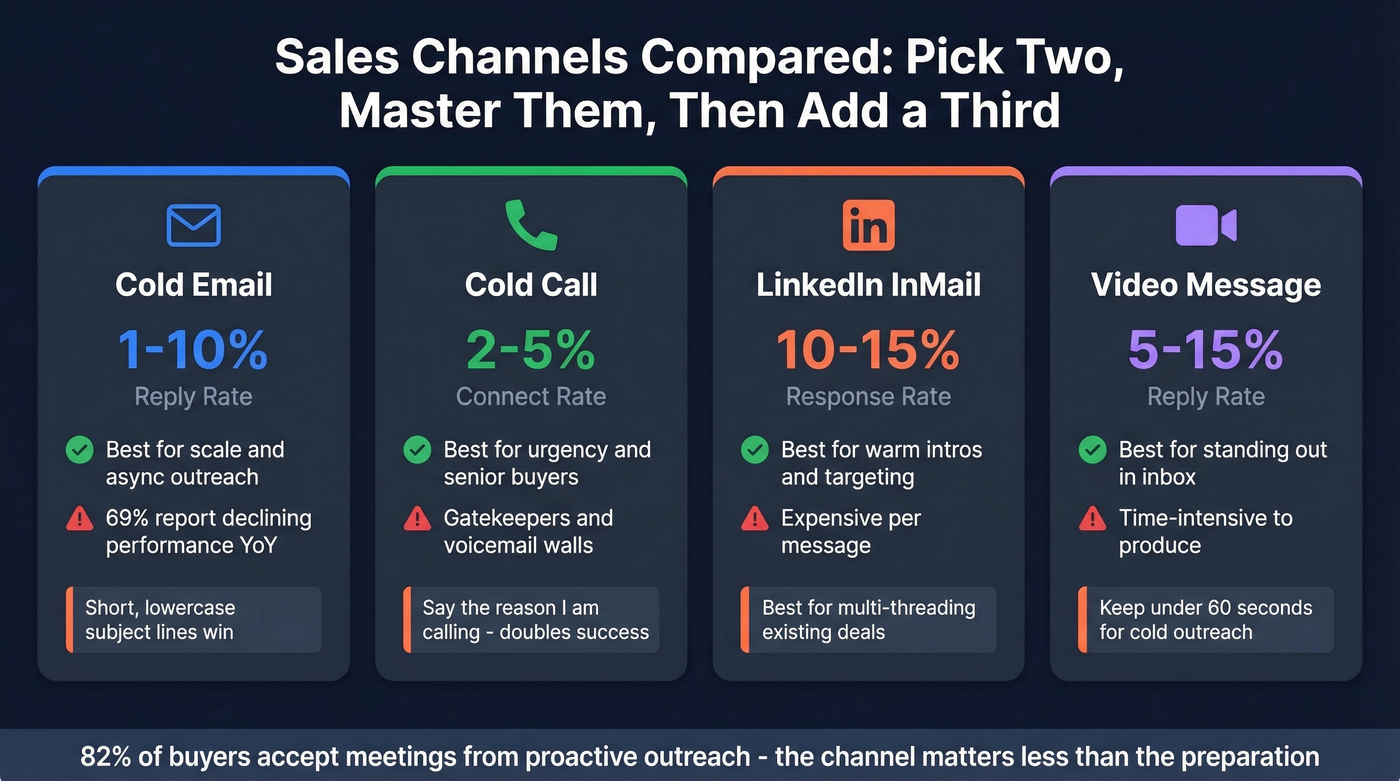
| Channel | Avg Response | Best For | Watch Out For |
|---|---|---|---|
| Cold email | 1-10% reply | Scale, async outreach | 69% report declining YoY |
| Cold call | 2-5% connect | Urgency, senior buyers | Gatekeepers, voicemail walls |
| LinkedIn InMail | 10-15% response | Warm intros, targeting | Expensive per message |
| Video | 5-15% reply | Standing out in inbox | Time-intensive to produce |
Email still works at scale, but the headwinds are real. 69% of cold email senders report declining performance year over year. The average office worker receives 121 emails per day - your cold email is competing with 120 others. Only 5% personalize every email individually. Short, lowercase, internal-looking subject lines increase open rates. And verify the address before you send: a 5% bounce rate tanks your domain reputation (see email bounce rate benchmarks and fixes).
Phone rewards preparation. 82% of buyers accept meetings from proactive outreach, and 69% accepted at least one cold call last year. Successful cold calls average 5:50 in duration versus 3:14 for failed ones. Saying "the reason I'm calling" doubles your success rate. Asking "is this a bad time?" cuts your meeting chances by 40%. Small language choices, massive impact. If you're rebuilding your motion, start with a repeatable cold calling system.
LinkedIn leads on response rates but doesn't scale the way email does. It's best for warm multi-threading - reaching the second and third stakeholders in a deal you've already opened.

Multi-threading boosts win rates 130%, but only if you can actually reach those 6-10 stakeholders. Prospeo gives you verified emails (98% accuracy) and direct dials (125M+ mobile numbers) for every member of the buying committee - not just your single champion.
Stop single-threading deals because you can't find the rest of the committee.
Multi-Threading and Team Alignment
Multi-threading is the most underrated skill in B2B selling. Almost nobody teaches it systematically, which is frustrating because the data is overwhelming.
Analysis of 1.8M opportunities found that 77% of deals involve multiple contacts. Closed-won deals have 2x as many buyer contacts as lost deals. For deals over $50K, multi-threading boosts win rates by 130%. Strategic enterprise deals average 17 contacts on the buying side.
The typical B2B buying group has 6-10 decision-makers. If you're only talking to one champion, you're not selling - you're hoping. Bringing in a sales engineer lifts win rates up to 30% on technical deals. Team selling isn't a luxury. It's how complex deals close (more on team selling).
Your strategy can't be "talk to my contact." It needs to be "map the buying committee, build rapport with at least 3-4 stakeholders, and tailor messaging to each role." Strong internal coordination between AEs, SEs, and managers keeps messaging consistent across every stakeholder touchpoint - and the consensus on r/sales is that misaligned messaging between team members kills more enterprise deals than bad discovery ever does.
Mistakes That Kill Deals
- Talking too much. 62% talk time correlates with lost deals. Past 60%, you're monologuing.
- "Is this a bad time?" Decreases meeting chances by 40%. State why you're calling instead.
- Wrong stakeholder. Failing to qualify budget authority wastes entire deal cycles (use a real sales qualification method).
- Buyer-unfriendly jargon. Your internal acronyms mean nothing to a CFO evaluating five vendors.
- Feature-dumping. Nobody cares about your architecture. They care about what changes for them.
- 20+ questions. Prospects shut down when they feel cross-examined.
- Unprepped for objections. If "we're happy with our current vendor" catches you off guard, you didn't do your homework.
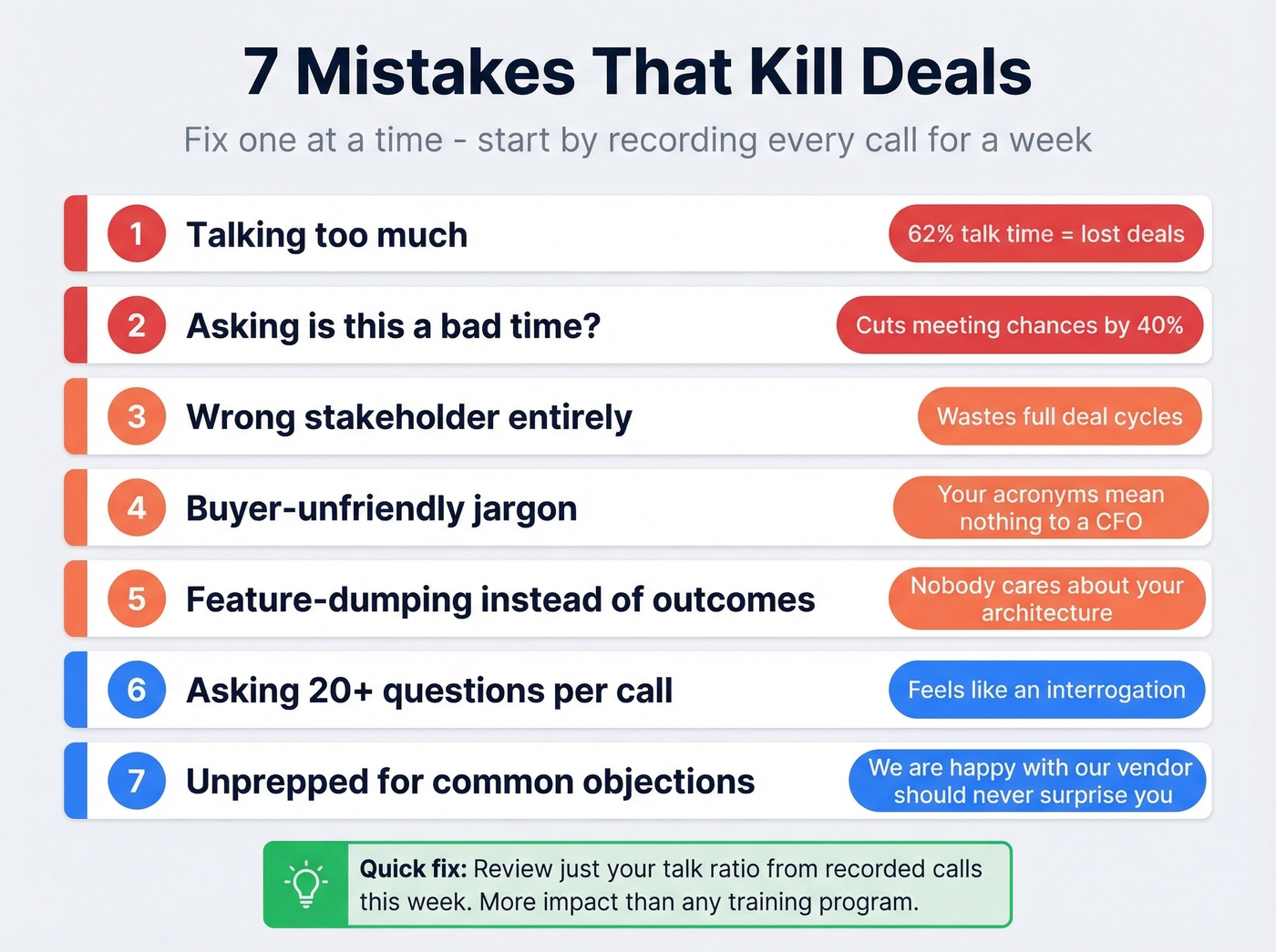
Skip the temptation to fix all seven at once. In our experience, recording every call for a week and reviewing just your talk ratio produces more improvement than any training program.
AI's Role in 2026
AI is already reshaping how top reps communicate. Analysis of 7.1M opportunities found that sellers who frequently use AI generate 77% more revenue than those who don't. That's not a marginal edge - it's a generational gap. McKinsey reports that 78% of organizations now use AI in at least one business function, and their research shows AI tools can increase leads by up to 50% while cutting acquisition costs by up to 60%.
But AI amplifies skill. It doesn't replace it. Reps who let AI draft emails without editing them sound robotic and generic - exactly the outreach prospects delete on sight. The winning pattern is AI for research, prep, and first drafts, combined with human judgment for tone, timing, and relationship nuance. Let's be honest: if your AI-generated email reads like everyone else's AI-generated email, you've gained nothing. (For a practical workflow, see AI cold email outreach.)
The Data Problem Nobody Talks About
You can master every framework in this article and still fail if you're calling dead numbers and emailing invalid addresses. Reps lose 27.3% of their selling time to bad contact data. B2B data decays at 2.1% per month - that's 22.5% of your database going stale every year.
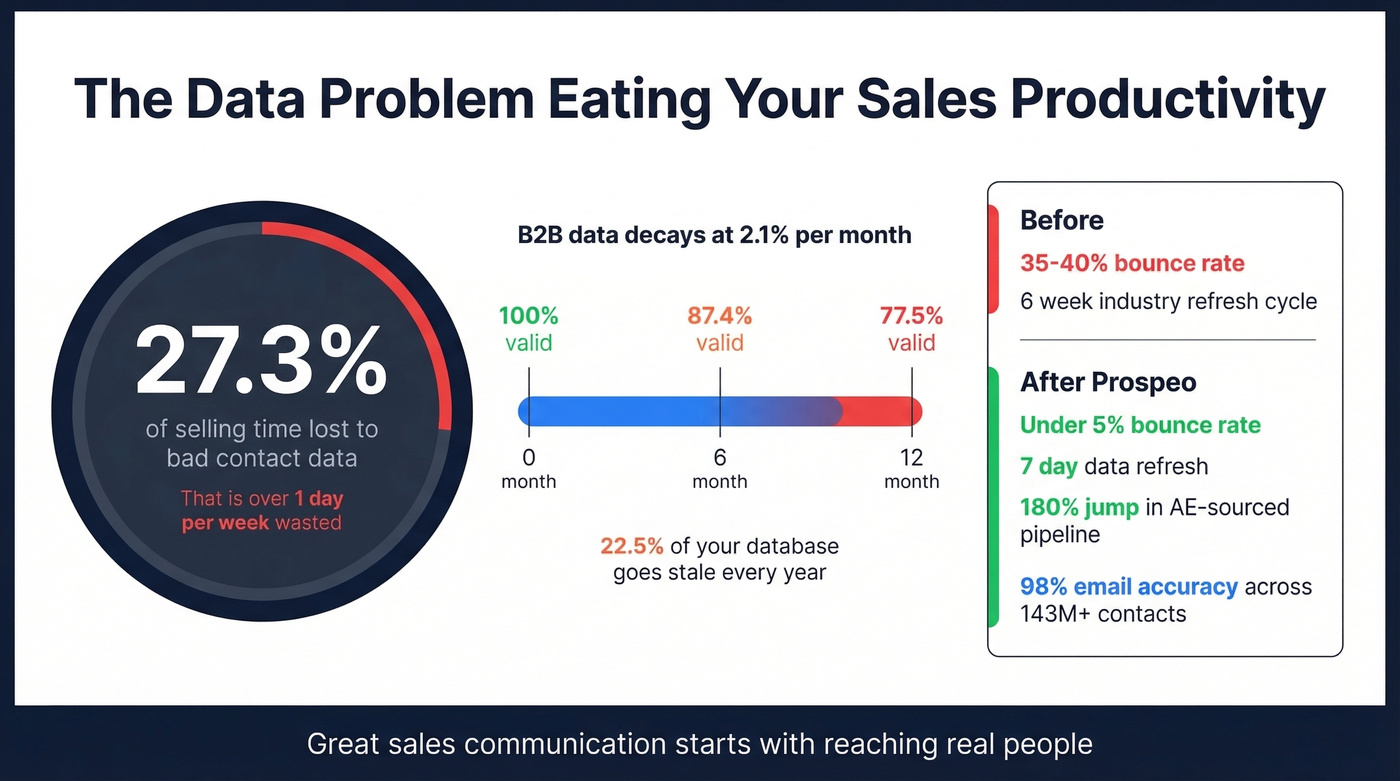
Prospeo tackles this at the source: 143M+ verified emails at 98% accuracy, 125M+ verified mobile numbers, all refreshed every 7 days compared to the 6-week industry average. When Snyk rolled it out to 50 AEs, their bounce rate dropped from 35-40% to under 5%, and AE-sourced pipeline jumped 180%. That's what happens when your outreach skills actually reach real people. If you're evaluating vendors, start with data enrichment services and an email deliverability guide so you fix the root cause, not symptoms.
69% of cold emailers report declining performance - and most of that decline is deliverability, not copywriting. Prospeo's 5-step email verification and 7-day data refresh keep your bounce rate under control so your carefully crafted messages actually land in inboxes.
Great sales communication starts with emails that don't bounce.
Building a Repeatable Playbook
Aberdeen Research found that 42% of best-in-class companies use sales playbooks versus just 14% of laggards. With 70% of reps reporting more complex processes, winging it isn't a strategy.
A playbook that actually gets used needs four things: a defined methodology (SPIN, Challenger, consultative - pick one and commit), buyer process mapping aligned to how your customer actually buys, plays recorded from your top reps rather than a consultant's theory, and channel-specific templates for email, phone, and social. Keep it digital and short. A 40-page PDF nobody reads is shelf decoration. If you need a starting point, borrow proven sales follow-up templates and adapt them to your ICP.
Top producers generate 10x more revenue than bottom producers. A 5-point shift in your talk ratio is worth more than any new tool in your stack. Record every call, review your talk-to-listen ratio weekly, and share winning clips across the team so everyone learns from real conversations, not theory. Improving your sales communication is a compounding investment - small weekly gains stack into massive quarterly results.
FAQ
What's the ideal talk-to-listen ratio?
Closed-won reps talk 57% of the time, so aim for 43% talk / 57% listen. Consistency matters more than hitting the exact number - high performers stay within a tight band while low performers swing wildly between calls.
How many discovery questions should I ask?
Ask 15-16 questions per discovery call - that's the range correlated with winning deals in Gong's dataset. More than 20 feels like an interrogation and measurably hurts close rates. Focus on fewer, deeper questions that open real dialogue.
Which outreach channel gets the best response?
LinkedIn InMail leads at 10-15% response rates. Cold email averages 1-10%, and cold calls connect 2-5%. The best teams use all three in coordinated sequences rather than relying on a single channel.
How does bad data affect outreach results?
Reps lose 27.3% of selling time to outdated contacts, and B2B databases decay at 2.1% per month. A 7-day refresh cycle and 98% email accuracy keep bounce rates under 5% - tools like Prospeo prevent your messaging skills from going to waste on dead addresses.
Does AI actually help reps sell more?
Sellers who frequently use AI generate 77% more revenue than those who don't. AI works best for research, prep, and drafting - not as a replacement for human judgment in live conversations. Edit everything before it goes out.