

RevOps Manager: What the Role Really Looks Like in 2026
Your CEO pulls up the quarterly dashboard. 500 MQLs came in last quarter. Marketing's celebrating. But only 12 turned into closed deals, and nobody can explain why. Sales blames lead quality. Marketing blames follow-up speed. CS says half the "wins" churn in 90 days because expectations were set wrong during the sales cycle.
That's the alignment mess that created the RevOps manager role.
Gartner predicted 75% of highest-growth companies would adopt a RevOps model by 2025. That prediction landed. In 2026, the question isn't "Do we need RevOps?" It's what the job actually looks like, what it pays, and how to hire (or become) someone who can do it without turning into the default CRM help desk.
What You Need (Quick Version)
- The role in one sentence: A RevOps manager unifies sales, marketing, and customer success operations under one process, tech stack, and data layer to maximize revenue efficiency.
- What it pays: $97,748.76 average base for managers and $140,708.91 average base for senior managers (ROA Salary Report 2024).
- The skill that matters most: Salesforce admin is table stakes. SQL is the differentiator - SELECT, JOIN, GROUP BY, and window functions separate you from the pack.
- When companies should hire one: The evaluation window opens around $10M ARR and runs through the scaling phase (roughly $10M-$100M ARR).
- First priority on day one: Run a data quality audit. Everything downstream - sequences, forecasts, attribution - breaks when the underlying data's wrong. Export 1,000 contacts, verify them, and measure your bounce rate before touching anything else.
What Does a Revenue Operations Manager Do?
RevOps isn't Sales Ops with a new title. That misconception leads to bad hires and miserable first quarters.
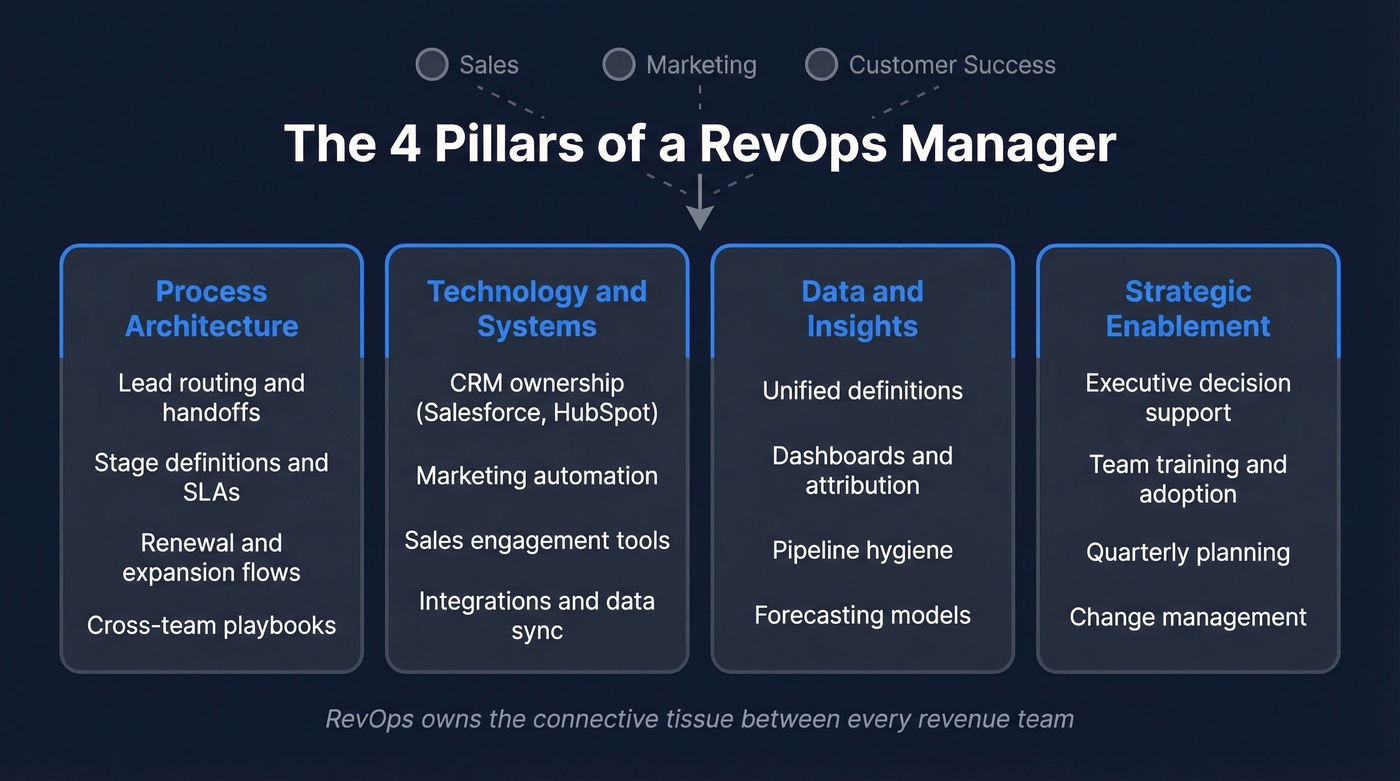
Gartner defines Revenue Operations as an "end-to-end model unifying customer engagement across functions by integrating people, processes, and technology." The key phrase is across functions. A Sales Ops Manager optimizes the sales team's tools and workflows. A revenue operations manager owns the connective tissue between sales, marketing, and customer success: the shared data model, the unified tech stack, and the processes that decide whether a lead becomes a customer and stays one.
The role usually breaks into four pillars:
- Process architecture: how leads, opportunities, renewals, and expansions move through the business
- Technology and systems: CRM, marketing automation, sales engagement, support tools, billing, integrations
- Data and insights: definitions, dashboards, attribution, forecasting, pipeline hygiene
- Strategic enablement: helping leaders make decisions and helping teams execute consistently
In practice, you're the person who designs how a lead flows from first touch to closed-won to renewal, makes sure the systems support that flow without breaking, and surfaces the data that tells leadership whether it's working.
This is a multi-team job by default. You might report to the VP of Sales, the CRO, or even the COO, but you serve the whole revenue engine. That distinction matters because it changes what you optimize for: Sales Ops optimizes win rates and rep productivity; RevOps optimizes the full revenue lifecycle.
Daily Workflow: What the Week Looks Like
Let's kill the abstraction and talk about a real week.
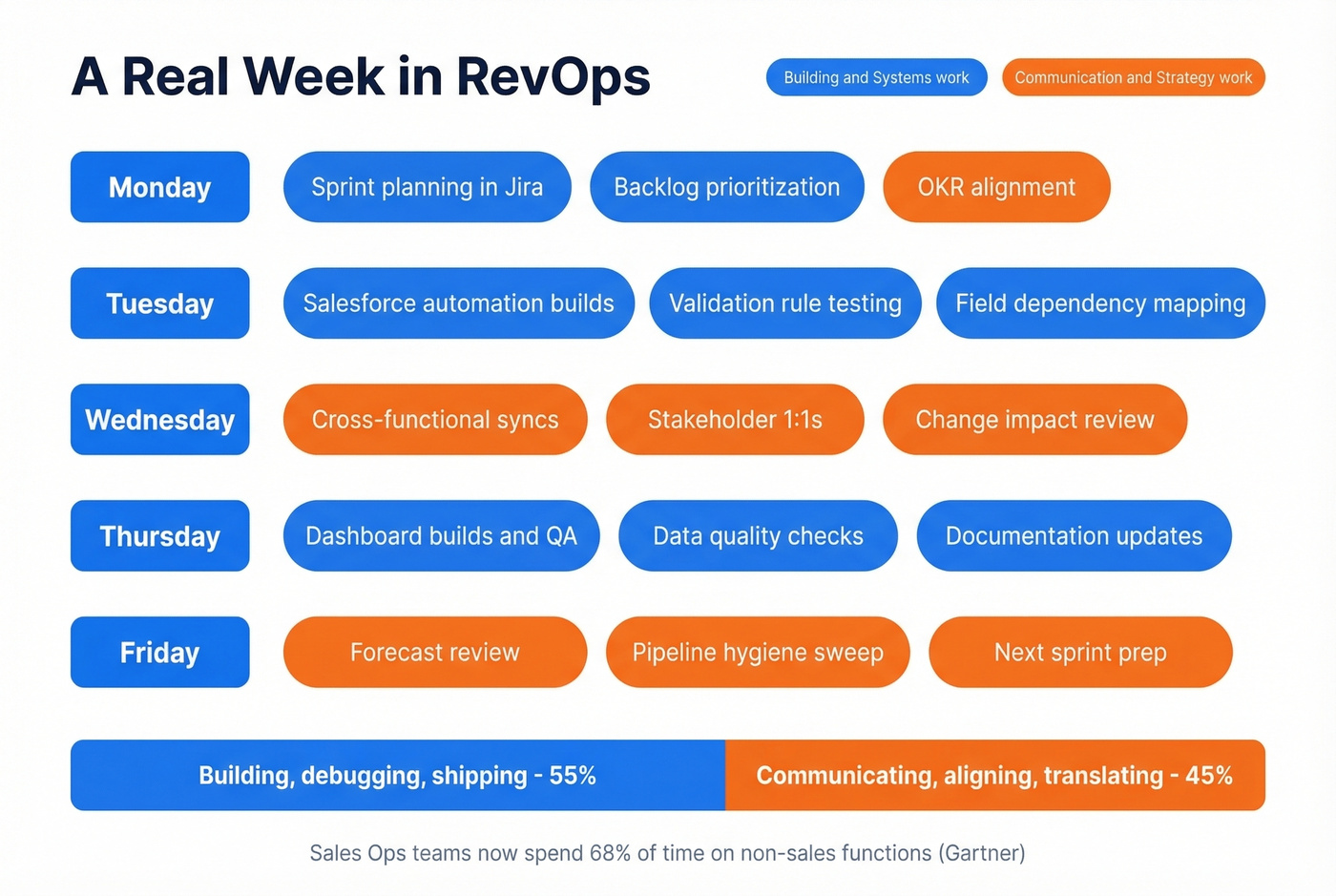
Monday often starts with sprint planning in Jira: reviewing the backlog, prioritizing work against quarterly goals and OKRs, and pushing low-urgency requests down the list. Then the week turns into a mix of building, debugging, and translating between teams that don't share the same definitions (or patience).
On the building side, you're deploying Salesforce automations, designing workflows, testing validation rules, and creating reports. One practitioner described a recent project: implementing a churn process that required a custom "Churn" object in Salesforce, automated churn logging linked to contact records, data integrity rules that update related fields, auto-association of open renewal opportunities, and a permission set governing access.
That's not "strategy deck" work. That's hands-in-the-system engineering, and it has to be done carefully because one sloppy field change can break attribution, CS workflows, and exec reporting in the same afternoon.
On the communication side, you're running weekly 1:1s with stakeholders and cross-functional syncs. Here's the thing most people underestimate: a single CRM change - say, modifying opportunity types - cascades into marketing reporting, customer handoffs, and forecasting logic. You have to map dependencies before you ship anything, document the change, and then deal with the inevitable "why did my dashboard change?" messages.
Gartner found Sales Ops teams now spend 68% of their time on non-sales functions, up from 39% in 2019. That's why the RevOps title exists: the scope already expanded beyond sales. The title just caught up.
Ask anyone in this role what keeps them up at night, and you'll hear two answers: data quality and stakeholder alignment. They don't go away as you scale; they get more expensive. And look, it's frustrating how often RevOps gets treated like "the CRM admin with better branding." The skill that fixes that isn't another tool. It's saying no, clearly, with receipts.
Key Metrics and Goals
A RevOps scorecard looks different from a Sales Ops dashboard. Here's the core set most teams end up using:
| Metric | Formula / Definition | Target Range |
|---|---|---|
| Weighted Pipeline | (# deals) x ACV x Win Rate | Varies by stage |
| Sales Velocity | Pipeline Value / Avg Cycle Length | Higher = better |
| CAC:CLV Ratio | Customer Acquisition Cost / Lifetime Value | 1:3 or better |
| Forecast Accuracy | Actual vs. Predicted Revenue | +/-10% variance |
| S&M Efficiency | S&M Spend per $1 New ARR | $2.00 median |
| MoM MRR Growth | Monthly recurring revenue growth rate | 10-20% (early stage) |
Let's make one of these real. If your pipeline is $1.5M and your average sales cycle is 120 days, your sales velocity is $12,500/day. That becomes your baseline, and you improve it by shortening cycle length, increasing ACV, improving win rates, or (usually) fixing stage hygiene so the number isn't fantasy.
The CAC:CLV ratio gets the most boardroom attention. Best-in-class companies target at least 3:1, meaning every dollar spent acquiring a customer returns three dollars in lifetime value. If you're below that, you don't have a "marketing problem" or a "sales problem." You have a revenue system problem.
Forecast accuracy is the metric that builds or destroys your credibility with leadership. Miss by 20% two quarters in a row and nobody trusts your pipeline data. Keep it within 10% and you become the person the CEO calls before board meetings.
RevOps Manager Salary in 2026
Let's talk money. The ROA Salary Report provides clean base-pay benchmarks, and it's still one of the more useful references for RevOps comp.
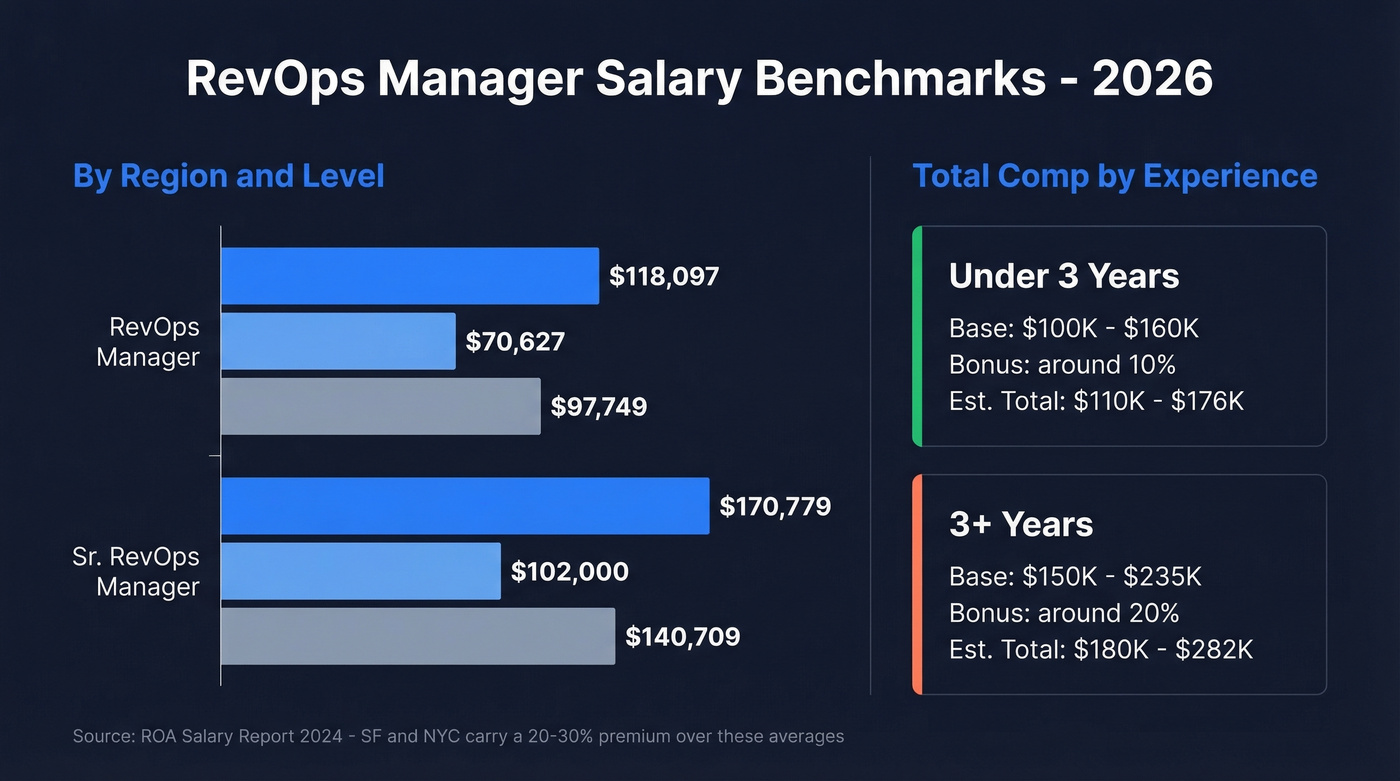
ROA Salary Report (Base Pay)
| Level | Global Avg Base | North America Base | Europe Base |
|---|---|---|---|
| RevOps Manager | $97,748.76 | $118,097 | $70,627 |
| Sr. RevOps Manager | $140,708.91 | $170,778.57 | $102,000 |
Experience Bands (Base + Typical Bonus)
| Experience | Base Range | Typical Bonus | Est. Total Comp |
|---|---|---|---|
| <3 years | $100K-$160K | ~10% | $110K-$176K |
| 3+ years | $150K-$235K | ~20% | $180K-$282K |
Geography matters more than most people expect. Someone in this role in San Francisco can land around $130K base, while the same job in a lower-cost market lands closer to $90K. SF and NYC often carry a 20-30% premium. Company size drives a similar wedge: startups under 50 employees tend to pay lower cash (sometimes with meaningful equity), while 1,000+ employee companies pay more cash and often have clearer bonus bands.
The real jumps come from promotions and equity, not 3% annual raises. Bonus structures for managers usually land in the 10-20% range, and senior roles increasingly include equity or profit-sharing.

The article says your first RevOps priority is a data quality audit. Export 1,000 contacts and check your bounce rate. Prospeo makes that easy - 98% verified email accuracy, 7-day refresh cycles, and CRM enrichment returning 50+ data points per contact at 92% match rate. Fix the foundation before you build anything else.
Run your first data quality audit in minutes, not weeks.
Career Path: Analyst to VP
| Title | Salary Range (Base) | Typical Timeline |
|---|---|---|
| RevOps Analyst | $55K-$90K | Entry point |
| RevOps Manager | $100K-$235K | Analysts often advance within 1-2 years |
| RevOps Director | $140K-$215K | 3-5 yrs from manager |
| VP / CRO | $180K-$400K+ | 5-10+ yrs experience |
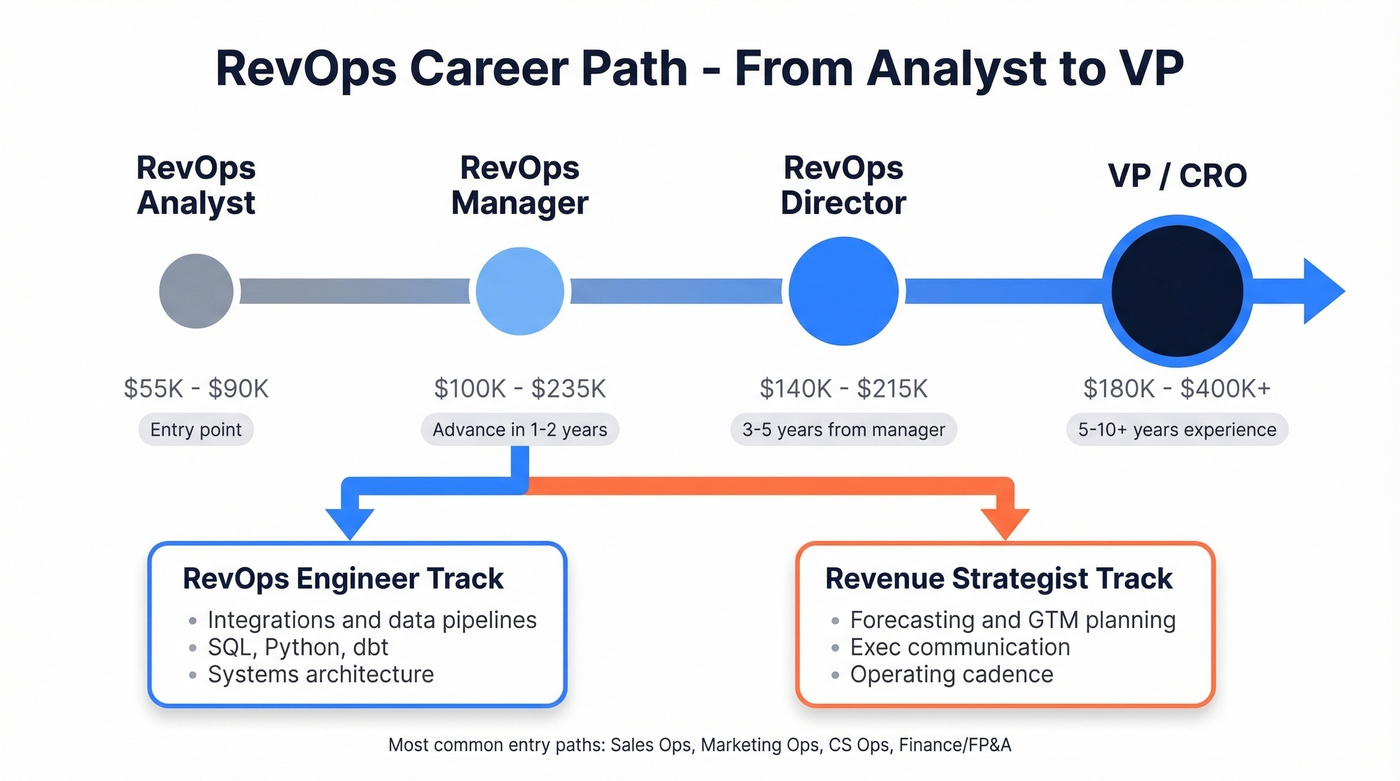
The most common entry path into RevOps is Sales Ops. Marketing Ops, CS Ops, Finance/FP&A, and technical roles round out the rest. Entry-level analysts often advance quickly if they show two things: systems thinking and quantified impact.
We've also seen the title split into two tracks in 2026:
- RevOps Engineer: deeply technical, building integrations, enrichment workflows, and data pipelines
- Revenue Strategist: forecasting, GTM planning, multi-team alignment, and operating cadence
Knowing which track fits you matters more than collecting another certification. If you love SQL and system architecture, go engineering. If you love planning, modeling, and exec communication, go strategy.
One thing nobody tells you about the role: it's always-on. Because you sit between every revenue team, you're the first call when anything breaks - at 7 AM or 9 PM. The managers who last build ruthless prioritization habits and protect their calendar like it's pipeline.
Skills That Actually Matter
Table stakes (stop listing these as differentiators on your resume): Salesforce admin certification, HubSpot proficiency, basic reporting and dashboard building, and the ability to communicate across teams.
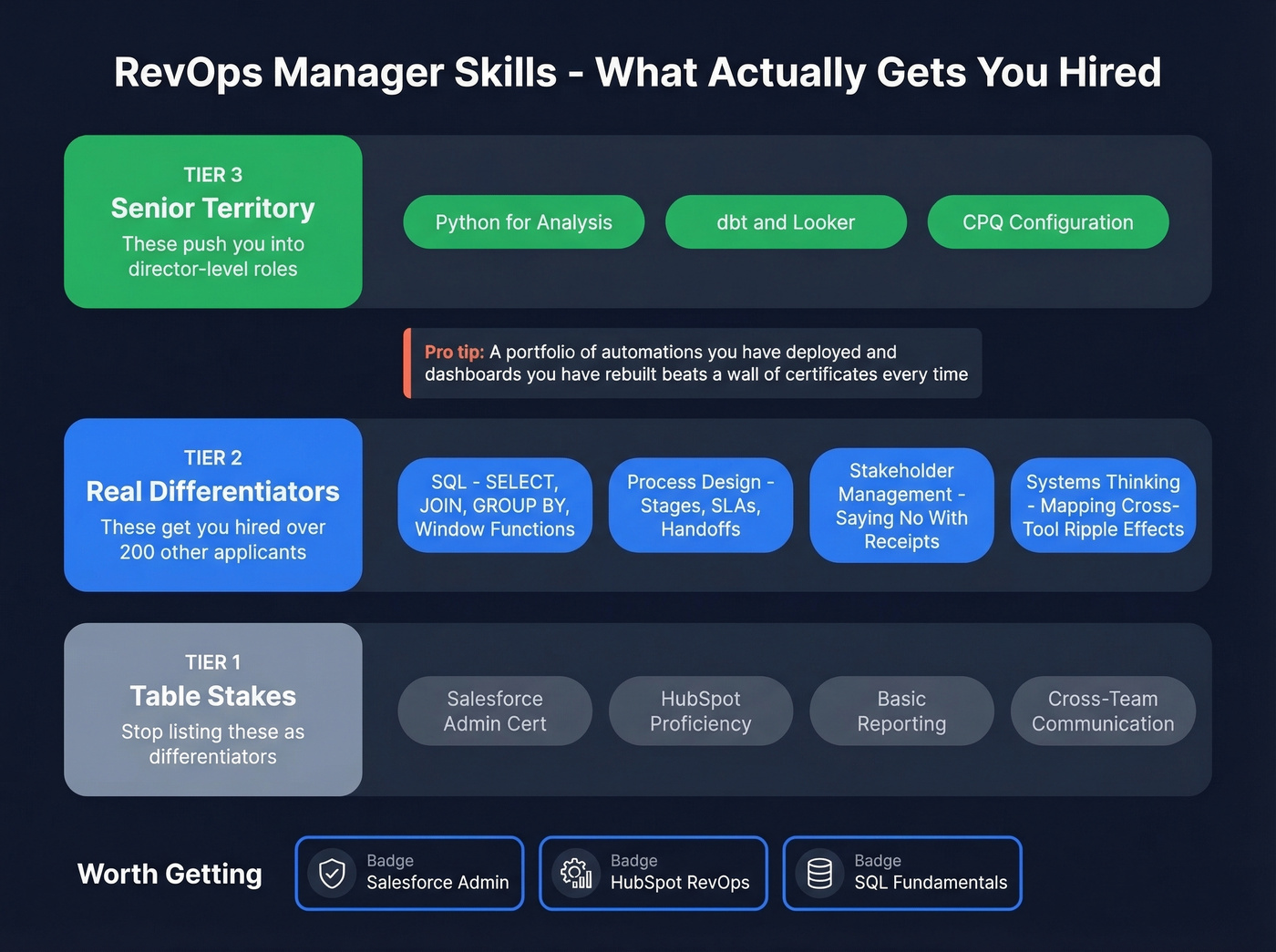
Real differentiators are what get you hired over the other 200 applicants:
- SQL: SELECT, JOIN, GROUP BY, window functions
- Process design: clear stage definitions, handoffs, SLAs, and exception handling
- Stakeholder management: saying no with context, and offering a workable alternative
- Systems thinking: understanding how a change in one system ripples across the revenue engine
Nice-to-haves that push you into senior territory: Python for analysis, dbt/Looker for analytics engineering, and CPQ configuration.
The three credentials worth getting are Salesforce Admin, HubSpot Revenue Operations, and a solid SQL fundamentals course. Everything else is optional. We've seen too many candidates stack badges instead of shipping real work. A portfolio of automations you've deployed and dashboards you've rebuilt beats a wall of certificates every time.
If you're trying to break in, here's a practical project that reads well in interviews: pick one funnel (inbound demo requests, outbound SDR, or renewals), document the current process, define the fields and stage gates, build the dashboard, and write a one-page "what broke and what we fixed" summary. It's simple, but it proves you can think end-to-end.
The RevOps Tech Stack
Core Stack Categories
The average enterprise RevOps team manages 12-18 tools. Most overlap, and plenty aren't used consistently. A clean stack usually looks like this:
| Category | Tools | SMB Cost | Enterprise Cost |
|---|---|---|---|
| CRM | Salesforce, HubSpot | $75-$150/user/mo | $150-$300/user/mo |
| Marketing Automation | HubSpot, Marketo | $800-$1,500/mo | $2,000-$3,500/mo |
| Sales Engagement | Outreach, Salesloft | $100-$130/user/mo | $130-$150/user/mo |
| Revenue Intelligence | Gong, Clari | $100-$150/user/mo | $150-$200/user/mo |
| BI / Analytics | Tableau, Looker, Power BI | $35-$50/user/mo | $50-$75/user/mo |
| Integration | Zapier, Make, Workato | $20-$100/mo | $500-$2,000+/mo |
One stat that should make you audit your stack: ZoomInfo and Apollo have roughly 70% coverage overlap on US business contacts. If you're paying for both, you're often paying twice for the same record.
Stack Audit Framework
When we inherit a stack, we audit it in five buckets: CRM (system of record), sales engagement, data/enrichment layer, analytics/attribution, and activation/orchestration. The enrichment layer is consistently the most bloated because teams stack three or four data providers without measuring overlap, match rate, or actual deliverability impact.
A smarter approach is waterfall enrichment: query multiple providers in sequence, dedupe results, and write one authoritative record back to your CRM. You pay for net-new data, not redundant coverage, and you stop creating duplicate contacts that make attribution and routing a mess.
Our advice for building from scratch stays boring on purpose: start with a CRM, a data enrichment tool, and an integration layer. Add everything else after you've proven the core workflow works and your data's clean enough to trust.
Fixing Data Quality First
Before you blame your SDRs for low connect rates, audit your data. We've watched teams spend months tweaking sequences and cadences when the real issue was simple: 30% of phone numbers were disconnected and 15-20% of emails bounced, so the "performance problem" was really a data problem.
A quick scenario we see a lot: a Series B team inherits a CRM from two migrations and three list uploads. Routing rules are brittle, lifecycle stages don't match between tools, and the CEO's dashboard is built on fields nobody uses consistently. The RevOps manager walks in, gets asked to "fix forecasting," and then discovers half the pipeline has missing close dates and the other half has stage definitions that mean different things to different managers. You can't forecast your way out of that. You clean it up, then you forecast.
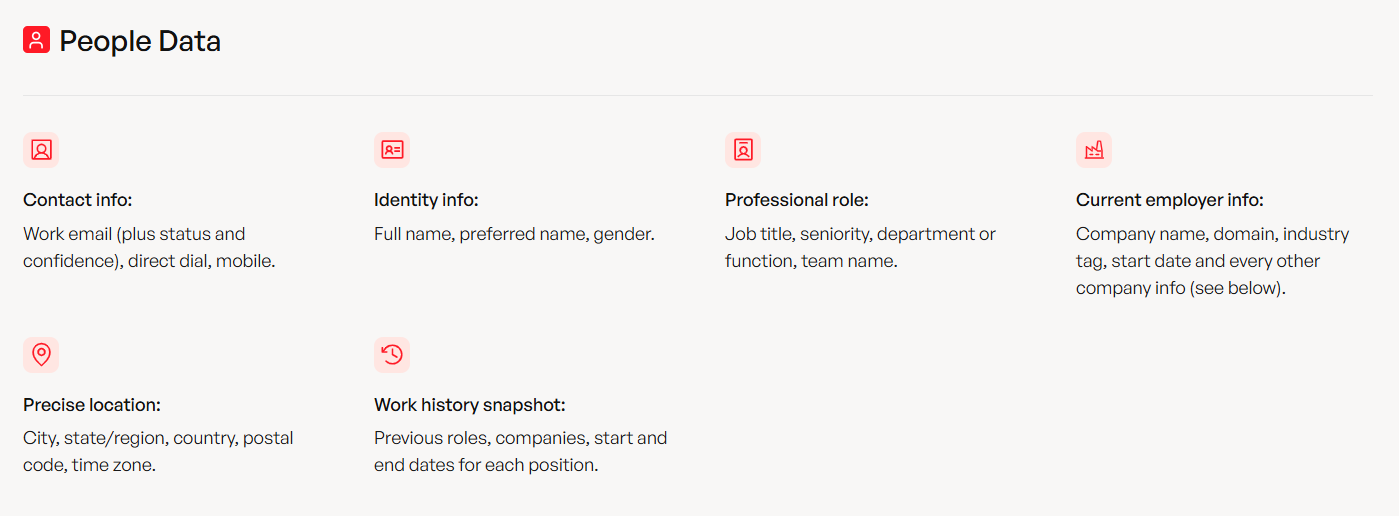
Prospeo fits here at the enrichment layer. It returns 50+ data points per contact, hits 98% email accuracy, and refreshes records every 7 days, which is exactly what you want when you're fighting data decay instead of doing quarterly cleanup drills. It also has native Salesforce and HubSpot integrations, so you can connect your CRM, map fields, and run enrichment without turning it into a six-month "data remediation project" that never ends.
Skip Prospeo if your CRM's already pristine and your outbound motion is tiny. But if you're seeing bounce rates that hurt deliverability, it's one of the fastest ways to stop the bleeding and get back to work that actually moves revenue.
For more on data hygiene and deliverability basics, these are worth bookmarking:
- https://www.gartner.com/en/sales/insights/revenue-operations
- https://www.salesforce.com/resources/research-reports/state-of-sales/
- https://www.hubspot.com/state-of-marketing
Responsibilities vs. Sales Ops
| Dimension | Sales Ops Manager | RevOps Manager |
|---|---|---|
| Scope | Sales team only | Sales + Marketing + CS |
| Reporting | VP of Sales | CRO or CEO |
| Tech Ownership | Sales tools config | Full stack integration |
| KPIs | Win rate, quota attainment | Full-funnel velocity, CAC:CLV |
| Team Sizing | Varies by org | 1 per 12 reps |
| When to Hire | Any stage | $10M-$100M ARR scaling window |
The distinction isn't semantic. A Sales Ops Manager configures Salesforce for the sales team, builds comp models, and manages pipeline methodology. Core revenue operations manager responsibilities span further: owning the process that connects a marketing-sourced lead to a closed deal to a renewed contract, and the data layer that makes that process visible.
If your Sales Ops person is already spending most of their time on cross-functional work - and per Gartner, many are - you might not need a separate hire. You might need to retitle and re-scope the role you already have, then protect their time so they aren't stuck doing ticket triage all day.
When (and How) to Hire
Hiring Triggers
The $10M ARR mark is when most companies start evaluating the hire. A PeerSignal analysis of 2,500 B2B SaaS companies found a benchmark ratio of 12:1 - twelve sales reps per one RevOps person. As you scale, the math often looks like this: $50M ARR supports 4-5 RevOps headcount, $100M ARR needs 7-10, and $200M ARR requires 14-19.
Most companies hire too late. By the time you feel the pain - broken handoffs, conflicting dashboards, reps complaining about data - you've already lost 6-12 months of pipeline efficiency, and you're now trying to fix the plane mid-flight.
For pre-$10M companies that can't justify a full-time hire, fractional RevOps is a real option. Several consultancies offer part-time leadership in the $5K-$15K/month range, and it can be a good bridge if you have a clear scope and someone internal who can execute.
Interview Questions That Work
Whether you're hiring or interviewing, these questions separate real operators from resume polishers:
"Walk me through how you'd investigate a sudden drop in pipeline conversion."
Good answers follow a framework: clarify the question, form hypotheses, test with data, communicate findings, recommend actions. Weak answers jump straight to "I'd look at the CRM."
"What KPIs would you present to a VP of Sales vs. a VP of Marketing?" This tests multi-team fluency. Sales wants pipeline velocity and forecast accuracy. Marketing wants attribution, CAC by channel, and lead-to-op conversion with clear definitions.
"Describe a time you had to say no to a stakeholder request." RevOps lives at the intersection of competing priorities. The ability to decline with context - and offer an alternative - is a core competency.
"How would you audit a tech stack you're inheriting?"
Look for a structured approach: CRM, engagement, enrichment, analytics, orchestration. Bonus points if they talk about overlap analysis and waterfall enrichment.
One more that we like (and that r/sales threads complain about constantly): "Tell me a metric you refused to report and why." Good RevOps leaders don't just build dashboards; they protect the company from bad incentives.
Job Description Template
Customize the bracketed sections for your company:
Revenue Operations Manager - [Company Name]
Overview: We're looking for a RevOps Manager to align our sales, marketing, and customer success operations under a unified process and data model.
Responsibilities:
- Design and optimize end-to-end revenue processes across sales, marketing, and CS
- Manage and integrate the revenue tech stack (CRM, engagement, enrichment, analytics)
- Build dashboards, reports, and forecasting models for leadership
- Own data quality, hygiene, and enrichment workflows
- Develop and track KPIs across the full revenue lifecycle
Qualifications:
- [3-5+] years in Revenue Operations, Sales Operations, or a related function
- Salesforce Admin certification or equivalent CRM expertise
- SQL proficiency - SELECT, JOIN, GROUP BY, window functions
- Experience with [HubSpot / Marketo / your marketing automation platform]
- Project management experience with Jira, Asana, or similar
Benefits: [Customize: salary range, equity, remote policy, PTO, etc.]
Strategic Goals and the Future of RevOps
AI is compressing analyst-level tasks - manual data entry, report pulling, basic list building - while expanding the strategic surface area of the role. Revenue modeling, GTM design, and AI workflow orchestration are becoming core competencies.
Real talk: if you're doing manual data entry in 2026, your job's at risk. If you're designing systems and making decisions between teams, AI makes you more effective, not less, because it clears the repetitive work that used to eat your week.
CRM data decays as people change jobs, companies merge, and phone numbers rotate. Automated enrichment with a weekly refresh cycle turns what used to be a quarterly cleanup project into background maintenance, which means fewer fire drills and more time spent on the work that earns promotions: process design, forecasting integrity, and cross-team operating cadence.
RevOps managers live and die by forecast accuracy and pipeline hygiene. Stale contacts, bad emails, and missing phone numbers silently destroy every metric on your scorecard. Prospeo refreshes 300M+ profiles every 7 days - not every 6 weeks - so your CRM stays current and your CAC:CLV ratio reflects reality, not last quarter's data.
Stop letting decayed data wreck your revenue metrics.
FAQ
What's the difference between a RevOps Manager and a Revenue Operations Analyst?
An analyst executes: building reports, pulling data, maintaining CRM hygiene. A manager designs systems, owns cross-team processes, and makes decisions about stack and workflow architecture. Analysts often earn $55K-$90K base; managers commonly land in the $100K-$235K range depending on geography and experience.
Do I need a Salesforce certification to get hired?
Salesforce Admin is table stakes for most roles. SQL is the separator. Get the Salesforce cert, then get comfortable writing queries without help. That combo puts you ahead fast.
How much does the role pay in Europe vs. North America?
The gap's significant. ROA's base-pay benchmarks put North America at $118,097 average compared to $70,627 in Europe, and the difference holds across seniority levels.
When should a startup hire its first RevOps person?
Around $10M ARR is the standard evaluation point, with the broader scaling window running $10M-$100M. Below that, fractional support at $5K-$15K/month can cover stack setup and process design without full-time overhead. Once you hit 12+ sales reps, you need a dedicated hire.
What's the fastest way to improve CRM data quality?
Export 1,000 contacts, run them through verification, and measure bounce rate. If more than 10% of emails bounce, you've got a data problem that's quietly killing outbound performance and deliverability. Tools like Prospeo help by verifying in real time and refreshing records every 7 days, so decay doesn't pile up between cleanups.