

The Best B2B Company Data Providers in 2026 (Compared)
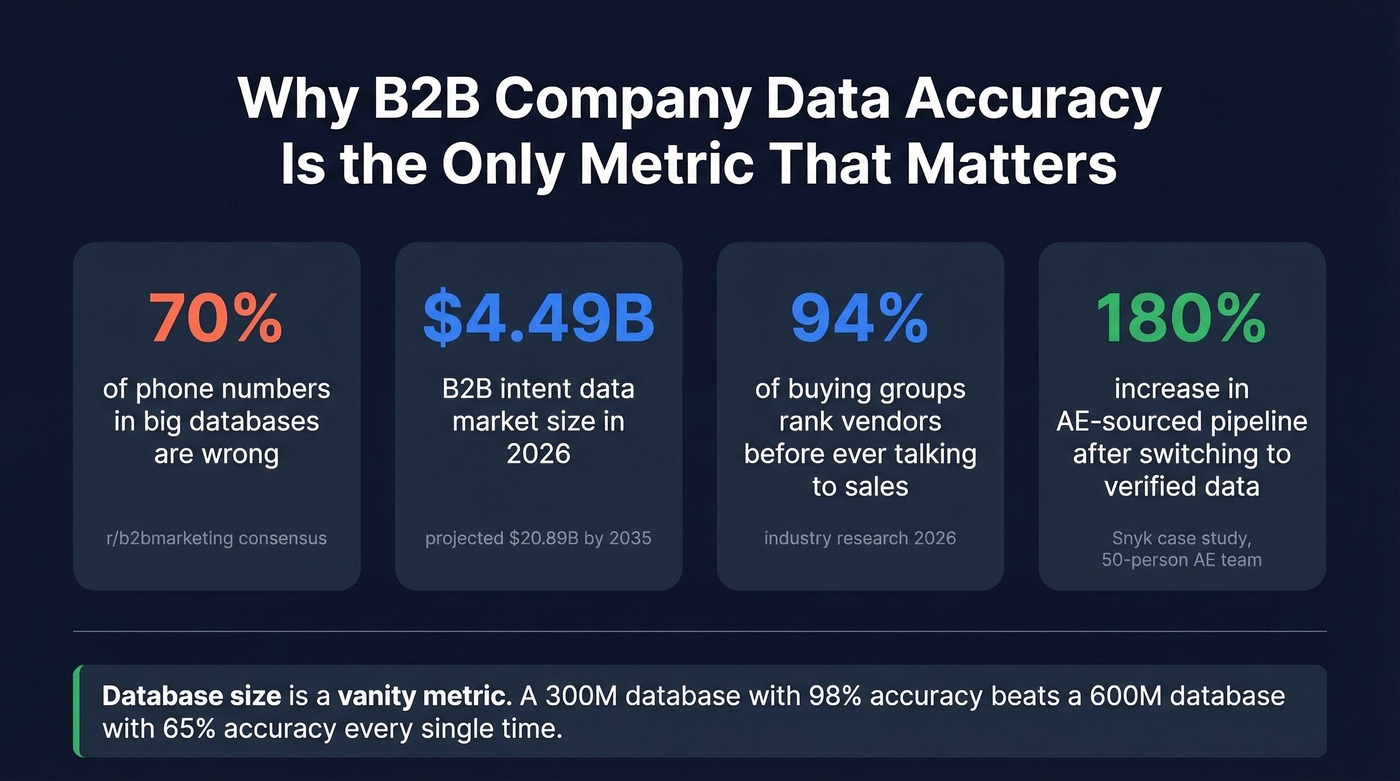
A practitioner on r/coldemail tested six B2B company data tools against 500-1,000 leads each, verified with NeverBounce. Apollo bounced 32-38%. Hunter and Snov hit 28-35%. Even Lusha landed at 22-28%. Database size is a vanity metric. Accuracy is the only number that matters - and most providers are failing at it.

The consensus on r/b2bmarketing is blunter: big databases are broken, 70% of phone numbers are wrong, and your competitors are emailing the same overused contacts. If you're not verifying before sending, you're burning your domain.
Our Picks
| Use Case | Tool | Starting Price | Why |
|---|---|---|---|
| Accuracy & freshness | Prospeo | Free; paid from ~$39/mo | 98% email accuracy, 7-day refresh |
| Enterprise ABM + intent | ZoomInfo | ~$15K/yr | Full GTM stack if you'll use it all |
| European coverage | Cognism | ~$15K/yr platform + seats | Diamond Data mobiles, GDPR-native |
| Free starting point | Apollo | Free; $49/mo paid | Generous free tier, verify before sending |
| Enrichment workflows | Clay | ~$149/mo | Waterfall enrichment across dozens of providers |
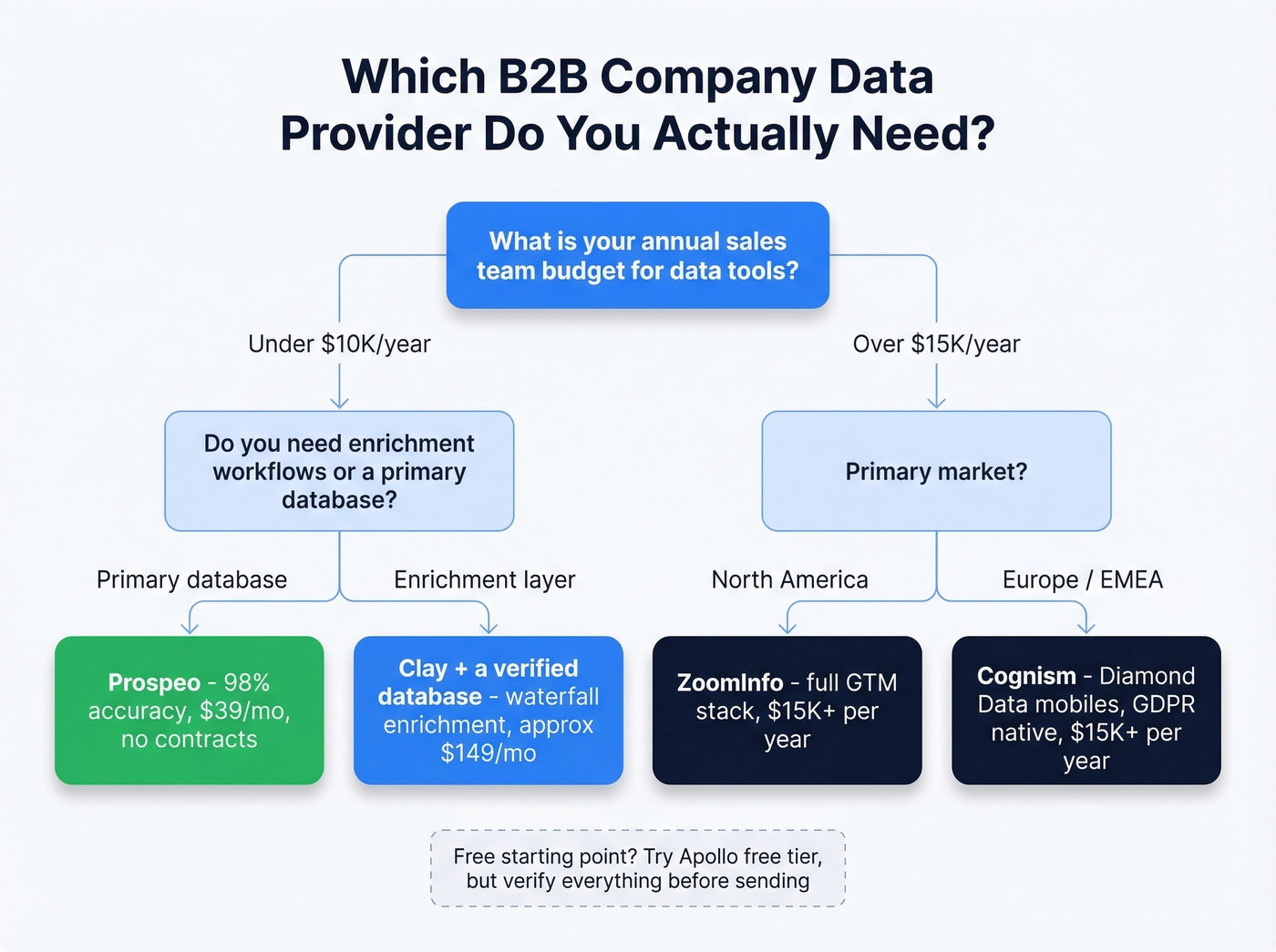
Here's our honest take: if your average deal size sits below five figures, you don't need ZoomInfo-level data. Two tools - a verified database and an enrichment layer - will outperform a $50K/year platform you only use for contact search. That's especially true for startups, where budget efficiency matters more than feature breadth.
Best B2B Company Data Providers
Prospeo
Prospeo's database covers 300M+ professional profiles, 143M+ verified emails, and 125M+ verified mobile numbers, all refreshed on a 7-day cycle. The industry average is six weeks. That gap explains why teams switching to Prospeo see bounce rates collapse from 30%+ down to under 5%.

Search runs 30+ filters including buyer intent powered by Bombora across 15,000 topics, technographics, job changes, and funding signals. The proprietary email-finding infrastructure doesn't rely on third-party email providers, which is why 98% email accuracy holds up in production - not just in cherry-picked demos. Mobile numbers carry a 30% pickup rate across all regions.
Snyk's 50-person AE team went from 35-40% bounce to under 5% after switching, and AE-sourced pipeline jumped 180%, generating 200+ new opportunities per month across the team. Pricing starts free with 75 emails and 100 Chrome extension credits monthly. Paid plans run from ~$39/mo - roughly $0.01 per email. No contracts, no sales calls, cancel anytime.
ZoomInfo
ZoomInfo is the default enterprise platform for firmographic and contact intelligence - and the one most teams realize they're overpaying for within six months. If you need account-based marketing orchestration, conversation intelligence, website visitor tracking, and intent data unified in one place, it's the most complete option. If you just need contacts, you're subsidizing features you'll never open.
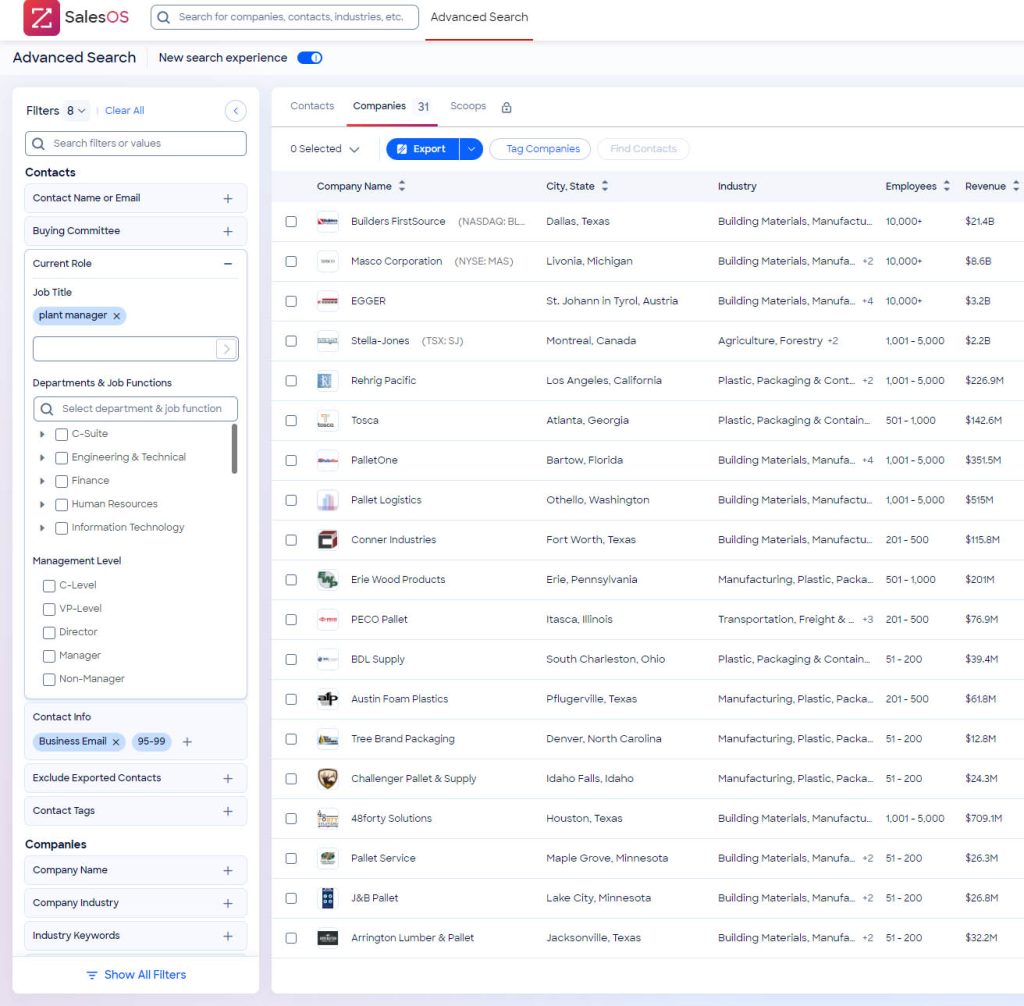
Pricing starts at ~$15,000/year for Professional with 5,000 annual credits. Advanced runs ~$24,000+/year with intent data and WebSights. Elite hits $40,000+. But the real number is what you pay after add-ons: extra credits at ~$3,000 per 5,000, Global Data at ~$9,995, and additional seats at $1,500+/user/year. Teams routinely report paying close to $50,000/year once everything's stacked. Discounts of 30-65% off list price are common if you negotiate - never accept the first quote. ZoomInfo pushes 2-3 year contracts with auto-renew windows of 60-90 days, so mark your calendar or you're locked in again.
The B2B intent data market hit $4.49B in 2026 and is projected to reach $20.89B by 2035 - 94% of buying groups now rank preferred vendors before talking to sales. That's why intent data matters. But you don't need ZoomInfo's price tag to access it.
Use this if: You're a 100+ person sales org running full-cycle ABM.
Skip this if: You just need verified emails and phones for outbound.
Cognism
Cognism's strength is EMEA. If you're selling into the UK, DACH, or Nordics, the Diamond Data mobile numbers - phone-verified by human researchers - are genuinely differentiated, with 98% accuracy on verified mobiles and 3x improvement in connect rates versus industry average.
The "unlimited" plan isn't unlimited, though. Fair-use caps sit around ~2,000 records per user per month, with page-level exports limited to 25 records at a time. Platinum starts at ~$15,000 platform fee plus ~$1,500/user/year. Diamond jumps to ~$25,000 platform plus ~$2,500/user/year. Budget an additional $2,000-$5,000 for onboarding and $5,000-$15,000/year if you need heavy API usage. Annual contracts only.
Where Cognism wins over ZoomInfo: GDPR compliance is native, not bolted on, and European mobile coverage is significantly better. Where ZoomInfo wins: US database depth and workflow breadth. If you're comparing the two directly, see Cognism vs Prospeo.
Apollo
Apollo is the obvious starting point for SMB teams. The free tier includes basic contact access, 50 AI credits, and up to 2 sequences - enough to test whether the data works for your ICP before spending anything.
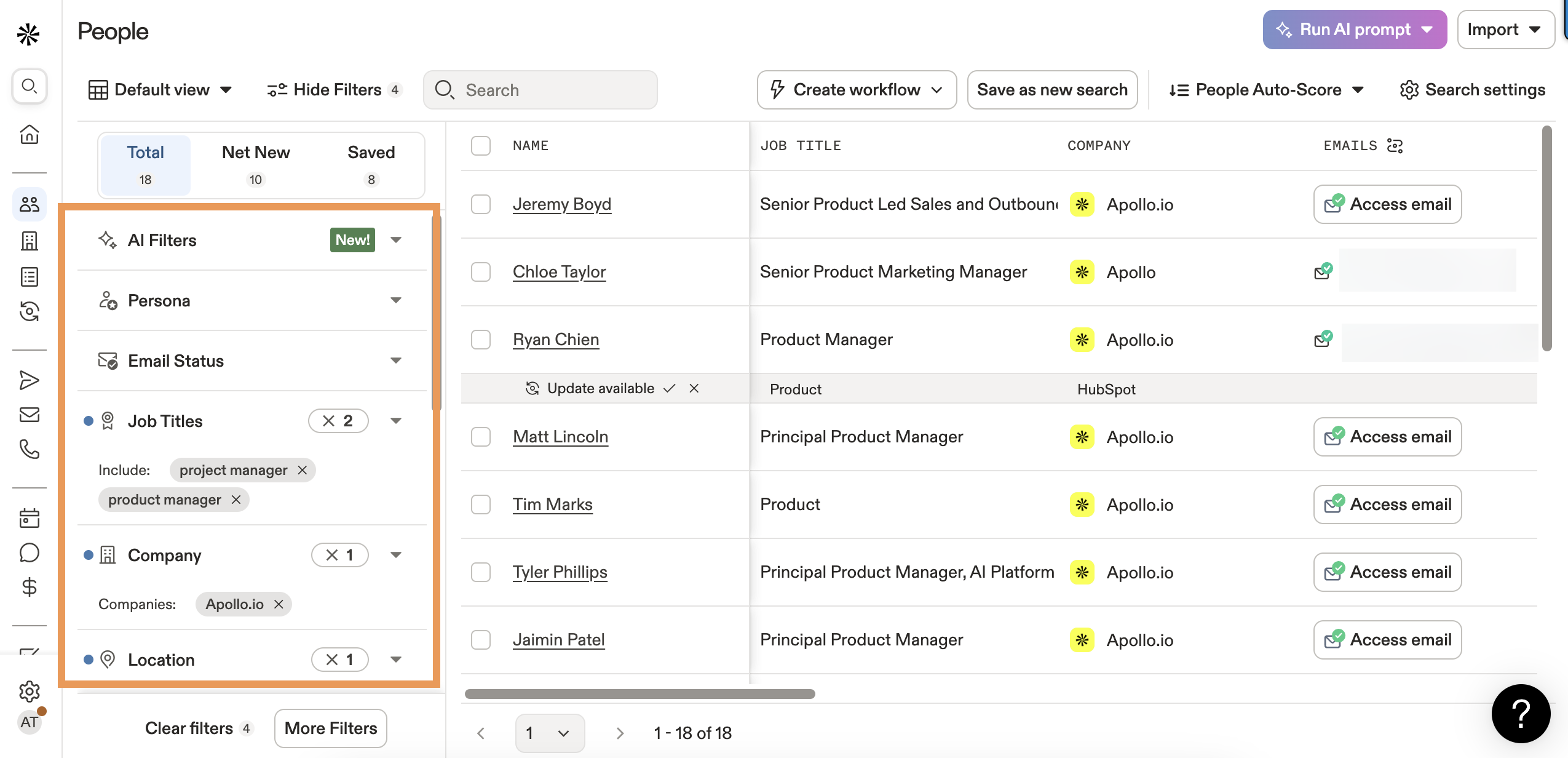
Paid plans start at $49/mo (Basic), $79/mo (Professional), and $119/mo (Organization) with a minimum 3-seat requirement on Organization. Credits don't roll over, overages trigger surprise costs, and the recent credit system migration has left different accounts on the same plan with different limits.
Look, Apollo's free tier is great to start, but the credit system becomes a trap at scale. That 32-38% bounce rate from practitioner testing isn't an outlier. Verify everything through an independent tool before sending.
Clay
Clay isn't a database - it's an enrichment orchestration layer. The waterfall approach pulls from multiple data providers, deduplicates, and returns the best match. In practitioner testing, Clay's waterfall produced the lowest bounce rates of any method: ~10-14%.
Plans start at ~$149/mo and scale up with volume. It doesn't replace a database - it makes your primary source work harder. Agencies running lead enrichment for multiple clients find Clay especially valuable because it consolidates dozens of providers into a single workflow. We've found pairing Clay with a high-accuracy primary database gives you the best of both worlds: verified contacts up front, waterfall fill for the gaps. For a deeper breakdown, see our guide to data enrichment tools.
Lusha
Lusha targets mid-market teams who want a clean interface without ZoomInfo's complexity. Pricing starts around ~$36/mo per user on annual plans with a limited free tier. Credits run out fast - that's the consistent complaint. Bounce rates in testing landed at 22-28%. Best for quick lookups rather than bulk list building.
UpLead
UpLead's differentiator is real-time email verification built into the platform. Plans start around ~$99/mo. Bounce rates came in around 20% in testing. The database is smaller than Apollo or ZoomInfo, so coverage for niche industries can be thin.
RocketReach
RocketReach works well for one-off lookups and recruiting - teams using contact databases for talent sourcing often start here because of its broad professional profile coverage. Plans start around ~$39/mo for individuals, scaling to ~$249/mo for teams. Email accuracy is decent for enterprise contacts but drops off for SMB and mid-market.
Lead411
Budget-friendly option for SMB outbound teams. Pricing starts around ~$99/mo. Worth testing if intent-driven outbound is your primary motion and you want a lighter-weight alternative to enterprise platforms.
Seamless.AI
Real-time contact search engine, not a static database. Pricing starts around ~$147/mo. Bounce rates in testing sat around 20%. We've seen it perform well for enterprise tech contacts and poorly for SMB verticals - accuracy varies significantly by ICP and industry.
Coldlytics
Human-researched lists built on demand, delivered within 24 hours. Free plan gives you 25 leads/month; Lite runs $49/mo for 50 leads. Credits carry over, which is rare. Best for hyper-niche ICPs where automated databases have gaps.
Dealfront
Formerly Leadfeeder + Echobot. European-focused with strong DACH coverage and website visitor identification. Pricing starts around ~$99/mo for visitor identification. Best for European B2B teams running inbound-to-outbound motions.
Pricing Comparison
| Tool | Starting Price | Model | Free / Contract | Est. Cost/Lead |
|---|---|---|---|---|
| Prospeo | ~$39/mo | Credits | Yes / No | ~$0.01 |
| ZoomInfo | ~$15K/yr | Tiered + credits | No / 2-3 yr | ~$3.00 |
| Cognism | ~$15K platform + seats | Platform + user | No / Annual | ~$1.50-2.50 |
| Apollo | $49/mo | Sub + credits | Yes / No | ~$0.10-0.50 |
| Clay | ~$149/mo | Credits | Yes / No | ~$0.05-0.30 |
| Lusha | ~$36/mo | Per user + credits | Yes / Annual | ~$0.50-1.00 |
| UpLead | ~$99/mo | Credits | Yes / No | ~$0.58 |
| RocketReach | ~$39/mo | Credits | Yes / No | ~$0.30-0.80 |
| Lead411 | ~$99/mo | Per user | Trial / Annual | ~$0.40-0.70 |
| Seamless.AI | ~$147/mo | Per user | Yes / Annual | ~$0.50-1.00 |
| Coldlytics | $49/mo | Per lead | Yes / No | ~$0.59-0.98 |
| Dealfront | ~$99/mo | Per user | Yes / No | ~$0.80-1.50 |

That Reddit test showed Apollo bouncing 32-38% and Lusha at 22-28%. Prospeo's 98% email accuracy isn't a marketing claim - it's what Snyk's 50 AEs proved at scale, dropping bounce rates from 35-40% to under 5%. 300M+ profiles, 7-day refresh, $0.01/email.
Stop paying for B2B company data that bounces. Start free today.
What the Bounce Rates Show
| Source | Bounce Rate |
|---|---|
| Apollo | 32-38% |
| Hunter / Snov | 28-35% |
| Lusha | 22-28% |
| Seamless.AI / UpLead | ~20% |
| Clay (waterfall) | 10-14% |
| Prospeo | <5% |
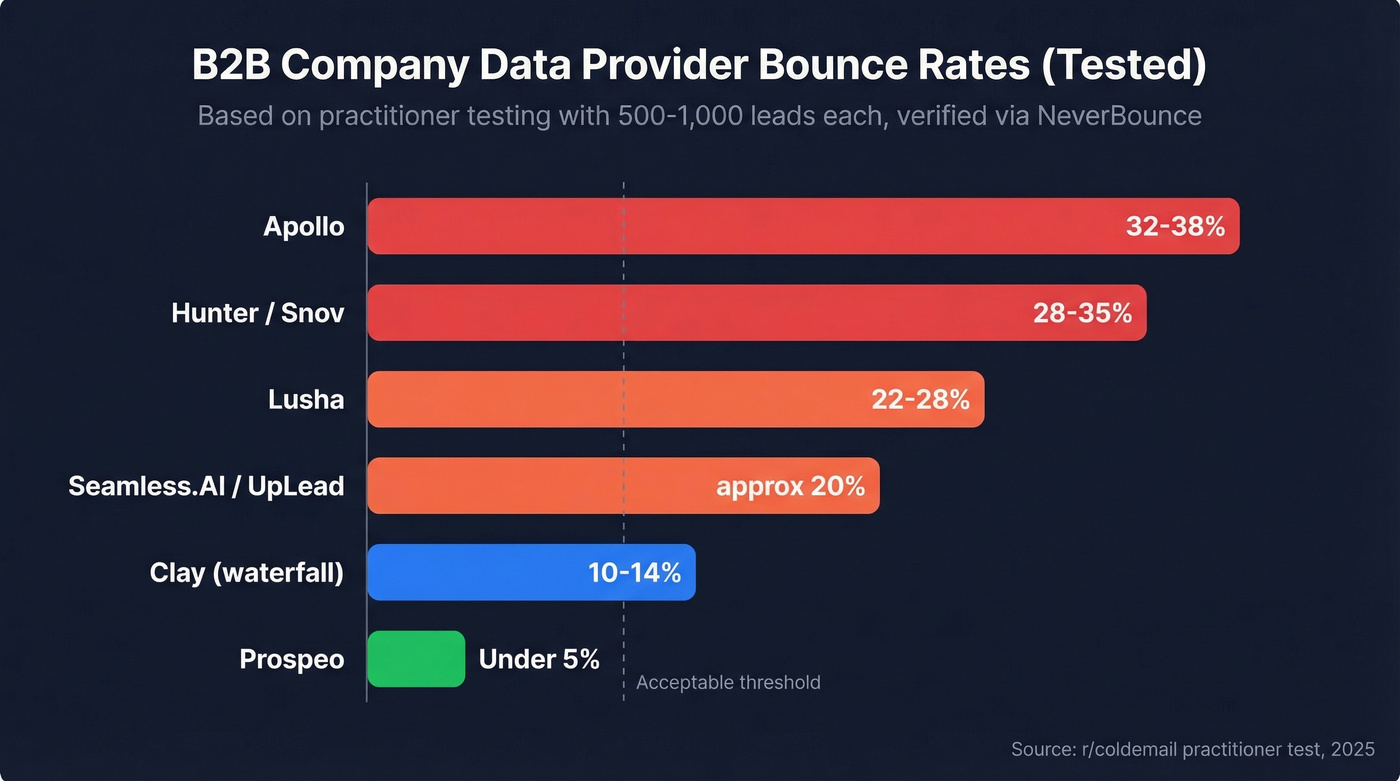
Single-source databases bounce more. Waterfall enrichment cuts bounce rates significantly. But the lowest rates come from providers with proprietary verification infrastructure and aggressive refresh cycles - weekly beats monthly every time.
You don't need a $50K/year platform to get accurate B2B company data. Prospeo gives you 30+ filters - buyer intent, technographics, funding, job changes - across 300M+ profiles refreshed every 7 days. Stack Optimize built a $1M agency on it with under 3% bounce rates.
Enterprise-grade company data at $0.01 per email. No contracts, no sales calls.
How to Evaluate B2B Company Data
In our testing, a 100-lead sample is the minimum that gives you a reliable signal. Here's the checklist we use:
Small-batch test. Pull 100-500 leads matching your ICP. Run them through NeverBounce or ZeroBounce before sending a single email. If bounce exceeds 8%, the provider fails. (If you need a process, start with our guide on check bounce.)
Check refresh frequency. Ask specifically: how often is contact data re-verified? Weekly is best. Monthly is acceptable. "Continuously updated" without a number is a red flag - push for specifics.
Ask about credit rollover. Do unused credits expire? Apollo's don't roll over. Coldlytics' do. This matters at scale, especially for teams with seasonal outbound patterns where monthly volume fluctuates.
Test for your ICP, not Fortune 500. Every database looks great when you search for VPs at Microsoft. Test with your actual targets - niche verticals, SMB companies, regional markets. That's where the real accuracy picture emerges.
Request compliance documentation. Ask for a DPA, lawful basis documentation, and their opt-out enforcement process. If they can't produce these quickly, walk away. (For a deeper checklist, see B2B compliance.)
Test CRM and outreach integrations. A database that doesn't sync cleanly with your CRM and sequencing tools creates manual work that kills adoption. We've seen teams abandon otherwise solid tools because the Salesforce sync was broken. If you're rebuilding your stack, use this RevOps tech stack blueprint.
Look for product usage signals. Some providers surface technographic and usage data that help expansion teams identify accounts ready for an upgrade - not just net-new pipeline.
Let's be clear about one thing: curated provider data beats purchased lists every time. Bulk lists from unknown brokers are a compliance liability and an accuracy disaster. If you're still considering lists, compare options in our guide to B2B list providers.
Compliance in 2026
Privacy enforcement is accelerating. GDPR fines can reach EUR 20M or 4% of global revenue. California's CCPA B2B exemption expired January 1, 2023 - B2B contacts in California now have full consumer privacy rights. The DROP platform is now live, requiring data brokers to honor deletion requests with 45-day sweeps and $200-per-incident penalties. New comprehensive privacy laws also took effect January 1, 2026 in Indiana, Kentucky, and Rhode Island.
Ask every vendor for a Data Processing Agreement before signing. Confirm their lawful basis for processing. Verify they enforce opt-outs globally. Teams that get compliance right spend less time on legal cleanup and more time selling. If you're buying data in the EU, use a GDPR compliant database checklist.
FAQ
What is B2B company data?
Firmographic, contact, technographic, and intent information about businesses - details like revenue, headcount, and tech stack alongside individual emails, phones, and job titles. It's the foundation for any outbound sales motion, from cold email to account-based marketing.
How do I choose a provider for lead generation?
Pull 100-500 ICP-matched leads, run them through NeverBounce or ZeroBounce, and measure bounce rate - above 8% is a fail. Also evaluate refresh frequency (weekly is ideal), credit structure, and CRM integrations.
Why do B2B databases have high bounce rates?
Job changes and infrequent refreshes cause contacts to go stale. Most providers refresh every 4-6 weeks; weekly refresh cycles paired with real-time verification keep bounce rates under 5%. Single-source databases are especially vulnerable - waterfall enrichment or proprietary verification infrastructure performs better.
Is using B2B data legal under GDPR?
Yes, when processed under legitimate interest with functioning opt-out mechanisms and proper documentation. Require a Data Processing Agreement from every provider and confirm they enforce opt-outs globally before signing any contract.