

How to Build an Ideal Customer Profile That Actually Gets Used
A founder posted on r/Entrepreneur asking for help defining their ideal customer profile. Their answer? "Busy professionals - founders, consultants, SMB owners, sales reps." That's not an ICP. That's a tagline. And it's exactly why their outbound wasn't converting.
The real problem isn't that teams skip the ICP exercise. Most don't. The problem is they build a "fairytale persona" - a fictional composite nobody talked to a real customer to create - then file it in a Google Doc that collects dust. The ICP never touches a CRM filter, never informs a scoring model, never changes how reps prioritize accounts.
We've watched this play out dozens of times. What follows is the scoring model, real examples, and operationalization method that most ICP guides skip entirely.
The Short Version
- Analyze your 20-30 best customers (best, not biggest)
- Identify 3-5 shared traits across firmographics, technographics, and behavior
- Score every target account on a 100-point rubric
- Prospect only Tier A and B accounts - ignore the rest
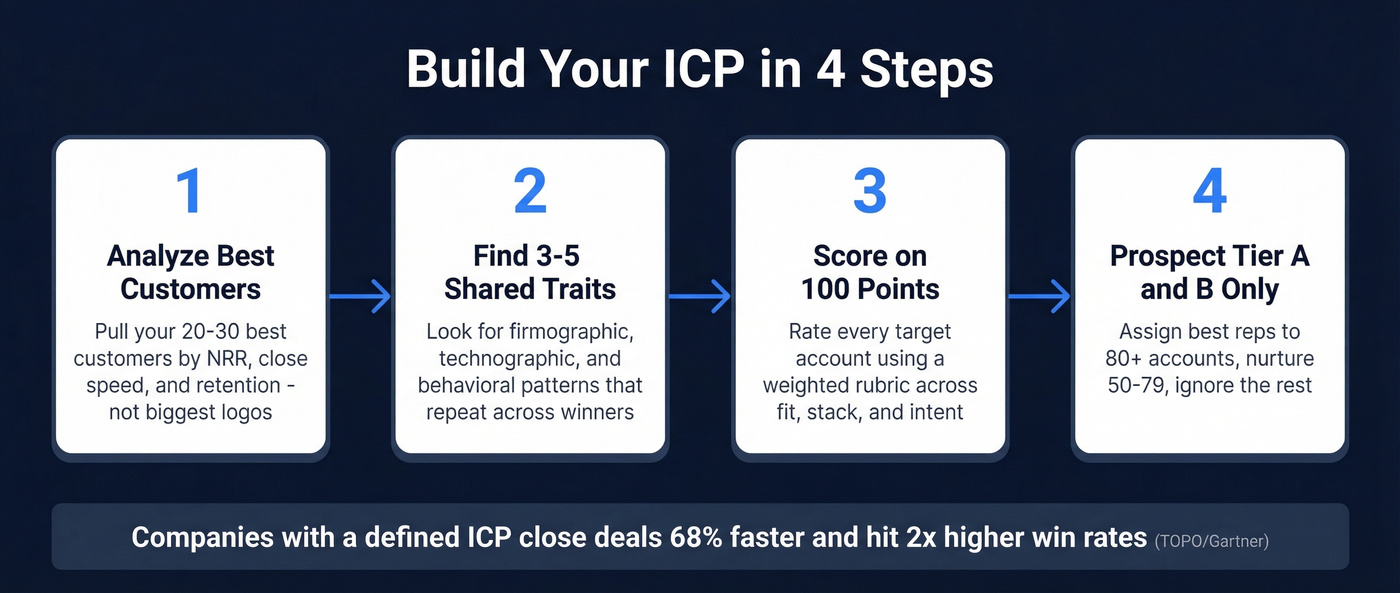
Companies with a defined ICP close deals 68% faster and hit 2x higher win rates. The rest of this guide shows you how.
What Is an Ideal Customer Profile?
It's a company-level description of the type of organization most likely to buy your product, get value from it, and stick around. Not a person. Not a demographic. It's a set of firmographic, technographic, and behavioral attributes that describe your best-fit accounts.
ICP vs. Buyer Persona
| Ideal Customer Profile | Buyer Persona | |
|---|---|---|
| Level | Company | Individual |
| Purpose | Which accounts to target | How to message contacts |
| Attributes | Revenue, headcount, tech stack, industry | Job title, goals, pain points |
| Example | SaaS, 50-200 employees, uses Salesforce, Series B | VP of Sales, manages 10 reps, cares about pipeline velocity |
They're complementary. Your ICP tells you which buildings to walk into. The buyer persona tells you who to ask for when you get there. Most teams conflate them, which is how you end up with a "persona" that's really just a vague company description with a stock photo attached.
Where ICP Fits in Market Sizing
Your TAM (total addressable market) is every company that could theoretically buy. Your SAM (serviceable addressable market) narrows that to companies you can actually reach and serve. Your ICP sits inside the SAM - the slice where you win most often, retain longest, and expand fastest. Below that is your prospect list: the actual accounts you'll work this quarter.
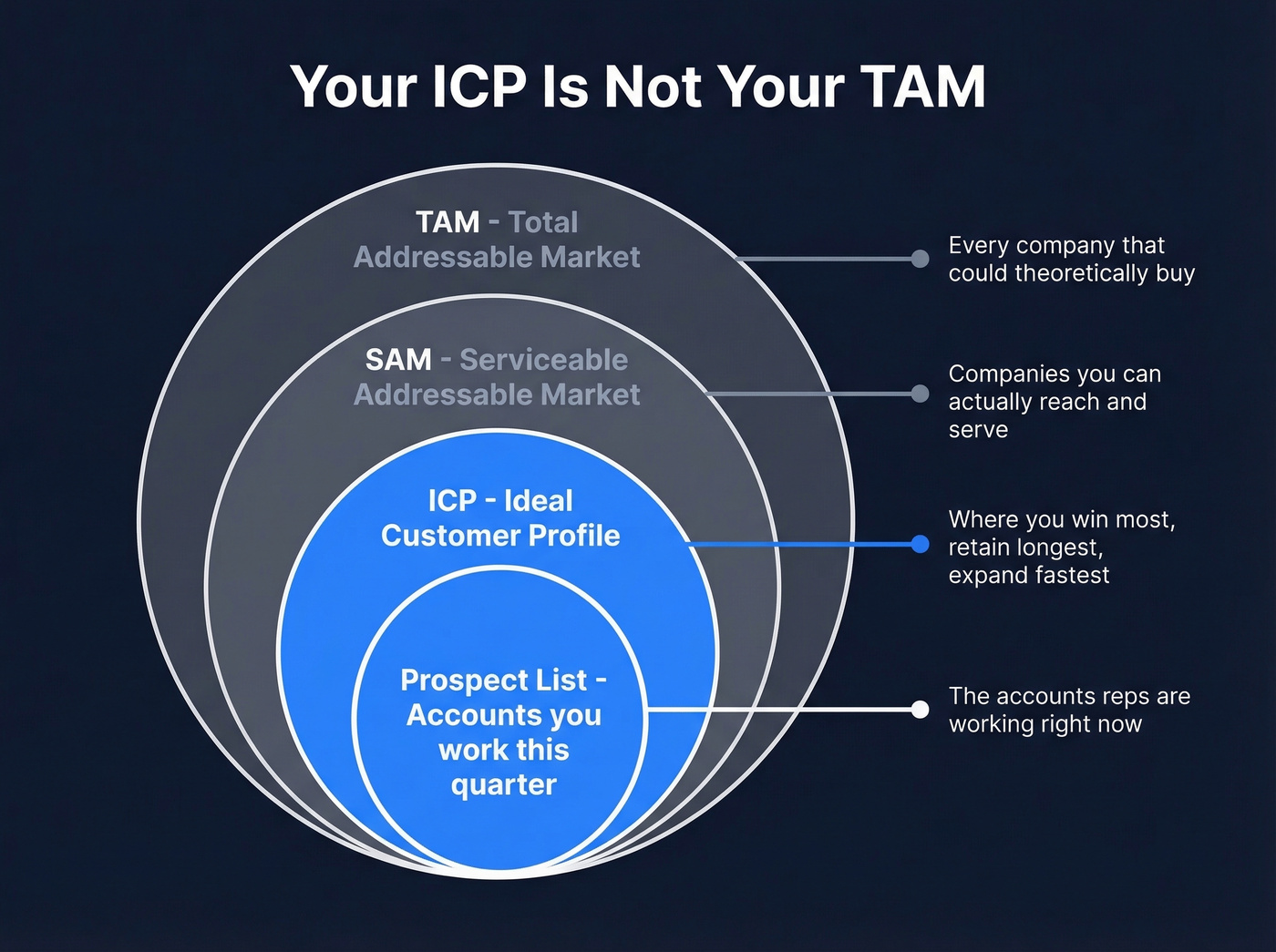
TAM gives you a fundraising number. Your ideal customer profile gives you a targeting strategy. Different problems entirely.
Why Your ICP Matters
The numbers aren't subtle. Companies with a clearly defined ICP close deals 68% faster and achieve 2x higher win rates, according to TOPO/Gartner Sales Development Benchmark data. That's the difference between a team that hits quota and one that doesn't.
Marketo's research reinforces this from a different angle: aligned teams see 36% higher customer retention, 38% higher win rates, and 208% growth in marketing-generated revenue. Alignment doesn't happen by accident - it happens when both teams agree on who they're targeting. The ICP is that agreement.
Here's the thing: the benefits go well beyond revenue. Reps waste fewer hours on bad-fit accounts. Marketing spends less on campaigns that attract the wrong leads. CS teams see lower churn because the customers coming in actually fit the product. Most teams already know this intuitively - reps can tell you which accounts "feel right," and marketing knows which leads convert. The ICP makes that tribal knowledge explicit, measurable, and scalable. Without it, you're relying on gut feel that walks out the door every time someone quits.
What Goes Into a Complete ICP
Most teams stop at firmographics. That's the single biggest mistake we see tank targeting accuracy. A complete profile covers four categories:
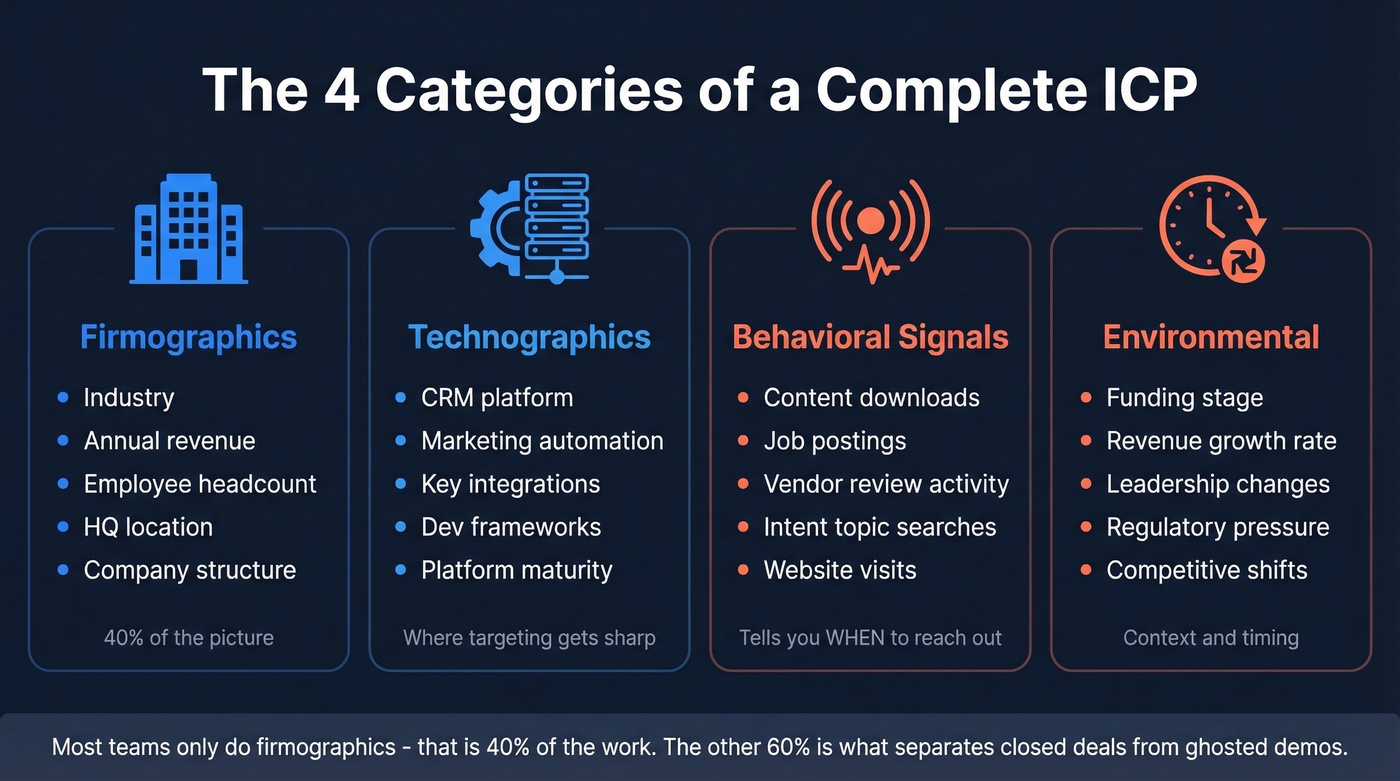
| Category | What It Covers | Example Fields |
|---|---|---|
| Firmographics | Company basics | Industry, revenue, headcount, HQ location, structure |
| Technographics | Tech stack | CRM, marketing automation, integrations, dev frameworks |
| Behavioral | Buying signals | Content downloads, job postings, vendor reviews, intent topics |
| Environmental | Context & timing | Funding stage, growth rate, leadership changes, regulatory pressure |
Firmographics are table stakes - every competitor has them. Technographics are where targeting gets sharp. Knowing a prospect runs Salesforce and Outreach tells you more about buying readiness than knowing they're a 200-person SaaS company. Behavioral signals and environmental factors tell you when to reach out, not just who.
If your ICP document only lists industry, company size, and geography, you've done maybe 40% of the work. The other 60% is what separates accounts that close from accounts that ghost you after the demo.

Your ICP defines the firmographics, technographics, and behavioral signals that matter. Prospeo's database lets you filter 300M+ profiles by all of them - buyer intent, tech stack, funding stage, headcount growth, and 30+ other attributes. Every email is 98% verified. Every record refreshes weekly.
Stop defining your ICP in a Google Doc and start prospecting it.
How to Define Your ICP Step by Step
Analyze Your Best Customers
Pull a list of your 20-30 best customers. Not your biggest logos - your best. Define "best" however makes sense for your business: highest NRR, fastest close, lowest support burden, most expansions. You need at least 20 to find patterns; fewer than that and you're finding coincidences.
Build a simple spreadsheet. For each customer, capture every attribute across the four categories: industry, revenue band, headcount, tech stack, how they found you, what triggered the purchase, sales cycle length, buying committee composition. Tedious work. Do it anyway.
Interview Super Users
Identify your 10 or so "super users" - customers who get the most value from your product - and actually talk to them. Not a survey. A conversation. This approach draws from Adele Revella's buyer persona methodology, adapted for account-level profiling.
Your question bank:
- What triggered the search for a solution like ours?
- What were you using before, and what broke?
- Who else was involved in the decision?
- What almost stopped you from buying?
- What's the primary problem we solve for you today?
- On a 1-10 scale, how ready were you to change when you first talked to us?
These questions force clarity on triggers, barriers, and decision criteria - the stuff that actually predicts whether a prospect will buy. The readiness-to-change question alone will reshape how you think about timing.
Identify 3-5 Shared Traits
Here's the pattern from every successful ICP we've studied: 70-80% of your wins share 3-5 common traits. Not 15 traits. Not one. Three to five. Look for attributes that show up in your best customers and don't show up in your churned or lost-deal accounts.
The traits that matter most are usually a mix of firmographic and technographic or behavioral. If every best customer uses Salesforce and came inbound after a funding round, that's your profile talking. Defining it around these overlapping patterns - rather than aspirational traits - is what separates a useful document from a wishlist.
Validate With Mandatory Checks
Before you finalize, run every criterion through these:
- Budget - Can companies matching this profile actually afford your product?
- Urgency - Do they have a pressing reason to buy now, or is this a "nice to have"?
- Readiness to change - How willing are these companies to switch from their current solution?
- Systems around them - Do they have the internal support (IT, ops, executive sponsorship) to implement?
If your ICP describes companies that match perfectly on paper but score a 3 on readiness to change, you've built a wishlist, not a profile.
The 100-Point ICP Scoring Model
Let's be honest: the ICP exercise is worthless without a scoring model. Every guide tells you to "define your ICP." Almost none tell you how to score accounts against it. That's like building a hiring rubric and then never using it in interviews.
Scoring Categories and Weights
| Category | Weight | What You're Scoring |
|---|---|---|
| Firmographics | 40 pts | Industry, revenue, headcount, geography, structure |
| Technographics | 30 pts | Tech stack fit, integration readiness, platform maturity |
| Intent Signals | 30 pts | Buying signals, content engagement, job postings, funding events |
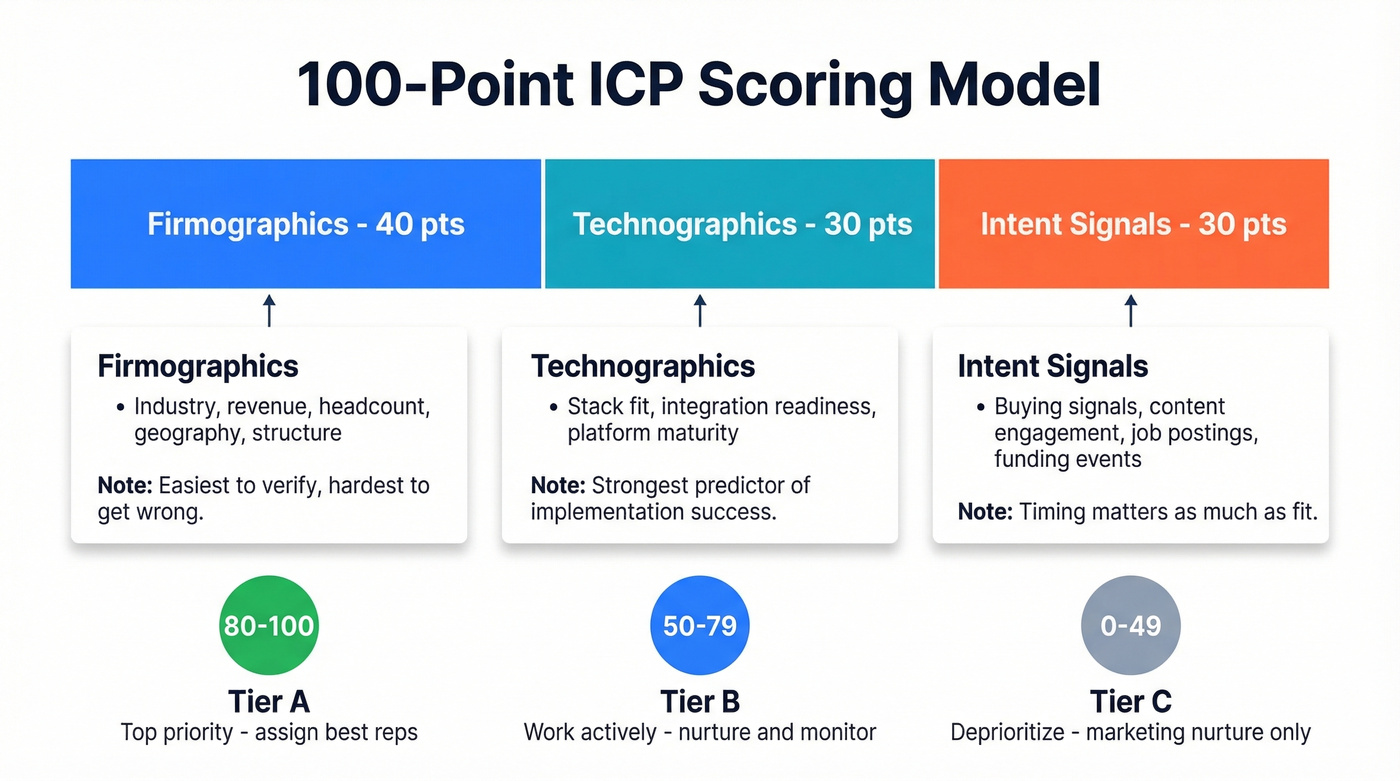
Firmographics get the most weight because they're the easiest to verify and the hardest to get wrong. Technographics get 30 because stack fit is the strongest predictor of implementation success. Intent signals get 30 because timing matters as much as fit - a perfect-fit account with zero buying intent is a waste of a rep's Tuesday.
Adjust the weights based on your data. If you've got 50+ closed-won deals from the past year, use that dataset to validate your weights. The model should reflect your reality, not a template.
Worked Example: Scoring a Real Account
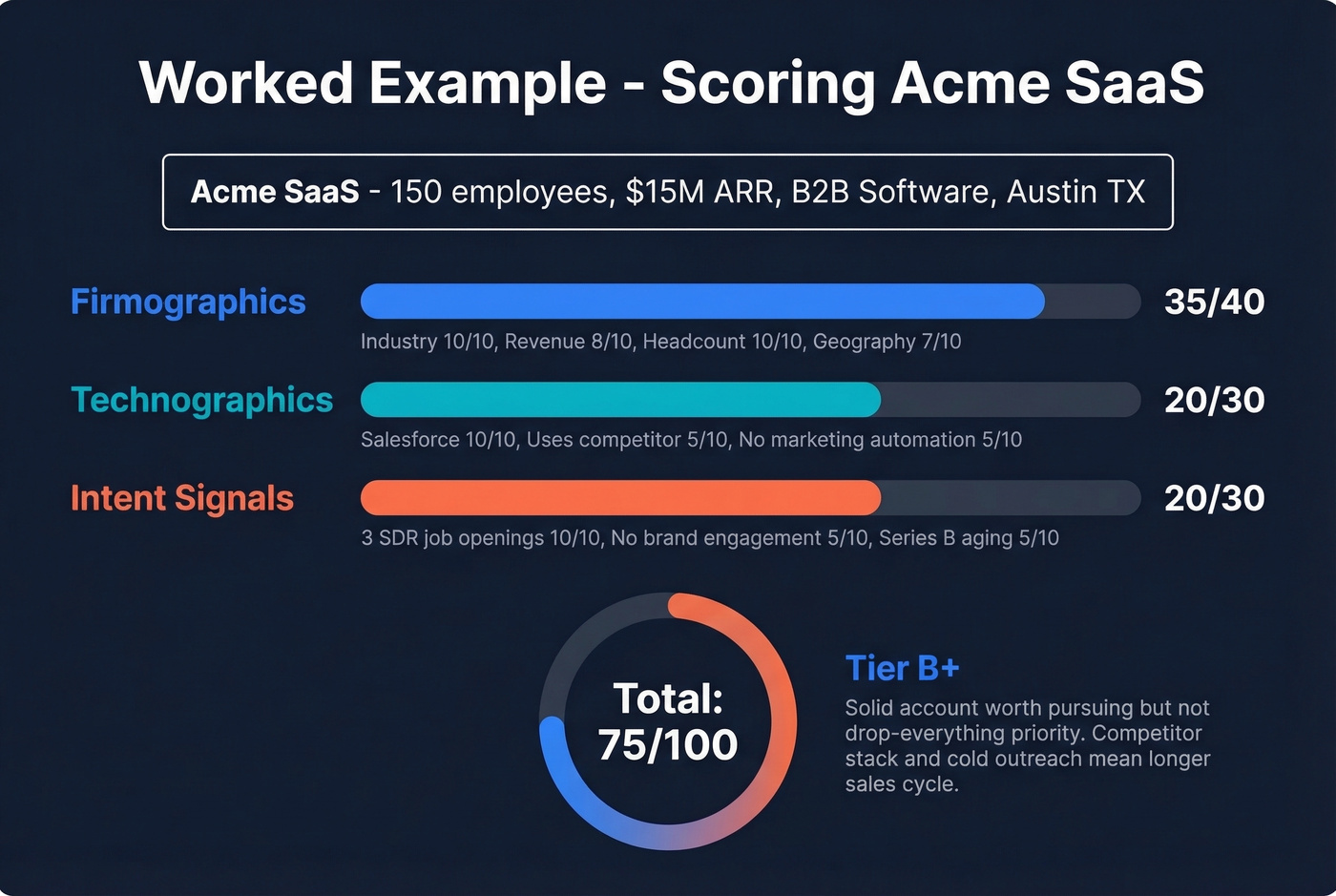
You sell a sales engagement platform. Here's how you'd score Acme SaaS, a 150-person B2B software company in Austin:
| Firmographics (40 pts) | Score | Notes |
|---|---|---|
| Industry: B2B SaaS | 10/10 | Direct fit |
| Revenue: $15M ARR | 8/10 | Sweet spot is $10-50M |
| Headcount: 150 | 10/10 | Ideal range |
| Geography: US | 7/10 | Ideal but not target metro |
| Subtotal | 35/40 |
| Technographics (30 pts) | Score | Notes |
|---|---|---|
| Uses Salesforce | 10/10 | Core integration |
| Uses Outreach (competitor) | 5/10 | Switching cost concern |
| No marketing automation | 5/10 | Less mature stack |
| Subtotal | 20/30 |
| Intent Signals (30 pts) | Score | Notes |
|---|---|---|
| 3 SDR job openings posted | 10/10 | Strong hiring signal |
| No brand engagement | 5/10 | Cold outreach needed |
| Series B closed 4 months ago | 5/10 | Funding is aging |
| Subtotal | 20/30 |
Total: 75/100 - Tier B+. A solid account worth pursuing, but not a drop-everything Tier A. The competitor tech stack and lack of brand awareness mean a longer sales cycle. A rep should work it, but not at the expense of an 85+ account.
Tier Thresholds
| Tier | Score | Action |
|---|---|---|
| A | 80-100 | Top priority. Assign to best reps. Multi-thread immediately. |
| B | 50-79 | Work actively. Nurture with content. Monitor for intent spikes. |
| C | 0-49 | Deprioritize. Marketing nurture only. Revisit quarterly. |
Tier A accounts convert at 1.5-2x the rate of Tier B and close 15-20% faster. That's the whole point - you're giving reps a prioritization framework that directly impacts pipeline velocity.
Real-World ICP Examples
Gusto: Six Constraints, 300K Customers
Gusto's early ICP is the gold standard for "start comically narrow." Their initial profile had six constraints: five or fewer employees, based in California, no existing benefits program, only salaried employees, no contractors, and willing to get paid eight days after payroll is run.
That's absurdly specific. And it worked. By nailing the experience for that tiny slice, they built the product quality and word-of-mouth that let them expand. Today Gusto serves 300,000+ businesses across the U.S. and 120 other countries.
Gong: 5,000-Company TAM
Gong's early ICP was equally tight: software companies selling in the U.S., in English, via video conferencing, with deal sizes between $1,000 and $100,000. Roughly 5,000 companies fit that profile worldwide - a TAM most VCs would laugh at. But it gave Gong a beachhead where their product was undeniably better than anything else.
Snyk: Depth-First Niche
Snyk started with developers building with Node.js who were security-conscious. One technology. One mindset. They went deep before expanding to other languages and frameworks.
The lesson across all three: narrow beats broad at the early stage. If your ICP describes more than 50,000 accounts, you don't have an ICP - you have a market segment. The companies that win early pick a beachhead of 2,000-10,000 accounts and dominate it before expanding. Comfort with a small TAM is the single best predictor of early-stage go-to-market success.
B2B SaaS ICP Template
Here's a filled-in template for a hypothetical sales analytics startup:
| Category | Field | Value |
|---|---|---|
| Firmographics | Industry | B2B SaaS |
| Revenue | $5M-$50M ARR | |
| Headcount | 50-300 employees | |
| Geography | US, UK, Canada | |
| Structure | Sales-led with SDR team | |
| Technographics | CRM | Salesforce or HubSpot |
| Engagement tool | Outreach, Salesloft, or similar | |
| Data warehouse | Snowflake or BigQuery | |
| Behavioral | Hiring signal | 2+ sales roles posted in last 90 days |
| Content signal | Engaging with "sales analytics" or "pipeline forecasting" content | |
| Environmental | Funding | Series A or B in last 18 months |
| Growth rate | 20%+ headcount growth YoY |
Copy this, replace the values with your own data, and you've got a working ICP document in 30 minutes.
Common ICP Mistakes
Fairytale personas built without customer input. If nobody talked to an actual customer before writing the ICP, you've written fiction. The consensus on r/b2bmarketing is blunt - these documents "collect dust" because they describe a fantasy, not a pattern.
Too broad. "Mid-market SaaS companies" isn't an ICP. Skip this mistake by asking: can I name 50 specific companies that fit? If you can name 50,000, it's not specific enough.
Firmographics only. Stopping at industry, size, and geography ignores the technographic and behavioral signals that predict buying behavior. This is especially common in ABM programs that never get past the account list stage.
Not involving sales and CS. Marketing builds the ICP in a vacuum. Sales ignores it. CS never gets asked. The profile needs cross-functional input or it won't get adopted. Period.
Never updating. B2B data decays at roughly 22.5% per year. Markets shift. Your product evolves. Revisit your ICP at least twice a year - quarterly if you're growing fast.
Turn Your ICP Into a Prospect List
Every ICP guide stops at "now you have your profile." None show you how to find the companies that match it. That's where most ICPs die - in a slide deck, never touching a CRM.
The workflow: take your ICP criteria, translate them into database filters, pull a scored account list, verify the contacts, and push to your sequencer. The hard part is finding a data source that supports firmographics, technographics, and intent signals in one place, then piping the results into your CRM as filtered views your reps actually use.
Prospeo's B2B database is built for exactly this. Its 30+ search filters map directly to ICP criteria - including intent data across 15,000 topics, technographics, headcount growth, funding, and revenue. With 300M+ profiles and 98% email accuracy on a 7-day refresh cycle, the contacts you pull are actually reachable. That refresh cadence matters: B2B data decays fast, and stale prospect data degrades your targeting within weeks.
The free tier lets you test the workflow before committing - 75 emails plus 100 Chrome extension credits per month. Define your ideal customer profile, set your filters, pull a list, and see how many Tier A accounts you find in 10 minutes.
You just built a scoring model with firmographic, technographic, and behavioral layers. Prospeo is the only database that lets you filter across all three - including Bombora intent data on 15,000 topics, technographic signals, and company growth metrics - at $0.01 per verified email.
Turn your 100-point ICP rubric into a live prospect list in minutes.
FAQ
What is an ideal customer profile?
An ideal customer profile is a company-level description of the organizations most likely to buy your product, succeed with it, and renew. It includes firmographic, technographic, behavioral, and environmental attributes - not just industry and company size.
How is an ICP different from a buyer persona?
An ICP describes a company - industry, revenue, tech stack, buying behavior. A buyer persona describes an individual - job title, goals, pain points. You need both: the ICP tells you which accounts to target, the persona tells you how to message the people inside them.
How many customers do I need to build one?
Start with your 20-30 best customers. If you're pre-revenue, use your best 10 plus 10 lost deals to identify what separates wins from losses. The contrast between the two groups is just as valuable as the wins alone.
How often should I revisit my ICP?
At minimum twice a year. B2B data decays at roughly 22.5% annually, and markets shift faster than most documents get updated. For fast-growing teams, review quarterly.
What's the best way to find accounts that match my ICP?
Use a B2B database with filters for firmographics, technographics, and intent signals. Prospeo covers all three with 30+ filters, 15,000 intent topics, and 98% email accuracy - plus a free tier so you can test before committing. Apollo and ZoomInfo also offer multi-filter search, though accuracy and refresh rates vary.