

How to Identify Buying Signals (and Score the Ones That Actually Matter)
Your SDR just blasted a few hundred "personalized" emails to contacts who downloaded a whitepaper last month. Response rate? Predictably awful. Meanwhile, prospects are hitting your pricing page multiple times this week, and nobody follows up. That's the core problem with identifying buying signals - teams chase noise and ignore the indicators that actually predict revenue.
Here's the short version: most signals don't predict anything. The ones that do - RFP activity, demo requests, pricing inquiries, decision-maker introductions - deserve immediate, personalized follow-up. Everything else is noise until proven otherwise. The scoring model below gives you exact point values to plug into your CRM today.
83% of B2B buyers mostly or fully define their requirements before talking to sales. And 86% of B2B purchases stall somewhere in the process. The gap between those two numbers is where deals die - and where correctly reading buyer intent separates a pipeline that converts from one that just looks full.
What Buying Signals Are (and Aren't)
A buying signal is any action - verbal, nonverbal, or digital - that indicates a prospect is actively evaluating a purchase. A prospect asking "What does implementation look like?" on a call qualifies. So does leaning forward during a demo, or visiting your pricing page three times in a week.
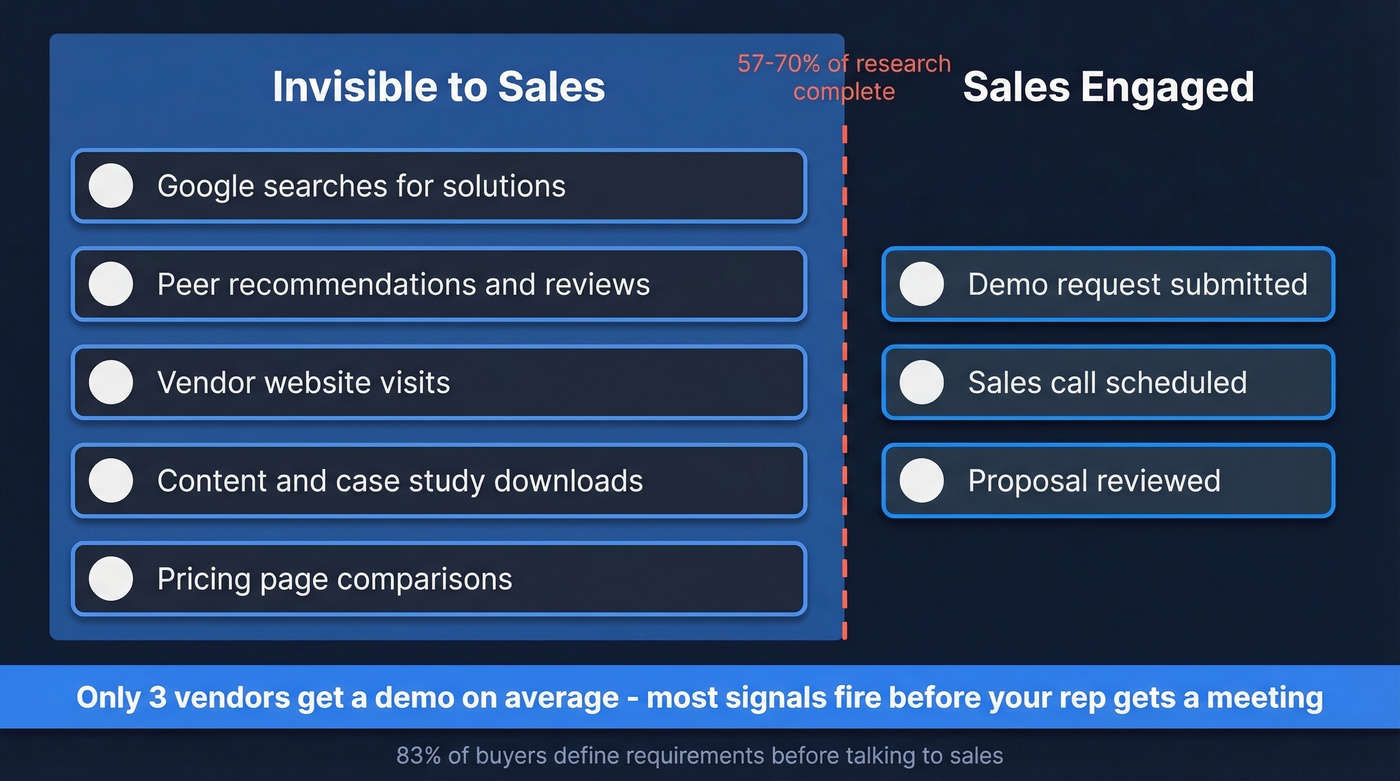
Here's what makes this tricky: prospects are [57-70% through their research](https://www.forrester.com/blogs/15-05-25-myth_busting_101_insights_intothe_b2b_buyer_journey/) before they ever speak to a salesperson, and on average only three vendors get a demo. Most of the signals that matter happen before your rep gets a meeting. Recognizing these indicators early is what separates top-performing teams from everyone else.
Signal Strength Scoring Model
Most guides list signals with vague "high/medium/low" labels. That's not actionable. We've used a point-based model across multiple teams that you can plug directly into your CRM:
| Signal | Tier | Points | Why It Matters |
|---|---|---|---|
| RFP / vendor eval | Tier 1 | 10 | Active purchase process |
| Procurement/legal acceleration | Tier 1 | 9 | Deal velocity confirmed |
| Demo or trial request | Tier 1 | 9 | Shortlist confirmed |
| Pricing inquiry | Tier 1 | 8 | Budget conversation |
| Decision-maker intro | Tier 2 | 7 | Buying committee engaged |
| Repeat pricing page visits | Tier 2 | 6 | Comparison shopping |
| Job change at target account | Tier 2 | 5 | New budget, new stack |
| Case study download | Tier 3 | 3 | Research phase |
| Social media follow | Tier 3 | 2 | Awareness only |
| Newsletter signup | Tier 3 | 2 | Awareness only |
| Single blog visit | Tier 3 | 1 | Noise |
Set your SQL threshold at >=15 points from at least two signal types. Three blog visits and a newsletter signup? That's a 5. Leave them in nurture.
Ask any SDR team what their most overrated signal is, and content downloads come up every time.
The math backs them up. WhatConverts demonstrated a scenario where Campaign A generated 100 leads at $50 CPL with 2% conversion (2 customers), while Campaign B generated 20 leads at $250 CPL with 15% conversion (3 customers). Campaign A had lots of homepage-only visitors and generic report downloads with just a few demo requests. Campaign B had more case study downloads and demo requests on lower lead volume. Signal quality beats lead volume every single time.

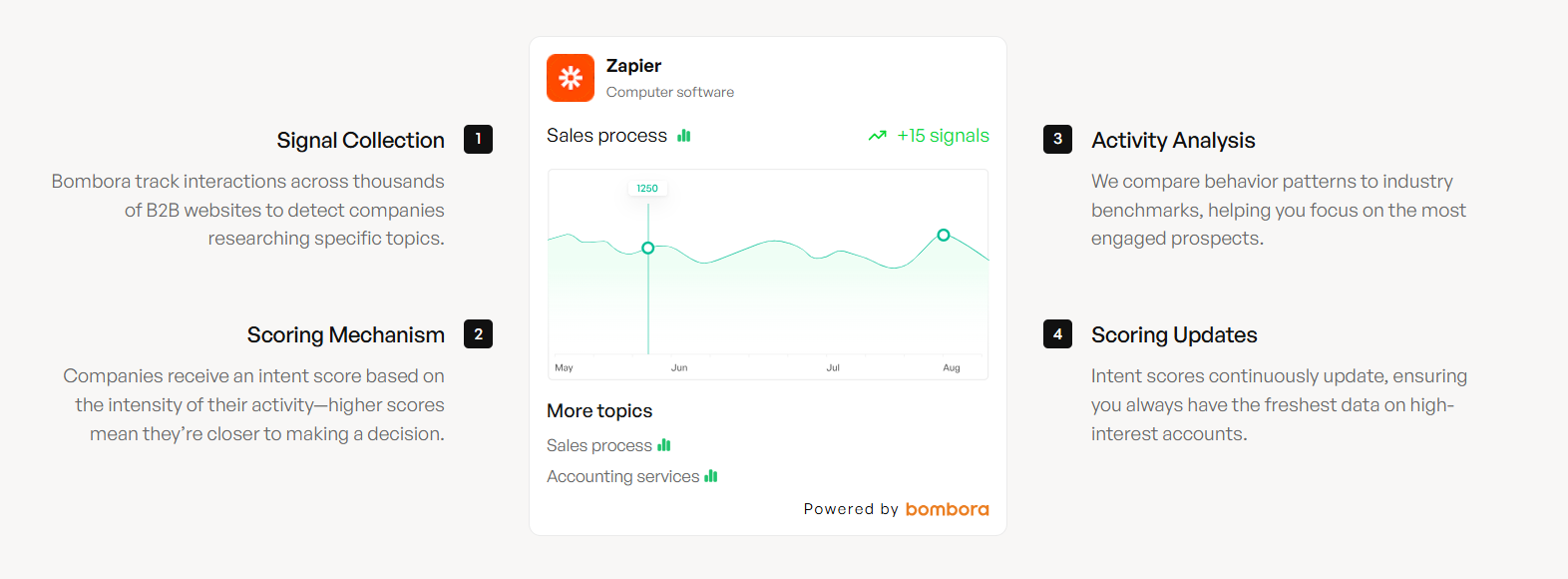
Your scoring model is only as good as your ability to act on it. When a Tier 1 signal fires, you need a verified email and direct dial within minutes - not a research sprint. Prospeo tracks 15,000 intent topics via Bombora and pairs them with 300M+ profiles, 98% email accuracy, and 125M+ verified mobiles. All refreshed every 7 days.
Close the gap between signal detected and first touch to minutes.
How to Interpret Signals Without Overreacting
Treating all signals equally. In this model, a pricing page visit is weighted 8x a blog visit. Weight your scoring accordingly - pricing and comparison pages should trigger immediate action, not just a lead score bump.
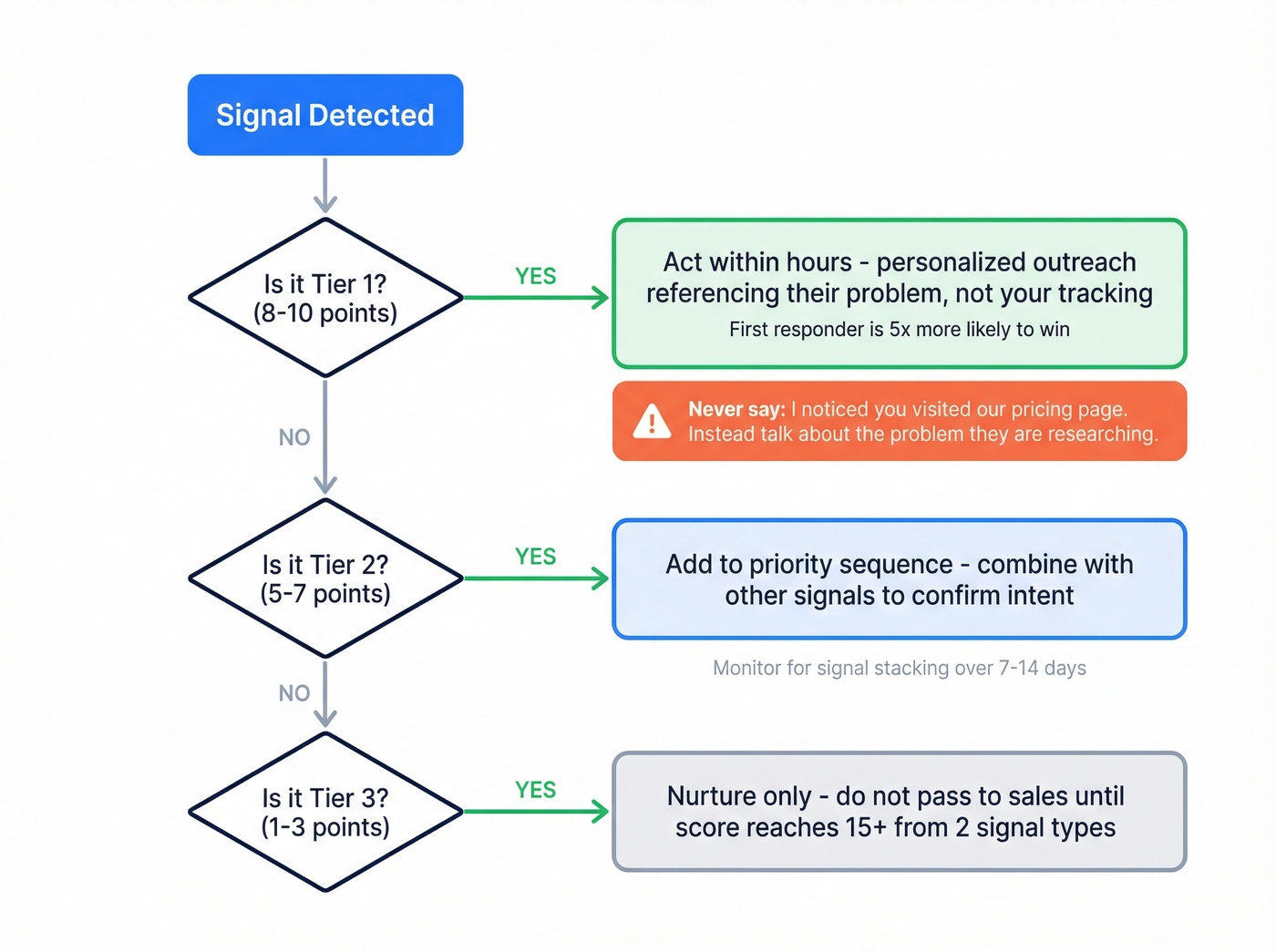
Acting too slowly. The first seller to contact after a trigger event is 5x more likely to win the deal. Hours matter. Days are fatal.
Referencing your surveillance. "I noticed you visited our pricing page" makes prospects feel watched. Talk about the problem they're researching, not the pageview. We've seen reps torpedo warm leads this way - don't be that person.
Relying on a single signal source. Blend first-party data (your site, product usage) with third-party intent (Bombora, G2 signals). One source gives you a guess. Multiple sources give you conviction.
Measuring the wrong thing. Track signal-to-meeting and signal-to-pipeline, not signal-to-MQL. Teams using signal-based selling see 18% average response rates versus 3.4% for cold outreach. But you'll only know which signals drive that lift if you're measuring conversion, not just volume. In our experience, the teams that struggle most aren't missing signals - they're drowning in them and measuring the wrong ones.
Act Fast or Lose the Deal
91% of B2B marketers use intent data, but only 24% report exceptional ROI. That's not a data problem. It's an execution problem. Detection without action is expensive noise, and spotting high-intent behavior is only half the battle - the other half is having the infrastructure to respond before the window closes.
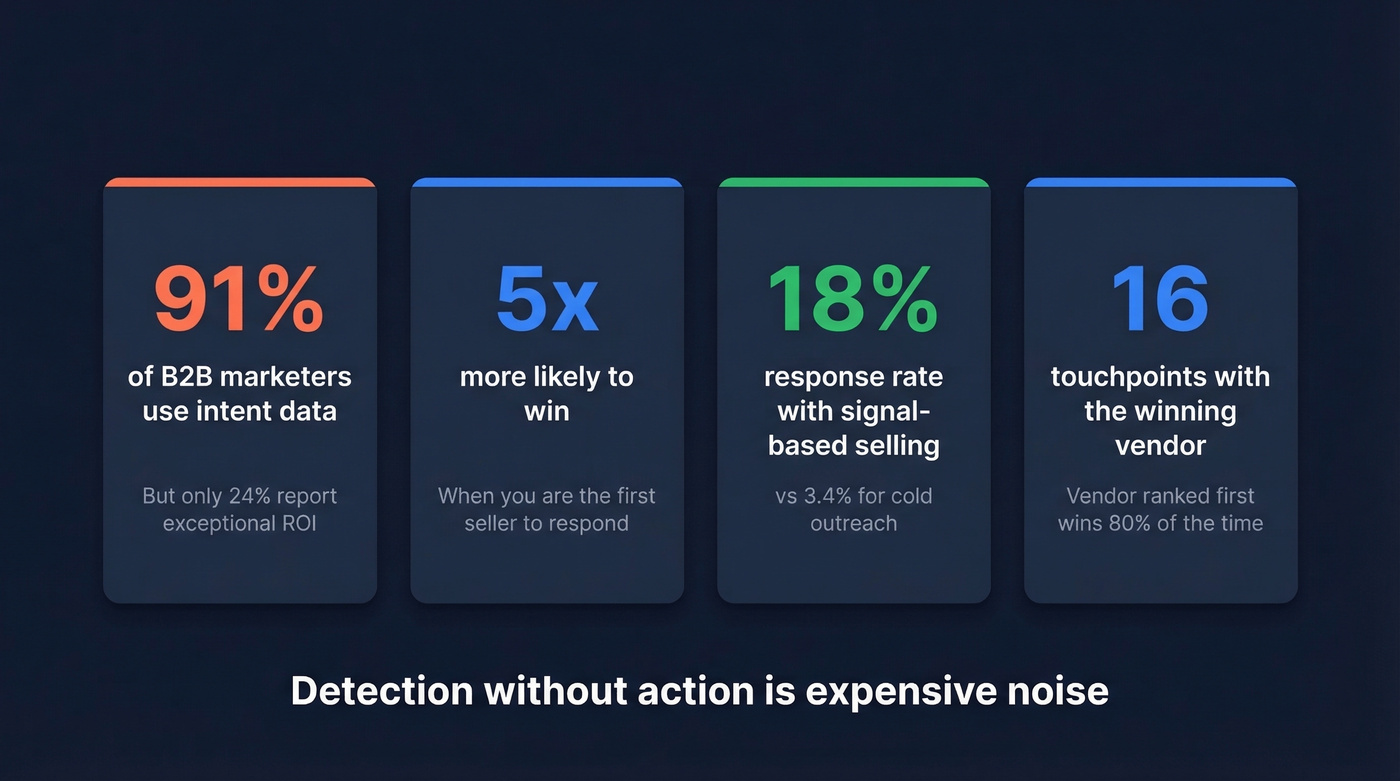
Buyers average 16 interactions with the winning vendor, and the vendor ranked first wins about 80% of the time. Getting there first isn't a nice-to-have. It's the game. As sales trainer Richard Harris puts it: "You don't know if they're ready to buy until they tell you - and you can't believe it until you get a signed contract." Your job is to be in the conversation early enough that you're the one they tell.
Detecting the signal is step one. Having a verified email and a direct number ready when it fires is step two. Prospeo covers both - 300M+ professional profiles with 98% email accuracy, 125M+ verified mobile numbers, data refreshed every 7 days, and Bombora-powered intent data across 15,000 topics. At roughly $0.01 per email with a free tier to start, the gap between "signal detected" and "personalized email sent" shrinks to minutes.
For enterprise teams with bigger budgets, Bombora runs $12-40K/year and 6sense starts around $35K/year for smaller deployments (enterprise contracts run $300K+), with 3-6 month implementation timelines. The B2B intent data market hit $4.49B in 2026 - but most of that spend goes to platforms with six-figure contracts. You don't need one to act on signals the same day they fire.
Let's be honest: if your average deal size is under $25K, you almost certainly don't need a six-figure intent platform. A solid scoring model, fast contact data, and disciplined follow-up will outperform a $300K 6sense contract with sloppy execution every single time. Skip the enterprise stack until your team has the process discipline to use it.
If you want to go deeper on tooling, compare buyer intent tools and intent data platforms before you commit to a long contract.
The first seller to respond is 5x more likely to win. But speed means nothing if your contact data bounces. Prospeo's 5-step verification keeps bounce rates under 4%, and at $0.01 per email, you can act on every high-scoring signal without blowing your budget on a six-figure intent platform.
Stop scoring signals you can't act on fast enough.
FAQ
What's the strongest buying signal in B2B?
An RFP or vendor evaluation request is the strongest, followed by demo/trial requests and direct pricing inquiries. These indicate active evaluation, not passive research. In a typical buying process, only about three vendors get a demo - if you're one of them, you're on the shortlist.
Are content downloads a reliable indicator of purchase intent?
No. Content downloads are among the weakest signals - Tier 3, worth 1-3 points at most. Prioritize demo requests, pricing inquiries, and decision-maker introductions instead. Those correlate with closed deals; whitepaper downloads rarely do.
How fast should you respond to a buying signal?
Same day, ideally within hours. The first seller to contact after a trigger event is 5x more likely to win the deal. Speed requires verified contact data ready when the signal fires - a 7-day refresh cycle and 98% email accuracy mean fewer bounces while competitors scramble for a working address.