

Buyer Intent: What It Is, Why It Fails, and How to Make It Work
Your intent data vendor just flagged 500 "high-intent accounts." Your SDRs call into them for two weeks. Three meetings booked. 91% of B2B marketers use intent data to prioritize accounts, but only 24% report exceptional ROI. That gap isn't a data problem. It's an activation problem rooted in how teams understand and act on buyer intent.
Here's the short version: buyer intent is the detection of in-market accounts through behavioral signals. Most programs fail because teams buy expensive data and never act on it within the critical 48-hour window. You need a signal hierarchy, a decay model, and verified contact data to reach decision-makers fast.
What Is Buyer Intent?
Two things get conflated here. The definition most teams work with is too narrow - they treat it as a score in a dashboard. Buyer intent is the actual readiness to purchase. It exists whether you measure it or not. Intent data is the set of behavioral signals - website visits, content downloads, search activity, competitor research - that indicate that readiness exists.
The distinction matters because too many teams treat the data as the thing itself. A high intent score doesn't mean someone wants to buy from you. It means someone at that account is researching a problem you solve. As one practitioner on r/LeadGeneration put it after testing 6sense, ZoomInfo, and Bombora: even with perfect ICP and copy, "you can't sell to a person/business who doesn't need it." Intent is about timing, not targeting.
The uncomfortable reality: 67% of the B2B purchase journey happens digitally, mostly before a buyer ever visits your website. Buying groups average 14-23 stakeholders per Gartner's research, and those people are reading analyst reports, scanning G2 reviews, and comparing pricing pages - all without raising their hand. 92% of buyers already have a shortlist before formal evaluation begins. Intent data is your only window into that invisible activity. But a window isn't a door.
Why It Matters in 2026
Gartner projected that 80% of B2B sales interactions would happen in digital channels by 2025, and that trajectory has only accelerated. Buyers spend just 17% of their time meeting suppliers, use 10 interaction channels on average, and do 12 online searches before visiting a specific brand's website.
Speed compounds the urgency. Up to 50% of sales go to the first vendor to respond. Meanwhile, 84% of reps missed quota last year. Your buyers are researching in the dark, your competitors are trying to reach them first, and your reps are flying blind without signal data.
Understanding the difference between intent and interest is critical. Interest is passive - someone finds your category mildly relevant. Intent reflects active research tied to a purchase timeline. Conflating the two is how teams waste outreach on accounts that were never in-market.
Let's be honest: if your average deal size is under $15K, you probably don't need a $50K intent platform. You need fast, accurate contact data and a disciplined follow-up process. Intent data amplifies good execution - it doesn't replace it.
Types of Intent Data
The source of your data determines signal quality, coverage, and noise.
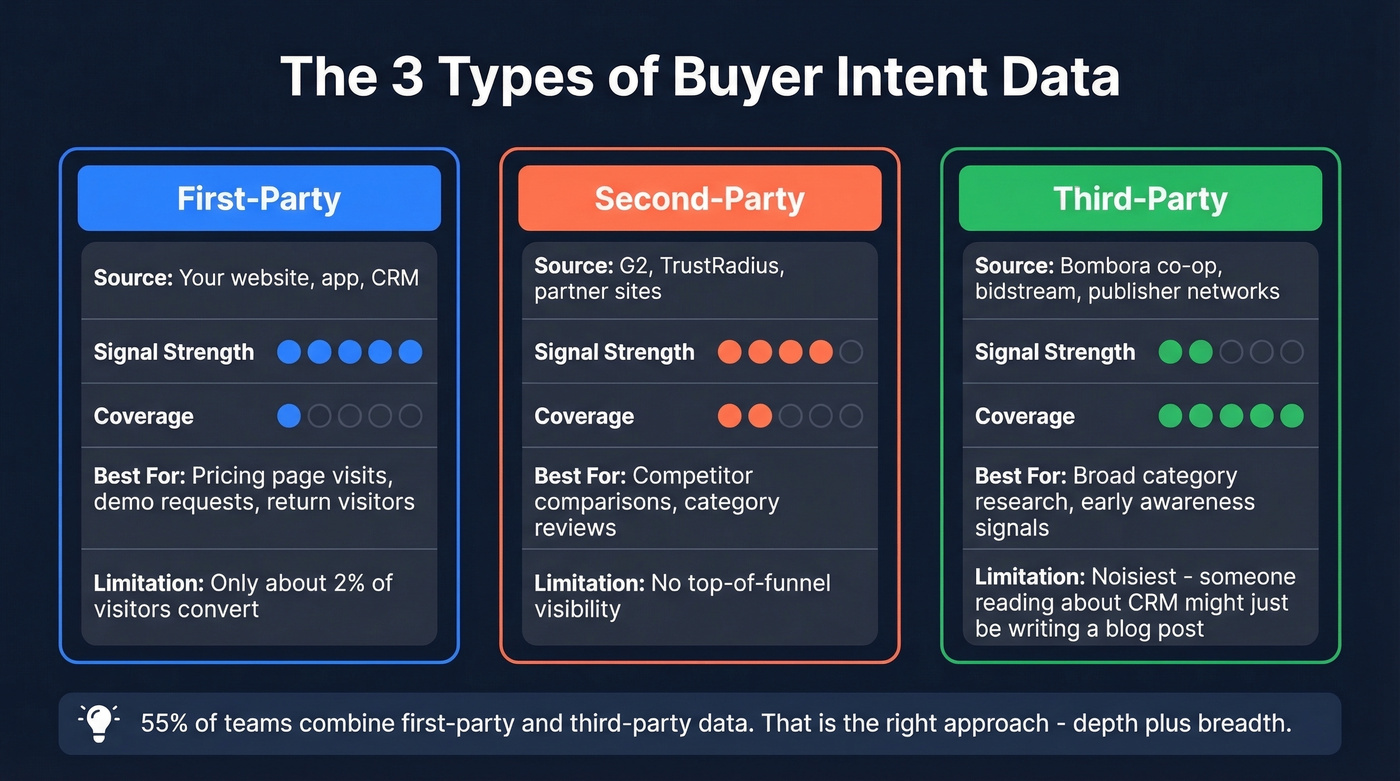
| Type | Source | Signal Strength | Coverage | Limitation |
|---|---|---|---|---|
| First-party | Your website/app | Strongest | Narrow | ~2% convert |
| Second-party | G2, TrustRadius | Strong (lower-funnel) | Limited | No top-of-funnel |
| Third-party | Bombora co-op, web | Moderate | Widest | Noisiest |
First-Party Intent
Activity on your owned properties - pricing page visits, demo requests, product page deep-dives, return visits. It's the highest-fidelity signal because you control collection and can verify it against real behavior. The limitation is reach: only about 2% of first-time visitors ever convert. First-party data is essential but insufficient on its own. HubSpot's Breeze Intelligence and similar tools can help de-anonymize some of this traffic, but they only scratch the surface.
Second-Party Intent
A partner's first-party data shared with you. In B2B, the most common sources are review sites like G2 and TrustRadius. When a prospect reads your G2 profile or compares you against a competitor, that's a strong lower-funnel signal. The tradeoff is limited top-of-funnel visibility.
Third-Party Intent
This is the broadest category - research activity across the wider web. Third-party data gets sourced three ways: publisher co-ops like Bombora's network of 5,000+ sites tracking 17B+ interactions monthly, bidstream data from real-time ad exchanges, and owned-and-operated publisher networks. Co-op data tends to be the cleanest; bidstream is noisier but broader. Category interest doesn't equal a purchase signal - someone reading about "CRM software" might be writing a blog post, not evaluating vendors.
55% of teams use a combination of first- and third-party data. That's the right instinct: first-party for depth, third-party for breadth, second-party for high-fidelity comparison signals. Community signal aggregators like Common Room can add another layer by tracking product mentions across Slack, Discord, and GitHub.
How to Identify Buyer Intent Signals
Not every signal deserves the same response. A demo request and a blog visit are both "intent," but treating them equally is how teams waste pipeline.
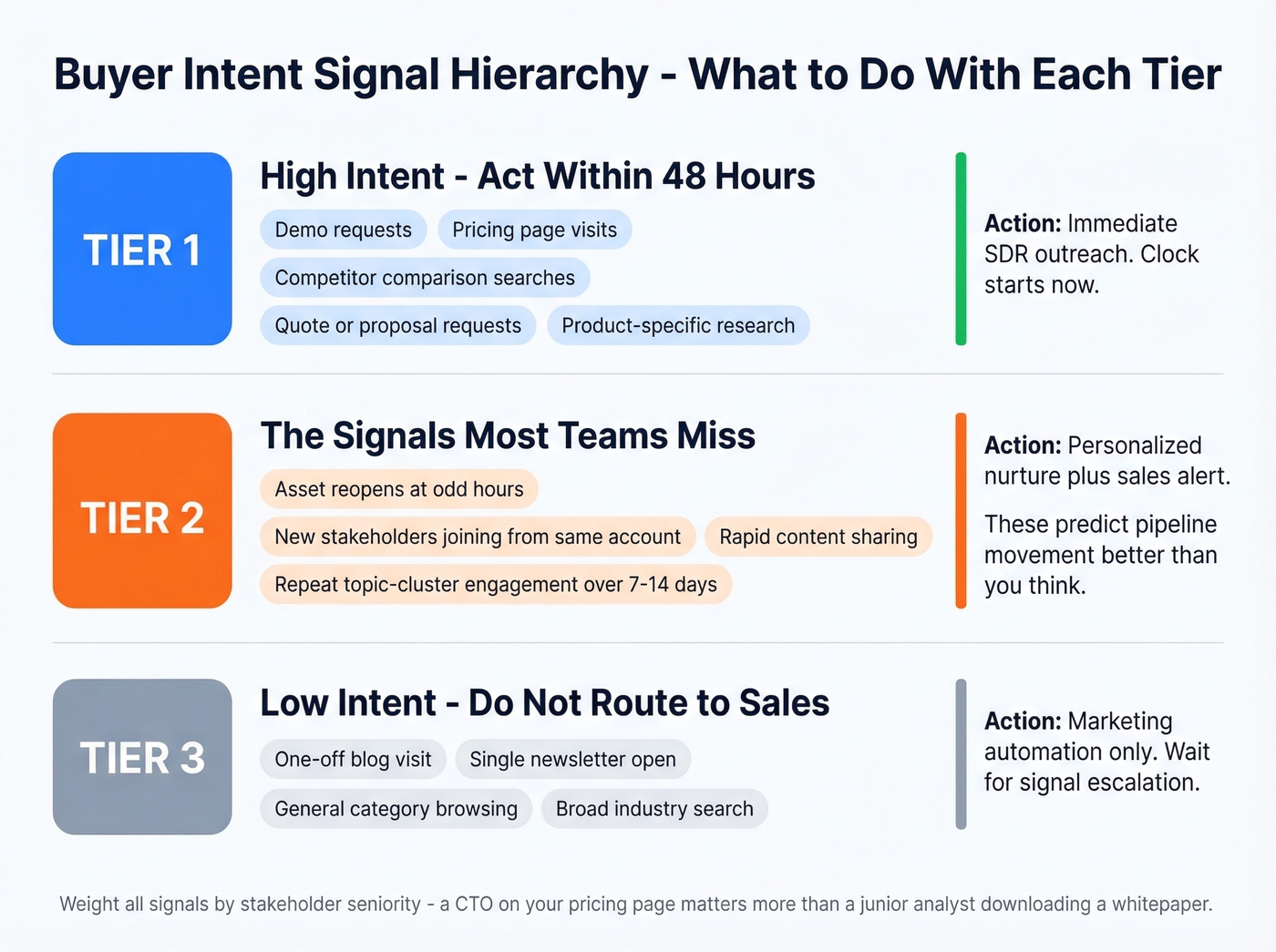
Some vendors classify signals by buyer-journey stage - awareness, passive, active. That's useful conceptually, but it doesn't tell your team what to do. A tiered hierarchy tied to specific response actions is more operational.
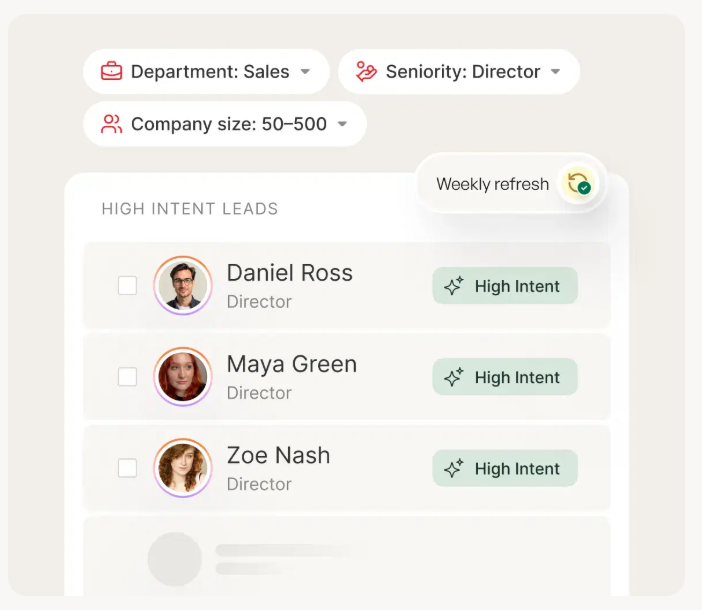
Tier 1: High Intent
These signals indicate active purchase evaluation and should trigger immediate outreach: demo requests, pricing page visits (especially repeat visits), product-specific research combining your category with competitor names, competitor comparison pages on review sites, and quote or proposal requests. Weight signals by stakeholder seniority - a CTO visiting your pricing page carries far more weight than a junior analyst downloading a whitepaper.
When you see Tier 1 signals, the clock starts. You have 48 hours before the signal decays and a competitor likely gets there first.
Tier 2: The Signals Most Teams Miss
Highspot's research highlights several subtle signals that correlate strongly with closed-won deals: asset reopens (someone re-reading your case study at 11pm is a buying signal, not casual browsing), new stakeholder invites from the same account, rapid-fire content sharing across an organization, and repeat engagement with topic-cluster content over 7-14 days.
We've seen teams ignore Tier 2 signals because they don't look dramatic. That's a mistake. Benchmark your signal patterns against closed-won data - you'll likely find that Tier 2 activity predicts pipeline movement better than most Tier 1 signals.
Tier 3: Low Intent
One-off blog visits, general category browsing, a single newsletter open, broad industry searches. Don't route these to sales. Nurture them with marketing automation and wait for escalation.

Intent signals decay in 48 hours. Prospeo tracks 15,000 Bombora intent topics and pairs them with 143M+ verified emails so your reps reach decision-makers before the window closes. Layer buyer intent with job role, technographics, and headcount growth using 30+ filters - then export verified contacts at $0.01/email.
Stop flagging accounts you can't actually reach.
Signal Decay and the 48-Hour Rule
How Decay Works
Intent signals are perishable. A pricing page visit from yesterday is actionable. The same visit from six weeks ago is noise.
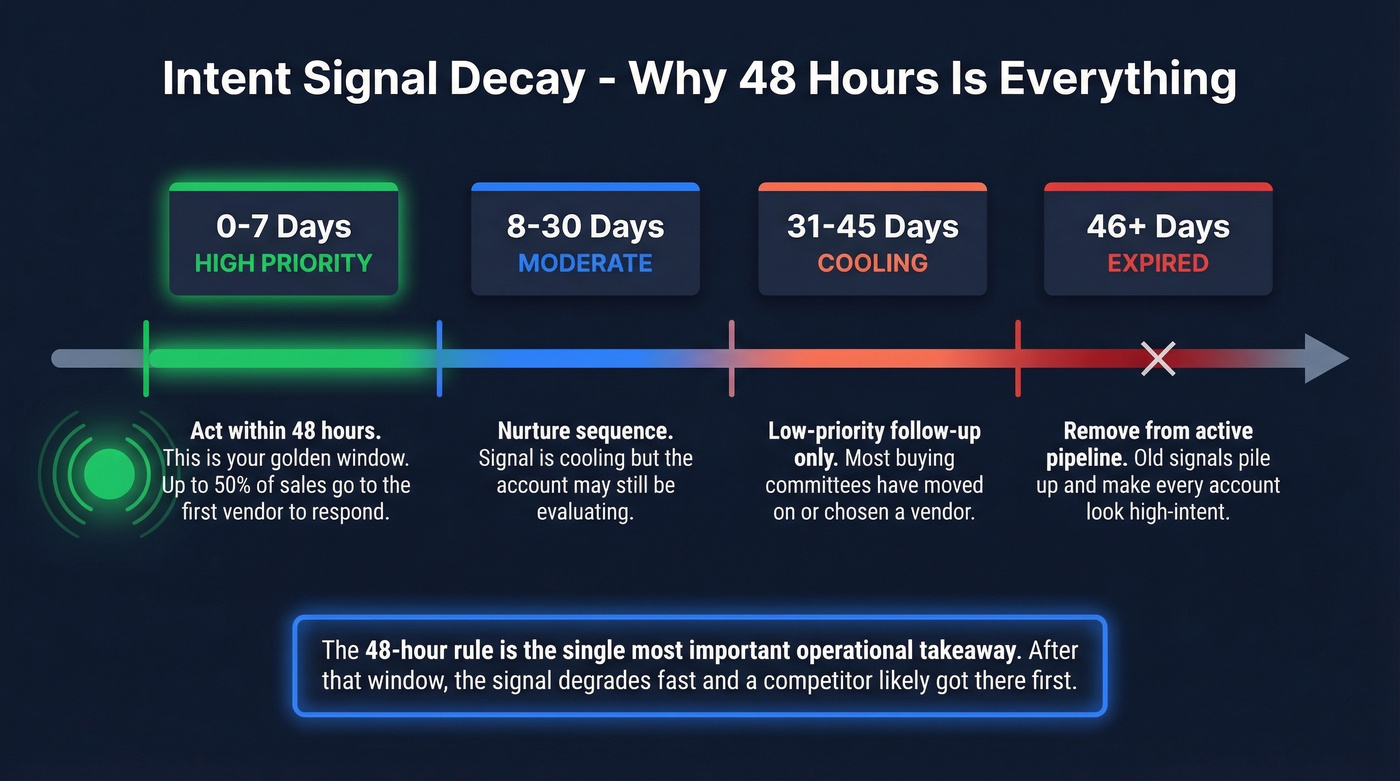
| Time Since Signal | Priority | Action |
|---|---|---|
| 0-7 days | High | Act within 48 hours |
| 8-30 days | Moderate | Nurture sequence |
| 31-45 days | Cooling | Low-priority follow-up |
| 46+ days | Expired | Remove from active pipeline |
The 48-hour rule is the single most important operational takeaway from this entire article. When a high-priority signal fires, your team needs to reach the right person within two business days. After that, the signal degrades fast - and the account is likely talking to whoever got there first.
Building a Scoring Model
The best scoring models combine three dimensions: ICP fit (firmographic match), behavioral engagement (what they're doing on your properties), and intent signals (what they're researching across the web). No single dimension is sufficient on its own.
Update your scoring model quarterly. Teams that refresh scoring on that cadence see a 35% boost in conversion rates. AI-driven scoring pushes that further - machine-learning models drive a 40% boost in sales efficiency when they handle signal weighting, because they catch patterns humans miss in high-volume data.
Why Most Intent Programs Fail
The technology works. The implementation usually doesn't. 70% of teams cite data quality as their number one challenge, and 64% struggle to turn data into action.
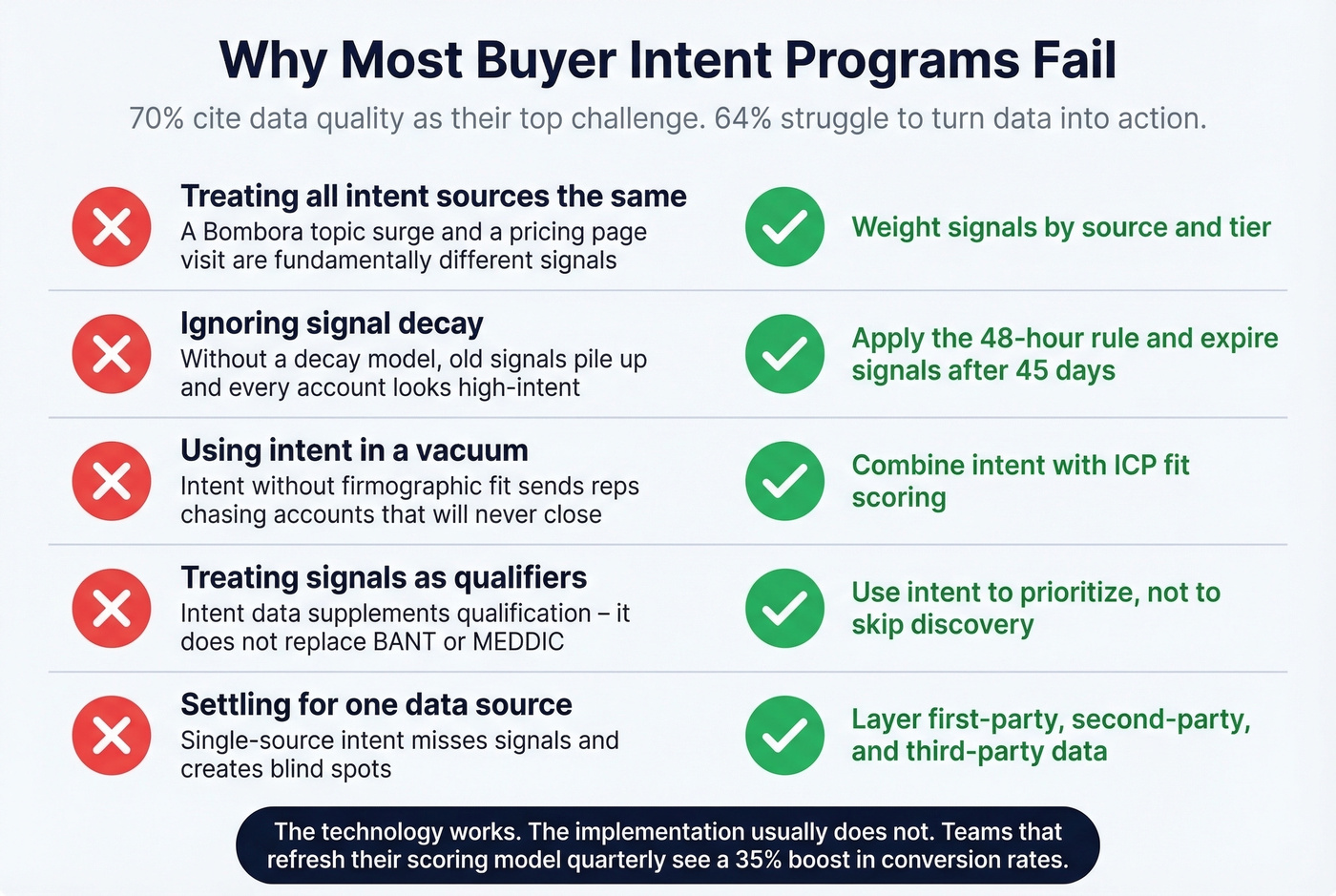
Forrester identified the most common mistakes, and we've seen every one in the wild:
- Treating all intent sources the same. A Bombora topic surge and a pricing page visit are fundamentally different signals. Weight them accordingly.
- Ignoring data decay. Without a decay model, every account eventually looks "high intent" because old signals pile up.
- Using intent in a vacuum. Intent without firmographic fit sends reps chasing accounts that'll never close.
- Treating signals as qualifiers. Intent data supplements qualification - it doesn't replace it.
- Settling for one source. Multi-source intent is more predictive, as long as you're not just duplicating the same co-op data.
The Reddit consensus on intent data vendors is blunt: "most buyer intent data solutions out there are trash." That frustration is real. One practitioner with 15+ years in sales engineering tested 6sense, ZoomInfo, and Bombora and described the experience as "mostly disappointed with the quality of data" - specifically calling out "mysterious intent scores" with no context.
On the flip side, teams that operationalize intent properly see results. NFON UK used intent-based ABM to identify 400 high-intent resellers in six months and signed 8 new partners. That same Reddit practitioner built a custom, evidence-backed intent system and increased monthly closed deal value from $200K to nearly $600K in 30 days. The data wasn't the problem. The approach was.
From Intent to Action
Intent data without contact data is a dashboard you stare at. You know an account is in-market. Now who do you call? Which VP is driving the evaluation? What's their verified email?
This is where most intent programs hit a wall. The intent vendor tells you "Company X is surging on CRM topics." Your rep searches for contacts, finds outdated emails, sends a sequence, and bounces 25% of it. The signal decays. The deal goes to a competitor with better data.
The operational fix has two parts. First, push scored intent into the systems your team actually works in - CRM, marketing automation, ad platforms. Intent data that lives in a standalone dashboard doesn't drive revenue. Second, pair intent signals with verified contact data so reps can act within that 48-hour window.
Prospeo tracks 15,000 intent topics powered by Bombora and pairs them with 143M+ verified emails at 98% accuracy and 125M+ verified mobile numbers. You go from "this account is researching your category" to a verified decision-maker's direct dial in one workflow - no separate intent vendor, no stitching together three tools. Data refreshes every 7 days, so you're not acting on stale contacts when a live signal fires.
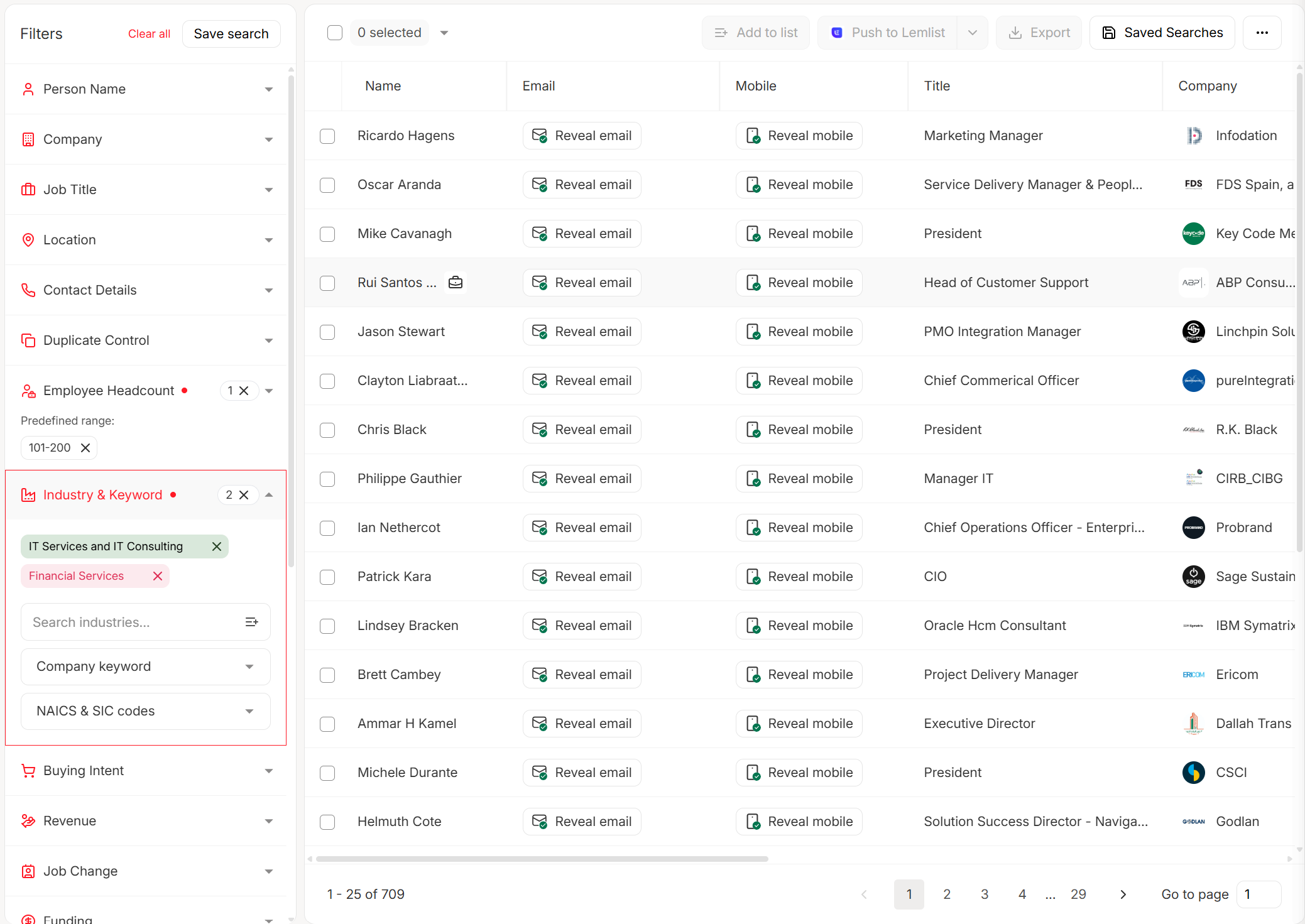
You read it above: 92% of buyers have a shortlist before evaluation starts. Prospeo's intent data surfaces those accounts while they're still researching, and 98% email accuracy means your outreach actually lands. No bounced emails burning your domain. No stale data from a 6-week refresh cycle.
Turn dark-funnel signals into booked meetings - starting today.
What Intent Data Costs
The intent data market hit $4.49B in 2026 and is growing at 16.6% CAGR. More options, more confusing pricing. Most vendors hide their numbers behind "talk to sales" walls.
Here's what we've been able to pin down:
| Tool | Annual Range | Notes |
|---|---|---|
| Bombora | $25K-$80K | Standalone intent, annual contract |
| 6sense | $35K-$150K+ | Full-stack revenue AI |
| Demandbase | $40K-$120K | ABM platform; intent is one module |
| G2 Buyer Intent | $10K-$87K+ | Add-on to G2 profile |
| ZoomInfo | $7.2K-$36K | Intent is add-on to core platform |
| Prospeo | Free tier; ~$0.01/email | 15K intent topics, no contract |
Budget 15-25% above the quoted license for total cost of ownership - implementation, integration, and optimization add up. For enterprise teams running full-stack ABM with 6sense or Demandbase, those platforms earn their price tag through workflow depth. But if you need intent signals paired with verified contact data and don't want to commit $25K+ before proving ROI, the pricing gap is enormous.
Skip the enterprise platforms if you're a team under 20 reps and haven't validated that intent data moves your pipeline. Start smaller, prove the model, then scale up.
Buyer Intent FAQ
What's the difference between buyer intent and intent data?
Buyer intent is the actual readiness to purchase - it exists in the buyer's mind whether you measure it or not. Intent data is the measurable set of behavioral signals (web visits, content downloads, search activity) that indicate that readiness. One is the phenomenon; the other is the measurement.
Does intent data actually work?
Yes, but execution matters far more than the data itself. 91% of B2B marketers use it, yet only 24% report exceptional ROI. Teams that act within 48 hours on high-priority signals and pair intent with verified contact data see dramatically better conversion rates. The ones who treat it as a passive dashboard don't.
How quickly should I act on an intent signal?
Within 48 hours for high-priority signals like demo requests, pricing page visits, and competitor comparisons. After 7 days, priority drops significantly. After 46 days, consider the signal expired and remove the account from active pipeline.
Can small teams afford intent data?
Enterprise platforms run $25K-$150K+/year, but smaller teams don't need to start there. Credit-based tools with free tiers let you prove the model before committing serious budget. The key is pairing intent with verified contacts so you're not just watching a dashboard.
What are the best signals to track?
Demo requests, pricing page visits, product comparisons, and quote requests are Tier 1 - they indicate active purchase evaluation and should trigger immediate outreach. Tier 2 signals like asset reopens, new stakeholder invites, and rapid content sharing are subtler but often predict pipeline movement just as reliably. We've found that teams who track both tiers together outperform those who only chase the obvious ones.