

The 10 Best Intent Data Platforms for 2026 - With Real Pricing
A marketing leader with 15+ years of experience posted on r/LeadGeneration about spending "a lot of money and time" testing intent data platforms - 6sense, ZoomInfo, Bombora - through 2021-2022. The verdict: "mostly disappointed with the quality of data." Intent scores lacked "context and coherence." That same poster built a custom system and saw monthly closed deals jump from $200K to nearly $600K, but most teams don't have that option.
Intent data works. But only if you choose the right solution for your workflow, pair signals with verified contact data, and act before the signal decays. The majority of orgs fail at step two. They buy account-level surge data, stare at a list of company names, and realize they still don't know who to email.
Our Picks (TL;DR)
- Best for intent + verified contact data (self-serve): Prospeo
- Best for enterprise ABM orchestration: 6sense
- Best third-party intent data provider: Bombora
- Best for proprietary intent signals: Intentsify
- Best for budget-conscious teams: Leadfeeder (free tier) + G2 Buyer Intent (free profile)
What Intent Data Actually Tells You
Gartner research is widely cited as finding that 61% of B2B buyers prefer to complete a purchase without talking to a sales rep. That's why tracking digital research behavior isn't optional - it's the only way to know what's happening before a hand raise.
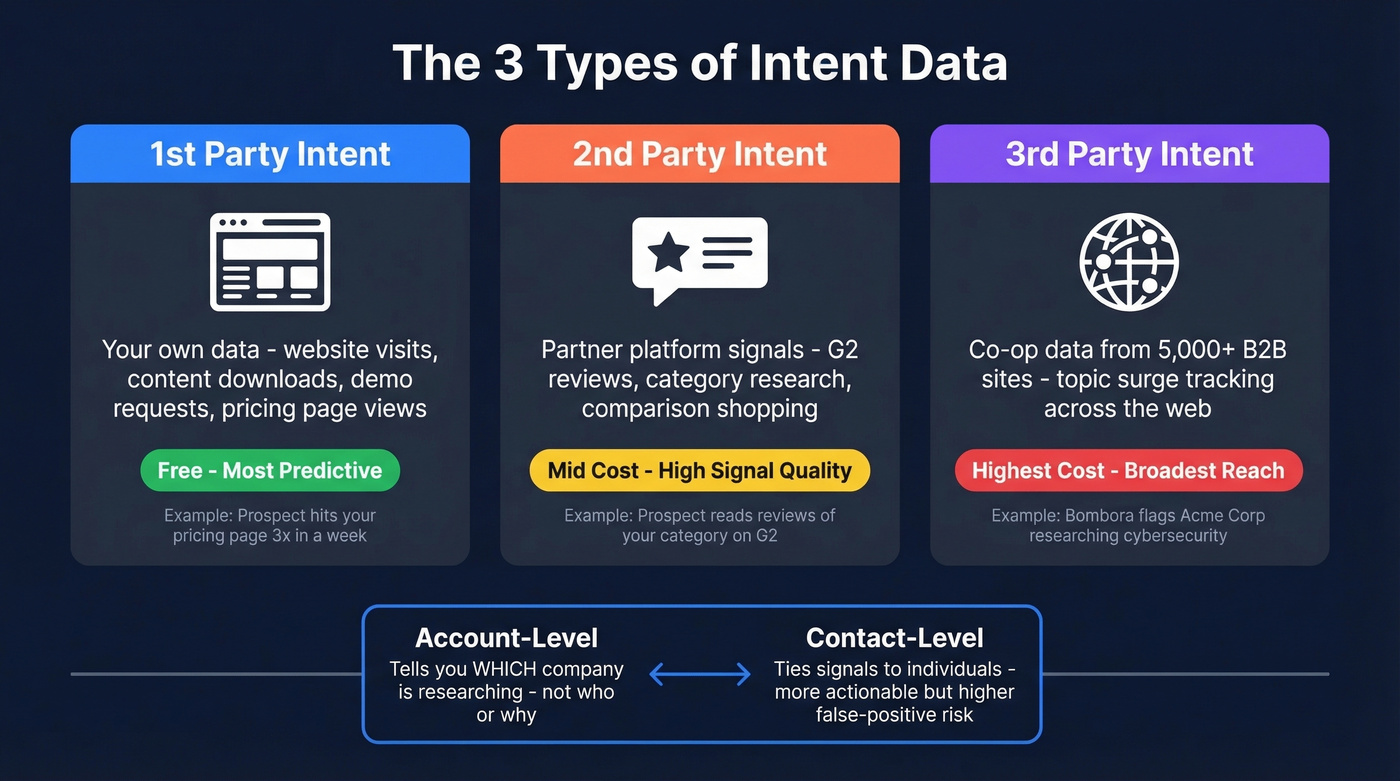
Intent data comes in three flavors, and conflating them is the first mistake buyers make.
First-party intent is data you already own - website visits, content downloads, demo requests. If someone hits your pricing page three times in a week, that's real intent. Nearly every team we've worked with undervalues this source, which is wild considering it's free and more predictive than anything you'll buy from a vendor.
Second-party intent comes from partner platforms where buyers actively research. G2 is the classic example: when a prospect reads reviews of your category, that's a buying signal you'd never see otherwise.
Third-party intent is the big-budget category. Providers like Bombora track content consumption across a co-op of ~5,000 B2B websites, flagging when a company's research activity on a topic exceeds a baseline. This is what most people mean when they say "intent data."
Here's what trips up most buyers: account-level vs. contact-level. Account-level intent (what Bombora and most providers deliver) tells you "Acme Corp is researching cybersecurity." It doesn't tell you who at Acme Corp, or why. Contact-level intent ties signals to individuals - more actionable, but higher false-positive risk and thornier privacy implications.
With buying committees running 6-10 decision-makers deep, account-level signals help you monitor broader committee activity. You still need a way to find verified contacts at those accounts, though, and that gap is where most intent investments quietly die.
One thing vendors rarely mention: intent data isn't just for acquisition. If an existing customer starts researching competitor categories, that's a churn signal your CS team should act on immediately. We've seen this save six-figure accounts.
How to Evaluate Intent Data Solutions
Score platforms against these six criteria before you demo anything. Numerical scoring frameworks create false precision - a 4.2 vs. 4.3 tells you nothing about fit. These questions actually matter:
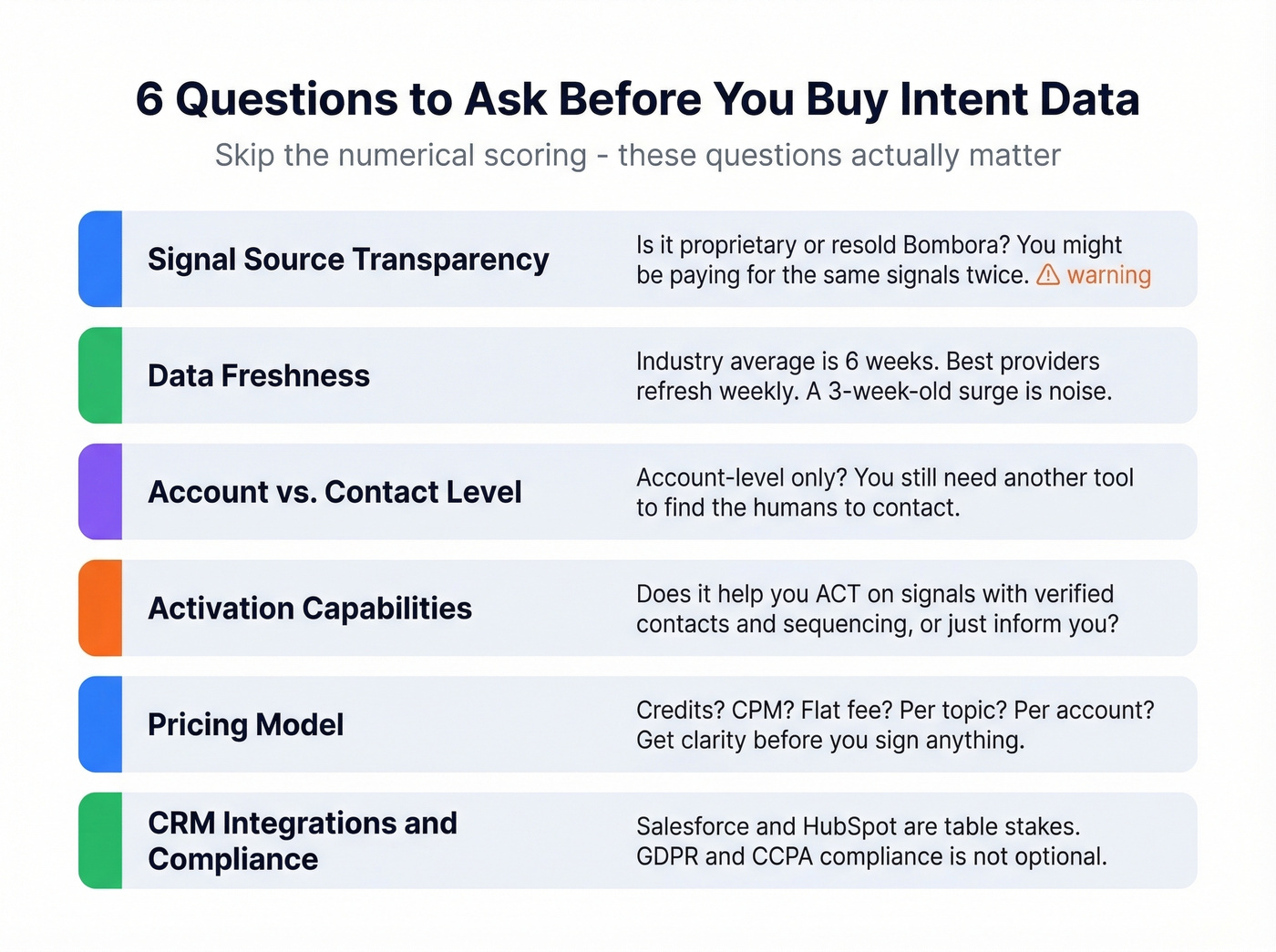
- Signal source transparency. Is the intent data proprietary, or is the vendor reselling Bombora? Many platforms - including ZoomInfo and Cognism - layer Bombora data into their product. You might already be paying for the same signals twice.
- Data freshness. Intent signals decay fast. A surge from three weeks ago is noise. The industry average refresh cycle is roughly six weeks; the best providers refresh weekly.
- Account-level vs. contact-level. If it's account-level only, you'll need a separate tool to find the actual humans to contact.
- Activation capabilities. Does the platform help you act on signals - with verified contacts, orchestration, or sequencing - or just inform you that something happened?
- Pricing model. Credits? CPM? Flat annual fee? Some vendors charge per topic, per account, or per data point. Get clarity before you sign.
- CRM integrations and compliance. Salesforce and HubSpot are table stakes. GDPR and CCPA compliance isn't optional, especially for intent-driven outreach into EMEA.

Most intent data platforms tell you which companies are researching. Then you're stuck. Prospeo tracks 15,000 intent topics and pairs them with 300M+ profiles - so you go from "in-market account" to verified buying committee contacts in one search. 98% email accuracy, 7-day refresh, no second vendor needed.
Close the gap between intent signal and first touch - in one platform.
10 Best Buyer Intent Data Providers for 2026
Prospeo - Best for Intent + Verified Contacts
Use this if you want intent signals and verified contact data in a single self-serve platform without a $50K annual commitment. Prospeo's B2B database covers 300M+ professional profiles with 30+ search filters - including buyer intent across 15,000 topics (powered by Bombora), technographics, job changes, headcount growth, and funding signals. Every email is verified in real time at 98% accuracy.
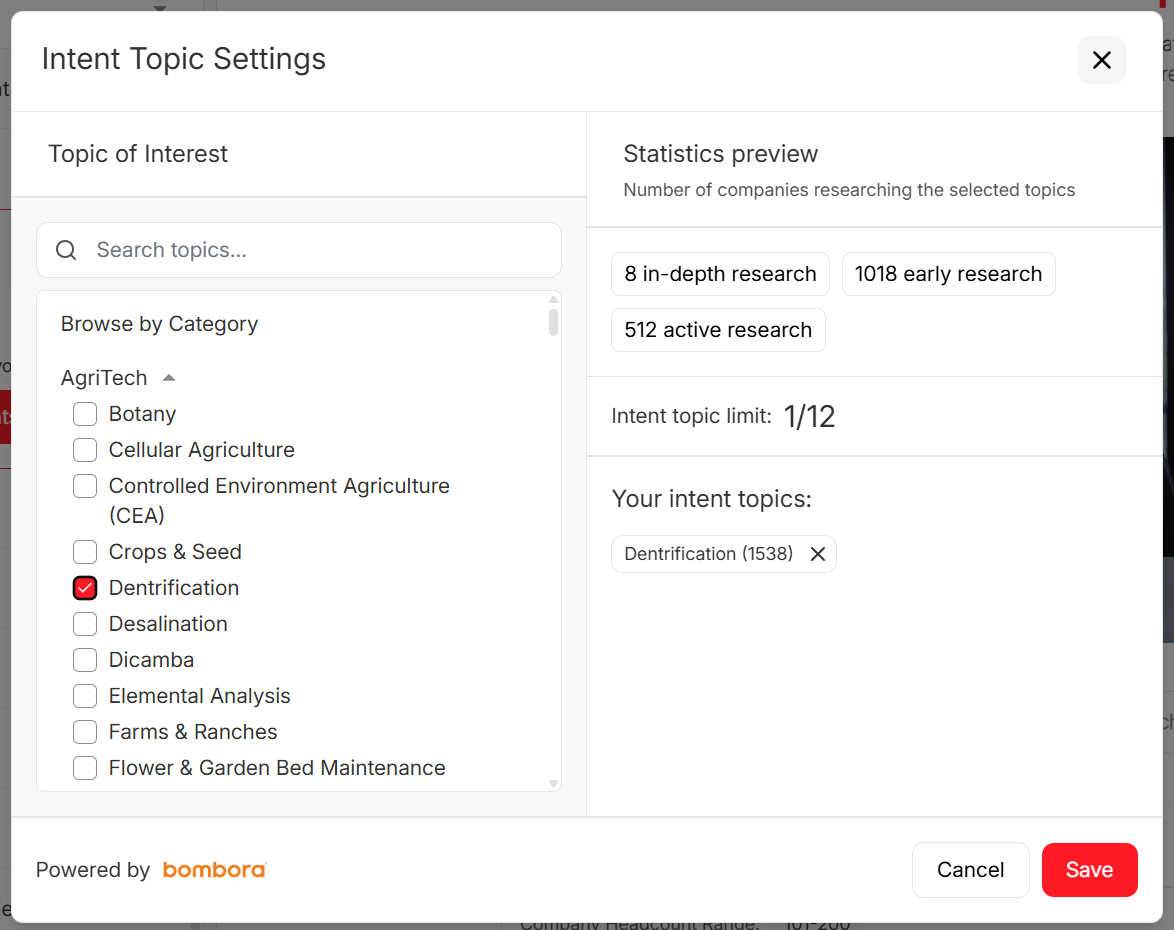
Data refreshes every 7 days, which matters more than most buyers realize. When Snyk rolled out Prospeo to 50 AEs, their bounce rate dropped from 35-40% to under 5%, and AE-sourced pipeline jumped 180%.
The real differentiator is that you don't hit a wall after identifying surging accounts. You go straight from "this company is in-market" to "here are 8 verified contacts in the buying committee" without switching tools or paying a second vendor. That workflow compression is why teams book 26% more meetings compared to ZoomInfo and 35% more compared to Apollo.
Skip this if you need a full ABM orchestration platform with predictive buying-stage models and ad targeting built in - pair Prospeo with your existing ABM or sequencing tools for the full workflow.
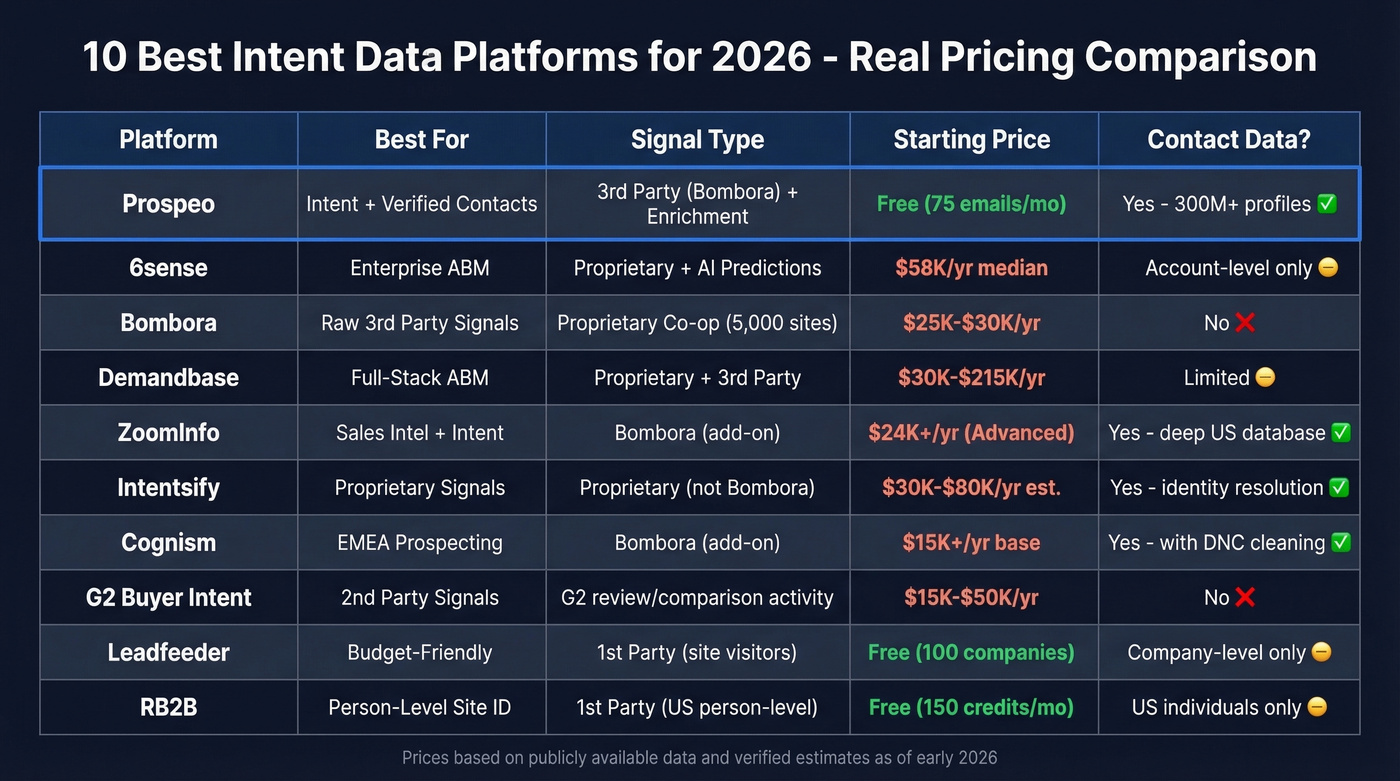
Pricing: Starts free (75 verified emails/month). Paid plans run ~$0.01/email with no contracts - roughly 90% cheaper per lead than ZoomInfo.
6sense - Best for Enterprise ABM
Use this if you're an enterprise team running account-based everything and need predictive buying-stage models. 6sense's AI predicts where accounts sit in the buying journey - not just "they're researching," but "they're in the decision stage." It earned a Forrester Wave Leader designation, and the orchestration capabilities are genuinely best-in-class for large orgs. The platform also offers unlimited custom keyword tracking and web de-anonymization.

Skip this if you're a team under 50 people or your budget is under $50K/yr. The median contract runs $58,617/year across 314 tracked purchases, and mid-market deployments start at $60K-$100K/yr. There's a free plan (50 credits/month), but it's a taste, not a meal. The biggest gap: 6sense delivers account-level signals, so you still need a contact data layer to reach the humans at surging accounts.
Bombora - Best Third-Party Signal Source
Use this if you want the raw intent signal that half the industry resells. Bombora's Company Surge methodology tracks content consumption across a co-op of ~5,000 B2B websites, flagging when a company's research on any of 18,000+ topics exceeds its baseline. It's account-level, topic-level, and threshold-based - the foundational third-party intent dataset.
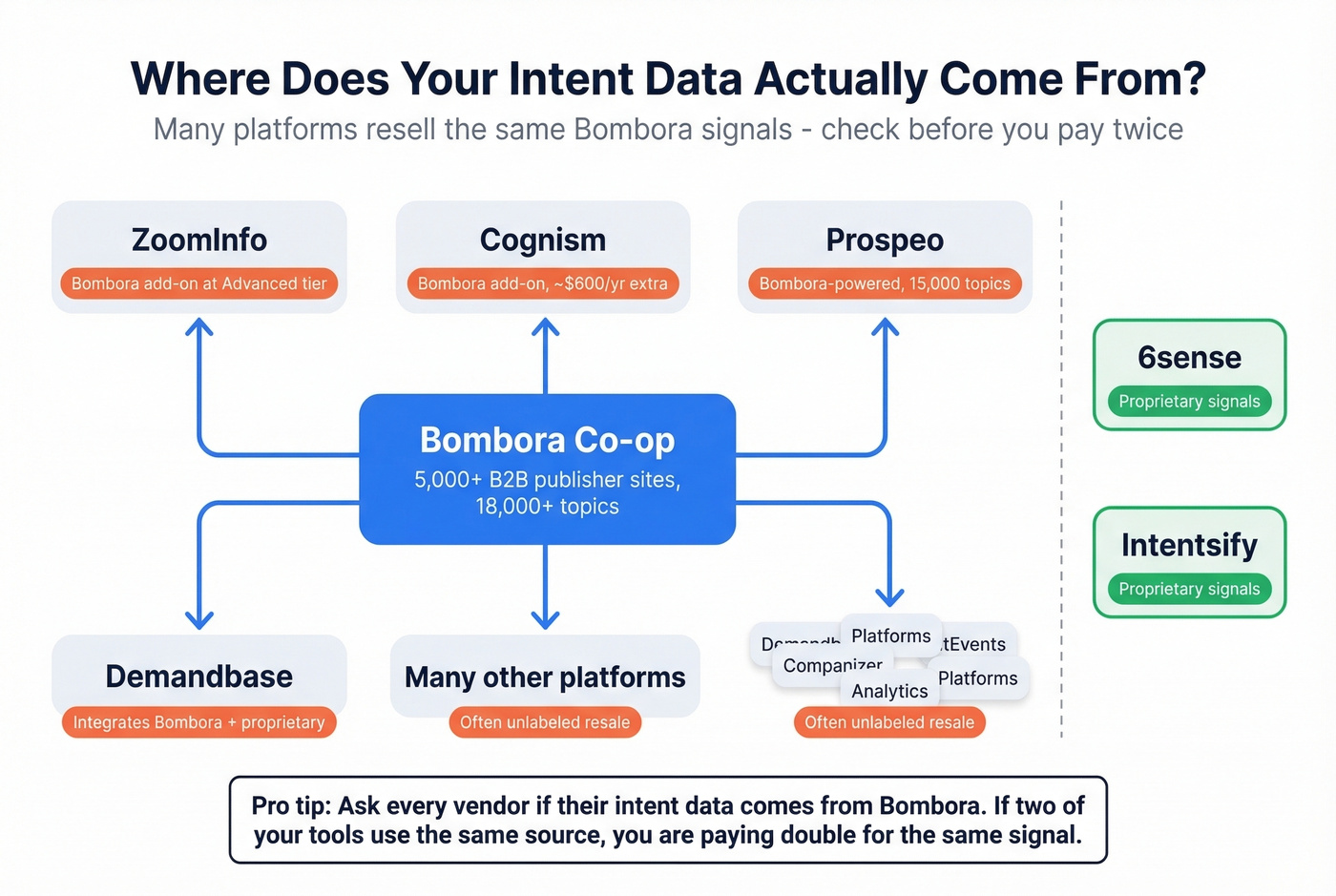
Skip this if you need contact-level data or a platform that helps you act on signals. Bombora is the signal, not the activation layer. And check whether you're already paying for it - ZoomInfo and Cognism both integrate Bombora data.
Pricing: Basic Company Surge starts ~$25K-$30K/yr. Enhanced packages run $50K-$100K/yr. Annual contracts required, no monthly option.
Demandbase - Full-Stack ABM
Demandbase is a Forrester Wave Leader you pick when you want advertising, intent, and orchestration consolidated under one roof. Strong for enterprise teams tired of stitching together point solutions. The trade-off is cost and complexity: an AWS Marketplace listing shows Demandbase One at $215,000 for 12 months. Typical range is $30K-$100K+/yr depending on company size. Implementation timelines can stretch months.
ZoomInfo - Sales Intelligence + Intent
One of the deepest US B2B databases, period. If your reps already live in ZoomInfo for prospecting, adding intent is a natural extension - the Advanced tier ($24K+/yr) includes intent data, buying signals, and WebSights. The Professional tier ($15K+/yr) doesn't include intent at all. Add-ons stack fast: extra credits, NeverBounce verification, and global data can push total cost near $50K/yr. Watch the contract terms - ZoomInfo pushes 2-3 year deals with 60-90 days' auto-renewal notice.
Intentsify - Proprietary Signals
In the most recent Forrester Wave (Q1 2025), Intentsify earned the highest score in current offering, with perfect 5/5 scores in 12 of 21 criteria - including identity resolution, accuracy filtering, and geographic coverage. The data is proprietary, not repackaged Bombora. One Reddit user called it "insanely awesome." Less brand recognition than 6sense or Bombora, and enterprise pricing runs an estimated $30K-$80K/yr with custom quotes.
Cognism
Popular with EMEA-focused teams. Cognism layers Bombora intent as an add-on, with DNC list cleaning baked in - a genuine differentiator for European prospecting. Base pricing starts ~$15K+/yr, with intent layered on for roughly $600+/yr extra. The intent component isn't proprietary; it's the same Bombora data you'd get elsewhere.
G2 Buyer Intent
Second-party intent from actual review and comparison activity on G2. When prospects research your category, you see it. Free vendor profiles are available, but intent signals require a paid plan at $15K-$50K/yr. Best as a supplementary signal layered on top of a primary intent source, not a standalone solution.
Leadfeeder (Dealfront)
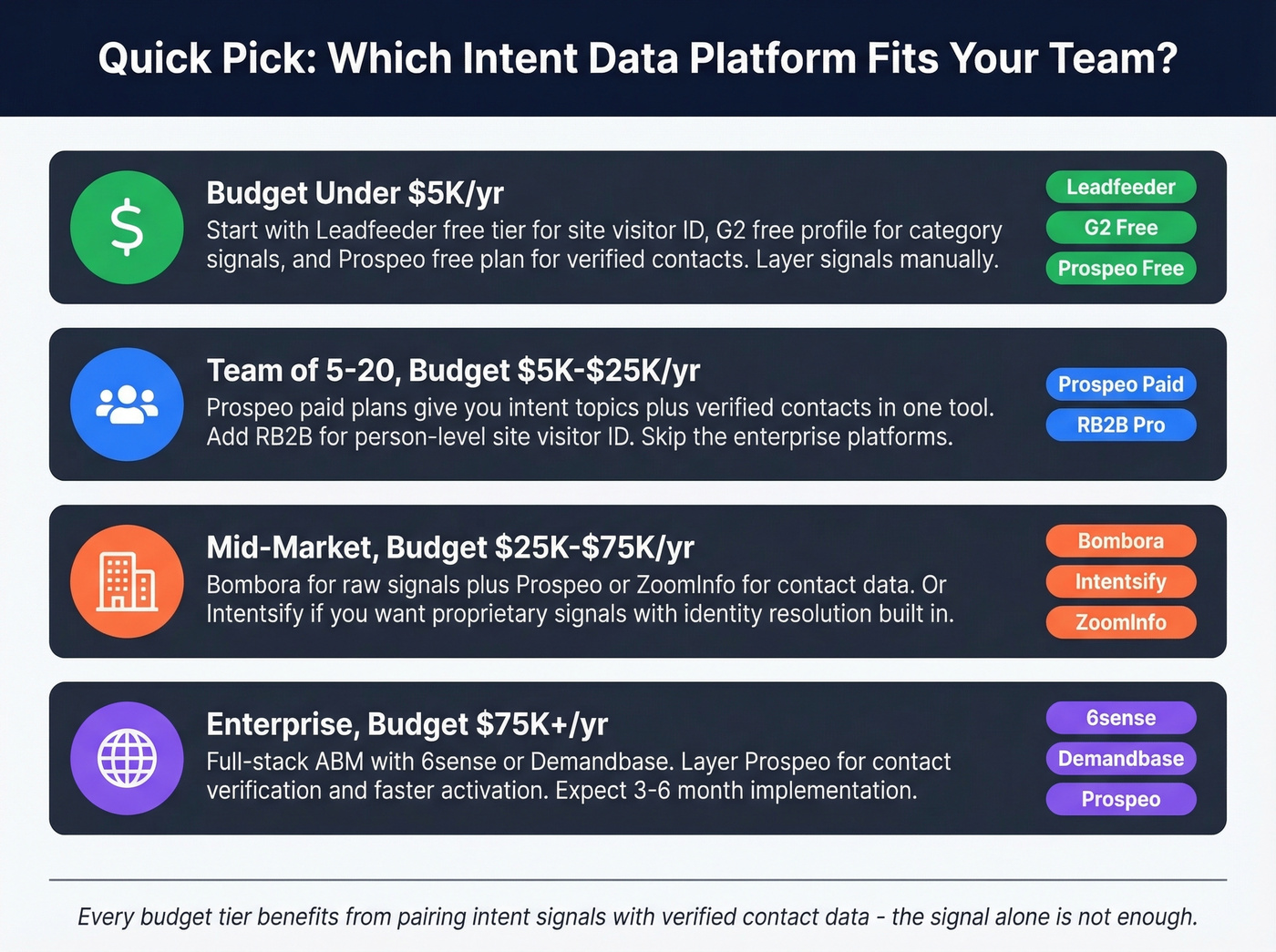
$0 entry point, no strings. Leadfeeder identifies which companies visit your site - not what they're researching elsewhere. The free plan covers 100 identified companies with 7-day history. Paid plans start at EUR99/month. For inbound-heavy teams that want to de-anonymize traffic without a massive budget, start here before spending $25K on third-party signals.
RB2B
The narrowest tool on this list, and that's the point. RB2B does person-level website visitor identification - individual visitors, not just companies - with U.S.-focused person-level ID and company-level identification globally. Free tier gives 150 credits/month; Pro runs $129/month (~$1,500/yr). If your site gets meaningful US traffic and you want contact-level visitor data without an enterprise contract, RB2B fills a gap nobody else does.
Intent Data Pricing Comparison
Let's be honest: the fact that most intent vendors require custom pricing conversations in 2026 - for a data product - tells you everything about how they sell.
| Tool | Starting Price | Typical Annual | Free Plan? | Contract |
|---|---|---|---|---|
| Prospeo | Free (75 emails/mo) | ~$500-$2,000/yr | Yes | None |
| 6sense | Free (50 credits/mo) | $60K-$100K+ | Yes | Annual+ |
| Bombora | ~$25K/yr | $50K-$100K+ | No | Annual |
| Demandbase | ~$30K/yr | $60K-$215K+ | No | Annual |
| ZoomInfo | ~$24K/yr (Advanced) | $30K-$50K+ | No | 2-3 years |
| Intentsify | ~$30K/yr | $30K-$80K | No | Annual |
| Cognism | ~$15K/yr | $15K-$25K+ | No | Annual |
| G2 Buyer Intent | ~$15K/yr | $15K-$50K | Free profile | Annual |
| Leadfeeder | EUR99/mo | ~EUR1,200-$5K+ | Yes | Monthly |
| RB2B | Free (150 credits/mo) | ~$1,500/yr (Pro) | Yes | Monthly |
Mistakes That Burn Your Intent Budget
Forrester's research on intent data pitfalls maps almost perfectly to what we see in the field. Here are the ones that cost real money.
Treating all intent sources the same. First-party website visits, G2 category research, and Bombora topic surges are fundamentally different signals with different reliability. Weight them accordingly.
Ignoring signal decay. Intent data has a half-life. A surge from two weeks ago is already stale. If your platform refreshes monthly, you're acting on ghosts.
Undervaluing first-party intent. This one drives us crazy. Teams chase expensive third-party signals while ignoring the highest-quality data they already own. Your pricing page visits, content downloads, and demo requests are more predictive than any third-party surge - and they're free.
Settling for one source. Triangulating across first-party, second-party, and third-party signals is dramatically more predictive than relying on any single vendor.
The shelfware problem. You bought Bombora six months ago. Your SDRs looked at surge reports for two weeks, couldn't figure out what to do with account-level signals, and went back to cold calling. The contract auto-renewed. We've seen this exact scenario play out at three different companies in the last year alone.
Failing to map signals to buying stages. A company researching "what is SIEM" is in a different stage than one researching "CrowdStrike vs. SentinelOne pricing." Treat both signals the same and your outreach will miss badly.
How to Activate Intent Signals
Here's the uncomfortable truth: most intent data becomes shelfware. The three-step workflow below is what separates the teams that get ROI from the ones who auto-renew a contract they've stopped using.
Step 1: Identify surging accounts. Your intent provider flags companies researching relevant topics above their baseline. Every tool on this list does this part well enough.
Step 2: Find verified contacts at those accounts. This is where workflows break. Account-level signals don't tell you who to email. You need to map the buying committee - typically 6-10 decision-makers - and get verified contact data for each. In our experience, this single step is where 80% of intent investments stall out, because the intent vendor and the contact data vendor are two separate products with two separate budgets and two separate champions internally.
Step 3: Act within 48 hours. Intent signals decay fast. If your workflow takes a week to go from "surging account" to "email sent," you've already lost the window. Build the automation before you buy the data.
Intent signals decay fast, and stale contact data kills deliverability. Prospeo refreshes every 7 days - not the 6-week industry average - so you reach surging accounts while they're still surging. Snyk dropped bounce rates from 35% to under 5% and grew AE-sourced pipeline 180%.
Act on intent before it expires. Start at $0.01 per verified email.
FAQ
Is intent data worth the investment?
Yes - if you pair it with verified contact data and act within 48 hours. Teams that use intent as a prioritization layer alongside first-party engagement data see the strongest ROI. Teams that buy a $50K platform and never operationalize it get nothing.
What's the difference between Bombora and 6sense?
Bombora supplies raw third-party intent signals across 18,000+ topics. 6sense is an ABM platform that layers third-party intent with its own AI for predictive buying-stage scoring and orchestration. Many vendors resell Bombora, so you may already have the same underlying signals.
Can I get buyer intent data for free?
Yes. Prospeo offers 75 verified emails/month with intent filters at no cost. 6sense gives 50 credits/month free. Leadfeeder identifies 100 companies free with 7-day history. Full enterprise solutions start at $25K+/yr.
How do I avoid buying bad intent data?
Triangulate across multiple sources - first-party, second-party, and third-party. Test with a small account list before committing annually. Pair third-party signals with your own engagement data and ICP filters to separate real buying activity from noise.