

Technographics: What It Is, How It Works, and How B2B Teams Use It in 2026
Most technographic guides hand you a definition and a vague list of benefits. None tell you what the data actually costs, where detection methods fall short, or how to build a scoring model that connects tech-stack signals to pipeline. This one does.
The technographic data market grew from roughly $367M in 2020 to over $1.17B by 2025 - proof that B2B teams are betting heavily on knowing what software their prospects run. The term itself is a mashup of "technology" and "demographics": profile companies by their tech stack the same way you'd profile them by industry or headcount.
Here's the short version. Technographic data tells you what software a company runs so you can sell to them smarter. Most tools give you company data but not contacts - you need a second step to reach decision-makers. The best teams layer tech-stack intelligence with firmographics and intent data for real targeting precision.
What Is Technographic Data?
Technographic data describes the technology tools and platforms a company uses - their CRM, marketing automation, cloud infrastructure, analytics stack, payment processors, and more. It's a method of segmenting and prioritizing accounts based on what they've already bought, what they're likely to need next, and where competitive displacement opportunities exist.
The concept traces back to 1985, when Dr. Edward Forrest studied VCR adoption patterns and published the framework in the Journal of Advertising Research. Forrester Research later commercialized the approach for enterprise tech markets.
Think of it as a company's technology fingerprint. Where firmographic data tells you a company has 200 employees and $30M in revenue, technographic data tells you they run Salesforce, use Marketo for marketing automation, host on AWS, and recently adopted Snowflake. That distinction matters enormously for sales teams.
Here's what a technographic profile looks like for a fictional mid-market SaaS company:
| Field | Example Value |
|---|---|
| CRM | Salesforce (Enterprise) |
| Marketing Automation | Marketo |
| Cloud Provider | AWS |
| Analytics | Snowflake + Looker |
| Estimated Spend Tier | $150K-$300K/yr |
| Adoption Date | Q2 2024 |
| Renewal Window | Q2 2026 |
That renewal window is gold. If you sell a competing product, you now know when the budget conversation happens. This is what separates a technographic profile from a generic company record - it reveals buying signals that firmographics simply can't.
How Detection Methods Work
Not all tech-stack data is created equal. The detection method determines what you can see - and what stays invisible.
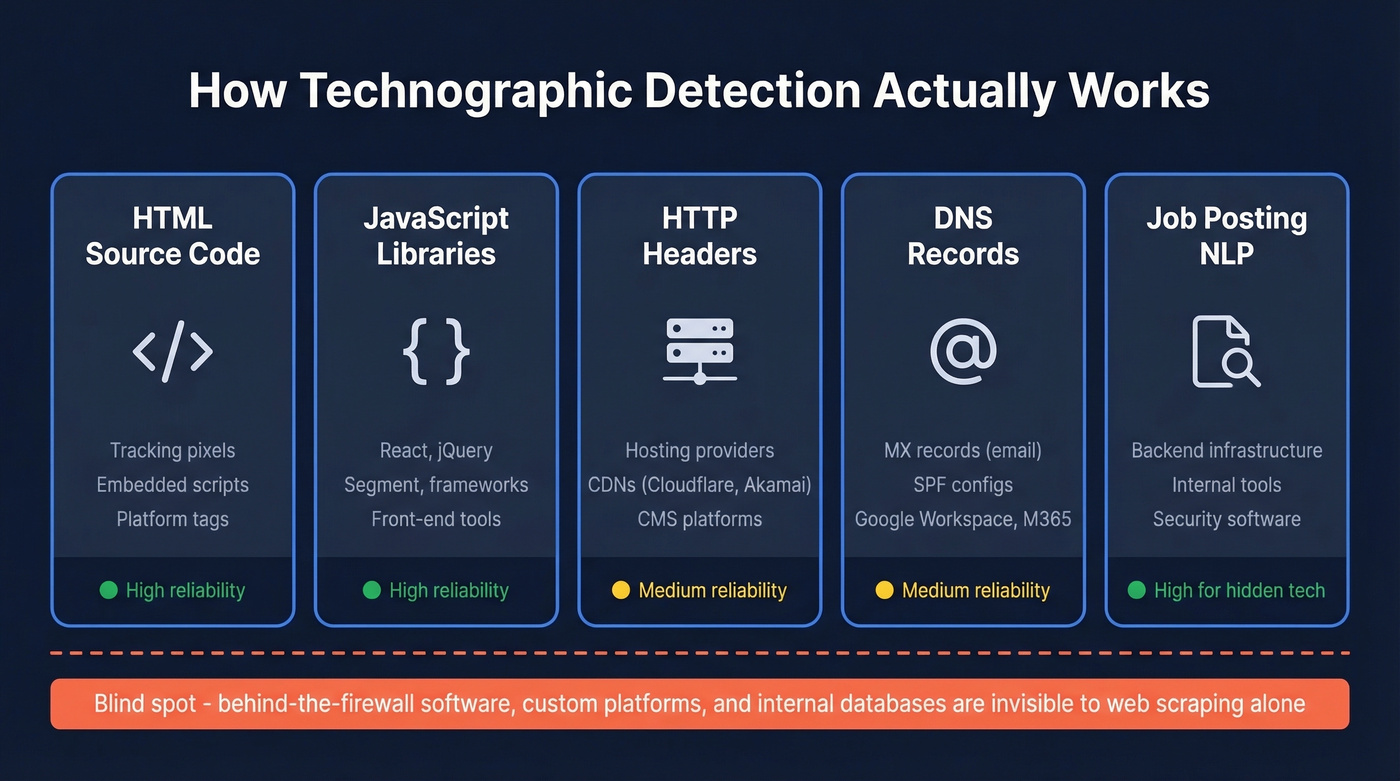
HTML source code analysis reads a website's source code looking for tracking pixels, embedded scripts, and platform-specific tags. This catches tools like Google Analytics, HubSpot forms, and Intercom chat widgets reliably. JavaScript library detection identifies frameworks and libraries loaded on a page - React, jQuery, Segment. Fast and accurate for front-end technologies. Tools like Wappalyzer use this approach.
HTTP header inspection reveals hosting providers, CDNs like Cloudflare and Akamai, and sometimes CMS platforms through server response headers. Low-effort detection with decent reliability.
DNS record analysis exposes email providers through MX records (Google Workspace, Microsoft 365) and can reveal email marketing tools through SPF configurations in TXT records.
Job posting NLP extraction is the sleeper hit. It pulls technology mentions from job descriptions and is especially useful for catching internal tools and backend infrastructure that web scraping misses entirely. If a company is hiring a "Snowflake Data Engineer," they're running Snowflake - and no front-end scraper would ever see that.
What tools can't see: web scraping typically can't detect behind-the-firewall software. Internal security tools, custom-built platforms, database systems, and anything without a front-end footprint often won't show up unless you supplement with surveys or third-party purchase data.
Technographics vs. Firmographics vs. Intent Data
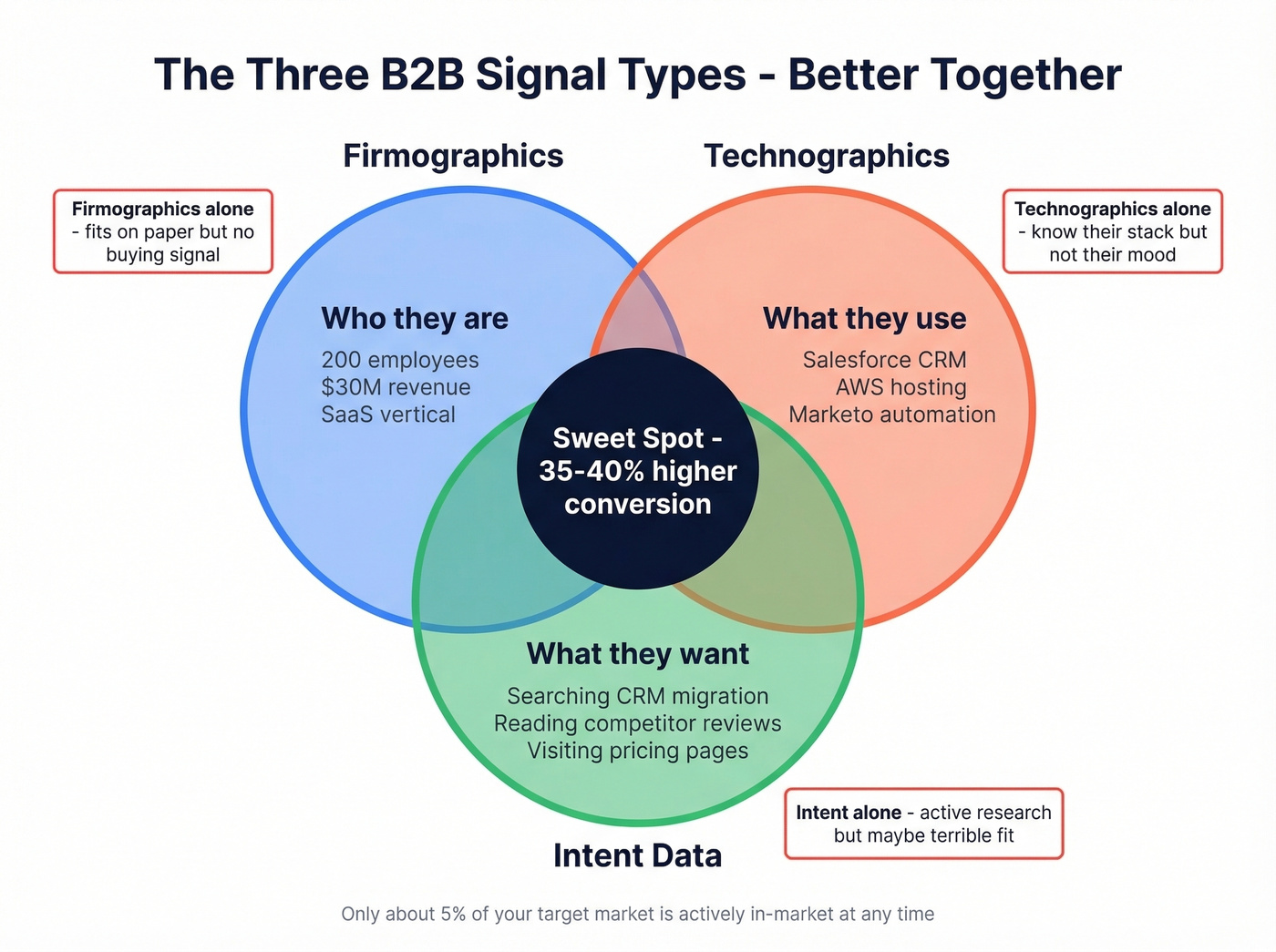
These three signal types answer fundamentally different questions. Smart teams use all three together.
| Signal Type | What It Tells You | Example |
|---|---|---|
| Firmographics | Who they are | 200 employees, $30M revenue, SaaS |
| Technographics | What they use | Salesforce, AWS, Marketo |
| Intent Data | What they're researching | Searching "CRM migration" |
Used alone, each has blind spots. Firmographics tells you a company fits your ICP on paper but nothing about their current tools or buying intent. Tech-stack data reveals their software but not whether they're happy with it. Intent data shows research activity but not whether the company is actually a good fit.
Only about 5% of your target audience is actively in-market at any given time. Layering these signals together - firmographic fit + technographic compatibility + active intent - can boost conversion rates 35-40%. That's the difference between spraying emails at a list and reaching the right person at the right company at the right moment.
How B2B Teams Use Tech-Stack Data
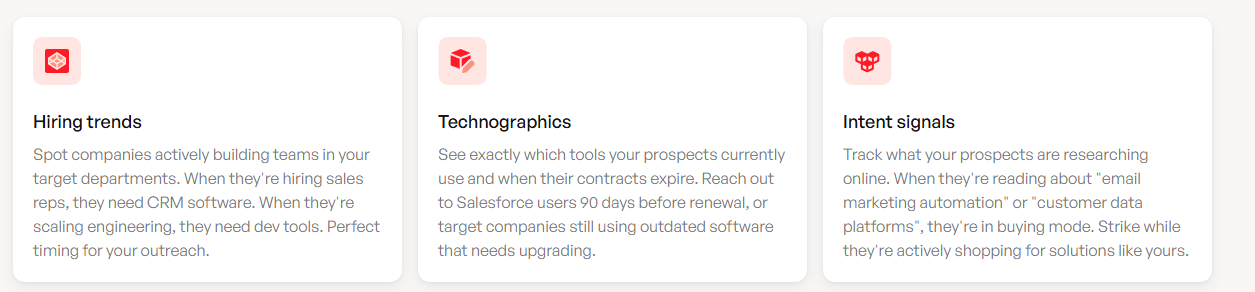
Seven use cases that actually move pipeline:
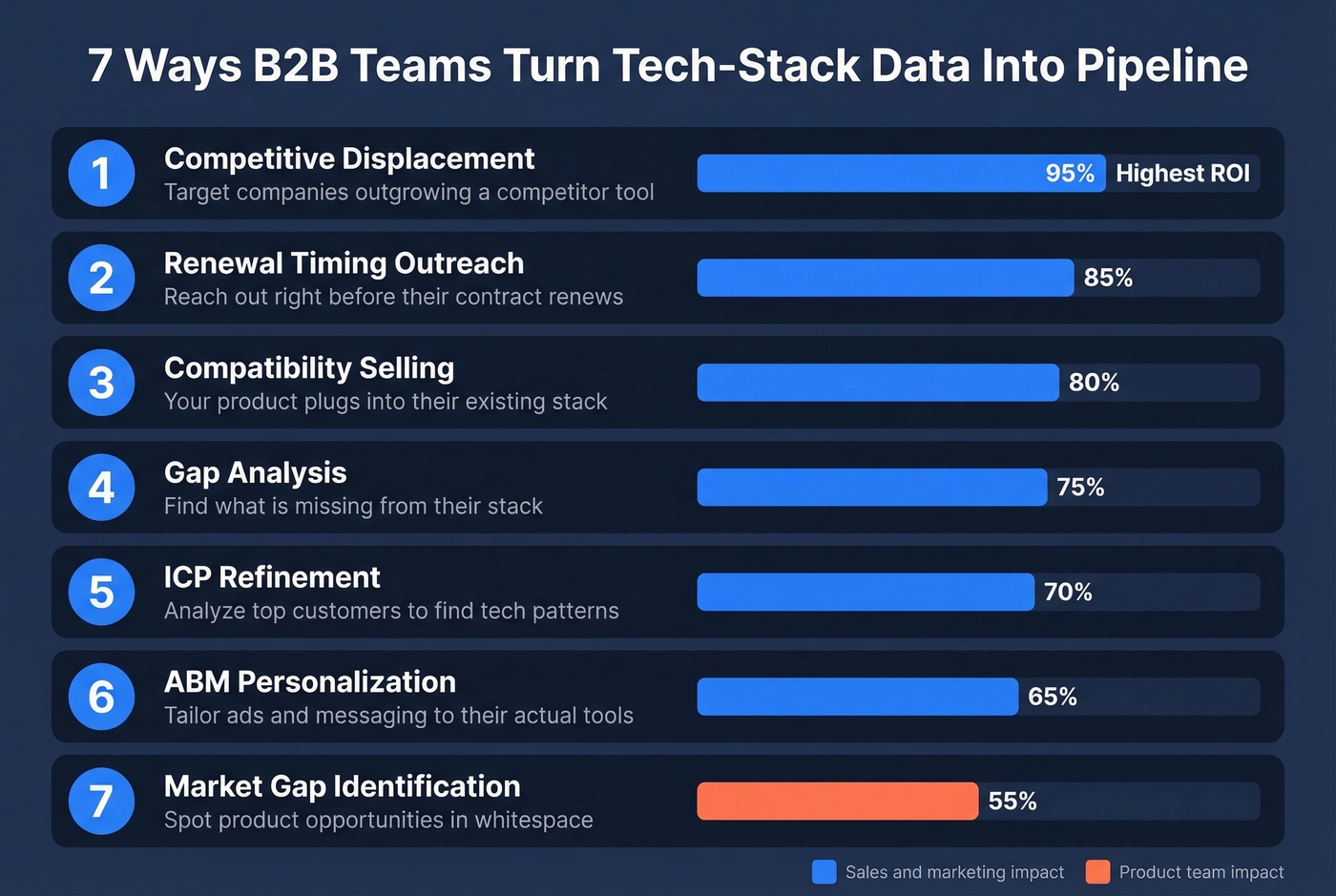
Competitive displacement. You sell a CRM. You filter for companies running HubSpot's free tier with 100+ employees - they've likely outgrown it. Your VP of Sales builds a campaign targeting exactly that segment with migration messaging. This is the highest-ROI technographic play, and we've seen teams build entire outbound motions around it.
Compatibility selling. Your product integrates natively with Salesforce and Snowflake. Filter for companies running both, and your pitch writes itself: "We plug into your existing stack with zero migration."
Gap analysis. A company uses Salesforce but has no marketing automation tool? That's a gap you can fill. Tech-stack intelligence reveals what's missing, not just what's present.
Renewal timing outreach. If you know a competitor's contract typically renews annually and the prospect adopted it 11 months ago, your timing is perfect. Some providers track adoption dates that make this possible.
ICP refinement. Analyze your best customers' tech stacks. If 70% of your top accounts run AWS + Datadog + Terraform, that's a technographic ICP signal worth encoding into your ideal customer profile and scoring model.
ABM personalization. Generic ABM ads underperform. "Still running legacy on-prem analytics?" lands harder when you know the account actually runs on-prem Tableau.
Market gap identification. Product teams use this data to spot whitespace. If thousands of companies use Tool A and Tool B but nothing connects them, that's a product opportunity.

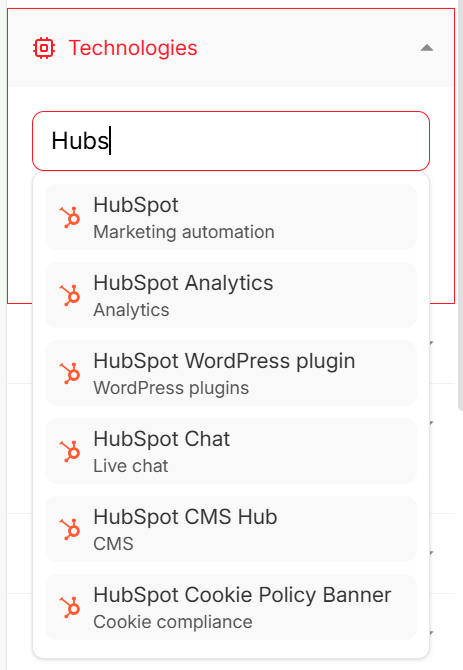
Prospeo lets you filter 300M+ profiles by technographics powered by Wappalyzer and live job posting signals - then gives you verified emails and direct dials for decision-makers at those companies. No second tool needed. Layer tech-stack filters with buyer intent across 15,000 Bombora topics to find the 5% actually in-market.
Stop mapping tech stacks you can't act on. Get contacts at $0.01 per email.
How the Data Is Collected
6sense breaks collection into three categories: surveys, data mining, and third-party purchase. Each has real limitations.
Surveys get the most accurate answers but suffer from abysmal response rates - nobody wants to fill out a form about their tech stack. Data mining through website scraping, source code analysis, and DNS records is scalable but only catches web-visible technologies. Security software, internal databases, and custom tools often stay invisible. Third-party purchase involves buying usage data from SaaS, PaaS, or IaaS providers directly, but personal data must be anonymized to comply with privacy regulations.
Job posting analysis adds another layer. Companies hiring for specific technologies reveal their stack in job descriptions, and NLP models can extract those signals at scale - catching internal platforms, backend databases, and security infrastructure that web scraping misses.
No single method gives you the full picture. The best providers combine multiple approaches, and smart teams treat any single source as a starting hypothesis rather than ground truth.
Technographic Data Providers Compared
Here's what the market actually looks like in 2026.
| Provider | Technologies Tracked | Starting Price | Best For |
|---|---|---|---|
| Prospeo | 7,400+ technologies | Free / ~$39/mo | Tech filters + verified contacts |
| BuiltWith | 112,000+ | $295/mo | Deep tech coverage |
| ZoomInfo | 30,000+ | ~$15-40K/yr | Enterprise GTM |
| Wappalyzer | 7,400 | Free (50 lookups/mo) | Occasional lookups |
| Datanyze | Not public | $29/mo | Budget entry point |
| SimilarTech | Not public | ~$200-490/mo | Competitive intel |
| Clearbit (HubSpot) | Not public | Included with HubSpot | HubSpot users |
| HG Insights | Not public | ~$30-80K/yr | Market sizing |
| 6sense | Not public | ~$30-100K+/yr | ABM + intent |
| Coresignal | 87M technographic records | ~$10-30K/yr | API-first enrichment |
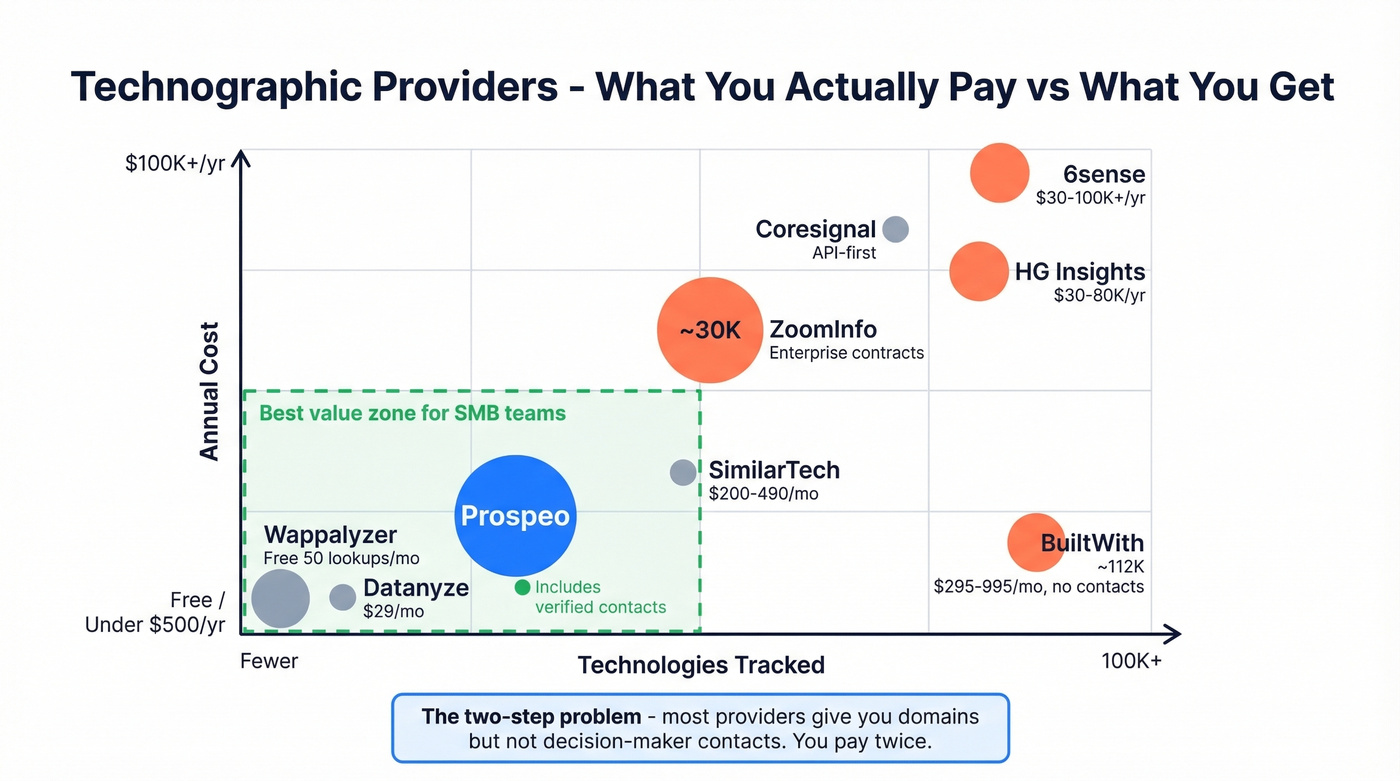
The biggest frustration in this space is the two-step problem. Most technographic tools - BuiltWith included - export domains and company names. They don't give you the VP of Engineering's verified email. You end up paying for BuiltWith to identify targets, then paying again for another tool to find decision-makers. Two subscriptions, two workflows, twice the data reconciliation headaches.
Prospeo solves this directly. Its B2B database includes technographic filters alongside 300M+ professional profiles - filter by tech stack and get verified emails for the people who manage those tools. 98% email accuracy, refreshed every 7 days. Pricing starts free with 75 emails/month, paid plans from ~$39/mo, no contracts.
BuiltWith is the deep pure-play technographic tool. 673M+ websites and 112,000+ technologies tracked. But pricing runs $295/mo for Basic, $495/mo for Pro, and $995/mo for Team. Reddit threads consistently call the cost brutal for smaller teams, and the ROI math gets shaky if you're only pulling a few exports per month. BuiltWith is built for power users who live in tech-stack data daily.

ZoomInfo makes sense if you're already on a ZoomInfo contract and need technographics bundled with 500M contacts and 30,000+ technologies. It's the enterprise default. Skip it if you're a smaller team - a 10-seat contract with intent data and technographic modules can run $15-40K/year, and you'll pay for features you never touch.
Wappalyzer is the best free option: 7,400 technologies across 106 categories, 50 free lookups per month, and a browser extension that identifies tech stacks as you browse. Perfect for occasional lookups or validating what another tool told you. Datanyze starts at $29/mo and works as a budget-friendly entry point for basic technology intelligence.
Let's be honest: if your average deal size is under $10K, you probably don't need a standalone technographic tool at all. If your data platform already includes tech-stack filters, buying BuiltWith on top is redundant unless you need the deepest possible technology coverage.
The article says layering firmographics, technographics, and intent data boosts conversions 35-40%. Prospeo is the only platform at this price point that combines all three - 30+ search filters including tech stack, intent data on 15,000 topics, and 98% verified emails - refreshed every 7 days, not 6 weeks.
Run competitive displacement campaigns with data that's actually fresh.
Building a Lead Scoring Model
Knowing what software a company uses is step one. Turning that into a prioritized pipeline is where the real value lives. Here's a five-step framework we've refined across dozens of outbound campaigns.
Step 1: Gather your data. Pull tech-stack data from your provider of choice. Focus on the 5-10 technology categories that actually predict buying behavior for your product - don't try to score everything.
Step 2: Define scoring criteria tied to your ICP. Assign point values based on correlation with your ideal customer. A company running your competitor's product gets +20 points. A complementary tool gets +15. Legacy or outdated versions of relevant software get +10 - they're likely looking to upgrade.
Step 3: Enrich scored segments with verified contacts. A scored list of companies is useless without reachable people. Once you've tiered your segments, enrich them with verified contacts through your data platform's data enrichment API or CRM integration.
Step 4: Create lead tiers. Tier 1 accounts scoring 40+ get personalized outbound from your best reps. Tier 2 at 20-39 enters automated sequences. Tier 3 under 20 goes into nurture campaigns or gets deprioritized entirely.
Step 5: Refine by analyzing conversion rates. After a quarter, pull conversion data by tier. If Tier 2 accounts are converting better than Tier 1, your scoring weights are off. Adjust. The model isn't static - it should evolve as you learn which technology signals actually predict closed deals.
Why Smart Teams Treat This Data as a Hypothesis
We've run bake-offs where the technographic data said a company used Salesforce, but their CRM was actually a custom-built system. The Salesforce tag was a legacy script from a trial three years ago, still sitting in their website's source code.
This happens more than vendors want to admit. Legacy tags persist on websites long after tools are abandoned. Multi-domain companies show different stacks on different properties. Behind-the-firewall tools - the ones that often matter most - are invisible to web-based detection.
The practitioners on r/b2bmarketing don't treat technographic data as gospel. They treat it as a starting hypothesis and validate before outreach. The workflow: cross-reference your tool's output with job postings, check the website source code manually, look at CRM notes from previous conversations, and only then build your messaging around the stack assumption.
If you're personalizing outreach around a prospect's tech stack and you get it wrong, you've just demonstrated that you didn't do your homework. Validation takes five minutes. Skipping it can cost you the deal.
Compliance Considerations for 2026
Privacy rules for technographic data are shifting fast.
On the US side, a wave of comprehensive state privacy laws became effective during 2025 across Delaware, Iowa, Nebraska, New Hampshire, New Jersey, Tennessee, Minnesota, and Maryland. As of January 1, 2026, Indiana, Kentucky, and Rhode Island joined the list. The FTC continues aggressive enforcement with particular scrutiny on sensitive data categories and AI-driven data uses.
In Europe, GDPR compliance is evolving from a checkbox exercise to a dynamic, risk-based framework. Purpose limitation and transparency requirements mean you can't collect tech-stack data for one use and repurpose it for another without clear justification.
The key compliance point: company-level technology data - what tools Acme Corp uses - is generally lower-risk. But the moment you tie it to a specific person's name and email, you're in personal data territory and full privacy obligations apply. Third-party purchased data must be anonymized.
FAQ
What is technographic data and how does it differ from firmographics?
Firmographics describe company attributes like size, revenue, and industry. Technographic data describes the technology tools a company uses - CRM, cloud provider, analytics stack. Both segment B2B accounts, but tech-stack profiling reveals buying signals and competitive displacement opportunities that firmographics can't surface.
How accurate is technographic data?
Front-end detection methods are reliable for web-facing tools like analytics platforms, chat widgets, and CDNs. Backend software, internal databases, and security tools are often invisible to scrapers. Smart teams cross-reference with job postings and direct conversations before building campaigns around stack assumptions.
How much does technographic data cost?
Wappalyzer offers 50 free lookups per month. Datanyze starts at $29/mo. BuiltWith runs $295-995/mo. Enterprise platforms like ZoomInfo and 6sense run $15-100K+/year. Prospeo includes technographic filters starting free with 75 emails/month, paid plans from ~$39/mo - and bundles verified contacts alongside the tech-stack data.
Can I get tech-stack data and contact data from one tool?
Yes. Prospeo's B2B database includes technographic filters alongside 300M+ professional profiles with 98% email accuracy, eliminating the two-step problem. Several other enterprise platforms bundle both, though typically at $15K+/year minimums with annual contracts.
Is technographic data collection GDPR compliant?
Company-level technology data is generally lower-risk under GDPR and US state privacy laws. Tying it to individual contacts triggers full personal-data obligations. Multiple US states enacted comprehensive privacy laws effective 2025-2026, and the FTC is actively enforcing against AI-driven data misuse. Verify your provider's compliance certifications before purchasing.