

The Best Account Based Marketing Tools for 2026
You got the quote. $60,000 for the platform, $100,000 in ad spend, plus onboarding. Meanwhile, your sales team says ABM "doesn't work" because half the contacts in the target account list have bounced emails and disconnected phone numbers.
ABM doesn't fail because you picked the wrong account based marketing tools. It fails because of stale data, stack overlap, and the gap between what the tool promises and what your team actually uses. Buyers initiate 79% of engagements before sales ever gets involved - so if your data layer is feeding bad contacts into your orchestration engine, you're activating against ghosts. The platform doesn't matter if the foundation is broken.
The ABM market is projected to hit $1.15 billion in 2026, growing at nearly 12% annually. More tools, more vendors, more confusion. Let's cut through it.
Our Picks (TL;DR)
Prospeo - Best for building verified account lists and buying committee contacts before you spend a dollar on ads or orchestration. 98% email accuracy, 7-day data refresh, intent data across 15,000 topics, no contracts.
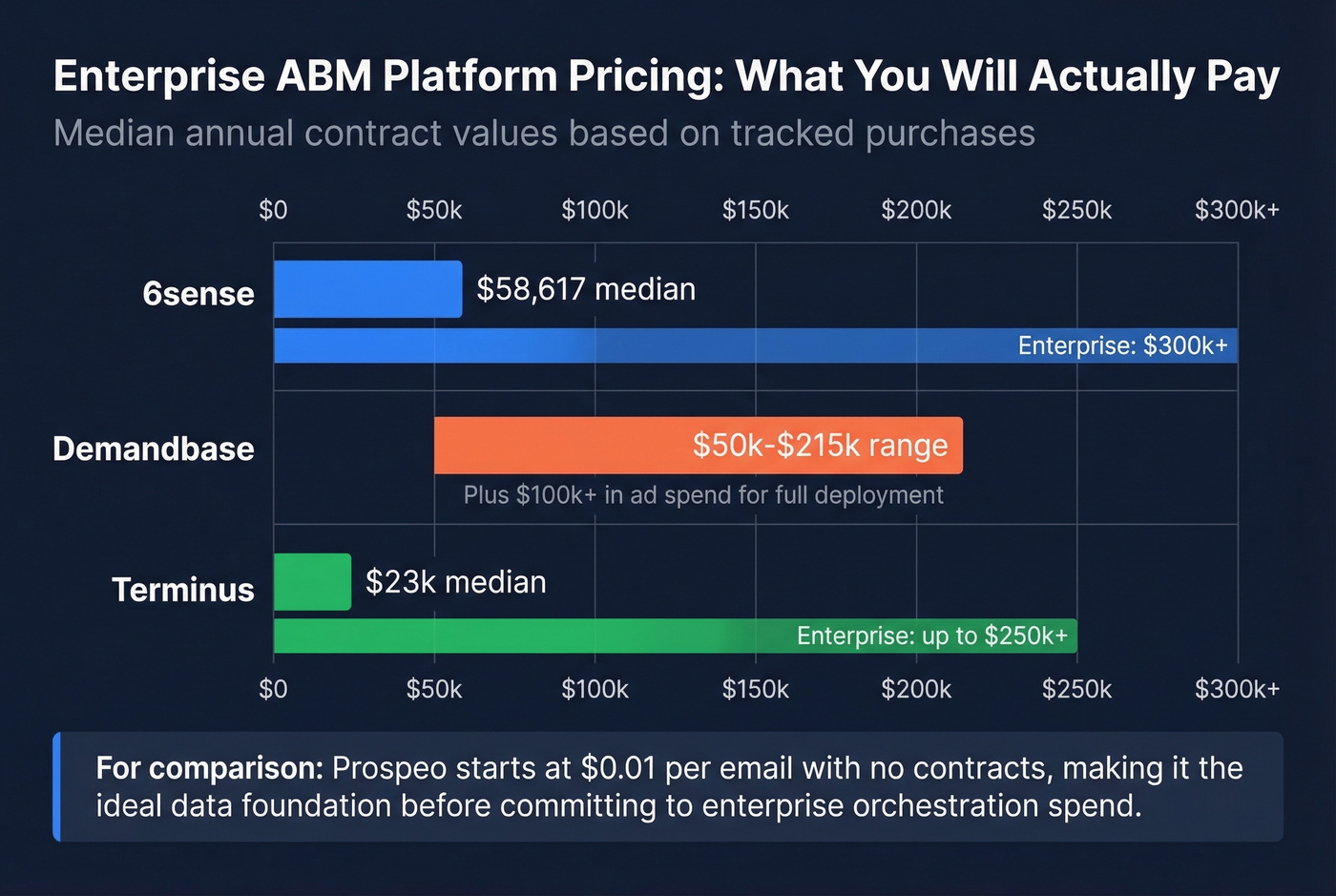
6sense - Best for enterprise teams that need predictive intent scoring and full-funnel orchestration. Median contract $58,617/year based on 314 tracked purchases. Powerful, but you need the TAM to justify it.
Demandbase - Best for large organizations that want account intelligence, advertising, and attribution in one platform. Budget $50k-$215k+/year depending on deployment size.
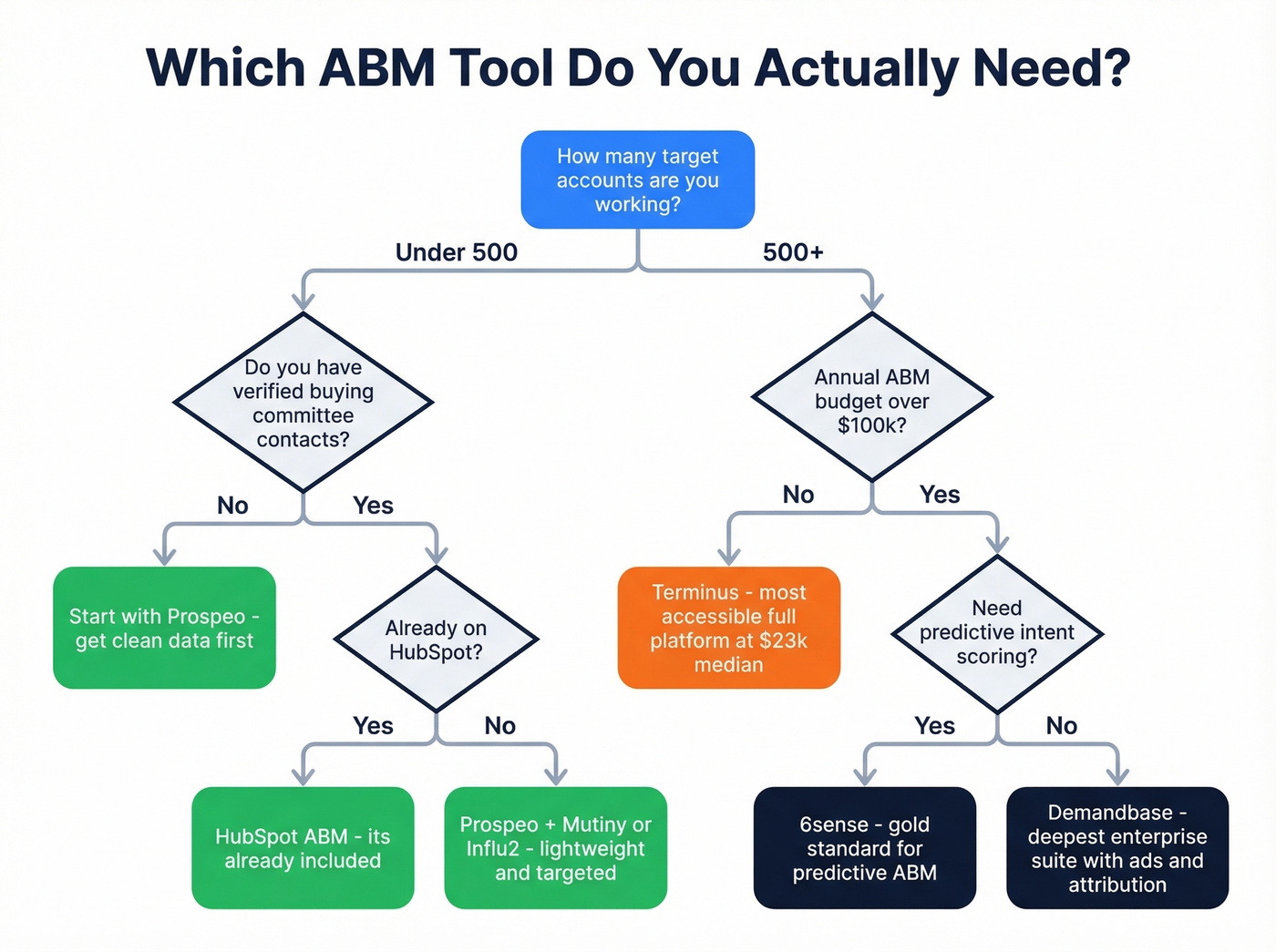
How to Choose the Right ABM Platform
Before you buy anything, answer four questions. Get these wrong and no tool saves you.
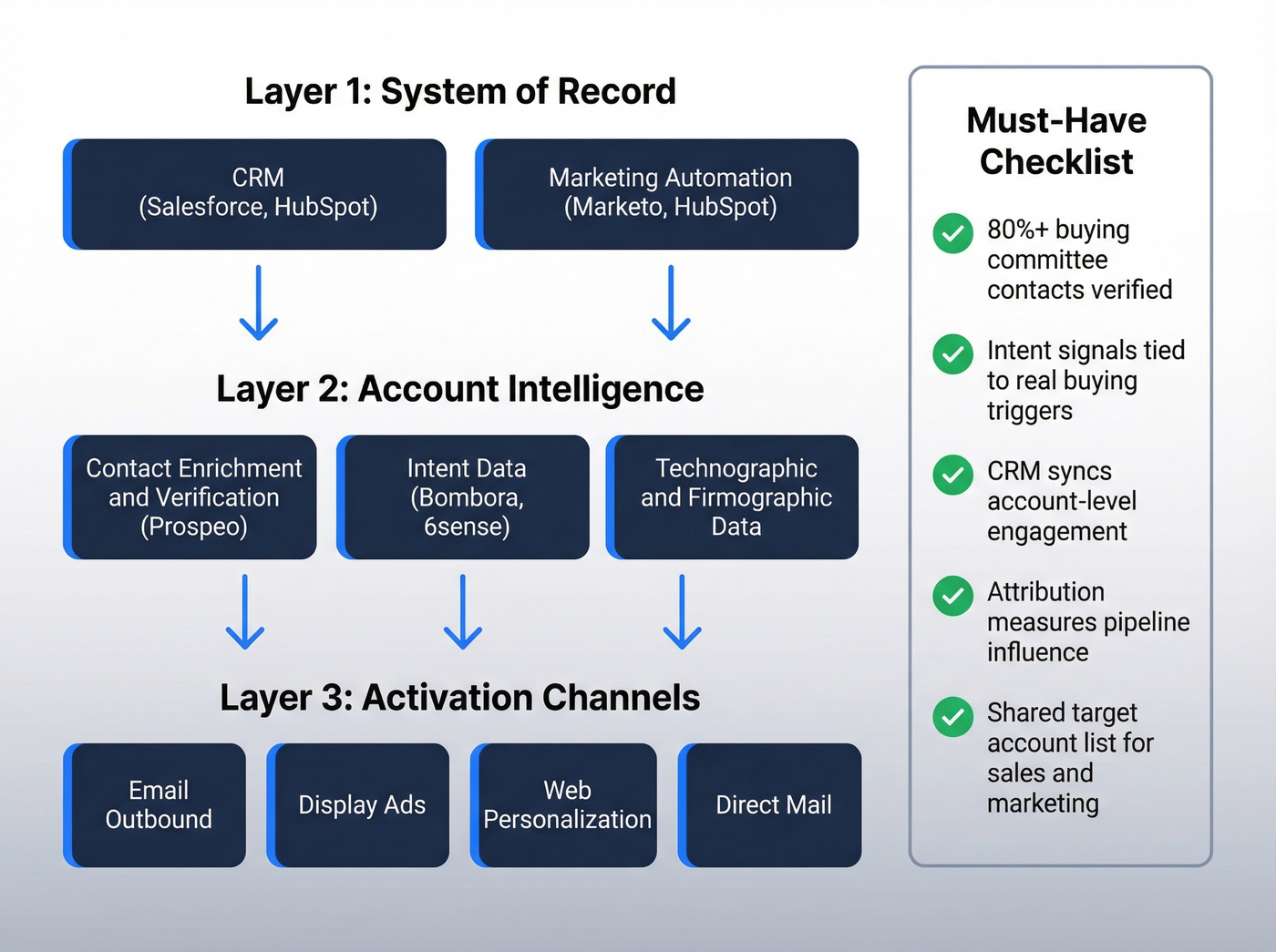
How many target accounts are you working? If it's under 500, you probably don't need a $200k orchestration platform. You need clean data and a disciplined process. The r/b2bmarketing consensus is blunt: enterprise ABM tools are "incredibly expensive" and overkill for small TAMs.
Do you have verified contacts for buying committees? Not company records - actual people with working emails and direct dials. If your data enrichment match rate is below 80%, your orchestration tool is targeting empty chairs.
What activation channels will you use? Email outbound, display ads, web personalization, direct mail - pick one to start. You can add channels later. Trying to activate across five channels on day one is how teams burn budget without learning anything.
How will you measure account-level influence? If you're still measuring MQLs, you're not doing ABM. You're doing lead gen with a fancier label. Account-level engagement scoring and pipeline attribution are non-negotiable.
Think of your ABM stack in three layers: a system of record like your CRM and MAP, an account intelligence layer for intent and enrichment, and activation channels for ads, email, and web. Here's a quick must-have checklist before you evaluate any platform:
- ☐ Verified contact data for 80%+ of buying committee members
- ☐ Intent signals tied to your ICP's actual buying triggers
- ☐ CRM integration that syncs account-level engagement, not just leads
- ☐ Attribution that measures pipeline influence, not just clicks
- ☐ A shared target account list owned by both sales and marketing
Stop reading 40-tool lists. Pick one tool per layer.
The 10 Best ABM Tools for 2026
Prospeo
Best for: Data accuracy, freshness, and self-serve enrichment - the foundation every ABM motion needs.
Every ABM workflow starts the same way: build a list of target accounts, then find the right people inside those accounts. Prospeo handles both steps with 300M+ professional profiles, 30+ search filters covering buyer intent, technographics, job changes, headcount growth, funding, and revenue, plus 98% email accuracy. The 125M+ verified mobile numbers with a 30% pickup rate mean your SDRs actually reach humans, not voicemail boxes.
What makes Prospeo essential for ABM is the 7-day data refresh cycle. The industry average is six weeks. When you're running a coordinated campaign against 200 accounts, a six-week-old contact list means you're emailing people who've already changed jobs. Intent data covers 15,000 Bombora topics, so you can layer in-market signals on top of firmographic filters to prioritize accounts showing buying behavior right now.

The proof point that matters: Snyk ran 50 AEs on Prospeo, dropped their bounce rate from 35-40% to under 5%, and grew AE-sourced pipeline 180%. That's what clean data does for an ABM program.
Pricing: ~$0.01/email with a free tier of 75 emails and 100 Chrome extension credits per month. No contracts, self-serve onboarding.
Verdict: If your ABM program doesn't start with verified data, it doesn't start.
6sense
Best for: The most complete predictive ABM platform on the market.
6sense's AI models score accounts based on intent signals, technographic data, and behavioral patterns, then orchestrate outreach across channels. If you need to know which of your 10,000 target accounts are actually in-market right now, this is the tool.
The tradeoff is price. The median contract is $58,617/year across 314 tracked purchases. Mid-market deployments monitoring 5,000-10,000 accounts typically run $60k-$100k annually, and enterprise implementations push past $300k. For advertising, expect add-on costs of $5k-$30k/month depending on account volume. Pricing is driven by TAM volume, modules, data packages, and contract length - expect 12-24 month commitments. Buyers save ~17% on average through negotiation.
There's a free plan with 50 credits/month for basic account and people search, which is genuinely useful for evaluating the platform. But the real value - predictive scoring, orchestration, advertising - lives behind the paywall.
Verdict: If your TAM justifies the spend and you have the ops resources to implement it properly, 6sense is the gold standard for predictive ABM. Skip it if you're a 20-person company with 300 target accounts.

Demandbase
Best for: Enterprise organizations wanting account intelligence, advertising, and attribution in one platform.
We watched a team implement Demandbase last year. The platform itself was impressive - account identification, intent signals, advertising, web personalization, orchestration, and attribution all in one place.
But the year-one cost isn't just the SaaS line item. A Forrester TEI modeled example breaks it down as ~$48k in software, $100k in ad spend, plus onboarding and premium support. There's a visible AWS Marketplace listing at $215,000 for a 12-month Demandbase One contract. For budgeting, expect $50k-$200k/year for the software, with enterprise deployments running higher. Average discount is 13%, implementation takes ~2 months, and median ROI timeline is ~13 months.
Verdict: The deepest enterprise ABM suite available. Skip it if your total ABM budget is under $100k/year - the software alone will eat most of it.

Terminus (DemandScience)
Best for: Mid-market teams wanting ABM advertising and orchestration at a lower entry point than 6sense or Demandbase.
Terminus merged under the DemandScience brand, which matters for buyers evaluating long-term product roadmap stability. The median contract sits at ~$23k/year, making it the most accessible full-featured ABM platform on this list, with a range from $23k up to $250k+ for enterprise deployments. Watch for hidden cost drivers: the Bombora intent data add-on and professional services can push costs well above the base. Confirm the product roadmap post-merger before signing a multi-year deal.
RollWorks (NextRoll)
Best for: Account-based advertising with retargeting capabilities.
RollWorks earns a 4.3/5 on G2 across 601 reviews, and the campaign setup and retargeting experience are genuinely smooth. The problems show up after implementation. Journey tracking only goes back 90 days. Bombora intent data can't be used directly in journey stage filters - you'll need manual Salesforce workarounds. Company identification accuracy lags behind competitors, and you can't set a monthly cap that auto-paces spend, which means you're babysitting budget manually. Median contract runs $80,400/year with an observed range of $46,798-$233,749 and an average discount of 9%.
Here's the thing: if your tool needs manual CRM workarounds to use intent signals, you didn't buy automation. You bought a project. RollWorks is fine for teams that primarily want account-based display ads, but don't expect it to replace a full orchestration platform.
ZoomInfo
Best for: B2B data and intent as an ABM intelligence layer, paired with a separate orchestration tool.
ZoomInfo isn't an ABM platform - it's a data platform that many ABM stacks depend on. The contact database and intent signals are strong, especially for US-based accounts. But you'll still need an orchestration layer to actually run coordinated ABM campaigns. Pricing runs ~$15k-$40k/year depending on seats and modules, with enterprise contracts going higher.
If you're comparing data vendors, start with a sales prospecting database breakdown before you commit to a multi-year contract.
HubSpot ABM
Built-in ABM features for existing HubSpot users: target account lists, company scoring, account-level reporting, and ads integration. Nothing revolutionary, but it's included in Marketing Hub Professional at $890/month and above. If you're already on HubSpot and running ABM against fewer than 500 accounts, this is likely all you need before adding a dedicated platform.
Bombora
The intent data provider powering many ABM platforms, including 6sense and Terminus. If you want intent signals without buying a full ABM suite, Bombora sells standalone access to its cooperative data pool covering 5,000+ B2B topics. Custom-quoted, typically $25k-$50k/year. Useful as a layer you pipe into your existing CRM or MAP.
Mutiny
AI-powered website personalization for target accounts. Mutiny lets you show different content to different account segments when they hit your site - a powerful ABM tactic that most platforms handle poorly. Starts ~$10k-$30k/year. Pair it with an intent tool to personalize based on buying stage.
Influ2
Person-based advertising - not account-based, person-based. Influ2 targets specific individuals within your buying committees with display ads, then tracks engagement at the contact level and syncs it to your CRM. Typically $20k-$50k/year. The concept of contact-level ad targeting is compelling for high-ACV sales cycles where you know exactly who the decision-makers are.

ABM fails when your buying committee contacts bounce. Prospeo gives you 300M+ profiles with 98% email accuracy, 125M+ verified mobiles, and intent data across 15,000 topics - all refreshed every 7 days, not every 6 weeks.
Stop orchestrating campaigns against ghosts. Start with verified contacts.
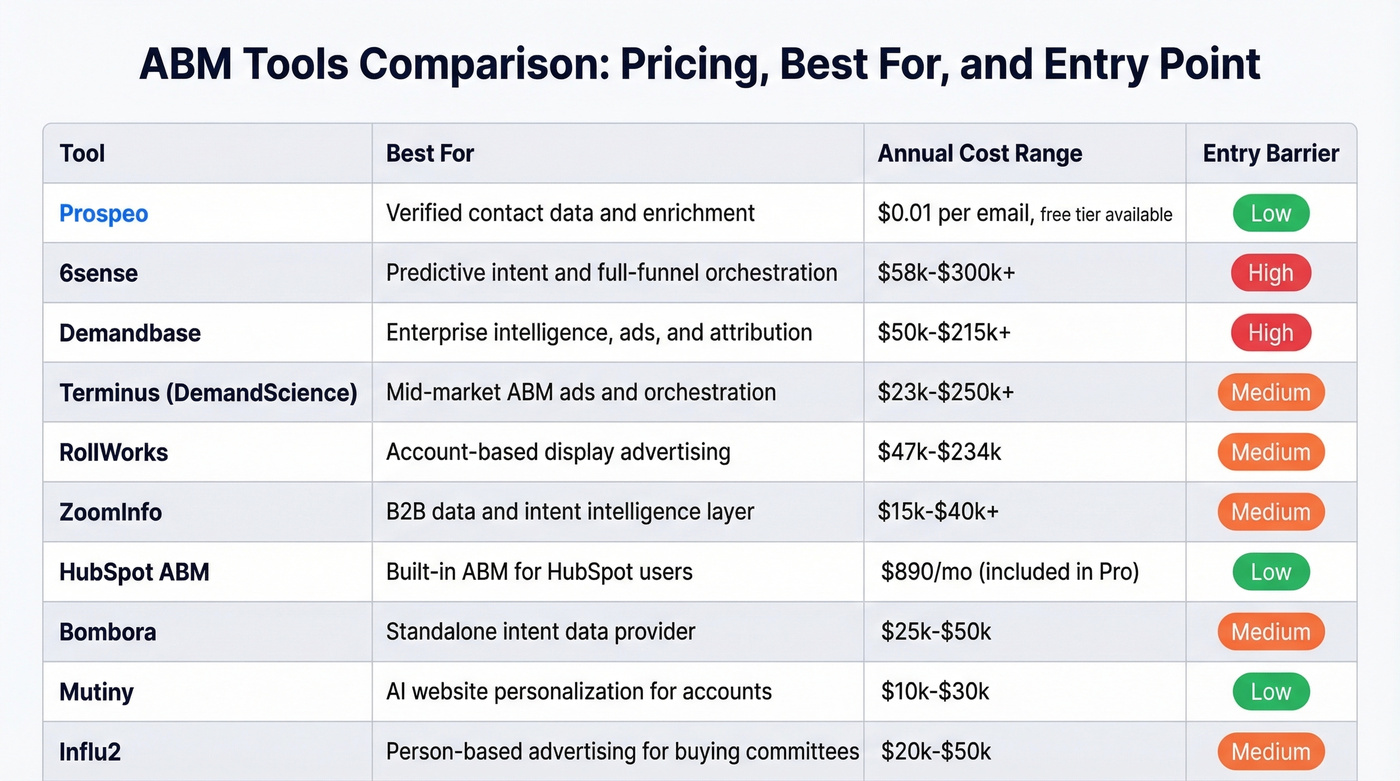
ABM Tool Pricing: 2026 Benchmarks
| Tool | Annual Cost | Entry Point | Contract | Best For |
|---|---|---|---|---|
| 6sense | $50k-$300k+ | Free plan (50 credits) | 12-24 months | Predictive ABM |
| Demandbase | $50k-$215k+ | ~$50k | Annual | Enterprise ABM |
| Terminus | $23k-$250k+ | ~$23k | Annual | Mid-market ABM |
| RollWorks | $47k-$234k | ~$47k | Annual | ABM display ads |
| ZoomInfo | $15k-$40k+ | ~$15k | Annual | Data layer |
| HubSpot ABM | Incl. in Hub Pro | $890/mo | Monthly/annual | HubSpot users |
| Bombora | $25k-$50k+ | ~$25k | Annual | Standalone intent |
| Mutiny | $10k-$30k+ | ~$10k | Annual | Web personalization |
| Influ2 | $20k-$50k+ | ~$20k | Annual | Person-based ads |
What the table doesn't show: year-one total cost is typically 2-3x the SaaS line item. Demandbase's Forrester TEI model breaks it down - ~$48k in software, $100k in ad spend, plus onboarding and premium support. That's $150k+ before you've optimized a single campaign. ABM platforms range from $12k to $300k+ annually depending on deployment. Negotiate hard - Demandbase buyers average 13% discount, RollWorks 9%, and 6sense buyers save ~17%.
ABM Tool Categories Explained
Understanding the different types helps you avoid buying overlapping capabilities. They generally fall into five categories:
Data and enrichment (Prospeo, ZoomInfo) give you the contacts and firmographics. Intent providers (Bombora, 6sense) tell you who's in-market. Orchestration platforms (6sense, Demandbase, Terminus) coordinate multi-channel campaigns. Activation tools (RollWorks, Mutiny, Influ2) handle ads and web personalization. Measurement and attribution sits across all of them.
Most vendors try to span multiple categories, but no single platform excels at all five. Build your stack by selecting the strongest option in each category rather than settling for a bundled platform that's mediocre across the board.
Implementation Gotchas
ABM programs fail for six predictable reasons. Every one is preventable.
Wrong accounts. Your ICP definition is too broad, or you're targeting accounts based on firmographics alone without intent signals. You end up running expensive campaigns against companies that aren't in-market.
Sales-marketing misalignment. Marketing builds the target account list. Sales ignores it. Or worse, sales adds 500 accounts that don't match the ICP. Without shared ownership of the list, ABM becomes two teams running parallel programs that never intersect.
Superficial personalization. Swapping a company name into an email template isn't personalization. If your "personalized" outreach doesn't reference the account's specific pain points, tech stack, or buying signals, you're just doing mass outreach with extra steps.
Wrong measurement. Measuring ABM by MQLs is like measuring a basketball team by individual free throws. Account-level engagement, pipeline influence, and deal velocity are the metrics that matter.
Treating ABM as ad tech. ABM is a coordinated go-to-market motion, not an advertising program. If your entire ABM strategy is "run display ads to a target account list," you've built a fractured funnel that looks like ABM on a dashboard but doesn't actually influence deals.
Stack conflict. RollWorks can't use Bombora intent directly in journey filters without manual Salesforce imports. Demandbase can't sync to Salesforce custom objects without middleware. These aren't edge cases - they're common integration realities that add weeks of implementation work. We've seen teams burn an entire quarter just getting two tools to talk to each other.
Data quality is the most common silent failure. If your enrichment match rate is low or emails bounce at 20%+, your orchestration tool is activating against ghosts. Fix the data layer first - everything else compounds from there.
If you're troubleshooting bounces, start with email bounce rate benchmarks and fixes before you scale volume.
The Minimum Viable ABM Stack
Let's be honest: if your average deal size is under $25k, you probably don't need ABM software that costs six figures. You need clean data, a shared target account list, and the discipline to run coordinated outreach against 200 accounts before you buy a platform that promises to orchestrate 10,000.
Crawl: Start with Prospeo for verified account lists and buying committee contacts, your existing CRM, and one activation channel like email outbound or display ads. This gets you running ABM for under $500/month. Build your target account list with intent and firmographic filters, verify every contact, and run coordinated outreach. That's ABM.
Walk: Add a standalone intent data source like Bombora or upgrade to HubSpot's ABM features. Layer in web personalization with Mutiny. You're now running multi-channel ABM with intent-driven prioritization for $30k-$60k/year total. Other tools worth evaluating at this stage include Madison Logic and Foundry ABM.
Run: When you're working 2,000+ accounts with a dedicated ABM team, that's when 6sense or Demandbase earns its price tag. The orchestration, predictive scoring, and attribution capabilities justify the investment at scale. These are the best account-based selling tools for teams with the budget and operational maturity to use them fully.
The key insight: you can always add orchestration later. You can't retroactively fix six months of campaigns built on bad data. Get the data layer right first.
Snyk dropped their bounce rate from 35-40% to under 5% and grew AE-sourced pipeline 180% with Prospeo's data. At $0.01 per email with no contracts, you fix your ABM data foundation before spending $60K on an orchestration platform.
Clean data first, expensive platforms second. That's the order.
FAQ
What's the difference between an ABM platform and an ABM tool?
A platform like 6sense or Demandbase bundles account identification, intent, orchestration, advertising, and attribution into one product. A tool handles one function - enrichment, intent, or ads. Most teams need 2-4 specialized tools rather than one monolithic platform, especially below the enterprise tier.
Which account based marketing tools work best for small teams?
A CRM, a data enrichment tool like Prospeo (free tier: 75 emails/month), and one activation channel form a functional ABM stack for teams with fewer than 500 target accounts. 6sense also offers a free plan with 50 credits/month. Add orchestration when you outgrow manual workflows, not before.
How long does ABM tool ROI take?
Demandbase and RollWorks both benchmark median ROI at roughly 13 months. Implementation runs 1-2 months depending on the platform. Budget for 3-6 months of optimization before expecting meaningful pipeline impact from any new tool.
What's the biggest mistake teams make when buying ABM tools?
Overbuying. Teams purchase a $100k+ orchestration platform before they have clean account data, verified contacts, or sales-marketing alignment on target accounts. Fix the data and process first - the platform is the last thing you should buy, not the first.
How are ABM tools different from marketing automation?
Marketing automation platforms like HubSpot or Marketo focus on individual lead nurturing and scoring. ABM tools coordinate engagement across multiple stakeholders within a single buying committee, prioritize accounts over leads, and measure pipeline influence at the account level rather than by individual conversion.