

The Best Sales Prospecting Databases in 2026 - With Real Pricing
Your ZoomInfo renewal just came in 20% higher, and your SDR team says half the phone numbers are dead. Meanwhile, 84% of reps missed quota last year. The sales prospecting database you pick isn't a back-office decision - it's the thing that decides whether your pipeline is real or fictional.
Our Picks (TL;DR)
- Prospeo - Best for email accuracy and data freshness. 98% verified emails, 7-day refresh cycle, ~$0.01/email. No contract required.
- Apollo.io - Best all-in-one for SMBs who want outreach and data in a single platform. Free tier available, paid from $49/user/mo.
- Cognism - Best for teams selling into EMEA where GDPR compliance is non-negotiable. Diamond Data for verified mobiles. Starts ~$15k/year.
What Is a Prospecting Database?
A prospecting database is a searchable collection of B2B contact and company records - verified emails, direct dials, firmographics, technographics - designed to help you find people who match your ideal customer profile. The U.S. alone has 70M+ businesses, and public records from the Census Bureau, SEC filings, and state registries almost never include contact-level details. That's the gap these platforms fill.

Here's the thing most vendors won't tell you upfront: B2B contact data decays roughly 2-3% per month. That's ~30% annually. Poor data quality costs the average organization $12.9 million per year. So database size is a vanity metric - 600M contacts means nothing if a third of them bounced since the last refresh. What matters is how often the data gets verified and how the vendor handles decay, which is why real-time verification tools that check contacts at the moment of lookup consistently outperform static databases on deliverability.

B2B data decays 2-3% per month. That means the prospecting database you bought last quarter already has thousands of dead contacts. Prospeo's 7-day refresh cycle and 5-step verification keep 300M+ profiles current - delivering 98% email accuracy at ~$0.01 per email. No contract, no sales call.
Stop prospecting with stale data. See the difference a weekly refresh makes.
What to Look for Before You Buy
Data accuracy and verification methodology. Ask how the vendor verifies records. Algorithmic pattern-matching, human verification, or a multi-step process? A database running 5-step verification with catch-all handling and spam-trap removal will outperform one that simply scrapes and serves.
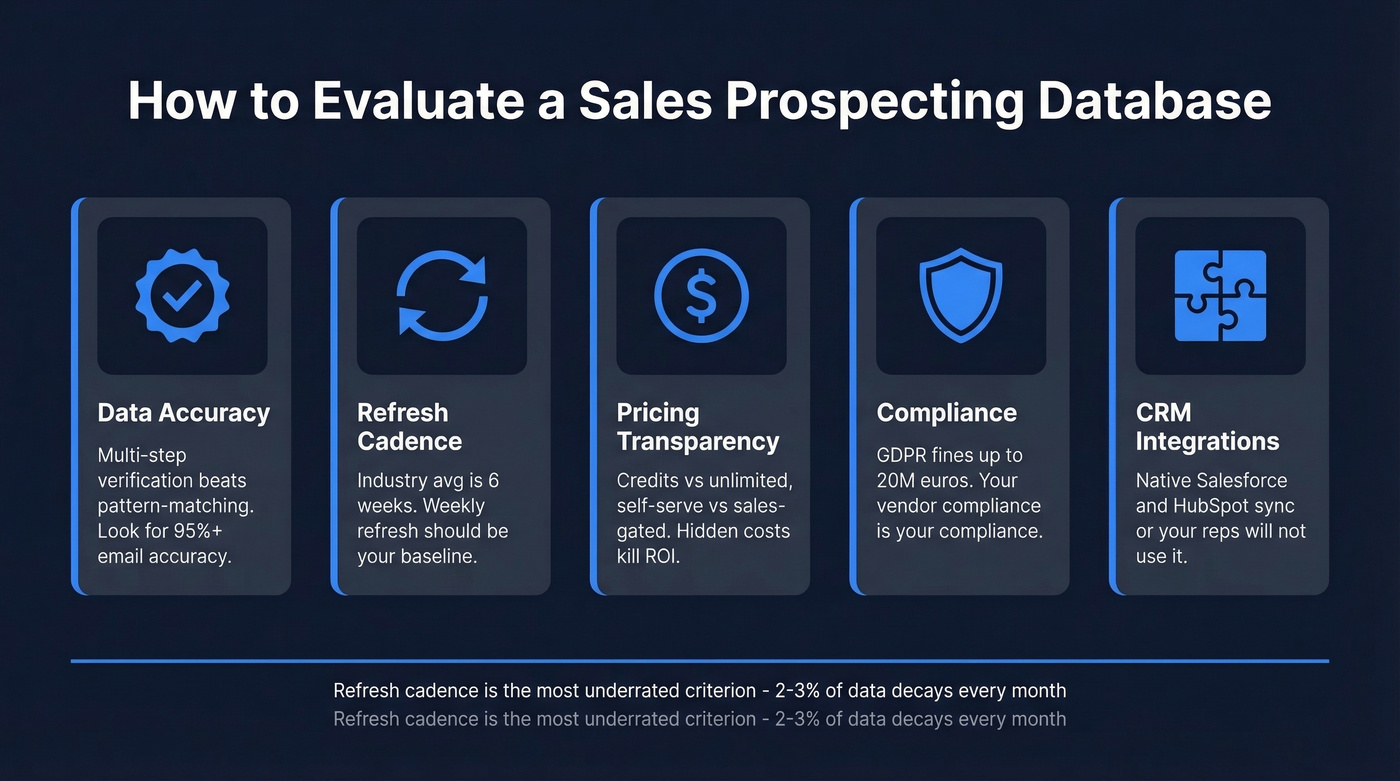
Refresh cadence. This is the single most underrated criterion. The industry average sits around 6 weeks between refreshes, meaning 3-5% of your data goes stale between cycles. Weekly refresh should be your baseline expectation.
Pricing model transparency. Credits vs. unlimited, self-serve vs. sales-gated - these distinctions matter more than sticker price. If a vendor won't show pricing on their website, they're optimizing for their sales team's commission, not your budget.
Compliance. GDPR fines run up to €20M or 4% of global turnover. CCPA penalties hit $7,500 per intentional violation. Your database vendor's compliance posture is your compliance posture.
CRM integrations. Native CRM integrations are table stakes. If the data doesn't flow into Salesforce or HubSpot automatically, your reps won't use it. Simple as that.
Top 8 B2B Prospecting Databases Compared
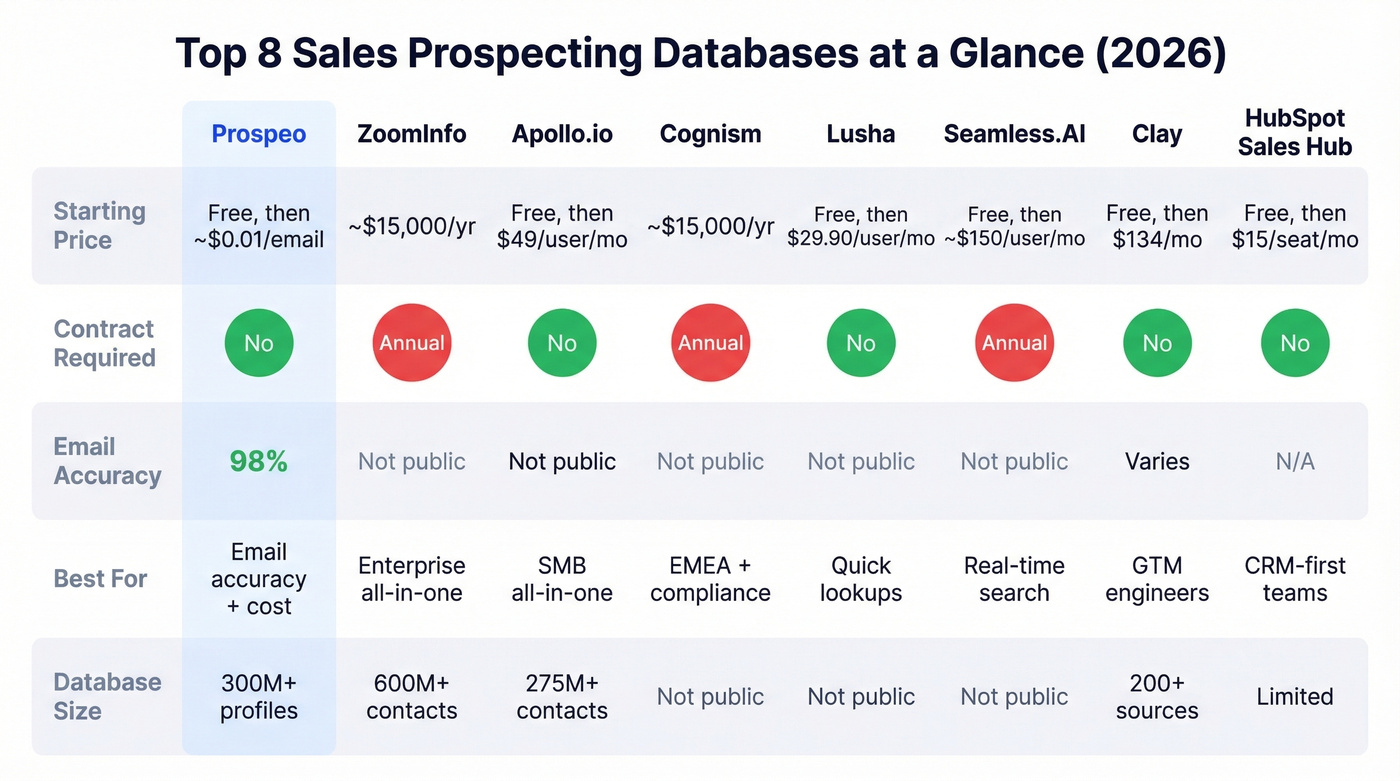
| Tool | Database Size | Email Accuracy | Best For | Starting Price | Contract |
|---|---|---|---|---|---|
| Prospeo | 300M+ profiles | 98% | Email accuracy + cost | Free; ~$0.01/email | None |
| ZoomInfo | 600M+ contacts | Not public | Enterprise all-in-one | ~$15,000/yr | Annual |
| Apollo.io | 275M+ contacts | Not public | SMB all-in-one | Free; $49/user/mo | Monthly ok |
| Cognism | Not public | Not public | EMEA + compliance | ~$15,000/yr | Annual |
| Lusha | Not public | Not public | Quick lookups | Free; $29.90/user/mo | Monthly ok |
| Seamless.AI | Not public | Not public | Real-time search | Free; ~$150/user/mo | Annual typical |
| Clay | 200+ sources | Varies by source | GTM engineers | Free; $134/mo | Monthly ok |
| HubSpot Sales Hub | Limited native | N/A | CRM-first teams | Free; $15/seat/mo | Monthly ok |
Prospeo
Prospeo's database covers 300M+ professional profiles with 98% email accuracy and 125M+ verified mobile numbers that deliver a 30% pickup rate. The 7-day refresh cycle is the fastest we've seen in production - the industry average is 6 weeks, which means data goes stale fast without continuous verification.

The search interface offers 30+ filters including buyer intent powered by 15,000 Bombora topics, technographics, job changes, headcount growth, and funding signals. Pricing runs ~$0.01 per email with 10 credits per mobile number, and there's a free tier (75 emails + 100 Chrome extension credits monthly) generous enough to run a real evaluation. No contracts, no sales calls required.
Real results back this up: Snyk's team of 50 AEs cut their bounce rate from 35-40% to under 5% and grew AE-sourced pipeline 180% after switching. Meritt tripled pipeline from $100K to $300K/week while dropping bounce rates below 4%. That's not marginal improvement - it's a different category of data quality.
ZoomInfo
Use this if: You're an enterprise org running outbound, ABM, and intent from one platform and you have the budget to match.
Skip this if: You're a Series A company with 5 SDRs and a $30k annual data budget.
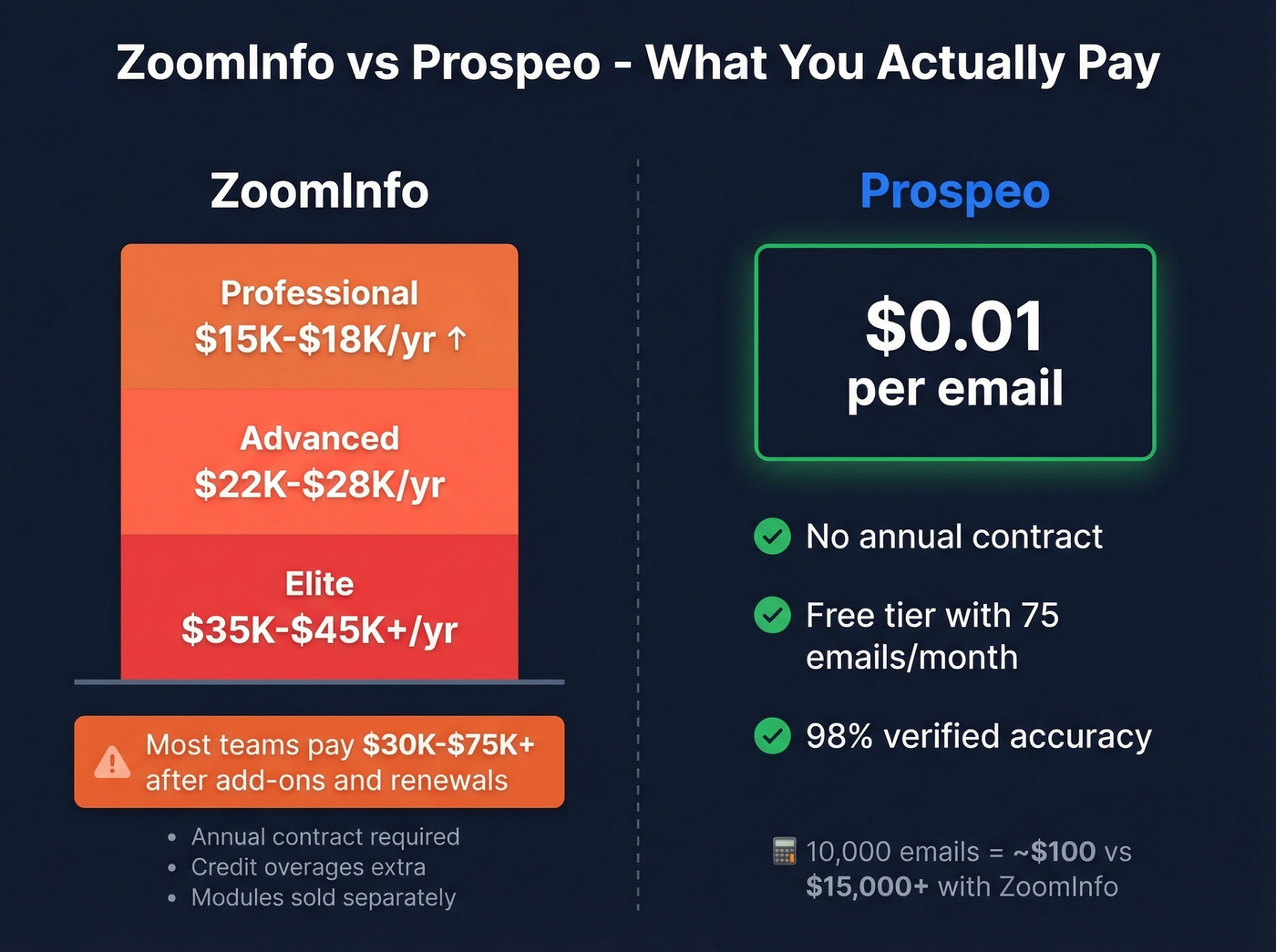
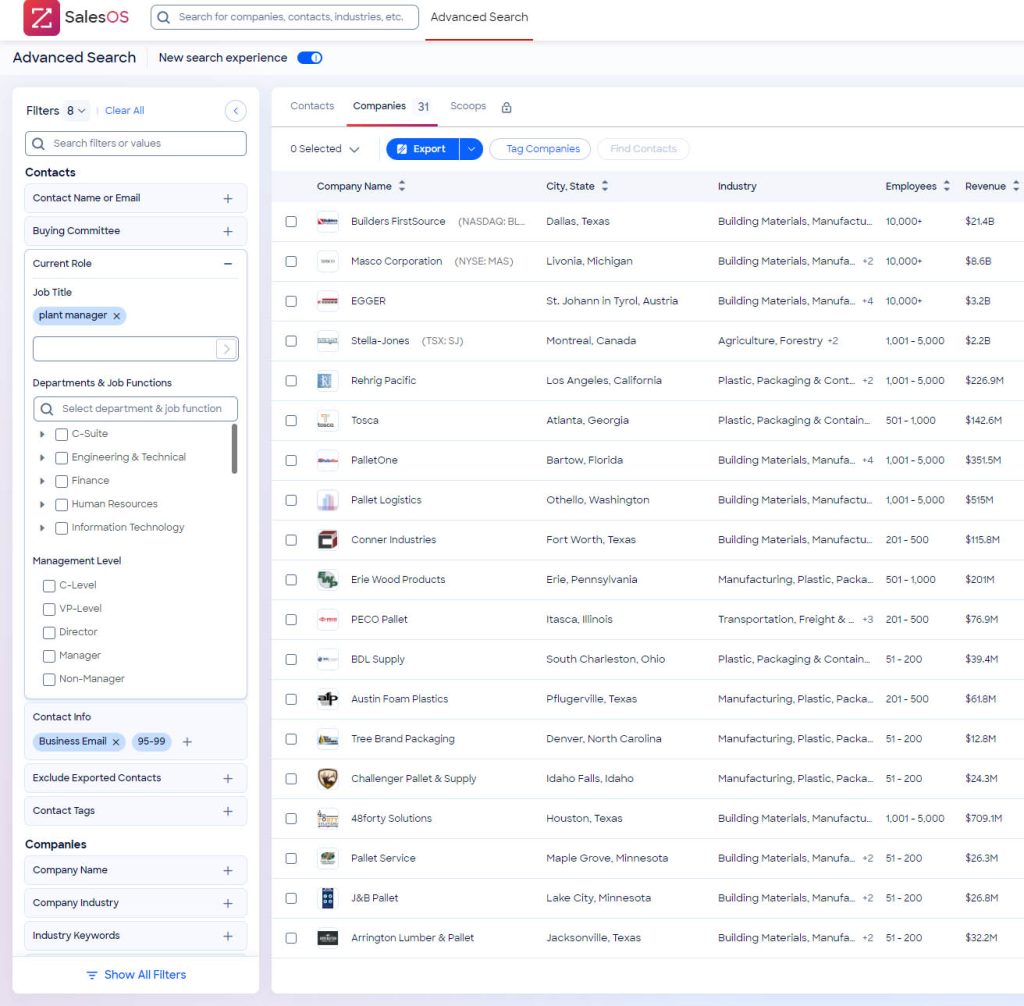
ZoomInfo's database includes 600M+ contacts and one of the broadest feature sets in the market - intent data, org charts, workflow automation, and conversation intelligence under one roof. Professional tier starts at $15k-$18k/year, Advanced runs $22k-$28k, and Elite hits $35k-$45k+. But most teams pay $30k-$75k+ after add-ons, seat expansion, and renewal uplifts. Vendr data shows teams of ~200 employees typically pay $25k-$44k, while 1,000+ employee orgs pay $50k-$160k.
The #1 complaint across pricing guides and community discussions - and the consensus on r/sales backs this up - is surprise costs. Credit overages, modules sold separately, and annual-only contracts with aggressive renewal pricing. Discounts of 30-65% are negotiable if you push, which tells you everything about the list price.
Look, ZoomInfo is still the most complete all-in-one platform. But if your deal sizes sit below $15k, you're paying for a Ferrari to drive to the grocery store. Most teams don't need all-in-one - they need accurate data that plugs into the tools they already use.
Apollo.io
Use this if: You're an SMB team that wants outreach and data in one platform without enterprise pricing.
Skip this if: You're running international campaigns - pricing guides and comparisons consistently flag accuracy issues outside the U.S.
Apollo combines a 275M+ contact database with built-in email sequences, a dialer, and basic CRM functionality. The free tier includes 5 mobile credits and 10 export credits monthly. Paid plans run $49 (Basic), $79 (Professional), and $119 (Organization) per user/month billed annually.
The credit math matters here. Basic gives you 75 mobile + 1,000 export credits per month. Overages cost $0.20/credit, and unused credits expire at the end of each billing cycle. For domestic outbound, Apollo is excellent value. For EMEA and APAC contacts, verify the data independently before you send.
Cognism
Why it wins: EMEA compliance and Diamond Data - human-verified mobile numbers. GDPR-aligned, SOC 2 and ISO 27001 certified.
Key tradeoff: Price. Grow tier runs ~$15k platform fee + ~$1,500/user/year. Elevate jumps to ~$25k platform + ~$2,500/user/year. "Unlimited exports" hits a fair-use cap around 2,000 records/user/month.
For a 5-person team on Grow, you're looking at ~$22,500/year minimum. Elevate with intent data crosses $40k easily. If you're selling heavily into Europe and compliance is a hard requirement, Cognism earns its price. For U.S.-only teams, it's harder to justify.
Lusha
Lusha's strength is speed - the Chrome extension reveals contact details fast, and the interface is dead simple. Free tier gives you 70 credits/month, Pro runs $29.90/user/mo (annual), and Premium hits $52.45/user/mo.
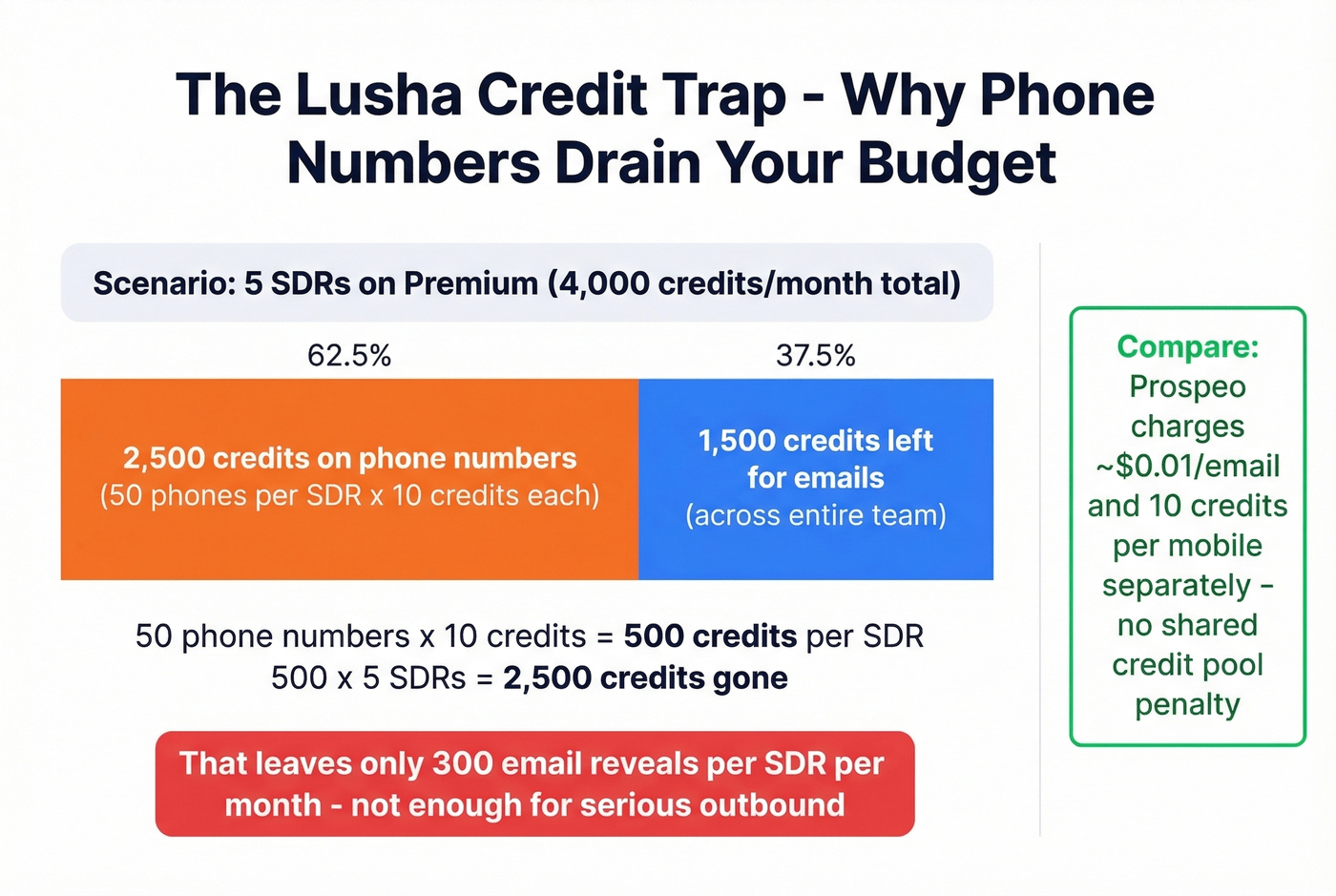
But the credit math punishes you on phone numbers. One credit reveals an email, while a phone number costs 10 credits. Put 5 SDRs on Premium (4,000 credits/month total), have each pull 50 phone numbers, and you've burned 2,500 credits on phones alone - leaving just 1,500 email reveals across the entire team. Lusha's credit model looks cheap until you need direct dials.
Seamless.AI
Use this if: You want data verified at the moment of search, not pulled from a static database.
Skip this if: You need pricing transparency or hate aggressive sales outreach after signup. The Reddit threads on this one are... colorful.
Seamless.AI uses a real-time search model that verifies contacts on demand rather than serving cached records. Free tier gives you 50 credits. Beyond that, expect annual contracts around $150/user/month and a "Switch & Save" program offering up to 50% off competitor pricing. You get verified data at the moment of search, but once exported, there's no ongoing refresh.
Clay
Clay isn't a traditional B2B contact database - it's a waterfall enrichment engine that pulls from 200+ sources and lets you build custom prospecting workflows. Built for GTM engineers and RevOps teams who want to chain data sources together and automate enrichment logic, not for traditional SDRs who just need a search bar. Free tier includes 1,200 credits/year, Starter runs $134/mo, Explorer $314/mo, and Pro $720/mo.
HubSpot Sales Hub
CRM-first with limited native prospecting data. If you're already in HubSpot's ecosystem, Sales Hub adds sequences, meeting scheduling, and basic contact management. Free for 5 users, Starter at $15/seat/mo, Professional from $1,450/mo for 5 seats. Don't expect it to replace a dedicated prospecting database - it's a CRM that does light prospecting, not the other way around. Pair it with a real data source and you're set.
How to Test Before You Commit
Don't sign an annual contract based on a demo. Run a bake-off instead.
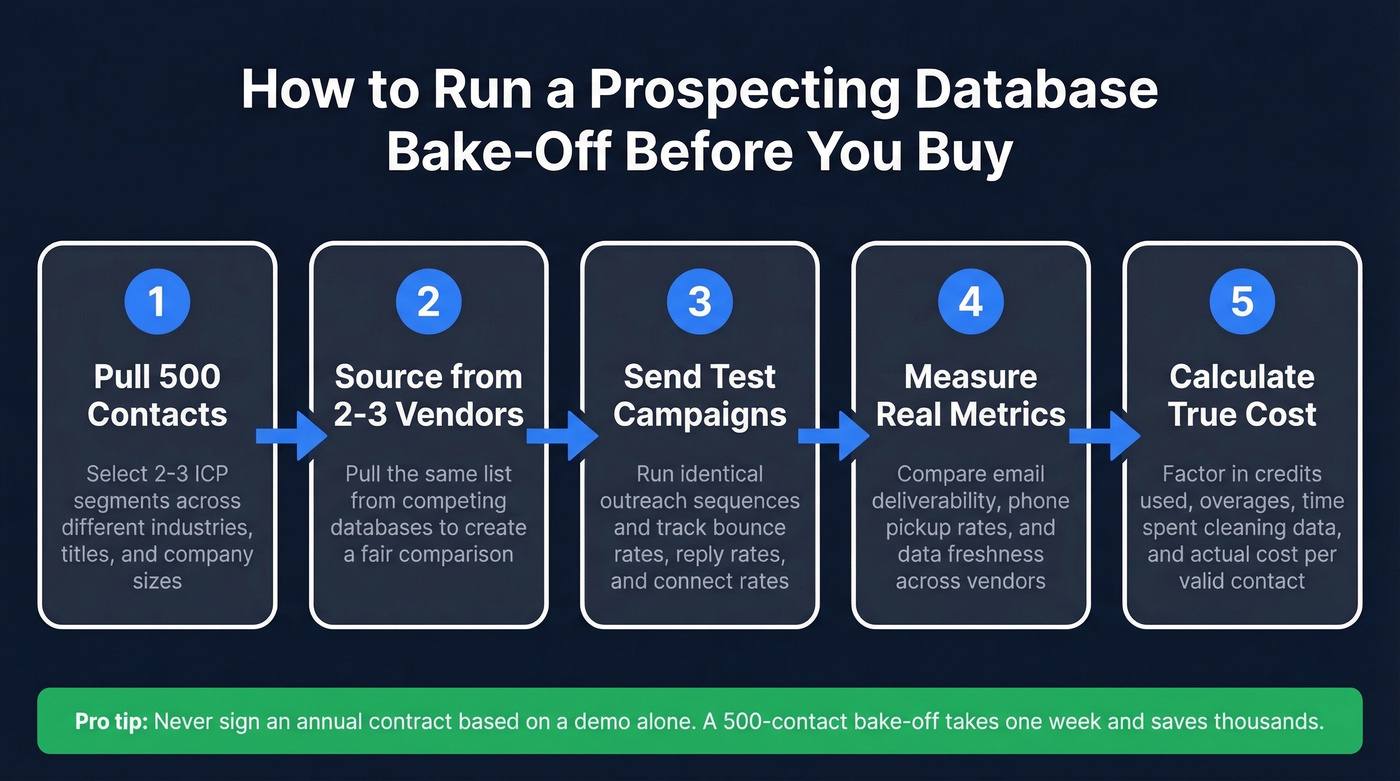
Start by pulling 500 contacts across 2-3 ICP segments - different industries, titles, and company sizes. Source the same list from 2-3 databases using their free tiers. Send identical sequences through each data source with the same copy and cadence, then measure bounce rate, reply rate, and phone connect rate. We ran this exact test last quarter with three tools, and the accuracy gap between the best and worst source was 19 percentage points - on the same list of prospects.
The metric that matters is cost-per-verified-contact and cost-per-meeting - not cost-per-seat. A tool with 98% accuracy at $0.01/email will outperform one with 79% accuracy at $0.00/email every single time.
Walk away if the vendor won't offer a free trial, requires an annual commitment before you can test, or can't explain where their data comes from. If you're seeing high bounces, start by benchmarking your email bounce rate and tightening email deliverability before scaling volume.
Snyk cut bounce rates from 35-40% to under 5% and grew AE-sourced pipeline 180%. Meritt tripled weekly pipeline to $300K. The difference wasn't effort - it was switching to a prospecting database with 98% accuracy, 125M+ verified mobiles, and 30+ filters including buyer intent across 15,000 topics.
Get enterprise-grade prospecting data at $0.01/email with zero contracts.
FAQ
CRM vs. Prospecting Database: What's the Difference?
A CRM like Salesforce or HubSpot stores and manages contacts you already have. A prospecting database helps you find new contacts you don't have yet - verified emails, phone numbers, and firmographic data for people matching your ICP. Most teams use both: a database to source leads, a CRM to manage them through the pipeline.
How Much Does a Sales Prospecting Database Cost?
Free tiers exist at Apollo, Lusha, and Prospeo. Mid-market tools run $49-$150/user/month. Enterprise platforms like ZoomInfo and Cognism start at $15,000/year and scale to $75k+ with add-ons and seats. Always calculate cost-per-verified-contact - a $0.01/email tool with 98% accuracy beats a free tool with 30% bounce rates every time.
How Often Should Prospecting Data Be Refreshed?
B2B contact data decays 2-3% per month - roughly 30% annually. A database refreshing weekly catches job changes, new emails, and company updates before they go stale. The industry average is around 6 weeks between refreshes. If your vendor can't tell you their refresh cadence, that's your answer.
What's the Best Free Option for Small Teams?
Prospeo's free tier (75 emails + 100 Chrome extension credits/month) includes full verification and enrichment - enough to run real outbound campaigns. Apollo offers the most generous free all-in-one platform with limited mobile and export credits. Lusha gives 70 free credits monthly for quick lookups. Let's be honest though: run a bake-off with real ICP contacts before committing budget. The free tiers exist specifically so you can test.