

The RevOps Tech Stack Blueprint: Fewer Tools, Better Data, More Revenue
You just inherited a stack with 23 tools, four overlapping enrichment vendors, and a Salesforce instance that looks like it was configured by a committee of interns across three fiscal years. Nobody can tell you which tools drive pipeline and which just burn budget.
That's the revops tech stack problem in 2026. 47% of RevOps professionals rate their stack's ROI as average or worse, and over 11,000 GTM solutions now compete for your budget. Gartner projects that 75% of the highest-growth companies will adopt a RevOps model by 2026. The model is winning. The tooling decisions are where teams keep stumbling.
Start With Exactly Five Tools
Build or rebuild your revenue operations tech stack starting with five tools. Add nothing else until these are fully adopted.
- CRM - Salesforce or HubSpot. Everything flows from your system of record. Pick one, invest in implementation, don't cheap out on setup.
- Marketing automation - HubSpot or Marketo. Your MAP needs to pass campaign member data cleanly. If it can't, nothing downstream works.
- Sales engagement - Outreach or Salesloft. Where reps actually live. Apollo works as a budget alternative.
- Revenue intelligence - Gong. Conversation intelligence changes how you coach, forecast, and understand deals. Essential once you're past ~10 reps.
Five tools. Get adoption above 80% on all five before you even think about adding a sixth.
Why Most Revenue Tech Stacks Underperform
The problem isn't a lack of tools - it's the opposite. Organizations use only 42% of their GTM software capabilities, and roughly 30% of SaaS spend goes to underutilized tools. You're paying for features nobody touches.
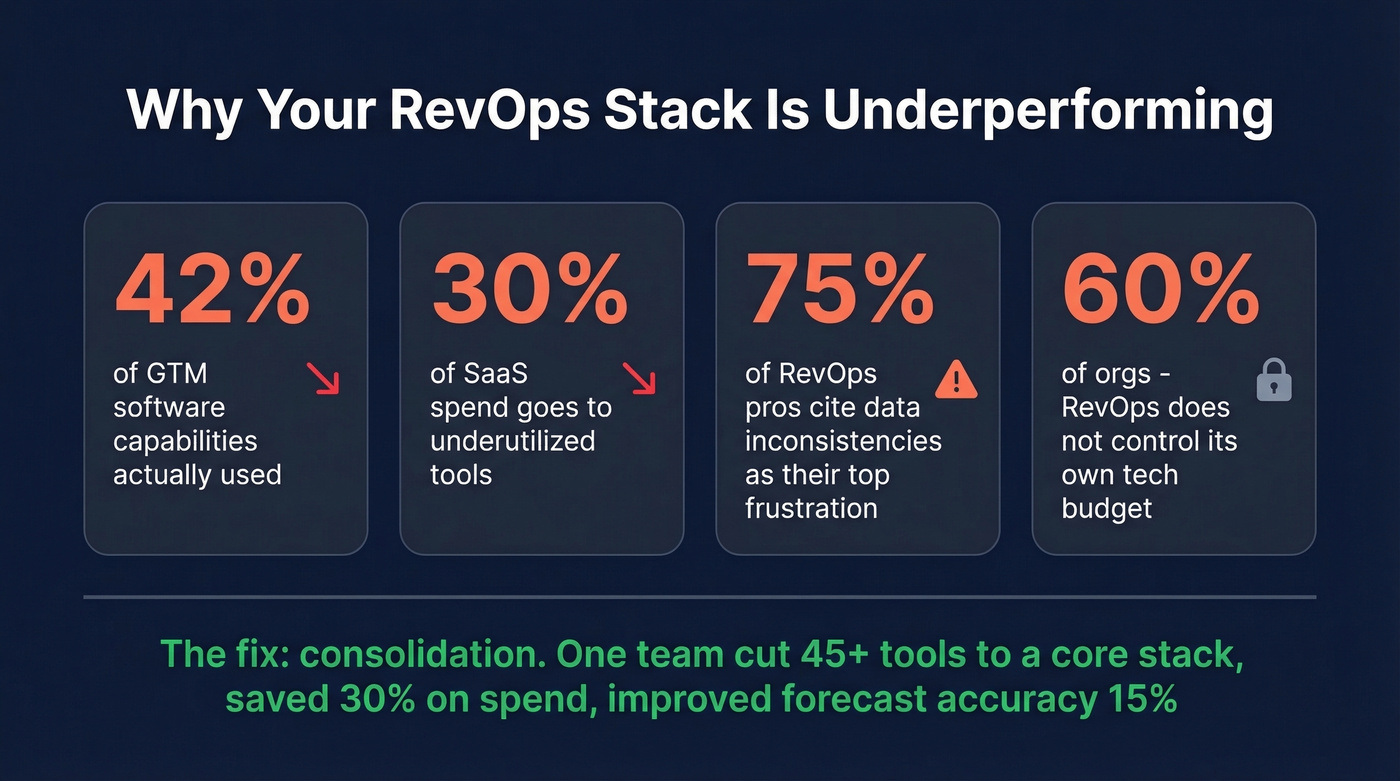
75% of RevOps pros cite data inconsistencies as their #1 frustration. That's not a tooling problem - it's a governance and architecture problem. When five different tools write to the same CRM fields with different formatting, confidence, and freshness, you get garbage data dressed up as a "unified view."
Here's the thing: in 60% of organizations, RevOps doesn't even control its own tech budget. Marketing buys Marketo, Sales buys Outreach, CS buys Gainsight. Nobody coordinates. The result is a Frankenstack where tools overlap, data conflicts, and RevOps spends all its time stitching things together instead of driving strategy.
One practitioner on r/revops shared their consolidation story - a 200-person Boston SaaS company that went from 45+ tools down to a core stack. The results: 30% reduction in tech spend, 15% improvement in forecast accuracy, 25% increase in cross-functional data visibility, and 40% less time on manual reporting. Consolidation isn't just a cost play. It's an accuracy play.
The 8 Layers of a Modern RevOps Tech Stack
Every revenue technology stack maps to the same eight layers. The tools change by stage and budget. The architecture doesn't. Some enterprise stacks add CPQ and billing layers like DealHub or Zuora, but those are typically post-$10M ARR concerns.
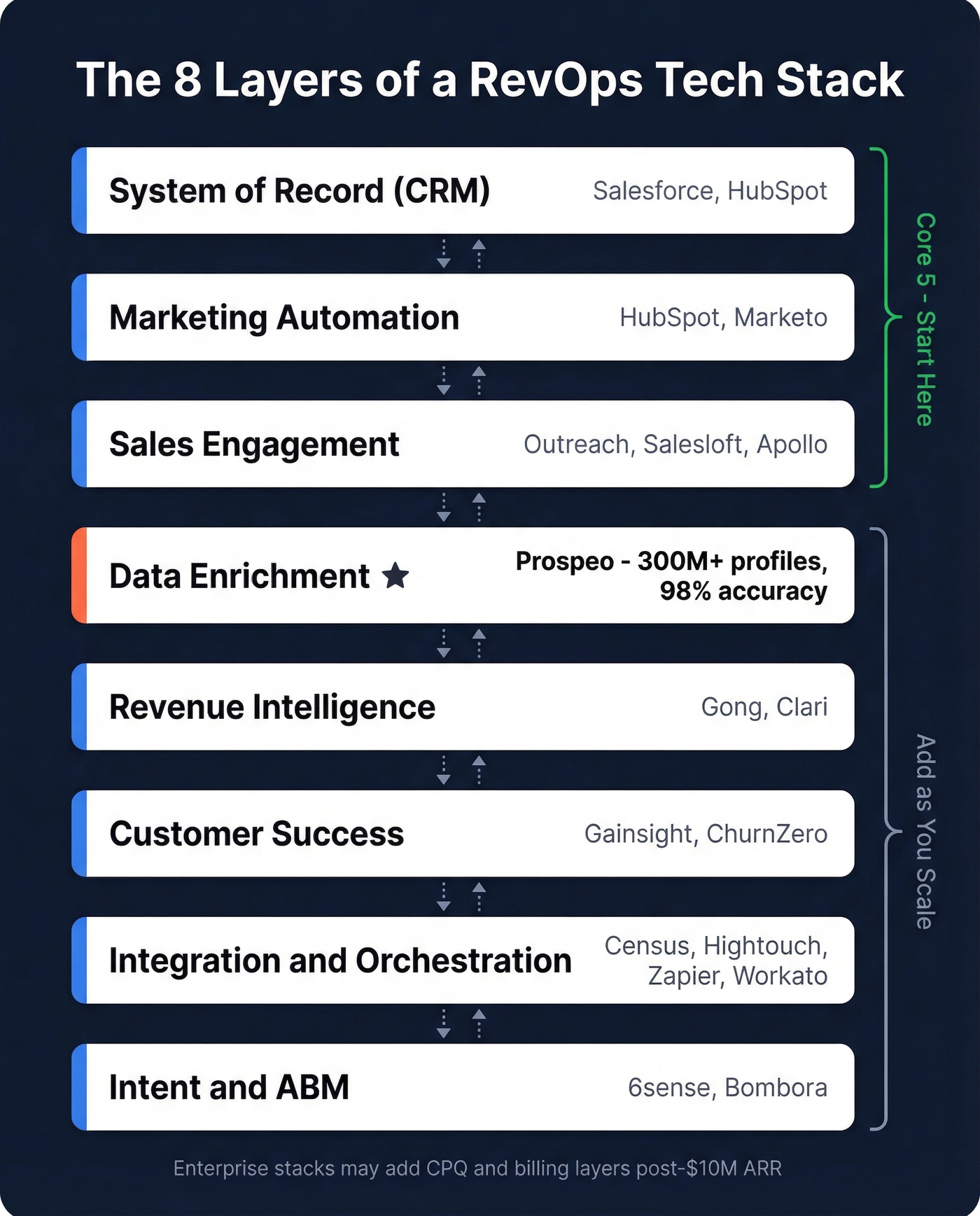
System of Record (CRM)
Salesforce runs $25-$500/user/month. HubSpot offers a free CRM, and Ops Hub starts at $20/seat/month, scaling to $2,000/month at enterprise. The choice between them matters less than implementation quality. A bad data structure forces a rip-and-replace later that costs far more than doing it right the first time.
Marketing Automation
HubSpot or Marketo (around $1,000-3,000/month for mid-market) - those are your real options. Pardot? Salesforce has failed to innovate the integration. If you're on Pardot, start planning your migration now. Any MAP that can't pass campaign member data to your CRM is a non-starter. And watch HubSpot's marketing vs non-marketing contact designation - it's a cost-control lever most teams discover too late.
Sales Engagement
Outreach and Salesloft both run ~$100-150/user/month. They're mature, well-integrated, and where reps actually spend their day. Apollo works as a budget alternative at $49/user/month, especially for startups that want prospecting and sequencing in one tool. The pitfall: buying engagement tooling before you've nailed your ICP and messaging. The tool amplifies whatever you feed it - good or bad.
Data Enrichment
This is the most bloated layer in most stacks. We've seen teams running four to six overlapping enrichment subscriptions with manual coordination between them. ZoomInfo and Apollo have roughly 70% coverage overlap on US business contacts. You're paying twice for the same data.
Prospeo covers 300M+ professional profiles, 143M+ verified emails at 98% accuracy, and 125M+ verified mobile numbers - all on a 7-day refresh cycle versus the roughly 6-week industry average. The API match rate runs 92%, and it integrates natively with Salesforce, HubSpot, Outreach, Salesloft, Smartlead, Instantly, Lemlist, Clay, Zapier, Make, and n8n. At ~$0.01 per email, you're looking at a fraction of a $15,000-40,000/year ZoomInfo contract. Snyk's team of 50 AEs saw bounce rates drop from 35-40% to under 5% with Prospeo, and AE-sourced pipeline climbed 180%.

For teams that need multiple data sources, use waterfall enrichment - query your primary provider first, then fill gaps with a secondary. Dedupe, write one authoritative record, and move on.

Your enrichment layer is the most bloated part of your RevOps stack. Prospeo replaces overlapping vendors with 300M+ profiles, 98% email accuracy, and a 92% API match rate - on a 7-day refresh cycle. Snyk's 50-AE team cut bounce rates from 35-40% to under 5% and grew AE-sourced pipeline 180%.
Kill the Frankenstack. One enrichment provider, zero bounced emails.
Revenue Intelligence
Gong handles conversation intelligence (~$100-150/user/month). Clari handles forecasting (~$50-100/user/month). They complement each other - Gong tells you what's happening in deals, Clari tells you whether the pipeline math works. The pitfall is buying Gong and then not actually reviewing calls. The tool is only as good as the coaching cadence around it.
Customer Success
Gainsight ($2,500-10,000/month) and ChurnZero ($1,000-3,000/month) are the most common options. Our honest take: skip this layer entirely until you're past $5M ARR. Before that, your CS team is small enough to run health scores in spreadsheets or CRM-native dashboards. Adding a dedicated CS platform too early creates another integration to maintain with too few users to justify it.
Integration & Orchestration
This is the layer most teams hack together with Zapier and regret later. The modern approach is warehouse-centric: use your data warehouse as the single source of truth, then reverse ETL tools like Census or Hightouch (from ~$300-500/month) push insights back into your CRM and operational tools. Teams using this approach report ~18-day shorter sales cycles and ~60% less manual data entry.
Some teams add a dedicated orchestration layer - tools like Default or LeanData that handle routing, assignment, and workflow triggers across your stack. For smaller teams, Zapier or n8n handles basic workflows fine. Once you're past 20 integrations, move to Tray.io or Workato. The non-negotiable: appoint an integration owner. Only 20% of teams with poor integrations are satisfied with their stack.
Intent & ABM
6sense ($30,000-100,000+/year) and Bombora ($25,000-60,000/year) are the big players. These are enterprise-tier investments that only make sense when you have the sales capacity and deal size to act on intent signals. For most growth-stage companies, bundling enrichment and intent in one platform is the smarter play - fewer contracts, fewer integrations, faster time to signal.
You're spending $15K-$40K/year on ZoomInfo for data that overlaps 70% with your other vendors and refreshes every 6 weeks. Prospeo delivers 143M+ verified emails at ~$0.01 each, refreshed every 7 days, with native integrations into Salesforce, HubSpot, Clay, and every major sequencer. That's the consolidation win your RevOps budget needs.
Cut enrichment spend by 90% and get fresher data. Run your bake-off today.
Choosing Tools by Company Stage
| Layer | Startup (<$5M ARR) | Growth ($5-30M) | Enterprise ($30M+) |
|---|---|---|---|
| CRM | HubSpot Free/Starter | HubSpot Pro or SFDC | Salesforce Enterprise |
| MAP | HubSpot (bundled) | HubSpot Pro or Marketo | Marketo or Eloqua |
| Engagement | Apollo | Outreach or Salesloft | Outreach or Salesloft |
| Intelligence | Gong (if budget allows) | Gong + Clari | Gong + Clari + 6sense |
| CS | Manual / CRM-native | ChurnZero or Gainsight | Gainsight |
| Integration | Zapier / n8n | Zapier + warehouse | Workato + warehouse + rETL |
| Budget range | $500-2K/mo | $5-15K/mo | $20-60K+/mo |
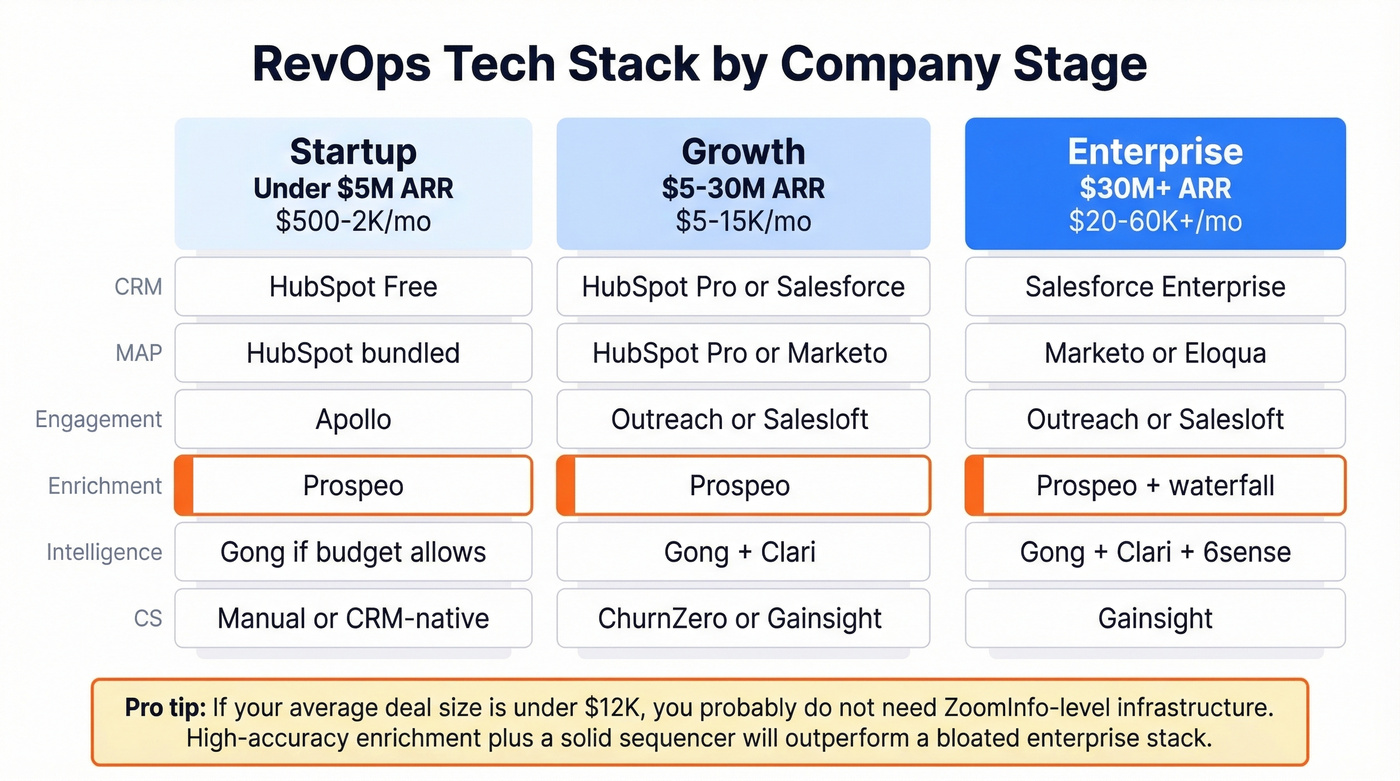
The startup failure mode is prioritizing low spend over proficiency. Saving $200/month on a cheaper CRM tier while creating technical debt that costs $50K to unwind at Series B isn't a win. Don't let a newly minted Salesforce admin run your initial implementation - bad data structures haunt you for years. Invest in getting the foundation right.
Let's be direct: if your average deal size is under $12K, you probably don't need ZoomInfo-level data infrastructure. A high-accuracy enrichment tool plus a solid sequencer will outperform a bloated enterprise stack that nobody fully adopts.
AI and Revenue Operations
Only 4% of RevOps teams use AI extensively. Over half are experimenting, but meaningful adoption is still early - only about a third of teams have automated more than half their RevOps processes. The automation opportunity is still massive. Gong reports 96% of revenue leaders expect their teams to use AI tools by end of 2026. The question isn't whether to adopt, but where to start.
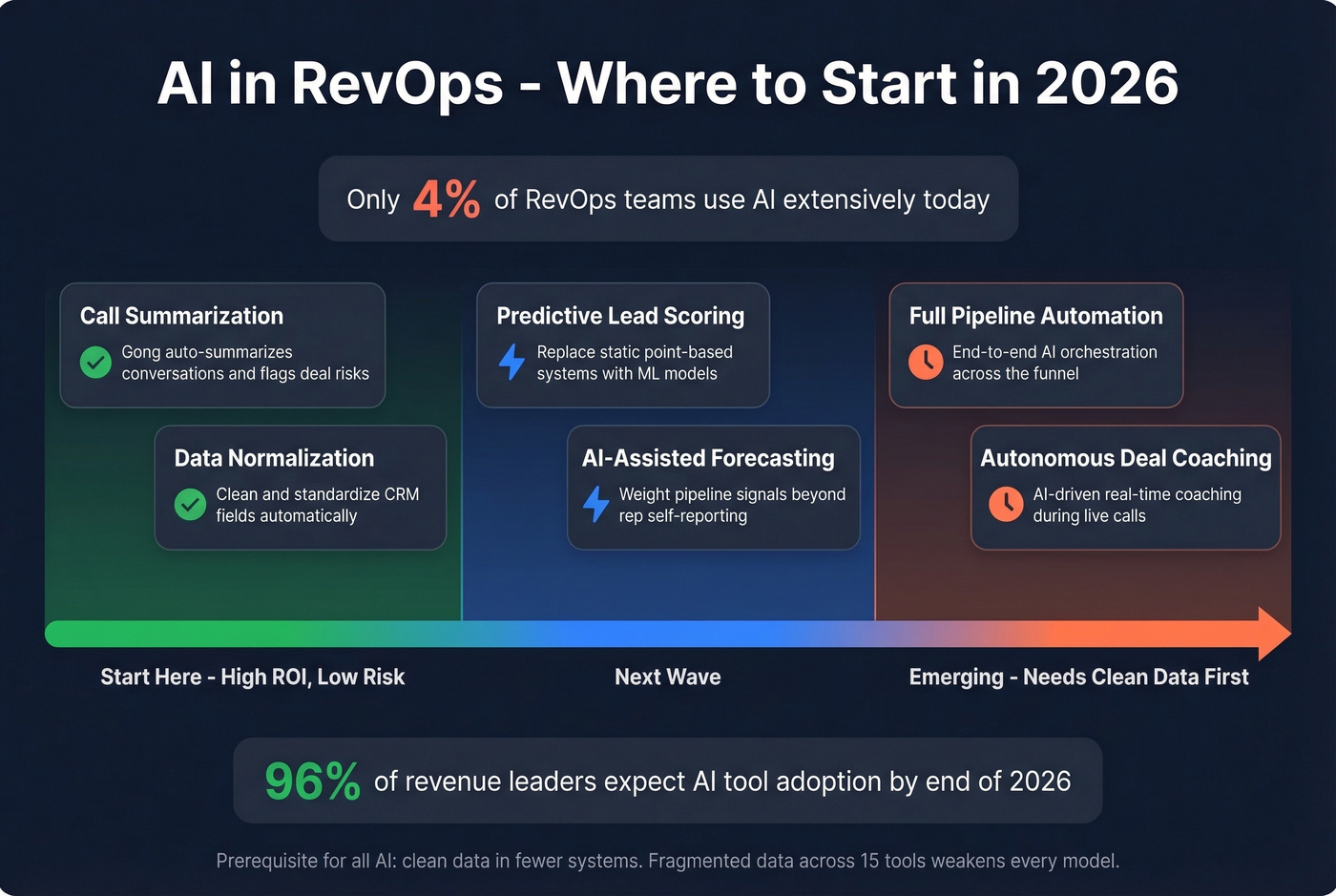
Data normalization and call summarization deliver ROI immediately with minimal risk. Gong and similar tools auto-summarize conversations and flag risk signals without any workflow changes. Predictive lead scoring replaces static point-based systems, and AI-assisted forecasting weights pipeline signals beyond rep self-reporting. These use cases work today.
The bigger trend to watch is platform consolidation. AI tools are expensive, and fragmented data across 15 tools weakens every model you try to build. Clean data in fewer systems is the prerequisite for AI that actually works.
Governance: The Unsexy Part That Matters Most
A RevOps practitioner on Reddit nailed the core problem: "Too much flexibility leads to redundant fields, misaligned metrics, and conflicting workflows." Teams with RevOps in place 3+ years are twice as likely to say their stack directly supports revenue growth. Governance is how you get there.
Quarterly audits. Check adoption rates, integration health, and spend per tool. Kill anything under 50% adoption. No exceptions.
Integration owner. One person owns the data flow map, monitors sync health, and manages API limits. We've found that teams without a named owner end up with broken syncs that go unnoticed for weeks.
Compliance hygiene. Disparate CRM and MAP data creates duplicates, which creates opt-out visibility gaps - that's a lawsuit risk, not just a data quality issue.
Standard objects first. Prefer standard fields over custom objects. If you can't justify why a custom field exists, delete it.
Without governance, even the best-designed revenue operations stack degrades into the same mess you started with within 18 months.
Pricing Cheat Sheet
| Category | Tool | Approx. Price |
|---|---|---|
| CRM | Salesforce | $25-$500/user/mo |
| CRM | HubSpot | Free to ~$2K/mo (Ent.) |
| MAP | Marketo | ~$1K-3K/mo |
| Engagement | Outreach | ~$100-150/user/mo |
| Engagement | Salesloft | ~$100-150/user/mo |
| Engagement | Apollo | From $49/user/mo |
| Enrichment | Prospeo | ~$0.01/email, free tier, no contracts |
| Enrichment | ZoomInfo | $15K-40K/year |
| Enrichment | Cognism | ~$1K-3K/mo |
| Enrichment | Clay | From $134/mo |
| Intelligence | Gong | ~$100-150/user/mo |
| Intelligence | Clari | ~$50-100/user/mo |
| Intent/ABM | 6sense | $30K-100K+/year |
| Intent/ABM | Bombora | $25K-60K/year |
| CS | Gainsight | $2.5K-10K/mo |
| CS | ChurnZero | $1K-3K/mo |
| Integration | Zapier | Free to $20+/mo |
| Reverse ETL | Census / Hightouch | Free to ~$300-500/mo |
Cognism deserves a mention for teams with heavy European prospect lists - GDPR-compliant mobile data is their strength. Most tools on this list require a sales call, and the fact that enrichment vendors still hide pricing in 2026 is genuinely frustrating.
FAQ
How many tools should a RevOps tech stack include?
Five to eight core tools for most teams. The average enterprise runs 12-18, but utilization drops sharply past eight. Start with CRM + MAP + enrichment + engagement + intelligence and add only when you've maxed adoption on what you have.
What's the most common RevOps tooling mistake?
Buying tools before defining workflows. Map your GTM process first - lead routing, handoff triggers, attribution model - then select tools that fit. Data inconsistencies are the #1 frustration for 75% of RevOps pros, usually caused by tools that don't integrate cleanly.
How often should you audit your stack?
Quarterly. Check adoption rates, integration health, and spend per tool. Kill anything under 50% adoption. The Reddit team that cut from 45+ tools saved 30% on tech spend and improved forecast accuracy by 15%.
What's the best enrichment tool for a lean RevOps stack?
Prospeo delivers 98% email accuracy on a 7-day refresh at ~$0.01/email - roughly 90% cheaper than ZoomInfo with higher verified-email accuracy. Start with the free tier (75 emails/month), run it against your existing provider, and let the bounce rates speak for themselves.