How to Turn Hiring Signals for Sales Into Booked Meetings
Your SDR finds 50 companies hiring RevOps managers. Perfect signal. She builds the list, loads a sequence, hits send - and 18 emails bounce before lunch. The signal was right. The data wasn't.
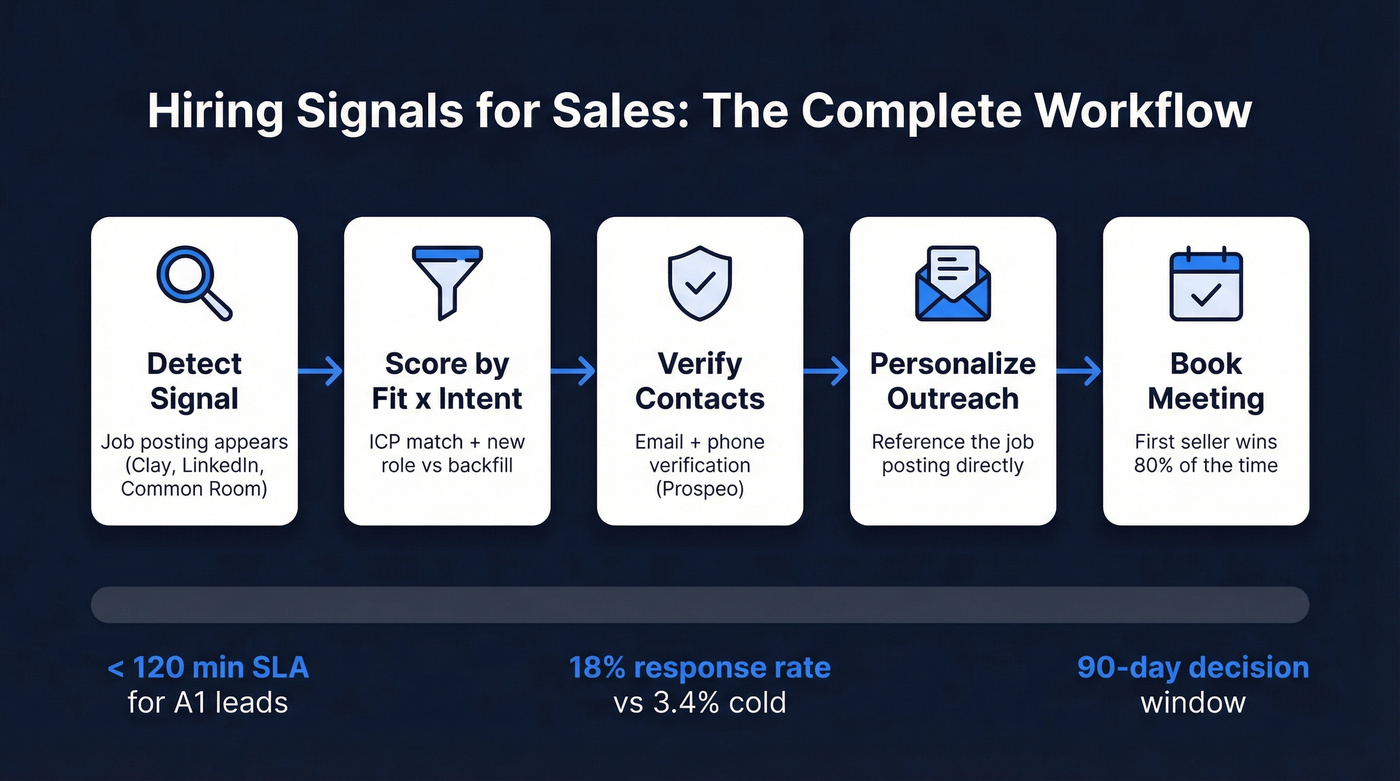
That gap is why hiring signals for sales teams remain underused despite being the highest-intent trigger in outbound. The first seller after a trigger event is 5x more likely to win, while everyone else is still cleaning their spreadsheet.
What You Need (30-Second Version)
What Are Hiring Intent Signals?
When a company posts a job, they're telling the market exactly where they're investing next - intelligence you can act on before competitors even notice.
Four types matter most:
- New role creation - A company hiring its first RevOps Manager or Head of Demand Gen. This carries 2-3x higher purchase intent than adding to existing teams because the company is building a function from scratch and needs tools to support it.
- Department expansion - Adding headcount to an existing team. A surge like this means growth and new tooling needs.
- Leadership appointments - A new VP of Sales or CRO joining. These executives bring playbooks and vendor preferences from their last company.
- Hiring velocity spikes - A company that normally posts 5 roles a month suddenly posts 25. Something changed: funding, a new product line, a market push.
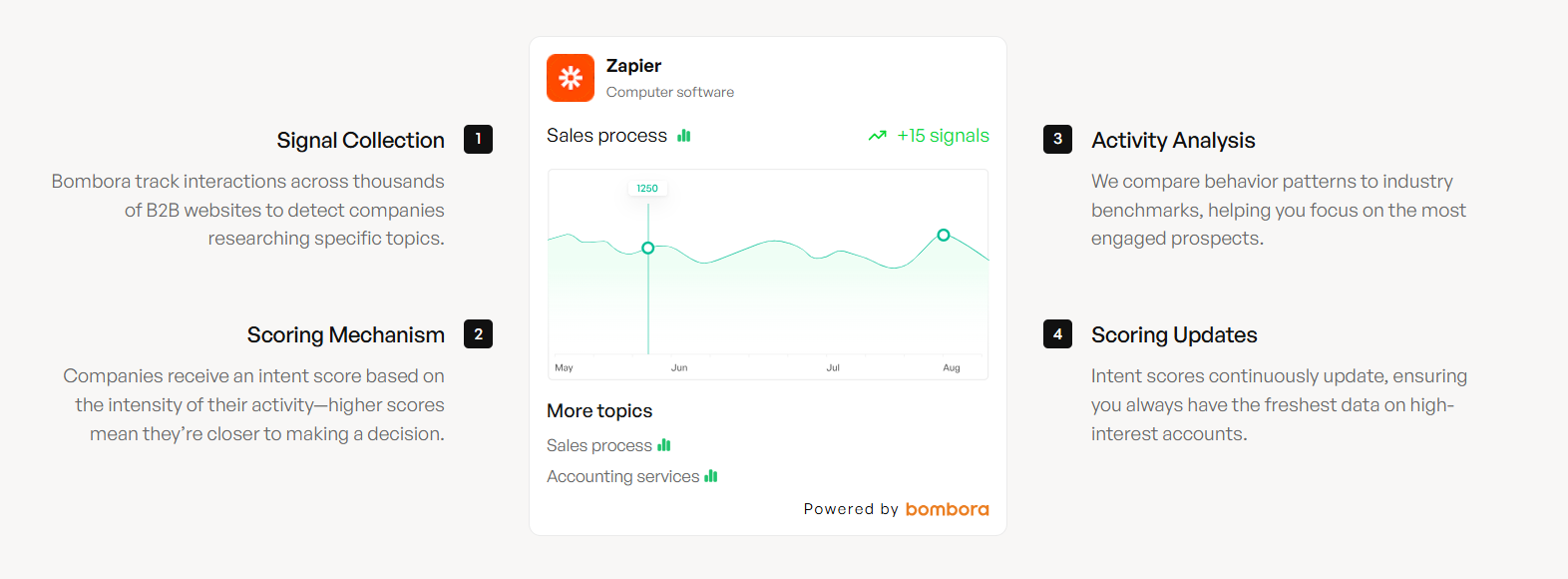
The distinction between new role creation and backfills is critical. A company replacing a departing SDR needs to keep the lights on. A company hiring its first RevOps Manager is building infrastructure and will buy software to support it. Those are fundamentally different buying situations.
Why They Outperform Cold Outreach
The numbers aren't subtle. Teams using signal-based outreach see ~18% response rates vs. the 3.4% cold average. Triggered outreach generates +70.5% higher open rates and +152% higher CTR compared to standard sequences.
You're not interrupting - you're arriving at the right moment. A new VP of Sales doesn't need you to explain why sales intelligence matters. She's evaluating tools right now. Forrester found that 92% of B2B buyers start with at least one vendor already in mind, and the vendor ranked first on day one wins roughly 80% of the time. Job-posting intelligence lets you be that first vendor.
How to Read a Job Posting Like a Signal
Not every job posting is a buying signal. Here's what to look for.
Keywords That Reveal Intent
Scan the requirements and responsibilities sections for technology mentions and strategic language:
- Tool-specific keywords: HubSpot Admin, Salesforce Migration, Marketo, Outreach implementation
- Function-building language: "build from scratch," "establish processes," "first hire"
- Urgency qualifiers: ASAP, immediate start, "rapidly scaling"
- Strategic terms: ABM, RevOps, demand generation, sales enablement
The reporting structure matters too. A RevOps Manager reporting to the CRO signals a strategic hire. The same title reporting to a Sales Manager signals a tactical backfill. And the tech stack listed in "requirements" tells you exactly what they're already using - and what they might replace.
The Fit x Intent Scoring Matrix
Score every signal on two dimensions before it hits a rep's queue. This is your hiring intent filter - it separates noise from actionable opportunity:
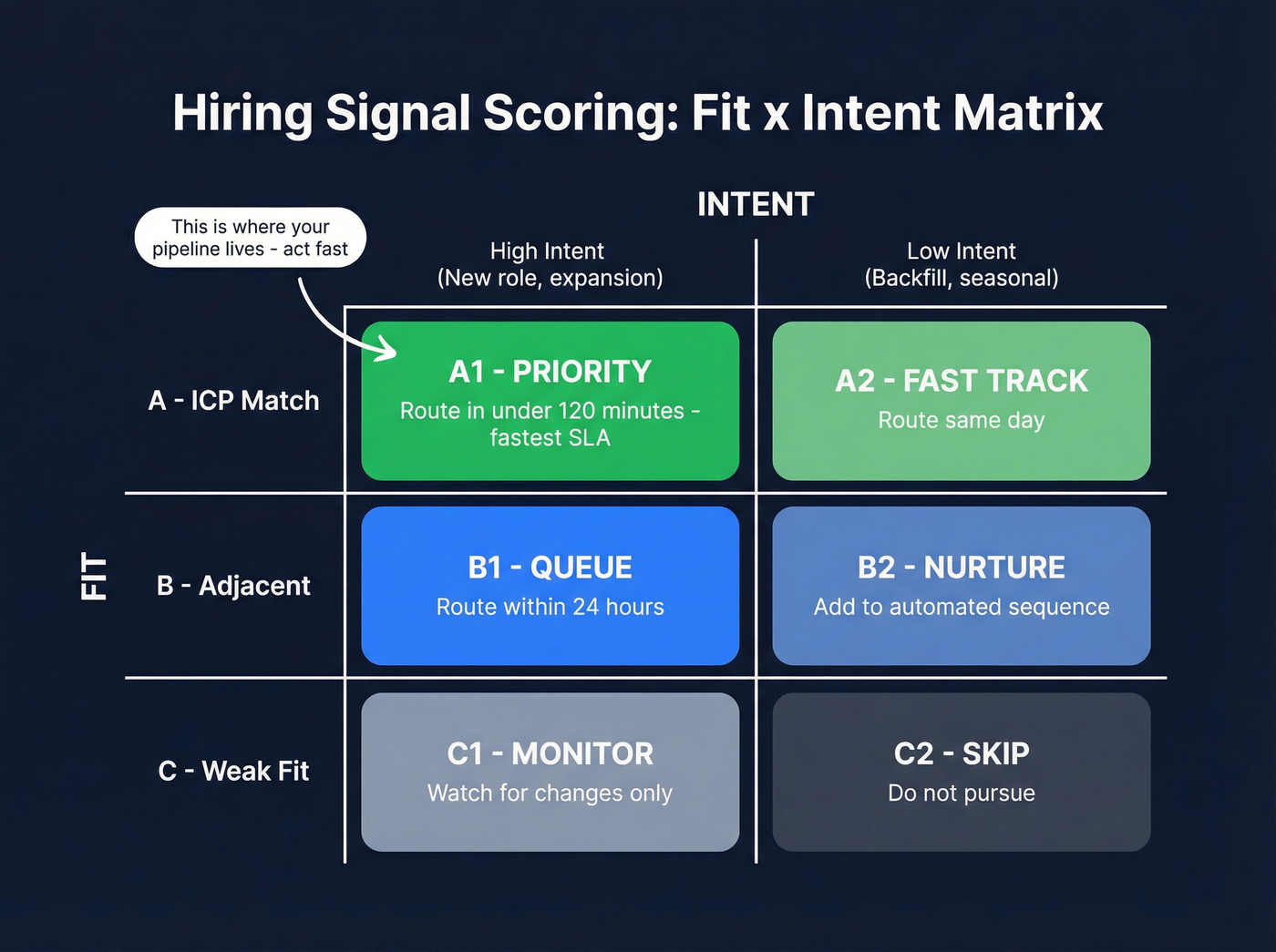
| Intent 1 (New role / expansion) | Intent 2 (Backfill / seasonal) | |
|---|---|---|
| Fit A (ICP match) | A1 - Route in <120 min | A2 - Route same day |
| Fit B (Adjacent) | B1 - Route within 24 hrs | B2 - Nurture sequence |
| Fit C (Weak fit) | C1 - Monitor only | C2 - Skip |
A1 leads - ICP-matching companies creating new roles - get the fastest SLA you can manage. Under 120 minutes from signal to first touch is the target. Everything else can wait or go into automated nurture.
Department-by-Department Playbook
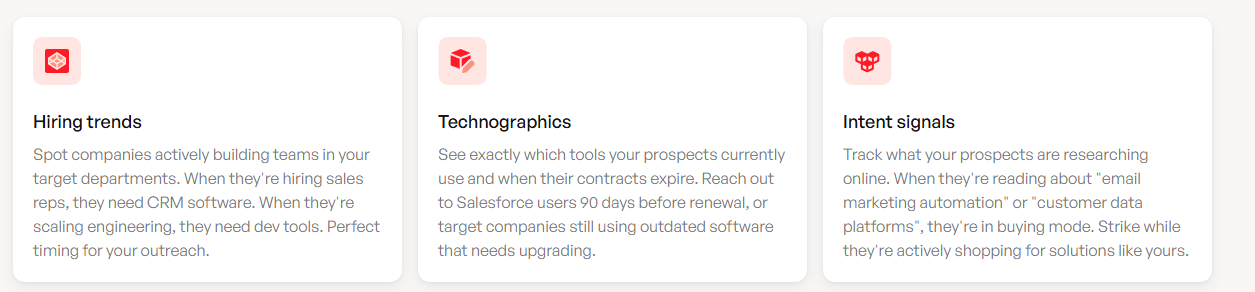
Different hires signal different purchase needs. Mapping hiring trends to buying signals by department lets you tailor messaging to the specific pain each team faces:
| They're Hiring... | They Likely Need... | Why |
|---|---|---|
| SDRs / BDRs | Prospecting tools, verified data | Reps need leads on day one |
| RevOps | CRM optimization, enrichment, workflow automation | Building the data stack |
| Demand Gen / Content | Marketing automation, ABM platforms | Scaling pipeline programs |
| VP Sales / CRO | Full-stack evaluation | 60% initiate tech review in Q1 |
| Customer Success | Onboarding tools, health scoring | Retention investment |
The leadership hire row deserves extra attention. 60% of new executives initiate a technology review within their first quarter. That's a 90-day window where everything is on the table - including the tools your competitors sold them last year.
Here's the thing: if your average deal size is under $10K, you probably don't need a $60K/yr intent platform to act on job-posting signals. A $250/mo stack with good CRM hygiene will outperform an enterprise suite with a long implementation cycle. We've seen it happen repeatedly.

Your hiring signal workflow is only as good as the data behind it. Prospeo's 7-day refresh cycle and 98% email accuracy mean your sequences land in inboxes - not bounce folders - while competitors are still cleaning stale lists.
Be the first seller after the trigger, not the third with a bounced email.
Timing Your Outreach
Speed matters, but "immediately" isn't always the right answer.
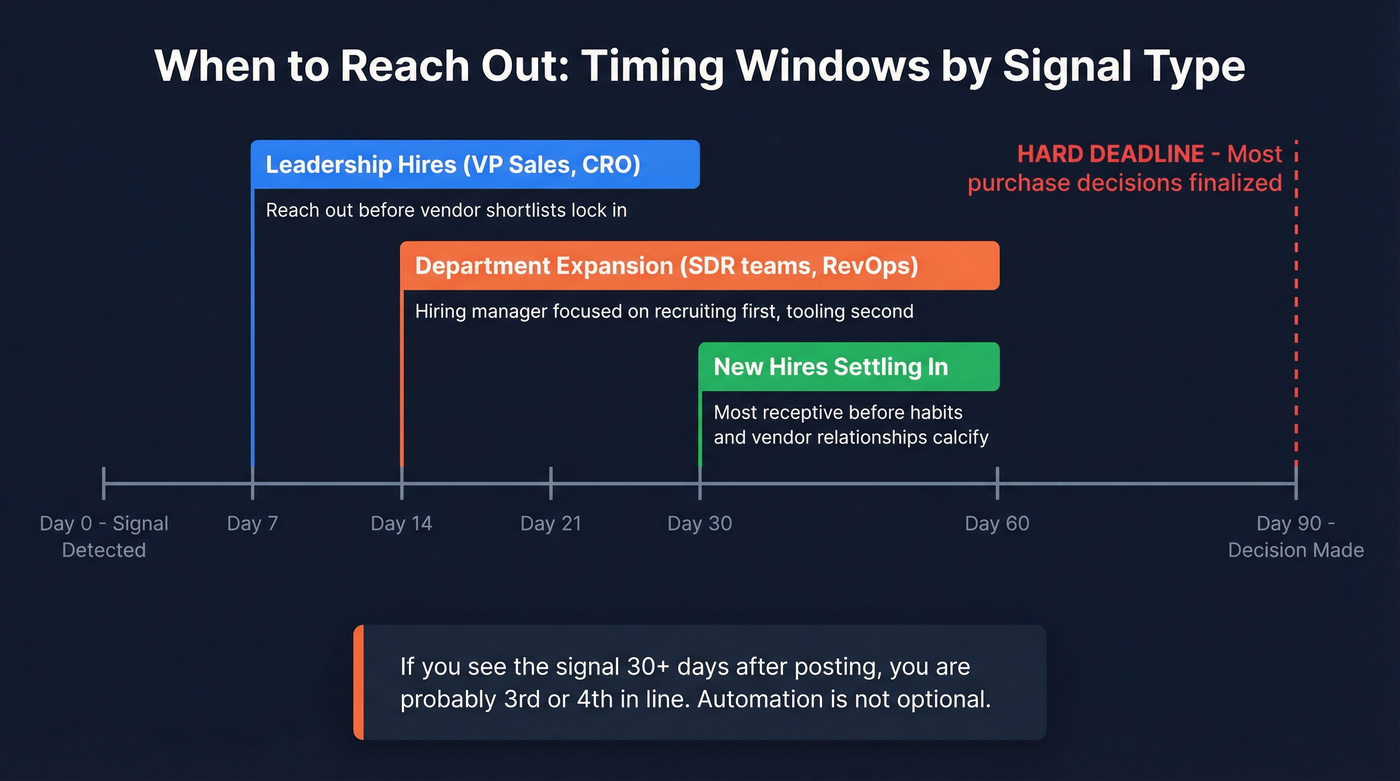
Leadership hires: 7-14 days after the announcement. Give them time to get oriented, but reach out before they've locked in vendor shortlists. Department expansion: 14-21 days - the hiring manager is focused on recruiting first, tooling second. New hires settling in: Most receptive in their first 30-60 days, before habits and vendor relationships calcify.
The hard deadline? Most purchasing decisions happen within the first 90 days of a trigger event.
Real talk: if you're seeing the signal 30 days after the job posted, you're probably third or fourth in line. Automation isn't optional here - it's the difference between being first and being forgotten.
The Step Most Teams Skip: Data Verification
Signal detection is the easy part. Every tool on the market can tell you that Acme Corp is hiring a RevOps Manager. The hard part is getting a verified email and direct dial for the hiring manager before your competitor does.
We've watched teams build beautiful Clay workflows, score signals perfectly, route leads in under two hours - then watch the sequence bounce 30% because the contact data is stale. One team at GreyScout cut their bounce rate from 38% to under 4% and saw pipeline jump 140% after switching to a verification-first enrichment approach with Prospeo's 5-step verification process, which includes catch-all handling, spam-trap removal, and honeypot filtering. That 98% email accuracy on a 7-day data refresh cycle - compared to the 6-week industry average - matters when you're racing to be first after a trigger event. Meritt saw similar results: bounce rate dropped from 35% to under 4%, and pipeline tripled from $100K to $300K/week.
Best Tools for Tracking Hiring Signals
You don't need a signal platform. You need a workflow. Here's what works at each price point:
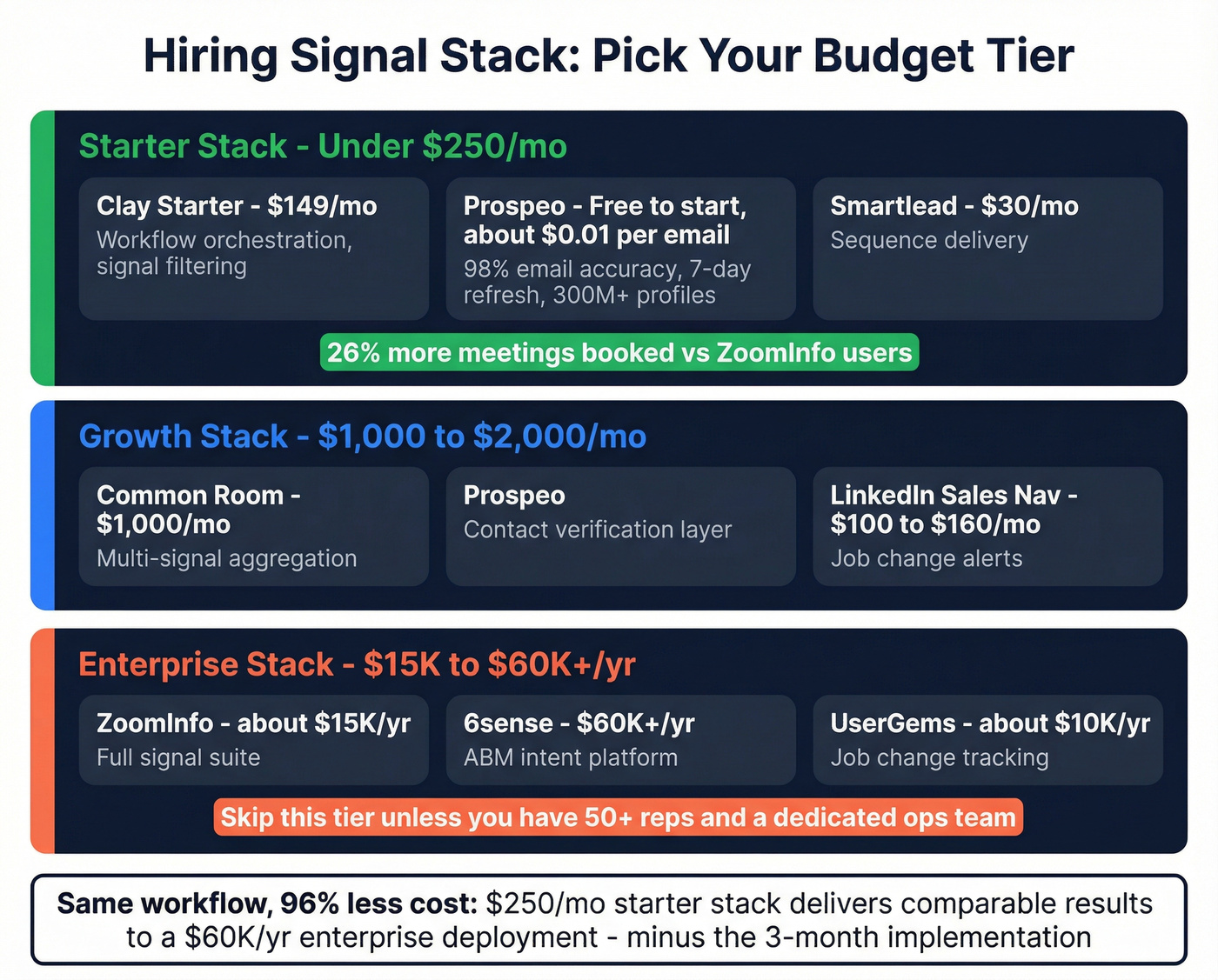
| Tool | Best For | Starting Price | CRM Sync |
|---|---|---|---|
| Clay | Workflow orchestration | Free (100 credits/mo) / $149/mo | Pro ($800/mo) only |
| Common Room | Multi-signal aggregation | $1,000/mo | Salesforce: Enterprise tier |
| LinkedIn Sales Nav | Job-change alerts | ~$100-160/mo | Limited |
| UserGems | Job-change tracking | ~$10K/yr | Yes |
| ZoomInfo | Enterprise signal suite | ~$15K/yr | Yes |
| 6sense | Enterprise intent | ~$60K+/yr | Yes |
Clay is the orchestration layer - ingest job postings, filter by ICP keywords, enrich contacts, score by Fit x Intent, and push to a sequencer. Watch the credit economics: failed lookups still consume credits, and top-ups carry roughly a 50% markup. Enterprise contracts average ~$30K/yr per Vendr data.
Prospeo handles the enrichment and verification step that makes or breaks the entire workflow. With 300M+ professional profiles, 143M+ verified emails, and 125M+ verified mobile numbers (30% pickup rate), it fills the gap between "we found the signal" and "we reached the right person." Native integrations with Clay, Smartlead, Instantly, HubSpot, and Salesforce mean leads flow directly into your sequencer without manual exports. At ~$0.01 per email, it's 90% cheaper than ZoomInfo - and teams using it book 26% more meetings than those on ZoomInfo and 35% more than Apollo users.
Common Room aggregates hiring signals alongside product usage and community activity. At $1,000/mo for the starter tier, it's a serious investment but the best option for combining hiring intent data with other signals in one view.
UserGems specializes in tracking when your existing contacts change jobs. Focused and effective for that specific use case.
Skip ZoomInfo (~$15K/yr) and 6sense ($60K+/yr) unless you're running a full ABM motion with a dedicated ops team. For most teams under 50 reps, they're overkill.
The complete stack: Clay Starter ($149) + Prospeo (free to start, ~$0.01/email when you scale) + Smartlead (~$30) = under $250/mo. That's the same workflow a 6sense deployment at $60K+/yr is trying to accomplish, minus the 3-month implementation.
Outreach Templates That Reference Hiring Activity
The job posting is your personalization engine. These templates turn hiring signals into conversations.
Template 1 - New Leadership Hire
Subject: {{FirstName}}, congrats on the {{Title}} role
Hey {{FirstName}}, saw you just joined {{Company}} as {{Title}}. Given your background at {{PreviousCompany}}, I'd guess {{priority from job description}} is high on the list. We help teams like yours {{one-sentence value prop}}. Worth a 15-minute call this week?
Pull the job description for stated priorities. If the posting's been removed, check the Wayback Machine.
Template 2 - Department Expansion
Subject: {{Company}} is scaling {{Department}} - quick question
{{FirstName}}, noticed {{Company}} is adding {{number}} roles to the {{Department}} team. When teams grow that fast, {{common pain point}} usually becomes the bottleneck. We've helped similar teams {{specific outcome}}. Open to a quick chat?
Reference the specific number of open roles - mentioning the exact count shows you did your homework.
Template 3 - First-Time Role Creation
Subject: Building {{Function}} from scratch at {{Company}}?
{{FirstName}}, saw {{Company}} is hiring its first {{Role}}. Building that function from zero usually means evaluating a new stack. We work with a lot of teams at exactly this stage. Happy to share what's working if that'd be useful.
"First" is the power word here. It signals you understand this isn't a backfill - it's a strategic investment.
Mistakes That Kill the Play
Treating backfills like buying signals. A company replacing a departing SDR isn't buying new tools. Filter for new role creation and expansion - that's where the intent lives. Watch for confidential searches and seasonal spikes that don't indicate real growth.
Acting on stale data. If the job posting was removed two weeks ago, the hiring manager has already filled the role and chosen their vendors. Automate signal detection so you're acting on fresh postings, not last month's scrapes.
Over-automating without QA. Blasting 500 signal-triggered emails without reviewing the list is how you email the wrong person at the wrong company with the wrong message. Start with a few hundred records, add a human checkpoint, then scale once the workflow is proven. One agency founder we spoke with described it as "the fastest way to burn a domain you'll ever find."
Ignoring Clay credit economics. Failed enrichment lookups still consume credits, and top-up credits cost roughly 50% more than your plan allocation. Budget for a 20-30% failure rate on lookups and plan your credit tier accordingly.
Forgetting to validate active postings. In a tightening market, many teams waste cycles on companies that posted roles months ago but quietly froze headcount. Validate that positions are still open before investing outreach effort - active hiring is the signal, not historical postings.
Teams acting on hiring signals need verified emails and direct dials within hours, not days. Prospeo returns 50+ data points per contact at $0.01/email with 92% match rates - so your A1 leads hit a rep's queue with real contact data attached.
Stop scoring signals perfectly then watching 30% of your sequence bounce.
FAQ
What's the difference between hiring signals and buying signals?
Hiring signals are a high-intent subset of buying signals. Buying signals include funding rounds, tech adoption, and earnings calls, while hiring signals specifically track job postings, role creation, and headcount changes. They're among the strongest triggers because a company can hide strategy from press releases but can't hide its job postings.
How do hiring signals improve lead generation?
Job postings pre-qualify accounts by revealing exactly what a company is investing in next. Instead of building lists from static firmographic data, you target companies actively hiring for the function your product supports - yielding ~18% response rates versus the 3.4% cold average.
What's a good affordable tool stack for acting on these signals?
Clay ($149/mo) for workflow orchestration, Prospeo (free tier with 75 emails/mo, ~$0.01/email at scale) for verified emails and direct dials at 98% accuracy, and Smartlead (~$30/mo) for sequencing. Total under $250/mo - comparable output to enterprise platforms costing $15K-$60K/yr.