7 Upsell Email Examples That Actually Drive Upgrades (With Copy You Can Steal)
Automated flows drive 20-30% of total email revenue and return $36-$42 for every $1 spent. Yet most upsell email examples floating around read like feature dumps nobody asked for. You don't need 70 screenshots. You need a 3-email sequence, the right triggers, and a clean list.
Below: all three, plus 7 real examples and 10 subject lines you can steal today.
7 Real Brands Nailing Upsell Emails
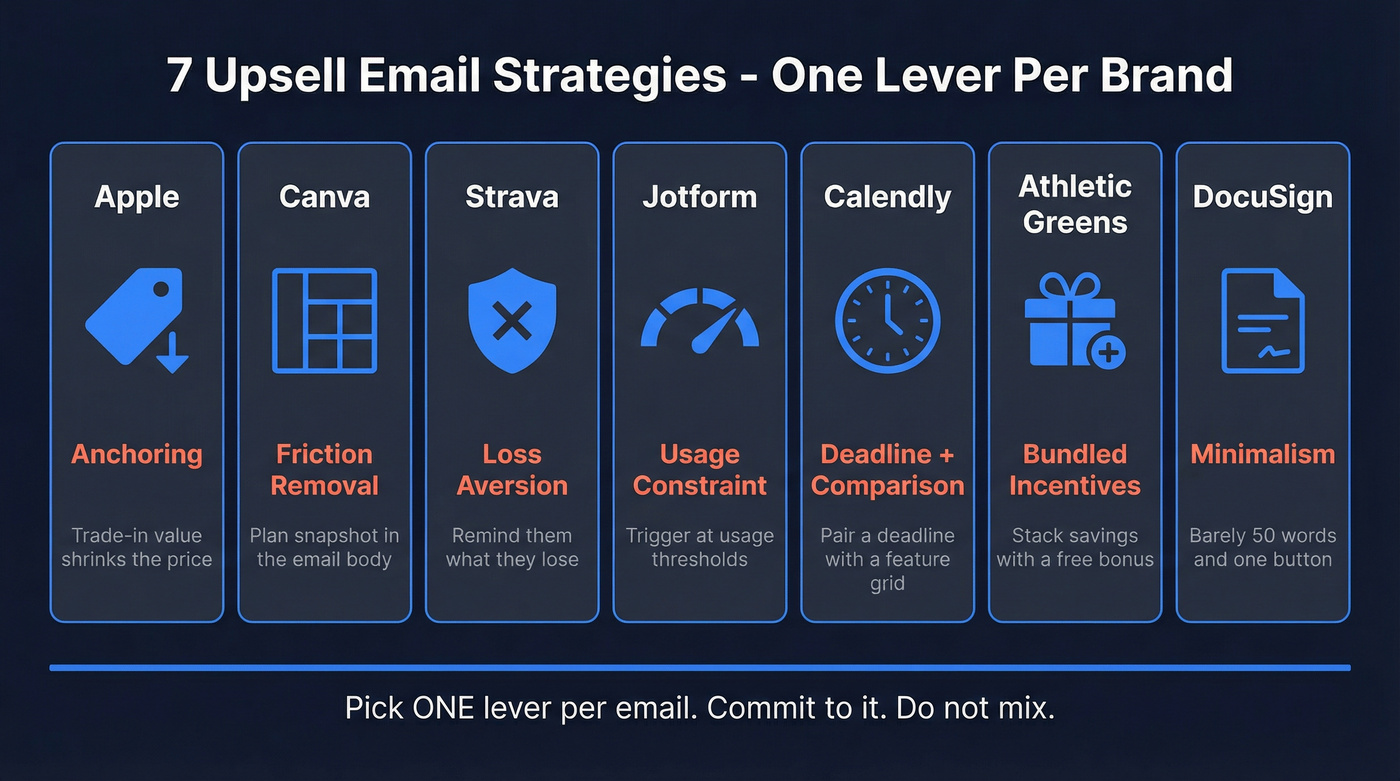
Every example follows the same skeleton: a behavioral trigger, a value recap, and a single CTA. The brands that nail upsells pick one psychological lever and commit to it.
Apple: Lead With What They Already Own
Apple's trade-in emails don't sell a new MacBook - they reframe the one you already have as currency. "Get up to $1,000 in credit" turns your old device into a down payment, following the Shu & Carlson "3 claims" rule: three short benefit statements, never more. The lesson is dead simple. Anchor the upgrade cost to something the customer already possesses, and the price tag shrinks in their mind before they ever see it.
Canva: Make the Upgrade Obvious
Forget long explanations. Canva's upsell email shows a snapshot of pricing plans right in the email body, so the upgrade decision feels simple and immediate. Reduce friction: put the plan comparison where the click happens.
Strava: Make Them Feel the Loss
Here's the psychological lever most brands ignore: loss aversion. When your Strava trial ends, the email doesn't pitch features - it reminds you of the training insights you're about to lose. You've been using premium for weeks, so the endowment effect is already locked in. Give temporary access, then frame the email around what disappears.
Jotform: Trigger Near the Usage Limit
Jotform's upgrade email fires when you're approaching a form view limit: if you don't upgrade, your service gets interrupted that month. The takeaway? Trigger upsells at usage thresholds, not arbitrary calendar dates.
Calendly: Trial-End Reminder + Clear Comparison
Trial-ending emails work best when they do two things: remind the user the decision point is here, and clearly show what changes on the paid plan. Urgency alone isn't enough. Pair a deadline with a concrete feature comparison so the reader can evaluate in 10 seconds flat.
Athletic Greens: Bundle Savings + a Freebie
AG1's subscription upsell stacks $20 monthly savings with a free welcome kit. Two incentives, one CTA. The savings frame the subscription as the smart financial choice, and the bonus makes the upgrade feel like a win rather than an expense.
DocuSign: Barely 50 Words, One CTA
DocuSign strips everything away. Barely 50 words explaining the upgrade. One button. No feature grid, no testimonials, no countdown timer. If your product is self-explanatory, follow their lead and cut the email to its skeleton.
Quick Reference
| Brand | Psychological Lever | Best For |
|---|---|---|
| Apple | Anchoring (trade-in value) | Physical product upgrades |
| Canva | Friction removal (plan snapshot) | Freemium SaaS |
| Strava | Loss aversion (trial expiry) | Subscription trials |
| Jotform | Usage constraint | Usage-based tiers |
| Calendly | Deadline + comparison | Trial conversions |
| Athletic Greens | Bundled incentives | D2C subscriptions |
| DocuSign | Minimalism | Self-explanatory products |
10 Subject Lines You Can Steal
Urgency: "Your premium access expires Friday" / "24 hours left to lock in your upgrade price"
Benefit-led: "Unlock unlimited exports - upgrade in one click" / "Get 3x the storage for $5/mo more"
Personalization: "{{First Name}}, you've used 80% of your plan" / "Your team hit a milestone - here's what's next"
Social proof: "12,000 teams upgraded this quarter" / "Join the creators who went Pro"
Curiosity: "You're one click from a feature you'll wish you had sooner" / "What happens after you upgrade? This."
When to Send - Trigger Timing
| Trigger | Timing | Example |
|---|---|---|
| Post-purchase | 0-2 days after | Accessory upsell |
| Trial ending | 7, 3, 1 days before | Plan conversion |
| Usage limit | Near capacity | Tier upgrade |
| Milestone | On achievement | Anniversary offer |
| Seasonal | Aligned to calendar | Holiday bundle |
Event-based triggers outperform fixed-day cadences every time. Send when behavior signals readiness, not when your marketing calendar says so. For renewal-specific sequences, a 30/7/1-day reminder cadence is a proven structure that balances persistence with patience.

A perfectly crafted upsell sequence means nothing if it bounces. Prospeo's 5-step email verification delivers 98% accuracy - so every trigger-based upgrade email lands in a real inbox, not a spam trap.
Clean your list before you send that upsell sequence.
Build a 3-Email Upsell Funnel
Step zero - verify your segment. Before you send a single upgrade email, run your list through email verification. We use Prospeo for this - 98% email accuracy means you're not burning sender reputation on dead addresses. Use dynamic segments that auto-update based on behavior so you're never pitching someone who churned six months ago. Clean data first, clever copy second.
Email 1 (Day 0 - the trigger fires). Subject: "You've unlocked something new." Recap the value they've already gotten. One benefit statement about the upgrade. Single CTA. Keep it short.
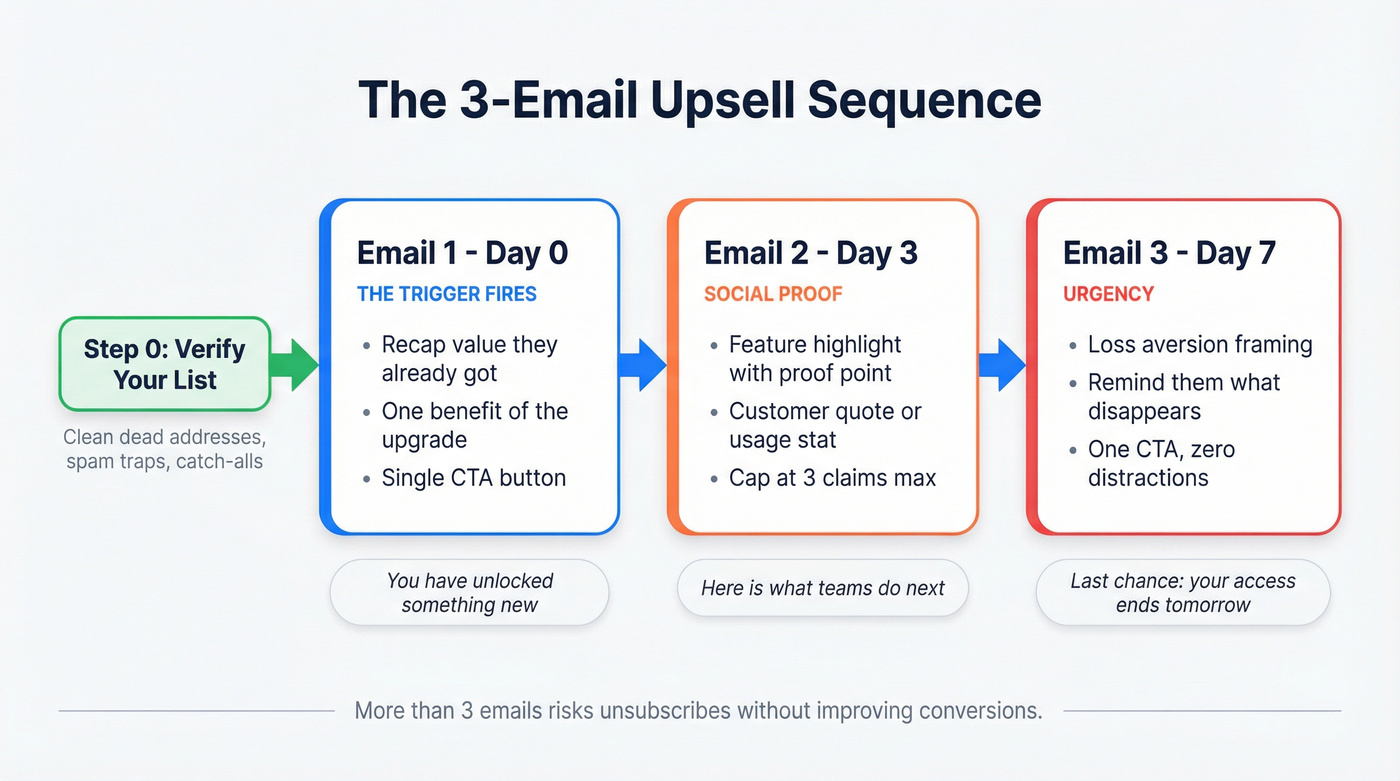
Email 2 (Day 3 - social proof). Subject: "Here's what {{Company}} teams do next." Feature highlight with a customer proof point or usage stat. Cap at three claims - more than three triggers skepticism, per the Shu & Carlson research on persuasion.
Email 3 (Day 7 - urgency). Subject: "Last chance: your {{feature}} access ends tomorrow." Loss aversion framing. Remind them what disappears. One CTA, no distractions.
2026 Benchmarks Worth Knowing
Here's what good looks like, per Klaviyo's 183,000+ brand dataset:
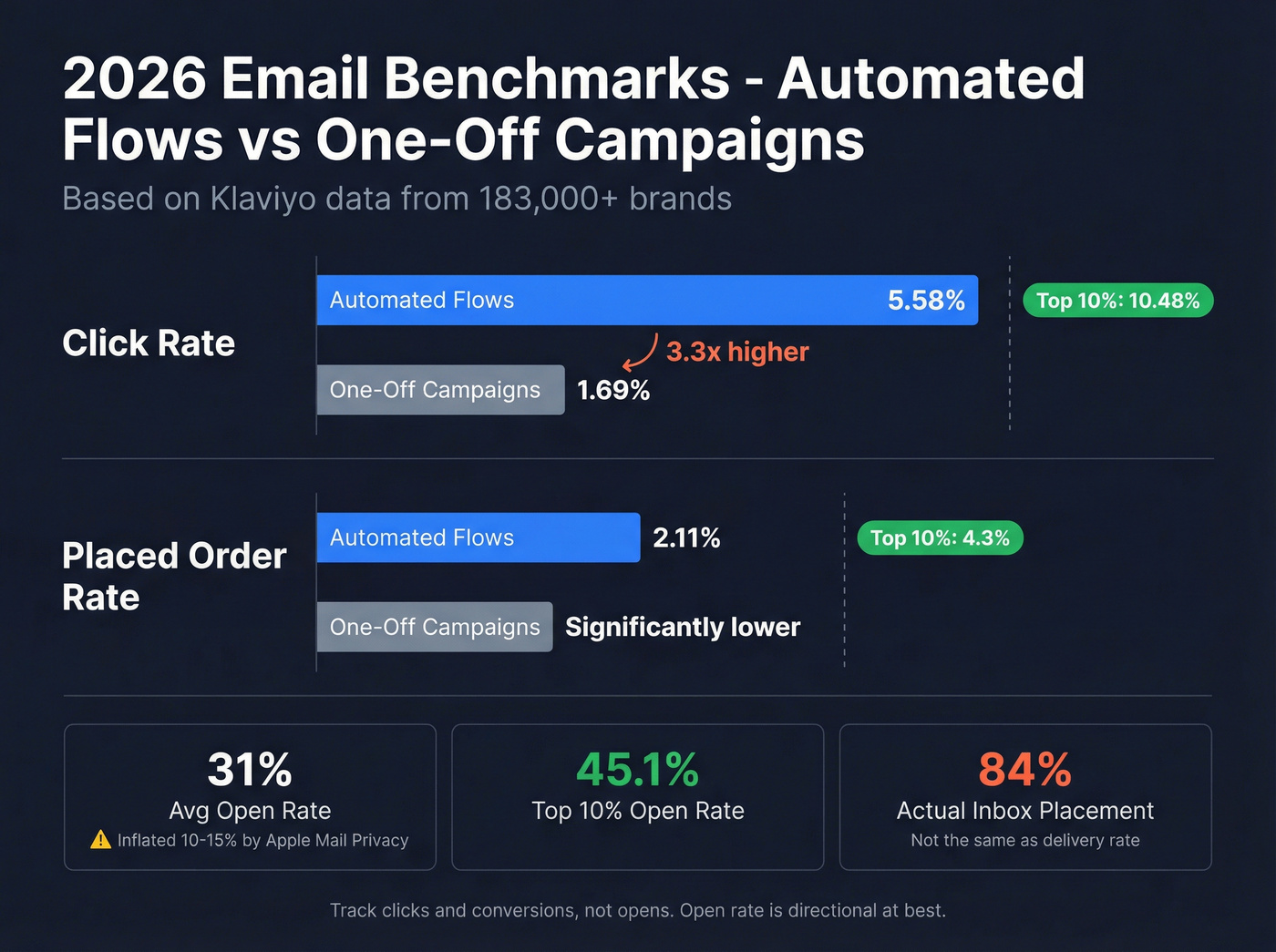
Automated flows average a 5.58% click rate (top 10% hit 10.48%) and a 2.11% placed order rate (top 10%: 4.3%). One-off campaigns? Just 1.69% click rate. Triggered sequences aren't just better - they're a different category entirely.
Open rates average 31% across campaigns, with the top 10% hitting 45.1%. But Apple Mail Privacy Protection inflates those numbers by 10-15%, so track clicks and conversions instead. Open rate is directional at best. If you want a clean way to interpret performance, use an open rate vs click rate framework.
Let's be honest: if your upsell flow isn't automated yet, you're leaving the highest-converting email channel on the table. Moving from batch campaigns to triggered sequences is one of the fastest ways to lift upgrade revenue, and the data backs that up overwhelmingly.
Mistakes That Kill Conversions
Blasting your full list. Upsell emails go to behavior-triggered segments. Same pitch to free users and power users = wasted sends and annoyed customers.
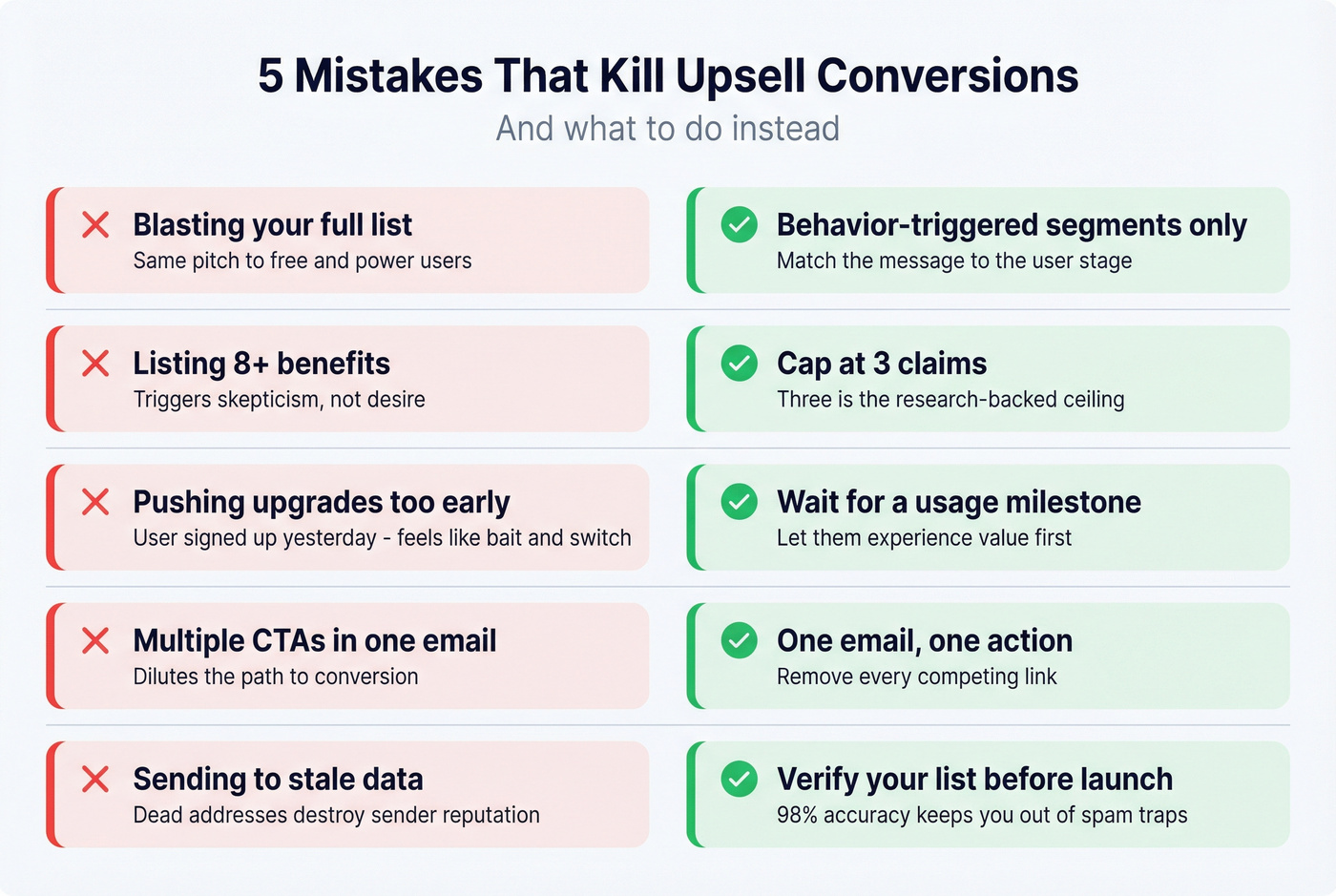
Listing 8+ benefits. Three claims is the ceiling. Beyond that, you trigger skepticism instead of desire.
Pushing upgrades before value. User signed up yesterday? An upsell feels like a bait-and-switch. Wait for a usage milestone.
Multiple CTAs. One email, one action. The moment you add "also check out our webinar," you've diluted the path to conversion.
Sending to stale data. Look - a 98% delivery rate doesn't mean 98% inbox placement. Actual inbox placement runs closer to 84%, which means roughly 15% of your emails are never seen. We've watched teams pour hours into perfect upsell copy only to discover a quarter of their list was dead addresses and spam trap. Run your list through verification before launching. Prospeo's 5-step process with catch-all handling, spam-trap removal, and honeypot filtering catches the addresses that silently destroy your sender reputation. Your upsell sequence is only as good as the list it's sent to - so follow an email deliverability checklist and keep your CRM hygiene tight.

Behavioral triggers need behavioral data. Prospeo enriches your CRM with 50+ data points per contact - usage signals, job changes, company growth - so your upsell emails fire at exactly the right moment.
Stop guessing who's ready to upgrade. Let the data tell you.
FAQ
What's the difference between upsell and cross-sell emails?
An upsell email promotes a higher-tier version of what the customer already uses - free to premium, basic to pro. A cross-sell promotes a complementary product, like recommending a case after a phone purchase. Different intent, different triggers, different timing.
How many emails should an upsell sequence include?
Three is the sweet spot: a value recap on Day 0, a social proof nudge on Day 3, and a final urgency email on Day 7. More than three risks unsubscribes without meaningfully improving conversions. Keep each email focused on a single message.
Why do triggered upsell emails outperform batch campaigns?
Triggered emails arrive when behavior signals readiness - a usage threshold hit, a trial expiring - not when your calendar says so. Klaviyo data shows automated flows hit a 5.58% click rate versus 1.69% for one-off campaigns. That gap is massive, and it widens further when you're sending to a verified list with the right segmentation in place.
Should I skip upsell emails for certain segments?
Yes. If a user hasn't logged in for 30+ days, an upsell isn't the right play - a re-engagement sequence is. Similarly, customers who just filed a support ticket are in problem-solving mode, not buying mode. Save the upgrade pitch for users who are actively getting value from your product.