

How to Build a Cold Email Lead List That Books Meetings
You send 500 cold emails on Monday. By Wednesday, 47 have bounced, your ESP flags your domain, and your deliverability tanks for the next two weeks. That's not a hypothetical - it's what happens when list building is an afterthought. The list is the single biggest variable in cold email success, and most teams get it wrong before they write a single subject line.
The Short Version
- Define your ICP with firmographics + intent signals - not just job titles
- Source leads from a verified database, never purchased lists
- Verify every email (real accuracy is 60-70%, not the 99% vendors claim)
- Segment by pain point, not just industry
2026 Benchmarks: What "Good" Looks Like
Before building anything, know what you're aiming for. Instantly analyzed billions of cold email interactions across thousands of active workspaces:
- Average reply rate: 3.43%
- Top quartile: 5.5%+
- Top 10%: 10.7%+
58% of all replies come from Step 1 - the first-touch email. Follow-ups matter, but your opener does the heavy lifting. The sweet spot for sequence length is 4-7 touchpoints. Under four, you're quitting early. Beyond seven, diminishing returns kick in hard.
Wednesday consistently pulls the highest reply rates, with Tuesday close behind. Best-performing campaigns use emails under 80 words with weekly A/B testing. Shorter emails win - keep that in mind when we get to segmentation.
Define Your ICP (and Actually Use It)
"VP of Sales at SaaS companies" isn't an ICP. It's a demographic filter that returns 200,000 results and tells you nothing about who's ready to buy. A real ICP combines four layers:
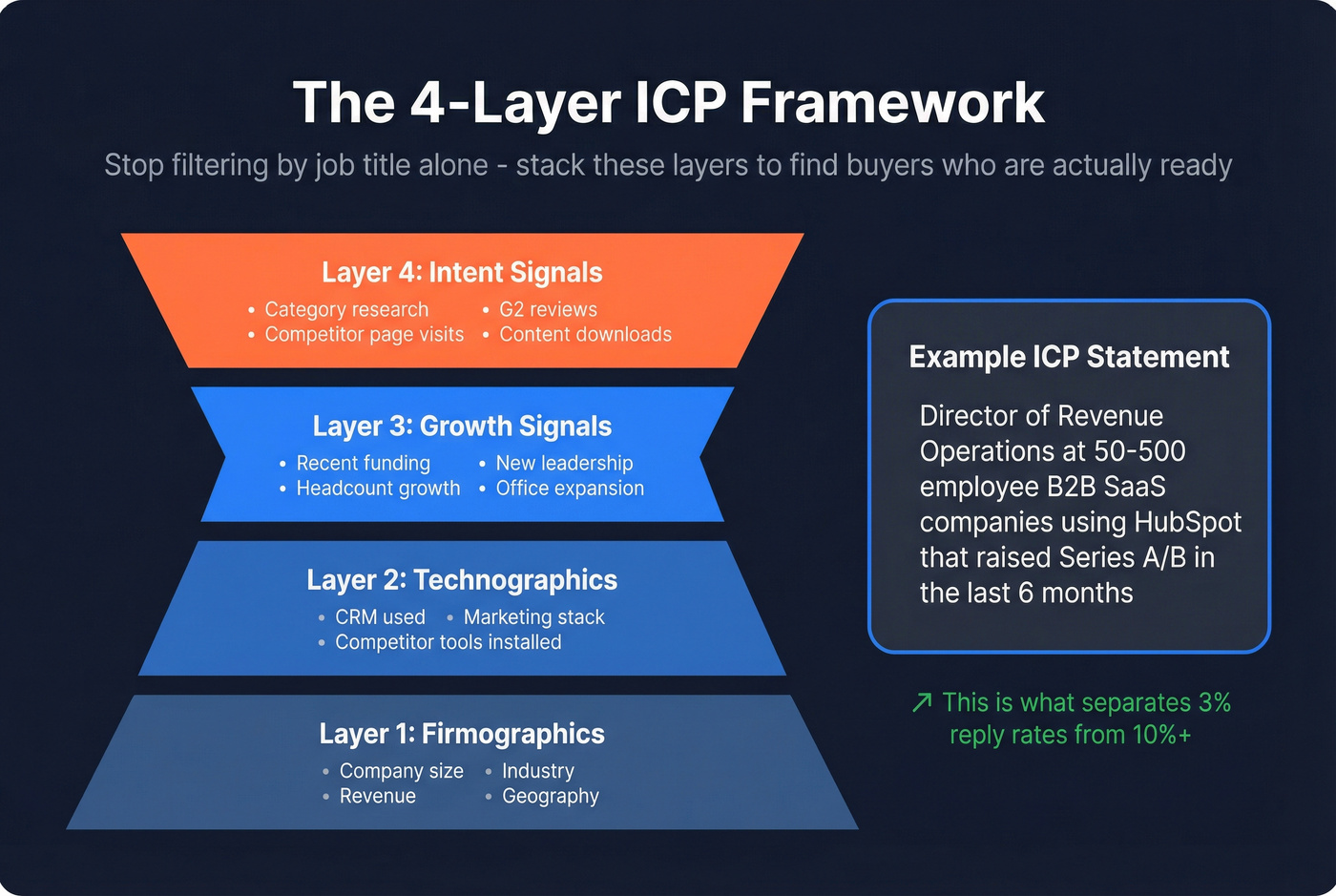
Firmographics - company size, revenue, industry, geography. Table stakes. Everyone filters on these.
Technographics - what tools they use. Selling a Salesforce integration? Filter for Salesforce shops. Replacing a competitor? Filter for their tech stack.
Growth signals - recent funding, headcount growth, new offices, leadership changes. A company that just raised a Series B and hired three SDRs is a fundamentally different prospect than one that's been flat for two years.
Intent signals - are they actively researching your category? Visiting competitor pages? Reading G2 reviews? This is the layer most teams skip, and it's the one that separates a 3% reply rate from a 10% reply rate.
Your ICP template should look like this: [Role] at [Company size] companies using [Tech stack] that recently [Trigger event]. Here's a concrete example: "Director of Revenue Operations at 50-500 employee B2B SaaS companies using HubSpot that raised Series A/B in the last 6 months."
How to Build a Prospect List for Cold Email
B2B Data Providers
Most major data providers rely on a single proprietary database, which tends to cap email accuracy around 80-85%. B2B data decays at roughly 22-30% per year - the average professional changes jobs every 2.7 years, and companies restructure constantly. The provider you choose sets your accuracy ceiling before you even start verifying.
| Provider | Contacts | Email Accuracy | Pricing | Key Strength |
|---|---|---|---|---|
| Prospeo | 300M+ | 98% | ~$0.01/lead | Pre-verified, 7-day refresh |
| ZoomInfo | 300M+ | ~85% | $15-40K/yr | Intent data, US depth |
| Apollo | 275M+ | ~80% | $59-149/user/mo | All-in-one outreach |
| Clearbit | 100M+ | ~85% | Custom (HubSpot) | HubSpot-native enrichment |
Apollo is the obvious pick if you want data + outreach in one tool without ZoomInfo prices. But 80% email accuracy means you're still verifying separately. ZoomInfo makes sense for large orgs that need intent data baked into a full GTM platform - but a 10-seat contract often lands around $40K+/year. That's real money for most teams.

Professional Network Sourcing
Sales Navigator remains the default prospecting tool for most outbound teams, but it comes with hard limits: 2,500 results per search query, 5,000 saved leads total, and no native CSV export. CRM sync is gated behind Advanced Plus at roughly $1,600/seat/year.
To get data out, you need an export tool: Evaboot ($29-99/mo), Kaspr (free-$99/mo), GiveMeLeads ($49-99/mo), or Surfe ($29-79/mo). The workaround for the 2,500 cap is splitting searches into narrower slices by location, company size, or seniority. Worth noting: exporting via third-party extensions operates in a gray area with platform ToS, so use small batches and human-speed pacing to minimize risk.
Advanced Tactic: Connect with competitor founders or CEOs, then use the "Connections of" filter to find people in their network. These contacts are pre-qualified - they already use a product in your category. It's one of the highest-signal sourcing methods nobody talks about.
Intent-Based Sourcing
Most third-party intent data is account-level - "someone at Company X researched your category" - useful but imprecise. Contact-level intent is the holy grail, and few providers deliver it reliably.
The major players include G2 Buyer Intent, 6sense, and Snitcher for website visitor identification. Prospeo layers Bombora-powered intent data across 15,000 topics directly onto contact records, so you can filter by both buyer intent and job role in a single search without needing a separate intent tool.

Most teams source leads at 80% accuracy, then verify with tools that measure 60-70%. Prospeo skips that broken workflow entirely - 300M+ contacts pre-verified through 5-step verification, refreshed every 7 days, with 30+ filters for intent, technographics, and growth signals built in.
Start with 98% accuracy instead of hoping your verifier catches the rest.
Find and Verify Every Email
The Accuracy Gap
Every verification tool claims 96-99% accuracy. The measured reality tells a different story.
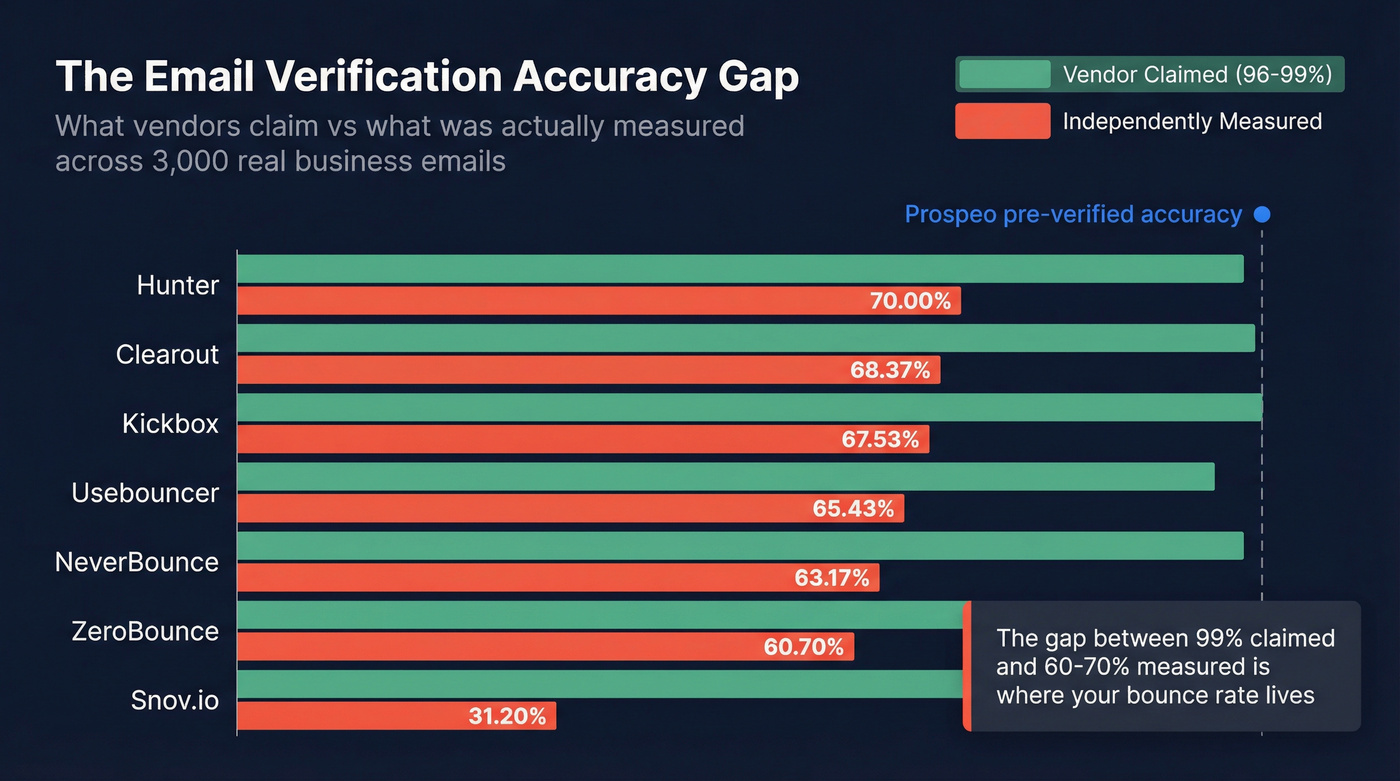
Hunter ran a benchmark across 15 email verifiers using 3,000 real business emails tested through Clay integrations:
| Verifier | Measured Accuracy |
|---|---|
| Hunter | 70.00% |
| Clearout | 68.37% |
| Kickbox | 67.53% |
| Usebouncer | 65.43% |
| NeverBounce | 63.17% |
| ZeroBounce | 60.70% |
| Snov.io | 31.20% |
Hunter acknowledges their dataset may have given them an edge - credit to them for the transparency. But the gap between "99% claimed" and "60-70% measured" is enormous. In our experience, this accuracy gap is the single biggest source of wasted budget in cold outreach, and most teams don't even realize it's happening.
This is why sourcing from a pre-verified database beats the "source then verify" workflow. Prospeo's 5-step verification - including catch-all handling, spam-trap removal, and honeypot filtering - runs on proprietary infrastructure rather than third-party email providers. If your source data is ~80% accurate and your standalone verifier's measured accuracy is ~60-70%, you still end up with meaningful residual risk. Starting at 98% accuracy eliminates that entire layer.
Verification Pricing
If you're running a separate verification step, here's what it costs:
| Tool | Cost per 1K | Free Credits | Claimed | Measured |
|---|---|---|---|---|
| Bouncer | $7 | 1,000 | 99.5% | 65.43% |
| NeverBounce | $8 | 1,000 | 99.9% | 63.17% |
| Xverify | $9.20 | None | 98% | Not tested |
| ZeroBounce | $15 (2K min) | 100 | 96-98% | 60.70% |
You're paying $7-15 per thousand emails for a tool that catches roughly two-thirds of bad addresses. Better than nothing, but not the safety net most teams think they're buying.
Handling Catch-All Domains
Catch-all domains accept all emails at the server level, so verification tools can't confirm whether a specific address is real. This is one of the biggest sources of bounces after verification.
Send catch-all addresses in small batches of 50-100. Monitor bounce rates per domain, not just per campaign. Remove any domain that bounces above 5%, and track catch-all performance separately from verified sends. We've seen "verified" lists still bounce at 10%+ because nobody accounted for catch-alls - it's a frustratingly common blind spot.
Segment for Personalization
Here's the thing: if your deal sizes sit below five figures, you probably don't need ZoomInfo-level data. What you do need is ruthless segmentation. A 500-lead list with tight segments will outperform a 5,000-lead list with generic messaging every single time. The under-80-word email benchmark means your personalization needs to be precise, not verbose.
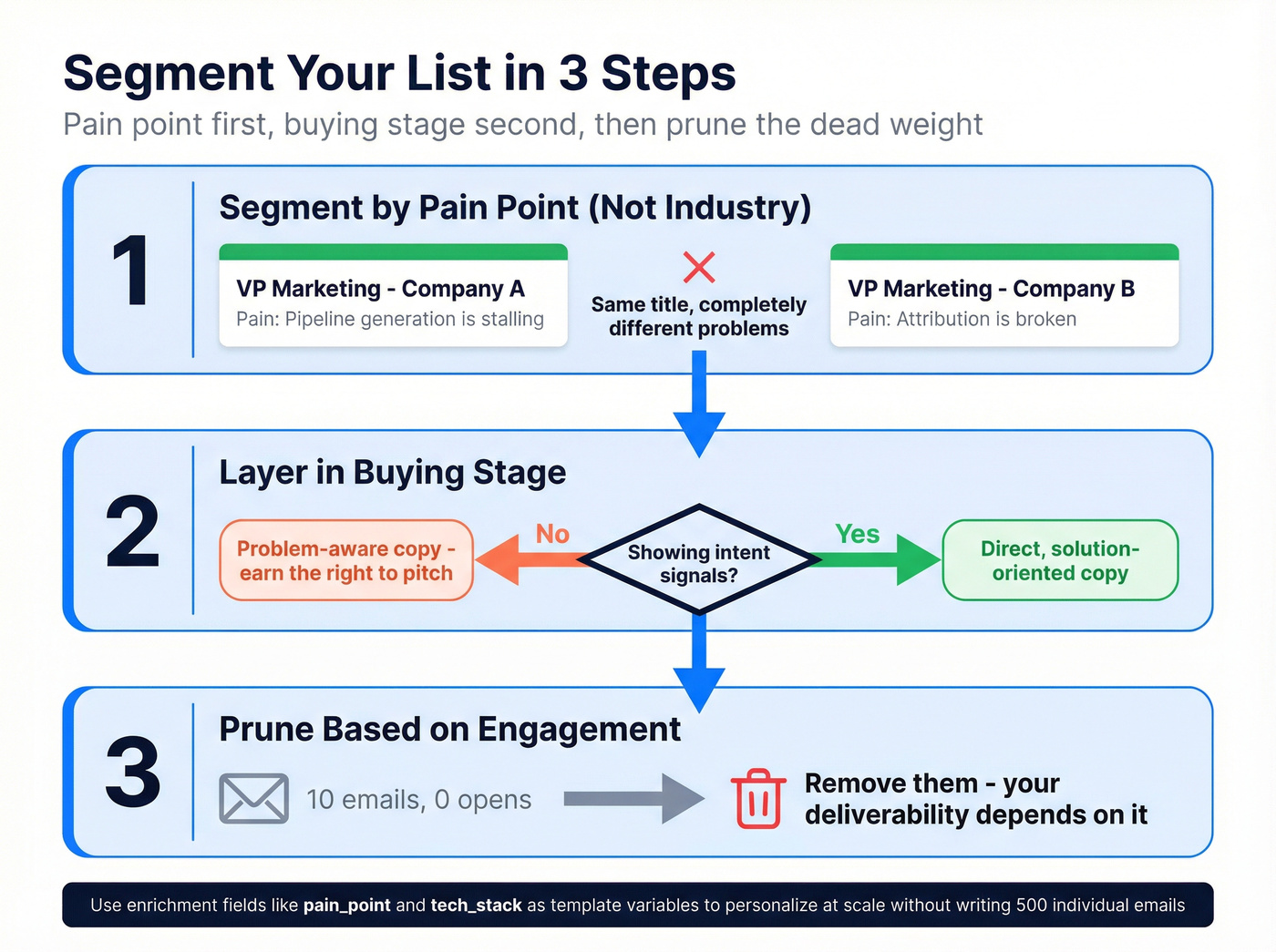
Segment by pain point first, not industry or title. Two VPs of Marketing at similar-sized SaaS companies have completely different problems - one's struggling with pipeline, the other with attribution. Your email should speak to the specific pain, not the demographic.
Then layer in buying stage. Contacts showing intent signals get direct, solution-oriented copy. Completely cold contacts get problem-aware copy that earns the right to pitch. Use enrichment data as template variables - fields like {{pain_point}} or {{tech_stack}} let you personalize at scale without writing 500 individual emails.
Finally, prune based on engagement. If someone hasn't opened your last 10 emails, they're not going to open the 11th. Remove them. Your deliverability depends on it.
The Full Cost of Building a Lead List
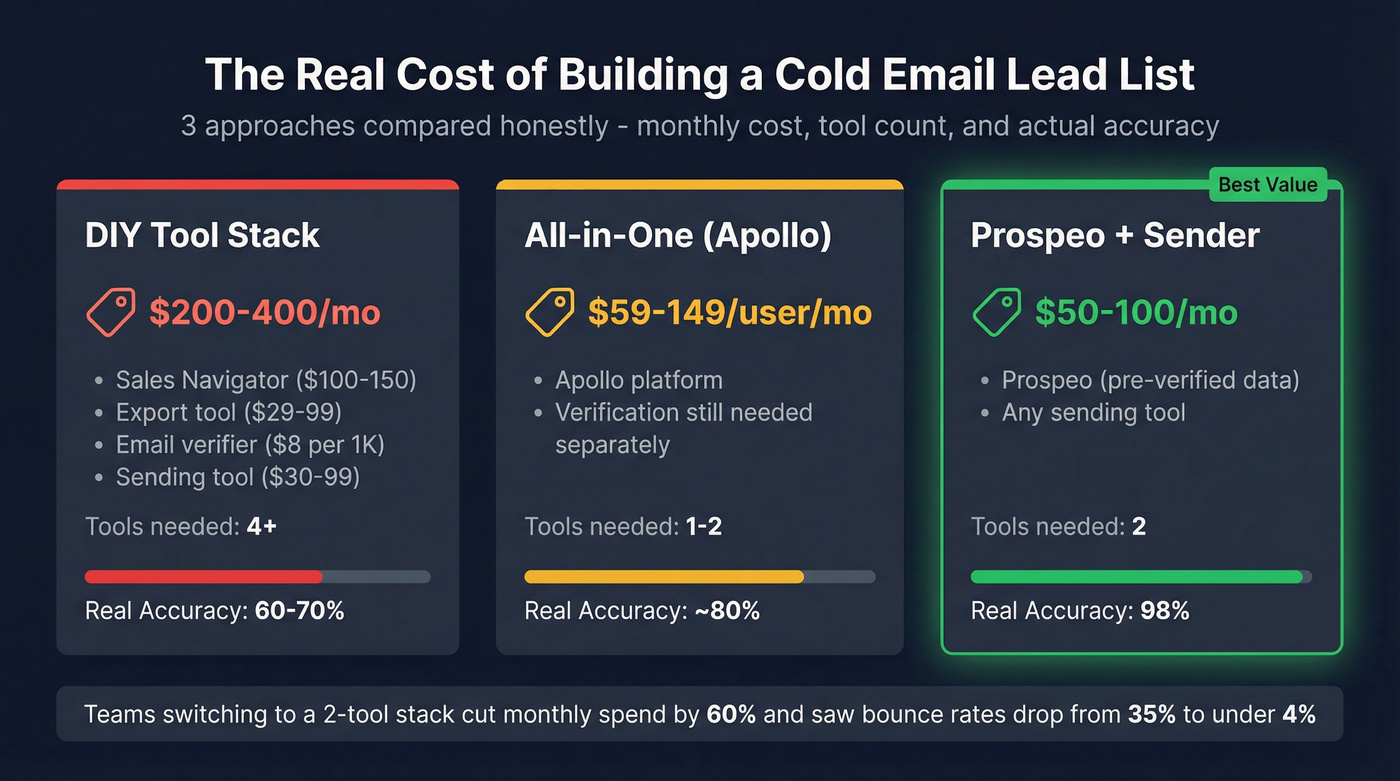
Let's break down three approaches honestly:
| Approach | Monthly Cost | Tools | Real Accuracy |
|---|---|---|---|
| DIY Stack | $200-400/mo | 4+ tools | ~60-70% |
| All-in-one (Apollo) | $59-149/user/mo | 1-2 tools | ~80% |
| Prospeo + sender | ~$50-100/mo | 2 tools | 98% |
The DIY stack tax is brutal. Sales Navigator ($99.99-$149.99/mo) + export tool ($29-99/mo) + verification ($8/1K emails) + sending tool ($30-99/mo) = $200-400/month for a workflow that still caps at ~60-70% verification accuracy. You're paying more for worse results.
We've seen teams cut their monthly tooling spend by 60% just by consolidating to two tools. Meritt switched and saw bounce rates drop from 35% to under 4%, with connect rates tripling to 20-25%. Stack Optimize built an agency from $0 to $1M ARR with client deliverability at 94%+, bounce rates under 3%, and zero domain flags across all clients.
Two tools. $50-100/month. 98% accuracy. Stop overcomplicating this.
Maintain Your Outreach Lists
Building the list is half the job. Maintaining it is the half most teams ignore until deliverability craters.
B2B data decays at 22-30% per year, which means roughly a quarter of your list goes stale every twelve months. Re-verify quarterly at minimum. Before you even send, make sure your infrastructure is solid: SPF, DKIM, and DMARC records are non-negotiable. Without proper authentication, even a perfectly clean list won't save your deliverability. Warm up new domains for at least two weeks before scaling volume.
Build these habits into your workflow:
- Re-verify your entire active list every quarter
- Remove role-based addresses (info@, support@, sales@) - they tank engagement
- Prune contacts with 10+ unopened emails
- Track bounce rates per data source so you know which pipeline feeds you bad data
- Flag job-change signals and update records before your next campaign
Skip the quarterly re-verification if you're pulling fresh leads from a database with a weekly refresh cycle - the source data is already current. But leads sitting in your CRM for months? Those need the check.
You just read that the best cold email lists combine firmographics, technographics, growth signals, and intent data. Prospeo layers all four into a single search - Bombora intent across 15,000 topics, funding and headcount filters, tech stack detection - at $0.01 per lead. No ZoomInfo contract required.
Filter by ICP, intent, and trigger events in one search - not four tools.
FAQ
Is cold emailing legal?
Yes, in most jurisdictions with proper compliance. CAN-SPAM (US) requires opt-out links and real sender info; GDPR (EU/UK) requires legitimate interest and easy unsubscribe. Germany and France enforce stricter norms - check local rules for those markets. Never email purchased lists; they contain spam traps that destroy domain reputation.
How many leads should I start with?
Start with 200-500 highly targeted leads, not 5,000 generic ones. A 500-lead list at 5% reply rate generates 25 conversations. A 5,000-lead blast at 1% gets 50 replies but burns your domain - and recovery takes weeks. Tight targeting beats volume every time.
How often should I refresh my list?
Re-verify quarterly at minimum. B2B contact data decays 22-30% annually, meaning 5-7% goes stale each quarter. Databases with a 7-day refresh cycle keep source data current automatically, but leads sitting in your CRM for months still need periodic checks.
Should I buy a pre-built lead list?
No. Pre-built lists contain outdated contacts, spam traps, and shared data that dozens of companies are already emailing. The overlap alone tanks reply rates. Build your own list using a verified database - it takes 30 minutes with the right tool and produces dramatically better results.
What's the fastest way to start?
Define your ICP with at least two layers beyond basic firmographics, pull 200-500 leads from a pre-verified database, segment by pain point, and send your first sequence within a day. Teams that ship a tight list in an afternoon outperform those who overthink it for weeks.