Intent Keywords: What They Are & How to Use Them (2026)
Your content team just published 30 blog posts targeting informational keywords. Traffic is up 40%. Pipeline is flat. The problem isn't your writing or your SEO tool - it's that you're targeting the wrong intent keywords. And until you fix that, more content just means more expensive traffic that doesn't convert.
What You Need (Quick Version)
Intent keywords carry two distinct meanings, and conflating them is the fastest way to waste a quarter's worth of content budget. In SEO, they describe the reason behind a search query - is someone learning, comparing, or buying? In B2B sales, they're the topic signals that reveal which accounts are actively researching your category right now.
The four-type taxonomy (informational, navigational, commercial, transactional) is table stakes. What actually matters is operationalizing intent to drive pipeline. This guide covers both sides - SEO keyword intent and B2B buyer intent signals - with real conversion benchmarks, an AI Overviews survival plan, and a framework for mapping intent to revenue.
If you're running a B2B team, skip to the B2B section. Account-level intent topics are a different game entirely. And if you only have five minutes, read the high-intent vs. low-intent section and the operationalization framework - those two will change how you plan your next content sprint.
What Are Intent Keywords?
The term gets used in two completely different contexts, and most articles only cover one. Let's untangle them.
SEO keyword intent is the reason a person types a query into a search engine. When someone searches "how to set up email authentication," they want to learn. When they search "buy DMARC monitoring tool," they want to purchase. The intent behind the query determines what kind of content Google serves - and what kind of content you should create.
B2B buyer intent is a different animal entirely. Platforms like Bombora and Demandbase track which companies are consuming content around specific topics - reading whitepapers, visiting competitor pages, engaging with review sites. These "intent data keywords" aren't search queries at all. They're topic clusters that signal a company is in-market for a solution. When an account suddenly spikes on topics like "sales engagement platform" and "outbound automation," that's a buying signal your sales team should act on today, not next week.
The overlap matters. A prospect researching "best CRM for mid-market" generates both a search query (SEO intent) and a topic signal (buyer intent). The smartest B2B teams use both layers - SEO intent to capture the searcher, buyer intent data to identify the accounts that never searched your brand at all.
The 4 Types of Keyword Intent
Every search query falls into one of four intent buckets - or sometimes straddles two. Here's the taxonomy with the SERP signals that confirm each type.
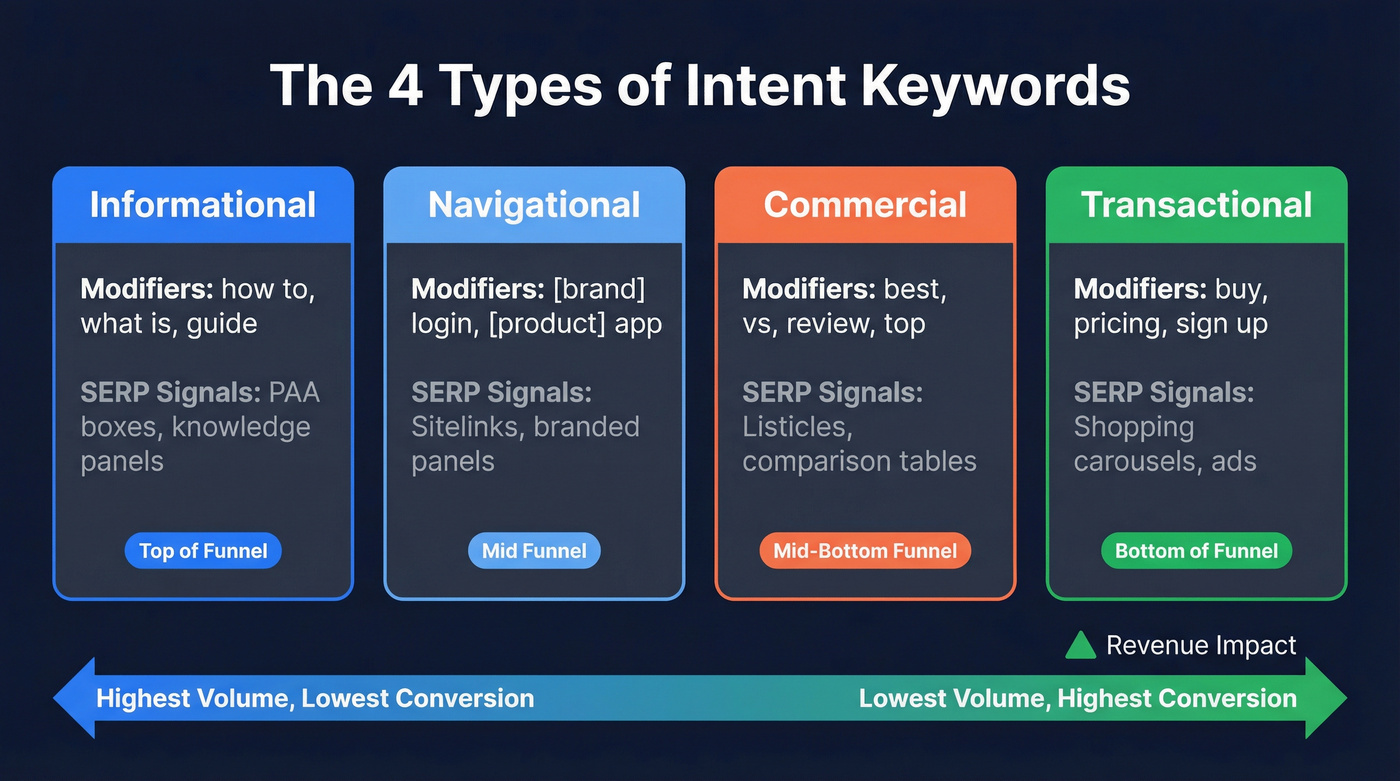
| Intent Type | Modifier Examples | SERP Signals | Funnel Stage |
|---|---|---|---|
| Informational | "how to," "what is," "guide" | PAA boxes, knowledge panels | Top |
| Navigational | "[brand] login," "[product] app" | Sitelinks, knowledge panels | Mid |
| Commercial | "best," "vs," "review," "top" | Listicles, comparison tables | Mid-Bottom |
| Transactional | "buy," "pricing," "sign up" | Shopping carousels, ads | Bottom |
And here's the quick-reference version for when you're staring at a SERP and need to classify on the fly:
| SERP Feature | Primary Intent |
|---|---|
| Shopping carousel | Transactional |
| PAA boxes | Informational |
| Knowledge panel | Navigational |
| Local pack | Transactional/Local |
| Featured snippet | Informational/Commercial |
Informational Intent
These are the "teach me" queries. Someone searching "what is email deliverability" or "how to improve cold email open rates" isn't ready to buy anything. They're building understanding. The SERP confirms it - you'll see PAA boxes, long-form articles, and knowledge panels dominating the results.
Informational keywords drive the most volume and the least direct revenue. They're the foundation of topical authority, but they're also where most content teams over-invest relative to pipeline impact.
Navigational Intent
Navigational queries are brand-specific: "HubSpot login," "Salesforce pricing page," "Semrush dashboard." The searcher knows exactly where they want to go - they're just using Google as a shortcut. SERPs show sitelinks and branded knowledge panels. These keywords matter for brand protection (you don't want competitors bidding on your brand terms), but they're rarely a content strategy priority.
Commercial Intent
This is where the money starts. "Best email verification tools," "ZoomInfo vs Apollo," "top CRM for startups" - these queries signal someone actively evaluating options. The SERP is full of listicles, comparison tables, and review snippets.
We've seen commercial intent content outperform informational content on pipeline contribution by 5-8x, even with a fraction of the traffic. The conversion math just works differently when someone's already comparing solutions.
Transactional Intent
"Buy CRM software," "HubSpot pricing," "sign up for Slack," "book a demo." These searchers have their wallet out. SERPs show shopping carousels, prominent ads, and product pages. Transactional keywords have the lowest volume but the highest conversion rates - and they're worth paying for in PPC.
The modifier cheat sheet is straightforward. "How to" and "what is" signal informational. "Best" and "vs" signal commercial. "Buy," "pricing," "discount," and "near me" signal transactional. When you're classifying at scale, these n-grams do 80% of the work.
High-Intent vs. Low-Intent
Not all intent is created equal. This distinction should drive your resource allocation more than any other factor.
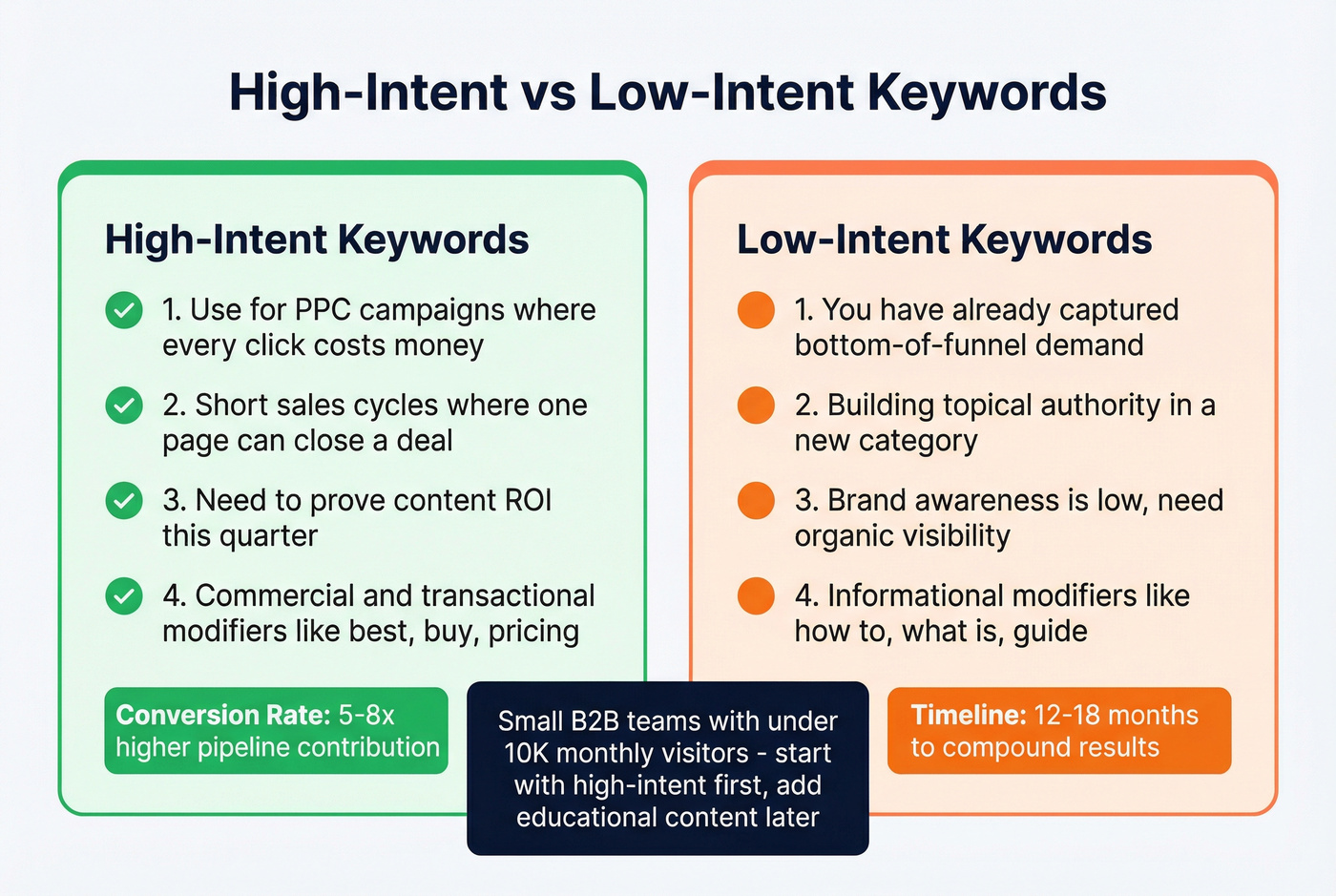
Target high-intent keywords when:
- You're running PPC campaigns where every click costs real money
- Your sales cycle is short enough that a single piece of content can influence a deal
- You need to prove content ROI to leadership this quarter, not next year
Target low-intent keywords when:
- You've already captured bottom-of-funnel demand and need to expand the top
- You're building topical authority in a new category
- Your brand awareness is low and you need organic visibility at scale
Here's the thing most content strategists won't say out loud: stop targeting informational keywords if you're a small B2B team with fewer than 10K monthly visitors. The topical authority argument is real, but it takes 12-18 months to compound. If you need pipeline now, commercial and transactional queries are where your limited content budget should go. Build the revenue engine first. Add the educational layer once you've proven the model works.
A common frustration we see in r/SEO and r/sales threads: teams classify intent perfectly but never measure whether the classification was right. Don't be that team.
Mixed Intent Keywords
Real queries don't always fit neatly into one box. "Best project management software pricing" blends commercial intent (comparing options) with transactional intent (ready to evaluate cost). "Make coffee at home" could be informational or commercial depending on who's searching.
Mixed intent is more common than most SEO teams acknowledge. Modern classification frameworks use NLP and behavioral signals - device type, location, session history - to identify primary vs. secondary intent. Context changes everything. The same query from a mobile device at 8pm near a restaurant district signals different intent than the same query from a desktop at 2pm in an office.
You don't need machine learning to handle this in practice, though. The resolution framework is three steps:
- Check the SERP composition in incognito. If 7 out of 10 results are comparison articles and 3 are pricing pages, the dominant intent is commercial with a transactional secondary.
- Segment by audience and funnel stage. The same query from a first-time visitor and a returning user warrants different content.
- Create content that serves the dominant intent while addressing secondary intent in a subsection. A comparison article with a pricing table at the bottom covers both commercial and transactional intent in one page.
Voice search adds another layer. Voice queries tend to be longer and more conversational - "what's the best project management tool for a team of five people" - which makes automated classification harder. The intent is often the same, but the phrasing requires more sophisticated pattern matching.

You just learned how intent keywords reveal who's ready to buy. Prospeo tracks 15,000 intent topics via Bombora so you can identify accounts actively researching your category - then reach them with 98% accurate emails and 125M+ verified mobiles.
Turn intent signals into booked meetings, not just traffic reports.
How AI Overviews Change Strategy in 2026
AI Overviews have reshaped the SERP game. When an AI Overview appears, organic links below it see roughly a 34.5% CTR drop according to analysis from Seer Interactive. That's not a rounding error - it's a third of your clicks evaporating.
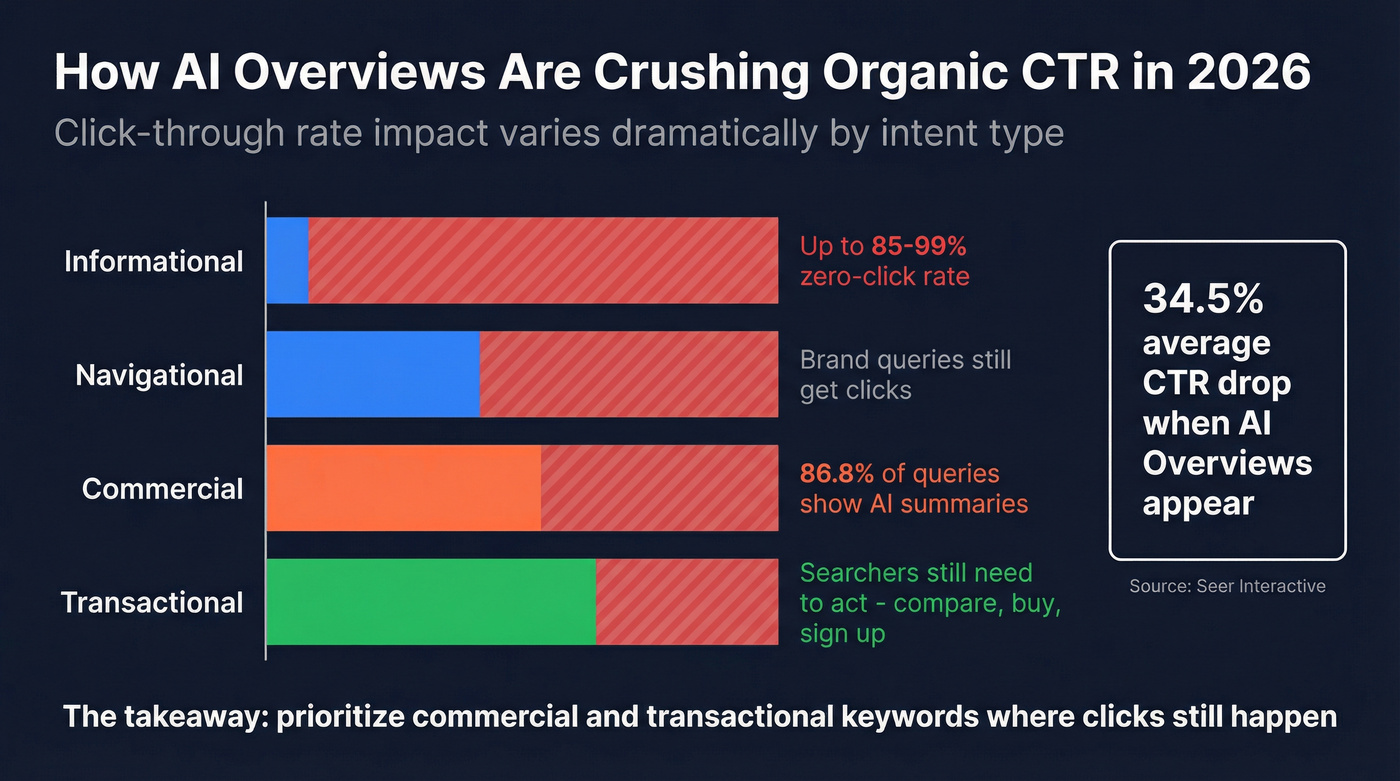
The numbers get worse for commercial queries specifically. In some datasets, AI summaries appear in 86.8% of commercial queries, and in certain niches, zero-click rates reach 85-99%. Google is answering the question before the searcher ever reaches your site.
This doesn't make intent strategy less important - it makes it more important. Every click is harder to earn, so each one has to count. The shift is from "keywords" to "entities" and "micro-intents." Google's AI connects topics, products, and user needs - not just keyword strings.
Instead of optimizing purely for position one, smart teams now optimize across multiple visibility surfaces: AI Overview citations, featured snippets, and community content that Google surfaces from Reddit and Quora. Your page can be cited in an AI Overview even if it doesn't rank first organically - but only if the content structure matches what the AI extracts.
The practical implication is clear. Informational queries are increasingly zero-click. Commercial and transactional keywords still drive clicks because the searcher needs to do something - compare, evaluate, purchase - that an AI summary can't fully replace. Prioritize accordingly.
Intent Keywords for B2B
B2B intent is a completely different game. Research from Gartner shows 70% of the B2B buying journey is completed before buyers ever talk to sales, and the average B2B purchase now involves 11.4 stakeholders, up from 6.8 in 2016. Your strategy needs to capture a buying committee, not a single searcher.
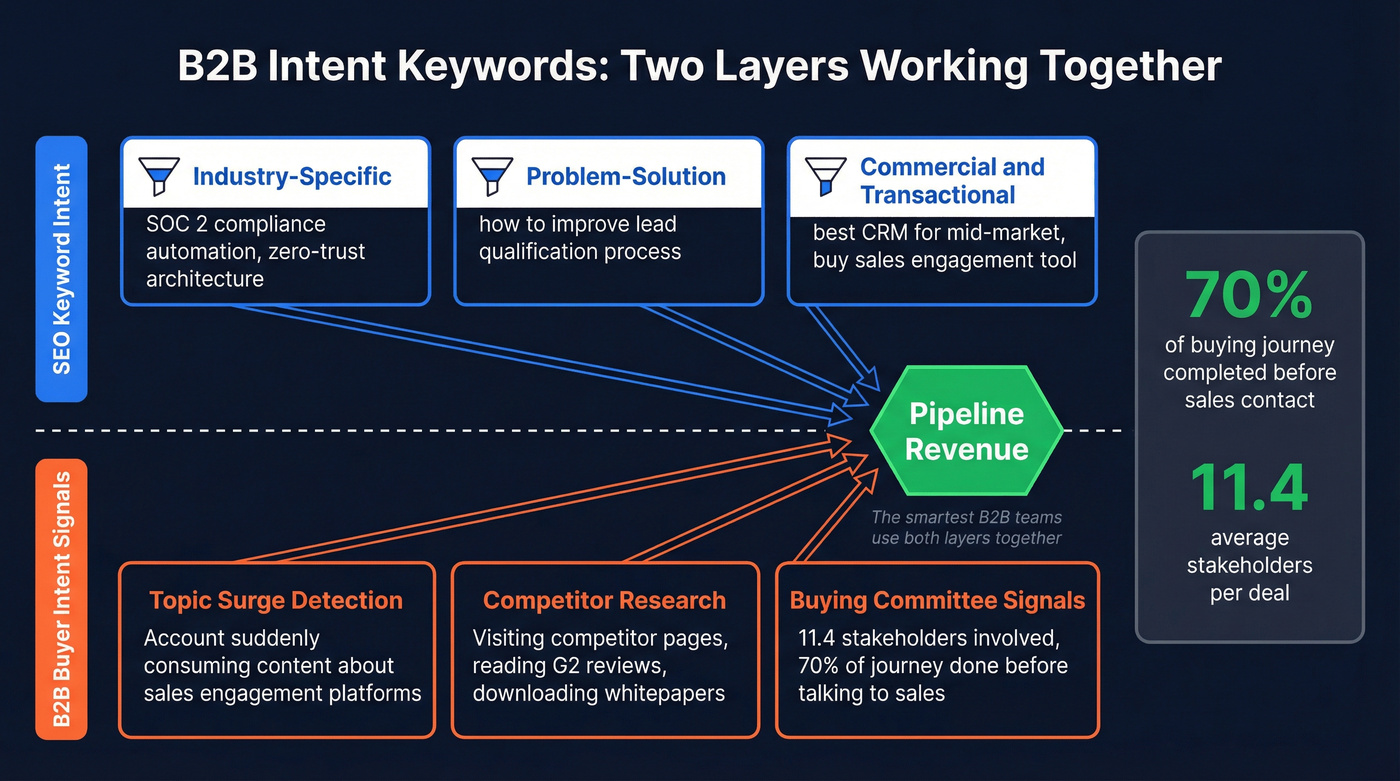
B2B keyword categories break down into four buckets:
- Industry-specific keywords like "SOC 2 Type II compliance automation" or "zero-trust network architecture implementation" target technical buyers.
- Problem-solution keywords like "how to improve lead qualification process" capture mid-funnel researchers.
- Product and service keywords like "enterprise email security platform" signal active evaluation.
- Comparison keywords like "QuickBooks Enterprise vs NetSuite" indicate a buyer narrowing their shortlist. You can find these for free by typing "[competitor] vs" into Google's autocomplete.
Using Account Intent Topics to Prioritize Outreach
The real power move in B2B is layering search intent with buyer intent data. Platforms that track topic consumption across the web can tell you which accounts are spiking on keywords related to your category - even if those accounts never visit your site. When you see a target account suddenly consuming content about "sales engagement platforms" and "outbound automation tools," that's a signal your SDRs should act on immediately.
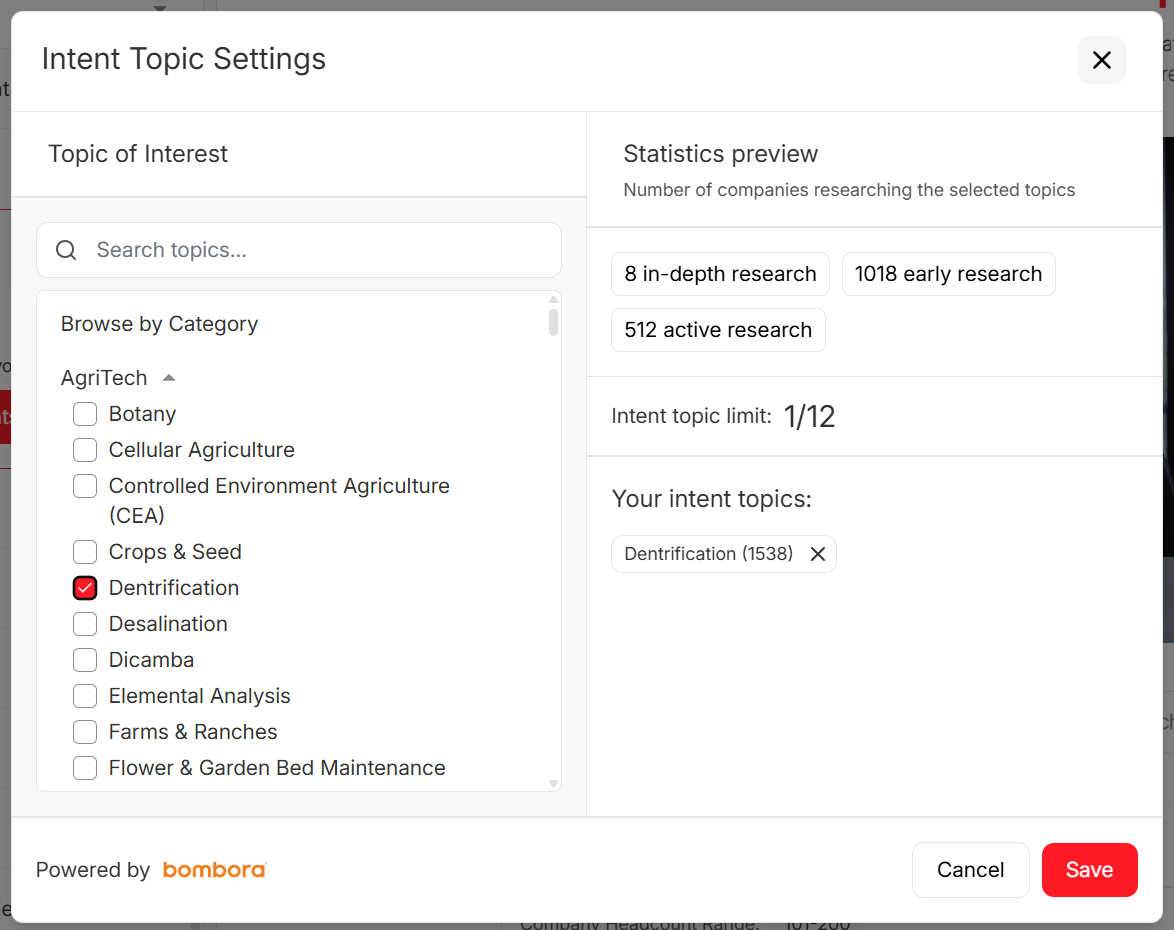
Building a curated list of your most relevant topics is the first step. Map your product's value propositions to the Bombora taxonomy, then monitor which accounts surge on those topics week over week. The accounts that spike across multiple related topic clusters - not just a single keyword - are the ones most likely to be in an active buying cycle.
Seeing which accounts are in-market is useless if you can't reach the right people. Prospeo tracks 15,000 Bombora-powered intent topics and layers those signals with 30+ filters - job role, company growth, technographics, funding - so you go from "this account is researching your category" to verified emails and direct dials for the actual decision-makers.
The HelloSign case study illustrates what happens when B2B intent strategy clicks. They achieved a 1,308% increase in organic traffic over 17 months by aligning content with buyer intent signals across the full funnel. That's not just SEO - it's intent-driven content strategy feeding a sales motion.
How to Find and Classify Intent Keywords
Classifying intent at scale requires a blend of manual analysis and tool-assisted automation. Here's the workflow that actually works.
Step 1: Manual SERP analysis. Open an incognito window and search your target keyword. Look at the format - are results blog posts, product pages, or comparison articles? Check the length, the topics covered, and the SERP features present. Shopping carousels mean transactional. PAA boxes mean informational. Listicles with "best" and "top" mean commercial. This takes 30 seconds per keyword and gives you ground truth.
Step 2: Tool-assisted classification. Semrush assigns intent labels for keywords in its database. Moz offers AI-powered intent classification. Ahrefs' keyword explorer provides SERP feature data that lets you infer intent. For most teams, Semrush's built-in labels are the fastest path to classification at scale.
Step 3: N-gram clustering for scale. When you're classifying thousands of keywords, simple pattern matching does the heavy lifting. Keywords containing "how to" are informational. Keywords with "buy" or "pricing" are transactional. Keywords with "best" or "vs" are commercial. Build a spreadsheet formula or a simple script, and you'll classify 80% of your keyword list in minutes. The remaining 20% - the ambiguous ones - get manual SERP review.
Step 4: Validate with engagement metrics. Classification is a hypothesis. Validation comes from data. Pull CTR, dwell time, bounce rate, and conversion rate from Google Search Console and your analytics platform. Segment by intent label. If your "transactional" keywords have a 0.5% conversion rate, either the classification is wrong or the landing page doesn't match the intent. Both are fixable.
Bonus: PPC negative keyword lists. Intent classification isn't just for organic. Use it to build negative keyword lists for your paid campaigns. If you're bidding on "email verification" and half the traffic is informational ("what is email verification"), you're burning budget on clicks that won't convert. Exclude informational modifiers from your ad groups and watch your ROAS improve overnight.
What Intent Keywords Are Worth
Let's put numbers on this. A Ruler Analytics study analyzing 100M+ data points across 14 industries found an average conversion rate of 2.9% for qualified leads, with an average form rate of 1.7% and an average call rate of 1.2%.
Those are averages across all traffic. Intent alignment changes the math dramatically.
| Page/Traffic Type | Typical Conversion Rate |
|---|---|
| Landing pages (intent-matched) | 3-5%+ |
| Organic search (intent-aligned) | 2-4% |
| Homepage (mixed intent) | 1-2% |
| Checkout pages | 20-40% |
Transactional keywords convert 3-5x higher than informational keywords based on channel and page-type data across our analysis. A well-optimized pricing page targeting "CRM pricing" will outperform a blog post targeting "what is a CRM" on pipeline contribution every single time - even if the blog post gets 50x the traffic.
The stat that should change your strategy: 67% of customers prefer self-service over speaking to a company representative. That means your transactional content - pricing pages, comparison tools, self-serve signup flows - isn't just nice to have. It's the primary conversion path for the majority of your buyers.
Here's our hot take: if your average deal size is under $10K, you probably don't need a 50-article content hub. You need five killer pages targeting commercial and transactional intent, a pricing page that doesn't hide behind "talk to sales," and a way to identify the accounts reading those pages. That's the whole strategy.
Best Tools for Research
SEO Intent Tools
| Tool | Starting Price | Best For |
|---|---|---|
| Semrush | $129.95/mo | Built-in intent labels |
| Ahrefs | $99/mo | Competitive analysis |
| Moz | $99/mo | Beginners, keyword difficulty |
| Ubersuggest | $29/mo | Budget-friendly ideas |
| KWFinder | $29.90/mo | Long-tail discovery |
| AnswerThePublic | $9/mo | Question-based research |
| Google Keyword Planner | Free | PPC keyword planning |
| Google Trends | Free | Seasonal intent shifts |
| Keyword Surfer | Free | Quick SERP-level data |
Semrush is the strongest all-in-one for SEO intent classification - it assigns intent labels at the keyword level across its entire database. Ahrefs excels at competitive analysis and understanding what intent your competitors are capturing. For teams on a budget, Google Keyword Planner plus manual SERP analysis gets you 80% of the way there for free.
B2B Intent Data Tools
The market splits between enterprise platforms and accessible tools:
| Tool | Starting Price | Best For |
|---|---|---|
| Prospeo | Free (75 emails/mo); ~$0.01/email | Intent data + verified contacts in one platform |
| Bombora | ~$2,000-5,000/mo | Raw intent data at scale |
| Demandbase | ~$30,000-100,000+/yr | Enterprise ABM workflows |
Demandbase and Bombora are powerful but priced for large organizations with dedicated ABM teams. Skip them if you're a team under 50 reps or don't have a dedicated ABM function - you'll pay enterprise prices for capabilities you won't fully use.
How to Operationalize Intent Keywords
Classifying intent is step one. Operationalizing it - turning classification into revenue - is where most teams stall. Here's what the mapping looks like in practice.
Transactional intent maps to bottom-of-funnel content: pricing pages, demo forms, signup flows, local landing pages. The KPIs are conversion rate and pipeline generated. Don't send transactional queries to blog posts. If someone searches "email verification tool pricing," they should land on a pricing page, not a guide about what email verification is.
Commercial intent maps to mid-funnel content: comparison articles, review roundups, case studies. The KPIs are engagement (time on page, scroll depth) and assisted conversions. These pages warm up the buyer for the transactional step.
Informational intent maps to top-of-funnel content: guides, explainers, how-to articles. The KPIs are organic traffic, time on page, and email signups. These pages build topical authority and capture early-stage researchers.
For transactional pages specifically, two copy frameworks consistently outperform. Problem-solution-proof leads with the pain point, presents your solution, and backs it with evidence - a case study, a testimonial, a benchmark. Feature-benefit-risk reversal lists the feature, explains the benefit, then removes the objection ("98% email accuracy - and if an email bounces, you don't pay for it").
The measurement loop closes in Google Search Console and your analytics platform. Segment your queries by intent label. Track CTR, dwell time, and conversions per segment. When you see informational keywords driving high CTR but zero conversions, that's expected. When you see transactional keywords driving low CTR, your title tags and meta descriptions don't match the intent - fix them.
Remember the team from the intro that published 30 blog posts, grew traffic 40%, and watched pipeline stay flat? We've seen this pattern repeatedly. One team we worked with reallocated 60% of their content calendar from informational to commercial and transactional intent. Traffic dipped 15%. Pipeline doubled.
Commercial and transactional intent keywords tell you someone's evaluating solutions. Prospeo's intent data tells you exactly which companies are doing it - even if they never visit your site. Layer buyer intent with 30+ filters like job change, funding, and technographics to build lists that convert.
Capture the 95% of in-market buyers who never searched your brand.
FAQ
What's the difference between keyword intent and buyer intent?
Keyword intent is the reason behind a search query - informational, navigational, commercial, or transactional. Buyer intent refers to signals that a company is actively researching a purchase, tracked via platforms like Bombora across thousands of topics. Keyword intent tells you what one person wants right now; buyer intent tells you which accounts are in-market across their entire buying committee.
How do I know if a keyword is high intent?
Check the SERP. If results are dominated by product pages, pricing pages, and shopping carousels, the keyword is high intent. Modifiers like "buy," "pricing," "demo," and "near me" are strong signals. Low-intent keywords show educational articles, PAA boxes, and knowledge panels instead.
How do AI Overviews affect keyword strategy?
AI Overviews cause roughly a 34.5% CTR drop for organic links and appear in up to 86.8% of commercial queries. This makes precise intent targeting more critical - you can't afford to rank for the wrong intent when every click is harder to earn. Prioritize commercial and transactional queries where searchers still need to click through to act.
How do I build an intent topic list for B2B outbound?
Map your product's core use cases to Bombora's topic taxonomy, then select 15-30 topics that align with your ideal customer's research behavior. Monitor which accounts surge weekly, and prioritize those spiking across multiple related topic clusters simultaneously - that cross-topic surge is a far stronger buying signal than a single-topic blip.
What's a good free tool for identifying buyer intent signals?
For SEO-side classification, Google Keyword Planner combined with manual SERP analysis covers the basics at zero cost. Semrush's free tier also provides limited intent labels per day. On the B2B side, Prospeo offers a free tier with 75 emails and 100 Chrome extension credits per month, including access to Bombora-powered intent data across 15,000 topics.