Behavioral Segmentation: What It Is, How to Implement It, and Why Most Teams Get It Wrong
Your abandoned cart email flow has a 2% conversion rate and you're calling it a win - the benchmark is 10.7%. That gap exists because most teams segment by who their customers are instead of what they do. Behavioral segmentation closes it, and this guide shows you exactly how.
The Short Version
This approach groups customers by observed actions - purchases, clicks, feature usage, engagement patterns - not demographics or job titles. The playbook is simpler than most articles make it sound: pick 3-4 high-impact segments (not 12), instrument event tracking with a clean taxonomy, activate with differentiated messaging per segment, and measure against revenue KPIs. Not campaign metrics. Revenue.
Here's the catch nobody talks about: segmentation is only as good as the data underneath it. You can build the most sophisticated behavioral cohorts in the world, but if half your contact data bounces when you try to reach those people, you've built a beautiful machine that doesn't do anything.
What Is Behavioral Segmentation?
Behavioral segmentation divides your audience based on observable actions - what they buy, how often they log in, which features they use, when they engage, and how they move through your funnel. It's the segmentation type most grounded in what people do, not what you infer about them.
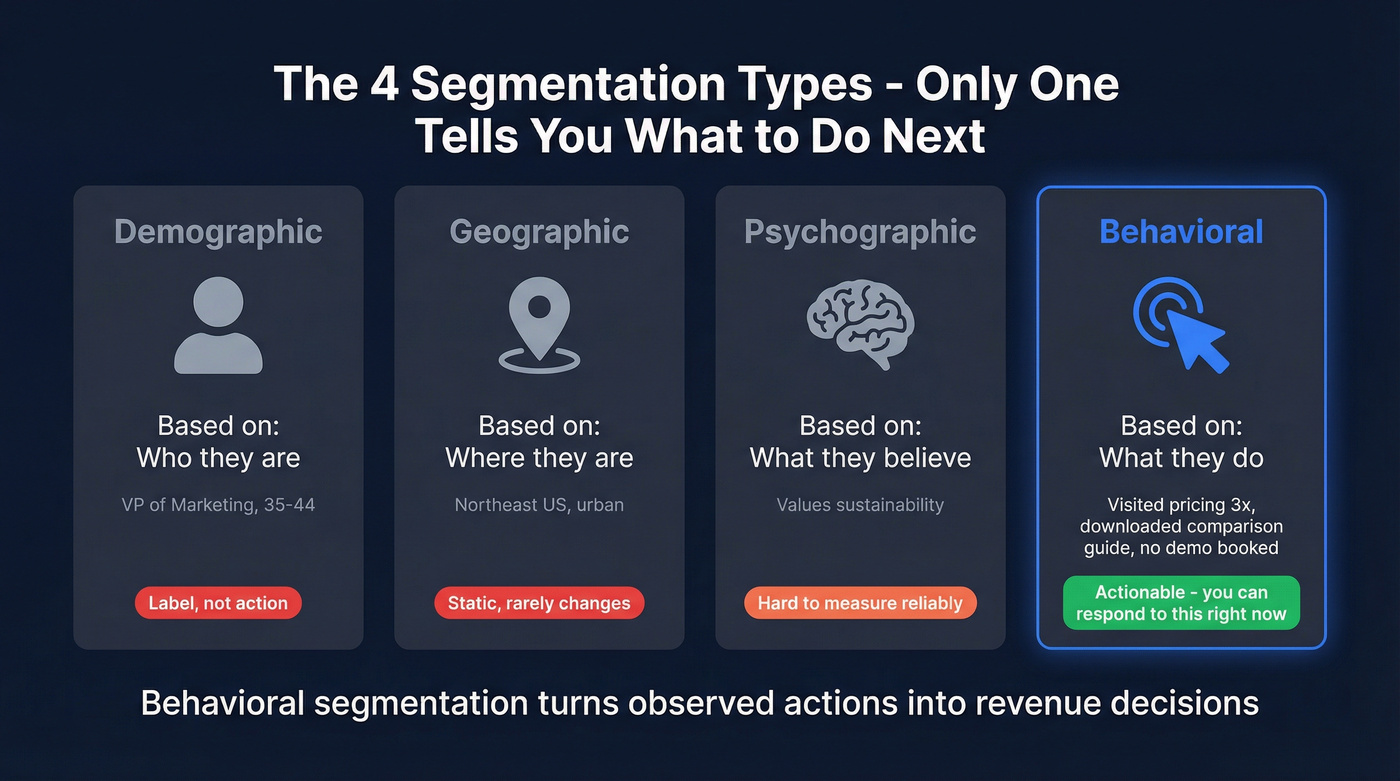
Let's make the distinction concrete:
| Segmentation Type | Based On | Example |
|---|---|---|
| Demographic | Who they are | VP of Marketing, 35-44 |
| Geographic | Where they are | Northeast US, urban |
| Psychographic | What they believe | Values sustainability |
| Behavioral | What they do | Visited pricing 3x, no demo |
Demographic tells you someone's a VP. Behavioral tells you that VP visited your pricing page three times this week and downloaded a comparison guide. One of those signals is actionable. The other is a label.
Why It Matters in 2026
The personalization expectation isn't new, but the penalty for ignoring it keeps getting steeper. McKinsey's research found that 71% of consumers expect personalized interactions and 76% get frustrated when it doesn't happen. That frustration translates directly into churn and lost revenue. On the flip side, 78% of consumers said personalized content made them more likely to repurchase - meaning segmenting by behavior pays its biggest dividends after the first sale, not before it.
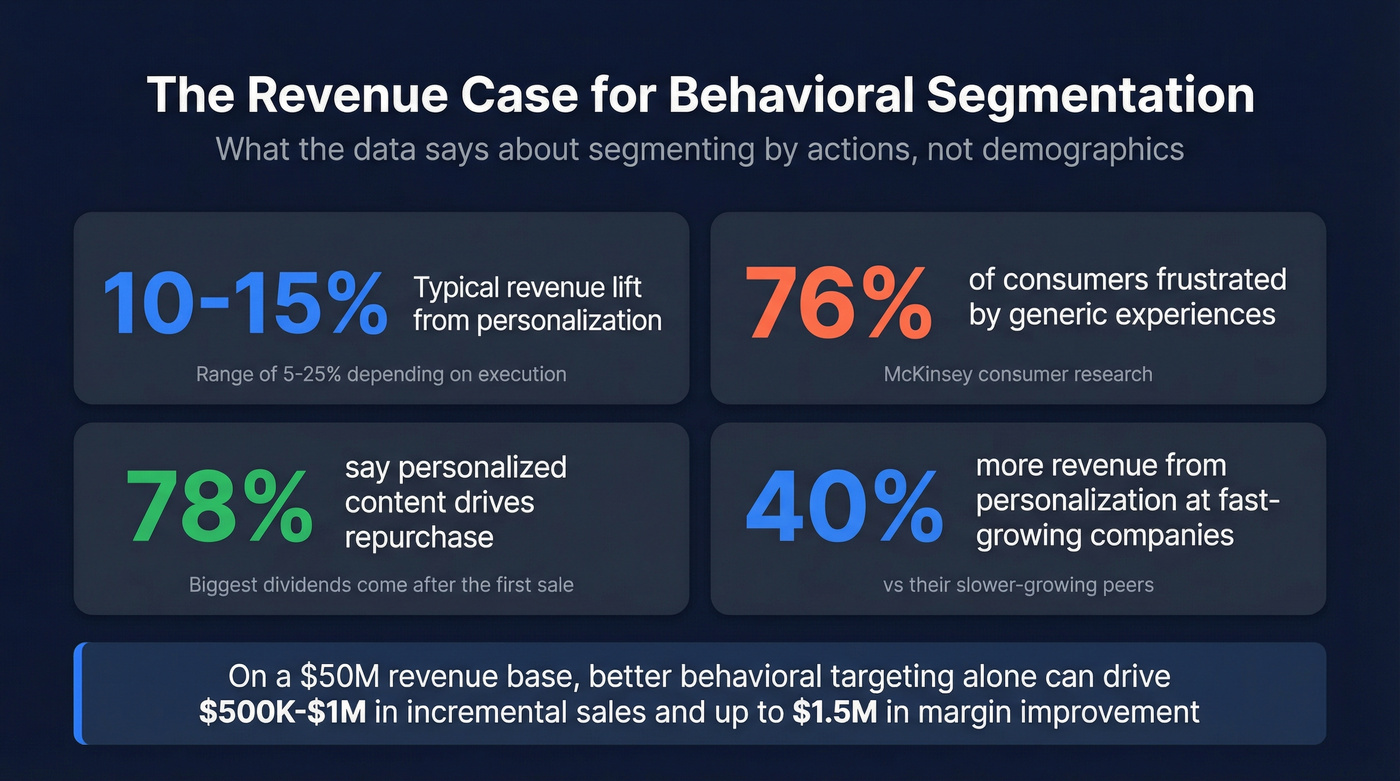
The upside is equally concrete. Personalization most often drives a 10-15% revenue lift, with a range of 5-25% depending on execution. Faster-growing companies drive 40% more of their revenue from personalization than slower-growing peers.
A McKinsey analysis of targeted promotions adds operational specifics: companies pushing incremental sales via targeted promotions see a 1-2% lift in sales and 1-3% improvement in margins. On a $50M revenue base, that's $500K-$1M in incremental sales and up to $1.5M in margin improvement from better targeting alone.
Here's the thing: Amplitude cites Forrester research showing customers are more receptive to personalization in post-purchase stages. Most teams over-invest in acquisition segmentation and barely touch post-purchase behavior. That's leaving the highest-ROI segments on the table.
Netflix is the textbook example. Its recommendations are driven by viewing behavior - what you watch, what you search, what you browse, and what you skip - and it personalizes the experience at scale using action-based data. Spotify does the same with behavior-driven discovery. These aren't marketing gimmicks. They're revenue engines built on observed user patterns.
Types of Behavioral Segmentation
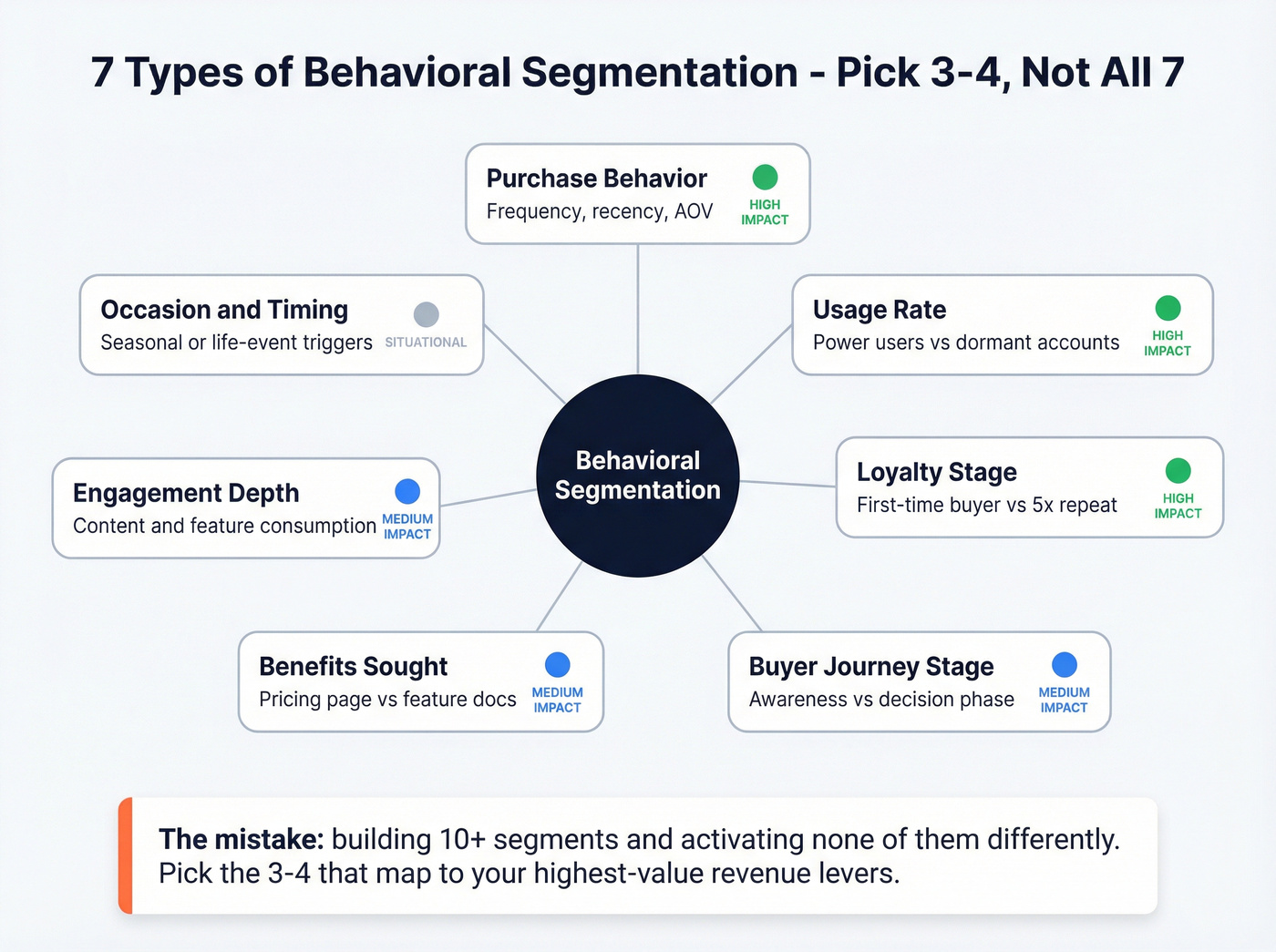
You don't need all seven types. Pick 3-4 with the highest revenue impact for your business and ignore the rest until those are working.
| Type | What It Tracks | Example |
|---|---|---|
| Purchase behavior | Frequency, recency, AOV | Bought 3x in 90 days, AOV $120+ |
| Occasion/timing | Seasonal or life-event triggers | Holiday shoppers, contract renewals |
| Benefits sought | What outcome they're after | Pricing page visitors vs feature page visitors |
| Loyalty/retention stage | Relationship depth | First-time buyer vs 5x repeat |
| Usage rate | Intensity of engagement | Power users vs dormant accounts |
| Engagement depth | Content/feature consumption | Read 8 blog posts, attended webinar |
| Buyer journey stage | Where they are in the funnel | Awareness (blog) vs decision (demo request) |
Amplitude's behavioral variable framework breaks these down further into trackable events: CTA clicks, cart abandonment, product usage patterns, session timing, and feature adoption sequences. The key is mapping each variable to a segment you'll actually activate differently.
Benefits Sought and Needs-Based Segmentation
Benefits sought is one of the most underused segment types - and it's closely related to needs-based segmentation, where you group customers by the specific outcome or problem they're trying to solve. Someone who spends time on your pricing page behaves fundamentally differently from someone reading your feature documentation. The first is comparing you to alternatives. The second is evaluating depth. Those two people need completely different messages, yet most teams send them the same nurture sequence.
Usage rate is where B2B teams especially leave money on the table. Your power users and your dormant accounts need opposite interventions - expansion offers vs. re-engagement campaigns. Treating them the same is how you lose both. Starbucks is a well-known example of using loyalty and usage patterns to tailor offers through its rewards program.
The contrarian take: most guides list these types and stop. Listing types isn't strategy. Strategy is choosing which 3-4 types map to your highest-value revenue levers and building activation workflows around them. A recurring theme on r/sales and r/marketing is teams building 10+ segments and activating none of them differently. Don't be that team.
Real-World Examples by Industry
Ecommerce
Ecommerce has the richest behavioral data and the most mature benchmarks.
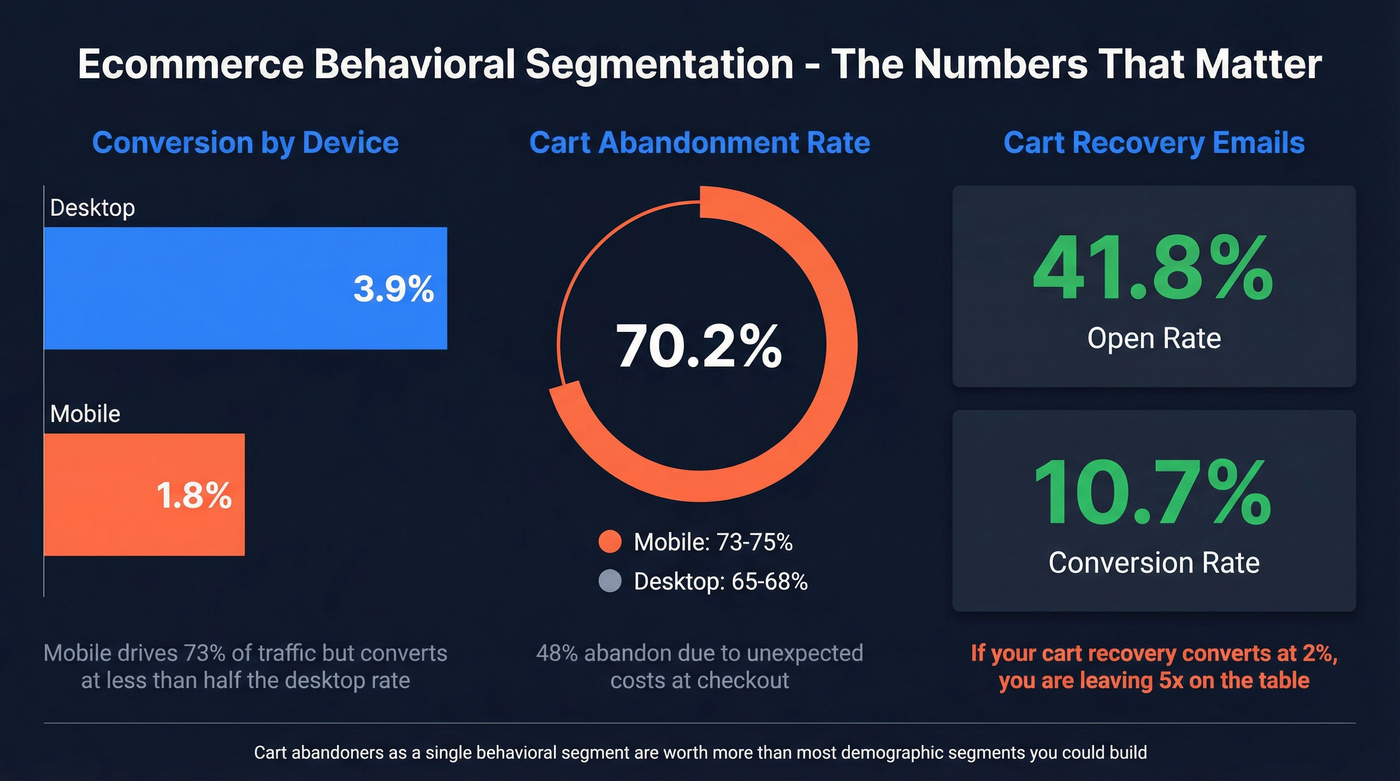
The global average ecommerce conversion rate sits at 1.9-2%, with Shopify stores averaging 2.5-3% and top 10% performers hitting 4.7%+. The device split is where action-based segmentation gets interesting: desktop converts at 3.9% while mobile converts at 1.8% - despite mobile driving 73% of traffic. That gap alone justifies a device-based segment with differentiated checkout experiences.
Cart abandonment runs at 70.22% overall, with mobile at 73-75% vs. desktop at 65-68%. Baymard Institute's research shows 48% of abandonment comes from unexpected costs at checkout - a behavioral trigger you can address with segment-specific messaging like free shipping thresholds and transparent pricing earlier in the flow.
The recovery opportunity is massive. Abandoned cart emails pull a 41.8% open rate and 10.7% conversion rate. If your cart recovery sequence is converting at 2%, you're not even close to the benchmark. Cart abandoners as a single segment are worth more than most demographic segments you could build. They've already demonstrated purchase intent - they just need the right nudge at the right time.
Amazon's "Frequently Bought Together" and "Customers Who Bought This Also Bought" features are pure purchase-behavior segmentation. Amazon uses machine learning trained on historical data and experimentation to improve its recommendation engine - a classic example of observed actions driving what customers see next.
B2B SaaS
B2B companies often lag B2C here. Most SaaS teams still segment by firmographics - company size, industry, title - and wonder why their outbound conversion rates are flat.
The SaaS funnel benchmarks tell the story: visitor-to-lead conversion runs about 1.4% for SMB SaaS and 0.7% for enterprise. MQL-to-SQL conversion hovers around 40%. These numbers improve meaningfully when you segment by behavior rather than demographics. For context, email marketing converts at nearly 17% while PPC sits around 1.5% and organic SEO at 2.6% - the channel you activate your segments through matters almost as much as the segments themselves.
Statsig frames B2B behavioral segmentation around value metrics and "golden moments" - the activation behaviors that predict long-term retention. Practical use cases include targeted onboarding paths based on where users drop off, upgrade prompts tied to usage thresholds, and re-engagement triggers when activity falls below a baseline.
June's research adds a critical insight: accounts with similar firmographics can have wildly different in-product behavior. Two 200-person SaaS companies in the same vertical might show completely different feature adoption patterns, but the ones that hit a key activation milestone within 30 days tend to become long-term customers. That's a segment worth building your entire CS motion around.
We've worked with SaaS teams that tripled their expansion revenue by segmenting on usage thresholds alone. A "high-usage, no expansion" segment tells your CS team exactly where to focus. A "declining usage, contract renewal in 60 days" segment is a churn risk that firmographics would never flag. The move that changes everything is combining product usage data with CRM context - and then actually acting on it.

You just built behavioral segments that could drive 10-15% revenue lift. Now you need to actually reach those people. Prospeo delivers 98% email accuracy with a 7-day data refresh - so your cart abandoners, power users, and high-intent buyers get real messages, not bounces.
Segments don't generate revenue. Delivered emails do.
How to Implement It Step by Step
Step 1 - Define Goals and KPIs
Every segment needs a revenue metric attached to it before you build it. Not after. ROAS, lead quality score, retention rate, LTV - pick the KPI that matters and tie the segment to it. We've seen teams build elaborate behavioral models that nobody activates because there's no clear "what do we do differently for this group?" answer. If you can't answer that question in one sentence, the segment isn't ready.
Step 2 - Build Your Event Taxonomy
Your event naming convention is the foundation everything else sits on. Use a standard Object_Action format with consistent properties:
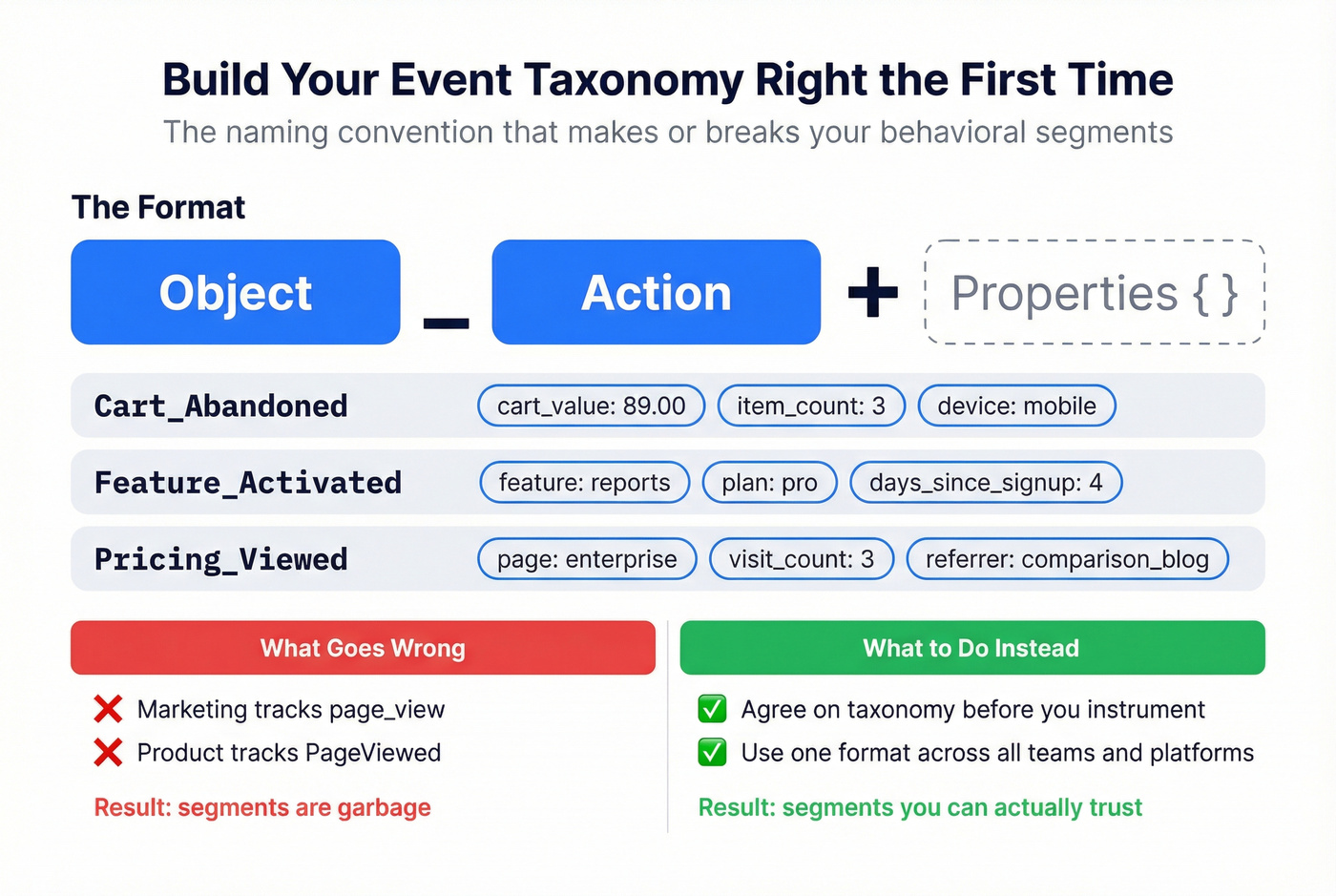
Cart_Abandoned {cart_value: 89.00, item_count: 3, device: "mobile"}
Feature_Activated {feature: "reports", plan: "pro", days_since_signup: 4}
Pricing_Viewed {page: "enterprise", visit_count: 3, referrer: "comparison_blog"}
Consistency across platforms matters more than sophistication. If your marketing team tracks page_view and your product team tracks PageViewed, your segments will be garbage. Agree on the taxonomy before you instrument anything.
Step 3 - Collect and Unify Data
First-party data from your own platforms is the most reliable and privacy-compliant source. Pull from product analytics, CRM engagement, email interaction metrics, website behavior, and purchase history. The hard part isn't collection - it's identity resolution. The same person visits your site anonymously, signs up with a work email, and logs in from a different device. A CDP like Segment stitches those profiles together so your segments reflect actual people, not fragmented sessions.
Step 4 - Validate Before You Scale
Start with 3-4 segments. Not 12.
Run cohort analysis to confirm that the behavior you're segmenting on actually predicts a meaningfully different outcome. If your "high-engagement" segment converts at the same rate as your "medium-engagement" segment, they're not distinct segments - merge them and try a different behavioral variable. The goal is segments that produce statistically different revenue outcomes. Everything else is decoration.
Quick self-audit before you move to activation: Can you name your top 3 segments? Does each have a unique activation workflow? When were they last refreshed? If you can't answer all three, you're not ready for Step 5.
Step 5 - Activate Across Channels
Sync your segments to every activation channel: email, paid media, outbound sequences, in-app messaging. Amplitude's workflow is a good reference - build a cohort of users who exhibited a specific behavior, then push that cohort to ad platforms for retargeting or to your email tool for targeted nurture.
For outbound activation, data quality is the bottleneck nobody talks about. Your SDR team is working a "high-intent" segment but half the emails bounce. That's not a segmentation problem - it's a data problem. Before you activate any segment via outbound, verify the contact data underneath it. Prospeo handles this with 98% email accuracy and a 7-day data refresh cycle that keeps contact data current while your segments evolve.
If you're seeing bounces, treat it like a deliverability incident and fix the root cause (not just the list): start with hard bounces, then work through an email deliverability checklist, and add an email ID validator before scaling volume.
Segmentation is only as good as the data underneath it - you said it yourself. Prospeo's 300M+ profiles with 30+ filters let you layer behavioral signals like buyer intent, job changes, and technographics onto verified contact data. At $0.01 per email, activating your segments costs less than ignoring them.
Stop segmenting into the void. Reach the right people with clean data.
Step 6 - Measure and Refresh
Static segments are worse than no segments - they give you false confidence in targeting that no longer reflects reality. A Q1 segment built on holiday shopping patterns is irrelevant by Q3. Set a quarterly refresh cadence at minimum. A/B test segment-specific messaging against generic messaging to prove the segment is earning its keep. Track segment-level conversion rates, not just campaign-level. If a segment isn't outperforming your baseline, kill it and reallocate the effort.
Best Tools for the Job
Tools for this work fall into four categories: product analytics for tracking behavior, CDPs for unifying identity, lifecycle platforms for activation, and data quality tools for making sure you can actually reach the people in your segments.
| Tool | Category | Best For | Starting Price |
|---|---|---|---|
| Amplitude | Product Analytics | Cohorts, funnels, usage | Free tier |
| Mixpanel | Product Analytics | Event tracking, retention | Free tier |
| Hotjar | Behavioral Analytics | Heatmaps, session recordings | Free tier |
| Prospeo | Data Quality | Verified outbound contacts | Free; ~$0.01/email |
| Klaviyo | Lifecycle Marketing | Ecommerce email/SMS | Free tier |
| Kissmetrics | Product Analytics | Budget behavioral tracking | ~$25/mo |
| Braze | Cross-Channel | Enterprise lifecycle | Custom; typically $50K+/yr |
| Segment | CDP | Data routing, identity | Free tier |
| Adobe RT CDP | Enterprise CDP | Real-time audiences | Custom; typically $50-200K+/yr |
| Salesforce MC | Enterprise Engagement | Multi-cloud CRM + marketing | Custom; typically $25-100K+/yr |
Pricing models vary significantly. Some tools charge by unique tracked users, others by sessions or events. Amplitude and Mixpanel both offer free plans that work for basic cohort analysis. Kissmetrics is a lower-cost option for teams that want behavioral analytics without going fully enterprise. At the enterprise end, Braze and Adobe require serious budget commitments.
For techniques, layer RFM scoring on top of your analytics data, use clustering to discover segments you didn't hypothesize, and apply friction scoring from session data to identify UX-driven segments.
Common Mistakes
1. No defined KPIs. Every segment needs a revenue metric before you build it. If you can't answer "what will we do differently for this group and how will we measure it?" - don't build the segment.
2. Static segments never refreshed. Behavior changes. A segment built on Q1 data is stale by Q3. Set a quarterly review cadence at minimum, monthly for high-velocity businesses.
3. Channel silos. Your email segments don't match your paid audiences, which don't match your outbound lists. The same person gets three different messages. Use a CDP or sync tool to maintain consistency.
4. Too many segments, no differentiated activation. Building 12 segments feels productive. Activating 12 segments with unique messaging, creative, and offers is operationally impossible for most teams. Start with 3-4 and prove they work.
5. Ignoring data quality. In our experience, this is the mistake teams discover last and regret most. Perfect segments with 30% email bounce rates are worthless. Verify contact data before activation - not after your domain reputation takes a hit. Bounced emails compound into deliverability problems that affect every campaign, not just the segmented ones.
6. Survivorship bias. You're only seeing the behavior of people who stuck around. The users who churned in week one never generated enough data to segment - but understanding why they left is often more valuable than optimizing for the people who stayed. Pair your segmentation with churn analysis to avoid building a model that only works for your happiest customers.
Privacy and Compliance
Look, the fact that most guides don't mention GDPR tells you they were written by content marketers, not practitioners. If you're collecting behavioral data, you're collecting personal data. Full stop.
Under GDPR, consent must be freely given, specific, informed, and unambiguous. Pre-checked boxes violate this. Bundled consent violates this. Consent must be as easy to withdraw as it is to give. You need granular consent by purpose - analytics, marketing, and personalization are separate consent categories, not one checkbox.
The core GDPR principles that apply directly: purpose limitation (don't repurpose analytics data for marketing without separate consent), data minimization (don't collect behavioral events you won't use), and retention limits (don't keep inactive records indefinitely).
Under CCPA/CPRA, you must disclose collection and use, provide a "Do Not Sell or Share My Personal Information" option when sharing data with ad or analytics partners, and honor Global Privacy Control signals automatically. CPRA adds obligations around sensitive personal information and data retention timeframe disclosures.
The cost of getting this wrong is real. The global average cost of a data breach was $4.4M as of 2025. GDPR fines can reach EUR20M or 4% of global revenue - whichever is higher. Meta's EUR1.2B fine in 2023 for improper EU-US data transfers shows these aren't theoretical numbers.
Advanced Techniques
Once your 3-4 core segments are working, layer these on.
RFM scoring assigns each customer a score based on Recency (when they last engaged), Frequency (how often), and Monetary value (how much they spend). Combine the three scores into tiers - your "high R, high F, high M" tier is your VIP segment. Your "low R, low F, any M" tier is your win-back target.
Predictive and ML-driven segmentation uses historical behavioral patterns to predict future actions - churn risk, expansion likelihood, purchase propensity. The AI marketing tools market, valued at $47.32B in 2025, is projected to reach $107.5B by 2028. Predictive segmentation is one of the highest-ROI applications of that investment.
Friction scoring analyzes session-level behavior - rage clicks, u-turns, dead clicks - to identify UX-driven segments. A user who rage-clicks your checkout button three times is in a fundamentally different behavioral state than one who glides through. Hotjar and FullStory surface this data natively.
Journey and funnel analysis identifies where specific segments drop off and builds micro-segments around those friction points. A "dropped at step 3 of onboarding" segment gets a targeted intervention that a broad "inactive users" segment never would.
Real talk: if your average deal size is under $15K, you probably don't need predictive ML models for segmentation. RFM scoring and basic cohort analysis will get you 80% of the value at 10% of the complexity. Save the machine learning budget for when your core segments are already driving measurable revenue lift.
FAQ
What's the difference between behavioral and psychographic segmentation?
Behavioral segmentation uses observed actions - purchases, clicks, feature usage. Psychographic segmentation uses inferred attitudes - motivations, lifestyle preferences, and beliefs. Behavioral data is objective and measurable at scale; psychographic research typically requires surveys or inference models, making it harder to validate. The strongest strategies layer both: psychographic insights inform messaging, behavioral data triggers it.
How many segments should you start with?
Three or four, each tied to a specific revenue KPI like retention rate or expansion revenue. Prove measurable lift before adding complexity. Teams that jump to 10+ segments almost always activate none of them with differentiated messaging, wasting the effort entirely.
Does behavioral segmentation work for B2B?
Yes - and it's massively underused. B2B segments include product usage thresholds, content engagement patterns, pricing page visits, and activation milestones. The key is pairing behavioral signals with verified contact data so outbound actually lands.
How do you collect behavioral data without violating privacy laws?
Use first-party data from your own platforms - product analytics, CRM engagement, email metrics, and purchase history. Under GDPR, get granular consent per purpose. Under CCPA/CPRA, disclose collection practices and honor opt-out signals. A CDP like Segment unifies these sources into a single profile while maintaining compliance.
What tools do you need to get started?
At minimum: a product or web analytics tool (Amplitude or Mixpanel, both free-tier), an activation platform like an email tool or outbound sequencer, and a data quality layer for contact verification. Skip the enterprise CDP until you've proven your first 3-4 segments drive real revenue lift - you don't need a $100K platform to validate the approach.