Job Change Outreach Email: 5 Templates That Work (2026)
A RevOps lead we know ran a job-change campaign last quarter - 200 leads, all "verified" by their existing provider. Thirty-eight emails bounced on the first send. That's a 19% bounce rate on what should've been the highest-intent segment in their pipeline. The templates were great. The data wasn't.
Job-change leads are the single best signal in B2B outbound. Previous champions are 114% more likely to convert than cold prospects, and champion job-change outreach can hit up to 40% conversion rates. But most reps waste these leads with generic "congrats!" emails, bad timing, and stale contact data. Here's the full playbook: a job change outreach email for every scenario, plus the timing framework, follow-up sequence, and data hygiene step everyone skips.
What You Need (Quick Version)
- Use the 30-90 day window - new leaders actively evaluate vendors and have budget authority to act.
- Lead with insight, not congratulations - every other rep sends "congrats." Stand out with relevance.
- Build a 4-touch sequence across email, phone, and social touches to capture the 2.5x multichannel uplift.
- Verify contact data first - job changes mean email addresses change. Skip this step and your templates never land.
The 30-90-180 Day Framework
Timing determines whether you're a helpful resource or background noise. Tools like UserGems and other job-change tracking platforms can automate signal detection so you catch moves early, but knowing when to reach out matters more than knowing that someone moved.
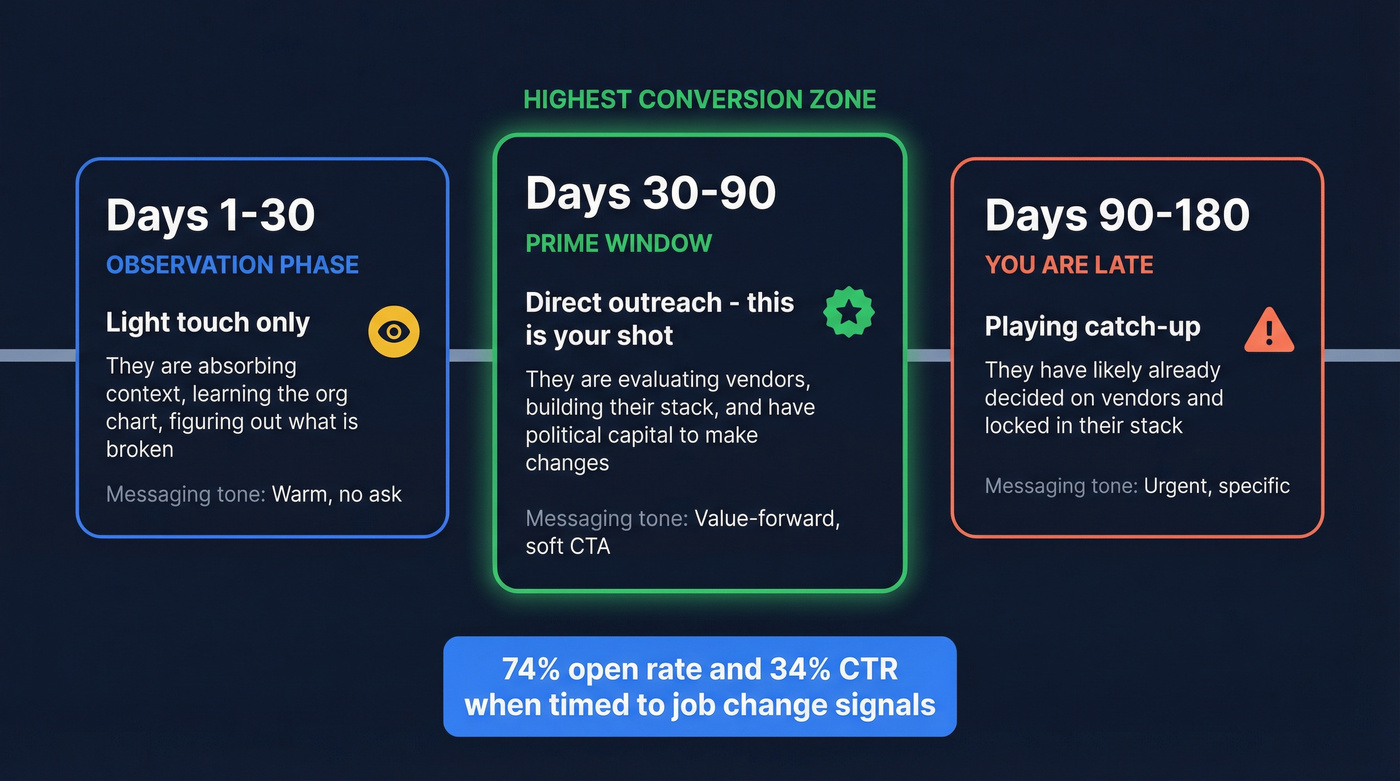
| Window | Phase | Your Move | Messaging Tone |
|---|---|---|---|
| Days 1-30 | Observation | Light touch, congrats | Warm, no ask |
| Days 30-90 | Planning | Direct outreach | Value-forward, soft CTA |
| Days 90-180 | Execution | You're late | Urgent, specific |
Days 1-30 is when the new leader is absorbing context - learning the org chart, inheriting problems, figuring out what's broken. A heavy sales pitch here gets ignored or actively annoys. Days 30-90 is the prime window: they're evaluating vendors, building their stack, and they've got the political capital to make changes. Past 90 days? They've likely already decided. You're playing catch-up.
The data backs this up. The Next Web ran personalized trigger-based sequences timed to job changes and hit a 74% open rate with 34% CTR. That's what happens when you combine the right signal with the right window.
One critical distinction most reps miss: not every job change is a buying signal. A lateral move to the same title at a similar company is noise. A VP of Sales moving from a 50-person startup to a 500-person Series C with a mandate to build outbound? That's a signal. Filter accordingly. A post-promotion outreach play can work well too, when a contact gets elevated internally - they now have more budget authority and a mandate to prove themselves.
5 Templates That Actually Get Replies
Here are five templates mapped to different scenarios and timing windows. Each one follows the Lavender micro-rules that correlate with higher reply rates - short subject lines, low reading level, minimal questions.
Reconnecting With a Former Champion
Subject: Quick question, [First Name]
Hey [First Name],
Saw you moved to [Company] - exciting stuff. We worked together at [Old Company] on [specific project/outcome], and it was one of my favorite partnerships.
No agenda here. Just wanted to say congrats and see how you're settling in. Happy to be a resource if anything comes up.
[Your name]
Subject line: 3 words. Body: 47 words. Reading level: 4th grade. No ask, no pitch. You're reactivating a relationship. The ask comes later in the sequence.
Email to Newly Hired Prospects
Subject: Quick question after your move
Hi [First Name],
Noticed you just stepped into [Role] at [Company]. When [Role] leaders move into companies at [Company's growth stage], [specific pain point] usually surfaces in the first 90 days.
Has that shown up yet - or is it more of a next-quarter problem?
[Your name]
Signal, then insight, then question. You're demonstrating you understand their world without pretending to know them personally. The curiosity question invites a reply, not a meeting. This template works especially well for newly hired prospects because it acknowledges the transition without assuming familiarity.
The Congrats Opener (Days 1-30)
Subject: Congrats on [Company]
[First Name], congrats on the move to [Company].
Most [Role]s I talk to in their first month are evaluating [category your product addresses]. We helped [similar company] [specific outcome] - happy to share what we learned if it's useful.
Either way, hope the new gig treats you well.
[Your name]
Subject line: 3 words. Body: 44 words. Reading level: 5th grade. Light touch, value-forward. You're planting a seed, not harvesting. Write at a 3rd-5th grade reading level - that correlates with 68% more replies.
The Value-First Follow-Up (Days 30-60)
Subject: Thought of you, [First Name]
Hi [First Name],
[Relevant insight - e.g., "We just published benchmarks on outbound connect rates for companies scaling past 100 reps"]. Thought it might be relevant given what [Company] is building.
[Link or one-line summary of the insight]
Worth a look?
[Your name]
No meeting ask. You're adding value and staying top of mind. The insight should tie directly to a challenge someone in their new role would face.
The Direct Ask (Days 60-90)
Subject: [Company] + [Your Company]
[First Name], I've reached out a couple times - wanted to be direct.
We help [Role]s at [stage] companies [specific outcome]. [Company] fits the profile, and I think there's a conversation worth having.
Open to 15 minutes this week or next?
[Your name]
This is the prime window. They've assessed their stack, identified gaps, and built internal buy-in. A clear, confident ask works here because the timing supports it.
Building Your Sequence
Most replies come on touch 2 or 3, not the first email. We've seen the break-up email generate the highest reply rate in the sequence - something about finality makes people respond. Here's a 4-touch sequence with 3-7 day spacing:
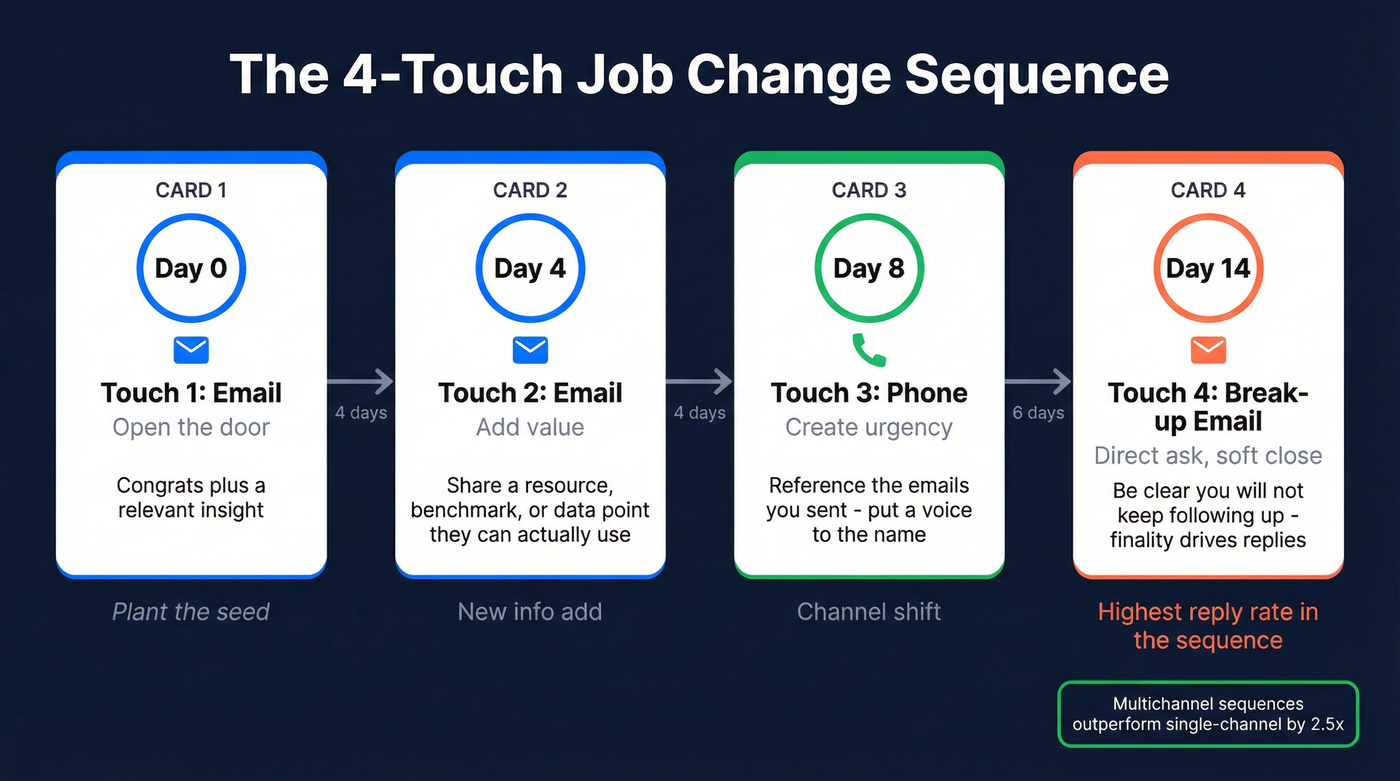
| Touch | Day | Channel | Purpose | Copy Approach |
|---|---|---|---|---|
| 1 | Day 0 | Open the door | Congrats + insight | |
| 2 | Day 4 | Add value | Share resource/data | |
| 3 | Day 8 | Phone | Create urgency | Reference emails sent |
| 4 | Day 14 | Break-up | Direct ask, soft close |
Touch 2 is the "new info add" - share something genuinely useful, not a repackaged pitch. Touch 3 shifts channels to phone, which we'll cover below. Touch 4 is the break-up email: direct, respectful, and clear that you won't keep following up. Something like: "If the timing's off, no worries - I'll circle back in a quarter. But if [pain point] is on your radar, let's talk this week."
Hot lead day tip: Block one day per month exclusively for working job-change leads. Batch your research, write your sequences, and launch them in a single focused session. Reps who do this consistently outperform those who sprinkle outreach across their week because the context-switching kills personalization quality.

That 19% bounce rate in the intro? It happens when your provider refreshes data every 6 weeks and a champion's email changed 3 days ago. Prospeo runs a 7-day refresh cycle across 300M+ profiles with 98% email accuracy - so your job-change templates reach the inbox, not the void.
Stop wasting your best signal on dead email addresses.
Writing Copy That Gets Replies
The average B2B cold email reply rate sits around 5.1%. Job-change outreach should crush that - but only if the copy is tight. Reps spend roughly 21% of their workday writing email, so efficiency matters as much as quality.
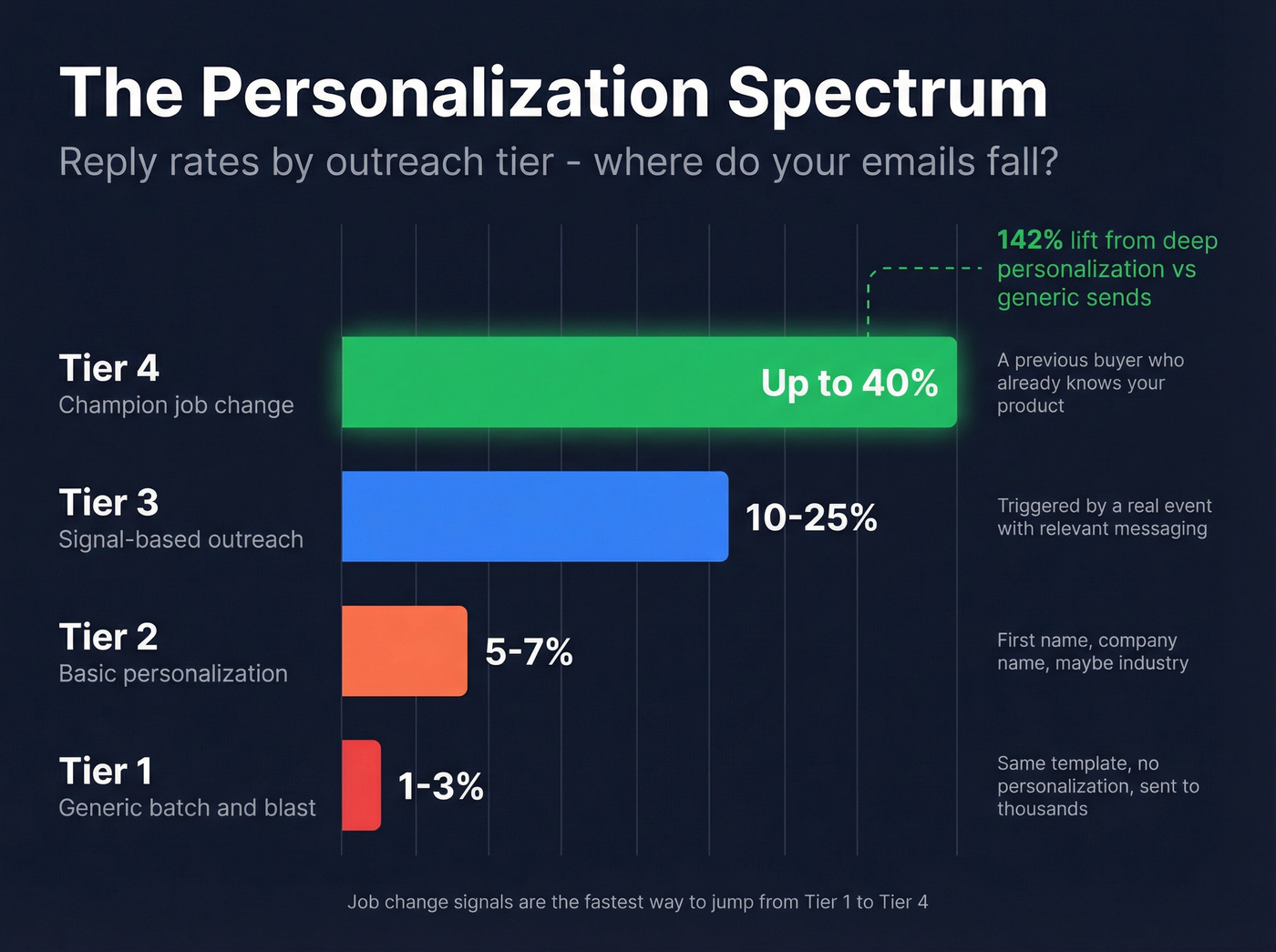
Here's the thing: where you fall on the personalization spectrum determines your results more than any template.
- Tier 1 - Generic batch-and-blast: 1-3% reply rate. Same template, no personalization, sent to thousands.
- Tier 2 - Basic personalization: 5-7% reply rate. First name, company name, maybe industry. Table stakes.
- Tier 3 - Signal-based outreach: 10-25% reply rate. Triggered by a real event with relevant messaging.
- Tier 4 - Champion job-change: Up to 40% conversion rate. A previous buyer who already knows your product, reached at the right time with the right message.
Belkins found that deep personalization lifts reply rates by 142% compared to generic sends. The gap between Tier 1 and Tier 4 is enormous, and job-change signals are the fastest way to jump tiers.
Let's break down the mechanics. Subject lines should be 3-5 words. Boring beats clever every time. "Quick question about [Company]" outperforms anything with emojis or ALL CAPS. Reading level matters more than most reps think - 3rd-5th grade drives 68% more replies. Short words, short sentences, no jargon. Tone should be unassuming, not authoritative. "I don't work in your org, but I was thinking..." beats "As the leader in [category]..." - authoritative tone leads to 26% fewer replies.
Keep body copy under 50 words. Every word earns its spot or gets cut. Max one question per email. And segment into cohorts of 50 or fewer - that drives 2.76x higher reply rates.
In our experience, the 3x3 research method is the single highest-ROI habit for outbound reps: spend 3 minutes finding 3 data points about the prospect. Their new company's recent funding round, a quote from their professional profile, a job posting that hints at their priorities. That's the difference between Tier 1 and Tier 3.
Go Multichannel
Email alone isn't enough. Multichannel sequences - phone, email, and social touches - outperform single-channel by 2.5x. Signal-informed calls convert at 5-8%, compared to 1-2% for cold dials without context. When you've already sent an email referencing their job change, the call opener writes itself:
"Hi [First Name], this is [Your name] from [Company]. I sent you a note last week about your move to [Company] - wanted to put a voice to the email. When leaders step into roles like yours, they usually evaluate [area]. Is that on your radar, or is it too early?"
Best calling windows: 10-11 AM and 2-4 PM, Tuesday through Thursday. If you hit voicemail, keep it to 18-25 seconds. Name, company, one sentence about why you're calling, and your number. That's it.
Verify Before You Send
Here's where most teams blow it. Your templates don't matter if the email bounces. Job changes are one of the biggest reasons contact data goes stale - someone moves from Acme Corp to NewCo, and their acme.com email is dead. If your data provider refreshes monthly or slower, you're sending to addresses that no longer exist.
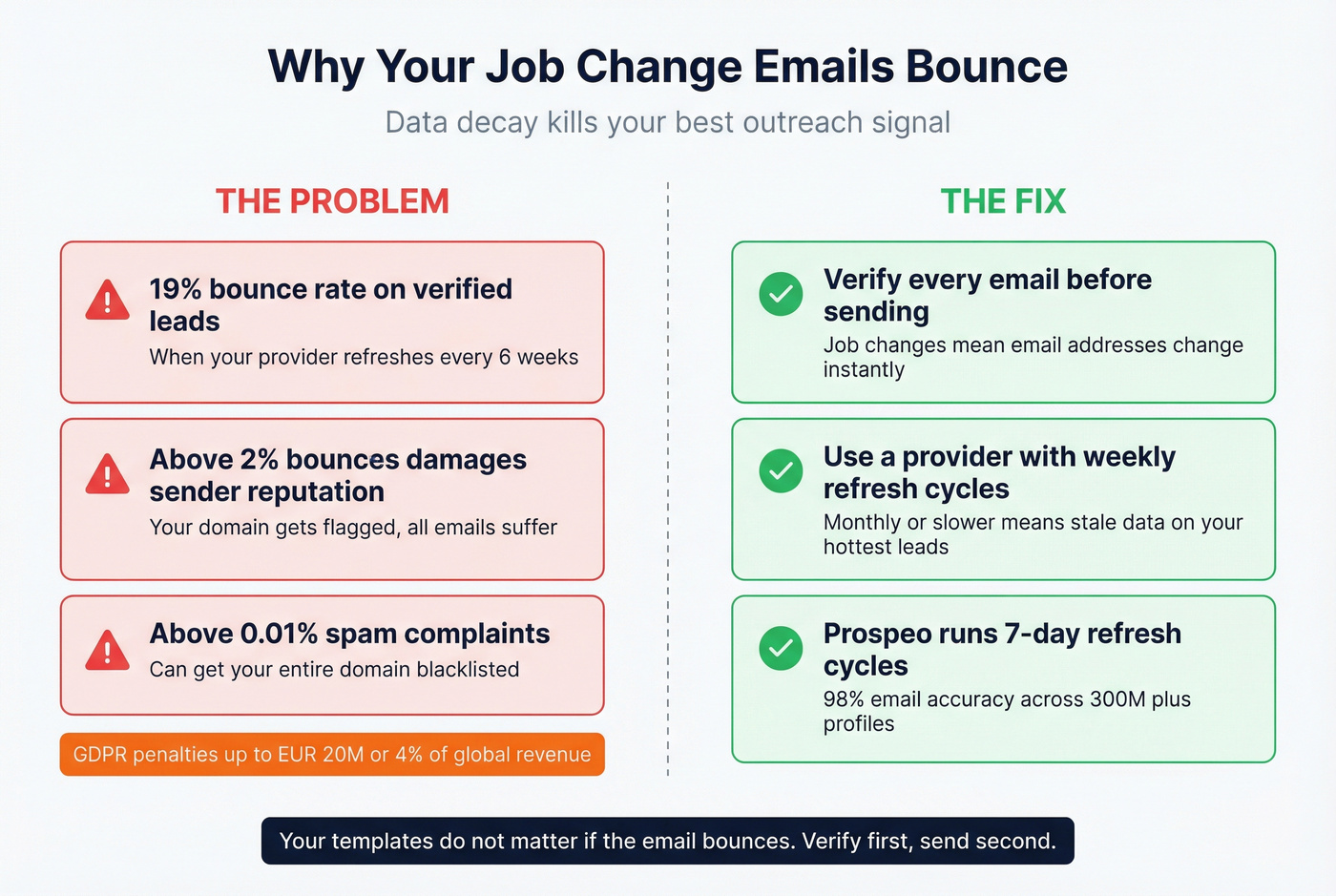
Bounce rates above 2% damage your sender reputation. Spam complaint rates above 0.01% can get your domain flagged. For companies operating in Europe, GDPR penalties run up to EUR 20M or 4% of global annual revenue. Bad data isn't just ineffective - it's actively destructive.
Real talk: most teams don't need a $10K+/year job-change tracking platform. Those tools are great for enterprise orgs with massive CRM databases and dedicated RevOps teams. But if your average deal size is under $30K or your team is under 20 reps, you need accurate data and a good filter - not an enterprise workflow engine.
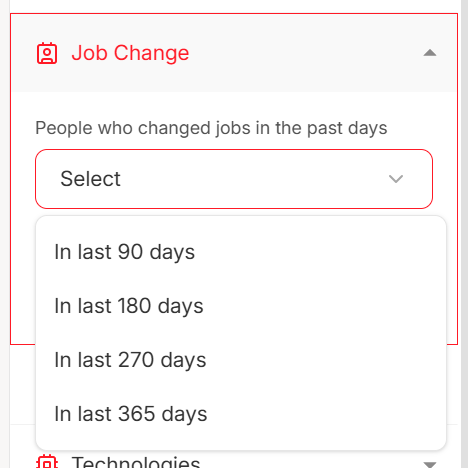
Prospeo's B2B database covers 300M+ professional profiles with a dedicated job-change filter. You can surface leads who moved in the last 30, 60, or 90 days and filter by role, seniority, industry, and company size. Every email is verified to 98% accuracy on a 7-day refresh cycle - so when someone changes jobs on Monday, their new verified email is in the system within days, not months. Native integrations with Instantly, Lemlist, and Smartlead mean you can push verified leads straight into your sequences. Free tier available, no contracts.
Your 30-90 day window is tight. Every day spent chasing a bounced email or wrong number is a day your champion picks another vendor. Prospeo tracks job changes and delivers verified emails at $0.01 each - with 125M+ direct dials when email alone won't cut it for Touch 3.
Reach champions at their new company before your competitors do.
Mistakes That Kill Your Results
Generic "congrats" with no insight. You sound like every other rep in their inbox. The congrats is the wrapper, not the message - always pair it with something relevant to their new role.
Selling hard on day one. The relationship hasn't earned a pitch yet. Wait for the 30-90 day window. We've watched reps torch warm leads by sending a demo link 48 hours after someone updated their profile.
Single-channel only. Email without phone and social leaves a lot of response on the table. The 2.5x multichannel uplift is real.
Unverified data. One bounced campaign can tank your domain reputation for weeks. Our team has seen companies lose months of sender reputation over a single bad list - and rebuilding it is painfully slow.
No follow-up sequence. Most replies come on touch 2 or 3. Most reps stop at 1. Don't be most reps.
FAQ
How soon should I email someone after a job change?
Send a light congrats within 30 days, but save your real pitch for days 30-90 - that's when new leaders actively evaluate vendors and have budget authority. Past 90 days, most decisions are already locked in.
What's a good subject line for a job-change email?
Keep it to three to five words. "Quick question about [Company]" or "Saw your move" consistently outperform clever or emoji-heavy alternatives. Boring subject lines earn higher open rates across every study we've seen.
How many follow-ups should I send?
Three to five touches, spaced 3-7 days apart. Most replies come on follow-up 2 or 3. End your sequence with a break-up email - the finality often triggers a response from prospects who've been meaning to reply.
How do I find verified emails for people who just changed jobs?
Job changes invalidate old email addresses immediately. Use a database with a dedicated job-change filter and real-time verification - look for providers that refresh data weekly rather than monthly. Stale data from slow-refresh tools will bounce and damage your sender domain.