Personalization vs Automation in Sales (2026): The Operating Model for Modern Outreach
Double outbound volume, and replies drop anyway.
That's personalization vs automation in sales in the real world: reps "personalize harder," managers add steps, and RevOps gets blamed for the stack. The truth's simpler: you've got an operating model problem, not a copywriting problem.
What you need (quick version)
Run this like an ops rollout, not a writing workshop.

Checklist (do these in order):
Tier your prospects (before you write anything)
- Define Tier 1 / Tier 2 / Tier 3 using deal value + ICP fit + buying signals.
- Set a hard time budget per prospect by tier (minutes, not vibes).
Route by signals (so personalization is earned)
- Personalize only at moments that change outcomes: Tier 1 first touch, post-click follow-up, post-meeting recap.
- Automate cadence, timing, and branching everywhere else.
Install deliverability guardrails (or automation will punish you)
- Keep spam complaints <0.10% (avoid >0.30%).
- Keep bounces <2%.
- Treat opt-outs as segmentation feedback, not a "copy problem."
Why personalization vs automation in sales is the wrong argument
I've watched this movie a dozen times: outbound volume doubles quarter over quarter. Meetings don't. Replies fall.
Leadership's default fix is "more personalization." Reps start spending 8-12 minutes per prospect, sequences bloat, and follow-ups get skipped because the task queue's on fire. The result's predictable: you pay more labor to execute less outreach, and you still don't fix the real constraint (targeting + routing + deliverability).
Buyers do expect relevance. McKinsey's stat is popular for a reason: 71% of people expect personalized interactions, and 76% get frustrated when it doesn't happen. McKinsey also finds personalization often drives 10-15% revenue lift (and top performers can do even better), so the goal isn't "less personalization." It's better allocation of human effort.
Here's the operating truth:
- Personalization works when it changes the buyer's decision (angle, proof, ask).
- Automation works when it protects consistency (timing, branching, SLAs).
- Most teams fail because they personalize the wrong moments and automate the wrong ones.
This is why the "automation vs personalization" debate is usually a distraction: the real win is deciding which moments deserve human judgment and which should be systemized.
Hot take: if your average deal size is in the low five figures, you probably don't need deep personalization at all. You need clean segmentation, fast follow-up, and ruthless deliverability discipline.
Definitions that actually matter in sales outreach
Most teams argue about personalization and automation without agreeing on what either word means.

Personalization (in outreach) Not tokens. Not "Congrats on the funding." Personalization is choosing the right angle, proof, and ask for this buyer right now.
Examples that count:
- A CFO opener anchored on risk, payback, margin, or cash conversion.
- A post-click follow-up that references the specific topic they engaged with (security, pricing, migration).
- A meeting recap that ties next steps to their stated priorities and timeline.
Automation (in outreach) Automation is consistent execution at scale: timing, branching, task creation, and routing based on rules.
Examples that count:
- Throttled sending windows and mailbox rotation.
- Auto-unenroll when a contact replies or books.
- Rules that move a prospect into a different cadence when they click or go inactive.
Now the tool layer matters, because "automation" usually means a Sales Engagement Application (SEA), not your CRM.
Gartner's framing is clean: sales engagement applications streamline how sellers execute sales activities and deal workflows at scale, bundling multichannel engagement (email, voice, SMS, video, social), outbound workflow execution, and AI-driven time savers that standardize work.
SEA vs CRM (the distinction that saves your rollout):
- CRM = system of record (accounts, opportunities, pipeline hygiene).
- SEA = system of action (cadences, tasks, routing, engagement analytics).
If you try to run modern outreach from CRM tasks alone, you'll create a backlog factory.

Your tiering matrix is useless if half your emails bounce. Prospeo keeps bounces under 2% with 98% verified email accuracy and a 7-day data refresh cycle - so your automation actually reaches inboxes and your personalization doesn't get wasted on dead addresses.
Fix the data layer before you rewrite a single subject line.
Personalization vs automation in sales: the matrix that ends the debate
The fastest way to stop the argument is to make it operational: persona × tier × touch level. Each cell gets its own default sequence, and RevOps can actually enforce it.

Rule I use in almost every redesign: Personalize the moments that change outcomes. Automate the cadence and decisioning.
Matrix: deal value/intent × persona seniority × touch level
| Segment | Seniority | Intent | Touch level | Default motion |
|---|---|---|---|---|
| Tier 1 | VP/CxO | High | High touch | Manual first touch |
| Tier 1 | Director | High | High touch | Semi-manual + fast follow |
| Tier 2 | VP/CxO | Mixed | Mixed | Templated proof + tasks |
| Tier 2 | Manager | Mixed | Low touch | Automation-first |
| Tier 3 | Any | Low | Low touch | Automation + caps |
What this does operationally:
- It stops your best reps from burning hours on low-value accounts.
- It stops your sequencer from treating Tier 1 like a webinar list.
- It gives RevOps enforceable rules: routing, step types, and guardrails.
Tier 1 (high value / high intent): manual first touch + custom angle
Tier 1 is where personalization pays because the upside is real and the buyer's intent is already warm.
You're not personalizing facts. You're personalizing the thesis: why now (trigger), why you (proof), and why this ask (next step). In practice, that means a manual first touch that's short and specific, followed by an automated follow-up cadence that's tight and fast, because speed matters when intent's real and competitors aren't waiting for your rep to finish "research."
Two moves win Tier 1 consistently:
- a manual first touch that nails the angle, and
- an automated follow-up cadence that actually runs on time.
Tier 2 (mid value / mixed intent): semi-personalized + templated proof
Tier 2 is where teams waste the most time.
The right approach is semi-personalized:
- Personalize one variable (industry pain or role pain or trigger).
- Keep proof templated (1-2 case snippets you can swap by segment).
- Add manual steps only when a signal appears.
Skip this if: Tier 2 requires more than 90 seconds of human time per prospect. That's not craft. That's mis-tiering.
Tier 3 (low value / low intent): automation-first + strict caps
Tier 3 is a math problem. You're optimizing for list quality, deliverability, clean segmentation, and fast iteration.
Personalization here should be structural (segment-based messaging), not artisanal. If you're inserting lots of tokens into Tier 3, you're paying a labor tax for the same outcome.
Benchmarks: what "good" looks like in 2026 (so you don't optimize the wrong thing)
Most teams obsess over opens and ignore the two numbers that actually cap scale: bounces and complaints.
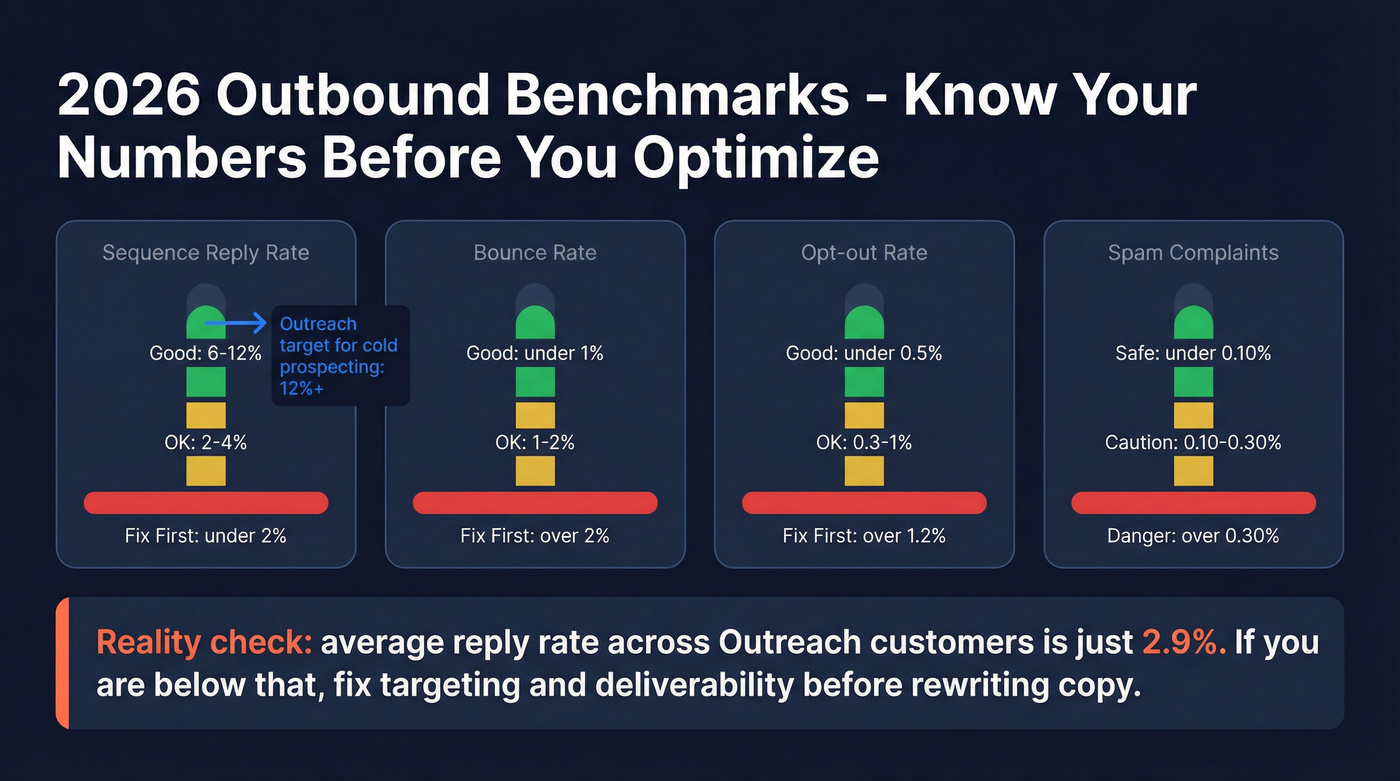
From Outreach's sequence benchmarks across their customer base (published Oct 2026):
- Open rate: 27.2%
- Reply rate: 2.9%
- Bounce rate: 2.8%
- Opt-out rate: 1.1%
Those averages are a reality check, not a goal.
Outreach's own bar for cold prospecting sequences is blunt: reply rate should be at least 12%. If you're below that, you don't have a personalization problem. You've got a targeting, offer, or deliverability problem.
Use one definition consistently: replies / delivered (not sent).
| Metric | OK | Good | Fix first if... |
|---|---|---|---|
| Sequence reply rate (all outbound) | 2-4% | 6-12% | <2% |
| Cold prospecting reply rate (Outreach target) | 8-12% | 12%+ | <8% |
| Bounce | 1-2% | <1% | >2% |
| Opt-out | 0.3-1% | <0.5% | >1.2% |
One behavior-changing benchmark: ~60% of replies come after the first follow-up.
If you "personalize" the first email and then half-send the rest, you're doing the expensive part and skipping the part that produces replies.
Where AI personalization helps vs hurts (and how to use "atomic insights")
AI personalization's useful when it produces decision-grade context quickly, not when it writes a longer email.
Gartner's direction is clear: AI is moving from "generate text" to atomic insights (small, reliable facts you can act on) and narrative automation (assembling those facts into a coherent angle inside a workflow). That's exactly how you should use it in outbound.
Where AI helps (high impact)
Use AI to generate atomic insights that change your angle or routing, like:
- Trigger detection: "New VP Sales hired" + "job posts for SDRs" -> route to a "new leader / new pipeline motion" cadence.
- Tech + constraint: "Uses X CRM + Y data warehouse" -> lead with migration risk reduction or time-to-value proof.
- Buying committee guess: "Security-heavy industry + SOC2 page views" -> route to a security-first follow-up with a human step next.

Then let narrative automation do the boring part: assemble a short opener that uses one insight, one proof point, and one ask, consistently, without turning every email into a 220-word essay that nobody asked for.
Where AI hurts (it scales the wrong kind of "personal")
AI hurts when it:
- invents familiarity ("Loved your post...") and triggers the buyer's scam radar
- overfits to trivia (schools, hobbies, vague compliments)
- increases send volume without fixing list quality and routing
Belkins' dataset of 20M+ outreach attempts is the best reminder here: the winners aren't the most clever messages. They're the ones that stay relevant, stay consistent, and follow up.
"Creepy personalization" red flags (don't do these)
Prospects hate three things, and they'll punish you with opt-outs and spam complaints:
- Over-specific surveillance: "I saw you viewed our pricing at 9:12am..."
- Fake intimacy: "As a fellow [hometown/college]..." when you clearly don't know them
- Irrelevant flattery: praising a post that has nothing to do with your offer
My rule: if the personalization would feel weird to say out loud on a first call, it doesn't belong in the first email.
What to automate vs what must stay human (by step type)
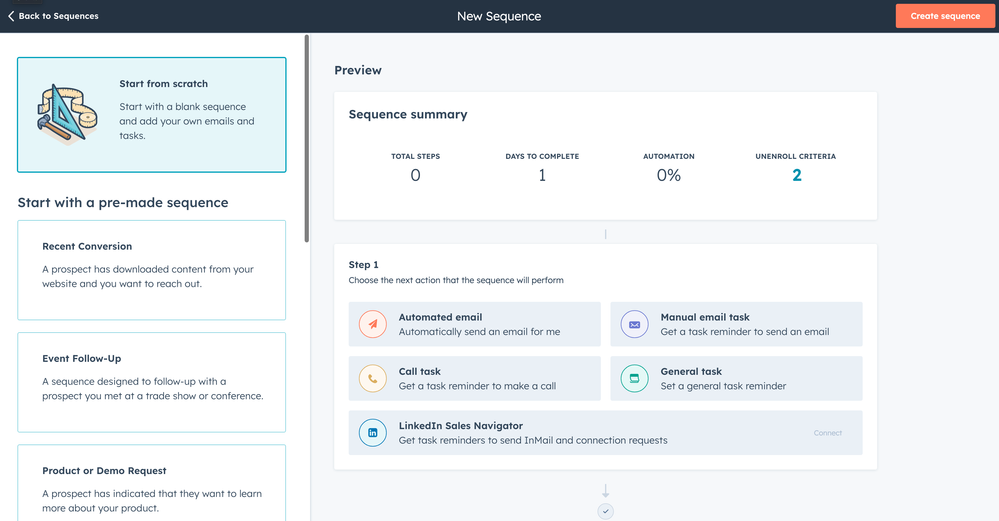
HubSpot's Sequences model is a clean mechanical view: sequences send automated emails and create tasks (manual email, call, general tasks). They also auto-unenroll contacts when they reply or book, so you don't keep emailing someone who engaged.
The failure mode is predictable: too many manual steps create a backlog, prospects stall, and your "automated" sequence becomes a half-finished to-do list. Outreach calls this Sequence Purgatory, and yeah, it's real. I've seen teams with "automated" sequences where Step 3 is a manual task that sits for four days because the rep's in meetings, and by the time it goes out the prospect's already bought from someone else.
Use this default split.
Automate
- Follow-ups that restate the same thesis (tight, short, consistent)
- Send timing windows, throttling, mailbox rotation rules
- Auto-unenroll on reply/meeting
- Branching based on engagement (click/reply/no activity)
- "Nudge" tasks for Tier 1 after a signal (not before)
Keep human
- Tier 1 first touch (or at least the first line + angle)
- Post-signal messages (after a click, after a reply, after a meeting)
- Objection handling (pricing, security, timing)
- Account-level judgment (who else to loop in, when to stop)
| Step type | Best for | Risk | When to use |
|---|---|---|---|
| Automated email | Follow-ups | Reputation | Tier 2/3, post-touch |
| Manual email task | Tier 1 angle | Backlog | Tier 1 Day 1 |
| Call task | Fast qualify | Low connect | After email 1-2 |
| Research task | Custom proof | Time sink | Tier 1 only |
Signal-based automation: personalize only when the buyer gives you a reason
The scalable rule is simple: don't personalize because you can. Personalize because the buyer did something.
Salesloft's automation rules are a good reference point because they're explicit about triggers that move people between cadences: reply, link click, call logged, meeting booked, finished cadence, and field updates. That's the play: use automation to detect signals and route the prospect into the right next motion.
Rules checklist (steal these):
- If reply -> auto-unenroll + create "respond within 2 hours" task
- If meeting booked -> move to "pre-call prep" cadence + stop outbound
- If link click (pricing/security/case study) -> move to "hot follow-up" cadence with a human step next
- If finished cadence with no engagement -> move to low-frequency nurture (or suppress for 60-90 days)
- If job change / role change -> restart with a new angle (don't keep the old thread)
Skip this if: you can't explain your routing rules in one sentence. If reps can't repeat it, automation won't run cleanly.
A few routing examples that actually move pipeline:
- Clicked your security page -> route to a cadence that offers a 2-minute security overview + sends the SOC2 summary.
- Clicked a case study -> route to a cadence that asks one qualifying question tied to that outcome.
- No engagement after 6 touches -> route to a quarterly value drop, not a weekly nag.
Deliverability: the ceiling on personalization vs automation in sales
Automation doesn't fail because your copy isn't clever. It fails because your sending reputation collapses, and then nothing reaches the inbox.
Deliverability is a math constraint. Once you hit the ceiling, every "optimization" inside the sequence is just rearranging deck chairs, and it's maddening to watch teams argue about subject lines while their bounce rate quietly nukes inbox placement across the whole domain.
The non-negotiable thresholds (complaints, bounces, opt-outs)
Use these as hard gates for scaling volume:
Spam complaints (Gmail guidance): keep <0.10%, and avoid >0.30%. Mailgun's breakdown of Google's complaint guidance is a clear summary: https://www.mailgun.com/blog/deliverability/google-postmaster-changes/
Bounces: keep under 2%. Treat >2% as a stop-the-line event.
Opt-outs: treat >1% as a segmentation problem. High opt-outs mean wrong persona, wrong timing, or you're over-mailing Tier 3.
| Metric | Green | Yellow | Red |
|---|---|---|---|
| Complaints | <0.10% | 0.10-0.30% | >0.30% |
| Bounce | <1.0% | 1.0-2.0% | >2.0% |
| Opt-out | <0.5% | 0.5-1.1% | >1.1% |
Common high-performing cadence range:
- 4-7 emails over 14-21 days
- ~60% of replies come after the first follow-up
- If your last-step reply rate is still strong (Outreach uses >3% for prospecting), the sequence's probably too short: add a step.
Monitoring after Postmaster v1 retirement (what to watch instead)
Gmail Postmaster Tools v1 reputation badges were retired on September 30, 2026. The mood-ring "high/medium/low/bad" is gone, which is annoying, but it also forces teams to manage inputs instead of chasing a badge.
Twilio's summary of what changed and why it matters: https://www.twilio.com/en-us/blog/insights/gmail-postmaster-tools-changes
What to watch now:
- Complaint rate by mailbox provider (where you can)
- Bounce rate by domain and by list source
- Reply rate by segment (Tier 1/2/3, persona)
- Time-to-first-reply (proxy for inbox placement + relevance)
- Engagement decay across steps (if Step 3 collapses, you're fatiguing)
Keep the technical basics boring and correct: SPF, DKIM, DMARC, consistent sending domains, and gradual volume ramps.
The "bad data" failure chain (bounces -> reputation -> lower inboxing -> fake "personalization problem")
This chain tricks teams into the wrong fix:
- You scale automation on a list that's stale.
- Bounces spike. Complaints creep up.
- Inbox placement drops, especially on follow-ups.
- Reply rate falls.
- Leadership demands "more personalization."
- Reps spend more time per email... that fewer people even receive.
I've run bake-offs where the "best copywriter" lost to the team that simply fixed list hygiene and routing. That's not glamorous. It's how you win.
Practical fix: verify + refresh contacts before you add volume
Before you touch templates, fix your inputs: verification and enrichment.
This is where Prospeo fits naturally. It's "The B2B data platform built for accuracy," and it's built for accuracy and freshness: 300M+ professional profiles, 143M+ verified emails, 125M+ verified mobile numbers, 98% verified email accuracy, and a 7-day refresh cycle (industry average: 6 weeks). It also includes intent data across 15,000 topics powered by Bombora, which is handy for routing, not just list building.
What matters for deliverability ops:
- 5-step verification with catch-all handling, plus spam-trap and honeypot removal (fewer risky sends).
- Proprietary email-finding infrastructure (not dependent on third-party email providers).
- Enrichment that returns 50+ data points with an 83% enrichment match rate (so segmentation improves, not just deliverability).
Native integrations include Salesforce, HubSpot, Smartlead, Instantly, Lemlist, Clay, Zapier, Make, Salesloft, and Outreach. Full list: https://prospeo.io/integrations
If you're scaling Tier 3 volume, do this weekly. If you're running Tier 1, do it continuously, because nothing kills relevance like emailing the wrong person at the wrong address.
Ready-to-copy playbooks: Tier 1 / Tier 2 / Tier 3 sequences
These are intentionally simple. The goal's an operating model you can run every week, not a "perfect" sequence you rewrite every month.
Tier 1 cadence (high value): manual Day 1, then fast follow
- Day 1 (Manual email task): 4-6 sentences. Custom angle + 1 proof + 1 question.
- Day 3 (Call task): reference the email thesis in one line.
- Day 5 (Automated email): bump with a second proof point (different customer, different outcome).
- Day 7 (Manual task): add a second stakeholder (multi-thread) or send a short video if that's your motion.
- Day 10 (Automated email): break-up / permission-based close.
Opinion: keep the manual work concentrated at the start and at signal moments. Spreading five manual tasks across three weeks is how you create backlog and miss follow-ups.
Tier 2 cadence (mid value): semi-personalized opener + templated proof
- Day 1 (Automated email with 1 variable): personalize by segment (industry/role/trigger), not trivia.
- Day 3 (Automated email): short follow-up + single CTA.
- Day 6 (Call task): only if phone coverage's decent; otherwise swap for a manual email task to top accounts.
- Day 9 (Automated email): common objection email (timing, budget, switching).
- Day 14 (Automated email): break-up.
Recommendation: A/B test thesis + proof (angle and credibility), not more personalization. If the thesis is wrong, no amount of cleverness rescues it.
Tier 3 cadence (low value): automation-first with caps and suppression
- Day 1 (Automated email): simple, direct, no body tokens.
- Day 4 (Automated email): follow-up (this is where a lot of replies happen).
- Day 8 (Automated email): different angle, same CTA.
- Day 14 (Automated email): break-up.
Hard rules:
- Suppress anyone who opts out or hard bounces immediately.
- If bounce rate's >2%, stop scaling immediately. Fix the list before you send another batch.
- Use sending windows + throttling + mailbox rotation so volume increases don't spike complaints.
- Use rulesets that prevent wrong-person sends (role mismatch, region mismatch, duplicate contacts).
You don't need an AI-first sequencer to win.
Teams win by routing on signals and protecting deliverability. The tool just needs to support those rules.
Tier 1 prospects deserve a manual first touch - not 12 minutes of research hunting for a valid email. Prospeo gives you verified emails and direct dials from 300M+ profiles so reps spend time on the angle, not the address.
Route human effort to the message, not the contact search.
FAQ
How do I decide which prospects get manual personalization vs automation?
Tier 1 (high value + clear intent) gets a manual first touch, while Tier 2 uses templates with one personalized variable and Tier 3 stays automation-first with strict caps. If a Tier 2 prospect needs more than 90 seconds of human time, re-tier them or you'll create backlog and miss follow-ups.
What deliverability metrics cap automation volume (bounces, complaints, opt-outs)?
Keep spam complaints under 0.10% (and never let them exceed 0.30%), keep bounces under 2%, and treat opt-outs above ~1% as a segmentation failure. When any metric hits red, pause volume increases immediately and fix list quality, targeting, and routing before touching copy.
Does AI personalization improve replies, or just scale mediocrity?
AI improves replies when it produces 1-2 atomic insights (trigger, constraint, likely committee) that change your angle or routing, then assembles a short message consistently. It scales mediocrity when it invents familiarity, over-personalizes trivia, or increases volume on a dirty list, usually raising opt-outs and complaints.
What's a good free tool to reduce bounces before launching sequences?
Start with a verifier/enrichment tool that suppresses invalid and risky records before you send. Prospeo's free tier includes 75 email credits + 100 Chrome extension credits/month, and it runs 5-step verification with catch-all handling and spam-trap/honeypot removal. If you're sending more than a few hundred emails a week, make verification a weekly gate, not a one-time cleanup.
Summary: the real answer to personalization vs automation in sales
The teams that win don't choose a side. They run a tiered operating model: human effort goes to high-leverage moments, systems handle cadence and routing, and deliverability guardrails protect scale.
If you want personalization vs automation in sales to stop being a recurring argument, lock the tiers, route on signals, and verify an email address before you turn the volume knob.