Why Your Email Click Rate Is Low (and How to Actually Fix It)
Your monthly report shows a drop from 3% to 1.2%. Your boss wants answers. Here's the thing: the reason your email click rate is so low is almost always simpler than you think - and it's rarely about your subject lines.
The Short Answer
If your campaign click rate sits around 1.69%, you're average, not broken. If it dropped suddenly, check tracking and attribution before rewriting anything. If it's genuinely low, the problem is email deliverability or CTA clarity.
When click rates fall, it's usually one of four issues. Let's work through them.
What Does Low CTR Actually Mean?
Most people panicking about click rates are comparing themselves to the wrong benchmark.
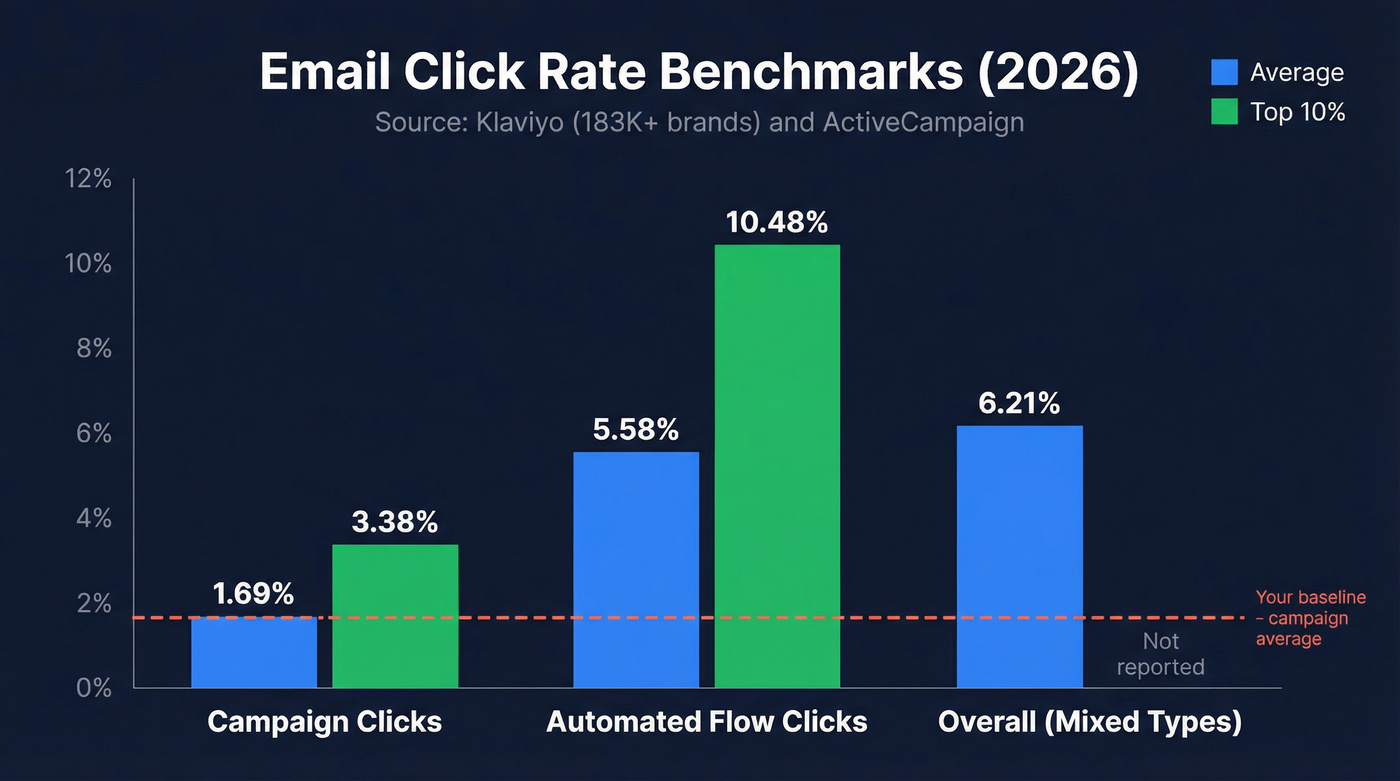
| Metric | Average | Top 10% | Source |
|---|---|---|---|
| Campaign clicks | 1.69% | 3.38% | Klaviyo (183K+ brands) |
| Automated flow clicks | 5.58% | 10.48% | Klaviyo |
| Overall (mixed types) | 6.21% | - | ActiveCampaign |
Klaviyo's benchmark data covers 183,000+ brands and separates campaigns from automated flows. That distinction matters enormously. Flows - welcome sequences, abandoned carts, post-purchase - get about 3.3x the clicks of broadcast campaigns. If you're comparing your newsletter to a welcome flow benchmark, stop. You're measuring against a completely different engagement context.
Industry matters too. Toys & hobbies averages 2.03% while health & beauty sits at just 1.24%. Your "low" rate might actually be above average for your vertical.
The ActiveCampaign figure of 6.21% looks high because it blends transactional, marketing, and automated sends into one number. It's not wrong, but it's not apples-to-apples with a campaign-only metric. Use the campaign-specific 1.69% as your baseline. Above that, you're fine. At 3.38%+, you're in the top 10%.

Your click rate won't recover if 30% of your list is dead weight. Prospeo refreshes every record on a 7-day cycle and verifies emails through a 5-step process - spam traps, honeypots, and catch-alls all filtered out. The result: 98% email accuracy and bounce rates under 4%.
Stop blaming your copy when your list is the problem.
Diagnosing the Real Problem
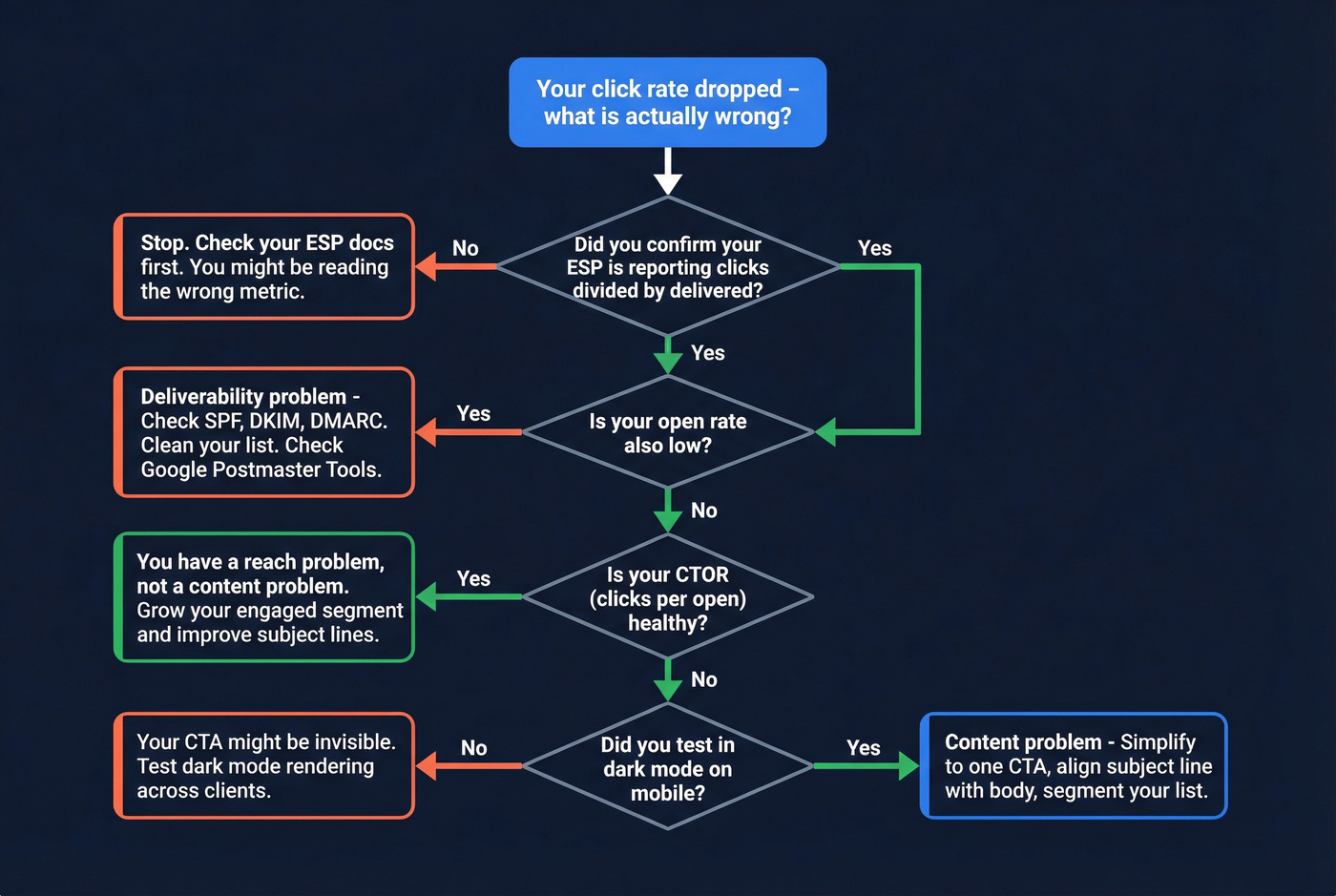
A low click rate has four possible root causes. They're not equally likely, and they need different fixes.
Are You Measuring the Right Metric?
"Click rate" doesn't mean the same thing across every ESP. Some platforms use it interchangeably with "click-through rate." Mailchimp's own documentation treats them as interchangeable in places, which creates real confusion.
If you want the clean breakdown of definitions, see Open Rate vs Click Rate before you change anything.
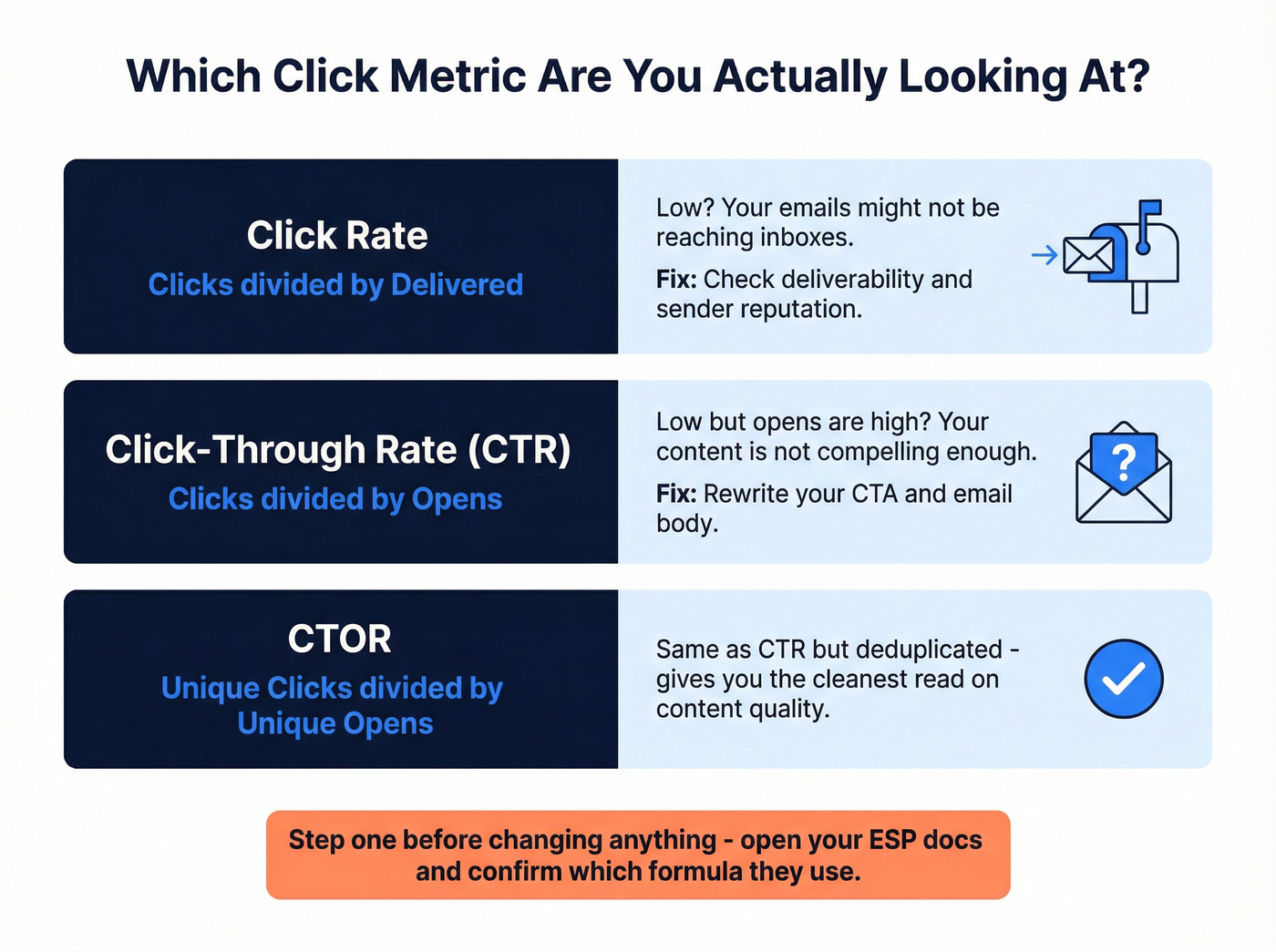
| Metric | Formula | What It Tells You |
|---|---|---|
| Click rate | Clicks / Delivered | Overall engagement per send |
| Click-through rate | Clicks / Opens | Content quality for openers |
| CTOR | Unique clicks / Unique opens | Same, deduplicated |
If you have a high open rate but low click-through rate, you don't have a visibility problem - you have a content problem. Your emails reach inboxes and get opened, but the body isn't compelling enough to drive action. Conversely, if your click rate is low but your CTOR is healthy, your emails aren't reaching enough inboxes or your subject lines aren't pulling enough opens. Those are completely different fixes than rewriting your CTA copy.
Before you change anything, check which metric your ESP is actually reporting. Open your platform's documentation and confirm the formula. Five minutes here saves weeks of optimizing the wrong thing.
Is Tracking Lying to You?
Apple Mail Privacy Protection launched in September 2021 and immediately made open tracking unreliable. Twilio's data showed unique opens jumped 6.5% in the first week alone - not because more people read emails, but because Apple started pre-fetching tracking pixels.
More recently, Apple's Link Tracking Protection strips UTM parameters from links in Mail and Safari. Your GA4 attribution can undercount email-driven traffic even when people are clicking. Some marketing blogs have overstated this, claiming MPP broadly blocks click tracking redirects. It doesn't. Click tracking through your ESP's redirect links still works in most cases. What's broken is UTM-based attribution in analytics tools.
If you're deep in measurement issues, it's worth reviewing real-time email tracking and what to trust in 2026.
Check GA4 for traffic spikes on send days. If you see landing page visits that don't show up as email-attributed clicks, your tracking is undercounting - not your emails underperforming.
Are Your Emails Reaching Inboxes?
An email in the spam folder gets zero clicks. Not low clicks - zero. This is the most common root cause, and it's the one most teams investigate last.
Check Google Postmaster Tools - it's free and shows your domain's spam rate and reputation directly from Google's perspective. Verify SPF, DKIM, and DMARC authentication through your DNS provider; missing or misconfigured records push you toward spam folders across every major provider. Then audit your list for decay. B2B email lists degrade roughly 30% per year as people change jobs, companies rebrand, and domains go offline. Every invalid address you hit damages your sender reputation, which pushes even your valid emails toward spam.
For a step-by-step, use an email deliverability checklist and a dedicated SPF, DKIM, DMARC explained guide to validate your setup.

Is Dark Mode Hiding Your CTA?
About 35% of email opens happen in dark mode, and not all email clients handle it the same way.
Apple Mail and Gmail Desktop don't touch your email rendering. But Gmail's iOS app, Outlook 2021 on Windows, and Windows Mail do a full color invert - and they don't always allow dark-mode targeting. Your bright orange CTA button on a white background becomes a muddy, low-contrast blob. Your reader literally can't see what to click.
The fix is @media (prefers-color-scheme: dark) CSS rules that explicitly set button colors, text contrast, and background fills for dark contexts. Gmail also clips emails longer than 102 KB, which can hide your entire CTA section. If your email template is heavy with images and inline styles, test the file size before you send.
How to Improve Low CTR Campaigns
If your deliverability is solid and your tracking is accurate, the problem is in the email itself.
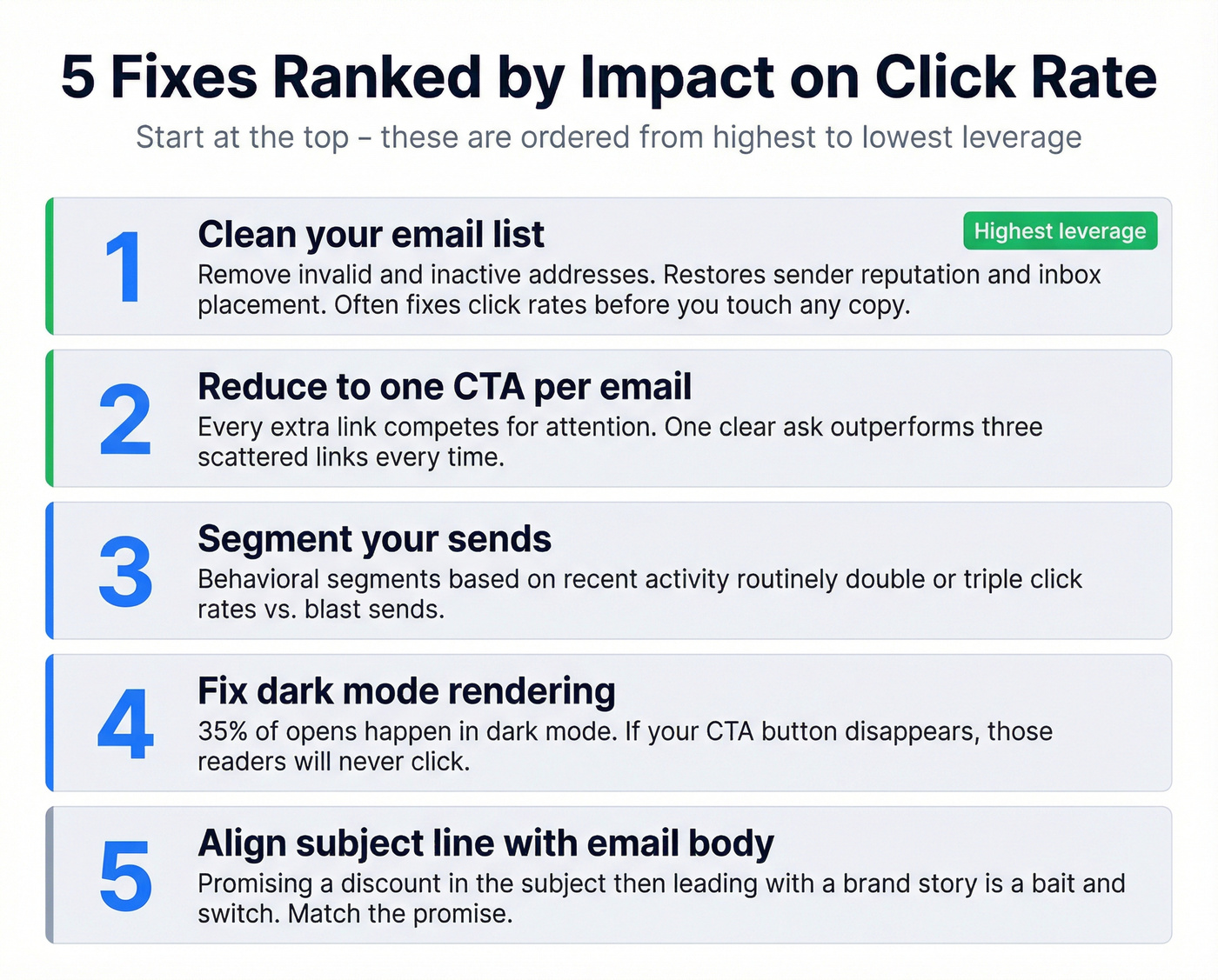
One CTA per email. Every additional link competes for attention and dilutes clicks. The top-performing campaigns we've tested stick to a single, clear ask - not three blog links and a webinar invite, just one thing you want the reader to do.
Match your subject line to your content. If your subject line promises a discount and your email body leads with a brand story, you've created a bait-and-switch. Readers who opened expecting one thing won't click on another.
Segment aggressively. The top 10% of senders - those hitting 3.38%+ click rates - segment their lists heavily. Behavioral segments based on recent clicks, purchases, or category browsing consistently outperform blast sends. Segmented campaigns routinely double or triple click rates compared to unsegmented sends, and the consensus on r/emailmarketing backs this up: generic blasts are dead weight. (If you need a framework, start with behavioral segments.)
Watch for offer fatigue. If you're emailing the same list daily with similar promotions, engagement per send will erode regardless of how good your copy is. Pull back frequency and see if rates recover.
Look, if your deals typically close under five figures, you probably don't need to obsess over click rate at all. Focus on reply rate and conversion rate instead. Click rate is a vanity metric for most B2B teams - it tells you people are curious, not that they're buying.
Quick Wins to Test This Week
- Check your ESP's click rate definition - confirm whether it's clicks/delivered or clicks/opens.
- Compare your rate to the campaign benchmark: 1.69% average, 3.38% for the top 10%.
- Send yourself a test email and open it in dark mode on your phone. Can you actually see the CTA?
- Run your active list through Prospeo's email verification to remove invalid addresses before your next send.
- Reduce to one CTA per email for your next three sends and measure the difference.
Skip step four if you've verified your list in the last 30 days and your bounce rate is under 2%. Otherwise, start there - it's the highest-leverage fix on this list.
B2B lists decay 30% per year. Every invalid address you hit drags your sender reputation down and pushes real prospects' emails into spam - killing your click rate silently. Prospeo's 143M+ verified emails are built on proprietary infrastructure with weekly refreshes, not stale third-party databases.
Get emails that actually reach inboxes for $0.01 each.
FAQ
What's a good email click rate in 2026?
For marketing campaigns, 1.69% is average and 3.38% puts you in the top 10%, based on Klaviyo's analysis of 183,000+ brands. Automated flows average 5.58%. Don't compare campaign rates to flow benchmarks - they measure fundamentally different engagement contexts.
Why do I have high opens but low clicks?
High opens with low clicks means your subject line works but your email body doesn't deliver on its promise. Check for misalignment between subject and content, unclear or buried CTAs, and dark mode rendering that hides buttons on mobile. This is a content and design problem, not a deliverability one.
Can bad email data cause low click rates?
Yes. Sending to outdated or invalid addresses tanks your sender reputation, which pushes even valid emails to spam. Cleaning your list with a verification tool often restores click rates before you touch a single piece of email copy. We've seen teams go from sub-1% click rates to above-average numbers just by removing dead addresses.
How do I fix a low email click rate quickly?
Start with the highest-impact changes: verify your list to restore deliverability, reduce to a single CTA per email, and test dark mode rendering across clients. These three fixes address the most common causes and typically show measurable improvement within two to three sends.